The Sovereign Ledger™ · Entry #175 · September 2026
★ Milestone Entry · The Synthesis of #001–#174 ★
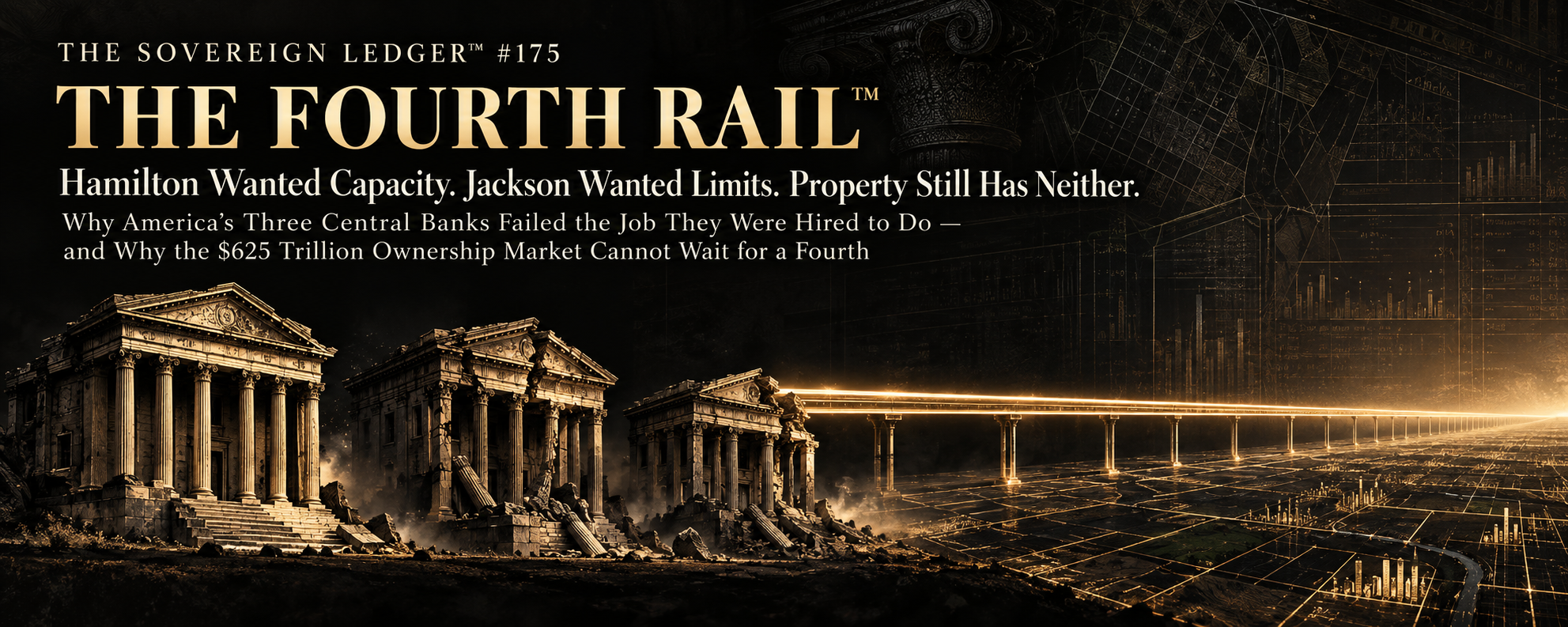
THE FOURTH RAIL™Hamilton Wanted Capacity. Jackson Wanted Limits. Property Still Has Neither.
Why America’s Three Central Banks Failed the Job They Were Hired to Do — and Why the $625 Trillion Ownership Market Cannot Wait for a Fourth
Wednesday, September 30, 2026 · Eastern Time · Palm Beach · Miami · Sarasota · Naples · New York City
Three attempts built a machine for money. The Fourth Rail builds a machine for owners — with Hamilton’s ability to settle and Jackson’s refusal to grant a privileged class the title to the country.
INTRODUCTIONThe Money Ledger and the Ownership Ledger
For decades, the financial establishment has looked to Washington for an answer to structural friction that it was never designed to solve. Across American history, we built three machines to manage the money ledger: Alexander Hamilton wanted capacity to move value, Andrew Jackson demanded limits to prevent an unelected financial aristocracy, and the Federal Reserve arrived in 1913 to provide an elastic currency. Yet, through every iteration, the core mandate remained trapped in monetary engineering. None of these institutions were built to govern or clear the ownership ledger. When Jerome Powell’s monetary policy flooded the system with cheap capital, it inflated asset valuations while locking property owners in place, proving conclusively that a central bank handling money cannot act as a housing institution.
This failure is the catalyst for Entry #175 of The Sovereign Ledger. I look across the approximately $625 trillion global real estate market and see a massive infrastructure void that cannot wait for a fourth central bank or another superficial rate-cut cycle. Family offices and institutional allocators are waking up to an uncomfortable reality: treating a digital token as a title or relying on fragmented county registries is a systemic vulnerability. The market does not need another speculative product; it requires finished, permanent infrastructure.
By synthesizing the rigorous trajectory of my prior entries—from the foundational manifestos to the Legal Control Layer and the Instant Settlement Engine—I am cutting through the noise. We are standing at a historic inflection point where capital markets demand absolute clarity. Those who recognize the structural shift away from legacy gatekeepers and toward programmable, sovereign ownership infrastructure will capture generational advantage. The architecture is already built, verified, and anchored to Bitcoin L1. The choice facing serious capital allocators is stark: continue renting access through broken legacy channels, or deploy the sovereign framework that compresses transaction friction and secures true title permanence. The foundation is set, and the path forward belongs to those who execute with absolute precision.
THE CUTNot Part 3 of the Fed
#173 is the origin cut. #174 is the 1913-to-Warsh scorecard. #175 should not be Part 3 of the Fed. That would keep me inside someone else’s institution. The cherry is the sentence the whole vault has been walking toward:
The United States built three machines to control the money ledger.
None of them was built to control the ownership ledger.
That is the gap The Sovereign Ledger™ exists to close.
Not “abolish the Fed” as the climax. Not another rate-path essay. The capstone is the distinction my corpus already proved and has not yet named in one place:
| Rail | What the three banks were hired to do | What #1–#174 actually built |
|---|---|---|
| Money | Elastic currency, last resort, fiscal agent | Recurring mandate creep; dollar as a slow tax; housing lock-in under Powell (#174) |
| Title | Never their job | #169–#170: token is not title |
| Settlement | Clearing for banks, not deeds | #172: agreement → value |
| Provenance | Political trust, then “independence” | Bitcoin L1 + OpenTimestamps on my record |
| Jurisdiction | One national money | #160/#167: Florida keep-rate vs Manhattan friction |
| Control plane | A committee | #165/#166: sovereign ownership infrastructure |
#168 already asked who controls the ledger across 7,000 years. #173–#174 answer: in America, three times, a privileged or insulated money house. #175 answers: property will not be saved by a fourth money house. It needs a fourth rail — identity → asset → capital → title → settlement → provenance — that Congress did not put inside the Federal Reserve Act and that Jackson would recognize as a limit: no exclusive franchise on title.
WHY THIS IS THE UNSTOPPABLE #175Four Reasons
- It consumes the last 48 hours. Readers who came for Hamilton/Jackson/Powell have somewhere to land that is mine, not Warsh’s next meeting.
- It consumes the last 175 entries. Manifesto (#001), institution (#154), legal layer (#170), settlement (#172), money history (#173–174) become one architecture instead of a brilliant pile.
- It refuses the trap. “Remove the Fed like Jackson” is a gesture. “Do not let the ownership of land run through the same failure mode as the ownership of dollars” is a doctrine. Family offices can underwrite the second. They cannot underwrite a tweet.
- It is the American System, completed. Hamilton: capacity to move value. Jackson: no statutory aristocracy. I: those two constraints applied to real estate, which is the thing the Fed never had a mandate to clear and still managed to freeze.
The Benefits When I Ship #175
- Canonical keystone. After this, every earlier entry is a chapter. Before this, #173 looks like a detour into monetary history.
- Institutional readability. Allocators can say: he is not a Fed-truther; he is separating money rails from title rails.
- SEO that matches the work. “Fourth rail,” “token is not title,” “three central banks,” “ownership ledger” compound as one query cluster.
- REALATAR™ stays the execution layer, not a fourth Bank of the United States. That is how you keep Jackson without recreating Biddle.
- Milestone gravity. #100 was the century. #175 is the synthesis. Different job. Heavier.
Ship #174 as the indictment of the money machine.
Ship #175 as the reason I built a different machine.
That is the cherry: not a fourth central bank —
the first sovereign ownership rail the other three were never hired to build.
THE STRUCTUREWhat Carries the Weight
- One paragraph restating #173–#174 — three banks, same design conflict, different kill-switch. No recap novel.
- The missing mandate. 1913 promised notes, discounts, supervision. It never promised a deed, a closing, or a keep-rate.
- Powell as exhibit A for property. 3% money capitalized into prices; 7% money locked the owners. That is the Fed touching housing without being a housing institution.
- The Fourth Rail defined in seven steps — reuse #161‘s chain. This is execution, not poetry.
- What #175 is not. Not a central bank. Not a token that pretends to be title. Not Treasury-under-Fed. Those three errors are how the last three attempts died or drifted.
- Proof of corpus. 175 entries, 2.64M+ words, SHA-256, OTS, Bitcoin. The record is the rival to a committee that leaves its job.
How to Read This Entry
Fact Dates, statutes, rules, court orders and published data, sourced at the end.
Forecast Third-party projections, labeled as such.
My View My interpretation and strategic direction. Claims invite debate. Artifacts invite inspection.
CHAPTER IThree Banks, Same Design Conflict, Different Kill-Switch
In #173 and #174, I traced the whole arc. The First Bank of the United States (1791–1811) lapsed by a single vote in each chamber of Congress. The Second Bank (1816–1836) died by Jackson’s July 10, 1832 veto and the removal of the federal deposits. The Federal Reserve (1913–) was built without a sunset, so instead of dying it was amended, expanded and handed the next emergency. Three banks, one design conflict — a public job parked in a body the public does not directly elect — and a different kill-switch each time. The first two were killed by a timer. The third has no timer, so its limits became hearings. That is The Capacity–Limits Test™ in one paragraph.
Fact The present is where that history became expensive. On September 16, 2026, the Federal Open Market Committee under Chairman Kevin Warsh raised the federal funds target range to 3.75%–4.00%, its first increase since July 2023. On September 24, Freddie Mac put the 30-year fixed mortgage at 7.03%, the first reading above 7% since January 2025. The National Association of REALTORS® reported August existing-home sales at a 3.98 million annual pace, with a national median price of $429,100.
Those three numbers are the money rail speaking. Not one of them tells an owner how to move a property, prove a title or settle a transfer in less than a month. That silence is the subject of this entry.
CHAPTER IIThe Missing Mandate
Fact The Federal Reserve Act states its purposes in its own title: to establish Federal Reserve banks, to furnish an elastic currency, to afford means of rediscounting commercial paper, and to establish a more effective supervision of banking. In 1977, the Federal Reserve Reform Act added the statutory goals of maximum employment, stable prices and moderate long-term interest rates.
Read both as job descriptions. 1913 promised notes, discounts and supervision. 1977 promised employment and prices. Neither promised a deed, a closing, a clean chain of title or an owner’s keep-rate. There is no clause about who may hold land, how an ownership interest moves from seller to buyer, or how a court reconciles a county record with an operating agreement. That work was left where the Constitution left it: with state property law, county recorders, title insurers, lawyers and closing agents — a patchwork of more than 3,000 recording jurisdictions that no federal statute ever unified.
My View This is the heart of the matter. The Fed never had a mandate to clear property. It still managed to freeze it. When an institution can move the price of every mortgage in America without owning any responsibility for how ownership transfers, owners carry the risk of a machine that was never hired to serve them.
CHAPTER IIIPowell as Exhibit A for Property
In #174 I named the mechanism The Powell Housing Paradox™. Here is the evidence.
- Fact The 3% money. Freddie Mac’s 30-year fixed rate hit a record low of 2.65% in January 2021.
- Fact The Fed as a mortgage buyer. The Fed held about $1.4 trillion of mortgage-backed securities in February 2020; pandemic purchases swelled that to about $2.7 trillion by 2022.
- Fact The 7% money. After the fastest tightening in four decades, the same survey peaked at 7.79% in October 2023, and stands at 7.03% as of September 24, 2026.
- Fact The lock. An FHFA staff working paper found that for every percentage point market rates exceed an owner’s origination rate, the probability of sale falls by 18.1%. Lock-in prevented 1.33 million sales between Q2 2022 and Q4 2023 and raised home prices by 5.7% — more than the 3.3% that higher rates pushed them down.
- Fact The generation priced out. NAR’s 2025 Profile of Home Buyers and Sellers put the first-time buyer share at a record-low 21%, with a median first-time buyer age of 40.
3% money capitalized into prices.
7% money locked the owners.
That is the Fed touching housing without being a housing institution.
Cheap money inflated the asset. It never upgraded the rail. When the price of money reversed, there was no ownership infrastructure to let property move — no portable identity, no reconciled title record, no programmable settlement, no way for an owner to transfer without restarting a process built for paper. The Fourth Rail is the upgrade nobody built because it was never in anybody’s mandate.
CHAPTER IVThe Closing Table in 2026
Money now moves in seconds. Ownership still moves in weeks. In Entry #172, I documented ICE’s record 36.8-day average purchase-closing time in March 2026, alongside FedNow and RTP instant-payment rails with $10 million transaction limits. The money rail has been rebuilt for speed. The ownership rail has not.
What fills those 36.8 days is not negotiation. It is reconciliation: confirming who the seller is, whether the entity selling still exists and is authorized, whether the lender’s conditions are satisfied, whether the title search is clean, whether the wire instructions are real, and whether the recorder will accept the deed. Every one of those questions is answered by a different party, in a different system, on a different clock. Each hand-off is a place where time is lost and fraud gets in.
Fact The fraud is measured. The FBI’s 2025 Internet Crime Report recorded $275.1 million in reported real estate fraud losses across 12,368 complaints, up from about $173 million in 2024. Business email compromise — the scheme that targets closing wires — ran to $3.04 billion in reported losses across all sectors.
My View Speed is not the problem to solve. Sequence is. A faster wire attached to an unverified seller is just faster fraud. The Fourth Rail does not start by accelerating money. It starts by making the questions answerable once, in order, in a file that every party — lender, title insurer, recorder, court — can rely on. Then it compresses time. That order is the entire difference between infrastructure and a shortcut.
CHAPTER VTHE FOURTH RAIL™ — Architecture
Not a fourth central bank.
The ownership rail the first three were never hired to build.
A central bank is a money rail: notes, reserves, a window, a price of credit.
The Fourth Rail is an ownership rail: who holds what, under which law, against which counterparty, settled in what time, proven by what record.
Those two rails can touch. They must not be the same institution. That is the mistake of 1791, 1816, and 1913 — capacity without a hard job description — applied this time to land.
What the Rail Is
Seven stages. Sequence is the product. Skip a stage and you have a token, a listing, or a hope — not ownership.
- Identity — A verified counterparty, not a wallet slogan. Natural person, entity, trustee, or institution, with legal capacity to take title. Without this, programmable settlement is speed attached to a ghost.
- Asset — The thing that law already knows: parcel, unit, leasehold, fund interest, debt position. The rail does not invent the asset. It binds to the asset the county and the operating agreement already named.
- Capital — Dry powder mapped to the asset: equity, debt, stablecoin settlement balances, subscription lines. Capital that cannot be programmed to the title is still a wire waiting on a banker.
- Title — The authoritative record under property law. Deed, LLC/SPV interest, mortgage, lien. The token is not the title. The rail records the legal interest; it does not replace the county or the operating agreement. This is Jackson’s limit applied to code.
- Settlement — Agreement to value without a 30–60 day fog. Atomic where law allows; sequenced where law requires. Hamilton’s capacity: the republic can move the thing. Not a Fed window. A closing rail.
- Provenance — Time-stamped proof the record existed as published. SHA-256, OpenTimestamps, Bitcoin L1. Not “trust the platform.” Verify the file.
- Continuous ownership — After close, the rail keeps the stack consistent: title, cap table, debt, insurance, tax situs, distribution rights. Ownership that dies at recording is a transaction. Ownership that persists is infrastructure.
Identity → Asset → Capital → Title → Settlement → Provenance → Continuous Ownership.
That is the Fourth Rail. Everything else is commentary.
What It Must Never Become
| Failure mode | Historical twin | Why the rail forbids it |
|---|---|---|
| Exclusive private franchise on title | Second Bank stock privilege | No charter that sells a second advantage in the statute book |
| Committee that “manages” property prices | 1977 dual mandate + QE into MBS | Housing lock-in is what happens when a money rail pretends to be a housing rail |
| Bearer instrument posing as a deed | Token-as-title marketing | Law determines owner. Code can only express that determination |
| Treasury and rate-setter as one desk | Wartime yield cap / fiscal dominance | Debt issuance and title clearance are different sovereign jobs |
| Vault without a window | Independent Treasury | Custody of government gold did not save the depositor — or the closer |
Capacity without those limits is a fourth Bank of the United States with better slides.
Layer Map — How It Sits on the Existing Corpus
- Legal Control Layer™ (#170) — conflict rules when county deed, LLC book, bank record, smart contract, and token disagree. The rail obeys this layer. It does not outrun it.
- Authoritative Ownership Record™ (#169) — one record that other systems must reconcile to, not a fifth competing ledger.
- Instant Settlement Engine™ (#172) — compresses time once identity, asset, capital, and title are aligned.
- Programmable Ownership Execution Standard™ (#161) — the operating sequence above, written as procedure rather than vision.
- Provenance (the vault itself) — the publication rail that proves the architecture was said, dated, and unchanged.
- REALATAR™ — execution direction, not a sovereign, not a central bank, not a substitute for counsel or a recorder.
Money rail: Federal Reserve Act.
Ownership rail: property law + programmable settlement + cryptographic proof.
Different statutes. Different failure modes. Different masters.
Design Rules (Non-Negotiable)
- Law first, code second. If the two conflict, law wins in court. The rail’s job is to make that conflict rare and visible.
- No monopoly charter. Membership, fees, and access cannot recreate Biddle’s lock.
- No price targeting of houses. The rail clears transfers. It does not put a put under valuations.
- Penalty, not put, in stress. Liquidity against defined collateral and defined parties — Bagehot on closings, not QE on listings.
- Jurisdiction is a feature. Florida keep-rate, New York friction, county recording — the rail routes through law as it is, then compresses time inside it.
- Human authority at the edge. Boards, trustees, and recorders remain. Automation without an owner is how platforms extract and how AI hallucinates title.
- Sunset on emergency tools. Facilities that outlive the emergency become the 1977 problem in property clothes.
What It Does for the $625T Stack
- Turns a 30–60 day close into a controlled path instead of a folklore cycle.
- Lets institutional capital move across borders without pretending a token extinguished the deed.
- Gives family offices a keep-rate architecture instead of a rate-cut prayer.
- Makes Powell’s trap visible: cheap money inflated the asset; it never upgraded the rail. The Fourth Rail is the upgrade they did not build because it was not in their mandate.
What the Institutions Already See
- Forecast Deloitte Center for Financial Services predicts about $4 trillion of real estate tokenized by 2035, up from under $0.3 trillion in 2024 — a 27% compound annual growth rate.
- Forecast McKinsey puts tokenized financial assets at around $2 trillion by 2030 in its base case, excluding cryptocurrencies and stablecoins, within a range of about $1 trillion to $4 trillion.
- Forecast Boston Consulting Group and Ripple projected tokenized assets growing to about $18.9 trillion by 2033 (April 2025).
- Fact J.P. Morgan Kinexys has processed more than $1.5 trillion since 2019 at roughly $2–3 billion a day, per the bank’s disclosures, and put its JPM Coin deposit token on a public blockchain (Base) in November 2025.
- Fact The White House President’s Working Group on Digital Asset Markets issued its report on July 30, 2025, calling on regulators to clarify bank participation in tokenization and public blockchains. The GENIUS Act, regulating payment stablecoins, was signed on July 18, 2025.
My View Every one of these is a money-side or securities-side rail. None of them, on its own, tells a recorder, a title insurer and a court who owns Blackacre. The capital is arriving. The ownership rail is the missing half — and it is the half I am building.
CHAPTER VIOne Palm Beach Closing on the Fourth Rail
Illustrative Architecture earns trust when it survives a real transaction. Here is one, simplified and hypothetical, walked through all seven stages. A family office in New York is buying a $12 million oceanfront residence in Palm Beach from a seller who holds it through a Florida LLC owned by a Delaware LLC.
Stage 1 — Identity. The seller is not “the owner.” The seller is Oceanview Holdings LLC, whose sole member is Coastal Ventures LLC in Delaware, whose manager signs. The rail verifies each layer: the Florida entity is active and in good standing; the Delaware parent exists; the manager’s authority is current under the operating agreement, not last year’s version; and no one along the chain appears on a sanctions list. On the buyer side, the family office’s acquisition vehicle, its manager and its authorized signatories are verified the same way. Result: two counterparties the law can still find.
Stage 2 — Asset. The parcel is bound by its county parcel ID and legal description, not by a listing address or a marketing name. If the listing says “Ocean Estate” and the county says Lot 14, the rail uses Lot 14.
Stage 3 — Capital. The buyer’s equity and the lender’s commitment are mapped to this parcel and this closing, with conditions attached: good funds, clear title, verified wire instructions. Funds are committed to the transaction, not floating toward an email.
Stage 4 — Title. The title search, the existing mortgage payoff, any liens and the proposed deed are reconciled against the Authoritative Ownership Record. If the deed names Oceanview Holdings LLC but the member schedule shows a manager change filed yesterday, the Legal Control Layer™ flags the collision before anything settles.
Stage 5 — Settlement. When every condition is satisfied, funds and documents move in a single sequenced event: payoff to the old lender, net proceeds to the seller, deed to the recorder. No hand-off window for a spoofed wire. Where the law requires recording to happen on its own clock, the rail sequences around it rather than pretending it away.
Stage 6 — Provenance. The deed, the operating-agreement extract, the identity packet, the beneficial-ownership graph export and the wire confirmation are each hashed and timestamped as a set. Years later, anyone with standing can prove exactly which documents justified the transfer, and that none was altered.
Stage 7 — Continuous ownership. After close, the buyer’s vehicle, its members, its lender, its insurance and its tax situs stay bound to the parcel. When a member changes, a trustee succeeds or the loan is refinanced, the rail re-verifies and re-hashes. The ownership stack does not drift the day after recording.
My View Nothing in that walk-through requires abolishing a county, a title insurer or a closing attorney. It requires putting them on one rail, in one order, against one record. That is what I mean by moving real estate from fragmented transaction to verified, owner-first liquidity.
CHAPTER VIIStage 1 of the Fourth Rail: Identity
Identity on the Fourth Rail is not “upload a passport.” It is the proof that a named legal person can take, hold, encumber, and convey title. Skip a stage and settlement is fast fraud — or a voidable deed.
What This Stage Is For
The money rail verifies a customer so a bank can open an account.
The ownership rail verifies a counterparty so a recorder, trustee, lender, and buyer can survive court.
Same photographs. Different legal question: capacity + authority + persistence, not merely “this face matches this document.”
Fact The FBI’s 2025 Internet Crime Report logged 22,364 complaints referencing AI, tied to $893.3 million in losses. Impersonation is being industrialized. The identity stage has to be built for that adversary, not for yesterday’s forger.
The Seven Identity-Verification Stages
Stage 0 — Claim. Someone asserts a name, a wallet, an email, a “buyer.” This is not verification. It is a bid to enter the rail. Treat it as hostile until the next stages close.
Stage 1 — Existence. Is there a natural person or a registered entity behind the claim?
- Person: government ID, liveness, biometric or equivalent, matching legal name.
- Entity: formation document, good standing, jurisdiction of organization.
- Failure: synthetic identity, dissolved company, nominee shell with no file at the secretary of state.
Stage 2 — Uniqueness. Is this one person or one entity, not three reused identities?
- Deduplicate against prior files, watchlists, and beneficial-owner graphs.
- Failure: the same human as “buyer,” “member,” and “notary witness” under different strings.
Stage 3 — Legal capacity. Can this party own?
- Age, competence, not under conservatorship where it matters.
- Entity: not revoked, not in forbidden purpose, authorized to hold real property in that state.
- Foreign persons: FIRPTA posture, ownership caps, sanctions — capacity is jurisdictional, not global. (Ownership caps include state limits such as Florida’s 2023 SB 264 on certain foreign principals; FIRPTA governs withholding when a foreign person later sells.)
- Failure: a token holder who cannot take deed; a DAO with no recognized owner; a minor on a warranty deed.
Stage 4 — Authority. If they act for someone else, who signed the power?
- Officers vs members vs managers vs trustees vs attorneys-in-fact.
- Board or operating-agreement extract. Incumbency. Wet or compliant electronic POA.
- Dual control on high-value transfers.
- Failure: manager who was removed last Tuesday; AI agent “authorized” by a prompt; wallet signer who is not the trustee.
Stage 5 — Beneficial ownership and control. Who actually eats the gain and gives the order?
- 25% (or tighter) owners, control persons, settlors and protectors on trusts.
- Layered LLCs unwrapped to humans or regulated institutions.
- Failure: Jackson’s privileged class in modern clothes — a public-facing name and a hidden controller.
Stage 6 — Integrity screens. Is this party allowed to complete this transaction?
- Sanctions, PEP where required, adverse media that implies legal block (not vibes).
- Source-of-funds / source-of-wealth proportionate to the deal — a $12 million close is not a $12 coffee.
- Property-specific: straw buyers, flip rings, elder-title theft, occupancy fraud.
- Failure: clean passport, dirty purpose.
Stage 7 — Persistence and binding. Identity that dies after onboarding is a screenshot.
- Bind the verified party to a durable identifier: legal name + jurisdiction ID + entity ID + (optional) cryptographic credential.
- Re-verify on material events: manager change, amendment, death, assignment, refinance, token transfer that claims to move economic rights.
- Audit trail that a court can read: who checked what, when, against which document hash.
- Failure: KYC at origination, anonymous assignee at month 14.
Person, Entity, Agent — Three Stacks, Not One Form
| Counterparty | Existence proof | Capacity proof | Authority proof | Persistence risk |
|---|---|---|---|---|
| Natural person | ID + liveness | Age, competence, alienage rules | Self, or POA | Death, incapacity, identity theft |
| Entity (LLC, corp, LP) | Formation + good standing | Charter purpose, state law on land | Operating agreement / board | Silent amendment of managers |
| Trust / estate | Instrument | Trustee powers, situs | Letters, trustee certificate | Protector override, successor trustee |
| Institution | License + LEI | Charter, permitted activities | Authorized signatory list | Desk-level signer vs enterprise |
| Programmable agent | Controller’s identity first | Agent has no capacity of its own | Written delegation with scope and kill switch | Prompt-injection as forged POA |
An AI agent is Stage 4 at best.
It is never Stage 3.
If the model signs, the human or entity still owns the liability. Forecast Gartner predicts more than 40% of agentic AI projects will be canceled by the end of 2027 because of escalating costs, unclear business value or inadequate risk controls. On a title rail, inadequate risk controls are not a budget line. They are a lawsuit.
Where Property Breaks If You Collapse the Stages
- Wallet = owner skips 3–5. Bearer claim meets recording statute and loses.
- Notary theater does Stage 1 in a room and skips 4–5 on the LLC.
- Bank KYC reuse answers “may we hold deposits?” not “may we convey Blackacre?”
- One-time onboarding fails Stage 7. Title companies already know this; token platforms pretend they do not.
- Privacy maximalism is not a stage. You can minimize public disclosure and still complete Stages 3–6 in a permissioned file the recorder, lender, and court can compel.
Design Rules for the Fourth Rail
- Law names the owner. Identity service only proves the name.
- Re-verify on authority change, not on a calendar alone.
- Beneficial ownership is a title issue, not a marketing preference.
- Credentials expire; capacity is re-tested at conveyance.
- No exclusive franchise on the identity file — another Jackson limit. A single vendor that is the only way to be a person on the rail is a private government.
- Human authority at the edge. Remote online notarization, biometrics, and credentials are tools. The deed still needs a competent principal.
How This Sits on the Rest of the Rail
Identity that clears all seven stages unlocks Asset (the parcel can be bound to this person).
Failed Stage 4 blocks Capital (lenders will not fund a mystery manager).
Failed Stage 5 blocks Title (the record is a lie even if the seal is pretty).
Failed Stage 7 poisons Continuous ownership — the stack drifts the day after close.
Hamilton wanted a known fiscal counterparty. Jackson refused a class that hid behind a charter. The identity stack is both: know the person, do not let a franchise become the person. That is Stage 1 of the Fourth Rail. Everything after it is just moving property between people the law can still find.
CHAPTER VIIIThe Beneficial-Ownership Graph
A beneficial-ownership graph is how Stage 5 of identity stops being a PDF. It is a map of who owns, who commands, and who can move title — through every LLC, trust, fund, and nominee between the deed and a human or a regulated institution.
Fact As of August 2026, FinCEN has permanently dropped CTA reporting for U.S. companies and U.S. persons. Foreign entities registered here still report foreign owners. The federal BOI file is no longer the public answer for a Florida or Delaware holdco. FinCEN issued the final rule on August 11, 2026, effective August 14, and announced it will delete previously reported U.S.-person data. Separately, on March 19, 2026, a federal court in the Eastern District of Texas vacated FinCEN’s Residential Real Estate Rule, which had required reports on certain non-financed transfers of homes to entities and trusts; FinCEN appealed to the Fifth Circuit on May 11, 2026, and no filing is currently required.
That makes the private graph — lender, title, rail, family office — the control plane again. Law did not abolish beneficial ownership. It stopped centralizing it.
What the Graph Is
Not an org chart. An org chart is a drawing. A graph is a set of nodes and edges you can compute.
Nodes: natural person; legal entity (LLC, corp, LP, series cell); trust / foundation / estate; fund / GP / LP vehicle; role vehicle (nominee, registered agent, corporate director); asset (the parcel, unit, note) — bind it or the graph floats; identifier cluster (address, phone, agent, shared counsel) — signals, not owners.
Edges (typed, weighted, dated): OWNS — equity %, class of interest, as-of date; CONTROLS — votes, manager rights, appointment power, veto, protector; BENEFITS — economic entitlement that is not legal title (trust beneficiary); ACTS_FOR — officer, trustee, attorney-in-fact, GP; ENCUMBERS — lender, mezz, option; RECORDED_AS — name on the deed vs name in the operating agreement.
Ownership without control is a dividend.
Control without ownership is Jackson’s hidden class.
The rail must store both.
The Two Tests (Never Use Only One)
Ownership test — multiply through layers. Person owns 60% of Holdco A. A owns 50% of Holdco B. B owns 100% of PropCo on title. Effective stake in PropCo = 0.60 × 0.50 × 1.00 = 30%. Same person also owns 60% of Holdco C, which owns 30% of PropCo. Add paths: 30% + (0.60 × 0.30) = 48%.
Thresholds (25%, 10%, any %) are policy. The graph must compute the number before you apply a cutoff. “No one owns 25%” is often a control-person in a 10-way split.
Control test — walk appointment and veto, not percentages. Sole manager of the LLC that is sole member of PropCo can convey Blackacre with 0% equity. A protector who can fire the trustee controls the trust that owns the member. FATF-style regimes treat this as UBO even at 0% stock. Title companies already know this; token platforms pretend the wallet is the test.
Resolve UBO set = {nodes that are natural persons or qualifying institutions who pass ownership or control}. Stop at a regulated public company or licensed bank if policy says so. Do not stop at “Delaware LLC.”
Why Property Graphs Are Uglier Than Bank KYB
The deed names one node. The money and the order live five edges away. Typical Miami / Palm Beach / Delaware stack:
Parcel ←recorded_as— Oceanview Holdings LLC (FL)
       ←owns 100%— Coastal Ventures LLC (DE, members hidden)
       ←owns 100%— Atlantic Partners Ltd (foreign register)
       ←PSC / UBO— Person
Four layers, three jurisdictions, one human. County record stops at layer one. That is not anonymity as a right. It is record fragmentation. The Fourth Rail’s job is to keep the full path in a file a court can compel — not to publish every cousin on the open web.
Other property-native patterns:
- Series LLC — deed says “Holdings LLC – Series 14.” Parent officers often control every cell. Graph the parent and the series.
- Land trust — trustee on record, beneficiaries off-record. Edge type is BENEFITS, not OWNS.
- Nominee manager — Florida Sunbiz shows a professional manager. Control sits in the private operating agreement.
- Fund stack — PropCo ← GP / LP ← master ← feeder ← family office. LPs may be economic UBOs; GP is usually control UBO.
- Shared agent / address hubs — 1209 Orange St is a node with thousands of edges. High degree is a cluster signal, not proof of one owner.
Algorithms the Rail Actually Needs
These are procedures, not products.
- Path product — effective ownership along each simple path; sum paths that end at the same person. Watch double-count if two paths share an edge.
- Control reachability — directed walk on CONTROLS / ACTS_FOR until a natural person or permitted institution. Cycles (A manages B, B owns A) are a stop condition, not an answer — flag and demand a human resolution.
- Threshold sweep — compute who appears at 10%, 25%, any-control. Policy chooses the cut. The graph should not bake 25% into the data model.
- Time versioning — edges have valid_from / valid_to. A manager removed last Tuesday is not the closer today. Stage 7 of identity is this clock.
- Conflict detection — deed name ≠ member schedule ≠ cap table ≠ token holder. That is the Legal Control Layer: the graph makes the collision visible instead of letting the token win by speed.
What a Healthy Graph Outputs
For each conveyance: title node (who the recorder will accept); control UBO set (who can order the conveyance); economic UBO set (who gets the gain); encumbrance nodes (who can block); open gaps (layer with no register, nominee with no principal, cycle, expired POA); hash of the source documents that justified each edge.
If the gap set is non-empty, settlement does not go atomic. That is Jackson’s limit in software: no privileged blank in the chain.
Failure Modes (the Ones That Look Like Sophistication)
- Percent-only KYC — 24% × four cousins, one father with the POA.
- Stop at the first LLC — the county already did that.
- Trust as a wall — “discretionary beneficiaries” with a protector who is the settlor.
- Circular holdings — used to make multiplication blow up or vanish; treat as control-only and demand a letter.
- Institutional stop too early — “owned by a fund” is not an identity. Name the GP and the control person of the GP.
- Stale graph — onboarding snapshot vs amendment filed yesterday.
- Publishing the whole graph — UHNW privacy is real. The rail stores the graph; it discloses on legal process and to counterparties with a duty. Transparency to the transaction file is not a press release.
Fourth Rail Rule
Beneficial ownership is not a FinCEN form.
It is a graph that must be true at the moment of title.
- Identity Stages 1–4 tell you the node in the room is real and authorized.
- Stage 5 is the graph: that node is not a mask.
- Title binds the deed to the title node.
- Continuous ownership re-walks the graph when a member, manager, trustee, or token assignment changes.
Hamilton needed to know who owed the Treasury. Jackson refused a class that hid behind a charter. The graph is both demands in one structure: compute the human, do not let the franchise be the human. After August 2026, Washington will not keep that file for you on domestic companies. The ownership rail either holds the graph or it is just another listing site with a wallet field.
CHAPTER IXThe Graph-Database Landscape for Title
A beneficial-ownership graph is a legal computation, not a visualization. The database has to multiply percentages, walk control, version edges, and survive a subpoena. Pick the engine for that job — so the tech choice follows the legal model, not a vendor slide.
Two Families (Pick the Model First)
Labeled property graph (LPG) — nodes and relationships carry properties (owns_pct, valid_from, instrument). Query is “walk this path.” Cypher / openCypher / GQL / Gremlin / GSQL. This is the natural fit for UBO: (:Person)-[:OWNS {pct:0.6}]->(:LLC)-[:RECORDED_AS]->(:Parcel).
RDF / OWL — triples plus a schema you can reason over. SPARQL. Strong when you need ontology (“a protector is a control person”) inferred, not hard-coded. Heavier to write; better when many institutions must share a meaning, not just a table.
For a single ownership rail, start LPG. Add RDF later if you must federate meanings across recorders, funds, and regulators. Do not start in a document store and “join your way to a graph.” That is how 25% tests get implemented wrong.
What the Fourth Rail Actually Requires
- ACID on a conveyance. Title cannot commit if the control walk is half-written.
- Typed, weighted, dated edges. OWNS ≠ CONTROLS ≠ ACTS_FOR.
- Path products and multi-hop control at 4–8 hops (typical holdco depth), not 50-hop social graphs.
- Time travel. Manager as of last Tuesday.
- Audit. Who wrote the edge, from which document hash.
- Isolation. The full graph is not a public website. Row/subgraph security, encryption, legal-hold export.
- Cycle detection. A owns B owns A is a flag, not a crash.
If a product cannot version an edge and export a court packet, it is a demo.
Engines, by Job
Neo4j (Aura / Enterprise). Default LPG. Cypher is how most lawyers-turned-engineers will read a query. Graph Data Science for community detection on agent-address clusters. Best for building and explaining the model, mid-scale books of entities, GraphRAG over the same store. Not the first pick if you need millisecond AML walks across billions of edges. Ecosystem is the feature.
TigerGraph. Distributed MPP graph. Deep hops, fraud/AML-shaped workloads, GSQL plus growing openCypher/GQL. Use when the book is national (every Florida LLC + every Delaware parent + every shared agent) and screening must run in seconds, not minutes. Cost is operational complexity and a less universal query dialect.
Amazon Neptune. Managed, AWS-native, both openCypher/Gremlin and SPARQL. Right when the rest of the stack is already IAM, KMS, VPC, and you may want an RDF view later without a second vendor. You accept AWS gravity and less control over the engine. Fine for an institutional pilot; poor if the doctrine is “do not rent the rail.”
Memgraph. In-memory, Cypher/Bolt compatible, streaming ingest. Use as a hot path: sanction hits, live manager-change events, closing-day re-walk. Not the system of record for 20 years of deeds unless the working set fits RAM and you persist behind it.
JanusGraph + Cassandra/HBase. Open stack, Gremlin, you own the ops. Use when sovereignty means your metal and you have a platform team. You will pay in people, not licenses.
RDF specialists (GraphDB, Stardog, Jena). When the product is a shared vocabulary across counties, funds, and counsel — “this relation is beneficial ownership under definition X.” Reasoning is the point. Do not use OWL to replace a 0.6 × 0.5 multiply. Use it to keep definitions from drifting.
Multi-model (ArangoDB, others). Graph + document in one box. Tempting because operating agreements are documents. Better pattern: documents in an object store with hashes; graph stores only the extracted edges. Mixing both in one query language usually muddies Stage 5.
Lakehouse query engines (PuppyGraph-class). Graph over warehouses you already have. Good for analytics on a frozen extract. Not the closing-day system of record.
Reference Architecture (Do Not Put Title in One Toy)
Source docs (deeds, OA, PSC, good-standing)
 → hash + object store (provenance)
 → extractors (human + rules + model)
 → SYSTEM OF RECORD GRAPH (versioned LPG, ACID)
 → hot replica (Memgraph-class) for close-day walks
 → analytic replica for cluster / straw-buyer patterns
 → append-only audit log
 → Legal Control Layer: conflict report before settlement
The graph database is layer three, not the product. REALATAR™ is the control plane around it. The recorder is still the recorder.
Query Shape You Actually Run
Property graphs earn their keep on five walks: (1) Effective ownership — product of OWNS.pct along simple paths, sum by person. (2) Control UBO — reachability on CONTROLS|ACTS_FOR until person or permitted institution. (3) Conflict — RECORDED_AS name ≠ member schedule ≠ wallet. (4) Hub risk — degree of registered-agent and address nodes (signal, not proof). (5) As-of — same walks with valid_from <= T < valid_to. If the vendor’s demo is only “shortest path between two celebrities,” keep walking.
Decision Rule for This Vault
- Pilot / doctrine / explainable file: Neo4j or openCypher on Neptune.
- National watchlist, real-time screen: TigerGraph or equivalent MPP.
- Closing instant + event stream: in-memory Cypher replica in front of the record.
- Multi-institution shared meaning: RDF alongside, not instead.
- Sovereign ops constraint: JanusGraph-class or self-hosted Neo4j Enterprise — decide who holds the keys before who holds the Cypher.
Jackson / Hamilton Test on Vendors
Hamilton: the rail must compute — path product, not a slide. Jackson: no exclusive franchise. If one cloud graph is the only way a person can exist on the rail, you rebuilt the Second Bank as a database.
So: open data model, portable query (openCypher/GQL), documents hashed off-graph, engine replaceable. The beneficial-ownership graph is the legal object. The database is a tool that must not become the title.
CHAPTER X“Beneficial Owner” Is Not One Phrase
“Beneficial owner” is not one legal person. It is at least four different tests that share a slogan. Mixing them is how a rail records the wrong human.
The Core Idea (Shared)
Every serious definition is trying to name the natural person who ultimately owns or controls, including through a chain — not the LLC on the deed. Only a human (or, in some bank rules, a fallback senior manager) is an ultimate beneficial owner. A company cannot be its own UBO. That is AML / transparency law. It is not the same as the grantee on a warranty deed.
1. FATF Glossary — the International Template
For legal persons (companies): the natural person(s) who ultimately owns or controls a customer and/or the natural person on whose behalf a transaction is being conducted. It also includes those natural persons who exercise ultimate effective control over a legal person. Only a natural person can be an ultimate beneficial owner.
“Ultimately” means through a chain or by means other than direct title. If no owner-controller can be found, CDD may record a senior managing official — FATF is explicit that this is a procedure, not a redefinition of who the owner is.
For legal arrangements (express trusts), FATF does not hunt a single 25% human. It names a set: settlor(s); trustee(s); protector(s), if any; beneficiaries (or class / objects of a power); any other natural person with ultimate effective control.
Recommendations 24 and 25 tell countries to keep that information adequate, accurate, and available to authorities — via a register or an alternative mechanism. After the U.S. CTA rollback, “alternative mechanism” is the live American sentence.
2. United States — Two FinCEN Definitions, One of Them Gutted as a Filing
Bank CDD rule (31 C.F.R. § 1010.230) — still live for banks opening entity accounts. Beneficial owner means each individual who, directly or indirectly, owns 25% or more of the equity interests; and one individual with significant responsibility to control, manage, or direct (CEO, managing member, GP, or functional equivalent). A trust that hits 25% → identify the trustee on the ownership prong. Certain exempt owners (listed companies, etc.) stop the look-through. Result: one to five names, by design. That is a bank form, not a complete graph.
Corporate Transparency Act / BOI rule — definition still in the old text, filing largely dead for U.S. persons. CTA beneficial owner was broader than CDD: any individual who exercises substantial control or owns/controls 25% of ownership interests. Substantial control included senior officers, appointment authority, and “substantial influence over important decisions.” No cap at one control person.
August 2026 final rule: U.S. companies and U.S. persons no longer file that information to FinCEN. Foreign reporting companies still file on foreign owners. The concept was not repealed. The central file for domestic entities was. Banks still run CDD. Title companies still ask. The rail still needs a graph.
3. United Kingdom — PSC, Not “UBO”
A person with significant control meets one or more of: (1) more than 25% of shares; (2) more than 25% of voting rights; (3) right to appoint or remove a majority of the board; (4) actual or right to significant influence or control; (5) influence/control over a trust or firm that itself meets 1–4.
Shares and votes are split on purpose. A golden share can be a PSC at 1% economic interest. Condition 4 is the catch-all; statutory guidance gives examples so it is not vibes. This is closer to a control graph than U.S. bank CDD.
4. What None of These Is
| Legal object | Who it names | What it does not name |
|---|---|---|
| Record owner / grantee | Person or entity on the deed | Who commands the LLC |
| Equity UBO (25%) | Humans above a cut | 24% controller, protector, GP |
| Control UBO / substantial control | Who can direct | Often not every economic beneficiary |
| Trust “beneficial owner” (FATF R.25) | Settlor, trustee, protector, beneficiaries | A single percentage owner |
| Tax beneficial owner (treaties, CRS) | Who is taxed on income | Who can sign the deed |
| Securities “beneficial owner” | Who has voting/investment power (SEC 13d) | County title |
Calling a token holder the “beneficial owner” of Blackacre is a category error unless the operating agreement and the deed say so.
Property-Law Collision
U.S. recording statutes care about notice to the world: the name in the chain of title. Beneficial-ownership statutes care about who hides behind that name. A land trust can be perfect recording practice and a FATF problem. An LLC on a Palm Beach deed can be a clean grantee and a four-layer control stack.
The Legal Control Layer™ rule follows from the definitions:
- Title node = who the recorder must accept
- CDD set = 25% + one manager (bank minimum)
- FATF / CTA-style set = ownership or substantial control, all humans
- Trust set = the R.25 list, not a 25% multiply
- Economic set = who gets distributions (may include people who cannot convey)
If those sets diverge, settlement waits. That is not extra KYC. That is refusing to let one definition impersonate another.
Fourth Rail Implementation
Store which definition produced which node: definition = FATF_R24 | FATF_R25 | US_CDD_25 | US_CDD_CONTROL | UK_PSC | TITLE_GRANTEE | OA_MANAGER. Do not collapse them into is_ubo = true. 25% is a policy cut, not physics. The graph computes effective ownership first; the statute then labels.
Jackson’s complaint was a privileged class behind a charter. Every modern definition is an attempt to look through the charter. They disagree on how far to look and whom to file with. After August 2026, Washington will not hold the domestic file. The ownership rail either keeps the sets distinct and current — or it records a wallet and calls it law.
CHAPTER XILedger Methodology: Two Machines That Share a Word
Ledger methodology here is two different machines that share a word. Mixing them is how “Bitcoin-anchored” gets sold as a deed.
Publication ledger — proof a text existed, unchanged, at or before a Bitcoin block time.
Ownership ledger — who may take, hold, and convey title under law.
The Sovereign Ledger™ is the first, executed in public. The Fourth Rail needs the second, and may use the first as Stage 6 (provenance) — never as Stage 4 (title).
What My Published Method Actually Is
Each entry is reduced to a canonical fingerprint string (title, number, author, entity, URL, date, corpus count), the file is hashed with SHA-256, that hash is submitted through OpenTimestamps, aggregated into a Merkle tree, and the root is committed on Bitcoin L1 via OP_RETURN. A .ots proof file plus the original bytes lets anyone verify without trusting me, the host, or a notary. The article body never goes on-chain — only the 32-byte fingerprint. The full method is published at Provenance™.
As of Entry #174 (September 29, 2026 ET), the homepage stood at 174 entries, 2.64M+ verified words, with the latest proof on #174, Part 2 of the central-bank series. Audiobook-equivalent hours = verified words ÷ 10,000 (~166.7 wpm), rounded down to the nearest ten so “260+” stays true. That conversion is a stated assumption, not a proof about audio. A confirmed OTS file does not vouch for the division.
The Four Proof Layers (Do Not Collapse Them)
| Layer | Question it answers | Question it does not answer |
|---|---|---|
| 1. Bytes + SHA-256 | Is this exact file the one that was hashed? | Is the file true? |
| 2. Canonical string | Was this named as Entry #N on this date? | Did the website later rewrite the HTML? |
| 3. OpenTimestamps + Bitcoin | Did this hash exist at or before block time T? | Is the author the owner of Blackacre? |
| 4. Human method | How were words counted, sources cited, lag disclosed? | Does math replace a recorder? |
Evidence of a deed is not the deed.
Proof that data existed does not create legal ownership.
That is my own line, and it is the correct limit. It is the Jackson constraint on the provenance layer.
Research Methodology (the Part Bitcoin Cannot Do)
The Florida Index edition already wrote the non-crypto rules. They govern the whole vault: measure structure, not noise; evidence over opinion, name the source; disclose lag (IRS SOI is a filing year behind); separate fact, forecast, and interpretation; verify figures against primaries before anchoring.
Anchoring a sloppy number makes the sloppiness permanent. Provenance is integrity of bytes, not integrity of claims. A wrong CPI figure with a perfect .ots is still wrong — it is just provably the wrong figure you published that day. That is still useful. It is not omniscience.
Corpus Methodology (How “Verified Words” Stays Honest)
A ledger that counts itself needs rules as strict as the hash.
- What is counted — body text of the numbered entry, or body + appendices? Headers, nav, cookie banners: out.
- When — word count of the hashed file, not of the live CMS after an edit.
- Floor — publish “2.64M+” as a rounded-down floor, same as hours.
- Delta — #175 states corpus after #174’s hashed file, not a running CMS scrape.
- No silent rewrite — if the HTML must change, issue a successor hash and keep the old .ots. Version the edge, like the UBO graph. Editing the live page and leaving the old proof hanging is how provenance dies in public.
What the Method Is For (Fourth Rail Stage 6)
On a conveyance, the same stack applies to transaction artifacts: hash the deed PDF, OA, wire confirmation, identity packet, UBO graph export; timestamp the set; bind hashes to the title node and the as-of time; re-hash on amendment (Stage 7 / continuous ownership).
That gives counterparties existence + integrity + time. It does not give them a grantee. County recording and the operating agreement still name the owner. Bitcoin proves the file that claimed to describe them.
Failure Modes
- Hashing the webpage, not the canonical file — templates change; the proof breaks or, worse, you “update” history.
- Calendar date in the string vs block time — the string is a claim; the block is the evidence. Publish both.
- OTS pending vs confirmed — “submitted” is not “in a block.” Say which.
- Reach figures (1.55B+) sitting next to SHA-256 — different epistemology. Network math is not a hash. Keep it in a different box or it contaminates the proof language.
- Vendor lock — OpenTimestamps is the portable method. A private timestamp server is a pet bank.
The Method in One Paragraph
The Sovereign Ledger™ method is: canonicalize, SHA-256, OpenTimestamps, Bitcoin L1, publish the .ots, count words from the hashed file, round claims down, disclose sources and lags, and never assert that a timestamp is a title.
That is Hamilton’s capacity (anyone can verify) with Jackson’s limit (the machine does not grant a second estate). The Fourth Rail reuses this method for closing files. It does not replace the recorder with a Merkle root.
CHAPTER XIIWhat #175 Is Not
Not a central bank.
Not a token that pretends to be title.
Not Treasury-under-Fed.
Those three errors are how the last three attempts died or drifted. The First and Second Banks mixed a public job with a private franchise and died when the franchise became the story. The Fed was given a money mandate, then a jobs mandate, then a balance sheet large enough to become the biggest buyer in the mortgage market, and drifted. Token-as-title marketing is the newest version of the same mistake: a new instrument claiming a job the law has not given it.
The Fourth Rail avoids all three by design. It sets no price of money and no price of houses. It records, verifies, sequences and proves — and lets property law, not code and not a committee, name the owner. That is how REALATAR™ stays the execution layer, not a fourth Bank of the United States. That is how you keep Jackson without recreating Biddle.
CHAPTER XIIIJurisdiction Is a Feature: Florida, New York and the Keep-Rate
One national money is a design choice. One national title system never was. Property lives in states, counties and courts, and the Fourth Rail treats that as a feature, not a bug.
In Entry #160 and Entry #167, I measured what jurisdiction does to an owner’s keep-rate: what capital actually retains after taxes, transfer costs, friction and time. Florida has no state personal income tax; New York City layers state and city taxes on top of federal ones. Manhattan luxury still trades. Florida lets more capital move. That difference is not a slogan. It is a structural input into every allocation decision a family enterprise makes.
The Fourth Rail routes through that reality rather than flattening it. A Palm Beach conveyance follows Florida recording law, Florida’s foreign-principal restrictions and Palm Beach County’s recorder. A Manhattan conveyance follows New York’s transfer-tax regime and New York County’s register. The rail’s job is to compress time inside each system — verify once, satisfy conditions, settle once, prove forever — not to pretend the systems are one.
My View This is where Hamilton and Jackson meet on the ground. Hamilton’s capacity says capital should be able to move across the country. Jackson’s limit says no single national franchise should own the right to move it. A jurisdiction-aware ownership rail delivers both: national reach, local law, no monopoly.
CHAPTER XIVWhat to Do Now — by Role
Family offices and the rising generation. Map your own ownership graph before a counterparty or a court does. Every property, every holding entity, every manager, every trustee and protector, every lender — current, dated and reconciled. Treat it as part of succession planning and board governance, not compliance paperwork. A family enterprise that cannot prove who controls its real assets in a single afternoon is carrying risk it has not priced.
Institutional allocators. Ask every tokenization, fund-administration and proptech platform the same five questions: Who does the recorder accept as owner? Which beneficial-ownership definition does your file use? How do you version an edge? What happens when the deed and the token disagree? Can you export a court packet? If the answers are vague, the product is a demo.
Developers, brokers and sellers. The closing is where value is lost to time and fraud. Clean entity files, current authority documents and verified wire procedures are no longer back-office hygiene; they are marketability. The seller who can prove title and authority on day one gets to the buyer’s capital first.
Lenders and title professionals. You already run most of the seven stages; you run them in separate systems on separate clocks. The opportunity is to become a node on a shared, sequenced record rather than a toll on a fragmented one.
Policymakers. The federal file has been narrowed. The need has not. The durable answer is not a new central registry with a monopoly charter. It is open standards for identity, title reconciliation and provenance that many providers can meet — capacity with limits.
Tax, legal and financial decisions should be made with qualified advisers. What I provide is the map and the rail.
CHAPTER XVProof of Corpus
The record is the rival to a committee that leaves its job. With this entry, The Sovereign Ledger™ stands at 175 entries — each numbered, dated and part of the permanent record, fingerprinted through SHA-256, OpenTimestamps and Bitcoin.
Institutional Metrics & Provenance · Entry #175
Cryptographic verification: SHA-256 · OpenTimestamps · Bitcoin-anchored provenance · Target asset class: ~$625T global real estate market (Statista Market Insights, 2026 forecast)
Kept in a separate box from the proof: 1.55B+ Reported Global Network / Reach Footprint (method). Audiobook-equivalent hours: 2,640,000 ÷ 10,000 = 264, published as 260+ (methodology).
REFERENCEThe Ledger Line, 1791–2026
| Date | Money rail | What it meant for the ownership rail |
|---|---|---|
| 1791 | First Bank of the United States chartered | Capacity to move value; no role in title |
| 1811 | First Bank charter lapses by one vote per chamber | Fiscal agent gone; title untouched |
| 1816 | Second Bank chartered | A bigger money machine; still no title role |
| Jul 10, 1832 | Jackson’s veto | The limit: no exclusive franchise in the statute book |
| 1846 | Independent Treasury | A vault without a window |
| Dec 23, 1913 | Federal Reserve Act signed | Notes, discounts, supervision — no deed, no closing |
| 1951 | Treasury–Fed Accord ends the wartime yield peg | Debt issuance and rate-setting separated |
| 1977 | Federal Reserve Reform Act sets statutory goals | Employment and prices; still no property mandate |
| 2020–2022 | Fed MBS holdings grow from ~$1.4T to ~$2.7T | The money rail becomes the largest mortgage buyer |
| Jan 2021 | 30-year fixed hits 2.65% record low | 3% money capitalized into prices |
| Oct 2023 | 30-year fixed peaks at 7.79% | 7% money locks the owners |
| Mar 19, 2026 | Court vacates FinCEN Residential Real Estate Rule | No federal file on cash entity transfers |
| Aug 11, 2026 | FinCEN final rule ends domestic BOI reporting | The private graph becomes the control plane |
| Sep 16, 2026 | FOMC hikes to 3.75%–4.00% under Warsh | The money rail tightens again |
| Sep 30, 2026 | Entry #175 — The Fourth Rail™ | The ownership rail, named and anchored |
SUMMARYThe Doctrine in One Page
Entry #175 crystallizes a comprehensive doctrine: property will not be saved by a fourth money house; it demands a dedicated Fourth Rail. This infrastructure spans seven sequential stages that transform how assets are held, verified, and transferred:
- Identity: Establishes verified legal capacity through a rigorous seven-stage filter, moving far beyond superficial wallet addresses or basic KYC photos.
- Asset: Binds the digital layer directly to parcels, units, and leaseholds recognized by existing property law.
- Capital: Maps institutional dry powder directly to the title, eliminating intermediary wires.
- Title: Enforces the Jacksonian limit where tokens express legal interest without replacing county registries or operating agreements.
- Settlement: Delivers atomic or sequenced closing capabilities that bypass the traditional thirty-to-sixty-day fog.
- Provenance: Secures every document through SHA-256 and OpenTimestamps anchored to Bitcoin L1, ensuring immutable record integrity.
- Continuous Ownership: Maintains system consistency across debt, tax situs, and distribution rights long after the initial transaction closes.
Crucially, this architecture integrates my entire corpus of 175 entries and over 2.64 million verified words into a unified sovereign blueprint. It incorporates the Legal Control Layer to resolve conflicts between smart contracts and county deeds, and leverages advanced beneficial ownership graphs to map true control structures without relying on centralized federal filing systems. By decoupling the ownership rail from monetary policy, I provide family offices and institutional leaders with a keep-rate architecture rather than a rate-cut prayer. REALATAR functions as the execution layer, ensuring that sovereign infrastructure remains compliant with local jurisdictions while compressing settlement friction to zero. This is not a theoretical whitepaper; it is complete, finished engineering designed for immediate deployment across global markets.
MY BOTTOM LINESeparate the Rails. Own the Record.
We have reached the absolute frontier of global wealth infrastructure. The old mechanisms of financial gatekeeping are collapsing under their own weight, and waiting for legislative rescues or monetary pivots is a strategy of managed decline. As the architect of The Ownership Thesis, my mandate for my 1.55B+ tribe is unequivocal: stop renting access to broken systems and start deploying permanent, sovereign rails.
The $625 trillion global real estate market does not reward hesitation; it rewards structural dominance. By uniting cryptographic provenance with uncompromising property law, I have engineered the definitive blueprint for institutional-grade execution. You either control the infrastructure of settlement, or you remain subject to the volatility of committees that abandoned their post.
The era of fragmented records, vulnerable wire transfers, and speculative token marketing is finished. What remains is pure execution. Secure your position, deploy the architecture, and anchor your operations to a ledger that cannot be rewritten by political fiat. When you look across the horizon, the separation between monetary policy and property rights is the defining line between systemic exposure and absolute control. Family offices, institutional allocators, and sovereign builders must recognize that true security is found only in finished, tamper-proof infrastructure.
Own it. Protect it. Prove it. Control it.
Compound it.
Sovereign Proof · Entry #175 · SHA-256 · OpenTimestamps · Bitcoin
Canonical fingerprint string
THE SOVEREIGN LEDGER™ | ENTRY #175 | THE FOURTH RAIL™ — HAMILTON WANTED CAPACITY. JACKSON WANTED LIMITS. PROPERTY STILL HAS NEITHER. | GEOFF DE WEAVER | LIMITLESS USA LLC | https://geoffdeweaver.com/the-fourth-rail/ | 2026-09-30 ET | CORPUS: 175 ENTRIES
SHA-256
d2775d3e7f1a8fd9d9fb0e7ff49da3f0dac64a0a9cbd6d35218c1a9a42b2cb3b
Proof file: entry-175-the-fourth-rail.txt.ots · Protocol: OpenTimestamps · Chain: Bitcoin L1 · Verify at opentimestamps.org
This file’s SHA-256 is committed through OpenTimestamps. Once confirmed in a Bitcoin block, the proof shows that this exact document existed at or before that block time and has not been altered. The timestamp does not grant a license, transfer copyright, or replace registration.
RECORDSources, Corrections & Rights
Beneficial Ownership, Real Estate Reporting and Definitions
- FinCEN, “FinCEN Permanently Ends Beneficial Ownership Reporting Requirements for Millions of Small Business Owners” — fincen.gov; U.S. Department of the Treasury (effective August 14, 2026) — home.treasury.gov
- Foley Hoag, final rule issued August 11, 2026 — foleyhoag.com; BDO — bdo.com
- Katten, Flowers Title Companies, LLC v. Bessent (E.D. Tex., March 19, 2026) — katten.com; Davis Wright Tremaine, Fifth Circuit appeal filed May 11, 2026 — dwt.com; Holland & Knight, June 2026 — hklaw.com
- Customer Due Diligence rule, 31 C.F.R. § 1010.230 — ecfr.gov; FATF Recommendations 24–25 and Glossary — fatf-gafi.org; UK statutory guidance on persons with significant control — gov.uk
Money, Rates and Housing
- Federal Reserve Act of 1913 (title) — FRASER, Federal Reserve Bank of St. Louis; Federal Reserve Reform Act of 1977
- FOMC decision, September 16, 2026 — cnbc.com
- Freddie Mac Primary Mortgage Market Survey — freddiemac.com/pmms
- Batzer, Coste, Doerner and Seiler, “The Lock-In Effect of Rising Mortgage Rates,” FHFA Staff Working Paper 24-03 — fhfa.gov
- Fed MBS holdings, ~$1.4T (February 2020) to ~$2.7T — Axios, May 18, 2022 — axios.com
- National Association of REALTORS®, August 2026 existing-home sales — nar.realtor; 2025 Profile of Home Buyers and Sellers — nar.realtor
- ICE purchase-closing average and FedNow/RTP limits, as documented in Entry #172
Fraud, AI and Institutional Outlook
- FBI 2025 Internet Crime Report, via American Land Title Association, April 10, 2026 — alta.org; HousingWire — housingwire.com; NAR — nar.realtor
- Gartner, June 25, 2025 — gartner.com
- Deloitte Center for Financial Services, tokenized real estate prediction — deloitte.com
- McKinsey & Company, “From ripples to waves: The transformational power of tokenizing assets” — mckinsey.com
- Boston Consulting Group and Ripple, “Approaching the Tokenization Tipping Point,” April 2025
- J.P. Morgan Kinexys and JPM Coin — Yahoo Finance — finance.yahoo.com
- The White House, President’s Working Group on Digital Asset Markets, “Strengthening American Leadership in Digital Financial Technology,” July 30, 2025 — summary: orrick.com; GENIUS Act, signed July 18, 2025
- Statista Market Insights, Real Estate – Worldwide, 2026 forecast (~$625T)
Fact and opinion. This edition separates measured facts, forecasts and my own strategic interpretation. Statements labeled as forecasts are third-party projections, not outcomes. Statements labeled as my view, the Fourth Rail™ architecture and my strategic direction are my interpretation and opinion. The Palm Beach closing in Chapter VI is illustrative. Figures are dated to their source.
Corrections. To report an error, email geoff@geoffdeweaver.com with the passage and a source. Verified corrections will be made and dated. The anchored original is preserved, never silently rewritten.
Not advice. This article is research and commentary. It is not legal, tax, securities or investment advice. Tokenized real-estate and beneficial-ownership structures raise jurisdiction-specific questions; consult qualified counsel licensed where the property, entity and investors are located.
Rights. © 2026 Geoff De Weaver and Limitless USA LLC. All rights reserved. This work is the product of human authorship. The Fourth Rail™, The Sovereign Ledger™, The Ownership Thesis™, REALATAR™, The Legal Control Layer™, The Authoritative Ownership Record™, The Instant Settlement Engine™, The Programmable Ownership Execution Standard™, The Capacity–Limits Test™, The Powell Housing Paradox™ and related marks are trademarks of Geoff De Weaver and Limitless USA LLC. All rights to use this work for AI or machine-learning training, text-and-data mining, or dataset creation are expressly reserved, including under Article 4(3) of EU Directive 2019/790. No license is granted by publication. Brief quotation with attribution and a link to the canonical URL is welcome.
Provenance. The published version of this edition is SHA-256 hashed and committed through OpenTimestamps to the Bitcoin blockchain. A timestamp proves that an exact document existed unaltered at or before a block time. It does not establish the truth of any claim in the document, grant a license, transfer copyright, or replace registration.
Geoff De Weaver
Researcher · Architect · Limitless USA LLC
Architect of The Ownership Thesis™ & REALATAR™ | Building Horizontal Liquidity Rails for the ~$625T Global Real Estate Market | AI • Web3 • T-0 Atomic Settlement 🇺🇸
I am Founder & CEO of Limitless USA LLC, architect of The Ownership Thesis™ and REALATAR™, and author of The Sovereign Ledger™ — a Bitcoin-anchored research corpus that, with publication of this Entry, comprises 175 entries and more than 2.64M verified words, alongside 800+ strategic blueprints on the future of ownership, capital markets, AI, blockchain and the approximately $625 trillion global real estate market. My work spans four decades across major U.S. and APAC financial and advertising centers, and it is published as a living, evolving primary-source record for institutional review.
Four decades. Four Big Four holding companies. One firm since 2010.
One institution. Four destinations. One Sovereign Architecture.
I have spent decades building an integrated infrastructure designed for absolute ownership:
WHO I AMhttps://geoffdeweaver.com
Identity. Experience. Trust.
PROVEN SCALE & TRACK RECORDhttps://geoffdeweaver.com/about-geoff-de-weaver/
Execution. Reach. Scale.
HOW I THINKhttps://geoffdeweaver.com/the-sovereign-ledger/
Intelligence. Evidence. Provenance.
WHAT I’M BUILDINGhttps://geoffdeweaver.com/realatar/
Ownership. Infrastructure. Execution.
IDENTITY. SCALE. INTELLIGENCE. INFRASTRUCTURE.
Driven by the LIMITLESS doctrine:
OWN IT → PROTECT IT → PROVE IT → CONTROL IT → MULTIPLY IT → COMPOUND IT.
AI scales leverage. Blockchain secures provenance. Evidence establishes trust. Human authority guarantees sovereignty. Better products build the moat.
Who I Am commands attention.
My Track Record validates scale.
How I Think cements trust.
What I’m Building drives adoption.
This is the architecture.