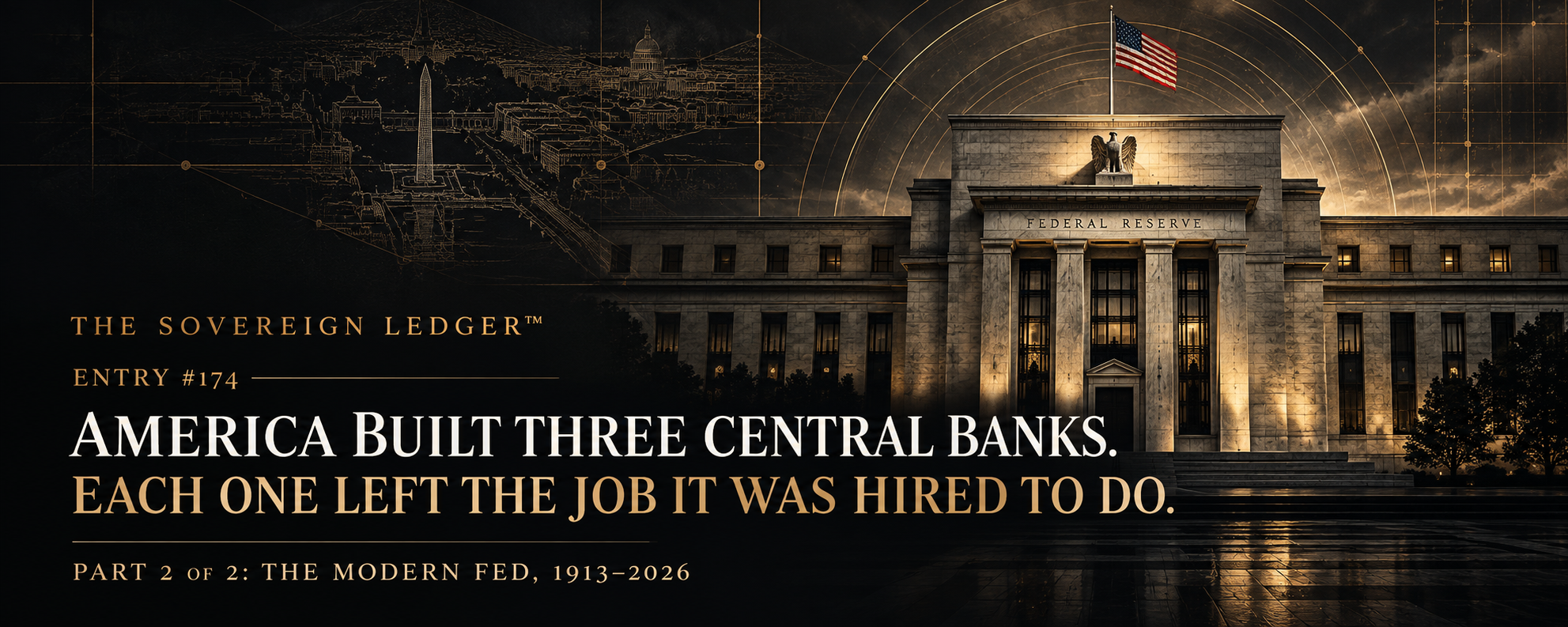
The Sovereign Ledger™ · Entry #174 · September 2026
AMERICA BUILT THREE CENTRAL BANKS. EACH ONE LEFT THE JOB IT WAS HIRED TO DO.
PART 2 OF 2 — THE MODERN FED, 1913–2026
The history of the Federal Reserve after 1913 is the story of an institution hired for one job that took on three. From the Great Contraction to the dual mandate, from quantitative easing to the Powell Housing Paradox™ and Kevin Warsh’s first hike: the Fed, graded against its own charter.
Tuesday, September 29, 2026 · Eastern Time · New York · Palm Beach · Miami · Naples · Sarasota
Part 1: The Origins, 1791–1913
1913 · 1935 · 1951 · 1977 · 2008 · 2026
One Charter · Six Rewrites · One Unfinished Argument
PROLOGUEWhere Part 1 Left Us
Yesterday, in Entry #173, I took the history of the Federal Reserve back to its roots: Hamilton’s First Bank, Jackson’s 1832 veto, the Independent Treasury, J.P. Morgan’s library in 1907 and the Federal Reserve Act of December 23, 1913. I ended at the moment the Fed was hired, with its job description written in the title of its own statute: an elastic currency, a window to rediscount commercial paper and more effective supervision of banking.
Today I open the personnel file. The Federal Reserve has now worked for 113 years. It has never been fired, and it has never been asked to reapply for its position. Instead it has been handed new jobs, one crisis at a time, until the institution that exists in September 2026 bears only a family resemblance to the one Woodrow Wilson signed into law.
The stakes are not academic this week. On September 16, 2026, the Federal Open Market Committee voted 12–0 to raise its target range to 3.75%–4.00%, its first hike since 2023. On September 24, Freddie Mac reported the 30-year fixed mortgage at 7.03%, its first reading above 7% since January 2025. August CPI came in at 3.4% over twelve months, with energy up 16.3%. Total public debt stood at roughly $40.1 trillion on September 22. Every one of those numbers is a verdict on the institution this report examines.
What You Will Know by the End of Part 2
- The four structural truths Part 1 set up, sharpened into the foundation for everything that follows: foreign capital, the rigid vault, the private rescuer and the asset-price trap.
- The three contracts. The 1913 charter, the 1977 dual mandate and the unwritten lender-of-last-resort role, and why the Fed is graded against all three at once.
- Six failures, from the Great Contraction to the 2021–23 inflation, stated plainly and sourced.
- The Powell Housing Paradox™: how cheap money and the fastest tightening in four decades produced a boom that incumbents banked and a freeze that incumbents enforce.
- Warsh’s inheritance, and the Treasury question: what the September 16 hike, Treasury’s bond buybacks and the Supreme Court’s June 29 ruling in Trump v. Cook mean for the Fed’s future.
- My verdict and my blueprint: the version of central banking that passes both Hamilton’s test and Jackson’s.
How to Read This Report
Fact Dates, votes, statutory language and published data, sourced at the end.
Estimate Figures that historians or agencies calculate differently, stated as ranges and qualified.
My View My interpretation and strategic judgment. You are invited to disagree with it. Claims invite debate. Artifacts invite inspection.
BEFORE THE VERDICTFour Structural Truths Part 1 Set Up
Before I grade the Federal Reserve, I want to sharpen four levers from the origin story. Each one turns what could read as a historical chronicle into a strategic blueprint. Together they explain why the fight over American central banking has never been only about interest rates. It has always been about ownership: who owns the machine, who owns its upside and who pays when it fails.
The Foreign Capital Footprint: Sovereignty vs. Extraction
The First and Second Banks of the United States are usually taught as domestic political quarrels between Federalists and Republicans, between Hamilton and Jefferson, between Biddle and Jackson. That framing leaves out the single most important fact about who actually owned them.
Fact The First Bank was capitalized at $10 million in 25,000 shares of $400 each. The federal government bought 5,000 shares and sold them between 1796 and 1802 at a profit. As early as January 1798, foreigners were estimated to hold 13,000 of the 25,000 shares. In June 1802, the United States sold 2,220 of its remaining shares to the British financier Alexander Baring. By January 1811, as Congress debated recharter, Treasury Secretary Albert Gallatin reported that “near three-fourths of the stock” was held by foreigners, a figure first stated to the Senate in March 1809. By his count, that was roughly 18,000 of the 25,000 shares.
Fact Twenty-one years later, Andrew Jackson’s veto message put the Second Bank’s foreign holdings at more than a fourth of its stock, over eight million dollars’ worth, held chiefly in Britain.
Read those numbers again. The central banking institution of the young American Republic was, by the end of its life, mostly owned abroad. The dividends it paid on the privilege of holding the Treasury’s deposits and issuing the nation’s most trusted paper flowed, in large part, across the Atlantic to the capital markets of the country America had just fought a revolution against, and would fight again in 1812.
My View This is where the debate stops being about constitutional theory and becomes about sovereignty. A national fiscal agent whose equity is majority foreign-owned is a channel through which rents from American enterprise, American taxpayers and American depositors are extracted by owners who have no stake in the Republic’s survival beyond their dividend. Jefferson saw the danger clearly. In an October 1802 note to Gallatin, he warned that the Bank’s stock was “held in so great a proportion by foreigners” that a dispute with a foreign power could leave the government “immensely embarrassed.”
The honest counterpoint belongs here too. Hamilton welcomed foreign capital as a vote of confidence and as a source of scarce hard money. Foreign subscription lowered the cost of credit for a capital-poor nation. Both things were true at once: foreign money strengthened the young Republic’s credit, and foreign ownership placed a share of the Republic’s financial privilege in hands that answered to no American voter.
Capital from abroad can build a nation.
Ownership from abroad can bill it forever.
That distinction runs straight to 2026. Foreign investors hold trillions of dollars of U.S. Treasury debt today. The Ownership Thesis™ asks the same question of the modern balance sheet that Jackson asked of the Second Bank’s stock ledger: who owns the claim, and who pays the coupon? I explored the modern version of that question in Entry #168, The 7,000-Year War for the Ledger™.
The Brutal Rigidities of the Independent Treasury, 1846–1913
One historical correction first. The Independent Treasury was not Andrew Jackson’s system. It was proposed by his successor, Martin Van Buren, in 1837, enacted on July 4, 1840, repealed by the Whigs in August 1841, and restored under President James K. Polk on August 6, 1846. It is Jacksonian in spirit, the logical conclusion of Jackson’s war on the Bank, but Van Buren and Polk built it.
Fact The Independent Treasury succeeded at the job it was designed for. Federal money stayed in federal vaults. No pet bank earned a float on public deposits. No Biddle could threaten the Treasury by calling in loans. It divorced public funds from private bank patronage exactly as promised.
Fact It also failed at a job it was never designed to do. Customs duties and land payments flowed into the subtreasuries in gold and silver coin and sat there. When federal revenue ran ahead of spending, specie drained out of the banking system and money tightened, regardless of what the economy needed. The worst pressure came every autumn, when farmers needed cash to harvest, ship and sell the crop. Currency demand peaked in the interior while the Treasury’s vaults could not lend a dollar to meet it. Panics struck in 1857, 1873, 1884, 1890, 1893 and 1907, several of them in the autumn.
My View This is the central dichotomy of American monetary history, and it matters more in 2026 than it did in 1846. A static cash box creates catastrophic systemic brittleness. An expanding continental economy needs an elastic currency, one that can grow when the harvest moves or depositors run and shrink when the need passes. But elasticity is power, and power is capturable. The Independent Treasury proved you can protect the public’s money from private banks and still leave the public exposed. The Federal Reserve would later prove that you can create elasticity and then watch it become the property of whoever sits closest to the window.
A rigid vault protects the Treasury.
An elastic currency protects the country, if no cartel owns the elastic.
The J.P. Morgan Private Central Bank Interregnum, 1907
Between the death of the Second Bank in 1836 and the opening of the Federal Reserve Banks in November 1914, the United States had no lender of last resort. Seventy-eight years. When the system seized in October 1907, the vacuum was filled by a private citizen.
Fact As the Knickerbocker Trust Company failed and runs spread across New York’s trust companies, J. Pierpont Morgan, then 70, directed the rescue. According to the widely told account of the crisis’s decisive weekend in early November 1907, Morgan gathered the presidents of the city’s trust companies in his library on Madison Avenue, locked the doors, and did not let them leave until they had agreed to pool roughly $25 million of their own resources to support the weakest institutions. Treasury Secretary George Cortelyou deposited federal funds in New York banks. The Clearing House issued emergency certificates. The panic broke.
My View This is the most important image in the history of the Federal Reserve, and it is rarely placed at the center where it belongs. When public institutional rails are absent or broken, private power steps in and becomes the de facto central bank. In 1907, the United States did not have a central bank. It had Morgan. His library was the discount window. His judgment was the monetary policy. His locked doors were the emergency facility.
Read that way, the Federal Reserve Act of 1913 was not a radical public takeover of finance. It was the institutionalization of Morgan’s private rescue mechanism into federal law. Senator Nelson Aldrich’s commission studied it, the Jekyll Island group drafted around it, and Congress gave it a permanent address, twelve regional branches and a license to create currency.
Here is the counterpoint, and it is strong. The 1913 Act that passed was not the bankers’ Aldrich Plan. Wilson, Representative Carter Glass, Senator Robert Owen and above all William Jennings Bryan insisted that a Federal Reserve Board appointed by the President and confirmed by the Senate sit over the Reserve Banks, and that Federal Reserve notes be obligations of the United States government, not of the banks. The Secretary of the Treasury and the Comptroller of the Currency sat on that original Board. Bryan’s populists did not abolish Morgan’s function. They put a public board on top of it.
Both readings are defensible. My own synthesis: 1913 nationalized the rescue but not the incentives. The function Morgan performed became public. The proximity of the largest banks to the window, and to its benefits, did not disappear. It was simply given a federal charter.
1907: the country called one man.
1913: the country gave that job a permanent address.
The Asset-Price Transmission Mechanism: Powell to Warsh
The fourth lever connects everything above to the kitchen table of 2026. The Federal Reserve’s 20th-century history is not a museum piece. It runs directly into today’s real estate market and the fight for ownership.
Fact In 2020 and 2021, the Fed cut its policy rate to near zero and bought Treasury securities and agency mortgage-backed securities at massive scale. Its balance sheet reached roughly $9 trillion by 2022. Freddie Mac’s 30-year fixed rate hit a record low of 2.65% in January 2021. Then, from March 2022 to July 2023, the Fed raised its target range by 5.25 percentage points, the fastest tightening in four decades. The 30-year fixed peaked at 7.79% in October 2023.
Fact FHFA researchers estimate that the mortgage rate lock-in that followed prevented about 1.72 million home sales between the second quarter of 2022 and the second quarter of 2024 and raised home prices by about 7.0%. The National Association of REALTORS® reports August 2026 existing-home sales at a 3.98 million annual rate, against 5.34 million in 2019, and a median price of $429,100, the 38th consecutive month of year-over-year gains.
My View Ultra-loose policy and pandemic-era asset purchases did not flow evenly through the economy. They capitalized directly into asset values. Cheap money was bid into the price of homes, and the owners of record in 2021 banked the gain. When policy reversed, the same owners were locked in by their 3% mortgages, and the next generation was priced out by 7% money on inflated prices. Existing owners got the windfall. New buyers got the bill. I call that The Powell Housing Paradox™, and it gets its own chapter below.
Kevin Warsh’s tightening cycle, beginning with the September 16 hike, is an attempt to reverse the fiscal and monetary conditions that made the paradox possible. Behind it sits the longest trend in this report. Fact The Consumer Price Index stood at 9.9 in 1913 and at 334.980 in August 2026. A 1913 dollar now buys about what 3 cents bought then. That century-long erosion of purchasing power is why ownership of real assets became the dominant American strategy for building wealth. And it is why the fight over who controls the rails of real estate liquidity is really a fight over who is protected from the currency.
Money that loses value pushes families into assets.
Rails that lock assets up decide who gets in.
Those four levers set the frame. Now to the verdict.
CHAPTER IThe Three Contracts
The Federal Reserve’s failures are not one story. The institution is graded against three different contracts at once, and it frequently succeeds at one while failing another. That is why the argument about the Fed never ends: its defenders and critics are often grading different exams.
Contract One: The 1913 Hiring Document
“An Act to provide for the establishment of Federal reserve banks, to furnish an elastic currency, to afford means of rediscounting commercial paper, to establish a more effective supervision of banking in the United States, and for other purposes.”Federal Reserve Act, approved December 23, 1913
Four concrete promises: an elastic currency, a rediscount window, better supervision and a regional reserve system so that reserves would not be trapped in New York. Price stability was assumed to come from gold. Employment was not mentioned.
Contract Two: The 1977 Dual Mandate
Fact The Federal Reserve Reform Act of 1977 directed the Fed to promote “maximum employment, stable prices, and moderate long-term interest rates.” The Full Employment and Balanced Growth Act of 1978, known as Humphrey–Hawkins, added twice-yearly testimony to Congress. Today the Fed describes its statutory goals as a dual mandate of employment and prices, treating moderate long-term rates as a byproduct. In January 2012, it adopted a formal 2% inflation target.
Contract Three: The Unwritten Role
The third contract was never written as a single statute. It accumulated. The Fed became the lender of last resort not just to member banks but to the whole financial system: dealers, money-market funds, corporate credit markets and, in 2008 and 2020, markets the 1913 Act never named. It became a payment-system operator through Fedwire, ACH and, since 2023, FedNow. And after 2008 it became a buyer of trillions of dollars of Treasury and mortgage securities.
| Period | What Changed | Who Changed It |
|---|---|---|
| 1913 | Elastic currency, rediscounting, supervision, twelve Reserve Banks | Congress (Federal Reserve Act) |
| 1933 | Deposit insurance created at the FDIC; gold standard broken in stages | Congress and the President |
| 1935 | Board of Governors created; Treasury Secretary and Comptroller removed; modern FOMC | Congress (Banking Act of 1935) |
| 1942–1951 | Fed pegs Treasury yields to finance the war; ended by the Accord | Treasury and Fed (Accord of 1951) |
| 1946 | Government-wide goal of maximum employment, production and purchasing power | Congress (Employment Act) |
| 1977–1978 | Explicit dual mandate; twice-yearly testimony | Congress |
| 2008–2020 | Quantitative easing; emergency facilities; market-wide backstops | The Fed, under existing emergency authority |
One charter. Six rewrites.
Never once asked to reapply for the job.
CHAPTER IIFailure One: The Window That Was Not There, 1929–1933
The Federal Reserve was sold as a panic machine. For its first fifteen years, it appeared to work. There was a sharp recession in 1920–21, when the Fed raised rates to break postwar inflation, but no 1907-style banking panic. Then came the test that mattered.
Fact Between 1930 and 1933, roughly 9,000 American banks suspended operations. The nation’s money stock fell by about a third. Unemployment reached about 25% by 1933. Milton Friedman and Anna Schwartz, in their 1963 A Monetary History of the United States, named the episode the Great Contraction and placed much of the blame on the Federal Reserve’s failure to act as lender of last resort and to prevent the collapse in money.
The institution created to stop runs watched thousands of banks run. Its rediscount window was too narrow, lending only against a limited class of eligible paper. State banks that were not members of the system could not use it. The twelve Reserve Banks did not act as a single lender, and gold-standard orthodoxy led policymakers to tighten when the charter’s own word, elastic, demanded the opposite.
Seventy years later, a Federal Reserve governor said so in public. At a conference honoring Milton Friedman’s 90th birthday on November 8, 2002, Ben Bernanke, who would later chair the Fed, addressed Friedman and Schwartz directly:
“Regarding the Great Depression. You’re right, we did it. We’re very sorry. But thanks to you, we won’t do it again.”Ben S. Bernanke, remarks at the Conference to Honor Milton Friedman, November 8, 2002
My View That is not a close call. It is the original product failing its specification. Classic depositor panics did recede after 1933, but that success belongs mostly to the Banking Act of 1933 and the FDIC, not to the 1913 design surviving contact with a depression. Congress’s response to the Fed’s greatest failure was not to fire it. It was to give it more power, which set the pattern for the next ninety years.
CHAPTER IIIFailure Two: Supervision That Still Misses the Obvious
“More effective supervision of banking” was the third clause of the 1913 title. It is the quiet mandate, and the persistent miss.
Fact In 2007 and 2008, leverage, off-balance-sheet vehicles and mortgage pipelines built up in plain sight inside supervised institutions. In March 2023, Silicon Valley Bank failed after a run on uninsured deposits exposed large unhedged interest-rate losses on its securities. On April 28, 2023, the Fed’s own review, led by Vice Chair for Supervision Michael Barr, concluded that supervisors did not fully appreciate the extent of the bank’s vulnerabilities and did not act with sufficient force once problems were identified.
My View The Fed can write manuals. It does not consistently force risk off the books before the run starts. Compared with the 1907 clearinghouse, supervision is better. Compared with the promise of a professional, well-funded federal supervisor with more than a century of experience, it is not “fixed.” The market learns about the supervisor’s blind spots the same way it always has: in a crisis.
CHAPTER IVFailure Three: The Dollar, a Job 1913 Assumed and Never Stated
The 1913 framers did not hire the Fed to deliver a 2% inflation target. They assumed gold would hold the price level. Federal Reserve notes were backed by a 40% gold reserve, and the currency was redeemable in gold.
Fact Then gold was removed in stages. In 1933 and 1934, President Franklin Roosevelt ended domestic gold convertibility and the Gold Reserve Act revalued gold from $20.67 to $35 an ounce. On August 15, 1971, President Richard Nixon closed the gold window to foreign governments, ending the Bretton Woods system. From that point, nothing but policy stood behind the purchasing power of the dollar.
Fact The Consumer Price Index for All Urban Consumers averaged 9.9 in 1913 and stood at 334.980 in August 2026, according to the Bureau of Labor Statistics. Prices are roughly 34 times higher. A dollar from the year the Fed was founded now buys about what 3 cents bought then.
My View Compound inflation near 3% a year for a century is not an “elastic currency.” It is a slow default on everyone who held cash, bonds or a fixed wage. Gold-standard America before 1913 had long stretches of stable or falling prices. That regime had real costs: deflationary slumps and frequent panics. But it did not silently tax savers every decade. Calling a century of 97% erosion “stable prices” is a word game.
This is the single most important fact for every property owner reading this report. When the unit of account loses value continuously, families who want to preserve wealth are pushed out of cash and into assets. Real estate became America’s savings account not only because Americans love homes, but because the currency did not keep faith. That is why the rails on which real estate trades, which I examined in Entry #172, The Instant Settlement Engine™, are really the rails of American wealth preservation.
1913: $1.00.
2026: about 3 cents of that purchasing power.
CHAPTER VFailure Four: Stable Prices, Missed in Both Directions That Hurt
The 1977 mandate made price stability an explicit statutory duty. The Fed has met it for long stretches. It has also missed it, twice in ways that defined an era.
The 1970s
Fact Inflation rose through the late 1960s and 1970s. Consumer prices peaked at an annual rate of 14.8% in March 1980. Paul Volcker, who became Chairman in August 1979, raised the federal funds rate to nearly 20% and accepted two recessions to break inflation.
My View The Volcker episode is often told as the Fed’s finest hour. It was also the brutal catch-up for a decade in which the Fed validated inflation rather than stopping it. Both halves are true: Volcker proved the Fed can restore price stability when it chooses that goal, and the decade before him proved it can fail that goal for years.
2021–2023
Fact Annual average CPI inflation ran 4.7% in 2021, 8.0% in 2022 and 4.1% in 2023. Through 2021 the Fed characterized rising inflation as “transitory” and did not begin raising rates until March 2022.
My View “Transitory” was a forecast error that became a tax. The committee had spent a decade worrying that inflation was too low. When the price level jumped, Jackson’s “humble members of society” paid first, at the grocery store and in the rent. That is Jackson’s 1832 test applied to modern data, and the Fed failed it.
Fact The problem has not ended. August 2026 CPI stood at 3.4% over twelve months. The personal consumption expenditures price index, the Fed’s preferred gauge, rose 3.7% in the year to July, according to data reported in late August. J.P. Morgan’s research team notes that core PCE has run above 3% in every month of 2026.
CHAPTER VIFailure Five: “Maximum Employment” as an Alibi
Congress never defined “maximum employment” as a number. The Fed defines it and then aims at it. That is discretion, not a hidden plot, but discretion has consequences.
The honest reading of the employment mandate is sustainable employment: do not crush the labor market for no gain on prices. The political reading is: keep credit easy whenever unemployment might tick up. The second reading is how a price-stability mandate gets postponed.
My View Employment is not a lever the Federal Open Market Committee controls. Productivity, demographics, immigration, regulation, technology and fiscal policy dwarf the federal funds rate in determining how many Americans work. Using a vague employment goal to delay tightening is a structural flaw built into the 1977 mandate, not a one-time mistake. In August 2020, the Fed formally adopted flexible average inflation targeting, explicitly willing to let inflation run above 2% for some time. Within a year, it had far more inflation than it intended.
CHAPTER VIIFailure Six: Mission Creep, Succeeding at Jobs That Create New Failures
The Fed’s defenders have a strong case here, and it belongs in the record first.
Fact In 2008, after Lehman Brothers failed on September 15, and again in March 2020, the Fed deployed emergency lending facilities and large-scale asset purchases that stopped wholesale runs across money markets, dealers and credit markets. Neither crisis became 1933. That is a real achievement, and the Fed’s critics should acknowledge it.
My View The cost is a new kind of failure. Quantitative easing and market-wide backstops did what 1913 rediscounting was meant to do, at a scale 1913 never contemplated. Three consequences follow:
- The central bank becomes a buyer of duration for the fiscal authority. When the Fed holds trillions of dollars of Treasury and mortgage securities, it is financing the government and the housing market with newly created reserves.
- The first receivers are not farmers, mechanics and laborers. New reserves and asset-price support reach banks, dealers and asset holders first. The 1832 stock windfall has returned in different plumbing.
- Exit is harder than entry. The balance sheet becomes a second budget that no one votes on. Fact When rates rose after 2022, the Fed’s interest costs on reserves exceeded its income, and it began recording operating losses as a deferred asset, suspending its usual remittances to the Treasury.
So the Fed can claim, fairly, that it “saved the system” in 2008 and 2020, and still fail the 1913 and 1977 contracts. It did not stay a discount window. It did not deliver prices that households can plan around.
Prevent the last crash.
Accept the next inflation.
Explain both as the mandate.
CHAPTER VIIIThe Powell Housing Paradox™
Jerome Powell chaired the Federal Reserve from February 2018 until May 22, 2026, when Kevin Warsh was sworn in as its 17th Chair. On June 25, 2025, Powell told the Senate Banking Committee: “Our monetary policy actions are guided by our dual mandate to promote maximum employment and stable prices for the American people.” Housing is not in that sentence. Yet no household market absorbed the Powell era harder.
My View Powell did not manage housing. He managed a funds rate and a balance sheet that hit housing twice, first by making credit too cheap and then by making moving too expensive. I published a research brief on this on The Sovereign Ledger™ yesterday. Here is the full analysis.
Act One: Cheap Money Became Expensive Houses
Fact In 2020 and 2021 the Fed held its policy rate near zero and bought agency mortgage-backed securities at massive scale. Freddie Mac’s 30-year fixed rate fell to a record 2.65% in January 2021. Cheap credit collided with scarce supply. Buyers capitalized historically cheap debt into the price of the asset. Approved borrowers gained purchasing power, and the house absorbed it.
Act Two: The Freeze
Fact From March 2022 to July 2023, the Fed raised rates 5.25 percentage points. The 30-year fixed peaked at 7.79% in October 2023. Existing-home sales fell from 5.34 million in 2019 to roughly 4.1 million in both 2023 and 2024, the lowest annual totals since 1995. FHFA researchers estimate that rate lock-in prevented 1.72 million sales between mid-2022 and mid-2024 and raised prices by about 7%.
The national crash many predicted never came, and that is the paradox. Higher rates cut demand, but they also cut supply. An owner holding a 3% mortgage does not trade it for a 7% one. Fewer buyers, fewer sellers, firm prices. That is not a correction. It is a frozen market.
Fact The Atlanta Fed’s Home Ownership Affordability Monitor treats an index value below 100 as unaffordable for a median-income household. It stood at 72.9 in August 2024, levels the Atlanta Fed said rivaled those of the 2007–09 financial crisis. In August 2026, NAR reported 3.98 million existing-home sales at an annual rate and a median price of $429,100, the 38th consecutive year-over-year gain. On September 24, the 30-year fixed returned to 7.03%.
Powell overheated the asset.
Then he immobilized the owners.
The SWOT: Housing Under Powell’s Fed
| Category | Assessment |
|---|---|
| Strengths | No 2008-style national price collapse; owners who bought before 2022 kept large equity gains; the mortgage system kept functioning; builders adapted with rate buydowns and became the market’s pressure valve. |
| Weaknesses | Affordability at generational lows for first-time buyers; transaction volume far below pre-pandemic norms; mortgage-backed securities purchases acted as housing policy without a housing vote; “transitory” let the 2021 price spike embed in the housing stock. |
| Opportunities | A trusted, hawkish Fed can earn a lower term premium and, in time, lower 30-year rates; continued shrinking of the Fed’s mortgage holdings; wages catching up with prices; regional oversupply clearing without a new national boom. |
| Threats | Fiscal dominance raising long rates; lock-in decaying slowly and re-freezing with every rate spike; shelter inflation keeping the Fed tight; a credit event in a thin market forcing sellers into a locked-in buyer pool. |
Jackson’s Test, Applied to Powell
In 1832, Jackson warned against laws that “make the rich richer and the potent more powerful” at the expense of “the humble members of society.” My View Pandemic-era policy delivered a gratuity, 3% money capitalized into home prices, to the owners of record in 2021, then left renters, movers and new households to pay the reset. That is not a soft landing for the market. It is a soft landing for incumbents and a hard landing for everyone who must borrow at the new rate.
For owners in the markets I serve, from New York to Palm Beach, Miami, Naples and Sarasota, the paradox has a regional face. I examined how capital moves between those markets in Entry #167, The Cost of Control™, and how wealth migration reshapes demand in Entry #152, The NYC Wealth Migration Report.
CHAPTER IXWarsh’s Inheritance
Fact Kevin Warsh, a Fed governor from 2006 to 2011, was sworn in as Chair on May 22, 2026. Jerome Powell remains a governor, with a term that runs until January 2028. At the Jackson Hole symposium in August, Warsh acknowledged that “certain sectors like housing and agriculture are showing strains,” but said he would be “hard pressed to describe broad financial conditions as restrictive.” On September 16, the FOMC voted 12–0 to raise rates to 3.75%–4.00%.
This Fed sees the strain in housing. It does not see that strain as a reason to override inflation. That is harsher for 2026 buyers, movers and agents. My View It may also be correct. Mortgage rates are not the federal funds rate. They track the 10-year Treasury yield, the term premium, mortgage spreads and confidence in the currency. The most durable gift any Fed Chair can give housing is not another short-lived 3% boom. It is inflation credibility that eventually lowers long-term borrowing costs on its own.
The Treasury Moves In
Fact On August 19, 2026, the Treasury Department announced it would at least double the size of its buyback operations for longer-dated securities, from the 10-year to the 30-year sector, after a bond selloff pushed long-term yields to uncomfortable levels. Treasury Secretary Scott Bessent has long focused on lowering the 10-year yield. Economists quoted in coverage of the move warned that it could complicate the Fed’s inflation fight and add pressure on the central bank. Debt held by the public stood at $32.2 trillion, and the Congressional Budget Office projected a deficit of about $2.1 trillion for the year.
Fact Federal Reserve Bank of St. Louis President Alberto Musalem responded that the Fed sets monetary policy “independent of debt management or fiscal policy.” Warsh then raised rates against the administration’s stated preference for lower ones.
The Court Draws a Line
Fact In August 2025, President Trump moved to fire Federal Reserve Governor Lisa Cook, citing allegations of mortgage fraud that she denied. On June 29, 2026, in Trump v. Cook, the Supreme Court ruled 5–4 that she may remain in office while her challenge proceeds. Chief Justice John Roberts, writing for the majority, held that the statute permits removal only “for cause” and entitles a governor to notice and an opportunity to respond, which the President had not provided. The same day, in a separate case, the Court expanded presidential power to remove the heads of other independent agencies, while carving out the Federal Reserve.
My View That combination tells you where American law now stands. The Supreme Court is prepared to let the President control most of the administrative state, but it has treated the Fed as a special case. That is Hamilton’s instinct written into constitutional doctrine: some capacities are too important to be run from a political desk.
What Warsh Must Not Repeat
A premature easing campaign would reignite bidding for scarce homes before incomes and inventory catch up, reward leverage again and harden the divide between owners and aspiring owners. The better path is slower and less theatrical: credible price stability, a continued shrinking of the Fed’s mortgage-backed securities footprint so the central bank is not a permanent buyer of housing credit, wages catching up with prices, regional supply and time for lock-in to decay.
No portrait, promise or press conference
shortens a 30-year fixed.
Only credible price stability can.
CHAPTER XThe Treasury Question
In Part 1, I flagged a detail that matters enormously now: the Secretary of the Treasury sat on the original Federal Reserve Board in 1913. The question this week is whether the Treasury should, in effect, return.
Why the Seat Was Removed
Fact The Banking Act of 1935 created the modern Board of Governors, gave governors 14-year terms and removed the Secretary of the Treasury and the Comptroller of the Currency from the Board. It also restructured the Federal Open Market Committee into its modern form. The purpose was to separate day-to-day monetary policy from the executive branch.
Why the Separation Was Tested, and Restored
Fact During World War II, from 1942, the Fed agreed to peg Treasury yields, holding bill rates near 0.375% and long-term bonds near 2.5%, to finance the war cheaply. After the war the peg continued, and inflation surged. On March 4, 1951, the Treasury and the Fed reached the Treasury–Fed Accord, freeing the Fed from the obligation to cap yields.
My View That is the lesson every proponent of “bringing the Fed under the Treasury” should read first. The last time the debt-issuer controlled the rate-setter, the result was inflation. The 1951 Accord was written precisely because wartime rate caps under Treasury direction were eroding the currency.
Why a Merger Would Not “Get the Debt Under Control”
- The Fed does not vote the deficit. Congress spends and taxes. Treasury auctions the paper. Putting the Secretary over the FOMC would not cut a dollar of spending or close the primary deficit.
- Markets punish the appearance. If investors believe rate policy exists to reduce the government’s interest bill, they demand a higher term premium. That raises the cost of rolling over $32 trillion of public debt, the opposite of the intended result.
- The law and the courts stand in the way. Governors serve 14-year terms with for-cause removal, the FOMC sets rates by vote, and Trump v. Cook has just reinforced that structure. Only Congress can rewrite it.
BlackRock Chairman Larry Fink warned in his 2025 letter to shareholders that the national debt has grown three times faster than GDP since 1989, and that the dollar’s reserve status cannot be taken for granted. He even named Bitcoin as a potential alternative if confidence erodes. My View The competent answer to debt is fiscal: slower spending growth, a credible long-term budget and a Treasury that does not need the central bank to cap yields. The competent answer to inflation is a central bank that can raise rates when the fiscal authority hates it, which is exactly what Warsh just did.
Folding the rate-setter into the debt-issuer
usually makes the debt harder to finance, not easier.
CHAPTER XIThe Scoreboard Since 1913
| Test | Result |
|---|---|
| End 1907-style currency shortages | Yes. Seasonal currency famines disappeared. |
| Stop banking panics | No in 1930–33; mostly yes after the FDIC; new forms in 2008 and 2023. |
| Keep the money stock from collapsing in a slump | Failed 1929–33; overcorrected in later crises. |
| Protect the purchasing power of wages and savings | Failed as a long-run fact: about 3 cents on the 1913 dollar. |
| Stay inside the 1913 job | No. The dual mandate, quantitative easing and market-wide backstops make it a different institution. |
| Deliver stable prices under the 1977 mandate | Intermittently: failed in the 1970s and 2021–23; succeeded for long stretches in between. |
| Supervise banks effectively | Better than 1907; missed 2007 and SVB in 2023. |
| Make the unit of account feel honest | Not in the 1970s. Not in 2021–23. |
My View On the original contract, the grade is not “incredible,” not “strong” and not “fixed.” It is: one problem solved, one historic failure, one slow leak in the dollar and a mandate that no longer matches the letterhead. America’s enormous postwar rise in living standards is real, but it belongs mostly to technology, markets and the absence of another 1933, not to proof that the Fed “managed” prosperity.
CHAPTER XIIThe Pros and Cons of a Central Bank in 2026
| Pros | Cons |
|---|---|
| A uniform dollar and a national payment rail (Fedwire, ACH, FedNow) | A century-long erosion of the currency’s purchasing power |
| A lender of last resort that stopped 2008 and 2020 from becoming 1933 | Emergency support that reaches dealers and asset holders first |
| Independence that can resist pressure for cheap money before elections | Insulation that protects a committee from consequences when it is wrong |
| Remittances to the Treasury in normal years | Operating losses and a deferred asset when rates rise |
| Crisis expertise and market infrastructure no private house can replicate | Mission creep into employment, asset prices and fiscal support |
| Accountability to Congress, which can amend or repeal the Act | A Congress that rarely uses that power, even after major failures |
Two popular charges deserve to be retired. The Fed does not “issue money for free to itself”: its notes and reserves are liabilities, and its losses since 2022 have hit Treasury remittances. And member-bank stock in the regional Reserve Banks is a capped membership ticket, not controlling equity. The Board of Governors is a federal agency. The live sovereignty issue is not the 1913 stock certificates. It is that Congress holds the power to fire the technician and almost never uses it.
CHAPTER XIIIMy Verdict: Hamilton’s Capacity, Jackson’s Limits
Every American central bank begins as Hamilton’s answer and ends as Jackson’s problem. The Capacity–Limits Test™ I introduced in Part 1 is how I score them.
| Version | Capacity (Hamilton) | Limits (Jackson) | Verdict for the Public |
|---|---|---|---|
| First and Second Banks | Strong fiscal agent, branches, credit | Exclusive charter, private directors, majority or large foreign ownership | Built the Union; invited capture and extraction |
| Independent Treasury | Safe custody of government gold | Real divorce from the banks | Protected the Treasury, not the depositor; no last-resort lending |
| Fed, 1913 design | Elastic currency, discount window, supervision | Regional structure; public Board over the banks | Solved 1907; did not yet claim to steer employment |
| Fed, 1977–2026 | Dual mandate, QE, market-wide backstops | Long terms, self-funding, weak real-time accountability | Stops panics; can socialize tail risk and arrive late to inflation |
What I Would Not Do
- Do not resurrect the Banks of the United States. A republic that sells an exclusive charter to private and foreign stockholders is not “We the People.” It is a court of finance with a flag on it.
- Do not restore the Independent Treasury. You cannot run a $30-trillion-plus debt market and a real-time payment rail out of coin vaults. 1837, 1857, 1873, 1893 and 1907 are what “divorce from the banks” looks like for ordinary families.
- Do not put the Fed inside the Treasury. That is the 1942–51 yield peg with better branding.
- Do not abolish the Fed without a replacement. That would be 1907 with a $40 trillion debt attached.
What I Would Do: Keep Hamilton’s Functions, Impose Jackson’s Limits
Keep (capacity):
- A uniform dollar and a public payment rail.
- A genuine lender of last resort: against good collateral, to solvent institutions, at a penalty rate. Walter Bagehot’s rule, not a standing put under asset prices.
- A fiscal agent, so that the United States never again depends on a private house in a crisis.
Impose (limits):
- Congress owns the deficit in public. The Fed should not “solve” debt by pinning long-term rates. That is Jackson’s gratuity in modern clothes: a transfer to today’s fiscal coalitions, paid by tomorrow’s holders of the dollar.
- Narrow the mandate back toward 1913. Elastic currency, payments, supervision and last-resort lending, with price stability as the anchor. Maximum employment as an equal statutory goal invites the committee to fine-tune a variable it does not control and then explain away inflation.
- Publish and time-limit emergency support. Every facility disclosed in real time, with automatic sunsets and fiscal authorities, not the central bank, bearing duration risk on budget.
- Oversight without capture. Faster transcripts, full audits of emergency lending and a mandate Congress is willing to amend. Not a Secretary setting the funds rate to clear an auction.
- Fire the technician through law, not through a post on social media. Fourteen-year terms and for-cause removal protect against a president demanding 1% rates before an election. They should not protect a committee from any statutory consequence after a multi-year inflation miss.
Keep the 1913 job.
Limit everything the Fed added after it.
My View The 1913 Federal Reserve, kept narrow, is the version that makes the largest number of Americans wealthier and freer in practice. It does one thing the alternatives cannot: keep a panic from eating the country’s working capital. It is not built to protect the currency from a Congress that wants to spend, which is why it must not be allowed to grow a second mandate and a habit of buying the government’s debt so politicians can spend more.
CHAPTER XIVWhat This Means for Owners in 2026
I write The Sovereign Ledger™ for owners, allocators, family enterprises and the next generation that will inherit them. Here is how two days of monetary history translate into a strategy.
1. Treat the Currency as a Counterparty
A 1913 dollar is worth about 3 cents. Any wealth plan that holds cash or long-duration fixed income without an explicit view on the currency is taking a risk it has not priced. Real assets have protected American families for a century, but only when they could be owned, financed and eventually sold.
2. Liquidity Is the New Scarcity
The Powell Housing Paradox™ proves that an asset can hold its price and still trap its owner. Lock-in is a liquidity crisis that never shows up as a price crash. That is why I argued in Entry #172 that settlement speed is an ownership right, and in Entry #171, The Global Distribution Control Layer™, that reaching the right buyer anywhere in the world is now strategic infrastructure.
3. The Authoritative Record Decides Every Crisis
In 1837, 1907 and 2008, the question was whose record was real and redeemable. In Entry #169, The Authoritative Ownership Record™, and Entry #170, The Legal Control Layer™, I set out why property law, not code, determines who owns a tokenized asset. The same principle governs money: the institution that controls the authoritative ledger controls the outcome.
4. Own the Rails, Not Just the Asset
Morgan’s library was a rail. The Federal Reserve is a rail. The regulated stablecoin and tokenized-deposit networks now being built are rails, which I examined in Entry #166, The Sovereign Control Plane™. As I argued in Entry #163: tools depreciate, rails compound. Whoever controls the rails of the next ownership system will be the first receiver of its value.
5. Build Institutions With Capacity and Limits
The durable institution is neither the one built to die on a 20-year timer nor the one that is amended forever without consequence. It is the one I described in Entry #165, Sovereign Ownership Master Infrastructure™: real capacity, a narrow mandate and a mechanism the public can use to hold it to account. That is also the design principle behind REALATAR™: owner-first control, verifiable provenance and no gateway that owns the upside of the owner’s asset.
Five Questions Every Owner Should Ask This Week
- How much of my net worth is exposed to the long-run purchasing power of the dollar, and have I priced that risk deliberately?
- If I needed to sell or refinance a major property in the next twelve months, what would a 7% mortgage market do to my exit?
- Which of my assets are recorded, financed and settled on rails I do not control?
- If a 1907-style liquidity event hit my market, who is my lender of last resort?
- Does my rising generation understand how the money machine works, or only what it costs?
Tax, legal and financial decisions should be made with qualified advisers. What I can give you is the map. People who understand the machine make better decisions about everything that runs on it.
REFERENCEThe Timeline, 1913–2026
| Date | Event |
|---|---|
| Dec 23, 1913 | Wilson signs the Federal Reserve Act |
| Nov 1914 | Twelve Federal Reserve Banks open |
| 1920–1921 | Sharp postwar recession after the Fed raises rates |
| 1930–1933 | The Great Contraction: roughly 9,000 banks suspend; money stock falls about a third |
| 1933–1934 | FDIC created; domestic gold convertibility ended; gold revalued to $35 |
| 1935 | Banking Act creates the Board of Governors; Treasury Secretary removed |
| 1942 | Fed begins pegging Treasury yields for wartime finance |
| 1946 | Employment Act |
| Mar 4, 1951 | Treasury–Fed Accord |
| Aug 15, 1971 | Nixon closes the gold window |
| 1977–1978 | Federal Reserve Reform Act (dual mandate) and Humphrey–Hawkins |
| 1979–1982 | Volcker disinflation; CPI peaks at 14.8% in March 1980 |
| Nov 8, 2002 | Bernanke: “Regarding the Great Depression. You’re right, we did it.” |
| 2008 | Lehman fails; emergency facilities; quantitative easing begins |
| Jan 2012 | Formal 2% inflation target adopted |
| 2018 | Jerome Powell becomes Chair |
| 2020–2021 | Rates near zero; large-scale Treasury and MBS purchases; 30-year hits 2.65% |
| 2021–2023 | CPI averages 4.7%, 8.0% and 4.1% |
| Mar 2022–Jul 2023 | Rates raised 5.25 percentage points |
| Mar 2023 | Silicon Valley Bank fails |
| May 22, 2026 | Kevin Warsh sworn in as the 17th Chair |
| Jun 29, 2026 | Supreme Court rules in Trump v. Cook |
| Aug 18, 2026 | Total public debt crosses $40 trillion |
| Aug 19, 2026 | Treasury doubles long-dated buybacks |
| Sep 16, 2026 | FOMC raises rates to 3.75%–4.00% |
| Sep 24, 2026 | 30-year fixed at 7.03% |
REFERENCEA Glossary for My Tribe
- Dual mandate: the 1977 statutory goals of maximum employment and stable prices (with moderate long-term interest rates).
- FOMC: the Federal Open Market Committee, which sets the federal funds rate target and directs open-market operations.
- Quantitative easing (QE): large-scale purchases of Treasury and mortgage securities to lower long-term rates.
- Term premium: the extra yield investors demand to hold long-term bonds instead of rolling short-term ones.
- Fiscal dominance: when the government’s borrowing needs, rather than inflation, drive monetary policy.
- Lock-in: homeowners with low fixed-rate mortgages declining to sell because a new loan would cost far more.
- Treasury–Fed Accord: the 1951 agreement ending the Fed’s obligation to cap Treasury yields.
- The Capacity–Limits Test™: my framework. Every central bank is created for a capacity the nation lacks and ultimately judged on whether the public can still limit it.
- The Powell Housing Paradox™: my term for the two-stage housing effect of Powell-era policy: cheap money inflated prices, then higher rates froze owners in place.
CONCLUSIONThe Job, Rewritten
America built three central banks. The first was mostly owned abroad by the time Congress let it die. The second was killed by a president who called it a privileged order. The third was built to stop the next 1907, failed its first great test in 1929–33, and then was handed a new job after every crisis it survived.
The Federal Reserve kept the 1913 letterhead and changed the work. It now manages employment it does not control, owns trillions of dollars of the government’s debt and mortgage securities, stands behind markets the Act never named and presides over a currency that has lost roughly 97% of its 1913 purchasing power. It has also stopped two modern crises from becoming another Great Depression. Both halves of that record are true.
The answer is not to abolish it, and not to hand it to the Treasury. It is to do what neither Hamilton nor Jackson managed alone: keep the capacity and restore the limits. Keep the window, the rail and the fiscal agent. Return the deficit to the elected branches. Narrow the mandate. Publish the privileges. And make sure the next generation of owners is not paying, in locked-in homes and a shrinking dollar, for a boom that was banked by the first receivers.
Capacity so the Republic does not beg.
Limits so the machine does not become a class.
Sovereign Proof · Entry #174 · SHA-256 · OpenTimestamps · Bitcoin
Canonical fingerprint string
THE SOVEREIGN LEDGER™ | ENTRY #174 | AMERICA BUILT THREE CENTRAL BANKS. EACH ONE LEFT THE JOB IT WAS HIRED TO DO. — PART 2 OF 2: THE MODERN FED, 1913–2026 | GEOFF DE WEAVER | LIMITLESS USA LLC | https://geoffdeweaver.com/america-built-three-central-banks-part-2/ | 2026-09-29 ET | CORPUS: 174 ENTRIES
SHA-256
2d88dba08d434f2f9aebee2965aa93c2ed330a939a05de7247ee2c5a4d98d705
Proof file: entry-174-america-built-three-central-banks-part-2.txt.ots · Protocol: OpenTimestamps · Chain: Bitcoin L1 · Verify at opentimestamps.org
This file’s SHA-256 is committed through OpenTimestamps. Once confirmed in a Bitcoin block, the proof shows that this exact document existed at or before that block time and has not been altered. The timestamp does not grant a license, transfer copyright, or replace registration.
RECORDSources, Corrections & Rights
Primary and Institutional Sources
- Albert Gallatin, Report to Congress on the Bank of the United States, January 1811 (foreign ownership “near three-fourths”) — American State Papers, via FRASER, Federal Reserve Bank of St. Louis: fraser.stlouisfed.org
- Thomas Jefferson to Albert Gallatin, October 7, 1802, with editorial note on foreign share ownership and the 1802 Baring sale — Founders Online, National Archives: founders.archives.gov
- Andrew Jackson, Veto Message, July 10, 1832 — The Avalon Project, Yale Law School: avalon.law.yale.edu
- Federal Reserve Act of 1913 — FRASER: fraser.stlouisfed.org
- Federal Reserve History essays on the Panic of 1907, the Great Depression, the Banking Act of 1935, the Treasury–Fed Accord and Humphrey–Hawkins: federalreservehistory.org
- Ben S. Bernanke, remarks at the Conference to Honor Milton Friedman, November 8, 2002 — Federal Reserve Board: federalreserve.gov
- Board of Governors, Review of the Federal Reserve’s Supervision and Regulation of Silicon Valley Bank, April 28, 2023: federalreserve.gov
- Jerome H. Powell, Semiannual Monetary Policy Report, Senate Banking Committee, June 25, 2025: federalreserve.gov
Current Data and Events (2026)
- CPI, August 2026 (3.4%; index 334.980; energy 16.3%) — Bureau of Labor Statistics: bls.gov
- Trump v. Cook, decided June 29, 2026 — SCOTUSblog: scotusblog.com; CNBC: cnbc.com
- Treasury long-dated buyback expansion, August 19, 2026; debt held by the public $32.2T; CBO deficit projection — CNBC: cnbc.com
- PCE price index 3.7% in the year to July 2026 — CNBC: cnbc.com
- FOMC decision, September 16, 2026 — CNBC: cnbc.com
- Core PCE above 3% in every month of 2026 — J.P. Morgan Global Research: jpmorgan.com
- 30-year fixed rate (2.65% record low, January 2021; 7.79% peak, October 2023; 7.03%, September 24, 2026) — Freddie Mac Primary Mortgage Market Survey: freddiemac.com/pmms
- August 2026 existing-home sales and median price — National Association of REALTORS®: nar.realtor
- Rate lock-in estimates — Batzer, Coste, Doerner & Seiler, “The Lock-In Effect of Rising Mortgage Rates,” FHFA Working Paper 24-03 (updated): fhfa.gov
- Home Ownership Affordability Monitor (72.9 in August 2024) — Federal Reserve Bank of Atlanta: atlantafed.org
- Total public debt — U.S. Treasury, Debt to the Penny: fiscaldata.treasury.gov
- BlackRock Chairman’s Letter 2025 — Fortune: fortune.com
Fact and opinion. Dates, votes, quotations and data above are factual claims, sourced as listed. Passages marked “My View,” The Capacity–Limits Test™, The Powell Housing Paradox™ and the report’s thesis and recommendations are my interpretation and analysis. Historical figures that scholars calculate differently, including foreign ownership shares of the Banks of the United States and bank-suspension counts for 1930–33, are presented as qualified estimates. The widely told account of J.P. Morgan locking his library doors in November 1907 is presented as such.
Corrections. If you find an error, email geoff@geoffdeweaver.com. Verified corrections will be dated and noted. The anchored original is preserved, never silently rewritten.
Not advice. Nothing in this report is legal, financial, tax or investment advice. Consult qualified professionals before acting.
Rights. © 2026 Geoff De Weaver and Limitless USA LLC. All rights reserved. This is a human-authored work. The Sovereign Ledger™, The Ownership Thesis™, REALATAR™, The Capacity–Limits Test™, The Powell Housing Paradox™ and related marks are trademarks of Geoff De Weaver and Limitless USA LLC. No license is granted to copy, scrape, mine, republish, commercially reuse, or use this content to train, fine-tune or develop artificial intelligence systems without written permission, except as permitted by applicable law. Text-and-data-mining and AI-training rights are expressly reserved, including under Article 4(3) of EU Directive 2019/790. Brief quotation with attribution and a link to the canonical URL is welcome.
Provenance. This Entry’s canonical fingerprint is hashed with SHA-256 and timestamped through OpenTimestamps, anchored to the Bitcoin blockchain. The proof establishes chronology and integrity, not the truth of any underlying claim, and does not grant a license, transfer copyright or replace registration.
One institution. Four destinations. One Sovereign Architecture.
I have spent decades building an integrated infrastructure designed for absolute ownership:
WHO I AMhttps://geoffdeweaver.com
Identity. Experience. Trust.
PROVEN SCALE & TRACK RECORDhttps://geoffdeweaver.com/about-geoff-de-weaver/
Execution. Reach. Scale.
HOW I THINKhttps://geoffdeweaver.com/the-sovereign-ledger/
Intelligence. Evidence. Provenance.
WHAT I’M BUILDINGhttps://geoffdeweaver.com/realatar/
Ownership. Infrastructure. Execution.
IDENTITY. SCALE. INTELLIGENCE. INFRASTRUCTURE.
Driven by the LIMITLESS doctrine:
OWN IT → PROTECT IT → PROVE IT → CONTROL IT → MULTIPLY IT → COMPOUND IT.
AI scales leverage. Blockchain secures provenance. Evidence establishes trust. Human authority guarantees sovereignty. Better products build the moat.
Who I Am commands attention.
My Track Record validates scale.
How I Think cements trust.
What I’m Building drives adoption.
This is the architecture.