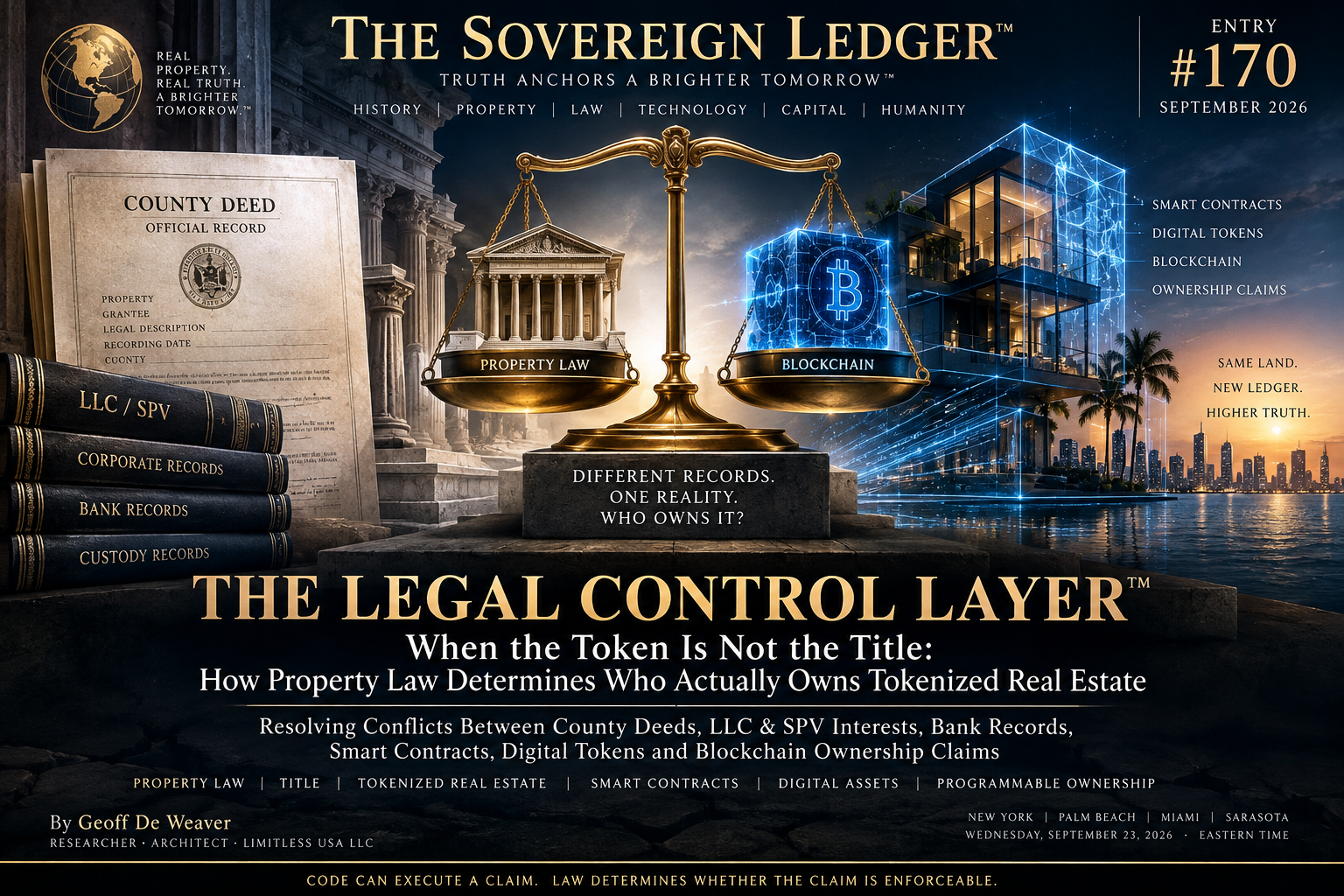
The Sovereign Ledger™ · Entry #170 · September 2026
The Ownership Thesis™ Research Report
THE LEGAL CONTROL LAYER™When the Token Is Not the Title
How Property Law Determines Who Actually Owns Tokenized Real Estate
Resolving conflicts between county deeds, LLC and SPV interests, bank records, smart contracts, digital tokens and blockchain ownership claims.
Remastered edition · Tuesday, September 22, 2026 (ET)
New York · Palm Beach · Miami · Sarasota
Originally published October 23, 2024 as “Navigating Legal Challenges in Web3 Real Estate Transactions.”
Why I Rewrote This
On October 23, 2024, I published an article arguing that Web3, blockchain and AI were becoming the “Holy Trinity” of luxury real estate. The direction held up. Much of the evidence I used did not.
Twenty-three months later, the market has given me something better than predictions: outcomes. Congress passed one digital-asset law and stalled another. The SEC told the market how it views tokenized securities, then proposed rewriting the rules that govern who keeps the official ownership record. A federal court vacated a national real-estate reporting rule. A New Jersey county began moving its deed records onto a blockchain. Dubai launched a regulated property investment token aligned to its official land registry. The BIS settled real money across borders on a shared programmable ledger.
So this is not a light refresh. I rebuilt the evidence base from primary and institutional sources, retired numbers I can no longer trace, and replaced the article’s central idea with a sharper one.
The decisive layer in tokenized real estate is not the blockchain. It is the legal control layer: the stack of statutes, registries, regulators and courts that decides who actually controls a property, whatever a token says.
Code can move a token.
Only law can move title.
Everything that follows is proof of that sentence.
What Changed Between October 2024 and September 2026
Congress moved on money, then stalled on market structure. The GENIUS Act, the first federal framework for U.S. payment stablecoins, was signed into law on July 18, 2025. The broader market-structure bill did not follow. On September 15, 2026, the Senate failed to advance the CLARITY Act on a cloture vote that needed 60. The roll call was 49–50. The bill never reached floor debate.
SEC staff addressed the core question, and the Commission moved to the record itself. On January 28, 2026, staff from three SEC divisions stated that tokenization is a method of recordkeeping and transfer. It does not change whether an instrument is a security or how the federal securities laws apply. That was a staff statement, not a Commission rule. On September 1, 2026, the Commission itself proposed modernizing transfer-agent rules to allow registered agents to use distributed ledger technology for tracking securities ownership.
And the Commission opened a narrow door for on-chain venues. On September 17, 2026, the SEC issued two five-year conditional exemptions to facilitate permissioned trading of tokenized NMS stock through automated market makers and liquidity pools — two days after the CLARITY cloture vote failed.
The national real-estate AML rule arrived, then was vacated. FinCEN’s Residential Real Estate Rule became unenforceable after a federal court order vacating it on March 19, 2026. The government appealed and the litigation continues.
Public records began moving on-chain. Balcony signed a five-year agreement with the Bergen County Clerk’s Office to bring 370,000 property deeds on-chain using Avalanche. Separately — and this is a different instrument, not the same thing — the Dubai Land Department launched a regulated tokenized property investment product through the Prypco Mint platform in May 2025.
Central banks proved atomic cross-border settlement works. The BIS reported on May 27, 2026 that Project Agorá demonstrated atomic settlement of wholesale cross-border transactions using tokenized central bank reserves and tokenized commercial bank deposits, securely and with finality across currencies and jurisdictions.
The on-chain market grew, but its composition matters more than its size. The real-world asset market reached $31.53 billion in distributed value on June 3, 2026, according to RWA.xyz. Most of that is Treasuries, funds, gold and credit. Very little of it is buildings.
Fraud grew faster than adoption. Reported real estate fraud losses rose to $275.1 million in 2025 from about $173 million in 2024, across 12,368 complaints.
Read together, these tell one story. The technology is ready enough. The binding constraint is legal control.
The Scarce Layer Is Not the Chain
Most of the market is still arguing about rails. Throughput, finality, token standards, oracle design. Those matter. They are not the scarce layer.
A token is a pointer. Property law decides what it points to.
Land does not move because a wallet signed a transaction. In the United States, title still runs through deeds, recording statutes and county records. In much of Europe it runs through notaries and land registers that do not read blockchains. The token can change hands in seconds. The name in the register does not.
That gap is not a bug in the chain. It is the legal system doing what it has always done: refusing to treat a bearer instrument as a conveyance of real property.
So almost every serious structure is indirect. The building goes into an SPV, a trust or a series LLC. The token represents a claim on that vehicle — membership interest, participation right, note or beneficial interest — not the dirt itself. The chain records who holds the claim. The legal wrapper is what makes the claim enforceable. Without that wrapper, the token is a receipt for an unenforceable story.
This is why “code is law” keeps failing the moment the asset is real. Code defines what is technically possible. Law defines what is a right, a duty and a remedy. Authority flows one way: law invests a technical state with legal consequence. It never flows the other way.
The cleanest example in U.S. commercial law is the 2022 UCC amendments and Article 12. A controllable electronic record can be subjected to control — the functional equivalent of possession. A qualifying purchaser who takes control in good faith, for value and without notice of a competing claim can take free of that claim. That is not the chain inventing property. That is a statute pointing at a verifiable technical fact and saying: this fact now carries the legal effects possession used to have.
That is the legal control layer. It is the interface that maps:
- private keys and smart-contract state → exclusive power
- exclusive power → control
- control → take-free rights, perfected security interests and priority
- the on-chain record → the off-chain instrument the register, the court and the secured lender already know how to enforce
Projects that skip this layer produce tokenized exposure. Projects that build it produce something a balance sheet, a repo desk and a foreclosure proceeding can use.
The dual-ledger problem does not disappear. You still have the county record and the chain. The winning architecture does not pretend they are the same system. It makes them consistent by design: the legal instrument is primary, the token is the programmable representation of rights in that instrument, and transfers the smart contract permits are the same transfers the operating agreement, the trust deed and the UCC already contemplate. Compliance — who may hold, where and for how long — lives in both places, or the structure is theater.
Speed is cheap. Legal meaning is not.
The chain that settles in 400 milliseconds and the chain that settles in four seconds will both lose to the stack that can answer, without a 90-day opinion letter every time: Who has control? Who takes free? What happens in insolvency? What does the register say after the transfer?
That stack is not a consensus algorithm. It is property law, commercial law, and a narrow set of technical primitives that law has already agreed to recognize. Build on that layer and the token stops being a marketing wrapper. It becomes the thing the next decade is actually about: a record that code can move and a court will still treat as property.
The 2024 Evidence I’m Retiring — and Why
My standard is simple. Nothing gets published that I would be uncomfortable defending to a CEO, a family office, a regulator, a journalist, a lawyer or an institutional investor. By that standard, parts of my 2024 article don’t pass.
Figures I could not trace to a primary source
- a blockchain real-estate market “surpassing $10 trillion by 2030”;
- a PwC projection of “$4.5 trillion” in tokenized real estate by 2030;
- a “73%” luxury-firm blockchain adoption figure attributed to Forrester and Gartner;
- a Forrester prediction that “30% of all real estate transactions” would involve smart contracts by 2025.
The last one was testable. 2025 was the test year, and it failed.
Percentages I could not match to published reports
The same applies to numbers I attributed to KPMG, CB Insights, Bain & Co., McKinsey, Gartner, JLL, Accenture, NAR and the American Bar Association, covering KYC savings, title-fraud reduction, investment returns, tenant retention and transaction costs. They are retired.
Examples that were real but framed too broadly
- Propy. The 2017 blockchain-recorded purchase of an apartment in Kyiv, Ukraine was a genuine milestone, as was the 2018 recording of a deed on a blockchain in South Burlington, Vermont. But a recorded hash is not a conveyance. Both transactions still ran through the legal instruments and the officials who recognize them; the chain carried a copy of the evidence, not the transfer of title.
- Sweden. Lantmäteriet ran a blockchain pilot. It was a pilot, not a live blockchain land registry.
- Skyline AI. JLL acquired it in 2021, so it no longer operates as the independent platform I described.
Three of my own lines
“Forget banks.” “Screw bricks and mortar.” And the claim that smart contracts “eliminate the need for title companies, escrow services, and brokers.” The 2026 evidence points the other way. Intermediaries are not disappearing. The ones that survive are becoming control-layer operators.
The original article remains part of my record, dated October 23, 2024. This edition supersedes its evidence, not its date. Preserve the past. Verify the present. Date the evidence.
The Market in 2026: Measured Facts Versus Forecasts
In tokenization, the most common error is mixing what has happened with what someone projects will happen. I separate them.
What has been measured
RWA.xyz counted $31.53 billion of real-world assets active on-chain as of June 3, 2026, held by 837,339 distinct holders. The composition is the story: tokenized Treasuries, funds, gold and credit dominate. Property is a rounding error inside a rounding error.
Measurement methods differ, so figures differ. DeFiLlama put tokenized real-world assets at roughly $23.6 billion in March 2026, up about 66% from around $14.1 billion on January 1. Even the same provider changes method: RWA.xyz revised its methodology in 2025, counting wallet-transferable assets as “distributed” and platform-locked tokens as “represented,” which breaks comparisons with earlier data.
The reason financial assets tokenized first is instructive. A Treasury bill has no registry problem, no notary, no county recorder, no title insurer and no transfer tax. Its ownership was already electronic and already centrally recorded. Real estate has all of those things. That is not a lag in enthusiasm. It is the legal control layer doing exactly what it exists to do.
What is forecast
The Deloitte Center for Financial Services predicts US$4 trillion of real estate will be tokenized by 2035, up from less than US$0.3 trillion in 2024, a compound annual growth rate of 27%.
McKinsey is more conservative across all asset classes, projecting in June 2024 that tokenized markets could reach about $2 trillion by 2030, possibly doubling to around $4 trillion in a bullish scenario.
Boston Consulting Group and Ripple projected the tokenized asset market could reach $18.9 trillion by 2033, with real estate a significant share.
Dubai has put a public-sector target on its own market: the Dubai Land Department expects tokenized assets to account for up to 7% of Dubai’s real estate market by 2033, about AED 60 billion ($16 billion).
Context: the whole market
For global property, I use Statista Market Insights’ 2026 forecast of roughly $625 trillion. That is a modeled forecast, not audited book value or transaction volume.
Put Deloitte’s 2024 estimate beside it and tokenized real estate is roughly five-hundredths of one percent of global property value. Different methods, different years — treat the comparison as directional only.
My interpretation
Forecasters disagree by an order of magnitude. They agree on direction. The spread between $2 trillion and $18.9 trillion is not a technology question. It is a legal-control question: how fast registries, securities regulators, AML regimes and courts accept on-chain records as legally meaningful.
The Legal Control Layer™, Defined
A blockchain can prove that a record exists and has not been altered. It cannot, by itself, make that record binding on a county recorder, a lender, a title insurer, a tax authority, a regulator or a judge.
The Legal Control Layer™ is the set of legal systems that decide what a digital ownership record actually means. Seven sub-layers. Each asks a question code cannot answer on its own.
- Title: Who does the state recognize as the owner?
- Contract: What did the parties agree, and what will a court enforce?
- Control: Who controls the digital record under commercial law?
- Securities: Is a fractional interest an investment contract, and who keeps the official register?
- Money: What is the settlement asset, and who regulates it?
- Identity: Who are the parties really, and who must report them?
- Jurisdiction: Whose courts and whose law decide the dispute?
The chain records. The state recognizes. The court enforces.
A tokenization structure that answers all seven questions is infrastructure. One that answers none of them is a database with a marketing budget.
Layer 1 — Title: The Registry Still Rules
In the United States, real property ownership runs through county recording systems, state property law and, in practice, title insurance. A token issued outside that system does not replace a deed. The serious structures fall into three categories, and confusing them is the most expensive mistake in this market.
Category one: the official record moves onto a chain
Bergen County, New Jersey sits across the Hudson from Manhattan. It is the state’s most populous county, with nearly one million residents and around $500 million in annual property tax revenue.
Its five-year agreement with Balcony covers 370,000 property deeds, representing approximately $240 billion in real estate value. The county gains a tamper-proof, fully digitized and searchable chain of title across all 70 municipalities, with deed processing time expected to fall by more than 90%. That 90% figure is the vendor’s expectation, not a measured outcome.
Be precise about what this is and is not. This is records-grade digitization. It is the official deed record, maintained by the official custodian, on a chain the clerk controls. It is not a transferable fractional interest. A Bergen County search result is not something you can buy a piece of. Anyone who reads it that way has misunderstood the project and will misprice everything downstream of it.
It is also no longer isolated, which is the point. The Bergen project brought New Jersey’s total tokenized deed count to approximately 460,000, with Balcony also working with Camden, Orange, Morristown, Cliffside Park and Fort Lee. In Orange, the platform surfaced nearly $1 million in previously uncollected municipal revenue — an important detail, because it shows the business case for county adoption is fiscal, not ideological. Clerks are not adopting distributed ledgers to be modern. They are adopting them because the records were expensive, fragile and incomplete.
The Statutory Bridge
This is the convergence I have described for two years, and it is now visible at the clerk level. When a county recorder maintains its authoritative chain of title on a distributed ledger, two things that used to live in different worlds begin to occupy the same record: the statutory instrument the law recognizes, and the cryptographic reference a machine can verify.
That is the Statutory Bridge. It does not make a token a deed. It removes the gap between the land book and the ledger, so a single verified reference can be checked against both.
For anyone building ownership infrastructure, this is the integration point that matters more than any exchange listing. My design objective is to read from and reconcile against county-maintained records wherever they exist in machine-readable form, rather than assert a parallel record of ownership that no clerk recognizes. I state that as design intent, not as a live integration.
The winning architecture does not route around the courthouse. It plugs into it.
Category two: a regulated investment token aligned to the official registry
Dubai built a different instrument, and the distinction matters more than the similarity.
Ctrl Alt issues the ownership tokens on the XRP Ledger for the Prypco Mint program, which the Dubai Land Department and the Virtual Assets Regulatory Authority jointly oversee — DLD as regulator of the physical asset, VARA as regulator of the digital one. Ctrl Alt also built tools to integrate those tokens with Dubai’s official property registry, creating a digital record aligned with legal title ownership, with legal documentation of ownership issued by DLD.
The investor-facing design is deliberately conservative: a minimum of AED 2,000, transactions conducted exclusively in dirhams with no cryptocurrency in the pilot phase, and funds held in a Client Money Account overseen by the Central Bank until purchases complete.
This is a title-aligned investment token. It is transferable, fractional and regulated as an investment product — and its legal weight comes from the fact that the land regulator issues the ownership documentation, not from the ledger it rides on.
Records-grade and title-aligned are both “wired to the registry.” They are not the same instrument, they carry different rights, and they will not trade, price or finance the same way.
Category three: a claim floating above both
Most tokenized property is neither. Most tokenized assets do not give holders direct title; the token typically represents a claim on a special purpose vehicle, a debt obligation secured against the asset, or a contractual redemption right — and that structure determines recovery priority if the issuer fails.
That is not a flaw. It is a structure. But it must be disclosed as one. If you hold a token in a Palm Beach property LLC, you own a membership interest governed by the operating agreement and state LLC law. You do not hold a deed.
Europe: the notary is the control layer
American readers underestimate this. Across much of continental Europe, a transfer of real property requires a notarial deed and registration in a land register, and the register — not the contract, and not the chain — determines who owns the property against the world. The notary is not a formality. The notary is the control layer, performing identity verification, legality review and registry submission in one office.
A blockchain does not read a land register, and a land register does not read a blockchain. Until a civil-law jurisdiction legislates recognition, a token representing European property is a claim on an entity, full stop. The EU has legislated on crypto-asset markets, not on conveyancing: the Markets in Crypto-Assets Regulation, fully applicable since December 30, 2024, deliberately excludes instruments that already qualify as financial instruments — and says nothing about who owns a building in Milan.
My standing rule
Tokenization is not statutory title. Bitcoin anchoring is not legal conveyance. I anchor my own research through OpenTimestamps precisely because it proves a document existed unaltered at a point in time. It proves nothing about who owns the property the document describes.
Layer 2 — Contract: Smart Contracts Are Performance, Not Agreement
The question I asked in 2024 was whether smart contracts could be recognized as legal contracts. The better question is what role they play inside one.
The legal foundation already exists
- The federal ESIGN Act (2000) and the Uniform Electronic Transactions Act, adopted in nearly every state, give electronic records and signatures legal effect.
- Arizona’s HB 2417 (2017) amended its electronic transactions law to recognize blockchain signatures and smart contracts. Several states followed.
- Florida authorized remote online notarization effective January 1, 2020, which matters directly for cross-border closings on Florida property.
So “can code be part of a contract?” is answered. Yes.
What code cannot do
It cannot interpret ambiguity. It cannot recognize fraud, duress, mutual mistake or incapacity. And it cannot unwind itself when a court orders it to.
A court can rescind a transaction. A blockchain does not rescind anything; it only records a new transaction. That asymmetry is where most smart-contract disputes will live.
There is a second asymmetry worth naming. Real estate contracts are full of conditions that are inherently judgmental: satisfactory inspection, material adverse change, reasonable efforts, commercially reasonable consent. Code can execute a condition it can measure. It cannot execute a condition a human has to assess. Any structure claiming full automation of a purchase agreement has either simplified the agreement beyond recognition or quietly reinserted a human decision-maker and not told you who it is.
The practical answer: the paper governs the code
The durable pattern is a natural-language master agreement that expressly governs the code. The smart contract executes defined obligations — release escrowed funds, transfer a token, distribute rent. The written agreement defines everything else:
- what happens if the code misfires;
- who holds administrative, freeze or upgrade keys, and under what governance;
- which data feed triggers execution, and what happens if it fails or is manipulated;
- which conditions require human determination, and who makes it;
- how a court order is carried out on-chain;
- which document prevails in a conflict. It should be the paper.
A smart contract is the fastest clerk in the building. It is not the judge.
Layer 3 — Control: Commercial Law Finally Has a Word for It
The most important legal development for my thesis is one most real-estate professionals have never heard of: Article 12 of the Uniform Commercial Code.
The 2022 UCC amendments added Article 12, governing controllable electronic records, and clarified both what it means to “control” one and when a purchaser takes free of competing claims.
Control has four elements, not three
A person has control of a controllable electronic record when they have:
- the power to enjoy substantially all the benefit of the record;
- the exclusive power to prevent others from enjoying substantially all that benefit;
- the exclusive power to transfer that power to another person; and
- the ability to readily identify themselves as the person holding those powers — by name, identifying number, cryptographic key, office or account number.
The fourth element is the one everyone skips, and it is the hinge between the wallet and the courtroom. Control is not merely cryptographic capability. It is cryptographic capability attributable to an identified person. An anonymous key satisfies the first three elements and fails the fourth — which is precisely why anonymity is not a design goal in institutional structures. Identifiability is not a compliance tax bolted onto control. Under this statute, it is part of control.
Why lenders care: take-free and priority
Here is the commercial payoff. A qualifying purchaser — one who takes control of a controllable electronic record for value, in good faith and without notice of a competing claim — can take free of that claim. That is the digital analogue of the holder-in-due-course and good-faith-purchaser doctrines that make negotiable instruments financeable.
Article 12, together with the Article 9 amendments, also clarifies how a secured party perfects a security interest in these records and how priority is determined, including perfection by control.
This is what turns a token from a curiosity into collateral. A credit committee does not lend against a narrative. It lends against a perfected position with knowable priority and a predictable outcome if the borrower defaults. Before Article 12, a lawyer could not give that opinion cleanly for a digital record. Now, in enacting states, they can.
For family offices, the practical consequence is liquidity. An interest you can pledge is worth more than an identical interest you cannot, because it can be borrowed against instead of sold — which matters enormously in an asset class where selling triggers tax, and where the whole point of the structure is multigenerational holding.
Two practical cautions
- Adoption varies by state. Confirm that the state whose law governs your structure has enacted the 2022 amendments. Do not assume, and do not rely on a national summary.
- Article 12 governs the digital record, not the land. Title to real property remains a matter of state property law and the recording system. Article 12 tells you who controls the token. Layer 1 tells you what the token controls.
This is why I named the framework the Legal Control Layer™. In the new ownership economy, control is the asset. The law has now said so in writing.
The Four Structures, Compared
Before Layer 4, one piece of practical taxonomy. Nearly every property token in the market is one of four things, and the legal analysis is different for each.
1. The registry record. The official deed record maintained on-chain by the recording authority, as in Bergen County. Rights: none transferable to you. Function: evidence, search, fraud resistance, fiscal integrity. Legal weight: highest, because it is the statutory record. Investability: zero — and that is the correct answer, not a shortcoming.
2. The title-aligned investment token. A regulated fractional interest issued under a framework where the land regulator itself documents ownership, as in the DLD/VARA-supervised Prypco Mint program. Rights: fractional economic interest plus whatever the local regulator confers. Legal weight: high within that jurisdiction. Portability across borders: unproven.
3. The entity-interest token. A membership, beneficial or participation interest in an SPV, series LLC or trust that owns the property. This is the dominant U.S. model. Rights: governed entirely by the operating agreement, trust deed and state entity law. Almost always a security. Legal weight: exactly as strong as the wrapper documents and no stronger.
4. The debt or participation token. A note or participation secured by the property or by the entity interest. Rights: contractual payment rights plus security interest. Often the cleanest structure, because secured lending law is mature, priority rules are settled, and remedies are well understood.
Two observations. First, Deloitte’s own forecast expects tokenized debt securities to be the largest component of the 2035 tokenized real-estate market. That is consistent with the legal analysis, not a coincidence: debt tokenizes more easily than equity, and equity tokenizes more easily than title.
Second — this is my interpretation — the market has been chasing structure two while the near-term institutional money sits in structures three and four. The glamour is in fractional ownership of trophy assets. The volume will be in programmable credit against ordinary ones.
Layer 4 — Securities: The Token Doesn’t Change the Question, but the Register Is Being Rewritten
In 2024, many platforms treated fractional property tokens as a new category. The SEC has since made clear that they are not — and then moved on to the harder question of who maintains the official ownership record.
The SEC’s position, precisely dated
The line was drawn first by a commissioner. In her July 9, 2025 statement, “Enchanting, but Not Magical,” Commissioner Hester Peirce wrote that blockchain does not have magical abilities to transform the nature of the underlying asset: “Tokenized securities are still securities.”
Staff formalized the approach on January 28, 2026. That statement created no new rules, exemptions or bespoke regulatory regime for tokenized securities; it reiterated that the technological format in which a security is issued, recorded or transferred does not alter its legal characterization or the applicability of the federal securities laws. It remains a staff statement — the considered view of three divisions, not a Commission rule and not an adjudicated holding.
The model still matters. The statement acknowledges that the method used to tokenize a security may affect the rights and privileges conveyed to token holders, and distinguishes issuer-sponsored from third-party-sponsored tokenization.
The register itself is now in play
This is the development most operators are missing. On September 1, 2026, the Commission proposed modernizing transfer-agent registration and recordkeeping rules — largely unchanged since the late 1970s and early 1980s — to accommodate electronic and blockchain-based recordkeeping. The proposal expressly contemplates blockchain serving as the official ownership record for a securities issue, while subjecting that infrastructure to transfer-agent controls and new tokenized-securities reporting. Comments are due November 3, 2026.
The proposal also raises the bar for intermediaries. Proposed Rule 17ad-31 would create a gatekeeping obligation tied to Section 5 of the Securities Act, requiring transfer agents to form their own reasonable basis before processing unregistered transactions — transforming the role from largely ministerial recordkeeping into a substantially more regulated one.
Two weeks later, the Commission opened a trading door. On September 17, 2026, it issued two five-year conditional exemptions letting qualifying venues trade tokenized NMS stock through permissioned automated market makers and liquidity pools.
The market is building toward this. In March 2026, NYSE and Securitize signed a memorandum of understanding naming Securitize as the first digital transfer agent eligible to mint blockchain-native securities for corporate or ETF issuers on NYSE’s planned Digital Trading Platform.
What this means for property tokens
To be precise: the innovation exemption covers tokenized listed equities, not tokenized real estate. Its significance for property is directional. Regulators are building a model in which an on-chain record can be the official record, provided a regulated party stands behind it and the register stays authoritative.
That is the compliance target any serious property-tokenization structure should design against:
- the on-chain transfer and the official register must never diverge;
- transfer restrictions must be enforced at the token level, not by policy memo;
- identity, eligibility and sanctions status must be checked at every transfer, not once at onboarding;
- the party maintaining the register must be able to satisfy a regulator, not just a smart-contract audit;
- the structure must be able to produce, on demand, a legally meaningful holder list as of a given moment — for distributions, votes, notices and litigation.
Permissioned token standards already exist to do this. The architecture I am designing toward keeps register synchronization, transfer eligibility and sanctions screening inside the asset itself, so that compliance travels with the token instead of sitting beside it. That is my specification and my objective, stated as such.
In practice, U.S. property tokens still run on familiar paths: Regulation D private placements, Regulation A offerings, Regulation S for offshore investors, and trading venues that fit securities law.
Why the CLARITY stall matters less here than the headlines suggest
This is my interpretation, not a statement of law. CLARITY was designed mainly to divide SEC and CFTC oversight of digital-asset markets and define when a crypto asset is a commodity. Tokenized real estate was already a securities question, and remains one. CoinDesk reported that the failure potentially sends the process back to the drawing board absent long-odds maneuvers after November’s midterms.
The lesson for builders: the framework you need already exists. While Washington argued about jurisdiction, the SEC spent September writing the rules that actually govern ownership records.
Layer 5 — Money: Settlement Needs a Lawful Cash Leg
Every property transaction has two legs: the asset and the money. Tokenizing only the asset leaves half the transaction off-chain.
The regulatory foundation
The GENIUS Act, signed July 18, 2025, created a federal framework for payment stablecoins — reserve, disclosure and issuer-licensing requirements, with anti-money-laundering obligations attaching to regulated issuers. That gives a lawful basis for a digital cash leg in U.S. settlement.
It does not make every stablecoin acceptable to every escrow agent, lender or title insurer. Acceptance remains a counterparty decision governed by each institution’s risk policy — and that policy can change between contract and closing. Tesla is the cleanest illustration: it began accepting bitcoin for vehicle purchases in March 2021 and suspended the program roughly two months later. Acceptance of a digital settlement asset is a private policy choice, and private policy is revocable in a way that statute is not.
Dubai’s deliberate choice
Dubai’s regulators designed around exactly this risk. All pilot transactions are conducted exclusively in UAE dirhams, with no cryptocurrencies used during the pilot phase, and investor funds sit in a Client Money Account overseen by the Central Bank until purchases complete.
The most advanced government-backed property tokenization program in the world chose regulated fiat for its cash leg and a central-bank-supervised account for buyer funds. That tells you where the control layer sits — and it is a stronger argument than any policy debate about which stablecoin wins.
What a closing actually requires
Escrow is not a technical function. It is a legal one: a neutral party holds funds under instructions enforceable against both sides, with defined release conditions and a defined failure path. Atomic settlement collapses that into one moment — which is elegant when everything is correct and unforgiving when something is not. A same-second settlement against an undiscovered lien, a forged identity or an unauthorized signer does not produce a fast closing. It produces a fast loss.
That is the argument for building the identity and title layers before compressing the money layer, not after.
Cross-Border Settlement: What the Central Banks Just Proved
Project Agorá, convened by the BIS with the Institute of International Finance, brought together eight central banks — including issuers of the world’s major reserve currencies — and more than 40 private financial institutions to test a shared programmable platform.
The findings, published May 27, 2026, were direct: tokenisation can address long-standing inefficiencies in wholesale cross-border payments at scale while preserving the safety and integrity of settlement in central bank reserves, and atomic settlement of wholesale cross-border transactions is achievable securely and with finality across currencies and jurisdictions.
Then they used real money. In a July 2026 real-value test, 28 financial institutions and central banks settled roughly CHF 800,000 across 17 scenarios in several currencies, with tokens representing actual central bank reserves and commercial bank deposits. Reported settlement times averaged around 80 seconds, against the one-to-several business days typical of correspondent banking.
Two disciplines to hold
First, BIS calls this research, not a production payment network, with further live-value testing planned. Second, wholesale settlement between banks is not the same thing as a consumer closing on a Miami condominium.
Why it still changes the thesis
Cross-border capital sets the clearing price at the top of the Palm Beach, Miami, Manhattan and Sarasota markets. The historical friction was never the buyer’s willingness. It was the settlement chain: multiple correspondent banks, multiple time zones, days of float, and compliance checks performed serially rather than once.
Agorá demonstrates the money side is solvable at the central-bank level, with messaging, compliance and settlement bundled into a single operation.
T-0 atomic settlement remains an objective, not a current condition. It depends on compliant legal, identity, payment, title and settlement infrastructure arriving together. What changed in 2026 is that the hardest component — final, multi-currency, cross-border cash settlement — moved from theory to tested. The remaining gap is on the property side: the title, identity and register layers this report is about.
The settlement node is being built by central banks. The nodes on either side of it are the opportunity.
The Cost of Delay: Quantifying Friction
Institutions do not adopt infrastructure because it is elegant. They adopt it because it improves risk-adjusted returns. So let me put arithmetic against the argument.
Every day between contract and closing, committed capital earns nothing while still costing its holder something. I call this the capital deadweight loss, and it is calculable:
Capital Deadweight Loss = (Transaction Value × Cost of Capital × Days Held ÷ 365) + Transaction Fees
A worked example
Take a $50 million transaction, a 60-day closing timeline, an 8% annual cost of capital, and transaction costs of 1.5% across legal, escrow, title, agency and wire fees.
- Carry cost: $50,000,000 × 0.08 × (60 ÷ 365) = $657,534
- Transaction fees: $50,000,000 × 0.015 = $750,000
- Total friction: $1,407,534, or roughly 2.8% of transaction value
Change the assumptions and the answer changes with them. At a 90-day timeline and a 10% cost of capital, carry alone rises to $1,232,877 and total friction approaches $2 million. At 30 days and 6%, carry falls to $246,575.
How to read this honestly
These are my assumptions, not measured outcomes. Three disciplines apply:
- T-0 settlement compresses the carry component, not the whole number. Legal work, diligence, title examination and compliance still cost money whether settlement takes 60 days or 60 seconds.
- Compressing timelines does not eliminate fees. It changes who earns them and for what.
- Speed without legal certainty is a liability, not a saving. A closing that settles in seconds against a defective title has not saved anyone anything.
The strategic conclusion
The prize is not an exotic new asset class. It is the elimination of dead time in an asset class that already exists and already trades at enormous scale. Compress a 60-day closing to a legally sound same-day settlement and, on a $50 million transaction under these assumptions, the carry component alone returns roughly $657,000 to whoever owns that capital.
That is the number family offices, developers and institutional allocators should model. Not the token. The friction the token removes — and only once every layer of the control stack permits it.
Legal compliance is not a cost center in this architecture. It is the precondition for the yield.
Layer 6 — Identity: Where the Money Is Actually Lost
My 2024 article treated anonymity as a challenge to manage. In real estate, anonymity is not a feature. Verified identity is the product — and, under Article 12, identifiability is literally an element of control.
The fraud data
- Real estate fraud: more than $275 million stolen from at least 12,368 victims in 2025, up from 9,359 complaints and about $173 million in 2024.
- Business email compromise, which frequently targets home closings and wire transfers: $3.04 billion in losses across 24,768 complaints.
- AI-related fraud: 22,364 complaints tied to $893.3 million in losses. Americans 60 and older reported $7.748 billion in losses across all fraud types.
The definition matters, and I state it plainly: IC3 counts losses from real estate investments, rentals or timeshares as “real estate fraud,” so the category is broader than closing wire fraud alone. Cite it as what it is, not as a proxy for title fraud.
Note the demographic overlap. The age cohort reporting the heaviest losses is the same cohort that dominates high-value purchases and holds property through trusts. The fraud problem and the family-enterprise problem are the same population.
The AML reporting rule: issued, delayed, vacated, on appeal
- August 2024: FinCEN adopted the Residential Real Estate Rule on August 29, 2024 under Bank Secrecy Act authority, targeting non-financed transfers of residential property to legal entities and trusts, and requiring disclosure of details including price and the transferee’s beneficial ownership.
- Why FinCEN wrote it: among transactions previously reportable under geographic targeting orders, more than 40 percent of non-financed transfers involved individuals or entities that were the subject of Suspicious Activity Reports filed by financial institutions.
- Why the appeal was inevitable: federal district courts split on the rule — one upheld it, another vacated it — which is precisely the posture that sends a question to a court of appeals.
- March 2026 onward: while the vacatur order remains in force, reporting persons are not required to file real estate reports and are not subject to liability for failing to do so. The government has appealed; the litigation continues; the rule is not back.
That 40 percent figure is the one to remember. It is the government’s own measurement of why this segment attracted attention, and it does not become false because a rule was vacated on administrative grounds.
What this means for tokenized property
All-cash purchases through entities and trusts are standard practice for family offices and UHNW buyers. They are exactly the transactions regulators have targeted for a decade, and they are exactly the transactions tokenization makes easier to execute at speed.
Whatever the appeal decides, the direction is clear. Tokenized property that cannot prove who holds it will not be accepted by the institutions that matter. The design answer exists: permissioned tokens that transfer only between verified, whitelisted wallets, with identity and sanctions checks enforced at the moment of transfer and an auditable record of who was verified, by whom, against what, and when.
Anonymous ownership was never the goal. Portable, verified ownership is.
Layer 7 — Jurisdiction: The Chain Is Everywhere; Courts Are Somewhere
A blockchain has no location. Land always does.
Under long-standing conflict-of-laws principles, title to land is generally governed by the law of the place where the land sits. A token can be held in Singapore, issued by a Delaware entity and traded by a buyer in London. If it represents a Palm Beach property, Florida law and a Florida court still decide the title question. In civil-law Europe, the same question runs through the notary and the land register, as Layer 1 described.
Dubai assigned regulators by layer: the Land Department for the physical asset, VARA for the digital one, with all pilot offerings from VARA-licensed companies and legal documentation of ownership issued by the Land Department. That is a template worth studying — not because every market will copy it, but because it shows what it looks like when a jurisdiction decides deliberately rather than by litigation.
Cross-border tokenized property should answer three questions in writing before a single token is issued:
- Which law governs each layer: the land, the entity, the token and the payment?
- Which forum resolves disputes, and is it arbitration or a court?
- How is a judgment or award executed against the on-chain record?
If the documents are silent, the parties will learn the answers in litigation, at the worst possible time and the highest possible cost.
AI: Not an Eighth Layer
AI is not a layer in this framework. It is the reason three of the existing layers get more expensive.
McKinsey estimates generative AI could create $110 billion to $180 billion or more in value for real estate — while noting that many organizations are finding it difficult to implement and scale, and have not yet realized it. That is potential, not measurement, and I label it as such.
The number that does more work is the FBI’s: 22,364 AI-related fraud complaints in a single year. When fabricating a convincing document, voice or identity becomes nearly free, the cost of verification rises and the value of verified provenance, verified identity and legally recognized title rises with it. AI lowers the cost of forgery faster than it lowers the cost of diligence.
AI is exceptionally good at reading leases, reconciling title chains, flagging inconsistencies and drafting documents. It cannot hold a license, owe a fiduciary duty, sign as a principal or carry professional liability. Human intermediaries remain central: NAR found 88% of buyers used an agent or broker. PwC and ULI, surveying more than 1,700 industry professionals for Emerging Trends in Real Estate 2026, put AI infrastructure among the defining opportunities of the year and named Miami among the top markets to watch.
Tools depreciate. Rails compound.
Five Further Thoughts: The Tests Nobody Runs Until It’s Too Late
The seven layers describe the system. These are the five stress tests I would run on any structure before capital moves, because each is where elegant architecture usually breaks.
1. The insolvency test. Everything works until someone defaults. When a bankruptcy filing imposes an automatic stay, a smart contract that keeps executing distributions is not efficient — it is a problem for the estate and potentially for whoever controls the keys. When a receiver is appointed, can that receiver actually move the asset? If the private keys died with the sponsor, the estate holds an asset it cannot administer. Every structure needs a documented answer to one question: who signs when a court says the sponsor no longer may?
2. The lender-consent test. Most valuable property is encumbered. Mortgages and loan agreements routinely contain due-on-sale clauses, transfer restrictions and change-of-control covenants. Tokenizing equity in an SPV that owns mortgaged property can trip those covenants even though the deed never moves and the building never changes hands. A token transfer is a transfer. Get lender consent in writing before issuance, not after the first secondary trade.
3. The title-underwriter test. In American practice, the real gatekeeper is not the regulator or the chain. It is the underwriter who has to insure the title. Adoption arrives the day a national title insurer will write a policy over a structure without a bespoke endorsement negotiated deal by deal. Until then, every tokenized deal carries a legal-opinion tax. My forecast, labeled as one: standardized underwriting treatment will do more for volume than any throughput improvement.
4. The transfer-tax test. Several states tax transfers of controlling interests in entities that hold real property, precisely to stop people avoiding deed-level transfer taxes through entity sales. A token designed for frictionless secondary trading can accumulate taxable change-of-control events its sponsors never modeled. Model the tax before you model the liquidity, and get state-specific advice in every state where you hold assets.
5. The custody-and-duty test. If control is the legal equivalent of possession, then whoever holds the keys holds the asset — and, in most fiduciary structures, the duties that come with it. Key custody is no longer an IT decision. It is a fiduciary appointment, and it should be documented, insured, audited and subject to succession planning like any other trustee role.
Each of these is answerable. None of them is answered by a faster chain.
What This Means in Palm Beach, Miami, Sarasota and Manhattan
These markets matter to this argument because of their structure, not their glamour. They are dominated by entity and trust purchases, all-cash closings, cross-border capital and multigenerational holding. That combination puts them at the intersection of every layer in this report: the entity wrapper (Layer 1), the securities question when interests are divided (Layer 4), the settlement asset when the buyer is offshore (Layer 5), and the beneficial-ownership question regulators have spent a decade pursuing (Layer 6).
1. Succession has a new failure point, and this is the one to act on first. A family enterprise holding tokenized property interests must plan for control-key succession. A will that transfers the LLC interest and leaves the key behind transfers a right nobody can exercise. Who can move the digital record on death, incapacity or a dispute with the rising generation? Board governance, custody agreements, trust instruments and estate documents have to name the same people and survive the same events. This is the most common unpriced risk I see, and it is entirely preventable with drafting.
2. Diligence standards should rise even while the federal rule is vacated. The vacatur removed a filing obligation, not the underlying risk — and the government’s own 40-percent finding explains why. Buyers, lenders and title insurers will keep asking beneficial-ownership questions because their own exposure depends on the answers.
3. Cross-state and cross-border structures need explicit choice of law. A New York family office buying a Florida residence through a Delaware entity, holding the interest as a token, with an offshore co-investor, touches at least four legal regimes. Name them in the documents.
4. Registry-connected structures will command a premium — priced on legal weight, not on “blockchain.” Records-grade digitization, as in Bergen County, makes title searches faster and fraud harder for everyone in that county; it creates no tradable instrument. A title-aligned investment token, as in the DLD/VARA-supervised program, creates a tradable interest whose weight comes from the land regulator documenting ownership. Both beat a claim floating above the registry. They are not interchangeable, and I expect the pricing, lending terms and insurability of each to diverge accordingly. That is a forecast, labeled as one.
National buyer demographics reinforce the point without driving it: NAR’s 2025 Profile of Home Buyers and Sellers recorded record-high median ages of 59 for all buyers, 40 for first-time buyers and 62 for repeat buyers, with the first-time share at a record-low 21%. Older, wealthier, entity-buying, succession-planning purchasers are the constituency for this infrastructure.
The Legal Control Layer™ Due-Diligence Protocol
Ten questions I would want answered, in writing, before committing capital to any tokenized real-estate structure.
- What exactly does the token represent — a registry record, a title-aligned regulated interest, an entity interest, or a debt claim — and where is that stated?
- Is the structure connected to the official land registry, or does it sit above it?
- Which document prevails if the code and the written agreement conflict?
- Who holds administrative, upgrade or freeze keys, and under what governance?
- Which state’s UCC governs the digital record, has that state enacted Article 12, and can the holder be readily identified as required?
- What securities exemption or registration applies, who maintains the official register, and how is it kept synchronized with on-chain transfers?
- What is the settlement asset, who regulates it, and will every counterparty in the closing accept it?
- How are identity, sanctions and beneficial ownership verified: once at onboarding, or at every transfer?
- Which law and which forum govern disputes, and how is a judgment executed against the on-chain record?
- What happens to control of the token on death, incapacity, divorce, insolvency, foreclosure or a court order?
A structure that answers all ten is built on the legal control layer. A structure that cannot is asking you to carry legal risk the issuer never priced.
The Watchlist: Dated Items I Am Tracking
- November 3, 2026 — comment deadline on the SEC’s transfer-agent modernization proposal. The single most consequential U.S. item for on-chain ownership records.
- The FinCEN appeal — whether the Residential Real Estate Rule is reinstated, rewritten or abandoned determines the identity layer for entity and trust purchases.
- Post-midterm Congress — whether market-structure legislation returns in 2027, and in what form, after the September 15 cloture failure.
- Project Agorá’s next phase — further live-value testing and broader private-sector participation.
- Dubai’s international expansion — whether the Prypco Mint program opens beyond UAE ID holders, and what that implies for cross-border title-aligned tokens.
- County registry adoption — whether the Bergen model spreads to top-50 counties in New York, Florida and Texas.
- Title underwriting — the first national insurer to publish standard treatment for a tokenized structure.
Where I Stand Now on 2024’s Big Claims
The “Holy Trinity” of Web3, blockchain and AI was directionally right and structurally incomplete. Technology, capital and intelligence only compound on top of law.
“Democratizing access” was right in spirit but too casual about securities law, AML and investor protection. Access that ignores those rules gets shut down.
“Decentralized” was the wrong goal for property. The right goal is portable, verifiable, legally recognized ownership — built with registries, regulators and courts, not around them.
Identity → Title → Settlement → Provenance → Ownership. That sequence is this essay. This article is the legal layer everything else I build sits on.
My Bottom Line
In 2024, I asked whether the legal system would catch up with the technology. In 2026, the question is whether the technology will build properly on top of the legal system.
The evidence is clear enough to act on. County records are moving on-chain where governments lead. SEC staff have said tokenization changes the format, not the law, and the Commission is now proposing rules for blockchain as the official ownership record. Congress regulated the cash leg and stalled on the rest. Central banks have settled real money atomically across borders. AML reporting sits with the courts. Fraud is rising faster than adoption.
Tokenized real estate remains a small fraction of a roughly $625 trillion market. Whether it becomes $2 trillion, $4 trillion or more depends less on the speed of any blockchain than on how well each structure answers the seven questions of the Legal Control Layer™.
Code can move a token.
Only law can move title.
Related from The Sovereign Ledger™
The Sovereign Control Plane™
The 7,000-Year War for the Ledger™
Sovereign Proof — OpenTimestamps / Bitcoin
Canonical fingerprint string:
SHA-256:
This file’s SHA-256 is committed through OpenTimestamps. Once confirmed in a Bitcoin block, the proof shows that this exact document existed at or before that block time and has not been altered. The timestamp does not grant a license, transfer copyright, or replace registration.
Sources, Corrections & Rights
Fact and opinion
This edition separates measured facts, forecasts and my own strategic interpretation. Statements labeled as forecasts are third-party projections, not outcomes. The capital deadweight loss example is an illustrative model built on stated assumptions, not a measured saving. The four-structure taxonomy, the five stress tests, the watchlist and the due-diligence protocol are my analysis. Statements of design intent describe my objectives, not existing capabilities.
Congress and federal regulators
- Commissioner Hester M. Peirce, “Enchanting, but Not Magical: A Statement on the Tokenization of Securities,” July 9, 2025 — sec.gov
- SEC Divisions of Corporation Finance, Investment Management and Trading and Markets, joint staff statement on tokenized securities, January 28, 2026 — analysis: Cooley; Morgan Lewis
- SEC proposed modernization of transfer agent rules, September 1, 2026 (comments due November 3, 2026) — Skadden; Goodwin
- SEC “innovation exemption” for tokenized securities venues, September 17, 2026 — Sullivan & Cromwell
- GENIUS Act, signed July 18, 2025 — whitehouse.gov
- CLARITY Act cloture vote, September 15, 2026 (49–50) — NPR; CoinDesk
- NYSE and Securitize memorandum of understanding, March 24, 2026
FinCEN Residential Real Estate Rule
- Rule adopted August 29, 2024; vacated March 19, 2026 (E.D. Tex.); district-court split; government appeal pending — Holland & Knight
- Scope, reportable transfers and the 40% SAR finding — Katten
- Implementation delay to March 1, 2026 — Buchalter
Commercial law
- Uniform Law Commission & American Law Institute, 2022 Amendments to the Uniform Commercial Code, Article 12 (Controllable Electronic Records), including UCC § 12-105 (control) and § 12-104 (rights of qualifying purchasers); conforming Article 9 amendments on perfection and priority
Cross-border settlement
- BIS, “Project Agorá shows how tokenisation can improve wholesale cross-border payments,” May 27, 2026 — bis.org
- Project Agorá real-value testing, July 2026 — FinanceFeeds
- CoinDesk, Project Agorá findings
Fraud data (FBI IC3 2025 Internet Crime Report)
- NAR
- ALTA, April 10, 2026
- HousingWire
Buyer data
- NAR 2025 Profile of Home Buyers and Sellers (transactions July 2024–June 2025), November 4, 2025
- Agent usage — Florida Realtors
Registry and tokenization programs
- Bergen County Clerk’s Office / Balcony five-year agreement, May 28, 2025 — Jersey Digs; PR Newswire via Yahoo Finance
- New Jersey deed totals and municipal expansion — Cointelegraph; Inman
- Dubai Land Department, Prypco Mint launch, May 25, 2025 — dubailand.gov.ae
- Ctrl Alt / XRP Ledger issuance and registry integration — The Fintech Times
Market size and forecasts
- Deloitte Center for Financial Services, tokenized real estate
- RWA.xyz data as of June 3, 2026, as reported by Coinpaprika
- RWA.xyz methodology change and McKinsey 2030 projection — The Defiant
- DeFiLlama data, March 11, 2026 — Cointelegraph
- Boston Consulting Group & Ripple, tokenization projection (2025)
- Statista Market Insights, Real Estate – Worldwide, 2026 forecast
AI and industry outlook
- McKinsey, “Generative AI can change real estate, but the industry must change to reap the benefits”
- PwC & ULI, Emerging Trends in Real Estate® 2026
Other statutes and frameworks
- Electronic Signatures in Global and National Commerce Act (2000); Uniform Electronic Transactions Act (1999)
- Arizona HB 2417 (2017); Florida remote online notarization (effective January 1, 2020)
- EU Markets in Crypto-Assets Regulation (MiCA), fully applicable December 30, 2024
Corrections
This edition corrects and supersedes the evidence in my October 23, 2024 article, as set out in “The 2024 Evidence I’m Retiring.” To report an error, email geoff@geoffdeweaver.com with the passage and a source. Verified corrections will be made and dated.
Not advice
This article is research and commentary. It is not legal, tax, securities or investment advice. Tokenized real-estate structures raise jurisdiction-specific questions; consult qualified counsel licensed where the property, entity and investors are located.
Rights
© 2024–2026 Geoff De Weaver. All rights reserved. First published October 23, 2024; remastered September 22, 2026.
This work is the product of human authorship. The Legal Control Layer™, The Ownership Thesis™, REALATAR™ and The Sovereign Ledger™ are trademarks of Geoff De Weaver / Limitless USA LLC.
All rights to use this work for AI or machine-learning training, text-and-data mining, or dataset creation are expressly reserved, including under Article 4(3) of EU Directive 2019/790. No license is granted by publication.