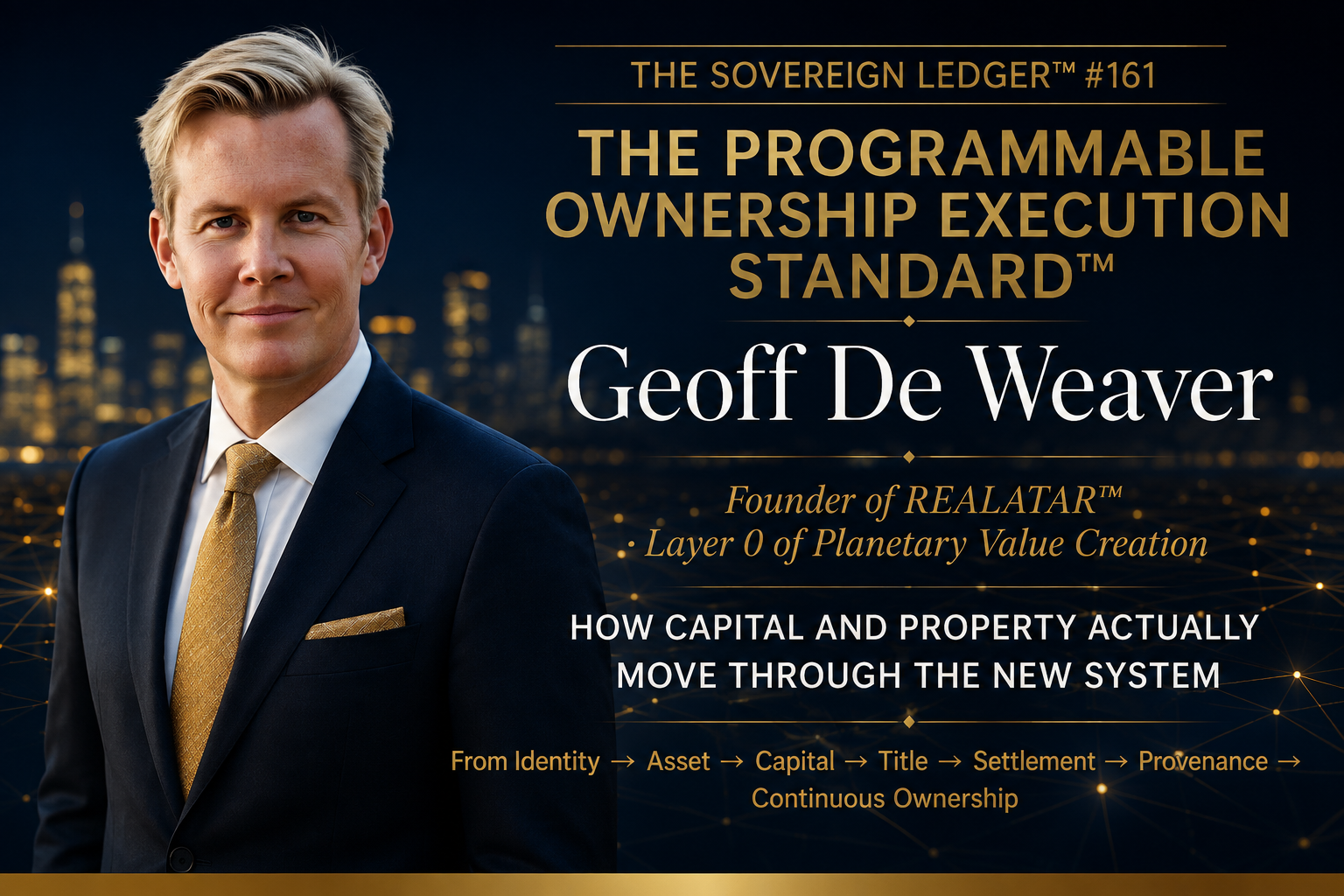
THE SOVEREIGN LEDGER™ · ENTRY #161 · SEPTEMBER 2026 · BITCOIN L1 ANCHORED · OPENTIMESTAMPS VERIFIED
THE PROGRAMMABLE OWNERSHIP EXECUTION STANDARD™
HOW CAPITAL AND PROPERTY ACTUALLY MOVE THROUGH THE NEW SYSTEM
From Identity → Asset → Capital → Title → Settlement → Provenance → Continuous Ownership
The Ownership Thesis™ Weekly Research Report
Wednesday, September 2, 2026
INTRODUCTION
For 160 entries of The Sovereign Ledger™, I have decoded one foundational truth: ownership is not the physical asset. It is the execution layer governing control, settlement and capital movement. Across fifteen years, 800+ strategic blueprints and 2.52 million authored words, my research keeps returning to the same fact — real estate, the world’s largest store of private wealth, still moves through sequential friction designed for a paper century.
Entry #160 mapped Florida 3.0 as the geographic zero-tax engine for sovereign capital allocation. Entry #161 converts that geographic blueprint into pure execution, operationalizing how capital, assets and legal rights actually move through a programmable architecture built toward T-0 settlement.
This entry is the master execution standard for my network, and it fortifies the foundation established across Reports #1 through #160. We are replacing disconnected vertical product players, manual title searches and legacy escrow gatekeepers with horizontal, interoperable liquidity rails. Programmable ownership is not an abstract technological thesis. It is an institutional-grade blueprint for buyers, sellers, family offices and developers who require absolute transaction clarity, reduced capital latency and unassailable provenance.
Most industry commentary fixates on speculative digital tokens or isolated AI algorithms. I focus exclusively on infrastructure. By establishing a continuous pipeline — Identity → Asset → Capital → Title → Settlement → Provenance → Continuous Ownership — we systematically reduce counterparty risk, compress capital idle time and improve asset legibility. Technology is the enabling mechanism. Legal property rights, sovereign identity and capital economics remain the ultimate arbiters of value.
Entry #161 provides the precise tactical workflow, bridging fifteen years of research with the physical AI infrastructure layer. We do not wait for legacy institutions to adapt. We build the verifiable execution standard that makes integration the rational choice. 🇺🇸
THE PROBLEM: REAL ESTATE STILL MOVES THROUGH A SEQUENTIAL WORLD
A modern investor can move millions between securities in seconds. An AI system can analyze extraordinary quantities of information almost instantaneously. Digital payments cross borders around the clock. Capital markets increasingly run on software.
Yet transferring ownership of a physical property can still require a chain of disconnected participants, databases, signatures, documents, wires, approvals, searches and manual reconciliations.
Seller
Agent
Broker
Attorney
Lender
Appraiser
Inspector
Title company
Escrow provider
Insurance provider
Bank
County recorder
Asset manager
Trustee
Accountant
Tax advisor
Each may perform an important function. The problem is not the people. The problem is that the system connecting them remains fragmented.
Information moves sequentially. Documents are duplicated. Identity is reverified. Data is re-entered. Capital waits. Humans reconcile databases. Counterparties repeatedly ask one another whether something happened. The transaction moves from one institutional silo to the next.
LATENCY CREATES UNCERTAINTY. UNCERTAINTY CREATES COST. COST REDUCES LIQUIDITY.
And reduced liquidity suppresses the usefulness of the largest store of private wealth on Earth.
TWO MEASUREMENTS. ONE REALITY.
My current 2026 framing places global property at approximately $625 trillion. That figure is a Statista Market Insights market-value forecast of $624.62 trillion for 2026 — a modeled projection under a broad transactional definition, not audited book value and not annual transaction volume. Savills separately measured the standing physical stock at $393.3 trillion as of the start of 2025 — residential $286.9 trillion, commercial $58.5 trillion, agricultural land $47.9 trillion. That is the figure behind the industry’s older “$400 trillion” shorthand.
Different methodologies. Different dates. Different perimeters. They are not one number that grew and must never be presented as such. But both confirm the same reality: real estate remains the world’s largest store of private wealth, and almost none of that standing stock is the annual transaction flow an ownership rail can price.
STOCK IS THE OPPORTUNITY. FLOW IS THE BUSINESS.
At that scale, even small improvements in transaction efficiency become economically significant. So the opportunity is not simply to make real estate “digital.” Much of real estate is already digital. PDFs are digital. Electronic signatures are digital. Online listings are digital. Bank portals are digital. Digital fragmentation is still fragmentation.
The real objective is far larger: turn the transaction into a coordinated ownership system. That means connecting the complete chain — Identity → Asset → Representation → Data → Due Diligence → Financing → Title → Escrow → Settlement → Provenance → Post-Transaction Ownership.
Entry #160 mapped that architecture. Entry #161 explains how it moves.
THE FIRST PRINCIPLE: PROPERTY AND CAPITAL ARE TWO DIFFERENT THINGS
To understand the future transaction, begin by separating two things legacy systems blur together. The property is the asset. Capital is the economic resource attempting to acquire, finance, develop, refinance, fractionalize, monetize or exit that asset. Between those two sits the ownership infrastructure.
CAPITAL → OWNERSHIP INFRASTRUCTURE → PROPERTY
Capital wants exposure. Property contains economic value. Ownership infrastructure determines whether the two can connect safely. Today that infrastructure includes contracts, identity verification, banking, financing, escrow, title search, insurance, legal conveyance, recording and custody. Tomorrow’s infrastructure can make far more of that system machine-readable, programmable, interoperable and continuously verifiable.
But the objective is not technology for its own sake. The objective is a materially better economic outcome for the owner. That separation of layers — legal rights, identity, capital economics and technology as distinct but interoperable systems — is the architectural position I established in Entry #146, The Ownership Thesis™ Founding Edition, and it governs everything that follows.
HOW CAPITAL AND PROPERTY ACTUALLY MOVE THROUGH THE NEW SYSTEM
Here is the simple version. Imagine a qualified buyer wants to acquire a $10 million property. Under a programmable ownership architecture, the transaction does not begin with a wire. It begins with identity and permissions.
STEP 1 — ESTABLISH THE PARTICIPANTS
Before capital moves, the system needs to know: Who is buying? Who is selling? Who is authorized to act? Is the buyer an individual, LLC, trust, partnership, fund or other legal entity? Who beneficially owns that entity? What compliance requirements apply? What jurisdiction governs the transaction?
The objective is a verified digital identity and authorization layer that can be reused appropriately rather than recreated manually at every stage.
The Benefit
The benefit is not “digital identity.” The benefit is less duplication, clearer authority, lower fraud exposure, faster compliance and fewer surprises at closing. The system knows who is permitted to do what before the transaction advances.
STEP 2 — CREATE THE ASSET’S DIGITAL IDENTITY
The property must also become machine-readable. That does not mean a digital token replaces the legal deed. It means creating a structured digital record associated with the asset, capable of referencing:
Parcel information
Legal description
Ownership history
Title records
Survey
Permits
Insurance
Valuation data
Inspections
Environmental
Liens
Financing
Operating performance
Contracts
Leases
Provenance records
Eventually, a high-value physical asset should possess something approaching a persistent digital passport — the continuous digital twin I specified in Entry #060, the Earth3 Operating System.
The Benefit
Today, information about a property is scattered across dozens of systems. A structured asset identity lets the owner and authorized counterparties work from a coherent information environment. Better information produces better decisions — and arriving earlier, it reduces expensive discoveries later.
STEP 3 — DEFINE WHAT IS ACTUALLY BEING BOUGHT
This is one of the most important steps in the entire standard. Not every “tokenized property” transaction involves direct conveyance of real property. An investor could acquire direct legal title, an LLC owning the property, shares of an SPV, a debt position secured by the property, preferred equity, a fractional economic interest, a revenue participation right, or a fund interest containing property exposure.
Those structures carry very different legal consequences. That distinction has been central to The Ownership Thesis™ from the beginning. Tokenization does not eliminate law. Tokenization of economic interests or SPV equity remains distinct from statutory real-property deed conveyance. Cryptographic evidence does not itself transfer legal ownership.
The point is commercial, not merely legal. In Entry #159 I documented the Deloitte Center for Financial Services projection that tokenized real estate reaches roughly $4 trillion by 2035, from under $0.3 trillion in 2024 — with debt and securitizations, not fractionalized buildings, as the largest projected component. The market is tokenizing the capital stack, not the bricks.
The Benefit
Clarity. Every participant knows exactly what is being acquired. Not a marketing abstraction. Not “real estate on blockchain.” A defined legal and economic interest. That reduces ambiguity and improves institutional credibility — which is precisely what unlocks institutional capital.
STEP 4 — ASSEMBLE AND VERIFY THE TRANSACTION DATA
The next layer is diligence. Traditionally, buyers, lenders, insurers, lawyers and investors perform overlapping information-gathering exercises. A better architecture creates permissioned access to verified information. AI can organize, compare, summarize and flag anomalies across large bodies of property data. Humans remain responsible wherever professional judgment, legal interpretation, fiduciary responsibility and physical inspection are required.
The objective is not removing expertise. It is eliminating needless duplication around expertise.
The Benefit
Instead of highly trained professionals spending expensive hours searching for information, they spend that time interpreting it. That means faster diligence, earlier identification of risk, better investment decisions, reduced administrative cost, greater transparency — and a stronger evidentiary record of what was known when the transaction occurred.
STEP 5 — MATCH THE PROPERTY WITH THE RIGHT CAPITAL
Now capital enters. The buyer may use cash, traditional mortgage financing, private credit, institutional debt, digital-asset-backed liquidity, fund capital, family-office capital, structured finance, SPV equity — or combinations of these.
In the legacy system, capital matching is relationship-driven and institutionally fragmented. In a programmable environment, verified asset information interacts with verified capital mandates. A lender sets predefined criteria. An investor sets return, geography, asset-class and risk parameters. A family office defines its allocation envelope. AI assists in matching eligible capital to suitable opportunities.
The Benefit
The real benefit is not an AI recommendation engine. It is capital optionality. Owners gain more potential sources of capital. Buyers gain more potential financing structures. Capital providers receive better structured information. Assets compete for capital across a broader network. Capital becomes less trapped inside local relationship silos.
STEP 6 — PROGRAM THE CONDITIONS OF THE TRANSACTION
Once the participants, asset and capital are established, the transaction itself becomes a series of conditions: identity verified, purchase agreement executed, deposit received, inspection completed, financing approved, title requirements satisfied, insurance confirmed, required disclosures accepted, legal documents approved, closing funds verified, recording package prepared.
These conditions can increasingly be represented as structured workflow states. Some can be machine-verified. Others must remain dependent on licensed professionals, legal authorities or human judgment. This is where smart contracts become valuable — not as magical replacements for law, but as execution logic.
IF condition A is satisfied
AND condition B is satisfied
AND condition C is satisfied
THEN the next authorized action can occur.
The Benefit
The buyer no longer needs to wonder what everyone is waiting for. The seller no longer needs to wonder whether the money has arrived. The family office no longer needs five people emailing one another for transaction status. Authorized participants see the transaction state. Transparency replaces chasing.
STEP 7 — MOVE CAPITAL INTO A CONTROLLED SETTLEMENT ENVIRONMENT
Now the most misunderstood component: escrow. It exists because buyer and seller face counterparty risk. The buyer does not want funds released without valid conveyance. The seller does not want ownership transferred without payment. So a trusted mechanism sits between them.
The future does not eliminate that underlying economic requirement. It makes its execution more precise. Funds can be verified. Transfer conditions can be established. Authority can be confirmed. Release instructions can become machine-readable. The system can coordinate the moment at which required conditions are satisfied.
The Benefit
Capital spends less time sitting idle. Participants have better visibility. Wire instructions face stronger verification procedures. Administrative handoffs decrease. And eventually, where the legal and payment infrastructure permits, settlement can approach atomic execution.
STEP 8 — COORDINATE TITLE AND PAYMENT
This is where the architecture becomes transformative. Traditional settlement is sequential. Money moves. Someone confirms it. Documents move. Someone verifies them. Recording occurs. Someone waits for confirmation. Balances are reconciled.
The programmable objective is simultaneous or near-simultaneous execution.
VALUE MOVES WHEN OWNERSHIP IS READY TO MOVE. OWNERSHIP MOVES WHEN VALUE IS READY TO MOVE.
That is the underlying principle of atomic settlement. I have described the long-term objective throughout The Sovereign Ledger™ as T-0 settlement. But precision matters. True T-0 real-estate settlement requires compliant interoperability between identity, banking and payment systems, contracts, escrow, title, legal conveyance, recording and regulatory frameworks. T-0 is an objective, not a current condition.
REALATAR™ is therefore not built on pretending those dependencies do not exist. It is built to connect them.
The Benefit
Settlement risk lives in the gap between obligations. Compress the gap and you compress counterparty exposure, capital idle time, administrative latency, wire-risk windows, failed handoffs and human reconciliation. The goal is not merely a faster close. It is a safer, more observable and more capital-efficient close.
WHAT THIS LOOKS LIKE ON A $10 MILLION TRANSACTION
Take the $10 million buyer introduced earlier. The owner does not need “blockchain.” They need transaction states they can see and understand: identity locked, deposit verified, diligence packet permissioned, title exceptions listed, funds in controlled escrow, every closing condition clearly green or red.
When every required condition is satisfied, value and the defined legal interest release in a coordinated transaction — followed by the licensed closer recording the conveyance in the jurisdiction that still governs the deed. Bitcoin anchoring timestamps and strengthens the provenance of the transaction packet. It does not become the deed, replace statutory title, or convey the property.
That distinction protects the architecture’s credibility. The breakthrough is not technology. It is control.
YOU STOP CHASING THE CLOSE. THE CLOSE REPORTS TO YOU.
STEP 9 — CREATE PERMANENT PROVENANCE
After a transaction completes, one of the most valuable assets is evidence. What documents existed? Which versions? When were they executed? What data existed at the time? Which party authorized which action? What ownership state preceded the current one?
A cryptographic hash creates a unique fingerprint of a digital file. That fingerprint can be timestamped against a highly durable public network such as Bitcoin through technologies including OpenTimestamps, providing independently verifiable evidence that particular digital information existed at or before a particular time. This is the same mechanism that anchors every entry of The Sovereign Ledger™, including this one.
But again: evidence of a deed is not the deed. Proof that data existed does not independently create legal ownership.
The Benefit
Provenance strengthens confidence. Instead of depending entirely on somebody saying “trust our database,” evidence can increasingly be independently verified. That creates a stronger historical record for owners, lenders, insurers, auditors, heirs and future counterparties.
STEP 10 — THE TRANSACTION DOES NOT END AT CLOSING
This may be the greatest conceptual change of all. The legacy industry views the close as the finish line. I view it as the beginning of the ownership lifecycle.
After acquisition, the asset keeps generating information. Value, income, expenses, insurance, taxes and financing all change. Maintenance and capital improvements occur. Ownership entities, beneficiaries and regulations change.
The owner may refinance, sell, fractionalize an economic interest, use the asset as collateral, transfer it into an estate structure, distribute income or reallocate ownership. The asset therefore needs continuous ownership infrastructure.
The Benefit
Instead of rebuilding the entire transaction record every time something happens, the property maintains an evolving, permissioned ownership history. That makes future financing, diligence, transfer and succession more efficient. The property is no longer simply owned.
IT BECOMES CONTINUOUSLY LEGIBLE TO CAPITAL.
FROM FEATURES TO BENEFITS: WHY SHOULD ANYONE CARE?
This is the question technology builders forget. Nobody wakes up wanting tokenization. Nobody dreams about APIs. Nobody buys a home because the escrow workflow has better cryptography. People want outcomes. So let us translate the system into human terms.
FOR PROPERTY OWNERS
More control. Know who has your information. Know what you are paying. Know where the transaction stands. Maintain better historical records. Access more potential sources of liquidity. Reduce avoidable friction. Protect long-term provenance. Make future financing and transfer easier. Your property stops being a static object sitting inside disconnected databases and becomes an increasingly intelligent capital asset.
FOR BUYERS
Greater confidence and faster decision-making. Better organized diligence. More transparent transaction status. Clearer ownership structure. More financing optionality. Reduced duplication. Better provenance. Fewer avoidable surprises between contract and closing.
FOR SELLERS
Reduce friction between your asset and global demand. Prepare the asset’s information before the buyer arrives. Create stronger evidence. Reduce diligence delays. Make the asset easier for qualified capital to understand. Expose the opportunity to a broader verified network. Shorten the capital-recycling cycle.
FOR FAMILY OFFICES
Family offices do not merely buy property. They coordinate legal entities, tax, estate planning, insurance, debt, cash, operating companies, private investments, beneficiaries, governance, cybersecurity and succession. A programmable ownership architecture gives them something invaluable: a coherent view of the asset inside the family’s entire capital system.
That is why Entry #160 argued that luxury real estate can no longer be treated as an isolated transaction. It must integrate into the broader wealth stack — the seven-layer structure I set out in Florida 3.0 Sovereign Signal Issue #005, The Wealth Stack.
FOR DEVELOPERS
Broader capital discovery. More structured investor reporting. Programmable distributions where legally appropriate. Potential fractional investment structures. Better asset provenance. Faster capital recycling. More transparent ownership administration. A development stops being viewed only as a building. It becomes an investable, financeable, data-rich capital node.
FOR INVESTORS
Greater transparency. Lower minimum exposure where fractional structures are legally appropriate. More efficient administration. Potential secondary liquidity. Automated distributions. Continuous asset information. Stronger provenance. Easier portfolio construction. Real estate begins moving closer to the information standards investors already expect from modern capital markets.
FOR ELITE BROKERS, LAWYERS, ACCOUNTANTS AND ADVISORS
This architecture should not be misunderstood as a declaration of war against expertise. Quite the opposite. The future should reward valuable expertise more highly while automating low-value administrative friction.
A world-class attorney should spend less time chasing documents and more time protecting the client. A great broker should spend less time performing clerical coordination and more time creating markets, negotiating and advising. A family-office professional should spend less time reconciling siloed information and more time allocating capital.
AUTOMATION SHOULD ELIMINATE LOW-VALUE LABOR, NOT HIGH-VALUE JUDGMENT.
THE #161 STARTING PLAN: HOW ANYONE CAN BEGIN
You do not need to wait for the entire future financial system to arrive. You can begin thinking like a programmable owner now. Here is the practical starting sequence I would give anyone in my global network.
1. DEFINE WHAT YOU OWN
List your meaningful assets. Real estate. Business interests. Investment entities. Digital assets. Intellectual property. Private-company interests. Do not start with technology. Start with ownership.
2. DEFINE HOW EACH ASSET IS OWNED
For every major asset, ask: Is it owned personally? Through an LLC? Trust? Partnership? Corporation? Fund? SPV? Joint ownership? Then identify who actually possesses authority. You cannot program ownership you do not understand.
3. ORGANIZE YOUR EVIDENCE
Gather the critical documents for each major property or investment. Deeds. Entity documents. Surveys. Insurance. Financing. Material contracts. Tax records. Inspection information. Major improvements. Relevant legal agreements. The immediate benefit is simple: you become transaction-ready before you need a transaction.
4. IDENTIFY THE FRICTION
Ask: Where am I repeatedly paying intermediaries? Where is information duplicated? Where am I waiting? Where is ownership unclear? Where is capital trapped? Where do I lack transparency? Where am I relying on one provider unnecessarily? Where would losing access to a database create problems? That is your friction map.
5. CREATE AN ASSET DATA ROOM
For significant assets, establish a secure, well-organized digital environment for relevant information. Control permissions carefully. Organize logically. Maintain version history. Record what changes. The goal is not storage. The goal is transaction readiness.
6. VERIFY YOUR PROFESSIONAL ARCHITECTURE
Identify the people whose judgment actually protects you. Legal. Tax. Estate. Insurance. Finance. Real estate. Cybersecurity. Investment. Ask what each participant contributes. Keep expertise. Eliminate unexplained duplication.
7. EXPLORE YOUR CAPITAL OPTIONALITY
If you own valuable property, do not think in binary terms — sell or don’t sell. Ask instead: Can I refinance? Can I restructure? Can I access private credit? Can I change entity ownership? Can I monetize part of the economics? Can I improve yield? Can I reduce capital drag? Can I redeploy capital more intelligently? Sophisticated ownership creates options. Options create resilience.
8. LEARN TOKENIZATION WITHOUT BELIEVING THE HYPE
Understand what is actually being tokenized. The deed? SPV equity? Debt? Revenue? Fund interests? Economic participation? Demand legal specificity. A token is a representation. The rights behind the representation are what matter.
9. DEMAND VERIFIABILITY
Where possible, ask for stronger evidence. Who signed? What version? When? Who changed it? What authority did they possess? Can the record be independently checked? The future belongs to systems where critical assertions become verifiable facts.
10. THINK BEYOND THE CLOSE
Before buying an asset, ask: How will I eventually finance it? Transfer it? Sell it? Place it into an estate? Share economics? Prove its provenance? Hand it to the next generation? The best time to design the exit architecture is before entry.
THE 1.55 BILLION+ NETWORK EFFECT
This is where my infrastructure thesis becomes decisive. Technology without distribution rarely becomes a standard. Distribution without infrastructure becomes media. The opportunity is the convergence of the two.
My 1.55B+ global network is a cumulative multi-platform reach figure, not a subscriber list. Its value is not audience size. It is the ability to connect owners, capital, developers, advisors, entrepreneurs, family offices, technology companies, institutions, buyers, sellers — and eventually autonomous execution agents.
The economic opportunity does not come from convincing 1.55 billion people to buy tokenized real estate. That would misunderstand the architecture. It comes from building rails that let even a tiny fraction of global participants discover, verify, finance, transact and manage ownership more efficiently.
THE RAIL DOES NOT NEED TO OWN EVERY ASSET. THE RAIL NEEDS TO MAKE MOVEMENT ACROSS THE ASSET CLASS BETTER.
REALATAR™: THE EXECUTION LAYER
The Sovereign Ledger™ researches the architecture. The Ownership Thesis™ explains why ownership infrastructure is changing. REALATAR™ is the execution direction.
Its purpose is not to pretend one application can replace property law, banks, governments, licensed advisors or capital markets. Its more ambitious objective is interoperability: connect identity, asset data, qualified counterparties, capital, contracts, title, compliant tokenized structures, settlement, provenance and post-transaction ownership intelligence.
That is why I describe REALATAR™ as horizontal infrastructure. The enduring opportunity is not another vertical application sitting on top of the same fragmented rails. It is improving the rails themselves. And as I argued in Entry #158, The Model-Agnostic Sovereign Option™, the rail must remain independent of any single model provider — because models are replaced and rails compound.
THE BRIDGE FROM #1 TO #160
Entry #161 does not begin a new idea. It operationalizes one developed across the entire Ledger. The earliest entries diagnosed friction. The middle architecture explored blockchain, AI, liquidity and tokenization. The later Ledger moved from technology toward institutional design.
#146 — The Ownership Thesis™ Founding Edition established that ownership is deeper than possession. #147 — Every Asset Eventually Becomes Software stated the second principle: what can be programmed will be. #148 argued ownership infrastructure will create more wealth than AI alone; #149 codified twenty infrastructure principles behind REALATAR™.
#150 — Own Yourself™ established Layer 0: the owner precedes the owned. #152 — The NYC Wealth Migration Report documented where capital was actually moving, and #153 — The Institutional Playbook for the AI Economy™ connected compute, energy and data centers to programmable ownership.
Then came the constitutional trilogy. #154 — The Sovereign Institution™ asked what survives technology cycles. #155 — Culture Is Infrastructure™ reminded us that systems ultimately require trusted human behavior. #156 — Own the Rails, Not the Model separated permanent infrastructure from temporary AI models. #157 connected architecture to capital formation.
#159 — The Tokenized Real Estate Capital Stack connected the thesis directly to LP/GP structures, SPVs, equity, debt, distributions and institutional real-world assets. #160 — Florida 3.0 then placed the architecture geographically: Florida is where the stack becomes geography.
Entry #161 completes the next transition. The Programmable Ownership Execution Standard™ is where geography becomes transaction. The complete index of all 161 entries is permanently maintained at The Sovereign Ledger™.
#160 ANSWERED: WHERE CAN THE NEW CAPITAL ARCHITECTURE EMERGE?
#161 ANSWERS: HOW DOES OWNERSHIP ACTUALLY MOVE THROUGH IT?
And that prepares the next stage. Because capital cannot move through an AI economy without physical infrastructure. Compute requires electricity. Electricity requires generation and transmission. Data centers require land. Land requires ownership. Ownership requires capital. Capital requires trust. Trust requires identity and evidence. And increasingly, all of it requires machine-readable infrastructure. That takes us directly toward #162.
FROM PROPERTY TO THE PHYSICAL AI ECONOMY
This is why #161 matters far beyond residential real estate. Once a property asset can be made identifiable, verifiable, financeable, programmable and transferable, the same architecture applies to every other real asset: data centers, industrial facilities, energy infrastructure, logistics, land, compute campuses, transmission-linked property, AI factories.
The next generation of artificial intelligence is not simply software. As Entry #160 argued, AI has a physical stack:
LAND → ELECTRICITY → COOLING → FIBER → ACCELERATED COMPUTE → NETWORKING → GPUs → DATA → CAPITAL → SECURITY → PERMITTING → TIME
Every one of those physical layers ultimately intersects ownership. That is why real estate is not peripheral to the AI revolution. Real assets are becoming the physical foundation beneath machine intelligence. And the institutions that understand how ownership, capital and infrastructure connect will hold an extraordinary strategic advantage.
SUMMARY
The future of institutional real estate is not defined by superficial technological upgrades, crypto gimmicks or isolated software applications. It is driven by the structural reality of programmable ownership. Across 161 entries of The Sovereign Ledger™, I have built the framework converting fragmented, high-friction property transfers into continuous, capital-efficient liquidity rails. Legacy settlement locks capital in latency, exposes owners to counterparty risk and forces reliance on disconnected databases. Entry #161 operationalizes the fix.
This report provides the ten-step execution standard governing how capital and physical property interact. By treating identity, asset data, legal conveyance, financing and settlement as interoperable layers, we replace operational friction with machine-readable verification. The asset owner becomes the sovereign center of the ecosystem, and advisers, attorneys and elite brokers are elevated from document gatherers into strategic allocators.
This standard extends far beyond residential or commercial real estate. As machine intelligence accelerates, the digital economy requires an immense physical footprint. Data centers, energy facilities, fiber networks and compute campuses all require secure, programmable land ownership. Entry #161 creates the transaction architecture that lets institutional capital fund, settle and manage those nodes as settlement compresses toward T-0.
The Complete Execution Sequence
VERIFY THE PERSON → IDENTIFY THE ASSET → DEFINE THE LEGAL AND ECONOMIC RIGHTS → ORGANIZE THE DATA → VERIFY THE ASSET → MATCH THE CAPITAL → PROGRAM THE CONDITIONS → COORDINATE ESCROW AND TITLE → MOVE CAPITAL AND OWNERSHIP → CREATE PERMANENT PROVENANCE → MANAGE OWNERSHIP CONTINUOUSLY
By deploying this protocol through my global network and REALATAR™, we are building the execution layer for global property transaction flow. The legacy closing table is finished. Continuous, programmable ownership is the standard. 🇺🇸
WHAT THIS ENTRY DOES NOT CLAIM
Precision separates an institutional standard from a marketing claim, so I state the boundaries explicitly. Tokenization is not statutory title. Bitcoin anchoring is not legal conveyance — it evidences that specified data existed at or before a particular time, and nothing more. Smart contracts are execution logic, not legal authority. T-0 settlement is an objective, not a current condition.
None of this weakens the thesis. It is the thesis. Infrastructure that overstates its legal standing does not survive institutional diligence.
MY BOTTOMLINE
For over a century, the global real estate market has been constrained by a paradigm that treats the closing table as the core of the transaction. That architecture is obsolete. The owner must be the sovereign center of the asset stack. Every layer of technology, law, identity and finance must serve to protect that owner, maximize capital efficiency and deliver unassailable evidentiary provenance.
True sovereignty does not mean abandoning legal frameworks or replacing institutional expertise. It means exercising absolute informed control over your assets while using interoperable, machine-readable rails.
Entry #160 mapped the geographical deployment layer in Florida 3.0. Entry #161 delivers the transactional execution engine: Identity → Asset → Capital → Title → Settlement → Provenance → Continuous Ownership.
Now the mandate expands directly into the physical infrastructure of the machine intelligence economy. Software cannot exist without hardware, and AI cannot function without physical land, power and compute nodes. The strategic assets of the next century are clear: Energy, Compute and Land. That is the foundation of Entry #162. We have designed the rails, we hold the standard, and we are executing the blueprint. 🇺🇸
OBSERVE. THINK. PROVE. BUILD.
OWNERSHIP CHANGES EVERYTHING™
THE SOVEREIGN LEDGER™ — ENTRY #161
SOURCE NOTES & METHODOLOGY
Measured: the Savills standing-stock valuation of $393.3 trillion at the start of 2025 and its residential, commercial and agricultural components.
Projected: the Statista Market Insights 2026 figure of $624.62 trillion and the Deloitte forecast of roughly $4 trillion of tokenized real estate by 2035. Both are modeled forecasts under stated assumptions, not measurements.
Methodology distinction: Savills measures standing physical stock at a fixed date; Statista projects 2026 market value under a broader transactional definition. Different methods, dates and perimeters — not interchangeable, not directly comparable.
My strategic interpretations: The Programmable Ownership Execution Standard™, the ten-step sequence, the stock-versus-flow framing, the horizontal-rails thesis and the continuous-ownership model. My analytical positions, offered for inspection and debate.
Network figure: 1.55B+ represents cumulative multi-platform reach across a four-decade career — not a subscriber count or an addressable market.
SOURCES, REFERENCES & INSTITUTIONS CITED
Institutional research and industry sources — independent research, market intelligence, economic analysis and publicly available data referenced throughout Entry #161:
Statista Market Insights — statista.com
Savills World Research — impacts.savills.com
Deloitte Center for Financial Services — deloitte.com
Bitcoin Protocol — bitcoin.org
OpenTimestamps — opentimestamps.org
Proprietary intellectual property and frameworks — independently developed by Geoff De Weaver, Limitless USA LLC and the REALATAR™ ecosystem:
REALATAR™ — geoffdeweaver.com/realatar/
The Ownership Thesis™ — geoffdeweaver.com/ownership-infrastructure/
Limitless USA LLC — geoffdeweaver.com
The Sovereign Ledger™ Complete Index (161 entries, 2.52M+ verified words, Bitcoin-anchored) — geoffdeweaver.com/the-sovereign-ledger/
Sovereign Ledger™ entries cross-referenced in Entry #161: #060 · #146 · #147 · #148 · #149 · #150 · #152 · #153 · #154 · #155 · #156 · #157 · #158 · #159 · #160
ABOUT THE AUTHOR
Creator of The Ownership Thesis™ | Founder, REALATAR™ | Building Ownership Infrastructure for the $625T Global Real Estate Market | Web1 → Web∞ | Four Eras. One Operator. | AI • Web3 • Tokenization 🇺🇸
Geoff De Weaver is Founder & CEO of Limitless USA LLC, creator of REALATAR™, author of The Ownership Thesis™, and architect of a Bitcoin-anchored research corpus comprising more than 2.52 million verified words and 800+ strategic blueprints exploring the future of ownership, capital markets, AI, blockchain and the global real estate market. His work spans four decades across every major U.S. and APAC financial and advertising center — a limitless, evolving primary source for institutional capital.
Four decades. Four Big Four holding companies. One firm since 2010. The full record — including a verified patrilineal line to four U.S. Presidents — is here: geoffdeweaver.com/about-geoff-de-weaver/
Research Methodology. The Ownership Thesis™ synthesizes independent institutional research, proprietary strategic frameworks, historical analysis and four decades of executive operating experience across global advertising, the commercial Internet, digital transformation, artificial intelligence and ownership infrastructure, alongside original strategic research developed by Geoff De Weaver and Limitless USA LLC.
⛓ Sovereign Proof & Verification
Permanently anchored to the Bitcoin blockchain via OpenTimestamps. The fingerprint below is immutable, independently verifiable by anyone, anywhere, and cannot be back-dated or altered — not even by me.
Fingerprint:
The Sovereign Ledger™ | Entry 161 | The Programmable Ownership Execution Standard™ | Geoff De Weaver | Limitless USA LLC | 2026-09-02
SHA-256:
116d1140630e16891d2860f6ded62d0b04b94a98bd469f4dbbd27ab0af626eb0
Proof File: entry-161-programmable-ownership-execution-standard.txt.ots
Anchored: Bitcoin L1 · Attestations confirmed September 3, 2026
Verify instantly: opentimestamps.org
MODELS EVOLVE · INFRASTRUCTURE COMPOUNDS · OWNERSHIP ENDURES
GEOFF DE WEAVER | REALATAR™ | LIMITLESS USA LLC
“Claims invite debate. Artifacts invite inspection.”
#GeoffDeWeaver #REALATAR #LimitlessUSALLC #Limitless155B #OwnershipInfrastructure #ProgrammableOwnership #ArtificialIntelligence #FutureOfRealEstate #Tokenization #InstitutionalInvesting #VentureCapital #Florida #Web3 #WealthManagement #GlobalLiquidity #FirstPrinciples