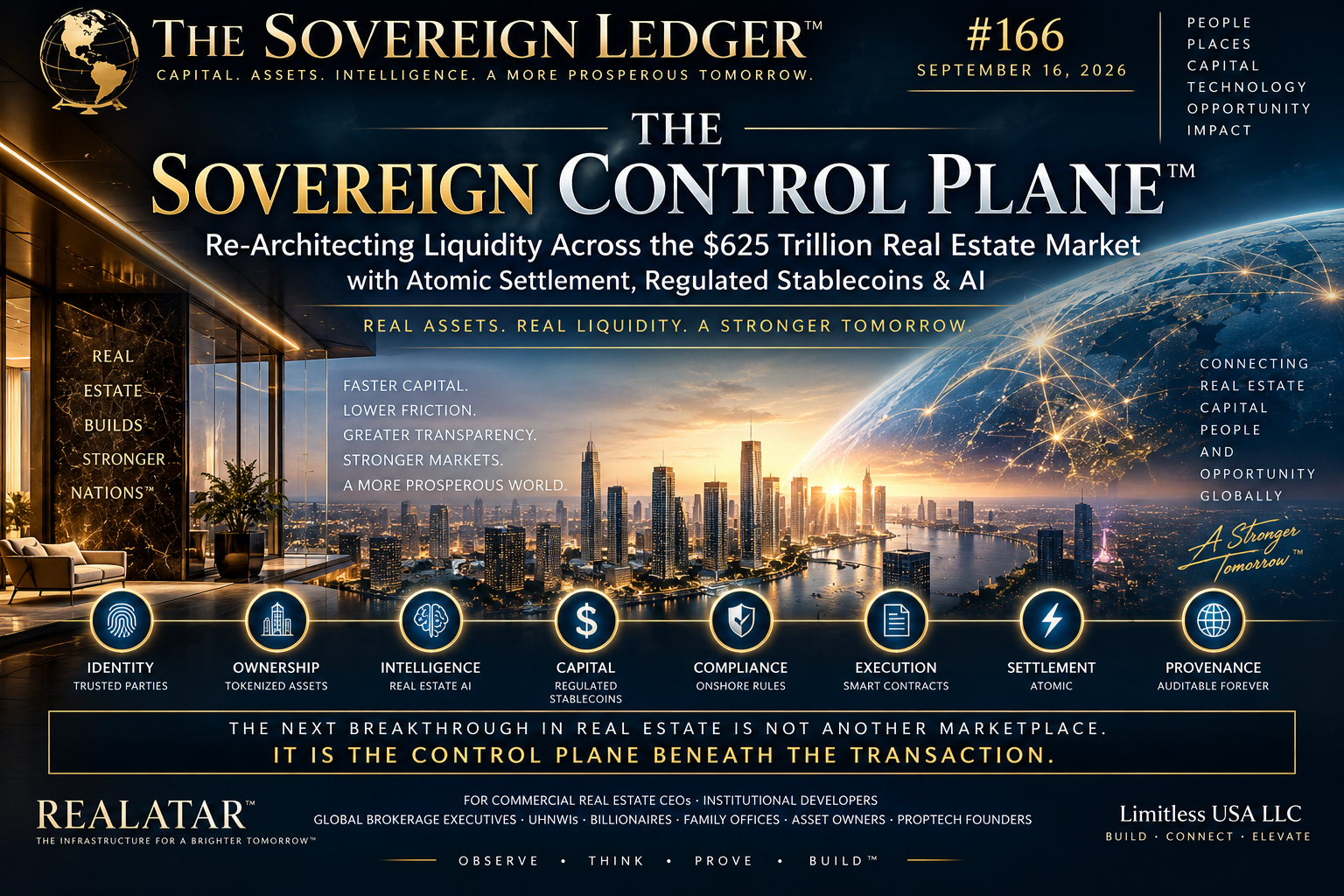
The Sovereign Ledger™ · Entry #166 · September 2026
The Sovereign Control Plane™: Unlocking $625T in Real Estate via Atomic Settlement, Regulated Stablecoins and AI
Sovereignty, Decentralization, AI, Crypto and the Re-Architecture of the $625 Trillion Real Estate System — why the next financial system must be faster, more transparent and more programmable, while keeping the human in control.
Written for commercial real estate CEOs, institutional developers, global brokerage executives and PropTech founders.
Executive Thesis: The Architecture of Re-Architecture
The most important question facing the next financial system is not whether artificial intelligence becomes more powerful. It will.
It is not whether crypto, blockchain and tokenized assets continue entering institutional finance. They are.
It is not whether stablecoins become increasingly important to payments, settlement, global dollar distribution and U.S. Treasury markets. That process is already underway.
And it is not whether the world’s largest asset class — real estate, forecast at roughly $625 trillion of market value in 2026 — will eventually become more programmable, interoperable and digitally financed. It will.
The defining question is more fundamental:
WHO RETAINS SOVEREIGN AUTHORITY WHEN INTELLIGENCE, MONEY, OWNERSHIP AND EXECUTION BECOME SOFTWARE?
That question connects five forces that are too often discussed separately:
SOVEREIGNTY · DECENTRALIZATION · REAL ESTATE · CRYPTO · ARTIFICIAL INTELLIGENCE
Together they describe the architecture of the next ownership economy.
For decades, financial systems — and global real estate above all — accumulated layers: intermediaries, databases, custodians, paperwork, reconciliation, settlement delays, title delays, institutional silos, proprietary systems, opaque handoffs and centralized gates. Many of those layers perform legitimate functions. Others exist because the architecture underneath them was built for an earlier technological age.
The opportunity is therefore not to destroy institutions. It is to distinguish what produces trust, expertise and accountability from what merely produces friction, opacity and rent extraction.
The objective is not “no intermediaries” as an ideological slogan. It is:
FEWER UNNECESSARY INTERMEDIARIES · FEWER OPAQUE HANDOFFS · FEWER SINGLE POINTS OF CONTROL · FASTER VERIFICATION · CLEARER ACCOUNTABILITY · PROGRAMMABLE COMPLIANCE · OWNER-FIRST ARCHITECTURE
And critically:
NO SINGLE GATEKEEPER SHOULD BECOME SOVEREIGN OVER THE OWNER.
Sovereignty is not isolation; it is retained authority. It requires agency, integrity, correspondence to reality and, critically, the power of interruption. When a mechanism begins governing the owner it was built to serve, nominal ownership remains — but practical sovereignty is lost.
This is where REALATAR™, The Sovereign Ledger™, Limitless USA LLC and the broader research I publish at The Sovereign Ledger™ archive converge.
The work is not fundamentally another property portal, another crypto project, another AI chatbot, another blockchain, another stablecoin or another brokerage technology layer. It is about constructing an ownership architecture in which technology serves the owner rather than quietly replacing the owner’s authority.
AI can increase intelligence. Blockchain can increase verifiability. Crypto can create digitally native property rights and economic instruments. Stablecoins can create programmable dollar settlement. Tokenization can make assets more programmable. But none of those advances automatically creates sovereignty.
SOVEREIGNTY MUST BE DESIGNED INTO THE ARCHITECTURE.
Key blueprint references
The Sovereign Ledger™ archive root: geoffdeweaver.com/the-sovereign-ledger/ · REALATAR™ ownership stack: geoffdeweaver.com/realatar/ · The Ownership Thesis™ series: geoffdeweaver.com/ownership-infrastructure/ · Companion execution standard, Entry #161: The Programmable Ownership Execution Standard™
The $625T Question in Numbers
Before architecture, evidence. Every figure below is dated, sourced and labeled by type, because a forecast is not a measurement and a policy model is not a market outcome. Different firms use different definitions — some count stablecoins and tokenized deposits as “tokenized assets,” others deliberately exclude them — so these numbers must never be added together.
Worldwide real estate market value, 2026 ($624.62T).
Statista Market Insights, Real Estate – Worldwide. Modeled estimate, not audited book value or transaction volume.
Tokenized real estate, up from less than $0.3T in 2024 (27% CAGR).
Deloitte Center for Financial Services, April 2025.
Tokenized assets, from $0.6T in 2025 — this definition includes stablecoins and tokenized deposits.
BCG with Ripple, April 2025.
Tokenized market capitalization, base case — excluding stablecoins, deposits and CBDCs. McKinsey expects real estate to adopt more slowly than funds, bonds and loans.
McKinsey & Company, 2024.
Total stablecoin market capitalization on September 10, 2026, below a roughly $322B peak in May 2026.
Stablecoin Beat daily tracker.
Cumulative transactions on J.P. Morgan’s Kinexys since inception, averaging about $7B per day.
J.P. Morgan Payments, August 2026.
Agentic-AI-driven spending — more than 26% of worldwide IT spend — with 1B+ agents executing roughly 217B actions a day.
IDC, 2025–2026.
Share of agentic AI projects Gartner predicts will be canceled by end-2027 over cost, unclear value or inadequate risk controls.
Gartner press release, June 25, 2025.
AI decision-makers reporting an EBITDA lift in the prior 12 months; Forrester predicts enterprises will defer 25% of planned 2026 AI spend into 2027.
Forrester, Predictions 2026.
EBITDA improvement Bain reports among AI leaders that scaled AI across core workflows.
Bain & Company, Technology Report 2025.
Added bank lending the White House Council of Economic Advisers models from banning stablecoin yield, at an $800M net welfare cost.
White House CEA, April 2026. Disputed by bank trade groups.
Cumulative rise in trading of tokenized U.S. properties in the two days after natural disasters — dependent on platform buyback features that add solvency risk.
BIS Working Paper No 1311 (author’s views), November 2025.
My interpretation: the capital is moving, the rails are live at bank scale, and the regulators are writing the rulebook — yet the AI evidence says most organizations have not converted capability into governed value. For real estate leaders without deep Web3, AI, crypto and global-settlement expertise, the risk is not missing a trend. It is buying tools without owning the control plane.
I. Sovereignty: From Philosophy to System Design
Sovereignty, in its fullest sense, is the legitimate authority and practical capacity of a conscious person to govern himself or herself, preserve integrity, exercise judgment, make meaningful choices within reality and remain accountable for the consequences of those choices without having those essential functions silently usurped by an external mechanism.
Sovereignty is frequently confused with independence. They are not the same. Nothing important exists completely independently. People depend on families. Families depend on communities. Businesses depend on markets. Markets depend on institutions. Institutions depend on law. Capital depends on confidence. Technology depends on infrastructure.
A sovereign person can cooperate. A sovereign owner can borrow. A sovereign company can enter contracts. A sovereign investor can employ specialists. A sovereign institution can use software. A sovereign transaction can comply with regulation.
Dependence becomes a sovereignty problem only when legitimate relationships become structural subordination.
SOVEREIGNTY IS NOT ISOLATION.
SOVEREIGNTY IS RETAINED AUTHORITY.
That retained authority requires six things.
- Integrity — the boundary and identity of the whole must remain intact.
- Agency — the person must retain the capacity to choose and act.
- Judgment — the person must be able to evaluate context, alternatives, meaning and consequences.
- Responsibility — authority must remain connected to accountability.
- Correspondence — meaningful judgment requires meaningful access to reality.
- Reversibility — a sovereign actor must retain the practical ability to say no, stop, withdraw, reconsider, change course, revoke access, move an asset, change providers, replace a model and interrupt automation.
This produces one of the most important principles in the architecture:
SOVEREIGNTY REQUIRES THE POWER OF INTERRUPTION.
If a system supposedly serves an owner but the owner cannot meaningfully interrupt it, the relationship has changed. Nominal ownership may remain. Practical sovereignty has not.
II. When the Mechanism Begins Governing the Owner
Every tool begins by solving a problem. The database remembers. The broker connects. The bank settles. The custodian safeguards. The platform distributes. The government records. The algorithm recommends. The AI reasons.
But systems compound. Functions expand. Dependencies deepen. And eventually the architecture can invert.
THE MECHANISM BEGINS TO GOVERN THE BEING IT WAS CREATED TO SERVE.
The bureaucracy substitutes procedure for human judgment. The corporation substitutes institutional optimization for individual objectives. The platform begins owning the customer relationship. The algorithm converts judgment into optimization. The database becomes the only permitted version of reality. The financial intermediary becomes the gate through which ownership must pass. The AI begins deciding because allowing it to decide becomes more convenient than continuously exercising judgment.
This is particularly important in an era of autonomous AI agents. Delegation is not surrender.
A person can ask AI to analyze 10,000 properties without allowing the model to determine what the person ought ultimately to value. A family office can deploy AI across a portfolio without surrendering final capital-allocation authority. A seller can automate global distribution without relinquishing authority to accept an offer. A platform can automate compliance without erasing institutional accountability. A transaction can become programmable without becoming ungovernable.
AUTOMATE THE FUNCTION.
DO NOT SURRENDER THE SOVEREIGNTY.
The calculator may calculate. The model may model. The agent may search. The smart contract may execute. The blockchain may verify. The stablecoin may settle. But ultimate authority must remain explicitly assigned.
III. Decentralization: Distribute Verification, Not Responsibility
Decentralization does not mean disorder. It does not mean eliminating institutions. It does not automatically mean deregulation. It certainly does not mean placing every piece of information on a public blockchain.
Decentralization means reducing unnecessary concentrations of control and designing systems capable of functioning when one database, institution, technology provider, AI model or intermediary changes.
A sovereign architecture can simultaneously contain centralized services, distributed verification, regulated institutions, permissioned networks, public cryptographic proofs, private information, open standards, specialist execution and owner-controlled authority.
The real question is therefore not “centralized or decentralized?” The better question is:
WHAT MUST BE CENTRALIZED FOR TRUST, WHAT SHOULD BE DISTRIBUTED FOR RESILIENCE, AND WHAT MUST REMAIN UNDER THE OWNER’S CONTROL?
That is the architecture I am building REALATAR™ to pursue. Not ideological decentralization, but sovereign decentralization: distributed verification where useful, specialized institutional accountability where necessary, open architecture where advantageous, privacy where required and human control where sovereignty is at stake.
IV. Crypto Must Evolve From Speculation Into Infrastructure
Crypto is often discussed as though it were one asset class. It is not.
Bitcoin is different from a dollar-backed payment stablecoin. A stablecoin is different from a tokenized Treasury security. A token representing an interest in real estate is different from a governance token. A decentralized protocol is different from a centralized exchange. A tokenized security does not stop being subject to securities law merely because its ownership record exists on a blockchain.
This distinction matters enormously. The next phase of crypto should be understood less as one speculative marketplace and more as a collection of emerging financial technologies:
DIGITAL SCARCITY · DIGITAL MONEY · DIGITAL SECURITIES · DIGITAL COMMODITIES · DIGITAL IDENTITY · TOKENIZED REAL-WORLD ASSETS · PROGRAMMABLE SETTLEMENT · DECENTRALIZED NETWORKS · CRYPTOGRAPHIC PROVENANCE
The importance of crypto moving forward is not simply that token prices may rise or fall. Its deeper importance is architectural. Crypto introduces the possibility that economic rights can become digitally native, globally transferable, cryptographically verifiable, programmable, interoperable and increasingly capable of settling against programmable money.
That is fundamentally different from simply digitizing the interface of the existing financial system. Online banking digitized access to the bank. Crypto can potentially change the underlying architecture of the record itself. That distinction is profound.
V. GENIUS + CLARITY: Two Different Layers of the Stack
The United States is attempting to establish a clearer statutory architecture around digital assets. Two legislative frameworks are especially important — the GENIUS Act and the Digital Asset Market Clarity Act — but they perform very different functions.
GENIUS ADDRESSES PAYMENT STABLECOINS.
CLARITY SEEKS TO ADDRESS THE BROADER MARKET STRUCTURE FOR DIGITAL ASSETS.
The GENIUS Act became law on July 18, 2025. It established the first federal statutory framework specifically for payment stablecoins. Permitted issuers must maintain reserves on at least a one-to-one basis, limited to specified assets including U.S. dollars, qualifying deposits, Treasury bills with 93 days or less to maturity, Treasury-backed repurchase agreements and government money market funds. The framework also contains reserve-disclosure, licensing, supervisory, anti-money-laundering and sanctions requirements — and it prohibits issuers themselves from paying interest or yield to holders.
Implementation is now in the rulemaking phase. The OCC proposed rules for OCC-licensed issuers in February 2026 and the FDIC followed in April. On August 17, 2026, Treasury issued a proposed rule defining when a payment stablecoin is issued, offered or sold in the United States. Beginning on the expected effective date of January 18, 2027, a person generally may not issue a payment stablecoin in the United States without an appropriate federal or state license; from July 18, 2028, digital asset service providers generally may not offer stablecoins to U.S. persons unless issued by a permitted issuer.
The CLARITY Act operates at another level. Its objective is broader digital-asset market structure: clarifying the regulatory treatment of digital commodities, defining regulatory responsibilities, establishing registration pathways and addressing the long-standing division of responsibilities between the SEC and the CFTC.
The House passed its version on July 17, 2025, by a vote of 294–134. The Senate Banking Committee advanced its version on May 14, 2026, by 15–9, with Democratic Senators Ruben Gallego and Angela Alsobrooks joining all 13 committee Republicans.
But the legislative story changed again yesterday.
AS OF SEPTEMBER 16, 2026, THE CLARITY ACT HAS NOT BECOME LAW.
On September 15, the Senate cloture vote on the motion to proceed fell short of the 60 votes required. CoinDesk reported the tally as 49–50 — short even of a simple majority — with several Republicans voting no. Industry and press coverage describe comprehensive market-structure legislation as effectively stalled for 2026, although congressional reconsideration remains procedurally possible.
That is not a minor political footnote. It reveals something structurally important: the United States now has a statutory framework governing payment stablecoins, while broader crypto market structure remains unfinished.
GENIUS = A LEGAL FRAMEWORK FOR PROGRAMMABLE DOLLARS.
CLARITY = AN ATTEMPT TO BUILD A BROADER RULEBOOK FOR DIGITAL-ASSET MARKETS.
One concerns the money rail. The other concerns the surrounding marketplace.
VI. What CLARITY Is Trying to Solve
The CLARITY framework matters because one of crypto’s long-standing structural problems has been uncertainty about which federal regulator governs which asset, transaction and intermediary.
The House framework defines a category of digital commodity and seeks to establish a regulatory structure around digital-commodity spot markets. It distinguishes payment stablecoins and certain other regulated instruments from that classification. It seeks to give the CFTC a clearer role over centralized digital-commodity exchanges, brokers and dealers while preserving SEC authority over securities and investment-contract activity. It also addresses secondary-market treatment, disclosure, custody, customer-fund segregation, conflicts and anti-money-laundering obligations.
That distinction becomes increasingly important as real-world assets migrate onto blockchain infrastructure. Consider a tokenized building. The technology is only one layer. The token may represent an equity interest, a debt claim, a beneficial ownership interest, a fund interest, a contractual entitlement or another legally defined right. The legal classification determines what the owner actually possesses.
THE TOKEN IS NOT THE RIGHT.
THE TOKEN REPRESENTS A RIGHT DEFINED SOMEWHERE ELSE IN THE LEGAL ARCHITECTURE.
REALATAR™ is built around that reality. Tokenization without legal correspondence is not sovereign ownership. It is merely a digital representation.
VII. Why Regulation Requires Continuous Design
The CLARITY debate is not one-sided. Supporters argue that a clearer division between SEC and CFTC authority, registration requirements, disclosures and customer protections could reduce regulatory uncertainty and make U.S. digital-asset markets easier to supervise.
Critics have raised concerns about possible securities-law gaps, illicit-finance safeguards, financial-stability implications, investor protections and potential conflicts of interest. Coverage of the Senate process identified ethics provisions, stablecoin rewards, DeFi treatment and regulatory authority among the unresolved issues; the Senate Banking text itself carried a compromise prohibiting yield on idle stablecoin balances while permitting activity-based rewards.
That disagreement should not be hidden. It reinforces the ownership thesis. Emerging infrastructure cannot be governed by slogans. It has to balance innovation, consumer protection, capital formation, market integrity, financial stability, cybersecurity, privacy, competition, national security and human agency.
This is precisely why the next ownership system must be built as architecture rather than ideology.
VIII. Stablecoins: The Internet-Native Dollar Rail
Stablecoins may become one of the most consequential bridges between crypto infrastructure and the conventional financial system.
A dollar-backed payment stablecoin is conceptually simple: a digitally native instrument designed to maintain a stable value relative to the U.S. dollar and capable of moving across blockchain-based infrastructure. But that apparently simple instrument changes several things at once. It can make dollars:
24/7 · PROGRAMMABLE · API-ACCESSIBLE · BLOCKCHAIN-NATIVE · GLOBALLY DISTRIBUTABLE · COMPOSABLE WITH DIGITAL ASSETS
This matters for real estate. Imagine a future transaction in which identity is verified digitally, beneficial ownership is confirmed, compliance requirements are checked, documents are authenticated, capital conditions are satisfied, the ownership interest becomes transferable and settlement occurs using regulated digital dollars.
The significance is not merely faster payment. It is the potential integration of money and transaction logic. Traditional systems separate the asset ledger from the payment rail. Programmable infrastructure can increasingly coordinate them.
That makes stablecoins strategically important to REALATAR™ — not as a speculative asset, but as potential settlement infrastructure.
IX. Scott Bessent’s Stablecoin Thesis
Treasury Secretary Scott Bessent has publicly connected stablecoins to a much larger U.S. financial strategy. Around the GENIUS Act’s enactment, he described dollar-denominated stablecoins as an internet-native payment rail that could broaden access to the dollar economy and increase demand for the U.S. Treasury securities used as reserves.
That argument deserves serious attention. It suggests stablecoins are not merely a crypto-sector product. They increasingly intersect with payments policy, dollar policy, Treasury financing, global capital flows, financial technology and national competitiveness.
At the Treasury Market Conference on November 12, 2025, Bessent put the stablecoin market at around $300 billion and said it could grow tenfold — to roughly $3 trillion — by the end of the decade, adding demand for Treasury bills. That is a projection, not a guaranteed outcome. The measured reality nearly a year later is more sober: total stablecoin capitalization stood at about $303 billion on September 10, 2026, below a peak of roughly $322 billion in May.
The Treasury Borrowing Advisory Committee — the private-sector group that advises Treasury on debt management — examined this relationship in an April 30, 2025 “Digital Money” presentation. The key qualification: the net effect on Treasury demand depends on whether stablecoins substitute for bank deposits, money market funds or existing Treasury holdings.
That qualification matters. Stablecoin growth does not create Treasury demand in an economic vacuum. Capital can migrate from somewhere else. The correct thesis is therefore not “stablecoins automatically solve U.S. debt financing.” The stronger thesis is:
REGULATED DOLLAR STABLECOINS CAN CREATE A NEW DISTRIBUTION CHANNEL FOR DOLLAR LIQUIDITY AND MAY BECOME AN INCREMENTAL SOURCE OF DEMAND FOR SHORT-DATED U.S. GOVERNMENT SECURITIES.
That is both more defensible and more significant.
X. The Treasury Connection: Digital Dollars Meet Sovereign Debt
Under the GENIUS framework, payment stablecoins require qualifying liquid reserve assets. That creates an extraordinary connection between digital money and sovereign debt.
A user may believe he is holding a digital dollar on a blockchain. Behind that digital unit may sit cash, bank deposits, Treasury bills, Treasury-backed repurchase agreements or government money market funds. Because eligible Treasuries are capped at 93 days to maturity, any reserve-driven demand concentrates at the front end of the curve — in bills, not long bonds.
If adoption brings genuinely new offshore demand into U.S.-dollar instruments, that creates a loop:
This could become strategically important. A person in another jurisdiction may one day encounter the U.S. dollar not primarily through a bank branch or physical currency, but through a regulated blockchain-based payment instrument. The distribution architecture of money changes. The dollar becomes increasingly software-accessible. And once money becomes software-accessible, its interaction with other software-native assets becomes much more powerful.
XI. But Stablecoins Are Not Risk-Free
The Sovereign Ledger™ does not treat innovation as theology. Stablecoins create genuine opportunities. They also create risks: reserve risk, liquidity risk, operational risk, cybersecurity risk, run dynamics, custody risk, interoperability problems, AML and sanctions issues, smart-contract risk, bank-deposit displacement and questions about monetary sovereignty outside the United States.
The Bank for International Settlements has argued that stablecoins may face limitations as large-scale money, raising concerns including fragmentation, bank funding effects, illicit finance and monetary-sovereignty implications.
The White House Council of Economic Advisers examined the bank-deposit question directly in its April 2026 paper. Its baseline model found that prohibiting stablecoin yield would raise total bank lending by only $2.1 billion — about 0.02% — while imposing an $800 million net welfare cost, and that even stacked worst-case assumptions produced a 4.4% lending increase. The Consumer Bankers Association and other bank groups have challenged the model’s assumptions. The debate itself is the lesson: the same instrument can look like a threat to deposits or a benefit to consumers depending on how reserves recirculate.
These are not reasons to reject stablecoins. They are reasons to engineer them carefully.
TECHNOLOGY DOES NOT ABOLISH RISK.
IT RELOCATES RISK.
The sovereign architecture must know where that risk moves.
XII. From Crypto Speculation to Programmable Ownership
This is where crypto becomes especially relevant to REALATAR™.
The first era of crypto was dominated by coins, trading, speculation, exchanges and price discovery. The next institutional era increasingly involves tokenized Treasuries, stablecoins, tokenized funds, digital identity, programmable securities, real-world assets, automated compliance, on-chain collateral, proof of reserves, atomic settlement and machine-to-machine commerce.
Real estate sits directly in the middle of this transition. Its enormous value makes it attractive. Its illiquidity makes it difficult. Its legal complexity makes it demanding. Its fragmentation makes it ripe for orchestration. Its physical nature prevents pure technological fantasy.
Real estate therefore becomes one of the ultimate tests of whether crypto can move from speculation into infrastructure.
XIII. Why Real Estate Is the Ultimate Test
Statista Market Insights forecasts worldwide real estate market value at approximately $625 trillion in 2026. That is a modeled estimate of standing value — not transaction volume and not revenue. The opportunity is not to claim that REALATAR™ somehow participates economically in all $625 trillion.
STOCK IS THE OPPORTUNITY.
FLOW IS THE BUSINESS.
Real estate remains unusually fragmented. Discovery is separated from diligence. Diligence is separated from financing. Financing is separated from identity. Identity is separated from title. Title is separated from escrow. Escrow is separated from settlement. Settlement is separated from the permanent record.
Different participants repeatedly reconstruct the same facts. That creates reconciliation. Reconciliation creates delay. Delay creates cost. Fragmentation creates opacity. Opacity creates information asymmetry. Information asymmetry creates dependency on gatekeepers.
The opportunity is to orchestrate these legitimate functions around a coherent ownership rail:
The chain becomes more inspectable. The handoffs become more programmable. The evidence becomes more durable. And the owner becomes the organizing principle.
XIV. Tokenization Is Not the Product
Tokenization is frequently marketed as though converting an asset into tokens automatically produces liquidity. It does not.
Technology can create transferability. Markets create liquidity. Law defines ownership. Regulation defines permissible activity. Capital creates market depth. Trust creates participation. Governance determines whether the structure survives.
BIS Working Paper No 1311, published in November 2025 using U.S. platform data from 2019–25, found that tokenized properties tend to emerge where access to credit is limited — suggesting tokenization may fill access gaps — and that trading in tokenized properties rose 35% cumulatively in the two days after natural disasters. But that liquidity depended on institutional backstops such as token buyback mechanisms, which carry higher solvency risk for the platform. McKinsey, for its part, expects real estate to tokenize more slowly than funds, bonds and loans.
That nuance is precisely what REALATAR™ needs. The objective should not be “tokenize everything.” It should be:
MAKE THE RIGHT OWNERSHIP INTERESTS MORE VERIFIABLE, PROGRAMMABLE, FINANCEABLE AND TRANSFERABLE WHEN THE LEGAL AND ECONOMIC CONDITIONS SUPPORT IT.
Tokenization is therefore one component of a much larger ownership stack. Identity matters. Property law matters. Title matters. Custody matters. Permissions matter. Securities law matters. Compliance matters. Settlement matters. Jurisdiction matters.
The token is not sovereignty. The architecture determining what the token legally represents is what matters. I mapped that capital stack in detail in Entry #159, The Tokenized Real Estate Capital Stack.
XV. Stablecoins + Tokenized Real Estate: The Strategic Connection
Now the architecture becomes much more interesting. Tokenized property without programmable money solves only half the problem. Programmable money without programmable ownership solves the other half. Combine them and a new transactional architecture becomes possible.
Imagine: a verified investor holds a compliant identity credential. An asset or SPV interest has digitally verifiable ownership. The asset is distributed globally to qualified participants. AI identifies suitable counterparties. Compliance systems determine eligibility. A transaction is authorized. A smart-contract workflow coordinates execution. A regulated stablecoin, tokenized deposit or other programmable settlement asset provides payment. Asset transfer and payment become conditionally linked. Provenance records the result.
This is the direction toward atomic settlement. Not necessarily instantaneous settlement in every jurisdiction. Not reckless automation. Not the removal of legal specialists. But the compression of unnecessary distance between agreement, verification, compliance, payment, transfer and finality.
That is the real breakthrough.
XVI. Atomic Settlement: Compress Agreement to Finality
BIS Project Agorá has already demonstrated elements of this architecture in institutional payments. On May 27, 2026, the BIS and the Institute of International Finance published the prototype findings of a collaboration involving seven central banks — including the Federal Reserve Bank of New York and the Bank of England — and more than 40 private-sector financial institutions. The prototype showed atomic settlement of wholesale cross-border transactions using tokenized central bank reserves and tokenized commercial bank deposits, and the work is advancing to real-value testing.
Note the settlement assets: central bank reserves and commercial bank deposits, not stablecoins. That is why my architecture stays settlement-agnostic.
The significance extends beyond wholesale banking. It demonstrates a structural principle:
MONEY AND OWNERSHIP NO LONGER HAVE TO MOVE THROUGH COMPLETELY SEPARATE INFORMATION SYSTEMS.
Asset state and payment state can increasingly become coordinated. The transaction can progress through instruction, verification, compliance, transfer, payment and finality as a programmable workflow rather than a series of disconnected messages. J.P. Morgan’s Kinexys, which reports more than $4 trillion processed since inception and roughly $7 billion a day, shows the bank-grade version of that shift is already operating — even though it remains a fraction of J.P. Morgan’s total payments flow.
For property, jurisdiction still matters. Recording requirements still matter. Consumer protection matters. Lenders matter. Tax authorities matter. Title law matters. But the direction is clear:
COMPRESS THE GAP BETWEEN AGREEMENT AND FINALITY.
Where legally and technically appropriate, this means movement toward regulated T-0 or near-T-0 workflows, programmable escrow, simultaneous exchange, atomic components, continuous provenance and reduced reconciliation. T-0 is an objective, not a current condition for property; it depends on compliant legal, identity, payment, title and settlement infrastructure.
XVII. September 15: Bessent, AI Accountability and the New Stack
On September 15, 2026, Treasury Secretary Scott Bessent delivered his annual House Financial Services Committee testimony on the international financial system. Much of the hearing turned to artificial intelligence.
Bessent pointed to Treasury convening the heads of the largest banks to discuss the risks advanced AI models pose to the financial system. According to Reuters and CNBC, he also told lawmakers that AI labs should not be given a liability exemption.
That principle intersects directly with the sovereignty thesis. As financial infrastructure becomes increasingly autonomous, accountability cannot disappear into software. “The AI decided” cannot become an institutional doctrine. Responsibility must remain attributable. Authority must remain visible. Actions must remain auditable. Interruption must remain possible.
This applies equally to AI agents executing financial actions and smart contracts executing digital-asset transactions.
AUTOMATION DOES NOT ELIMINATE ACCOUNTABILITY.
IT INCREASES THE NEED TO DEFINE IT.
XVIII. Washington Now Treats AI, Stablecoins and Tokenization as One Question
The 2026 policy record makes clear these technologies are no longer fringe topics.
Stablecoin rulemaking is moving across the OCC, FDIC and Treasury. The White House Council of Economic Advisers has modeled stablecoin yield against bank lending. Senator Mark Warner has urged Treasury to develop rules for agentic AI in financial services, arguing that AI agents should owe a duty of loyalty to the principal on whose behalf they act — the same principle this entry calls AI as an agent of the owner.
On July 14, 2026, U.S. Treasury and HM Treasury published ten recommendations from the Transatlantic Taskforce for Markets of the Future, including an industry-led group to test cross-border tokenization use cases and work toward common approaches for tokenized securities, including settlement finality.
The direction is unmistakable. AI, crypto, stablecoins, tokenization, cybersecurity, capital markets and payments are increasingly becoming different components of one financial infrastructure question.
That is precisely the territory REALATAR™ and The Sovereign Ledger™ will continue researching.
XIX. AI Must Become an Agent of the Owner
AI will become extraordinarily capable. It will discover opportunities faster than humans, compare assets faster, read documents faster, analyze jurisdictions faster, monitor risk faster, model financing structures faster, generate documents faster, coordinate workflows faster, negotiate within defined parameters and eventually execute an increasing number of authorized transactions.
The scale is not hypothetical. IDC expects more than 1 billion actively deployed AI agents by 2029 executing roughly 217 billion actions a day. Gartner predicts that by 2028, 33% of enterprise software applications will include agentic AI and at least 15% of day-to-day work decisions will be made autonomously — while also predicting that more than 40% of agentic AI projects will be canceled by the end of 2027 over cost, unclear value or inadequate risk controls.
That is why sovereignty matters more as AI becomes more powerful. Not less.
PREDICTION IS NOT PERMISSION.
OPTIMIZATION IS NOT OWNERSHIP.
RECOMMENDATION IS NOT CONSENT.
EXECUTION IS NOT SOVEREIGNTY.
REALATAR™ therefore adopts an explicit AI doctrine. AI may observe, research, analyze, recommend and simulate. AI may negotiate within authorized parameters. AI may execute within explicit permissions. But:
THE OWNER RETAINS AUTHORITY.
This can be implemented technically through permission scopes, transaction limits, human approval thresholds, multisignature authorization, revocable credentials, role-based access, model logs, provenance records, independent verification, policy engines, circuit breakers, risk thresholds, escalation requirements, model substitution rights, data portability and auditable action histories.
“Human in the loop” is no longer sufficient. The human must remain:
ABOVE THE LOOP.
XX. Consciousness Is the Interrupt
That principle can be reduced further.
CONSCIOUSNESS IS THE INTERRUPT.
CONSCIENCE IS THE CONSTRAINT.
SOVEREIGN JUDGMENT IS THE OFF-SWITCH.
An AI system can model ethical reasoning. It can predict preferences. It can identify precedents. It can optimize trade-offs. But computational capacity alone does not confer legitimate sovereignty over human beings.
That distinction allows society to deploy powerful AI without pretending intelligence and authority are synonymous. The objective is not weaker AI. It is stronger sovereignty.
MULTIPLY INTELLIGENCE.
DO NOT OUTSOURCE AUTHORITY.
XXI. REALATAR™: From PropTech to Ownership Infrastructure
Traditional PropTech often begins with an interface: listings, search, lead generation, CRM, marketing and transaction management. I built REALATAR™ to begin one layer lower — at ownership.
The owner-first architecture asks: Who owns the asset? Who controls identity? Who controls permission? Who controls data? Who controls provenance? Who controls distribution? Who controls the relationship? Who controls settlement instructions? Who controls the AI agent? Who captures the economic value created by liquidity?
This is why REALATAR™ connects:
A portal rents attention. Infrastructure coordinates the system. A listing site displays inventory. Ownership infrastructure coordinates rights, capital, intelligence and verification. An AI chatbot answers questions. A sovereign AI architecture orchestrates models, data, permissions and actions. A database stores records. A provenance layer allows evidence to be inspected. A conventional payment rail moves money. A programmable settlement layer coordinates money with transaction state.
FROM SOFTWARE AS INTERFACE
TO SOFTWARE AS OWNERSHIP INFRASTRUCTURE.
XXII. The Sovereign Ledger™: Research Becomes Provenance
The Sovereign Ledger™ occupies another layer. Its strategic value lies in turning research into a chronological body of inspectable intellectual provenance.
More than 2.56 million verified words across 166 Sovereign Ledger™ entries demonstrate something increasingly valuable in the AI era: continuity. AI makes text generation abundant. Imitation becomes cheap. Production becomes instantaneous. Provenance becomes scarce.
Value therefore migrates from “who can generate words?” toward:
WHO CAN PROVE THE THINKING, TIMELINE, DEVELOPMENT AND OWNERSHIP OF THE INTELLECTUAL ARCHITECTURE?
Cryptographic provenance therefore becomes more important — not less — as AI gets better. The same principle extends directly into property. Every significant asset, ownership structure, disclosure, authorization, valuation and transfer has provenance. Every AI decision should increasingly have provenance.
The Sovereign Ledger™ and REALATAR™ express the same philosophy in different domains.
OWN IT. TIMESTAMP IT. PROVE IT. MAKE IT INSPECTABLE.
XXIII. The Public Research-to-Product Flywheel
geoffdeweaver.com shows the institutional progression:
RESEARCH → DIAGNOSE → DESIGN → DISTRIBUTE → CONNECT CAPITAL → EXECUTE → CAPTURE PROOF → PRODUCTIZE → SCALE GLOBALLY
This is particularly important in crypto and AI. Claims are inexpensive. White papers are inexpensive. AI-generated concepts are inexpensive. Execution is not. Evidence is not. Provenance is not. Institutional trust is not.
The site therefore connects the doctrine, the evidence, the architecture, the commercial use case, the execution framework and the proof — every one of them indexed in the Sovereign Ledger™ vault and audited in State of the Corpus. That creates the flywheel:
XXIV. The Limitless Operating Doctrine
The complete architecture can be reduced to seven commands.
- Own the data. An owner who cannot access, export, authenticate or control critical data is increasingly an owner in name only.
- Protect the IP. As AI commoditizes generation, original frameworks, provenance, trademarks, verified research and institutional knowledge become increasingly valuable.
- Open the architecture. Open architecture does not mean exposing proprietary IP. It means interoperability. AI models should be replaceable. Payment rails should be orchestratable. Blockchains should be selectable. Providers should be substitutable. I set out that model-agnostic principle in Entry #158.
- Keep the human in control. High-impact decisions require clear authority, consent, reversibility and accountability.
- Multiply intelligence with agents. AI should expand research, monitoring, analysis, distribution and execution capacity.
- Publish the evidence. Documentation, cryptographic provenance, timestamps, receipts and source attribution convert claims into inspectable artifacts.
- Improve the product relentlessly. Infrastructure must continuously become faster, less expensive, clearer, safer, more interoperable, more useful and more valuable to the owner.
OWN THE DATA → PROTECT THE IP → OPEN THE ARCHITECTURE → KEEP THE HUMAN IN CONTROL → MULTIPLY INTELLIGENCE WITH AGENTS → PUBLISH THE EVIDENCE → IMPROVE THE PRODUCT RELENTLESSLY
This is not merely an AI doctrine. It is a crypto doctrine, a real-estate doctrine, a financial-infrastructure doctrine and an ownership doctrine.
XXV. Transparency Does Not Mean Making Everything Public
The next financial system needs transparency. But transparency does not mean universal disclosure. Personal information requires protection. Commercial information may be confidential. Regulated data requires controls. Private keys must remain private. Security credentials must remain protected.
The stronger principle is:
MAXIMUM VERIFIABILITY.
MINIMUM NECESSARY EXPOSURE.
The right person should be able to prove the right fact at the right time without revealing unrelated information. This is where cryptography, decentralized identity, verifiable credentials and selective disclosure become important. Sovereign architecture requires both proof and privacy.
XXVI. From Middlemen to Specialists
Crypto did not make expertise obsolete. AI will not make expertise obsolete. Blockchain will not make expertise obsolete. What these technologies can do is make unnecessary intermediation increasingly difficult to justify.
Expert attorneys remain valuable. Qualified custodians may remain essential. Banks perform legitimate functions. Title professionals matter. Compliance professionals matter. Lenders matter. Insurers matter. Tax specialists matter. Licensed and regulated professionals matter where law requires their participation.
The future does not remove everyone from the transaction. It changes the test:
DOES THIS PARTICIPANT CREATE TRUST, EXPERTISE OR ACCOUNTABILITY — OR MERELY CONTROL ACCESS?
REMOVE RENT-SEEKING INTERMEDIATION.
PRESERVE VALUE-CREATING SPECIALIZATION.
XXVII. The Sovereign Ownership Stack™
The resulting architecture can be expressed as twelve layers, from Layer 0 to Layer 11.
The Human — identity, conscience, agency, consent and authority.
Digital Identity — verifiable identity, credentials, permissions and authorization.
Data Sovereignty — owner-controlled data, portability and access governance.
Provenance — cryptographic evidence, timestamps and durable audit trails.
Ownership Rights — legal title, beneficial interests, contractual rights and tokenized representations.
Intelligence — model-agnostic AI, agents, analytics and decision support.
Distribution — global networks, marketplaces, participants and verified reach.
Capital — lenders, investors, liquidity providers and structured-finance pathways.
Compliance — KYC, AML, sanctions, jurisdictional rules and specialist regulated execution.
Transaction Logic — smart contracts, workflow automation, escrow logic and conditional execution.
Settlement — bank deposits, regulated stablecoins, tokenized deposits and other lawful rails.
Evidence — finality, transaction history, ownership provenance and performance records.
AT EVERY LAYER: WHO HAS AUTHORITY?
If the answer becomes unclear, sovereignty is degrading.
XXVIII. Why This Matters Now
For most of history, technological limitations forced societies to tolerate enormous institutional friction. Records moved slowly. Communication moved slowly. Verification moved slowly. Money moved slowly. Contracts moved slowly. Information lived inside disconnected systems. Coordination was expensive.
Artificial intelligence changes the economics of intelligence. Blockchain changes the economics of verification. Crypto changes the architecture of digitally native ownership. Stablecoins change the architecture of digital dollars. Tokenization changes the programmability of assets. Smart contracts change the economics of execution. Global digital networks change distribution.
The economic value therefore migrates. When information becomes abundant, provenance becomes scarce. When intelligence becomes abundant, judgment becomes scarce. When models become abundant, control of the architecture becomes scarce. When money becomes programmable, ownership rails become strategic. When transactions become automated, sovereign authority becomes more important.
That produces the central equation:
INTELLIGENCE BECOMES ABUNDANT
→ SCARCITY MOVES DOWN THE STACK
→ OWNERSHIP BECOMES THE CONTROL PLANE.
XXIX. The Standard REALATAR™ Sets
Every REALATAR™ workflow is designed to be tested against a simple institutional standard:
- Can the owner understand what is happening, verify critical facts and identify who has authority?
- Can the owner export relevant data, revoke permissions, replace the AI model and choose between settlement rails?
- Can the owner inspect what an autonomous agent did, interrupt execution and identify the responsible regulated specialist?
- Can the owner prove the transaction later?
- Can capital move faster without destroying essential protections?
- Can crypto increase programmability without hiding legal risk?
- Can stablecoins accelerate settlement without creating opaque counterparty risk?
- Can decentralization reduce gatekeepers without eliminating accountability?
If yes, technology increases sovereignty. If no, efficiency may merely disguise another transfer of control.
XXX. The End State: Ownership Infrastructure for Earth 3.0™
The future financial system will not be entirely centralized or entirely decentralized. It will not be entirely public or entirely private. It will not run on one blockchain, one AI model, one stablecoin or one form of money. It will not depend on one institution.
The durable architecture will be:
INTEROPERABLE · MODEL-AGNOSTIC · CHAIN-AGNOSTIC · SETTLEMENT-AGNOSTIC · JURISDICTION-AWARE · EVIDENCE-RICH · PRIVACY-PRESERVING · CRYPTOGRAPHICALLY VERIFIABLE · LEGALLY ANCHORED · CAPITAL-EFFICIENT · HUMAN-GOVERNED · PROGRAMMABLE
The winners will not merely possess the newest tools. They will control the architecture through which tools interact. That is the deeper ambition behind REALATAR™: not another application layered on top of an old property transaction, but a new ownership rail beneath it.
Not AI replacing judgment — AI multiplying intelligence while human judgment remains sovereign. Not crypto as speculation — crypto as infrastructure. Not stablecoins as another coin — stablecoins as programmable settlement. Not tokenization as marketing — tokenization as legally anchored ownership logic. Not blind decentralization — distributed resilience with explicit accountability. Not opacity — verifiability. Not unnecessary gatekeepers — owner-controlled access. Not paperwork as proof — cryptographic provenance. Not endless settlement friction — programmable finality.
And above all:
NOT AI AS SOVEREIGN.
AI AS AN AGENT OF THE SOVEREIGN OWNER.
Conclusion — Own Yourself. Own the Rails.
The history of economic systems is ultimately the history of who controls the ledger. Who can write to it? Who can inspect it? Who can alter it? Who can validate it? Who can deny access to it? Who can move value across it? Who can program it? And who captures the economic value created by the architecture surrounding it?
Artificial intelligence changes intelligence. Blockchain changes verification. Crypto changes digitally native ownership. Stablecoins change settlement. Tokenization changes asset programmability. Real estate brings all of these into contact with capital, law and the physical world.
But sovereignty determines who remains in control. That is why sovereignty must sit above technology.
The machine may become more intelligent. The transaction may become more automated. The asset may become more programmable. The dollar may become blockchain-native. Settlement may become increasingly instantaneous. But the sovereign human must retain judgment, consent, refusal, responsibility, reversibility and interruption.
That is the constitutional principle beneath the technology. And it gives us the architecture:
OWN YOURSELF™ → OWN YOUR IDENTITY → OWN YOUR DATA → OWN YOUR ASSETS → OWN YOUR PROVENANCE → CONTROL YOUR INTELLIGENCE → CHOOSE YOUR CAPITAL → ORCHESTRATE YOUR CRYPTO RAILS → CHOOSE YOUR SETTLEMENT → VERIFY THE EVIDENCE → RETAIN THE POWER TO INTERRUPT
The system should become faster, cheaper, more transparent, more programmable and more intelligent. But above all:
THE SYSTEM MUST REMAIN A SERVANT OF THE SOVEREIGN OWNER.
INTELLIGENCE OPTIMIZES. CRYPTO PROGRAMS. STABLECOINS SETTLE.
OWNERSHIP CAPTURES. PROVENANCE PROVES. SOVEREIGNTY DECIDES.
TOOLS DEPRECIATE. RAILS COMPOUND.™
Summary: Crypto, Stablecoins and the AI Agent Doctrine
The evolution of crypto from speculative trading into institutional infrastructure hinges on programmable settlement. Under the GENIUS Act, enacted July 2025, and the still-unfinished CLARITY market-structure framework, payment stablecoins are becoming the internet-native dollar rail. Regulated dollar-backed stablecoins connect to short-dated sovereign debt demand and allow money and transaction logic to operate together on-chain.
Applied to tokenized real estate, regulated settlement assets enable movement toward atomic settlement — compressing the gap between agreement, compliance, payment and transfer toward regulated T-0 execution. As autonomous AI agents begin researching, negotiating and executing complex workflows, I enforce a non-negotiable principle: automate the function; do not surrender the sovereignty.
| Technology Pillar | Functional Role | Sovereign Constraint |
|---|---|---|
| Artificial Intelligence | Observes, analyzes, models and recommends. | Human Above the Loop: the owner retains final authorization. |
| Blockchain / Tokenization | Verifies provenance and represents property rights. | Legal Correspondence: the token represents an enforceable right defined in law. |
| Regulated Stablecoins | 24/7 programmable dollar liquidity and settlement. | Reserve Integrity: 1:1 backing with eligible liquid assets. |
Board Brief: Five Decisions for Real Estate CEOs
If you run a global brokerage, a development platform, a CRE portfolio or a PropTech company without deep Web3, AI, crypto and cross-border settlement capability, these are the decisions I would put on the next board agenda:
- Name the control-plane owner. Assign one accountable executive for identity, data, AI agents and settlement — not three vendors.
- Map legal correspondence first. Before any token, define the SPV, the right it represents and the regulator it answers to.
- Stay settlement-agnostic. Design for bank deposits, tokenized deposits and permitted stablecoins, because 2027–2028 licensing deadlines will reshape which rails qualify.
- Govern agents before deploying them. Permission scopes, limits, logs and a human above the loop — the governance gaps Gartner and Forrester flag are where projects fail.
- Timestamp your evidence. Make diligence, authorizations and transfers inspectable later, because provenance is what institutional capital will pay for.
Join the Circle — or Be Outrun
The capital has already chosen programmable rails. The open question is who builds the operating system real estate runs on.
The Institutions Rewriting What Capital Can Do
The world’s most consequential allocators, builders and asset managers are not waiting for real estate to modernize. They are funding, operating and scaling the infrastructure that makes capital programmable, ownership verifiable and settlement continuous. The evidence is public, dated and inspectable.
BlackRock’s tokenized USD Institutional Digital Liquidity Fund (BUIDL), launched March 2024, surpassed $2.5 billion in tokenized U.S. Treasury assets in less than a year.
BitGo Holdings, Form S-1/A, U.S. SEC, 2026.
J.P. Morgan’s Kinexys has processed more than $4 trillion since inception, averaging about $7 billion a day — bank-grade programmable settlement, operating today.
J.P. Morgan Payments, August 2026.
Agents under one roof after Compass closed its acquisition of Anywhere Real Estate on January 9, 2026 — uniting Compass, Coldwell Banker, Corcoran and Sotheby’s International Realty. Scale is consolidating.
The Real Deal, January 2026.
On July 8, 2026, Douglas Elliman launched Elius, an intelligence company built with Google Cloud, to turn proprietary luxury market data into products beyond brokerage. Intelligence is becoming an asset class of its own.
Douglas Elliman, July 2026.
What those moves tell me. The incumbents are not standing still, and serious leaders are making serious bets. Compass is consolidating scale. Douglas Elliman is building proprietary intelligence. BlackRock and J.P. Morgan are proving that tokenized funds and programmable settlement work at institutional size. Each is a necessary layer.
But scale is a layer. Intelligence is a layer. A tokenized fund is a layer. Based on what has been publicly announced, the owner-first control plane that binds identity, legal correspondence, capital, compliance, settlement and provenance into one governed rail for real estate remains the open prize — and that is the layer I am building REALATAR™ to own.
THE NEXT CATEGORY-DEFINING REAL ESTATE COMPANY WILL NOT BE THE BIGGEST BROKERAGE.
IT WILL BE THE ARCHITECTURE EVERY BROKERAGE RUNS ON.
That is my conviction, not a market forecast. It is a design mandate — one I have documented publicly, entry by entry, in The Sovereign Ledger™, and timestamped to Bitcoin so the record of the thinking cannot be rewritten after the fact.
DOMINANCE BY DESIGN.
Disclosure: Institutions are named for their publicly reported strategic direction in capital, digital assets and infrastructure. Naming them does not imply any partnership, investment, endorsement or commercial relationship with Geoff De Weaver, Limitless USA LLC or REALATAR™. All marks belong to their owners.
My Bottom Line: Consciousness Is the Interrupt
The ultimate goal of REALATAR™ and my horizontal infrastructure layer is not to displace human judgment with silicon. It is to scale human capability while guaranteeing owner sovereignty.
CONSCIOUSNESS IS THE INTERRUPT.
CONSCIENCE IS THE CONSTRAINT.
SOVEREIGN JUDGMENT IS THE OFF-SWITCH.
I multiply intelligence without outsourcing authority. The future of $625 trillion in real estate belongs to the sovereign owners.
OWN THE RAILS. NOT THE MODEL.™
Annex A — Institutional Custody & U.S. Regulatory Alignment
Status of this annex. This annex describes the REALATAR™ reference architecture — the design specification I am building toward. It is not a representation that every component is live, licensed, registered or approved today. Tokenization is not statutory title; Bitcoin anchoring is not legal conveyance; and T-0 settlement is an objective dependent on compliant legal, identity, payment, title and settlement infrastructure. Every structure described requires jurisdiction-specific legal and regulatory review.
The integration of the REALATAR™ atomic settlement engine with institutional custody frameworks and SEC and CFTC requirements is designed to bridge programmable on-chain execution with strict institutional compliance. Because institutional capital demands segregated custody, bankruptcy remoteness and regulatory certainty before deploying balance-sheet liquidity into tokenized real-world assets (RWAs), the REALATAR™ architecture embeds compliance directly into the settlement workflow.
Institutional Custody Integration Architecture
1. Qualified Custody & MPC Integration
- Qualified custodian interoperability. REALATAR™ is designed not to force institutions into unhosted wallets. It is designed to interface with qualified custodians as used under Rule 206(4)-2 of the Investment Advisers Act and with institutional custody platforms using multi-party computation (MPC).
- Dual-key authorization protocol. Institutional assets — tokenized equity or debt SPV interests and payment stablecoins — remain in segregated, non-commingled vault structures. An atomic transaction requires two signatures: the asset owner’s and the qualified custodian’s compliance co-signature.
- Bankruptcy-remote SPV design. Real estate tokens represent beneficial ownership or debt claims in dedicated special purpose vehicles. Asset tokens held in custody are structured to be legally isolated from REALATAR™ operating balances, reducing platform-level counterparty risk.
SEC Alignment (Digital Securities)
| Legal Framework | Regulatory Requirement | REALATAR™ Design Response |
|---|---|---|
| Regulation D / Rule 144 | Accredited-investor limits and resale holding periods | Permissioned smart contracts enforce automated transfer restrictions — generally six or twelve months under Rule 144, depending on issuer reporting status — tied to investor eligibility. |
| Regulation S | Offshore offering conditions and U.S.-person restrictions | Geo-fencing and identity credentials restrict minting and transfers to eligible non-U.S. persons during applicable compliance periods. |
| Transfer Agent Rules | SEC Rules 17Ad-6 and 17Ad-7 recordkeeping and retention | The on-chain ledger serves as a tamper-evident securityholder record maintained with a registered transfer agent and mirrored off-chain for regulatory reporting. |
- Security vs. payment classification. REALATAR™ distinguishes the asset layer from the payment rail. Property tokens are structured and offered as securities subject to SEC oversight; capital settlement relies on 1:1-backed payment stablecoins from permitted issuers, tokenized deposits or conventional bank rails.
- Whitelisted identity credentials (ERC-3643). Token transfers cannot execute to arbitrary wallet addresses. The smart contract checks that sender and receiver hold valid, unexpired KYC/AML identity claims from approved verifiers — claims that can be implemented with privacy-preserving or zero-knowledge credentials.
CFTC Alignment (Digital Commodities & Derivatives)
- Spot vs. derivatives boundary. The CFTC oversees derivatives and has anti-fraud and anti-manipulation authority over commodity spot markets. REALATAR™’s atomic engine is designed for spot exchange of tokenized real estate equity or debt against fiat-backed settlement assets.
- Pre-funded, non-leveraged execution. Retail commodity transactions offered on leverage generally require actual delivery within 28 days unless conducted on a registered exchange. REALATAR™ atomic swaps are designed to require 100% pre-funding in smart escrow before state execution, so delivery is immediate and fully backed — subject to counsel’s review of each structure.
- Oracles and price reporting. For structured products or secondary liquidity pools involving tokenized real estate yield, REALATAR™ is designed to use multi-sourced oracle networks supplying audit-ready market data consistent with price-transparency and anti-manipulation expectations.
The Governance Standard: Human Above the Loop
While compliance checks, custody checks and cryptographic proofs run automatically, institutional risk models require strict operational controls. Under the REALATAR™ Agent Doctrine, automated agents and compliance algorithms may handle pre-trade verification, documentation routing and risk checks, but final capital release and settlement execution require explicit human multisignature authorization. Authority remains anchored to accountable institutional stewards.
Annex B — Cross-Border Capital & Multi-Jurisdiction Compliance
REALATAR™ is designed to handle cross-border capital flows and non-U.S. regulatory compliance not as separate regional silos, but as a unified horizontal infrastructure layer — decoupling programmable liquidity from paper-based friction while maintaining adherence to multi-jurisdictional securities, banking and data-privacy laws. The same status note in Annex A applies. The architecture governs capital movement and international compliance across four operational vectors.
1. Programmable Compliance & Smart-Contract Rule Sets
Cross-border real estate transactions fail when regulatory conditions are treated as post-close administrative checks. REALATAR™ embeds jurisdictional rules into tokenized RWA smart contracts before minting or secondary distribution.
- ERC-3643 / permissioned token standards. Asset tokens enforce identity, transfer and holding rules at the protocol level. A transaction between an international buyer and an offshore asset automatically runs compliance checks — investor eligibility, holding-period restrictions, capital limits — before state transition.
- Dynamic geofencing and whitelisting. Wallets must hold a signed identity attestation, optionally zero-knowledge, certifying that the holder satisfies local rules — such as MiCA in the EU, MAS requirements in Singapore or VARA rules in Dubai — without exposing personal data on-chain.
- Sanctions and AML screening. Transfers trigger automated wallet screening against sanctions lists including OFAC, EU, UN Security Council and UK lists before execution.
2. Multi-Jurisdiction Identity & KYC/AML Rails
- Reusable identity credentials. Investors complete one comprehensive KYC/KYB verification through an accredited provider, generating a reusable, privacy-preserving credential that reduces redundant onboarding across international asset pools, where regulators permit reliance.
- Automated source-of-funds and source-of-wealth provenance. Data bridges cross-reference banking records, corporate registries and tax-residency declarations, verifying transaction legitimacy while minimizing manual title and escrow delays.
3. Fiat/Digital FX & T-0 Cross-Border Settlement
Legacy international real estate transactions are slowed by correspondent-banking chains, cut-off times, FX slippage and fees. REALATAR™ is designed to compress that workflow.
- Regulated on/off ramps. Routing fiat currencies (EUR, GBP, AUD, AED, SGD, JPY) into fully reserved stablecoins or tokenized commercial bank deposits issued by regulated institutions in each market.
- Programmable FX escrow. FX rates and conditional disbursements are locked inside multisignature escrow contracts, protecting counterparty funds against intraday volatility during title transfer.
- Atomic settlement (DvP). Property rights or digital security interests transfer simultaneously with payment — delivery versus payment — reducing counterparty credit risk across time zones.
4. Cross-Border Tax Structures & Local Title Registries
Real estate remains local at the land-registry level. REALATAR™ bridges digital ownership rails with physical title records.
- SPV frameworks. Overseas assets are held within jurisdiction-compliant entities — for example Delaware LLCs, UK holding companies, Luxembourg SCSps or UAE foundation structures. Investor tokens represent fractional equity or debt claims against the SPV rather than direct deed changes, avoiding municipal re-titling for small transfers.
- Automated withholding and reporting. Smart contracts are designed to calculate localized withholding obligations — FIRPTA-type rules, foreign-buyer duties, VAT/GST — at distribution and route amounts to designated tax-remittance accounts or escrow reserves.
- Data privacy (GDPR and cross-border transfer). Personal identity records stay off-chain in local data nodes consistent with the EU GDPR, UK GDPR and Data Protection Act 2018 and the OECD Privacy Guidelines; only verification hashes reach the public blockchain.
Institutional Research & Source Links
- White House Council of Economic Advisers — Effects of Stablecoin Yield Prohibition on Bank Lending (April 2026)
- U.S. Treasury & HM Treasury — Recommendations of the Transatlantic Taskforce for Markets of the Future (July 14, 2026)
- Thomson Reuters Tax & Accounting — Treasury proposes rules defining stablecoin issuance and sales in the U.S. (August 2026)
- Sullivan & Cromwell — OCC proposes regulations to implement the GENIUS Act (March 2026)
- CoinDesk — CLARITY Act fails Senate cloture vote (September 15, 2026)
- The Block — Senate Banking Committee advances market-structure bill, 15–9 (May 14, 2026)
- Latham & Watkins — U.S. Crypto Policy Tracker: CLARITY Act (H.R. 3633) legislative history
- CNBC — Bessent House Financial Services hearing and American Banker — AI dominates Bessent hearing (September 15, 2026)
- DL News — Bessent at the Treasury Market Conference: stablecoins could grow tenfold (November 2025)
- Ledger Insights — TBAC “Digital Money” presentation on stablecoins and Treasury demand (May 2025)
- Stablecoin Beat — Total stablecoin market capitalization (data as of September 10, 2026)
- Bank for International Settlements — Project Agorá prototype findings (May 27, 2026)
- BIS Working Papers No 1311, Giulio Cornelli — When bricks meet bytes: does tokenisation fill gaps in traditional real estate markets? (November 2025)
- Deloitte Center for Financial Services — Tokenized real estate prediction (April 2025)
- Ripple & Boston Consulting Group — Approaching the Tokenization Tipping Point (April 2025)
- McKinsey & Company — What is tokenization? and “From ripples to waves: The transformational power of tokenizing assets” (2024)
- J.P. Morgan Payments — Kinexys volume and milestones (August 2026)
- IDC — Agentic AI is critical infrastructure (2026) and Worldwide AI IT Spending Market Forecast (August 26, 2025)
- Gartner — “Gartner Predicts Over 40% of Agentic AI Projects Will Be Canceled by End of 2027,” press release (June 25, 2025)
- Forrester — 2026 Technology & Security Predictions and Predictions 2026: AI Moves From Hype To Hard Hat Work (October 2025)
- Bain & Company — Technology Report 2025 (September 2025)
- Office of Sen. Mark R. Warner — Letter urging Treasury rules for agentic AI (2026)
- U.S. SEC / BitGo Holdings — Form S-1/A registration statement (BlackRock BUIDL reference) (2026)
- The Real Deal — Compass–Anywhere merger has closed (January 9, 2026)
- Douglas Elliman — Douglas Elliman launches Elius as part of AI transformation built with Google Cloud (July 8, 2026)
- YZi Labs — Binance Labs rebrands to YZi Labs (January 23, 2025)
- Statista Market Insights — Real Estate: Worldwide market-value forecast, 2026
- REALATAR™ — Sovereign Ownership Infrastructure
- The Sovereign Ledger™ Entry #165 — Sovereign Ownership Master Infrastructure™
- The Sovereign Ledger™ vault — the complete index, Entry #001 to Entry #166
About the Author
I am Founder & CEO of Limitless USA LLC, architect of The Ownership Thesis™ and REALATAR™, and author of a Bitcoin-anchored research corpus of more than 2.56M verified words across 166 Sovereign Ledger™ entries, alongside 800+ long-form articles exploring the future of ownership, capital markets, AI, blockchain and the global real estate market. My work spans four decades across U.S. and Asia-Pacific markets, and it is published without a ceiling — an evolving primary source for institutional capital.
Four decades. Four Big Four holding companies. One firm since 2010. The full record — including a verified patrilineal line to four U.S. Presidents — is here: geoffdeweaver.com/about-geoff-de-weaver/
Research Methodology
The Ownership Thesis™ synthesizes independent institutional research, proprietary strategic frameworks, historical analysis and four decades of executive operating experience across global advertising, the commercial internet, digital transformation, artificial intelligence and ownership infrastructure. This entry separates measured data, company-reported figures, forecasts, policy models and my own strategic interpretation, and labels each. Figures are dated to their source; forecasts are not presented as outcomes.
GEOFF DE WEAVER · LIMITLESS USA LLC · REALATAR™ · THE SOVEREIGN LEDGER™
Observe • Think • Prove • Build.
Claims invite debate. Artifacts invite inspection.
Sovereign Proof · Entry #166
This entry is anchored to the Bitcoin blockchain via OpenTimestamps. The fingerprint below is independently reproducible and verifiable by anyone.
Canonical fingerprint string
THE SOVEREIGN LEDGER™ | ENTRY #166 | THE SOVEREIGN CONTROL PLANE™ | AUTHOR: GEOFF DE WEAVER | PUBLISHER: LIMITLESS USA LLC | PUBLISHED: 2026-09-16 | URL: https://geoffdeweaver.com/sovereign-control-plane/ | CORPUS: 166 ENTRIES | ANCHOR: BITCOIN L1 VIA OPENTIMESTAMPS
SHA-256
be381fd82847c9162b6791e5399a6eda0635ad85a9e16977a92f2407cd717705
Proof file · entry-166-sovereign-control-plane.txt.ots · Anchor · Bitcoin L1 · Verify · opentimestamps.org
Sources, Corrections & Rights
Fact and opinion. Statements attributed to named sources reflect those sources as dated above. Forecasts, projections and policy models are labeled as such and are not outcomes. Frameworks, doctrines, interpretations, convictions and the REALATAR™ reference architecture are my own analysis and opinion.
Corrections. I correct verified errors promptly. Send corrections with supporting evidence to geoff@geoffdeweaver.com. Material corrections are dated and disclosed; the anchored original is preserved, not silently rewritten.
Not advice. This entry is research and commentary. It is not legal, tax, investment, securities or financial advice, and it is not an offer to sell or a solicitation to buy any security, token or interest. Consult qualified, licensed professionals before acting.
Rights. © 2026 Geoff De Weaver / Limitless USA LLC. All rights reserved. Human-authored work. The Sovereign Ledger™, The Sovereign Control Plane™, The Sovereign Ownership Stack™, REALATAR™, The Ownership Thesis™, Institutional Alignment™, Own Yourself™, Earth 3.0™, Tools Depreciate. Rails Compound.™ and Own the Rails. Not the Model.™ are trademarks of Geoff De Weaver / Limitless USA LLC. Third-party names and marks belong to their owners and imply no endorsement or affiliation.
AI training and text-and-data mining reservation. All rights to use this work for training, fine-tuning or evaluating artificial intelligence or machine-learning systems, and for text-and-data mining, are expressly reserved, including under Article 4(3) of EU Directive 2019/790. No license is granted by publication.
Provenance. Publication is timestamped to Bitcoin via OpenTimestamps. The timestamp proves when this record existed; the sources, definitions and dates above establish its evidentiary foundation.