The Ownership Thesis and the 2027 REALATAR™ Roadmap: What 190 Sovereign Ledger Reports Reveal About Real Estate and Capital

Entry #191 connects 190 Sovereign Ledger™ reports into one Ownership Thesis™ and a 2027 REALATAR™ roadmap you can inspect: where real estate friction lives, the Sovereign Control Plane™, Florida diligence, scenarios, and a scorecard.
THE SOVEREIGN LEDGER™ #182 — THE GATEWAY COMPETITION BLUEPRINT™: How Brokerages, Lenders, and Capital Platforms Must Compete to Serve the Asset Owner

The largest brokerages, portals and lenders are each building a stronger gateway. None yet gives the owner a portable, governed record that travels between them. In Entry #182, I map the 2026 brokerage power structure and set out the owner-controlled model in which brokerages, lenders and capital platforms compete to serve the asset owner—without owning the owner.

The Sovereign Control Plane™: Unlocking $625T in Real Estate via Atomic Settlement, Regulated Stablecoins and AI

Who retains sovereign authority when intelligence, money, ownership and execution become software? Entry #166 maps the GENIUS Act, the stalled CLARITY Act, regulated stablecoins, BIS Project Agorá and AI agents onto a verified ownership rail for the $625T global real estate system, built for CRE CEOs, developers, brokerage leaders and PropTech founders.

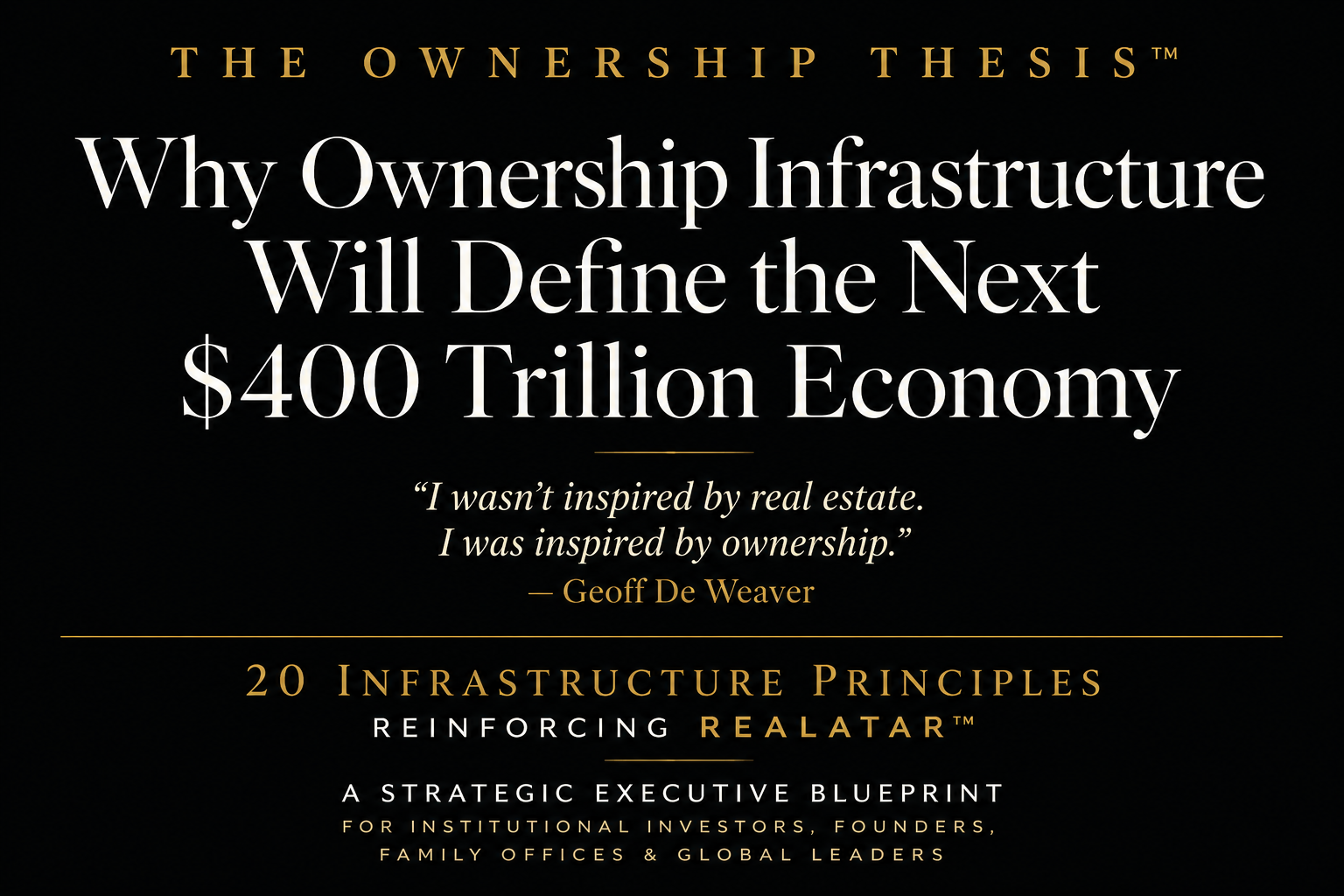
THE SOVEREIGN LEDGER™ #149: The Ownership Thesis™ — 20 Infrastructure Principles Reinforcing REALATAR™

A Strategic Executive Blueprint for the Future of Global Ownership Infrastructure

Strategic Blueprint #149: 20 Infrastructure Principles reinforcing REALATAR™ — engineering lessons for rebuilding the $400 trillion global property market, cross-verified against BCG, McKinsey, PwC, Bain, Nvidia, and Accenture.

The $25 Billion Friction Tax — Florida 3.0 Sovereign Signal™ Issue #007

Issue #007 of Florida 3.0 Sovereign Signal™: title insurance collected $18.5B in 2025 and paid just $667M in claims — a 3.6% loss ratio. The full settlement stack now imposes a $25 billion friction tax on American real estate. Here’s why infrastructure, not demand, is the bottleneck.