THE SOVEREIGN LEDGER™ #159 — THE TOKENIZED REAL ESTATE CAPITAL STACK: HOW INSTITUTIONAL LP/GP STRUCTURES ARE RE-PLATFORMING IN 2026
Why Debt, Equity and Sovereign Yield Layers Are Migrating From Paper Syndication to Programmable T+0 Settlement | The Ownership Thesis™ | A Strategic Blueprint for Institutional Allocators, Family Offices, Sovereign Wealth Funds, General Partners and Long-Term Capital
INTRODUCTION
There are moments when multiple exponential curves converge so rapidly that an industry is forced to reconsider not merely its software tools, but its foundational operating architecture. Real estate — the largest store of wealth on Earth — has reached that exact inflection point in 2026. For generations, institutional property capital has relied on a rigid hierarchy of general partners, limited partners, special-purpose vehicles, debt providers and legal intermediaries. That architecture built trillions of dollars of global wealth. It funded cities. It underwrote pensions. It carried families across generations. I have enormous respect for what it accomplished.
But its underlying machinery remains anchored in paper-speed operations: subscription documents traversing fragmented databases, redundant identity verifications, manual waterfall distributions, and multi-week transaction settlements. Meanwhile, intelligence has begun operating at machine speed. That collision is the subject of this entry. It is also, in my assessment, one of the largest institutional opportunities of the decade — and one of the most consequential responsibilities. Because whoever builds the rails beneath the next ownership system will shape who gets to participate in it. That is not a technology question. That is a civilizational one.
PART ONE — FROM MOORE’S LAW TO THE “NEW MOORE’S LAW”: WHY 2026 IS ANOTHER INFLECTION POINT
Before examining how real estate capital is becoming tokenized, programmable and increasingly machine-readable, it is worth restating one of the simplest — and most important — technology lessons of the past sixty years. It requires no technical background to follow. In 1965, Gordon Moore, who would later co-found Intel, observed something extraordinary happening inside computer chips. Engineers were learning how to place more and more electronic components onto the same piece of silicon. Moore documented the trend and projected that the number of components that could economically fit onto an integrated circuit would roughly double every year over the following decade. In 1975, he revised the longer-term trajectory toward a doubling approximately every two years.
That observation became known as Moore’s Law. It was never a law of physics. It was an observation about an exponential technology curve. Its importance was enormous. In everyday terms: more computing power, smaller machines, lower relative computing costs, better products, more applications, more people connected to computing — generation after generation. The computer that once required a room eventually became the computer sitting on a desk. The desktop became the laptop. The laptop was joined by the smartphone. And computing disappeared into automobiles, factories, satellites, medical equipment, financial markets, homes and billions of connected devices. Moore’s Law became one of the underlying economic engines of the digital age.
NOW SOMETHING DIFFERENT IS HAPPENING
In 2026, we can observe another extraordinary exponential curve — but this time we are not counting components inside a computer chip. We are watching the consumption of machine intelligence itself. First, one definition. A token is a unit used by AI systems to process and generate information; depending on the model and content, a token may represent part of a word, a whole word, punctuation, code or another encoded element. Token volume is therefore a useful measure of AI inference activity and consumption — not a literal measure of “thinking,” but a powerful signal of how intensively machine intelligence is being used.
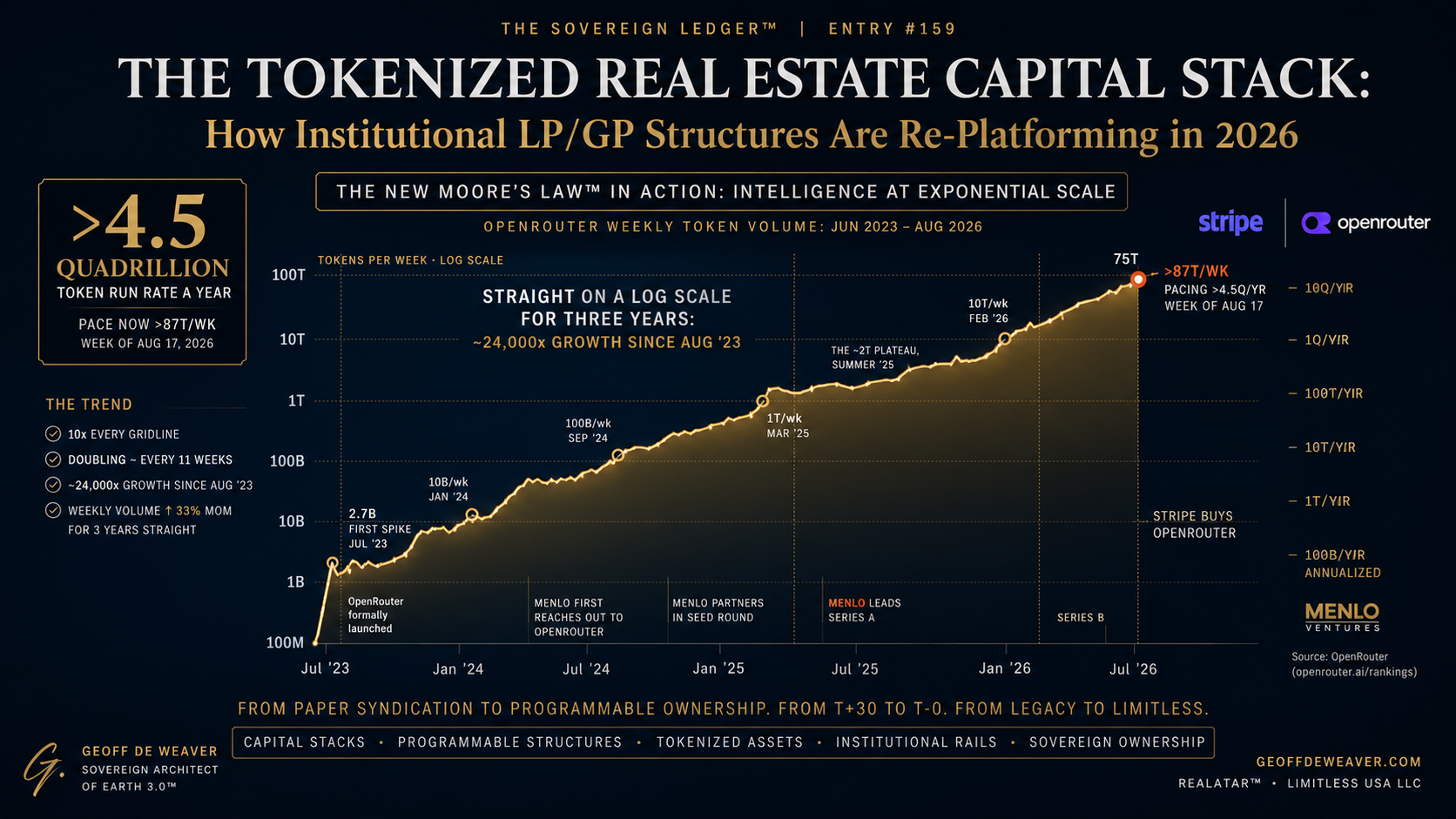
Now the data. OpenRouter operates an AI model gateway and marketplace through which developers and enterprises access and route inference across more than 400 models from over 80 providers. That makes its activity a valuable — though not comprehensive — window into AI consumption across its own platform. The supplied OpenRouter/Menlo Ventures chart plots weekly token volume on OpenRouter from 2023 through August 2026 on a logarithmic scale, where each major gridline represents a tenfold increase.
That detail matters enormously, and it is the part almost everyone misses. On a normal chart, explosive growth looks like a rocket. On a log scale, explosive growth looks like a straight line. A straight line on a log chart is not calm. It is the visual signature of relentless, compounding, multiplicative growth. OpenRouter’s line has been close to straight for three years.
Here is the ladder, read from that chart:
| Milestone | Weekly Token Volume |
|---|---|
| July 2023 — first spike, at formal launch | 2.7 billion |
| January 2024 | 10 billion / week |
| September 2024 | 100 billion / week |
| March 2025 | 1 trillion / week |
| Summer 2025 — the “~2T plateau” | ~2 trillion / week |
| February 2026 | 10 trillion / week |
| Week of August 10, 2026 | 75 trillion |
| Week of August 17, 2026 | pacing above 87 trillion |
Independent corroboration from the company’s own disclosures: OpenRouter’s May 2026 Series B announcement reported weekly volume rising from 5 trillion to 25 trillion tokens over the preceding six months. Its August 2026 announcement states the platform now processes more than 10 trillion tokens per day across 400+ models for a community of more than 10 million developers and companies, and that it has seen at least 10× growth in inference volume every year since founding. Those disclosures sit in the same order of magnitude as the chart’s late-2026 readings.
At 87 trillion tokens per week, the annualized run rate is approximately 4.5 quadrillion tokens a year.
The headline characteristics of the curve:
- Volume has doubled roughly every 11 weeks across the period.
- An 11-week doubling equates to approximately 31% growth month over month.
- Measured from the chart’s August 2023 baseline, cumulative growth is on the order of 24,000×. Measured from the July 2023 launch spike of 2.7 billion, it is higher still.
Read that number again. Not 24%. Not 24 times. Roughly twenty-four thousand times, in three years.
And note the institutional validation attached to the same curve. Menlo Ventures partnered with OpenRouter at the seed round in March 2025 through its Anthology Fund with Anthropic, led the Series A in May 2025, and increased its position again in the Series B. In May 2026, OpenRouter raised a $113 million Series B led by Alphabet’s CapitalG at a reported $1.3 billion valuation. On August 19, 2026, Stripe announced it had agreed to acquire the company; terms were not disclosed by either party, though Bloomberg reported a price above $7 billion and The New York Times reported approximately $7.5 billion. Sophisticated capital identified the routing layer years before the broader market did.
That is what I call, for strategic purposes, the:
NEW MOORE’S LAW OF INTELLIGENCE CONSUMPTION™
The comparison is simple. Original Moore’s Law: approximately every two years, dramatically more computing capability could be packed into silicon. New Moore’s Law: on this OpenRouter curve, the amount of AI intelligence being consumed has been doubling roughly every 11 weeks. These are not the same measurement — one counts manufactured capability, the other counts consumed activity on a single platform — and the 11-week rate should not be assumed to continue indefinitely. But strategically, the comparison is profound.
The first curve helped make computing abundant. The second is showing us what can happen when intelligence itself becomes abundant, inexpensive, accessible and continuously available through software. And the second curve is presently moving dramatically faster. A two-year doubling means enormous change across a decade. An 11-week doubling, if hypothetically sustained, would produce roughly 4.7 doublings in a single year — approximately 26×.
Again, that is arithmetic, not a forecast. No exponential growth curve continues forever. And the chart itself proves that point honestly. Look at the summer of 2025. The curve flattens at roughly 2 trillion tokens per week and stays there. Menlo labels it plainly: the ~2T plateau. For several months, the exponential simply stopped. I want every allocator reading this to sit with that plateau, because it is the most instructive feature on the entire chart. It demonstrates three things at once:
- Exponential curves stall. Anyone selling a straight line to infinity is selling something.
- Stalls are not reversals. The curve did not collapse. It consolidated, then resumed — and went on to multiply many times over within the following twelve months.
- The plateau is where infrastructure gets built. Consolidation phases are when serious operators construct the layer that the next expansion runs on top of.
We are, at this moment, in the expansion phase of intelligence and the plateau phase of ownership infrastructure. That is precisely the window in which rails are laid.
Now, why should a family office principal, a general partner or a pension trustee care about a chart tracking software traffic? Because of a single implication. When something becomes tens of thousands of times more abundant in three years, its price collapses and its use becomes universal. That has happened before, and each time it rewrote which institutions held power. When compute became abundant, the businesses that owned distribution and data won. When bandwidth became abundant, the businesses that owned platforms and identity won. Intelligence is now becoming abundant. And the businesses positioned to win this time are the ones that own the rails intelligence has to run across in order to touch a real asset.
That is not a technology prediction. It is a pattern that has repeated in every infrastructure cycle of the past sixty years. That is exactly why the current signal matters. The speed at which AI is being adopted and consumed is now colliding with institutions designed for a much slower world.
ORIGINAL MOORE’S LAW (1965/1975)
Hardware / Transistors
~2-Year Doubling
NEW MOORE’S LAW (2026)
Intelligence Consumption
~11-Week Doubling
AND THAT CREATES THE REAL 2026 PROBLEM
AI can increasingly analyze millions of data points almost instantaneously. AI agents can review documents, compare investments, detect anomalies, model scenarios and operate continuously. Yet enormous parts of the global financial and real estate system still depend upon PDFs, emails, spreadsheets, manual signatures, disconnected databases, repeated identity checks, multiple intermediaries, reconciliation, legacy settlement processes, and days — or even months — between agreement and final ownership transfer.
Intelligence is accelerating toward machine speed while ownership infrastructure still frequently operates at human and institutional speed. That mismatch is one of the most important economic opportunities of 2026 and beyond.
The question therefore is no longer simply: how powerful will AI become? The better question is: what happens when exponentially expanding machine intelligence encounters hundreds of trillions of dollars of assets whose ownership, financing, transfer and settlement infrastructure was designed for the previous century?
That is where the New Moore’s Law meets The Ownership Thesis™. And that is where tokenized real estate becomes much bigger than tokenization. Because if intelligence is becoming machine-speed, capital infrastructure must eventually become more machine-readable, programmable, interoperable and efficient as well.
AI can think faster. Capital must move smarter. Ownership infrastructure must catch up. And the institutions that understand that convergence early will have an extraordinary opportunity to help build — and own — the rails beneath the next economic system.

PART TWO — THE TOKENIZED REAL ESTATE CAPITAL STACK
For generations, institutional property capital has operated through a recognizable hierarchy: limited partners provide capital; general partners source and manage opportunities; funds and special-purpose vehicles establish legal ownership; banks and private-credit providers supply debt; lawyers, brokers, administrators, custodians, title companies and settlement agents move transactions through the system.
The structure has created trillions of dollars of wealth. But much of its operating machinery still belongs to another era. Capital calls can take days. Subscription documents travel through multiple systems. Ownership records live across databases, PDFs, spreadsheets and legal repositories. Investor eligibility is repeatedly verified. Distributions require layers of administration. Assets worth hundreds of millions of dollars can still take weeks or months to transfer.
And it leads to a fundamental question: what happens when the real estate capital stack becomes programmable?
1. START WITH THE SCALE: REAL ESTATE REMAINS THE WORLD’S GREAT OWNERSHIP ASSET
Real estate is not a niche market waiting for technological disruption. It is the largest store of wealth on Earth. Two credible measurements, built on different methodologies, are worth holding side by side.
Savills values all global real estate — residential, commercial and agricultural land — at $393.3 trillion as of the start of 2025, comprising $286.9 trillion residential, $58.5 trillion commercial and $47.9 trillion agricultural. On that basis, property exceeds the combined value of global equities, debt securities and all the gold ever mined.
Statista Market Insights, using a broader market-value definition covering residential and commercial property, projects the worldwide real estate market at approximately $624.62 trillion in 2026, with residential accounting for $506.73 trillion, growing at a projected 3.03% CAGR to $725.05 trillion by 2031.
These are not competing claims about the same number. They are different perimeters. Savills measures the standing value of physical stock across three asset categories at a fixed date. Statista projects total market value under a wider transactional definition. When I frame the broader ownership opportunity, I include the property itself, the debt, the financing and the associated capital stack layers surrounding it — which is why the larger figure is the relevant frame for infrastructure, and the Savills figure is the relevant frame for physical stock.
The institutional bottleneck is visible under either measure. In a December 2020 analysis, Bain & Company observed that global real estate then amounted to roughly $317 trillion, but only about $10 trillion of that was managed in funds and available to a broader investor base through the public real estate market.
Read that ratio again. On Bain’s own base, roughly three percent of the world’s largest asset class was structurally accessible. Against the larger contemporary estimates of the total universe, the accessible share is smaller still. Real estate is gigantic. But its liquidity architecture remains fragmented. That is the bottleneck. The next transformation is not simply putting property deeds “on blockchain.” It is the gradual re-platforming of the capital stack surrounding the property. I established this bottleneck as the central structural problem in Sovereign Ledger #150 — The $625 Trillion Real Estate Bottleneck.
2. THE CAPITAL STACK IS THE REAL PRODUCT
Consider a major real estate investment. The physical building is only one component.
Around it sits: senior debt → mezzanine debt → preferred equity → common equity → GP promote → LP interests → SPVs → fund interests → distributions → servicing rights → title → escrow → insurance → compliance → tax obligations.
Each represents rights, liabilities, priorities, contractual relationships or cash flows. Historically, these layers have been coordinated through institutions and paper documents. Increasingly, portions of them are represented through digital infrastructure. That is why tokenization becomes far more interesting when we stop thinking about a “tokenized building” and start thinking about a programmable capital stack.
The token is not the revolution. The architecture behind it is. A properly structured digital asset may represent an economic or ownership interest, while smart-contract infrastructure can automate selected rules around transfers, permissions, distributions and reporting. OpenTimestamps (OTS) can add a Bitcoin-anchored cryptographic timestamp proving that a commitment to specified data existed at or before a particular time, strengthening provenance, auditability and evidentiary integrity. It does not, by itself, establish legal ownership, transfer legal title, validate the underlying information as true, or replace contracts, registries, courts or applicable law. That distinction is essential to institution-grade ownership infrastructure.
3. THE TOKENIZATION CURVE IS NOW BECOMING INSTITUTIONAL
For years, tokenization produced more conferences than institutional-scale deployments. That phase is ending. Two of the most frequently cited institutional projections:
- BCG (with ADDX, 2022): projected that tokenization of illiquid assets could reach approximately $16 trillion by 2030 — a figure the firm framed as roughly 10% of global GDP.
- McKinsey & Company (2024): modeled roughly $2 trillion of tokenized financial assets by 2030 as a base case, under a narrower definition that excludes cryptocurrencies and stablecoins.
The eight-fold gap between those two numbers is not a contradiction. It is a definitional difference — and allocators should treat it as one. BCG’s figure counts a broad universe of illiquid assets under an optimistic adoption scenario. McKinsey’s counts a narrower set of financial instruments under conservative parameters. Both are projections, not measurements.
4. THE $4 TRILLION REAL ESTATE SIGNAL
The Deloitte Center for Financial Services predicts that $4 trillion of real estate will be tokenized by 2035, up from less than $0.3 trillion in 2024, representing a compound annual growth rate of 27%.
The composition of that forecast is more instructive than the headline. Deloitte anticipates tokenized ownership of loans and securitizations reaching approximately $2.39 trillion, tokenized private real estate funds reaching approximately $1 trillion, and tokenized ownership of undeveloped land and under-construction projects reaching roughly $50 billion. In other words, the largest projected component is not fractionalized buildings. It is debt. That is a capital-stack forecast, not a property forecast — which is precisely the argument of this entry.
5. THE ALLOCATORS HAVE ALREADY SPOKEN
Institutional allocators are re-underwriting their operating assumptions. In January 2026, EY-Parthenon and Coinbase surveyed 351 institutional decision-makers — asset managers, asset owners, family offices, private banks, hedge funds and venture firms:
- 73% plan to increase digital-asset allocations in 2026.
- 63% report interest in allocating to tokenized assets.
- 86% already use stablecoins or are actively exploring them, with T+0 settlement and internal cash management among the leading use cases.
- 61% expect tokenization to significantly affect trading, clearing and settlement within three to five years.
Note also what the same survey shows about discipline: 49% of respondents strengthened their emphasis on risk management, liquidity and position sizing in response to market volatility. This is not enthusiasm. It is institutionalization.
6. LP/GP STRUCTURES BECOME SOFTWARE-AWARE
Institutions remain, but their operating architecture evolves: Legal Title + Digital Identity + Compliance + Tokenization + Smart Contracts + Settlement + Bitcoin-Anchored Provenance + Governance. Each layer performs a distinct function. Legal title remains governed by applicable law and recognized records; OTS strengthens timestamped provenance and audit evidence. As established in Sovereign Ledger #154 — The Sovereign Institution™, enduring institutions re-platform while preserving governance integrity.
7. ENTER THE NEW MOORE’S LAW: INTELLIGENCE ACCELERATES FASTER THAN OWNERSHIP
OpenRouter volume pacing above 87 trillion tokens per week represents an annualized rate of approximately 4.5 quadrillion tokens. AI can analyze assets in seconds, yet property transactions still take weeks. Closing that gap is the definitive opportunity for REALATAR™.
SUMMARY
Re-platforming the real estate capital stack is not about putting property deeds on a blockchain; it is about digitizing the complex web of rights, liabilities, priorities and cash flows that surround physical assets. Savills values global real estate stock at approximately $393.3 trillion under its methodology; broader market definitions, such as Statista’s, place the worldwide real estate universe substantially higher. The addressable ownership and capital opportunity expands further when mortgages, private credit, equity structures and the financial infrastructure surrounding those assets are considered.
Institutional adoption of tokenization is moving beyond the experimental phase:
- BCG (with ADDX) has modeled tokenized illiquid assets reaching approximately $16 trillion by 2030.
- Deloitte predicts tokenized real estate growing from less than $300 billion in 2024 to approximately $4 trillion by 2035, at roughly 27% compound annual growth.
- McKinsey has modeled approximately $2 trillion of tokenized financial assets by 2030 under a narrower definition and conservative parameters.
THE PROGRAMMABLE CAPITAL STACK
This transition does not eliminate financial institutions or legal frameworks. Tokenized securities remain subject to applicable securities laws and regulatory requirements. Instead, legal architecture and software architecture increasingly work together. GP/LP relationships become software-aware, with capital calls, distribution waterfalls, transfer restrictions and investor reporting increasingly capable of interacting with programmable smart contracts and digitally native cash rails such as stablecoins or tokenized deposits, subject to applicable law and regulation.
Crucially, as advances in AI hardware and software continue to improve inference economics, AI agents increasingly require machine-readable economic rails if they are to interact efficiently with real-world assets. By combining identity, compliance, tokenization and cryptographic provenance — including Bitcoin-anchored timestamp evidence through OpenTimestamps where appropriate — systems such as REALATAR™ can be architected to create more verifiable evidence, coordination and transaction layers around ownership infrastructure.
This framework supports the Ownership Flywheel™ — moving static, fragmented and historically illiquid property structures toward increasingly dynamic, machine-readable and programmable capital infrastructure.
MY BOTTOMLINE
The central takeaway of Entry #159 is that tokenization is not merely a new distribution feature for real estate — it represents a potential foundational re-architecting of how portions of global capital markets operate. The convergence of exponential machine intelligence with programmable digital assets creates an environment in which financial infrastructure must adapt to increasingly machine-readable capital.
THE CONVERGENCE
New Moore’s Law: ~11-Week Doubling on the referenced OpenRouter curve
Deloitte: ~$4T Tokenized Real Estate by 2035
Four core principles govern this transition:
- Intelligence Demands Programmability: Deploying increasingly capable and lower-cost AI inference against legacy PDFs, fragmented databases and manual settlement systems creates an operational bottleneck. Autonomous economic agents require machine-readable capital infrastructure to operate efficiently at market speed.
- Capital Efficiency Over Fractionalization: The institutional value of tokenization extends far beyond dividing buildings into smaller fractions. The larger opportunity includes automating compliance, permissioned investor onboarding, distributions and movement toward near-simultaneous or atomic settlement where legally, technically and operationally possible. Deloitte’s own forecast makes the point: the largest projected component of tokenized real estate is debt, not equity in buildings.
- Evidence and Provenance Are Mandatory: As synthetic data and AI-generated information proliferate, cryptographically verifiable provenance becomes increasingly valuable for validating authorization and record state. Bitcoin anchoring through OpenTimestamps can provide durable timestamp evidence that a cryptographic commitment to specified data existed at or before a particular time. It does not, by itself, establish legal ownership, transfer legal title, prove that the underlying data is true, or replace applicable property law, registries, contracts or courts.
- Infrastructure Dominates Applications: Individual AI models, smart-contract standards, blockchains and property portals will continue evolving. Durable institutional value can accrue to horizontal rails that connect identity, compliance, execution, provenance and settlement across assets and jurisdictions. Stripe’s agreement to acquire the routing layer beneath the AI model market — rather than a model itself — is the clearest recent expression of that thesis I have seen in any adjacent industry.
The transition from paper syndication toward software-native capital formation is structural. The institutions that lead this era will be those that look beyond individual digital tokens or isolated AI applications and instead understand the programmable infrastructure layer connecting assets, ownership, capital and intelligence.
OWN THE RAILS BENEATH THE ASSET.
TARGET LOCKED. RIGHT ON THE MARK. 🎯
SOURCE NOTES & METHODOLOGY
- Measured facts in this entry: the Savills and Statista valuation figures; the EY-Parthenon/Coinbase survey percentages and sample size; OpenRouter’s disclosed volume and funding figures; and the Stripe acquisition announcement.
- Projections in this entry: the BCG, McKinsey and Deloitte figures. These are modeled forecasts under stated assumptions, not measurements, and should not be read as such.
- My strategic interpretations in this entry: the “New Moore’s Law of Intelligence Consumption™” framing, the mismatch-gap thesis, the Ownership Flywheel™, and the four governing principles. These are my analytical positions and are offered for debate.
- Methodology distinction on global real estate value: Savills measures standing stock value (residential, commercial and agricultural land) at the start of 2025. Statista Market Insights projects total market value for 2026 under a broader transactional definition covering residential and commercial property. The figures are not interchangeable and are not directly comparable.
- Bain figure dating: the “$10 trillion managed in funds” observation is from a December 2020 Bain & Company brief that used a then-current global real estate base of approximately $317 trillion. The ~3% accessibility ratio is calculated against that base.
- OpenRouter token ladder: milestone figures are read from the supplied OpenRouter/Menlo Ventures logarithmic chart and reflect activity on that platform only. They are not a measure of total global AI inference. Company-disclosed figures from OpenRouter’s May 2026 and August 2026 announcements are cited alongside as independent corroboration.
- Acquisition terms: Stripe and OpenRouter did not disclose transaction value. Reported figures cited here are attributed to Bloomberg and The New York Times.
SOURCES & REFERENCES CITED
- Savills — How much is global real estate worth? — impacts.savills.com
- Statista Market Insights — Real Estate, Worldwide — statista.com
- Bain & Company — For Digital Assets, Private Markets Offer the Greatest Opportunities (December 2020) — bain.com
- Deloitte Center for Financial Services — Tokenized real estate (April 2025) — deloitte.com
- Boston Consulting Group with ADDX — Relevance of On-Chain Asset Tokenization (2022) — bcg.com
- McKinsey & Company — From ripples to waves: The transformational power of tokenizing assets (2024) — mckinsey.com
- EY-Parthenon — Institutional Investor Digital Assets Survey (January 2026) — ey.com
- Coinbase Institutional — 2026 Institutional Investor Digital Assets Survey — coinbase.com
- Stripe Newsroom — Stripe agrees to acquire OpenRouter (August 19, 2026) — stripe.com
- OpenRouter — OpenRouter is Joining Stripe — openrouter.ai
- OpenRouter — $113M Series B (May 2026) — openrouter.ai
- Menlo Ventures — Stripe to Acquire OpenRouter: Why Everyone Is Obsessed With Model Routing — menlovc.com
- OpenTimestamps — opentimestamps.org
- Bitcoin Protocol — bitcoin.org
THE SOVEREIGN LEDGER™ — ENTRY #159
GEOFF DE WEAVER | REALATAR™ | LIMITLESS USA LLC
“Claims invite debate. Artifacts invite inspection.”