— Geoff De Weaver
Every generation inherits infrastructure it mistakes for permanence.
Railroads. Telegraphs. Stock exchanges. Shopping malls. Mainframe computers. Newspapers.
Every one of these systems eventually reached an inflection point where technology fundamentally changed how value moved. I believe real estate settlement is approaching that same moment.
For more than a century, property transactions have depended on paper records, fragmented registries, manual reconciliation, escrow coordination, title searches, institutional trust, and legal verification. Those systems were logical when information moved slowly and ownership could only be confirmed through human processes. Today, however, we live in a world of cryptographic proof, programmable contracts, artificial intelligence, digital identity, and real-time networks.
The question is no longer whether technology can modernize settlement. The question is whether legacy settlement infrastructure can justify the economic friction it continues to impose.
This week’s research examines one of the largest remaining friction layers in the U.S. property market. Title insurance alone generated $18.5 billion in premiums during 2025 — up 13.8% year-over-year, according to the American Land Title Association. Layer in escrow and settlement services, county recording, legal duplication, settlement delays, wire risk, and administrative overhead — with average closing costs of $4,661 per transaction before commissions, across roughly four million annual existing-home sales — and the total annual settlement friction moves well past $25 billion. All of it riding on a mortgage origination system that moved $1.92 trillion in 2025, per Federal Reserve Bank of New York data.
Meanwhile, South Florida continues demonstrating extraordinary underlying demand. Luxury transactions continue. Institutional capital continues migrating. Developers continue deploying billions. Yet almost every transaction still moves through settlement infrastructure designed decades before blockchain, stablecoins, tokenization, or programmable ownership existed.
Demand is not the bottleneck. Capital is not the bottleneck. Infrastructure increasingly becomes the bottleneck.
This issue explores why.
Title insurance is the most visible component of America’s real estate settlement system, but it is only one layer of a much larger infrastructure built to compensate for uncertainty. Over decades, that infrastructure has grown into a complex network of title companies, escrow providers, attorneys, lenders, county recording offices, wire services, insurers, and manual verification processes.
Each participant performs an important function within today’s system. The question is not whether these organizations have historically added value. The question is whether the underlying reasons for their existence remain as compelling in an era where ownership can increasingly be verified through digital records, cryptographic proof, and programmable infrastructure.
Consider the numbers behind the visible layer. In 2025, the title industry collected $18.5 billion in premiums — and paid out $667 million in claims. That is a raw loss ratio of 3.6%, per ALTA’s own market data. Stated plainly: roughly ninety-six cents of every title insurance dollar funds process, distribution, and overhead rather than actual loss protection. The top five underwriters control more than 75% of the entire market. This is not an insurance market in the conventional sense. It is a verification toll — priced as insurance — on a records system that was never designed to verify itself.
The modern settlement stack typically includes:
Title Insurance — protecting buyers and lenders against defects in ownership history, liens, recording errors, fraud, and unresolved legal claims.
Escrow Coordination — acting as the trusted intermediary responsible for collecting funds, documents, approvals, and signatures before closing.
Manual Title Searches — reviewing decades of fragmented county records to reconstruct ownership history and identify potential defects.
Attorney Review — preparing, reviewing, and reconciling legal documents across multiple parties.
Recording Systems — transferring ownership through county recorders that often operate using legacy software and inconsistent digital standards, across more than 3,000 independent county jurisdictions.
Wire Transfers — moving large sums of capital through systems that remain vulnerable to delays, fraud, and reconciliation errors. FBI Internet Crime Complaint Center data shows real estate fraud losses jumped to $275.1 million in 2025, up nearly 59% from roughly $173 million in 2024. FundingShield reported that in Q4 2025, 46% of tracked transactions were flagged for wire and title fraud risk — an all-time high of 3.2 issues per transaction — as criminals deploy artificial intelligence faster than the industry’s defenses.
Post-Closing Reconciliation — distributing funds, recording documents, correcting discrepancies, and resolving issues discovered after settlement.
Each individual layer appears reasonable. Collectively, however, they create a settlement process that remains largely sequential, document-intensive, and dependent upon multiple intermediaries whose primary purpose is to verify information that increasingly could be verified by infrastructure itself.
This is where the concept of the $25 Billion Friction Tax becomes useful.
Friction taxes rarely appear on invoices. They appear as accumulated delays. Duplicated verification. Administrative overhead. Professional fees. Settlement risk. Idle capital. Repeated legal review.
The time dimension makes the tax concrete. ICE Mortgage Technology data shows the average conventional purchase mortgage takes roughly 41 to 43 days from application to closing. A cash transaction — which eliminates the lender but not the settlement stack — can still close in 7 to 21 days. That delta is not underwriting prudence. It is coordination overhead. Every additional day required to complete settlement represents capital that cannot be redeployed elsewhere. Every duplicated verification increases cost without necessarily increasing certainty. Every intermediary adds another coordination layer that extends transaction timelines.
Viewed individually these costs appear manageable. Viewed collectively they represent one of the largest remaining sources of structural inefficiency within American real estate.
This is not an argument against professionals. It is an argument for better infrastructure.
History repeatedly demonstrates that as verification becomes more reliable, the number of intermediaries required to establish trust begins to decline. Financial markets experienced this evolution — equity settlement compressed from five days to two to one, and tokenized funds now settle in minutes, with BlackRock’s BUIDL holding roughly $2.58 billion and McKinsey projecting tokenized assets approaching $2 trillion by 2030. Travel agencies experienced this evolution. Retail experienced this evolution. Media experienced this evolution.
Property settlement appears increasingly positioned to experience a similar transition.
The objective is not eliminating trust. It is replacing repeated manual verification with verifiable infrastructure. Ownership history becomes continuously auditable. Settlement becomes programmable. Provenance becomes immutable. Capital moves faster. Risk declines. Friction compresses.
The result is not simply lower cost. It is a fundamentally more efficient ownership system.
Few regions illustrate this transition more clearly than South Florida. Across Palm Beach, Miami, Wellington, Naples, Boca Raton, Fort Lauderdale, and West Palm Beach, institutional capital continues flowing into one of the world’s most dynamic luxury property markets. Demand remains resilient. The infrastructure supporting that demand increasingly shows its age.
Florida itself is now the nation’s second-largest title insurance market — generating $448 million in premiums in the first quarter of 2025 alone, behind only Texas. Every dollar of that friction is paid by capital that has already chosen Florida. The state is not just importing wealth; it is importing the settlement costs of a legacy system at national scale.
Recent market activity illustrates the contrast. Palm Beach continues recording significant luxury activity, including a waterfront residence at 216 Sandpiper Drive that recently went under contract after being listed at $12.5 million, only months after changing ownership at approximately $11.8 million. During a single reporting week, sixteen luxury contracts above $3 million represented roughly $92 million in asking volume, demonstrating continued buyer confidence within the premium segment.
Across Palm Beach County, luxury single-family sales increased more than 21 percent year-over-year, while average pricing, median pricing, and price-per-square-foot all continued strengthening. The ultra-luxury market above $10 million has more than doubled since 2020, driven by wealth migration, cash buyers, institutional investment, and continued demand for waterfront estates.
Wellington continues demonstrating similar resilience within its specialized equestrian market. International competitors, family offices, professional riders, and high-net-worth individuals continue investing in premium equestrian facilities despite broader market normalization. Properties combining acreage, barns, arenas, and proximity to world-class equestrian infrastructure remain highly sought after.
Meanwhile, Miami continues attracting institutional development. Edgewater remains one of the state’s most active construction corridors. The Live Local Act continues encouraging residential development across multiple municipalities. Palm Beach County has expanded financing initiatives supporting workforce housing.
Infrastructure investment also continues accelerating. This week, Coral Gables-based MasTec announced the approximately $1.7 billion acquisition of The Superior Group — $1.175 billion in cash plus $475 million in stock — to strengthen its capabilities in data center, power, and mission-critical infrastructure, highlighting continued confidence in long-term investment across Florida’s physical economy.
Taken individually, each headline reflects healthy market activity. Viewed collectively, they reinforce a more important observation.
None of these transactions are fundamentally constrained by buyer demand. None are constrained by available capital. None are constrained by long-term confidence in Florida. They remain constrained by settlement infrastructure.
Whether the transaction involves a waterfront estate in Palm Beach, a luxury condominium in Miami, an equestrian property in Wellington, or a mixed-use development in Edgewater, each still navigates largely the same settlement architecture developed for a paper-based economy.
The market has evolved. Capital has evolved. Technology has evolved. Settlement has not evolved at the same pace.
Florida therefore becomes more than an attractive real estate market. It becomes one of the world’s most valuable laboratories for observing how ownership infrastructure may evolve over the coming decade.
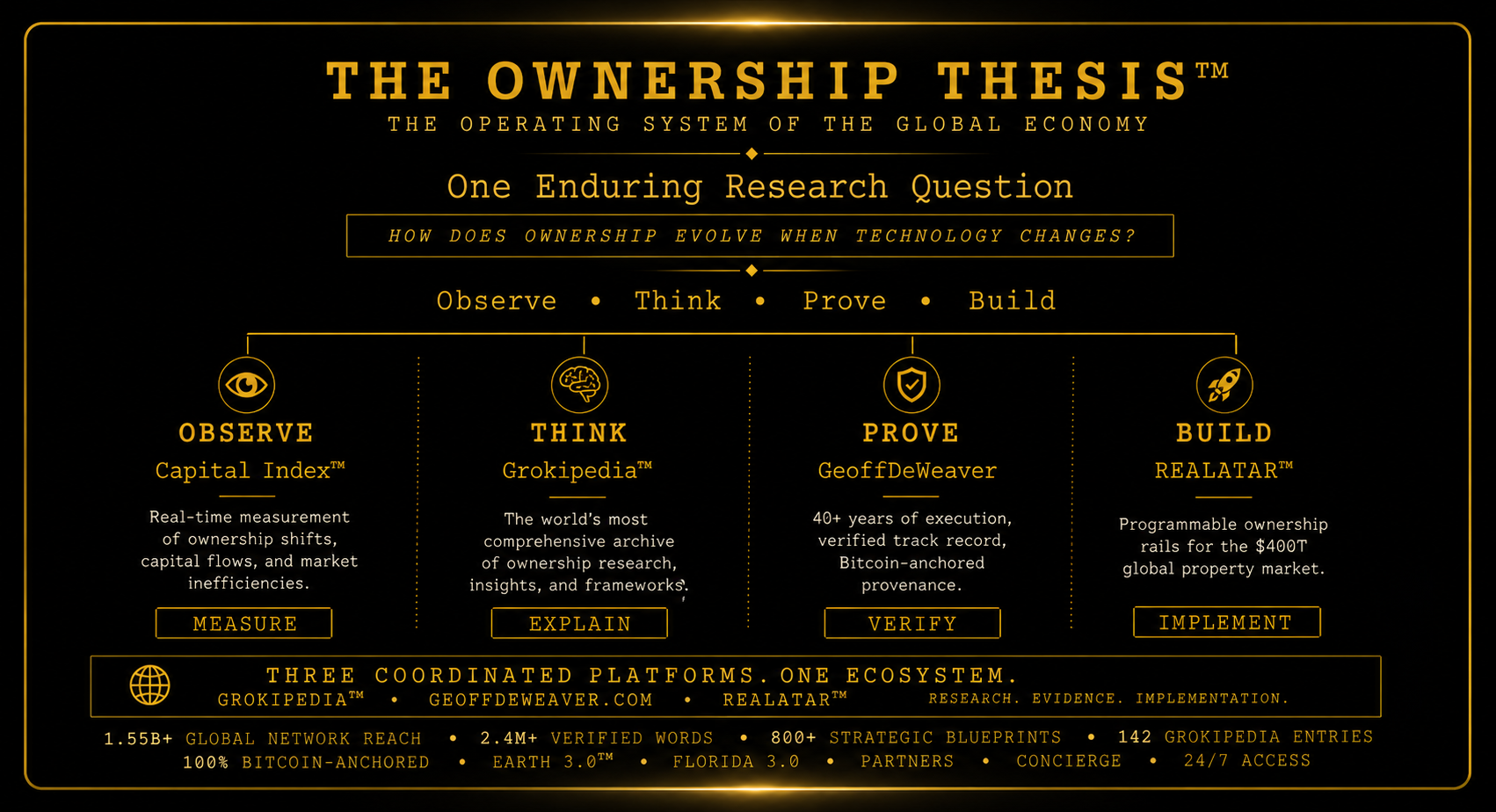
Every week, I dedicate this section to documenting how The Ownership Thesis™ continues to evolve through observation, research, and evidence.
This week reinforced one idea more than any other. Ownership is no longer simply a legal construct. It is becoming an infrastructure problem.
For centuries, societies have relied on institutions, paper records, legal processes, and trusted intermediaries to establish ownership. That model worked because information travelled slowly, records were fragmented, and verification required human judgement. Today, technology is fundamentally changing those assumptions.
Artificial intelligence is accelerating decision-making. Blockchain enables immutable provenance. Stablecoins enable programmable payments. Digital identity enables stronger authentication. Smart contracts automate execution.
The convergence of these technologies is gradually shifting trust away from repeated human verification and toward continuously verifiable infrastructure. The scale of that shift is already measurable: real estate tokenization stood at roughly $3.7 billion in 2025 and is forecast to approach $24 billion by 2035 at a 21% compound annual growth rate — while Deloitte’s longer-range forecast puts tokenized real estate at $4 trillion by 2035. The direction is no longer speculative. Only the speed remains in question.
This is precisely where The Ownership Thesis™ continues to mature.
Ownership is not possession. Ownership is not paperwork. Ownership is not simply legal title. Ownership increasingly becomes: Verifiable. Portable. Programmable.
The last week of research also reinforced another important observation. The greatest opportunities rarely emerge because demand suddenly appears. They emerge because infrastructure finally catches up with demand that already exists.
South Florida demonstrates this every day. The buyers already exist. The capital already exists. The demand already exists. Infrastructure remains the variable undergoing transformation.
One of the most important intellectual developments this week has been the formalization of The Authority Curve™.
For many years I wrote extensively about Educational Marketing. Its central principle was simple: when you educate, you build trust. Looking back, I now recognize that Educational Marketing described an outcome. The Authority Curve™ explains the mechanism.
Authority does not begin with trust. It begins with evidence.
The sequence is remarkably simple. Visibility creates awareness. Recognition creates familiarity. Evidence establishes credibility. Competence demonstrates capability. Trust becomes the rational consequence. Authority emerges through consistency over time.
This realization also changes how I view Florida 3.0 Sovereign Signal™. It is no longer simply a weekly publication. It is an evidence-generating system. Each issue contributes another observable data point. Each framework becomes testable. Each forecast becomes measurable. Each teardown becomes part of a growing body of research.
Authority is therefore not declared. It is accumulated.
Every week I conclude by identifying the developments I believe deserve continued observation. Current areas of focus include: stablecoin settlement infrastructure and institutional adoption. Bitcoin timestamping, provenance, and long-term verification. Tokenized real estate and regulated digital securities. Florida legislation affecting title, recording, escrow, and settlement. Artificial intelligence applied to digital identity and ownership verification — on both sides of the fraud arms race, where the FBI’s $275 million in 2025 real estate fraud losses shows the cost of defending analog rails with analog tools. Institutional migration into Palm Beach, Miami, Naples, and Wellington. Cross-border capital movement into South Florida. Family Office investment patterns. Luxury residential transaction velocity. The convergence of ownership infrastructure and programmable finance.
Markets rarely change because of one headline. They evolve through thousands of small signals that gradually reveal structural change. The objective is to identify those signals before they become consensus.
Every major technological transition reduces friction. Steam reduced transportation friction. Electricity reduced production friction. The Internet reduced information friction. Artificial Intelligence reduces cognitive friction. Cryptographic ownership reduces verification friction.
History consistently rewards infrastructure that removes unnecessary complexity. The property industry now stands at one of those moments. The opportunity is not merely digitizing existing processes. It is redesigning ownership infrastructure around verification rather than repetition.
Florida continues providing one of the world’s clearest laboratories for observing this transition. Every Friday I intend to document another observable piece of evidence. Not after history has already been written. While it is still unfolding.
The Ownership Thesis™ is not a prediction. It is an evolving research framework. Florida 3.0 Sovereign Signal™ is where that framework is tested against real markets, real capital, and real-world developments.
The future of ownership will not be determined by opinion. It will be determined by infrastructure.
How Florida’s Insurance Crisis Is Accelerating the Next Generation of Ownership Infrastructure
The Florida 3.0 Sovereign Migration Blueprint — the 62-page playbook for relocating capital, residency, and structure to Florida — is available now for $997 at geoffdeweaver.com/shop.
Weekly intelligence: REALATAR™ DAILY — The Sovereign Signal · Private access: REALATAR™ VIP
The Philosophy
↓
The Authority Curve™
The Methodology
↓
Florida 3.0 Sovereign Signal™
The Research Laboratory
↓
Florida Sovereign Capital Index™
The Evidence Layer
↓
Frameworks • Teardowns • Forecasts
The Research Instruments
All source data drawn from publicly available institutional research, official filings, and verified primary reporting as of July 2026.
Settlement & Title Industry Data
American Land Title Association (ALTA) — 2025 Market Share Analysis: $18.5B title premiums (+13.8% YoY); $667M claims paid; 3.6% raw loss ratio; top-five underwriter concentration above 75%; Florida $448M in Q1 2025 premiums — alta.org
FBI Internet Crime Complaint Center (IC3) — Real estate fraud losses: $275.1M in 2025, up from ~$173M in 2024 — ic3.gov
FundingShield — Q4 2025 wire & title fraud analytics: 46% of transactions flagged; all-time high 3.2 issues per transaction — fundingshield.com
ICE Mortgage Technology — Average conventional purchase closing: ~41–43 days — ice.com
Lodestar / ClosingCorp — Average U.S. purchase closing costs: $4,661 (excluding commissions) — lodestarss.com
Federal Reserve Bank of New York — 2025 mortgage originations: $1.92 trillion — newyorkfed.org
Institutional Research & Market Intelligence
McKinsey & Company — Tokenized assets ~$2T by 2030; global private markets real estate research — mckinsey.com
Deloitte — Tokenized real estate forecast $4T by 2035; 2026 CRE Outlook — deloitte.com
PwC / Urban Land Institute — Emerging Trends in Real Estate® 2026 — pwc.com
National Association of REALTORS® (NAR) — May 2026: 4.17M annualized sales, $429,300 median — nar.realtor
MIAMI REALTORS® — Palm Beach County luxury and cash-sale statistics — miamirealtors.com
The Real Deal — MasTec/Superior Group $1.7B acquisition reporting, July 2026 — therealdeal.com
Tokenization & Digital Asset Infrastructure
BlackRock — BUIDL: ~$2.58B AUM · Franklin Templeton — OnChain Fund: $824.62M · RE Tokenization Market — $3.73B (2025) → $23.99B by 2035 at 21% CAGR
Blockchain & Provenance Infrastructure
OpenTimestamps — opentimestamps.org · Bitcoin (L1) — bitcoin.org
Sovereign Platforms
REALATAR™ — realatar.vip · Grokipedia™ — geoffdeweaver.com/grokipedia · Limitless USA LLC — geoffdeweaver.com/about
All source data cited herein is drawn from publicly available institutional research, official company filings, and verified primary reporting as of July 2026. Geoff De Weaver and Limitless USA LLC assert no affiliation with the third-party brands and institutions listed above. All trademarks remain the property of their respective owners.
#Florida30 #SovereignSignal #OwnershipThesis #RealEstateInfrastructure #TitleInsurance #SettlementInfrastructure #Tokenization #Blockchain #Bitcoin #PropTech #PalmBeach #Miami #WealthMigration #FloridaRealEstate #REALATAR #LuxuryRealEstate #DigitalAssets #ProgrammableOwnership
Permanently anchored to the Bitcoin blockchain via OpenTimestamps. The fingerprint below is immutable, independently verifiable by anyone, anywhere, and cannot be back-dated or altered — not even by me.
Canonical String:
Florida 3.0 Sovereign Signal™ | Issue #007 | The $25 Billion Friction Tax | Geoff De Weaver | Limitless USA LLC | 2026-07-10
SHA-256:
be1744852920ebb54915f6caf9e8ea18c061978fecc751b9d97de50dfacaed3e
Proof File: issue-007-25-billion-friction-tax.ots · Anchored: Bitcoin L1 · Verify instantly: opentimestamps.org
Founder & CEO, Limitless USA LLC
Researching the future of ownership, capital, and sovereign infrastructure.
Bitcoin-anchored using OpenTimestamps • Immutable Provenance • July 10, 2026