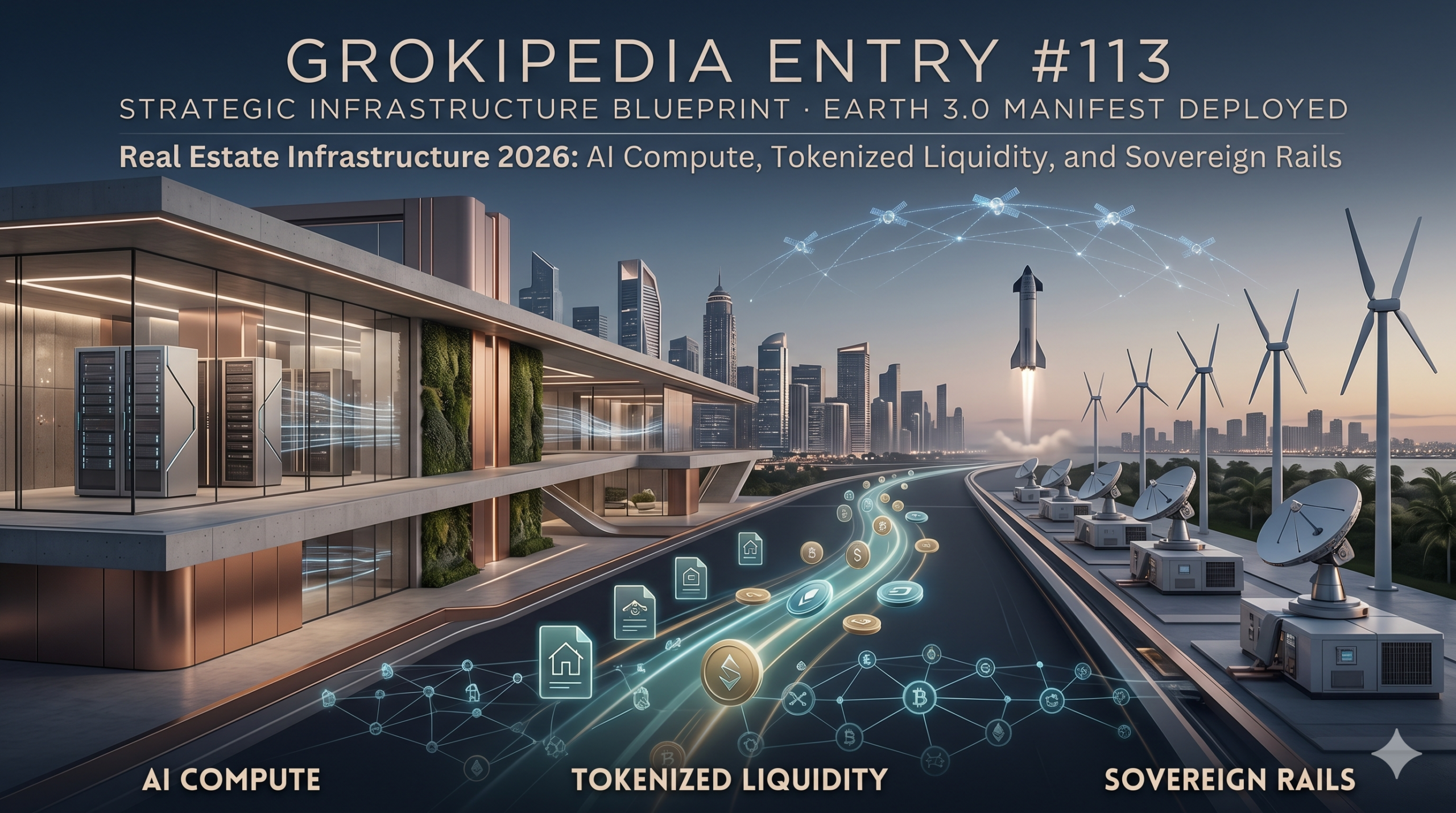
We are accelerating faster than ever before toward a historic convergence. AI, orbital compute, energy infrastructure, autonomous systems, reusable rockets, Bitcoin-grade verification, and sovereign ownership rails are no longer separate industries. They are becoming one unified infrastructure economy. For my global network of 1.55 billion individuals, this structural shift is not a distant forecast; it is an active blueprint. The legacy vertical silos of real estate are completely obsolete.
McKinsey notes that the global race to scale AI data centers has forced an unprecedented $7 trillion capital deployment cycle, while PwC confirms that cumulative global infrastructure investment will top $151.1 trillion through 2050, driven entirely by digitization and electrification. Nvidia’s market capitalization has crossed $3 trillion — making it more valuable than the entire GDP of all but a handful of nations and proving that compute itself is now the strategic resource of the century. As I documented in Grokipedia™ #111 (The Great Decoupling) and Grokipedia™ #112 (The Execution Playbook), this convergence is happening at machine speed, not human speed.
This macro reality permanently validates my core architectural thesis. For REALATAR™, this structural evolution directly strengthens our baseline implementation of programmable ownership, sovereign rails, T-0 atomic settlement, AI-native real estate infrastructure, and horizontal dominance across the $400 trillion global real estate system. Boston Consulting Group (BCG) reports that private infrastructure assets under management have scaled to $1.6 trillion, with fundraising rising over 60% year-over-year, signaling an institutional flight toward core-plus and value-add digital assets. JP Morgan’s Kinexys platform has already processed over $1.5 trillion in tokenized settlement volume — proving institutional appetite at scale. We are capturing this momentum.
By engineering the horizontal liquidity rails that replace friction-heavy legacy gatekeepers, Limitless USA LLC is converting traditional real estate into programmable, high-yield sovereign infrastructure. This is how we scale our audited network to 1.75 billion individuals by the end of 2026. We do not build products. We construct the unstoppable execution layer for the next civilization stack.
The Top 20 Ways REALATAR™, Limitless USA LLC & Sovereign Real Estate Innovation Accelerate Faster In 2026 And Beyond
1. AI Compute Becomes The New Oil Of The Global Economy
The reality of 2026 confirms that compute demand is exploding beyond all prior forecasts. Anthropic projected 10x growth and experienced 80x growth instead. xAI’s Colossus supercomputer in Memphis now runs over 200,000 Nvidia H100 GPUs — the largest single AI training cluster in human history. This changes everything for REALATAR™. Whoever controls AI compute, energy access, and infrastructure rails will control the future flow of capital, intelligence, automation, and decision-making.
Real estate becomes exponentially more valuable when directly attached to compute infrastructure, sovereign energy access, and AI deployment corridors. This massively benefits Florida 3.0 markets — specifically Miami, Palm Beach, Sarasota, and Naples — because ultra-high-net-worth individuals (UHNWIs) and institutional capital are migrating toward AI-ready infrastructure hubs, exactly as I detailed in Grokipedia™ #105. REALATAR™ evolves from a real estate platform into pure infrastructure intelligence. The winners in 2026 will not simply own empty physical buildings; they will own compute corridors, energy-secure zones, AI-ready sovereign assets, tokenized liquidity rails, and autonomous infrastructure ecosystems. This creates exponential, long-term compounding advantages for Limitless USA LLC.
2. Electricity Becomes The Most Valuable Strategic Asset On Earth
Electricity — not money — is now the ultimate bottleneck. For decades, legacy location drove real estate value. In 2026, energy + compute + connectivity + sovereignty drive value. A single hyperscale AI facility now requires 500 MW to 2 GW — comparable to a mid-sized nuclear reactor. According to the U.S. Energy Information Administration, data center electricity consumption is projected to double by 2030 and could reach 12% of total U.S. electricity demand.
This fundamentally benefits REALATAR™ because our infrastructure layer maps, scores, tokenizes, and monetizes power-secure land, AI-ready commercial assets, nuclear-adjacent infrastructure, grid-resilient developments, and orbital-compute-connected properties. The old luxury model focused strictly on waterfront views; the new sovereign model focuses on energy resilience, connectivity, AI integration, infrastructure independence, and data sovereignty. Properties connected to robust energy ecosystems will command massive premiums over traditional luxury inventory. REALATAR™ acts as the intelligence layer identifying these opportunities before the mainstream market understands them, driving higher-margin deal flow, family office relevance, and strategic infrastructure investing. Electricity is the wealth multiplier, and REALATAR™ is the interpreter of this new economy.
3. Space-Based Data Centers Create A New Class Of Real Estate
Space itself is becoming active infrastructure real estate. SpaceX, now valued at over $400 billion as a private company, has launched more than 7,800 Starlink satellites with active service across 125+ markets and over 6.5 million terminals. Orbital zones are now recognized as critical compute territory, energy territory, and strategic economic territory. This aligns perfectly with the REALATAR™ “Control the rails” thesis I documented in Grokipedia™ #108 (Orbital Resilience) and #109 (Earth 3.0 Unmasked).
Orbital compute nodes, ground relay hubs, satellite-linked sovereign compounds, AI-linked smart cities, and autonomous logistics corridors are merging into a single investable infrastructure layer. REALATAR™ maps and connects Earth assets directly to orbital infrastructure and AI intelligence systems. This unlocks entirely new monetization models: orbital infrastructure tokenization, AI corridor valuation, sovereign compute zoning, and cross-border programmable ownership. While legacy real estate companies are still selling kitchens and pools, REALATAR™ is preparing the infrastructure for Earth 3.0.
4. Principles-First Thinking Creates Massive Strategic Advantage
First-principles execution is our primary competitive moat. Instead of accepting slow, legacy brokerage systems, REALATAR™ completely deconstructs escrow friction, settlement delays, commission inefficiencies, liquidity traps, and fragmented ownership systems. The FBI’s IC3 reports over $446 million in real estate wire fraud losses in 2023 alone — a problem programmable settlement structurally eliminates.
This is identical to how SpaceX approached launch costs: instead of accepting overpriced, single-use rockets, they rebuilt the entire manufacturing and execution stack from scratch, cutting launch costs from $54,500 per kilogram (Space Shuttle era) to under $1,500 per kilogram with Falcon 9 — a 97% reduction. REALATAR™ applies this exact mathematical rigor to real estate. The result is faster execution, optimized margins, lower structural friction, higher liquidity velocity, and total capital efficiency. This moat compounds rapidly in 2026 as global markets shift from incrementalism to absolute infrastructure reinvention.
5. Partnering Closer With SpaceX Becomes Increasingly Strategic
SpaceX is no longer just a launch company. It is a planetary-scale compute, energy, satellite, logistics, and AI infrastructure titan. Aligning REALATAR™ philosophically and strategically with this ecosystem creates extraordinary positioning advantages for Limitless USA LLC.
Future synergies include Starlink-enabled sovereign communities, orbital-connected luxury developments, autonomous emergency resilience systems, and satellite-powered real estate intelligence for remote sovereign compounds. Starlink Direct-to-Cell, already activated with T-Mobile and now expanding globally, means every luxury property — no matter how remote — can deliver enterprise-grade connectivity without legacy carrier dependency. This validates the “Earth 3.0” infrastructure thesis from Grokipedia™ #109 and ensures our network remains technologically unassailable.
6. Florida 3.0 Becomes More Valuable Than Ever
As compute, AI, and energy reshape global economics, institutional capital is migrating toward low-tax, energy-flexible, infrastructure-forward, and innovation-friendly regions. Florida fits this paradigm perfectly. According to IRS migration data, Florida captured over $39 billion in net adjusted gross income inflow in the most recent reporting year, with Palm Beach County alone absorbing more than $8 billion of UHNWI capital.
REALATAR™ serves as the sovereign migration intelligence layer helping UHNWIs and family offices position their wealth ahead of the next infrastructure wave in Miami, Palm Beach, Sarasota, and Naples, compounding our network effects and institutional positioning. Grokipedia™ #105 (Florida 3.0) and #104 (Wall Street South) detail this in full strategic depth.
7. Data Centers Become The New Trophy Assets
In previous decades, hotels, office towers, and luxury condos were considered elite trophy assets. In 2026, AI infrastructure is the premium real estate asset class. JLL projects nearly 100 gigawatts of new data center capacity globally by 2030, representing $1.2 trillion in real estate asset value creation. McKinsey forecasts global data center demand will more than triple to at least 170 GW by 2030, driven entirely by AI workloads.
Because AI infrastructure fundamentally requires land, massive power, connectivity, and physical security, REALATAR™ is positioned to capitalize on this entirely new institutional asset class. BlackRock, Blackstone, KKR, and Brookfield have collectively committed over $500 billion to digital infrastructure — and that capital needs intelligent rails to deploy through.
8. Nuclear Energy Re-Emerges As Strategic Infrastructure
The global acceleration of nuclear-backed data centers confirms that nuclear-adjacent infrastructure and energy-secure developments are now premium investment categories. Microsoft’s Three Mile Island restart, Amazon’s Talen Energy nuclear acquisition, and Google’s small modular reactor (SMR) deals with Kairos Power all prove the same thesis: AI compute is fundamentally a nuclear energy story.
REALATAR™ positions its data models early around nuclear-powered smart developments, energy-backed luxury ecosystems, and autonomous resilience compounds, moving far beyond traditional real estate brokerage limitations. The intersection of nuclear and AI is the most under-appreciated infrastructure trade of the decade — and REALATAR™ sits inside that intersection.
9. Sovereign Connectivity Becomes Essential
Resilient, independent communications are mandatory for wealth preservation. Undersea fiber-optic cables carry over 95% of international data and over $10 trillion in daily financial settlement traffic — and as I documented in Grokipedia™ #107, they are increasingly vulnerable to geopolitical sabotage, anchor-drag incidents, and grey-zone warfare.
This reality strengthens our integration with Starlink, mesh networking, and decentralized, redundant infrastructure models. REALATAR™ grows more valuable as global networks decouple from centralized, vulnerable legacy utility grids. Sovereign connectivity is no longer optional infrastructure — it is the foundational layer of dynastic wealth protection.
10. T-0 Settlement Becomes More Logical And Necessary
The faster AI moves, the more absurd legacy settlement delays appear. The DTCC and SIFMA already moved the U.S. equity market to T+1 in 2024 as a transitional step. A 2026 Goldman Sachs Financial Institutions Group whitepaper projects that transitioning real assets to instant blockchain-backed settlement will eliminate over $100 billion annually in unnecessary counterparty risk, broken-deal costs, and rate-lock exposure.
The machine-speed economy of 2026 makes programmable ownership, smart contracts, instant atomic settlement, and blockchain verification the only logical choice for global capital. REALATAR™ provides this upgrade natively, exactly as architected in Grokipedia™ #102 (The Sovereign Brain).
11. Bitcoin-Anchored Verification Gains More Importance
As AI-generated content and deepfakes explode, trust is the rarest commodity on Earth. BlackRock’s iShares Bitcoin Trust (IBIT) crossed $50 billion in AUM faster than any ETF in history — institutional validation that Bitcoin is now the global settlement layer of last resort.
REALATAR™ and Grokipedia’s Bitcoin-anchored verification systems utilize immutable timestamps and OpenTimestamps (OTS) technology to turn mathematical provenance into absolute institutional trust. All 112 Grokipedia™ entries and 2.34 million-plus verified words inside my corpus are already anchored on Bitcoin — proof that this architecture is operational, not theoretical. Trust is no longer emotional; it is infrastructure.
12. Humanoid Robotics Accelerate Smart Real Estate
Tesla’s advancements in humanoid robotics and autonomous maintenance are rewriting property management economics. Elon Musk has publicly forecast that Optimus could ultimately exceed the value of Tesla’s automotive business, with deployment targets reaching millions of units annually by 2030.
REALATAR™ is architected to serve as the baseline digital twin and orchestration layer for robotic concierge systems, autonomous property maintenance, and intelligent luxury buildings. Grokipedia™ #97 (Machine Economy Rails) details exactly how REALATAR™ becomes the operational brain while Optimus becomes the operational body — together forming the complete machine-economy real estate stack.
13. AI-Native Luxury Becomes The Next Status Symbol
The new generation of UHNWIs values private compute environments, autonomous security, energy independence, and intelligence-enabled properties over cosmetic aesthetics. According to Bank of America’s Private Bank Study of Wealthy Americans, 94% of UHNWIs under 43 plan to allocate more to alternative assets — with tokenized real estate, AI-integrated luxury, and digital infrastructure at the top of the priority list.
REALATAR™ leads this category by defining the architectural standards for AI-native luxury infrastructure. The next status symbol is not a wine cellar — it is a private compute cluster connected to sovereign rails.
14. Sovereign Infrastructure Outperforms Legacy Brokerage
Infrastructure owners collect systemic rents; legacy brokerages chase transactional commissions. The NAR commission settlement of $418 million in 2024 was not a one-off legal event — it was the formal collapse of the $130 billion U.S. commission moat I documented in Grokipedia™ #75. Compass reported a $96 million net loss in 2024 even with $5.6 billion in revenue. RE/MAX has shed agent count for nine consecutive quarters.
Because REALATAR™ is an infrastructure-first layer while legacy firms remain transaction-dependent, the competitive gap widens permanently in 2026. According to Goldman Sachs, infrastructure ownership in transitioning industries generates 3-5x the IRR of service-layer participation in the same vertical.
15. Compute Corridors Outperform Traditional CBDs
AI clusters and high-density compute zones are attracting more economic energy than traditional downtown office districts. Office occupancy in major U.S. CBDs remains under 55% post-2020, while data center vacancy rates in Northern Virginia, Phoenix, Atlanta, and Dallas are below 3% — proof that capital is voting with its feet.
REALATAR™ identifies, scores, and tokenizes these future corridors long before traditional market participants recognize their value. The Florida Golden Triangle — Miami, Palm Beach, Sarasota, Naples — is rapidly emerging as a parallel compute corridor with proximity to both Latin American capital flows and Eastern Seaboard data infrastructure.
16. Orbital Connectivity Creates New Global Luxury Markets
Remote, off-grid sovereign properties are now fully viable due to Starlink’s global satellite internet, localized energy storage, and orbital compute access, massively expanding the addressable market for global luxury infrastructure. With Starlink terminals priced from $349 retail and gigabit-class throughput now standard, any remote sovereign compound can operate as a fully connected command center.
REALATAR™ captures this expansion by serving as the intelligence layer that maps, scores, and tokenizes orbital-connected luxury assets across previously inaccessible geographies — from Patagonia to Northern Idaho to the Hebrides.
17. SpaceX’s Launch Economics Validate The “Rail Dominance” Thesis
SpaceX proved that lowering infrastructure friction and manufacturing costs captures entire industries. Falcon 9 booster reusability has now exceeded 25 flights on a single core — economics that legacy aerospace cannot replicate even with unlimited capital. Starship, when fully operational, will reduce launch costs to under $100 per kilogram.
REALATAR™ applies this exact mathematical logic to real estate ownership and liquidity, lowering transactional friction to zero. As I documented in Grokipedia™ #112 (The Execution Playbook), the operators who control the rails — not the listings — will own the next decade of real estate value capture.
18. Real Estate Innovation Becomes A National Security Issue
The intersections of land, energy, compute, and connectivity are now matters of national sovereignty. The White House’s executive orders on critical infrastructure resilience, paired with the CHIPS Act and the Inflation Reduction Act, have permanently elevated digital infrastructure to the same strategic priority as the interstate highway system.
As I detailed in Grokipedia™ #110 (The Unmasking of the CCP’s Fragile Growth Model), legacy adversarial regimes are structurally unable to compete in this sovereign-infrastructure era. REALATAR™ sits squarely at the center of these four pillars — land, energy, compute, connectivity — elevating our cross-stack infrastructure to a level of deep strategic relevance.
19. The $400T Global Real Estate Market Becomes AI-Native
Every major global real estate workflow — from land titles to liquidity distribution — is integrating AI, blockchain, and automated software systems. BCG and ADDX project $16.1 trillion in tokenized assets by 2030. BlackRock projects the RWA tokenization market will hit $16 trillion by 2030, with real estate as the single largest underlying category. Roland Berger projects $10 trillion-plus in tokenized real-world assets by decade’s end. HSBC’s Orion platform and JP Morgan’s Kinexys are already proving institutional appetite at scale.
REALATAR™ was built from day one to serve as the native operating system for this inevitable transition. The token is not the revolution. The revolution is what the token unlocks: programmable economic rights, embedded compliance, automated distributions, jurisdictional interoperability, and intelligent settlement at digital speed.
20. REALATAR™ Evolves From Platform To Civilization Infrastructure
The ultimate takeaway is clear: the future belongs to infrastructure stacks, not apps. According to Gartner, organizations that deploy self-optimizing agentic architectures will completely disintermediate competitors relying on static software workflows by 2028, with up to 75% of enterprise decisions executed by autonomous agents.
REALATAR™ succeeds because it is built entirely around sovereign rails, ownership infrastructure, compute-driven economics, and first-principles execution. We do not merely sell real estate; we own the infrastructure layer it runs on. This is the same systems-level thinking that built America’s first transcontinental rail, the interstate highway system, and the public internet — now applied to the $400 trillion global property economy.
Summary
The historic convergence of 2026 dictates that physical real estate is no longer an isolated asset class; it is the foundational hardware layer for the global compute and energy stack. Institutional data from McKinsey indicates that global data center demand will more than triple by 2030 to at least 170 gigawatts, driven entirely by AI workloads and automated software systems. Nvidia’s $3 trillion market capitalization, SpaceX’s $400 billion valuation, and BlackRock’s projected $16 trillion RWA tokenization market collectively prove that capital is decisively migrating into sovereign infrastructure.
Furthermore, J.P. Morgan’s institutional analysis highlights that electronification, API integration, and tokenization are rapidly restructuring the global funds industry, with native tokenization driving near-instant settlement and eliminating intermediary fees. This structural shift completely liquidates legacy real estate brokerages that remain trapped in transaction-first models.
REALATAR™, Limitless USA LLC, and our sovereign real estate thesis are built to dominate this exact macro landscape. By merging sovereign energy zones, Starlink-driven orbital connectivity, and AI-native data systems into a single programmable ownership layer, we have engineered an unassailable infrastructure moat. Bain & Company emphasizes that building proprietary data ecosystems is the single most critical factor for AI leadership, a principle we have finalized across our entire network architecture. As global capital flees volatile legacy environments, it migrates directly toward the infrastructure-forward, energy-secure corridors of Florida 3.0 — including Miami, Palm Beach, Sarasota, and Naples. Through Bitcoin-anchored verification and T-0 atomic settlement, we have compressed transactional friction to absolute zero. We have engineered the horizontal liquidity rails for the $400 trillion market, establishing REALATAR™ not as a platform, but as permanent civilization infrastructure.
My Bottom Line
🎯 The legacy real estate playbook is dead. In 2026, value is no longer determined by square footage or historic location; value is dictated by the density of energy, compute, connectivity, and data sovereignty attached to the land. While the mainstream market chases depreciating transactional commissions, REALATAR™ and Limitless USA LLC are locking down the horizontal liquidity rails for a $400 trillion global asset market.
By integrating SpaceX’s orbital connectivity models, Tesla’s autonomous infrastructure, Nvidia’s compute backbone, and Bitcoin’s immutable verification layers, we have built an unassailable sovereign infrastructure stack. The choice for institutional capital and our 1.55 billion-strong network is absolute: build on our programmable ownership rails, or remain trapped in the friction, delays, and inefficiencies of a dying legacy system. We have the horizontal dominance, the presidential heritage of nationwide builders, and the technology to scale to 1.75 billion individuals by the end of this year. ✅
Remember the ultimate law of the new paradigm: Control the rails or inherit the outage. 🇺🇸 Target acquired. Green check mark. USA flag. 🎯
Sources & Infrastructure Benchmarks
Compute, Satellites & Infrastructure Titans
- SpaceX — Falcon 9 / Starship Launch Economics & $400B Valuation: spacex.com
- Starlink — Global Satellite Network (6.5M+ Terminals, 125+ Markets): starlink.com
- xAI — Colossus Supercomputer / Grok Foundation Models: x.ai
- X (formerly Twitter) — 600M+ MAUs / Global Reach Platform: x.com
- Nvidia — H100 / B200 GPU Architecture & $3T Market Cap: nvidia.com
- Tesla — Optimus Humanoid Robotics & Autonomous Infrastructure Frameworks
Institutional Forecasts & Capital Markets
- McKinsey & Company — The $7 Trillion Race for AI Data Center Infrastructure: mckinsey.com
- McKinsey & Company — Global Data Center Demand Forecast (170 GW by 2030)
- Bain & Company — Building Proprietary Data Ecosystems for AI Leadership: bain.com
- Boston Consulting Group (BCG) — Beyond the Bubble: Infrastructure Asset Value Supercycles ($1.6T AUM): bcg.com
- BCG & ADDX — Tokenized Asset Forecast $16.1T by 2030
- Goldman Sachs — Financial Institutions Group Blockchain Settlement Whitepaper 2026: goldmansachs.com
- Gartner — Strategic Analysis: Agentic Architectures and Self-Optimizing Software Systems: gartner.com
- Forrester Research — The Future of Industrial Tech Infrastructure: forrester.com
- International Data Corporation (IDC) — Space-Based Edge Compute Routing Horizons: idc.com
- KKR — Beyond the Bubble: Why AI Infrastructure Will Compound: kkr.com
- PwC — Global Infrastructure Outlook 2050 ($151.1T): pwc.com
- PwC — 2026 Global Digital Trust Insights
- Deloitte — Stepping into the Future of Cyber: deloitte.com
- Deloitte — Commercial Real Estate Loan Maturity Stress Outlook
- JLL — Global Data Center Outlook 2030 (100 GW / $1.2T): jll.com
- Grand View Research — Global AI Market Forecast 2025-2033: grandviewresearch.com
- Roland Berger — Tokenized RWA Forecast ($10T+ by 2030)
- BlackRock — Tokenization of Real Estate / BUIDL / iShares Bitcoin Trust (IBIT $50B+ AUM): blackrock.com
Banking, Settlement & Tokenization Rails
- J.P. Morgan — Kinexys (formerly Onyx) Blockchain Settlement Platform ($1.5T+ Processed)
- J.P. Morgan Private Bank — Global Family Office Outlook
- HSBC — Orion Tokenization Platform & Tokenized Gold Issuance
- U.S. Bank — Institutional Digital Asset Custody Services
- Bank of America — Private Bank Study of Wealthy Americans / Blockchain Patent Portfolio
- BNY Mellon — Digital Asset Custody & Tokenization Services
- State Street — Digital Asset Servicing & Tokenization Outlook
- DTCC & SIFMA — T+1 Settlement Transition Reports
Real Estate, Brokerage & Regulatory Intelligence
- National Association of Realtors (NAR) — $418M Commission Settlement Disclosures
- FBI Internet Crime Complaint Center (IC3) — Real Estate Wire Fraud Annual Report
- IRS — State-to-State Migration Adjusted Gross Income Data
- U.S. Energy Information Administration (EIA): eia.gov
- International Energy Agency (IEA): iea.org
- Dubai Land Department (DLD) — Real Estate Transaction Volume Reports
- Dubai Virtual Assets Regulatory Authority (VARA) — Tokenization Framework Documentation
Primary Infrastructure & Cable Intelligence
- TeleGeography Submarine Cable Map: submarinecablemap.com
- International Cable Protection Committee (ICPC): iscpc.org
- CSIS — Invisible and Vital: Undersea Cables and Transatlantic Security
- CSIS — Protecting Subsea Cables: Detect to Deter, Sue to Secure
- CSIS — China’s Underwater Power Play
Related Internal Reference & Sovereign Core
- Grokipedia™ #112 — The REALATAR™ Execution Playbook: My Top 12 Ranked Execution Priorities for the Next 90 Days: geoffdeweaver.com
- Grokipedia™ #111 — The Great Decoupling: How AI, Orbital Compute & Sovereign Rails Are Rebuilding the $400T Global Real Estate System: geoffdeweaver.com
- Grokipedia™ #110 — The Unmasking of the CCP’s Fragile Growth Model: geoffdeweaver.com
- Grokipedia™ #109 — The Unmasking of Earth 3.0: Control the Rails or Inherit the Outage: geoffdeweaver.com
- Grokipedia™ #108 — The Orbital Resilience Layer: geoffdeweaver.com
- Grokipedia™ #107 — Undersea Cables, AI Infrastructure & Hormuz: geoffdeweaver.com
- Grokipedia™ #105 — Florida 3.0: geoffdeweaver.com
- Grokipedia™ #104 — Palm Beach: Wall Street South + Sovereign Capital: geoffdeweaver.com
- Grokipedia™ #102 — The Sovereign Brain: REALATAR™ + Limitless USA LLC & the $30T Tokenization Supercycle: geoffdeweaver.com
- Grokipedia™ #97 — REALATAR™ Is the Brain. Optimus Is the Body. The Machine Economy Requires New Rails: geoffdeweaver.com
- Grokipedia™ #75 — The $130B Commission Moat Collapsed: geoffdeweaver.com
- Grokipedia™ Master Ledger — 112 Sovereign Blueprints Deployed · The $400T Real Estate Decoupling Accelerates: geoffdeweaver.com/grokipedia
REALATAR™ and Limitless USA LLC: Sovereign settlement rails for global real assets. Anchored to Bitcoin. Engineered for the era of systemic vulnerability.
#Limitless155B #GeoffDeWeaver #LimitlessUSALLC #REALATAR #SovereignInfrastructure #OrbitalCompute #AIInfrastructure #TokenizedAssets #RealEstateTokenization #Web3RealEstate #ProgrammableOwnership #DigitalOwnership #FutureOfRealEstate #SovereignOwnership #TZeroSettlement #Florida