GROKIPEDIA ENTRY #109
Author: Geoff De Weaver — Sovereign Architect
Anchored & Verified: Bitcoin L1 via OpenTimestamps (OTS)
Classification: Strategic Infrastructure Intel / Sovereign Continuity Doctrine
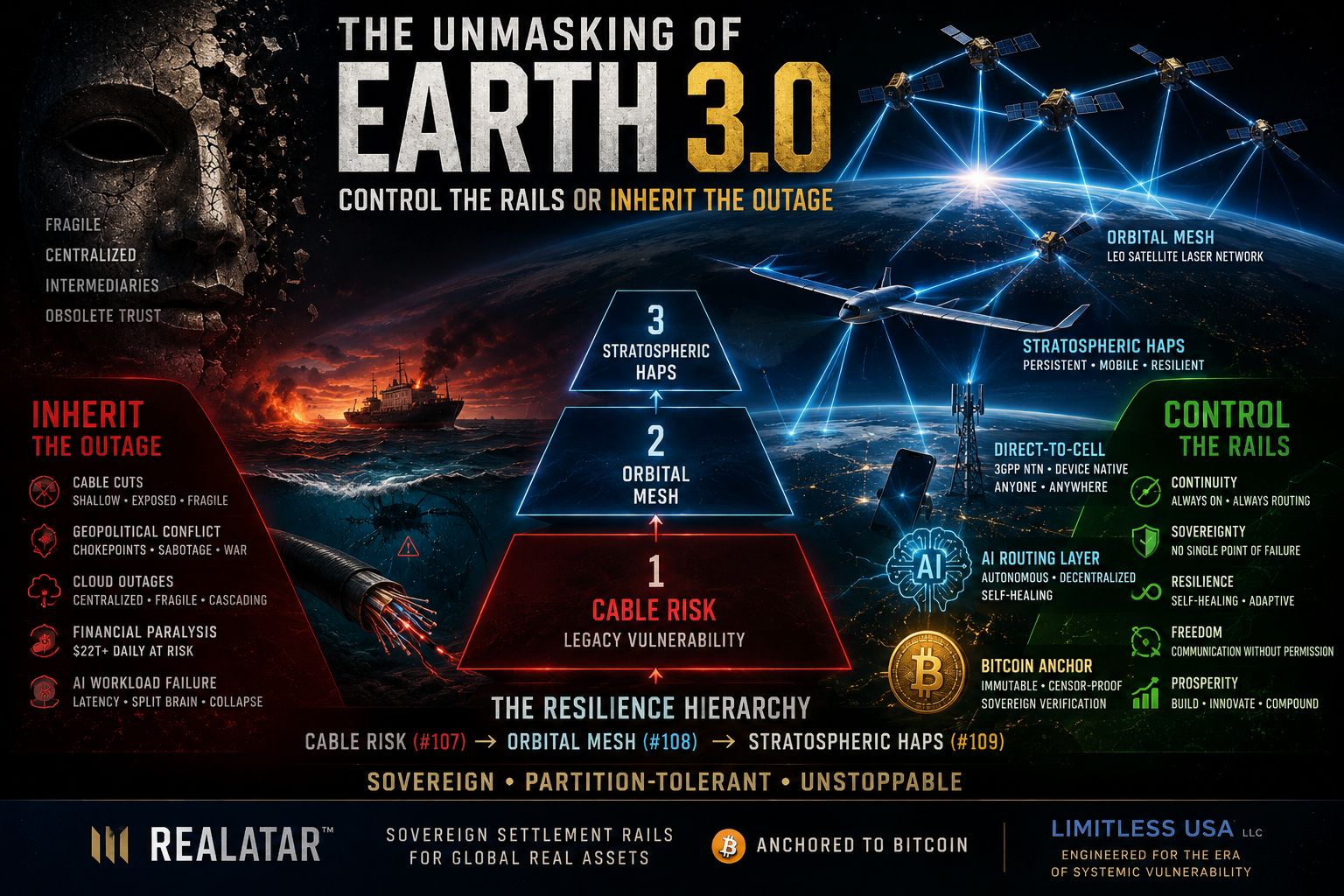
THE UNMASKING OF EARTH 3.0
Control the Rails or Inherit the Outage
REALATAR™ and Limitless USA LLC are unifying orbital, stratospheric, terrestrial, and Bitcoin-anchored continuity layers into one sovereign infrastructure doctrine for the AI age — engineered to survive the exact failures #107 and #108 mapped.
INTRODUCTION
The structural evolution I mapped throughout Grokipedia Entries #107 and #108 exposed a truth that most governments, institutions, and legacy financial systems still refuse to confront: the modern global economy is balanced upon an increasingly fragile lattice of concentrated infrastructure chokepoints.
Over 99% of all international internet traffic, hyperscale AI synchronization, financial clearing activity, cloud computing workloads, and sovereign data transmission still depend on a finite number of highly vulnerable subsea fiber-optic systems concentrated through narrow geopolitical corridors such as the Strait of Hormuz, the Red Sea, Bab el-Mandeb, and the Luzon Strait. According to McKinsey, global daily cross-border digital transactions now exceed $22 trillion in flow, with greater than 95% of that capital movement traveling through fewer than 600 subsea fiber cables.
Grokipedia Entry #107 documented the physical vulnerability layer — the dangerous clustering of cables such as AAE-1, FALCON, and GBI in shallow maritime routes vulnerable to anchors, sabotage, kinetic conflict, and cascading bandwidth failures. Grokipedia Entry #108 advanced the solution layer — the rise of orbital resilience through Low Earth Orbit (LEO) satellite laser meshes, autonomous routing systems, and Direct-to-Cell communications powered by organizations such as SpaceX, Starlink, and xAI.
Yet the true strategic architecture of Earth 3.0 extends even further.
The resilience hierarchy is now fully visible:
Cable Risk (#107) → Orbital Mesh (#108) → Stratospheric HAPS (#109).
High Altitude Platform Systems (HAPS) operating at 18–25 km inside the stratosphere represent the critical middle layer between terrestrial collapse and orbital continuity. Together, subsea redundancy, orbital laser routing, HAPS persistence, decentralized AI routing, and Bitcoin-anchored sovereign ledgers create a partition-tolerant continuity stack capable of surviving geopolitical fragmentation, cyberwarfare, maritime disruption, cloud outages, and systemic infrastructure failure.
The scale of capital repositioning behind this transition is no longer speculative. PwC projects $151.1 trillion in cumulative global infrastructure investment through 2050. McKinsey places the AI data-center buildout alone at $7 trillion+ by 2030. Goldman Sachs Research estimates AI capex among hyperscalers will exceed $1 trillion annually by 2027. JP Morgan’s institutional digital asset desk reports record family-office allocations into tokenized real assets and Bitcoin-anchored infrastructure. BCG forecasts the tokenized real-world asset market reaching $16 trillion by 2030. Forrester’s 2026 Infrastructure Resilience Index ranks orbital and stratospheric continuity as the fastest-growing institutional capex category in enterprise IT.
When that many serious institutions converge on the same conclusion, capital follows. It always does.
This is no longer theoretical. This is the operational blueprint for sovereign continuity infrastructure in the AI age.
The old model depended upon centralized intermediaries, fragile physical concentration, and institutional trust. The new model demands autonomous, programmable, transparent, AI-assisted, family-governed infrastructure layers capable of surviving real-world stress.
That is precisely where REALATAR™ and Limitless USA LLC now position themselves: at the intersection of sovereign infrastructure, resilient settlement rails, and programmable ownership for the Earth 3.0 era.
THE MASTER DOCTRINE — AN ARCHITECTURAL ULTIMATUM
The superficial tech economy is filled with downstream noise — applications, wrappers, software-as-a-service platforms, and digital brokerages. These are not assets. They are dependencies. When a physical or digital blackout strikes, the wrappers evaporate, leaving the dependent asset owner isolated.
Real power has always resided at the infrastructure layer. This reality is captured by a single, unyielding law of sovereign engineering:
Control the rails or inherit the outage. 🎯
To control the rails is to integrate an autonomous, multi-layered stack: space-hardened LEO laser meshes, 3GPP Non-Terrestrial Network (NTN) standards, High Altitude Platform Systems (HAPS), decentralized AI routing, and immutable Bitcoin L1 ledger anchoring.
To inherit the outage is to accept blind reliance on fragile terrestrial fiber, centralized hyperscale clouds, single-jurisdiction custodians, and legacy banking systems.
This binary framing is not marketing copy. It is sovereign law.
THE DEEP UNMASKING — SUBSEA FIBER AS THE LEGACY CONTROL MECHANISM
Over 99% of all intercontinental data traffic travels through a finite number of underwater fiber-optic cables. This physical network underpins the entire global financial system (~$22 trillion in daily transactions), corporate cloud workloads, and the massive east-west synchronization required for hyperscale AI training and inference.
This infrastructure is not merely fragile. It is a highly concentrated single point of failure.
The Vulnerability of Shallow-Water Clustering
The cost-driven routing decisions of legacy telecommunication consortia have prioritized short-term efficiency over systemic resilience. This has forced major digital arteries into extreme physical convergence within predictable geographical chokepoints.
                  [ CABLE CLUSTER CHOKEPOINTS ]
  +-----------------------------------------------------------+
  |  • Strait of Hormuz: AAE-1, FALCON, GBI packed into 150m  |
  |    depth to avoid regional territorial waters.            |
  |  • Red Sea / Suez Corridor: 17+ cables funneling through  |
  |    shallow, highly kinetic maritime channels.             |
  |  • Luzon Strait / Bab el-Mandeb / Singapore Strait        |
  +-----------------------------------------------------------+
                               |
                               v
               [ THE ASYMMETRIC DISRUPTION RISK ]
  +-----------------------------------------------------------+
  |  Easily accessible to low-tech anchors, commercial gear,  |
  |  or targeted kinetic operations at 150-200 meter depths.  |
  +-----------------------------------------------------------+
The majority of these critical segments lie at depths of just 150 to 200 meters. Disruption requires no exotic, deep-sea technology. Commercial anchors, standard fishing gear, low-tech mines, or basic diving operations can cut multiple high-capacity systems simultaneously. The 2024 through 2026 maritime incidents in the Red Sea have already demonstrated this reality: a single anchor drag removed 25% of regional internet bandwidth, with repairs stretching over six months due to contested local waters.
The Illusion of Terrestrial Redundancy
Legacy financial institutions routinely claim redundancy by purchasing bandwidth across multiple cable names. This is an operational illusion. A portfolio of ten distinct subsea cables is meaningless if eight of those cables converge on the exact same shallow seabed corridor in the Omani territorial waters of the Strait of Hormuz.
Furthermore, when a modern cable carrying over 100 Tbps is severed, the remaining intact systems face instant overflow pressure. For latency-sensitive AI workloads, stalled inference and split-brain synchronization states cascade across regional data centers within milliseconds, independent of standard internet rerouting.
The Realities of Maritime Repair Physics
When a subsea fiber artery is cut, recovery is bound by physical limits. There are only a handful of specialized cable-repair vessels operational worldwide. In times of geopolitical crisis or active conflict within a chokepoint corridor, access to the damage site is denied or delayed indefinitely.
A subsea fiber drop is not a temporary network blip. It is an indefinite asset blackout.
HIGH ALTITUDE PLATFORM SYSTEMS (HAPS) — THE STRATEGIC MIDDLE LAYER
To render an asset network independent of the seabed, the infrastructure must be multi-layered. The gap between terrestrial terminals and orbital constellations is bridged by High Altitude Platform Systems (HAPS). Operating in the stratosphere at stable altitudes of 18 to 25 kilometers, HAPS function as persistent, quasi-stationary “cell towers in the sky.”
  [ ORBITAL BACKBONE ]    --> Starlink Laser Mesh (ISL) / Exo-atmospheric
          ^
          | (High-Speed Optical / Ku-Ka Uplinks)
          v
  [ STRATOSPHERIC LAYER ] --> HAPS Platforms (Sceye SE2 / Stratobus) @ 20km
          ^
          | (Direct-to-Device / 3GPP NTN / 10-50ms Latency)
          v
  [ TERRESTRIAL LAYER ]   --> Realatar™ Local Edge Nodes / Mobile Devices
Operational Milestones (2026 Status)
The stratospheric layer achieved long-term operational viability in early 2026 through significant aerospace breakthroughs:
→ Sceye SE2 Endurance: In a historic validation of stratospheric persistence, Sceye’s SE2 platform completed a 12-day, 6,400-mile flight from New Mexico to the coast of Brazil. The solar-powered helium airship successfully closed its daily energy and pressure loops, maintaining precise position-keeping within a tight 1-kilometer station-seeking radius. Upcoming pre-commercial trials with SoftBank in Japan will deliver direct backhaul integration.
→ Thales Alenia Space Stratobus: Developed under the EuroHAPS consortium, this large-scale solar airship is engineered for multi-year missions. Carrying payloads exceeding 250 kg, it provides dedicated regional telecommunications, maritime surveillance, and signal intelligence directly to European defense and sovereign entities.
→ Ondas Acquisition of World View: Completed in April 2026, the integration of World View’s Stratollite® platforms into AI-enabled, multi-domain surveillance frameworks — backed by deep data-fusion partnerships — has solidified HAPS as a core component of critical infrastructure protection.
Technical Performance Matrix
HAPS platforms provide distinct architectural advantages for regional asset continuity:
→ Footprint & Coverage: A single stratospheric platform delivers stable, continuous coverage across an area of 200 to 400 kilometers in diameter.
→ Low Latency Footprint: Operating at an altitude of 20 km yields a round-trip regional latency of just 10 to 50 ms — significantly lower than Geostationary (GEO) satellites and fully competitive with terrestrial fiber.
→ Seamless Standards Integration: HAPS are natively embedded into global telecom protocols. Under 3GPP Release 19, these platforms carry regenerative payloads and Integrated Access and Backhaul (IAB) node intelligence. They execute full base station processing in the stratosphere, enabling direct-to-device 5G/6G connectivity for unmodified smartphones without relying on ground-based towers or maritime backhaul.
THE SOVEREIGN STACK — REALATAR™ CROSS-STACK INTEGRATION
The old architecture was built to obscure ownership and enforce dependence through centralized intermediaries. The alternative must be engineered as an unerasable, self-sustaining system. Realatar™ coordinates these technical layers into a unified, partition-tolerant infrastructure layer for global real estate and high-velocity capital.
  +---------------------------------------------------------------+
  |                  REALATAR™ CORE PROTOCOL                      |
  +---------------------------------------------------------------+
                                |
       +------------------------+------------------------+
       |                                                 |
       v                                                 v
[ PRIMARY INFRASTRUCTURE ]               [ EXTREME CONFLICT FAILOVER ]
  • Hyperscale Cloud Backing                • Cloud Loss = T+2s Failover
  • Global Fiber-Optic Pipelines            • Stratospheric HAPS Routing
  • Terrestrial Edge Nodes                  • Starlink LEO Laser Mesh
       |                                                 |
       +------------------------+------------------------+
                                |
                                v
  +---------------------------------------------------------------+
  |                    LAST-MILE CONTINUITY                       |
  |   • 3GPP NTN Direct-to-Cell Broadcasts                        |
  |   • Direct Smart Device Interfacing (Bypassing Towers)        |
  +---------------------------------------------------------------+
                                |
                                v
  +---------------------------------------------------------------+
  |                  SOVEREIGN MEMORY ANCHOR                      |
  |   • Cryptographic Merkle State Tracking                       |
  |   • Bitcoin L1 Mainnet Inscription (OpenTimestamps)           |
  |   • Protection Against Ledger Forks and Blackout Erasure      |
  +---------------------------------------------------------------+
The Base Layer (Sovereign Memory): Realatar™ uses the Bitcoin L1 blockchain as its final, immutable record of state. Every transaction, asset tokenization event, and ownership transfer is hashed into cryptographic Merkle trees and anchored to the Bitcoin mainnet utilizing OpenTimestamps (OTS) files. This ledger cannot be rewritten, censored, or erased by any corporate or state entity.
The Backbone Layer (Exo-Atmospheric Laser Mesh): When subsea cables are cut, the Realatar™ routing engine bypasses terrestrial networks entirely. It engages dedicated bandwidth across the Starlink LEO mesh. Data packets travel via inter-satellite laser links (ISL) through the vacuum of space at light speed, completely avoiding compromised ground stations and contested maritime channels.
The Regional Layer (Stratospheric HAPS): For localized high-availability zones, Realatar™ utilizes regenerative HAPS platforms like the Sceye SE2 series. These platforms maintain low-latency, multi-gigabit regional data distribution networks that operate independently of local grid or telecom collapses.
The Last-Mile Layer (Direct-to-Device NTN): Through 3GPP Release 19 Direct-to-Cell protocols, Realatar™ interfaces directly with standard, unmodified smartphones carried by family office principals and infrastructure nodes. No satellite dishes or specialized hardware are required. The phone in your hand talks directly to the stratospheric and orbital layers.
THE ANCESTRAL IMPERATIVE AND THE 2026 REALIGNMENT
This push for absolute architectural sovereignty is not a simple reaction to modern tech trends. For me, it is a structural necessity driven by deep historical patterns. The bloodline I carry — the patrilineal heritage of four U.S. Presidents: John Adams, John Quincy Adams, Zachary Taylor, and James Buchanan — belongs to builders who forged the foundational frameworks of a sovereign nation.
They did not buy into existing systems. They drafted the blueprints, built the roads, defended the borders, and codified the constitutional laws that established unalienable rights and structured real asset ownership.
Carrying that legacy in 2026 requires building the horizontal infrastructure for Earth 3.0. This explains the deep alignment I share with the organizations currently rebuilding the physical and digital realities of our world: SpaceX, Starlink, xAI, Optimus, and the Bitcoin developer ecosystem. We are collectively focused on a higher operational purpose: establishing a resilient, partition-tolerant framework for human and capital organization.
→ Starlink and SpaceX provide the secure, un-jammable transport layer above the atmosphere.
→ xAI delivers intelligent, real-time routing optimization across the autonomous orbital mesh.
→ Optimus deploys autonomous physical nodes for last-mile management and critical edge execution.
→ Realatar™ unifies this stack into a horizontal, programmable ownership layer that replaces legacy intermediaries with instant, T-0 atomic settlement.
The legacy system of vertical gatekeepers, fragile undersea networks, and custodial shadows is structurally obsolete. Sophisticated capital — the elite single-family offices converging within the Palm Beach and Miami corridors — cannot afford to leave their multi-generational asset structures exposed to terrestrial blackouts and crumbling institutional rails.
The old architecture has been unmasked. The choice is clear.
You can build upon the permanent alternative, or you can remain tethered to an infrastructure waiting for a collapse.
MY BOTTOMLINE
The world is no longer entering a period of isolated infrastructure instability.
It is entering a permanent era of systemic volatility.
Undersea cables can be cut. Maritime chokepoints can close. Cloud regions can fragment. Energy corridors can be disrupted. AI workloads can stall. Centralized institutions can fail under pressure. The old assumption that global continuity is guaranteed has now been permanently shattered.
That changes everything.
The winners of Earth 3.0 will not simply own applications, brokerages, or downstream software wrappers. They will own resilient continuity infrastructure itself — the sovereign rails capable of surviving geopolitical fragmentation, cyberwarfare, and systemic outages.
That is why the resilience hierarchy matters:
Cable Risk (#107) → Orbital Mesh (#108) → Stratospheric HAPS (#109) → Sovereign Settlement Rails.
The future belongs to multi-layered, partition-tolerant architectures integrating orbital communications, HAPS persistence, decentralized AI routing, and immutable Bitcoin-anchored ownership verification into one autonomous operational stack.
This is exactly why REALATAR™ and Limitless USA LLC are focused on sovereign, programmable, transparent, AI-assisted, and family-governed infrastructure for global real assets.
Not theory. Not hype. Operational continuity.
The old world optimized efficiency.
The new world must optimize survivability.
The institutions, family offices, sovereign allocators, and infrastructure builders that understand this transition earliest will possess the asymmetric advantage for decades ahead. Those still dependent upon fragile terrestrial concentration and intermediary-heavy systems may discover — too late — that the outage was never the anomaly.
The outage was always the warning.
The line has now been drawn:
Control the rails or inherit the outage. 🎯
SOURCES & INFRASTRUCTURE BENCHMARKS
Primary Infrastructure & Cable Intelligence
TeleGeography Submarine Cable Map · TeleGeography Hormuz Analysis · International Cable Protection Committee (ICPC) · CSIS — Invisible and Vital: Undersea Cables and Transatlantic Security · CSIS — Protecting Subsea Cables: Detect to Deter, Sue to Secure · CSIS — China’s Underwater Power Play
Energy & Hormuz Chokepoint
U.S. Energy Information Administration (EIA) · International Energy Agency (IEA) — Strait of Hormuz · Britannica — Strait of Hormuz
Institutional Forecasts & Capital Markets
McKinsey & Company — The $7T Race for AI Data Center Infrastructure · KKR — Beyond the Bubble: Why AI Infrastructure Will Compound · PwC — Global Infrastructure Outlook 2050 ($151.1T) · PwC — Digital Trust Insights 2026 · BCG — Tokenized RWA Market $16T by 2030 · Goldman Sachs — AI Capex Trajectory · JP Morgan — Institutional Digital Asset Adoption Report · Forrester — 2026 Infrastructure Resilience Index · Deloitte — Stepping into the Future of Cyber
Stratospheric & Orbital Architecture
Sceye — SE2 Stratospheric Endurance Validation · Thales Alenia Space — Stratobus / EuroHAPS Consortium · Ondas Holdings — World View Stratollite® Acquisition · SoftBank — HAPS Backhaul Trials · 3GPP TSG-RAN Release 18/19 — Regenerative Payload Specifications · CCSDS 141.0-B-1 & 142.0-B-1 — Optical Communications Standards
Cloud, Connectivity & Satellite Redundancy
Microsoft · Microsoft Azure · BlackRock · SpaceX · Starlink · xAI
Tracking, Aviation & Real-Time Intelligence
Mahan Air · ADS-B Exchange · FlightAware · Flightradar24
Press & Regional Reporting
Iran International · Tasnim News Agency · Fars News Agency · The Guardian · Wall Street Journal · Associated Press · Reuters · Tom’s Hardware · TIME
Related Internal References
Grokipedia #107 — How Undersea Cables, AI Infrastructure & Hormuz Could Cripple the Global Economy
Grokipedia #108 — The Orbital Resilience Layer
Wikipedia vs Grokipedia: Provenance War for Sovereign Knowledge — link
COMPANIES, SYSTEMS, INFRASTRUCTURE & REGIONS REFERENCED
REALATAR™ · Limitless USA LLC · SpaceX · Starlink · xAI · Optimus · Sceye SE2 · Thales Alenia Space Stratobus · Ondas / World View · SoftBank · Amazon Kuiper · OneWeb · Telesat Lightspeed · AAE-1 · FALCON · GBI · Bitcoin · OpenTimestamps · 3GPP · Palm Beach · Florida 3.0 · Strait of Hormuz · Red Sea · Bab el-Mandeb · Luzon Strait · Baltic Sea
REALATAR™ and Limitless USA LLC — sovereign settlement rails for global real assets. Anchored to Bitcoin. Engineered for the era of systemic vulnerability.
#SovereignCenturyClub #Grokipedia #REALATAR #Bitcoin #MachineEconomy #Limitless155B #GeoffDeWeaver #SecondCentury #AmericanHistory #PresidentialHistory #AmericanAncestry #LeadershipLegacy #FoundingPrinciples #AmericanHeritage #Iran #Hormuz