Introduction
For me, Florida has never been a location on a map. It is a working blueprint of what happens when a jurisdiction decides that capital, ambition, and individual liberty are assets to protect rather than targets to penalize.
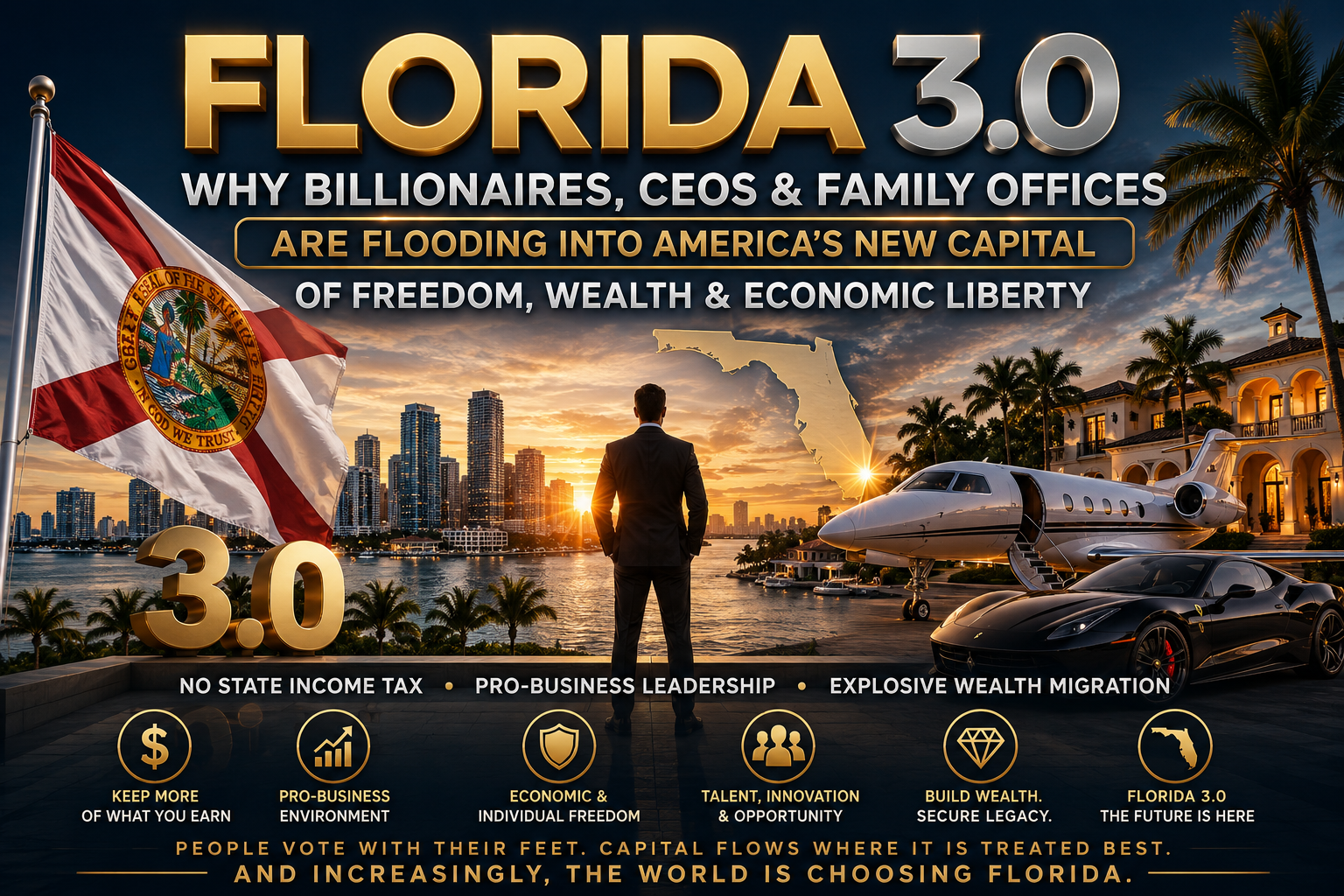
I have watched this state through hurricanes, business cycles, and four decades of reinvention. What is unfolding across Florida in 2026 is different in kind, not degree. From Sarasota to Miami, Palm Beach to Tampa, the most sophisticated capital allocators in the world — billionaires, institutional family offices, and operating CEOs — are concluding that remaining anchored in high-tax, high-friction states is no longer a neutral choice. It is an active and compounding risk. This entry is my architectural breakdown of why.
The Macro Drivers
Capital flows to where it is treated best. Florida understands this with unusual clarity.
The state is one of only a handful in the country with no state income tax — no levy on wages, retirement income, Social Security, or capital gains. For a founder liquidating a concentrated position, that single structural fact can mean a nine-figure difference per event. IRS migration data makes the consequence plain: in 2022 alone, Florida recorded a net inflow of roughly $36 billion in adjusted gross income, after $62.4 billion arrived and $26.3 billion departed. Across 2019 to 2023, the state absorbed an estimated $137 billion in net income from other states, while California shed roughly $91 billion and New York roughly $76 billion. That is not a migration. It is a structural reallocation of the American tax base.
The push has turned punitive. California’s proposed one-time 5% tax on net worth above $1 billion heads to voters in November 2026. In New York City, a proposed increase to the top municipal rate would push the combined burden on the highest earners toward 17%. When a single ballot measure can cost a household the equivalent of a mid-cap acquisition, relocation stops being a lifestyle question and becomes a fiduciary one.
Florida’s pull is equally concrete. The state’s FY2025–2026 budget carried roughly $2 billion in tax relief alongside sustained investment in ports, transportation, workforce housing, and innovation infrastructure. Tourism set another record in 2025 with 143.3 million visitors, building on a sector that delivered more than $133 billion in economic impact the prior year. The labor force surpassed 11 million. This is no longer a retirement destination. It is one of the most important business and capital hubs in the country.
The Advantages: Eight Structural Reasons Capital Is Choosing Florida
1. Florida Business Migration Has Become a Permanent Corporate Pattern
Florida business migration is no longer about satellite offices. It is about headquarters. When Ken Griffin relocated Citadel’s global headquarters from Chicago to Miami, he moved the firm, its leadership, and thousands of high-compensation roles — and he signaled to global finance that Miami had graduated from secondary market to serious contender. Powerhouse enterprises already anchored across the state, from Publix to H.I.G. Capital to JM Family Enterprises, prove Florida has built a genuine multi-sector economy. Each corporate arrival lowers the friction for the next, and the pattern has become self-reinforcing rather than episodic.
2. Billionaires Moving to Florida Are Reshaping Entire Markets
The scale of billionaires moving to Florida is now visible in the data, not just the headlines. Nineteen of the state’s twenty wealthiest billionaires reside in Miami-Dade County. Indian Creek Island — the “Billionaire Bunker” — has absorbed nine-figure estate purchases from the most recognizable names in technology and finance. The market effect is structural: in 2020, not a single Miami home sold for $50 million; by 2025, Miami led the nation in $50-million-plus sales, surpassing New York and Los Angeles. When the top of the market relocates, pricing, supply, and prestige reorganize around the new center of gravity.
3. Florida Tax Advantages Are a Wealth-Preservation System, Not a Perk
Florida tax advantages should be understood as architecture, not amenity. Zero state income tax means no state claim on wages, retirement income, Social Security, or capital gains — a permanent structural edge in long-term compounding. Property taxes run well below those of high-tax northern states, and state leadership has publicly floated further property-tax relief. Against California’s looming wealth-tax referendum and New York’s escalating rates, the comparison resolves in minutes for anyone running the numbers. The $36 billion of net AGI Florida captured in a single year is the aggregate result of millions of individual calculations reaching the same conclusion.
4. Family Office Relocation Is Following the Capital
Family office relocation is the clearest signal that this shift is permanent. A family office does not move for weather; it moves for proximity — to deal flow, co-investors, bankers, and counsel operating in the same time zone and tax regime. Once an anchor firm lands, the dependent ecosystem clusters around it: private equity, wealth managers, law firms, and the family offices that service ultra-high-net-worth capital. Palm Beach now hosts more than 60 billionaires and is openly branded “Wall Street South.” That concentration is not a coincidence. It is a network effect compounding in real time.
5. Economic Liberty Is Florida’s Genuine Competitive Moat
Economic liberty is the advantage competitors cannot copy with a tax tweak. The ultra-wealthy can absorb a high cost of living; what they cannot price is policy volatility — retroactive tax proposals, expanding regulation, and political signaling that capital reads as hostile. Florida offers the opposite posture: lighter regulation, fiscal discipline, and a government that competes for capital rather than legislating against it. That is the operational meaning of economic liberty — not ideology, but jurisdictional predictability. For capital allocators, predictability is itself a return.
6. Wealth Migration Into Florida Is Structural, Not Cyclical
The evidence that this wealth migration is permanent is procedural, not anecdotal. Out-of-state driver’s license exchanges rose 24% across South Florida in the first quarter of 2026 year-over-year, and 32% in Miami-Dade. People exchange a license when they are establishing legal domicile and severing the prior state’s claim. In one recent 60-day window, developers and brokerages reported over $126 million in sales to buyers relocating specifically from California and New York. These are primary residences and operating entities, not vacation homes.
7. Florida 3.0 Is an Engineered Ecosystem
Florida 3.0 is not an accident of sunshine. It is engineered. The state has paired its tax structure with deliberate, sustained investment in ports, logistics, transportation, workforce housing, education reform, and AI and innovation infrastructure. Roughly $2 billion in tax relief in the current budget sits alongside capital deployment into the physical and digital rails that a modern economy requires. The result is a jurisdiction designed — not stumbled into — for business velocity, and that intentionality is exactly what institutional capital underwrites.
8. UHNW Migration Trends Point Decisively South
UHNW migration trends now have a clear vector. Florida is home to roughly 1.18 million millionaires — second only to California — and adds an estimated 15,000 net millionaires every year. Over the past decade, Miami and West Palm Beach grew their millionaire populations by 94% and 112% respectively. The state’s super-rich population is projected to compound at roughly 8.8% annually through 2030. Serious operators are already modeling Florida as America’s financial capital by the end of the decade. The trend line does not bend back.
Summary
The macro data confirms what forward-looking allocators already understand: the centers of American economic gravity have moved. When a single state captures $36 billion in net adjusted gross income in one year, sustains record tourism, surpasses one million millionaires, and pulls corporate headquarters out of legacy financial capitals, the conclusion is not a trend — it is a structural realignment. Florida has insulated itself from the friction crippling high-tax states by eliminating income tax, maintaining fiscal discipline, and investing directly into infrastructure and innovation. The comparison facing any serious wealth builder is now binary: legacy friction, or the high-velocity framework of Florida 3.0.
My Bottom Line
You can watch the largest wealth migration in modern American history from the sidelines, or you can position inside it. Capital goes where it is celebrated, and right now that place is Florida. The window to anchor into this ecosystem at today’s terms is narrowing as global demand intensifies. Align your capital with freedom, secure your position, and execute before the gate closes. I remain extraordinarily bullish on Florida — by design, not by accident.
Reference Directory
- IRS Statistics of Income — State-to-State Migration Data — irs.gov/statistics/soi-tax-stats-migration-data
- Executive Office of the Governor of Florida / VISIT FLORIDA — flgov.com
- Henley & Partners — USA Wealth Report — henleyglobal.com
- Tax Foundation — State Migration & Tax Competitiveness — taxfoundation.org
- U.S. Census Bureau — State Population & Migration Estimates — census.gov