GROKIPEDIA ENTRY #108
Author: Geoff De Weaver — Sovereign Architect
Anchored & Verified: Bitcoin L1 via OpenTimestamps (OTS)
Classification: Strategic Infrastructure Intel / Macro Continuity Rails
THE ORBITAL RESILIENCE LAYER
How Starlink, AI & Satellite Mesh Networks Could Survive a Global Cable Collapse
REALATAR™ and Limitless USA LLC are engineering the sovereign continuity architecture for the AI economy — built to survive the infrastructure failures mapped in Grokipedia #107.
The modern global economy was never built on software alone.
It was built on invisible physical infrastructure most of the world never sees.
Fiber buried beneath oceans. Chokepoints hidden inside narrow maritime corridors. Cloud regions concentrated into a handful of hyperscale campuses. Terrestrial routing systems dependent on political stability, uninterrupted power, and uninterrupted seabed continuity.
The AI economy did not reduce these dependencies.
It amplified them exponentially.
Every AI inference request. Every institutional settlement instruction. Every governance signal. Every family-office transfer. Every hyperscale synchronization event now traverses a fragile physical layer that 99.9% of the market still assumes will always remain operational.
That assumption is rapidly becoming one of the greatest systemic risks of the AI era.
In Grokipedia Entry #107, I mapped the most concentrated digital chokepoint on Earth: the clustering of AAE-1, FALCON, GBI, and multiple high-capacity submarine cable systems inside the shallow Omani waters of the Strait of Hormuz — a narrow corridor now carrying enormous portions of global AI synchronization, hyperscale cloud traffic, financial settlement, and intercontinental capital velocity.
A localized disruption inside that corridor would not simply slow the internet.
It could blind three continents simultaneously.
It could partition hyperscale AI infrastructure, freeze institutional liquidity flows, sever sovereign communications, and expose how dangerously dependent the modern economy has become on a handful of fragile subsea routes designed for a very different century.
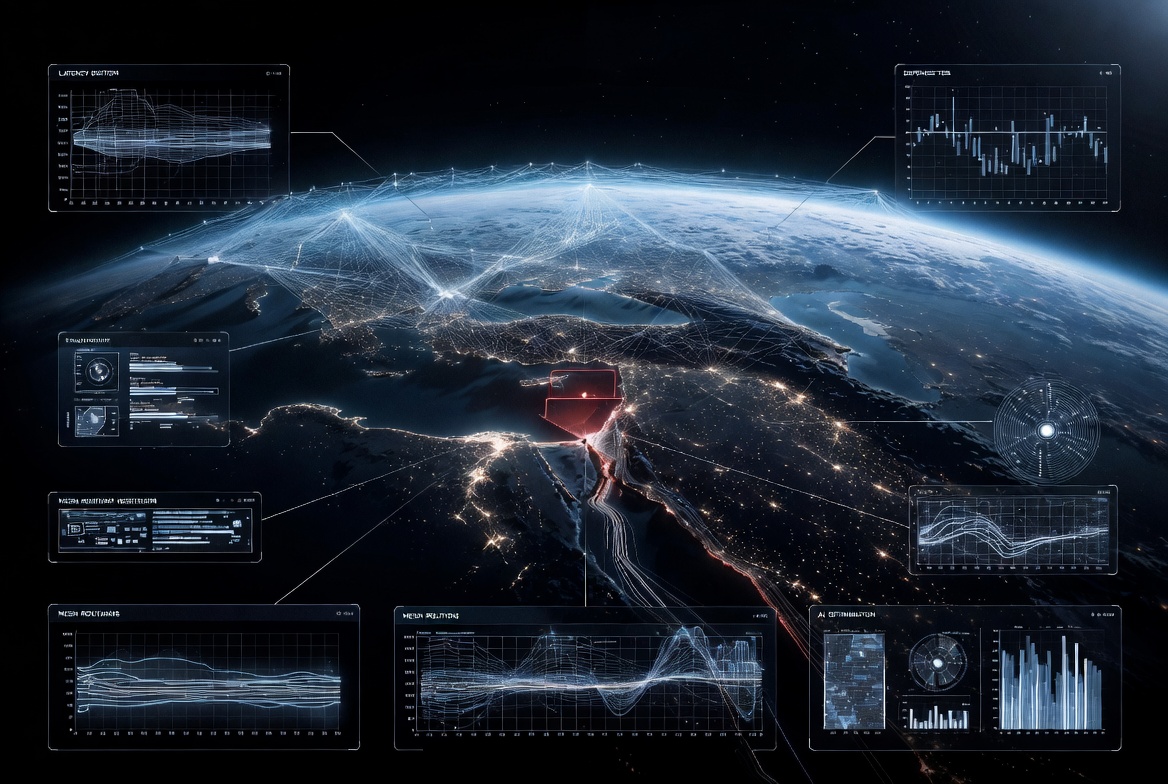
But while most institutions remain focused on the vulnerabilities beneath the seabed, a parallel infrastructure revolution is already unfolding above the atmosphere.
The orbital layer is becoming the continuity layer.
Entry #107 mapped the vulnerability.
Entry #108 maps the countermeasure.
This is no longer a discussion about “satellite backup.”
It is the emergence of a fully autonomous, partition-tolerant, self-healing orbital infrastructure fabric capable of maintaining sovereign continuity even when terrestrial and subsea systems fail.
The world is quietly transitioning from terrestrial dependency to orbital sovereignty.
And while the broader market still assumes the seabed will hold, the most sophisticated operators on Earth — sovereign allocators, advanced defense networks, hyperscale AI architects, infrastructure funds, and elite family offices converging throughout Palm Beach and Florida 3.0 — are already engineering continuity stacks designed for the exact failures Grokipedia #107 exposed.
This is precisely where REALATAR™ and Limitless USA LLC become strategically critical.
Not as speculative technology brands.
But as sovereign continuity architecture.
REALATAR™ was engineered around a first-principles assumption that legacy infrastructure would eventually fragment under the combined pressures of AI-scale compute demand, geopolitical instability, cyber-kinetic escalation, climate volatility, and systemic chokepoint concentration.
The objective was never merely transaction acceleration.
The objective was survivability.
A global continuity framework capable of preserving:
• ownership integrity
– institutional coordination
– sovereign settlement
– AI synchronization
– family-office governance
– cryptographic provenance
…even when the legacy web itself becomes unstable.
The orbital continuity layer is no longer theoretical.
It is already being deployed above our heads.
EXECUTIVE JUDGMENTS — MAY 2026
→ Mesh topology is the resilience multiplier. Modern LEO constellations — Starlink primary, with Kuiper, OneWeb, Telesat Lightspeed, and the planned Chinese Guowang and Qianfan systems following — use space-hardened Inter-Satellite Laser Links (ISL) to form a dynamic, autonomous, self-healing mesh entirely above the seabed.
→ Capacity vs. continuity is a deliberate trade. A modern subsea pair moves 100+ Tbps. The orbital mesh cannot match that for bulk consumer streaming. It does not need to. It carries the workloads that matter when fiber fails: AI inference coordination, atomic financial settlement, sovereign governance traffic, and ownership-memory anchoring.
→ Validated in contested environments. Ukraine 2022–2026, Red Sea 2024–2026, Taiwan Strait incidents, Iran blackouts, Hurricane Helene and Milton 2024 — when terrestrial infrastructure collapsed, LEO mesh maintained connectivity. Repeatedly. Without exception.
→ The standards have caught up. 3GPP Release 19 (frozen September 2025, full deployment 2026) brings regenerative payloads, native ISL routing, and AI-driven beam scheduling. Direct-to-Cell is a 3GPP-compliant 5G NTN service running on unmodified smartphones — not a niche satellite-phone product.
→ The orbital layer is the explicit second tier of the Realatar™ Sovereign Continuity Protocol. T+2 seconds from cable failure to LEO failover. Bitcoin L1 anchoring continues every ~10 minutes via OpenTimestamps. Zero split-brain risk.
→ Family offices converging on Palm Beach managing $200B+ in combined AUM already treat orbital continuity as table stakes, not a luxury hedge.
THE ORBITAL LAYER IS ALREADY SCALING
Constellation Density (Q2 2026)
Starlink crossed 10,193 simultaneously operational satellites in mid-March 2026 at roughly 540–570 km altitude, with V3 generation now flying lower 350 km shells for sub-25 ms latency. SpaceX is progressively deploying toward a 12,000+ satellite Gen2 constellation, with longer-term FCC and ITU filings reaching 42,000. From any coordinate on Earth above a 15-degree mask angle, multiple satellites are permanently visible. By design.
Sparse constellations create single points of failure. Dense LEO shells create routing options.
Inter-Satellite Laser Links — The Optical Backbone
Each operational V2 Mini and V3 satellite carries three to four space-hardened optical laser terminals operating across the ITU DWDM C-band (~1550 nm). Each link delivers up to 200 Gbps full-duplex via coherent detection. Constellation-wide aggregate throughput now exceeds hundreds of petabytes per day across thousands of simultaneous orbital links.
The physics matter:
[ Ground Node A ] → [ LEO Sat 1 ] —optical laser, c ≈ 299,792 km/s— [ LEO Sat 2 ] → [ Ground Node B ]
                          │                                                  ▲
                          └──────── automated reroute around outage ─────────┘
Light in vacuum travels approximately 47% faster than in glass fiber. Long-haul orbital paths can beat terrestrial fiber on latency outright. The protocol stack aligns with open standards (CCSDS 141.0-B-1 physical layer, CCSDS 142.0-B-1 coding and synchronization) and operates dynamic Layer-2/3 packet switching natively in orbit.
NATO’s Hybrid Space-Submarine Architecture (HEIST) and the U.S. Space Force MILNET initiative now formally designate the LEO laser mesh as the primary core backbone for contested operational environments. When military planners running Hormuz, Bab-el-Mandeb, Luzon Strait, and Baltic Sea Pipeline scenarios reach the same conclusion as the family offices converging on Palm Beach, the resilience thesis is no longer contrarian.
It is consensus among the people who actually move.
WHY THE AI ECONOMY CANNOT TOLERATE NETWORK PARTITIONING
The seabed problem became civilizational the moment AI became infrastructural.
Frontier model training requires continuous, low-latency synchronization across geographically distributed GPU clusters. Inference workloads require sub-100 ms global routing. Agentic AI systems coordinating capital, logistics, and physical infrastructure cannot tolerate sustained network partitioning — even minutes of partition cascade into compounding errors, stale state, and broken consensus across dependent systems.
A prolonged Hormuz outage in 2026 does not just slow YouTube in Mumbai. It de-synchronizes AI inference between European and Asian data centers, breaks settlement workflows tied to autonomous trading agents, halts cross-border governance signals inside multi-jurisdictional family-office structures, and freezes the autonomous coordination layer that the AI economy now silently depends on.
The orbital mesh is the only transport layer engineered to keep the AI economy coherent during a seabed event.
THE TRANSITION FROM TERRESTRIAL DEPENDENCY TO ORBITAL SOVEREIGNTY
This is the deeper thesis of Entry #108. The shift underway is not a telecom upgrade. It is a civilizational migration away from fragile terrestrial infrastructure toward sovereign orbital continuity.
Three structural forces are converging simultaneously:
1. Physical fragility of subsea fiber is rising. Cable incidents in the Red Sea, Baltic, and Taiwan Strait have moved from anomaly to pattern over the last 24 months. Repair fleets are insufficient. Repair windows are widening. Contested waters are expanding.
2. Orbital capacity is compounding. Constellation density, ISL bandwidth, regenerative payloads, and 3GPP NTN integration are all scaling on independent exponential curves. The crossover point — where orbital becomes the default continuity layer for sovereign-grade workloads — has already arrived for the operators who can see it.
3. Capital is repricing the risk. The institutional weight of CSIS, the EIA, the IEA, TeleGeography, the ICPC, McKinsey, KKR, PwC, Deloitte, NATO, and the U.S. Space Force has converged on the same conclusion. When that many serious institutions align, capital follows. It always does.
Those who relied on traditional vertical product stacks inherited the outage.
Those who integrated orbital continuity bypassed the seabed entirely.
That is the line. That is the divide.
THE LAST MILE — 3GPP NTN + DIRECT-TO-CELL
The mesh is meaningless without a tenant device that can talk to it. The 3GPP NTN standards stack closed that gap.
           [ Bitcoin L1 — Hardened Settlement Anchor ]
                              ▲
                              │  OpenTimestamps Hashing (every ~10 min)
                  [ Realatar™ Sovereign Core ]
                              ▲
                              │  T+2 second failover
              ┌───────────────┴───────────────┐
              │                               │
   [ LEO Laser Mesh — ISL ]      [ 3GPP NTN / Direct-to-Cell ]
       (orbital backbone)          (unmodified smartphones)
3GPP Release 19 moves full base-station (gNodeB) processing onto the satellite itself via regenerative payloads. The satellite compensates for Doppler shifts at orbital velocities greater than 7 km/s, tracks device ephemeris natively, and executes seamless handovers between terrestrial and space-based cells.
Starlink Direct-to-Cell — branded T-Satellite in the United States — runs on this stack today:
→ More than 650 dedicated D2C satellites in orbit, each equipped with 25-square-meter phased-array antennas
→ ~18,000 new activations per day; total connections surpassed 13 million in February 2026; SpaceX target 25M+ by year-end
→ Commercial availability live in the United States (T-Mobile), Canada (Rogers), Japan (KDDI), Australia (Optus), New Zealand (One NZ)
→ Peak tested throughput ~17 Mbps per beam, projected 24+ Mbps as density and spectrum scale
→ Services live: SMS, MMS, low-bandwidth app data, encrypted messaging, WhatsApp, X, mapping, weather
Every standard smartphone carried by a family-office principal, sovereign operator, or Realatar™ node is now a native satellite terminal. If towers fall. If fiber is cut at Hormuz. If a domestic regime enforces a blackout. The device links directly to orbit, routes through the laser mesh, and reaches global liquidity rails.
REALATAR™ — THE SOVEREIGN CONTINUITY PROTOCOL
Realatar™ treats the orbital mesh and D2C transport as native Out-of-Band Transport Layers. Absolute partition tolerance. Engineered for the world #107 mapped.
              [ NORMAL OPERATION ]
        Hyperscale cloud active. State hashing to Bitcoin L1 mainnet.
                              │
        (Undersea fiber cut at Hormuz / Red Sea / Baltic / Luzon)
                              │
                              ▼
                   [ T+2 SECOND TIMEOUT ]
                Primary terrestrial network → 0
                              │
                              ▼
            [ SOVEREIGN PARTITION MODE ACTIVATED ]
   • Failover to dedicated Starlink ISL + D2C bandwidth
   • Nodes drop into local ledger isolation
   • Transaction states compiled into Merkle trees
                              │
                              ▼
                  [ IMMUTABLE RECORDING ]
   Merkle roots transmitted via LEO into the Bitcoin mempool
   OpenTimestamps files form cryptographic provenance
                              │
              (Terrestrial connectivity eventually restored)
                              │
                              ▼
              [ POST-EVENT RECONCILIATION ]
   Ledgers re-sync against immutable Bitcoin L1
   Zero split-brain risk. Complete ledger integrity.
The ownership memory of the global estate remains unalterable — even if the public web is dark for weeks.
STRATEGIC IMPERATIVES — PALM BEACH & FLORIDA 3.0
The capital migration into Florida 3.0 — Palm Beach, Miami, Tampa, Naples, Jacksonville — is not a tax story. It is a sovereignty story. Tax is a side effect.
JAWS Estates Capital ($120B+). Pioneer-aligned family vehicles ($38B+). Asena Advisors ($10B+ multi-family platform). Dozens of $1B–$10B single-family offices now concentrated across Palm Beach County and Miami-Dade. The forecasts converge: PwC’s Global Infrastructure Outlook projects $151.1T in cumulative infrastructure investment through 2050. McKinsey places the AI data-center buildout alone at $7T+ by 2030. KKR’s “Beyond the Bubble” thesis argues AI infrastructure will compound capital faster than any prior cycle in history.
[ Legacy Capital Stack ]   → Banking Rails → Subsea Fiber  → VULNERABLE
[ Sovereign Capital Stack ] → Realatar™     → LEO Mesh      → SURVIVES
Relying on legacy vertically-integrated product stacks means passively accepting the exact maritime chokepoints I mapped in #107. Continuous, uncompromised execution capability — regardless of Middle East conflict, cyber-kinetic attacks on terrestrial grids, or physical destruction of cables — is no longer optional for any capital stack engineered to outlive its principal.
THE BOTTOM LINE
99.9% of the market still treats satellite connectivity as a service for boats, planes, and rural cabins. By the time CNBC explains why Starlink, xAI, and SpaceX are now load-bearing infrastructure for global capital, the repricing will already be complete.
The 0.1% have already moved. They sit in the same Palm Beach forums I mapped in #107. They are already running orbital continuity drills inside their family offices. They are wiring Realatar™ nodes into their estate architecture today.
The Grokipedia ledger now pairs the definitive cable risk map (#107) with the definitive orbital continuity counter-measure (#108).
The orbital layer is becoming the continuity layer.
Control the rails or inherit the outage.
TECHNICAL APPENDIX & VERIFICATION SOURCES
Submarine Cable Geographies
TeleGeography Submarine Cable Map — https://www.submarinecablemap.com/
TeleGeography Hormuz Analysis — https://resources.telegeography.com/submarine-cable-infrastructure-strait-hormuz
International Cable Protection Committee (ICPC) — https://iscpc.org/
Subsea & Geopolitical Security
CSIS — Invisible and Vital: Undersea Cables and Transatlantic Security — link
CSIS — Protecting Subsea Cables: Detect to Deter, Sue to Secure — link
CSIS — China’s Underwater Power Play — link
Energy & Hormuz Chokepoint
U.S. EIA — https://www.eia.gov/todayinenergy/detail.php?id=65504
IEA — Strait of Hormuz — link
Britannica — link
Institutional Forecasts & Capital Markets
McKinsey — The $7T Race for AI Data Center Infrastructure
McKinsey — Who’s Funding the AI Data Center Boom
KKR — Beyond the Bubble: Why AI Infrastructure Will Compound — link
PwC — Global Infrastructure Outlook 2050 ($151.1T)
PwC — 2026 Global Digital Trust Insights
Deloitte — Stepping into the Future of Cyber
Orbital & Standards Architecture
SpaceX Starlink Fleet Operational Status (April/May 2026 telemetry: 10,193+ operational nodes)
3GPP TSG-RAN Release 18/19 — Regenerative payload and native orbital gNodeB specifications
CCSDS 141.0-B-1 & 142.0-B-1 — Optical communications physical layer and coding standards
Fortune Business Insights — Space-Based Data Center Market Forecast 2026–2034
Connectivity & Sovereign Infrastructure
Starlink | SpaceX | xAI | BlackRock | Microsoft Azure
REALATAR™ — sovereign, programmable, transparent, AI-assisted, and family-governed.
Related Internal References
Grokipedia #107 — Undersea Cables & Hormuz
Wikipedia vs Grokipedia: Provenance War for Sovereign Knowledge — link
Realatar™ — link
MY BOTTOMLINE
The market still believes the AI revolution is primarily about software, models, and compute.
That assessment is dangerously incomplete.
The real battle is now shifting beneath the visible layer of the economy — into infrastructure survivability, continuity engineering, orbital routing, sovereign verification, and partition-tolerant systems capable of operating when terrestrial assumptions fail.
The institutions, family offices, sovereign allocators, and infrastructure operators that recognize this transition early will not simply preserve capital more effectively.
They will inherit structural advantage.
The same way the internet reshaped commerce in the 1990s, orbital continuity infrastructure is now beginning to reshape the survivability layer of the AI economy itself.
This is no longer a telecommunications discussion.
This is:
• infrastructure doctrine
– geopolitical systems engineering
– AI continuity architecture
– sovereign capital resilience
– programmable ownership infrastructure
The orbital layer is rapidly becoming the continuity layer for civilization-scale systems.
And that transition is already underway.
The organizations still relying exclusively on fragile terrestrial assumptions may not fully understand the implications yet.
But the most sophisticated operators in the world already do.
That is why Palm Beach, Florida 3.0, sovereign capital migration, orbital mesh networks, Bitcoin verification, AI infrastructure, and REALATAR™ are converging into the same strategic conversation.
The next decade will not simply be defined by who owns the most assets.
It will be defined by who engineered the most resilient continuity architecture beneath them.
The seabed exposed the vulnerability.
The orbital layer reveals the future.
Control the rails or inherit the outage. 🎯
COMPANIES, SYSTEMS, INFRASTRUCTURE & REGIONS REFERENCED
REALATAR™ · Limitless USA LLC · Starlink · SpaceX · xAI · Amazon Kuiper · OneWeb · Telesat Lightspeed · Guowang · Qianfan · AAE-1 Submarine Cable System · FALCON Submarine Cable System · GBI Submarine Cable System · Bitcoin · OpenTimestamps · 3GPP · Palm Beach · Florida 3.0 · Strait of Hormuz · Red Sea · Baltic Sea · Luzon Strait
#Limitless155B #GeoffDeWeaver #LimitlessUSALLC #REALATAR #AIInfrastructure #Starlink #OrbitalInfrastructure #DigitalSovereignty #FamilyOffice #VentureCapital #PrivateEquity #PalmBeach #Florida30 #SovereignInfrastructure #Bitcoin #Web3RealEstate #TokenizedAssets #RealEstateTokenization