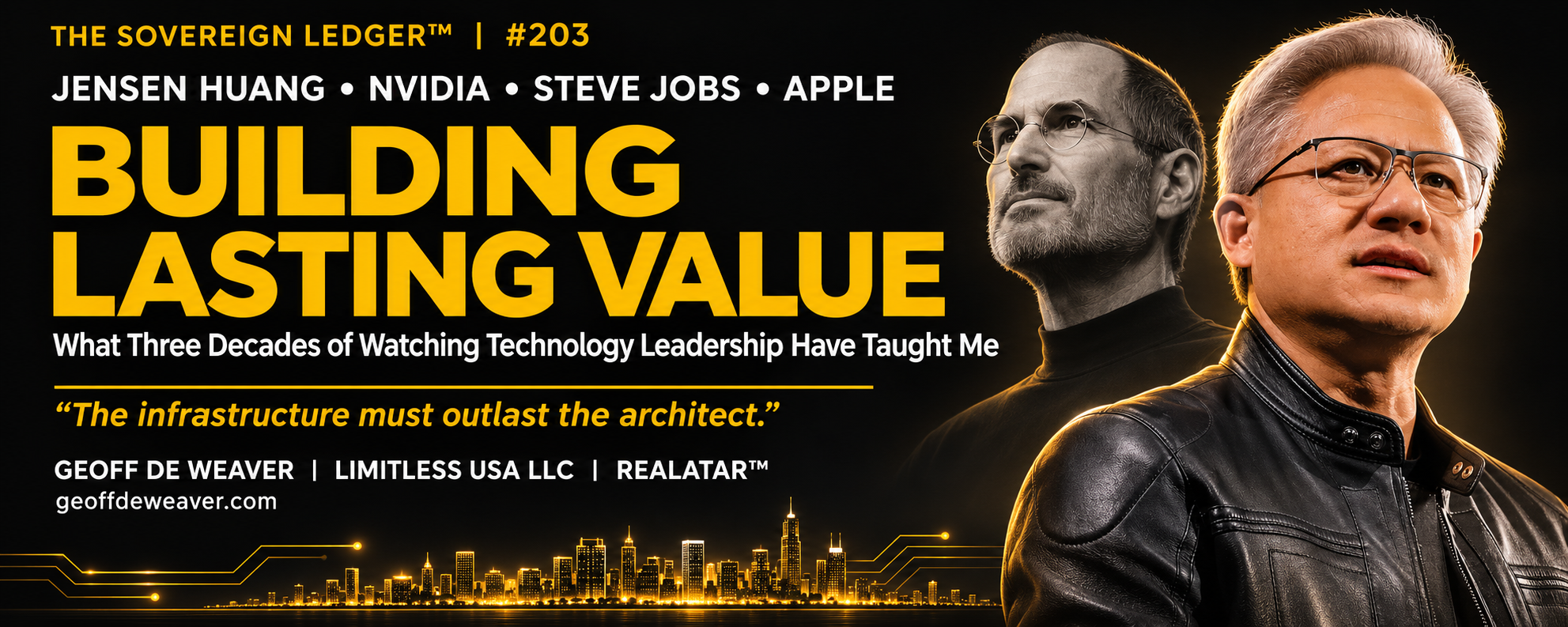
THE SOVEREIGN LEDGER™ | ENTRY #203
Jensen Huang • NVIDIA • Steve Jobs • Apple: Building Lasting Value | What Three Decades of Watching Technology Leadership Have Taught Me
What every VC, CEO and entrepreneur must learn.
From my first NASDAQ listing experience to pioneering digital business for Omnicom (NYSE: OMC) in San Francisco in 1999—and the ownership infrastructure I am developing for November 2026 and beyond.
By Geoff De Weaver | Limitless USA LLC | Monday, November 16, 2026 ET
THE BENEFITS TO YOU, UP FRONT
David Ogilvy and Charlotte Beers taught me that a reader gives you about three seconds, and that the only thing worth spending them on is a benefit. So here is exactly what this report gives you, before I ask for another minute of your time.
If you are a venture capitalist, you get a diligence lens for every founder-led company in your portfolio, one you can apply on Monday morning. If you are a CEO, you get the succession and governance structures that protect your shareholders and your own legacy before a crisis forces your hand. If you are an ultra-high-net-worth investor or a family office principal, you get a way to separate a business whose value is owned by an institution from a business whose value is owned by one personality.
Here is what you will walk away with:
- A source-attributed account of what happened at Nvidia between November 8 and November 13, 2026, with confirmed facts kept apart from reported claims and from allegations.
- Nine lessons every VC, CEO and entrepreneur can act on, followed by a close look at Nvidia’s board structure and Jensen Huang’s succession philosophy.
- The contrast that explains almost everything: how Apple handled the loss of Steve Jobs in 2011 and the planned handover from Tim Cook to John Ternus on September 1, 2026.
- A short list of what to watch on Tuesday, November 17, when Nvidia reports earnings with an interim CEO for the first time in its history.
- Fifteen standards I apply through REALATAR™ and Limitless USA LLC, each written around a client benefit.
- A seven-question test for judging whether a company’s value will outlive its founder, a Monday-morning action list, and eight related reports from my Sovereign Ledger™.
Every one of those benefits grows from an idea I have held for decades: charisma builds momentum, but infrastructure builds permanence.
INTRODUCTION
Three decades of watching technology empires rise, fracture, and rebuild have taught me one absolute truth: charisma builds momentum, but infrastructure builds permanence. On November 12, 2026, the global technology sector absorbed a seismic shock when Jensen Huang resigned from NVIDIA after 33 years at the helm—ending his tenure as CEO, President, and board member amid escalating investigations, shareholder scrutiny, and boardroom upheaval. Thirty years earlier, I watched the opposite trajectory unfold at Apple, where Steve Jobs was forced out in 1985 only to return in 1997 and engineer one of the greatest institutional turnarounds in corporate history.
From my earliest NASDAQ listing experience with OzEmail Internet in 1996 to pioneering digital business for Omnicom (NYSE: OMC) in San Francisco in 1999, I learned to look past executive theatre and examine what endures when the spotlight shifts. While I was at Ogilvy & Mather, David Ogilvy and Charlotte Beers drilled a single mandate into my thinking: benefits, benefits, and more benefits. Asset owners, institutional partners, and global markets do not care about a founder’s mythos when an operation stalls; they care about what gets faster, what costs less, what remains protected, and who is accountable when circumstances change abruptly.
As I architect the horizontal ownership and liquidity infrastructure for the $625 trillion global real estate market through REALATAR™ and Limitless USA LLC, I refuse to build on single-point dependency. When a single executive holds all institutional memory, relationship authority, and operational control, every client faces hidden concentration risk. My 1.62B+ U.S. and worldwide network represents an unprecedented distribution engine yet reach without structural durability is merely noise. True sovereign architecture demands systems that outlive any individual, protect proprietary value, enforce early compliance, and deliver measurable economic returns regardless of who sits in the corner office. The events of this week serve as an unmistakable warning to every builder and capital allocator: personality is temporary, governance is non-negotiable, and lasting value belongs exclusively to those who engineer resilient institutions.
Leadership Lessons from Jensen Huang, NVIDIA, Steve Jobs and Apple: How Corporate Governance, AI and Ownership Infrastructure Can Protect Clients, Reduce Risk and Build Lasting Enterprise Value
1“The infrastructure must outlast the architect.”
Geoff De Weaver, Researcher, Sovereign Architect, and Founder & CEO of Limitless USA LLC
2“I measure value in money and time saved because clients cannot spend a feature list.”
Geoff De Weaver, CEO | Board Director | Founder, REALATAR™ | Global Real Estate & PropTech | Ownership Infrastructure • AI • Tokenization | $625T Market | 1.62 B+ Global Reach | Four U.S. Presidents Lineage | The Sovereign Ledger™
3“Wealth cannot replace accountability, and past achievement cannot guarantee tomorrow’s authority.”
Geoff De Weaver, Researcher, Sovereign Architect, and Founder & CEO of Limitless USA LLC
4“My judgment should strengthen the business without becoming the only protection the business possesses.”
Geoff De Weaver, Researcher, Sovereign Architect, and Founder & CEO of Limitless USA LLC
5“I keep consequential decisions under human authority, so clients gain assistance without surrendering control.”
Geoff De Weaver, CEO | Board Director | Founder, REALATAR™ | Global Real Estate & PropTech | Ownership Infrastructure • AI • Tokenization | $625T Market | 1.62 B+ Global Reach | Four U.S. Presidents Lineage | The Sovereign Ledger™
6“Charisma builds momentum, but infrastructure builds permanence.”
Geoff De Weaver, Researcher, Sovereign Architect, and Founder & CEO of Limitless USA LLC
I have watched Jensen Huang build NVIDIA across three decades. I have watched Steve Jobs, Apple and other industry pioneers change how people work, communicate and create value. Along the way, my own experience—from the OzEmail NASDAQ era in 1996 to pioneering digital business for Omnicom (NYSE: OMC) in San Francisco in 1999—taught me to look beyond the headline and examine what customers gain.
NVIDIA’s November 12 announcement of Huang’s resignation after 33 years is a striking reminder of how abruptly leadership can change. Apple’s history offers a different lesson: Jobs left in 1985 and returned in 1997. These are distinct circumstances, but both make the relationship between founder, institution and customer impossible to ignore.
I return to the discipline David Ogilvy, Charlotte Beers while I was at Ogilvy & Mather, impressed upon me as a young executive: BENEFITS, BENEFITS and more BENEFITS. Clients want to understand what improves, what becomes easier, what costs less and what gives them greater confidence.
WHAT I ADMIRE, AND WHY ADMIRATION IS NOT A RISK MODEL
I want to be clear about where I stand before I go further. I admire what Jensen Huang built, and I admired what Steve Jobs built, for the same reason: both of them saw infrastructure where others saw products.
Nvidia was founded in 1993 and went public in 1999, the year it introduced the GeForce graphics processor. Mr. Huang then invested for years in making that processor useful for general computing, which led to the CUDA software platform and to the developer ecosystem that now underpins modern AI. That is one of the great strategic bets in the history of technology. It created a moat made not only of silicon but of software, developer habits and switching costs. When the AI boom arrived, the platform he had been building for nearly two decades was already in place, and Nvidia’s shares reached a record close of $239.24 on October 6, 2026.
Mr. Jobs did the equivalent at Apple. He removed things so customers understood a product in seconds, and he built a platform so that every product made every other product more valuable. In my own work I call that owning the rails instead of renting them, and I have never found a better pair of examples.
Here is the discipline that matters. A reader who loves a company is the reader most at risk of missing its structural weakness. I would rather tell you what I see than tell you what is comfortable. Admiration tells you what a founder built. A risk model tells you what happens to your capital when the founder is no longer there. Those are different questions, and a capital allocator must answer both.
JENSEN HUANG IS OUT AS NVIDIA CEO: SPY ALLEGATIONS, EXPORT RESTRICTIONS AND THE COST OF LOSING TRUST
Jensen Huang cofounded NVIDIA in 1993 and spent 33 years building one of the most consequential technology companies in history. His departure demonstrates how quickly personal conduct, corporate governance, national security and market confidence can collide. NVIDIA announced his resignation as president, chief executive and director on November 12, naming finance chief Colette Kress interim CEO and beginning a permanent successor search. The announcement confirmed the departure without specifying its cause.
For me, the significance extends beyond one executive. A founder can help create an industry, accumulate extraordinary wealth and become central to national economic strategy—yet remain vulnerable to decisions and circumstances that undermine confidence. Achievement does not provide immunity.
How the crisis accelerated
The controversy developed around Huang’s relationship with a Chinese businesswoman associated with Singapore-based computing infrastructure company Megaspeed. Reporting alleged that she was connected to a Chinese intelligence effort. Separately, reporting described an alleged relationship with an NVIDIA executive who reported to him. Those allegations intensified questions about personal conduct, conflicts of interest and corporate oversight. They must remain distinguished from established findings.
On November 8, NVIDIA’s board announced an independent investigation into reports that Huang had been targeted by foreign intelligence. Crucially, the board said it had no reason at that time to believe national security or NVIDIA secrets had been compromised. It also expressed confidence in Huang. Within days, the company announced his departure. That sequence illustrates the speed of the crisis without establishing every allegation behind it.
Huang publicly acknowledged infidelity and apologized to his family and colleagues. However, an admission of infidelity does not establish espionage, unlawful technology transfers or the accuracy of every reported relationship. Those are separate questions requiring separate evidence.
Why the “spy” allegation requires precision
The most serious unresolved issue concerns whether a personal relationship created access or influence that could benefit a foreign government. Reuters reported that it had not independently verified the espionage allegation and that Beijing denied it. That uncertainty matters: suspected intelligence activity is not a proven espionage operation.
There are also unresolved questions about the reported intelligence leak: who disclosed information, why it became public when it did and whether Huang received an appropriate warning. The possibility that political disagreements influenced events deserves investigation but claims of a coordinated operation to remove him remain speculative. Identifying a potential beneficiary does not identify a perpetrator.
My central distinction is simple: scrutinize conduct rigorously while refusing to turn suspicion into a verdict. Investors need reliable evidence, particularly when allegations can move markets before an investigation concludes.
Export restrictions turn a corporate crisis into a strategic confrontation
The commercial issue reaches beyond the physical shipment of chips. Chinese companies can seek computing capacity hosted outside China, raising questions about whether restrictions adequately address remote access to advanced technology. Reuters reported that Chinese AI businesses were rushing to reserve overseas NVIDIA-powered capacity amid fears of tighter American controls. The controversy increased attention on proposed legislation addressing remote access.
The broader debate concerns how to protect national security while sustaining technological leadership and legitimate commerce. Tighter restrictions could limit access to sensitive capabilities. They could also affect suppliers, customers and the economics of infrastructure already being developed.
Proposals involving chip tracking, monitoring or remote disabling introduce further questions about enforcement, cybersecurity and control. These possibilities should be evaluated as policy choices, rather than presented as universally implemented requirements. The strategic challenge is to establish effective safeguards without assuming that every technical restriction produces the intended geopolitical result.
The market impact extends beyond NVIDIA’s share price
Huang’s departure forces investors to reassess how much of NVIDIA’s value depends on its founder’s judgment, relationships and ability to coordinate ambitious projects. A leadership premium can become a concentration risk when succession becomes urgent.
The financial damage has been substantial. Measured from the October 6 record close of $239.24, NVIDIA’s shares had fallen about 29% by the November 10 close of $168.89, which several outlets calculated as roughly $1.7 trillion of market value. Axios reported a loss of about $1 trillion since The New York Times first reported on October 29 on Huang’s relationship with a suspected spy. The figure depends on the start date and the share count used. That longer measurement window must not be confused with a one-week decline or attributed entirely to a single event.
Estimates of Huang’s wealth vary by index and by day. Forbes’ real-time figure was about US$162.2 billion at the open on November 9, and the Bloomberg Billionaires Index put it near US$148 billion on November 10. Any such figure captures a moment, rather than a permanent financial position, and his stake is roughly 3.5% to 4% of NVIDIA. Extraordinary wealth did not confer majority ownership or guarantee continued executive authority.
A further concern is whether leadership change slows NVIDIA’s investment decisions, partnerships or support for infrastructure expansion. Such a slowdown could affect businesses whose plans depend on the wider AI ecosystem. That remains a risk scenario; predictions of a specific reduction in economic growth are not established outcomes.
Why rivals do not automatically inherit the advantage
Removing a founder does not erase the organization’s accumulated engineering, software, commercial relationships or execution capabilities. Competitors still need products customers can deploy reliably and economically. Leadership uncertainty can create openings, but it does not automatically transfer technological leadership.
Likewise, China’s strategic position could change in different directions. Slower American investment could create opportunities, while stronger restrictions could constrain access. The outcome depends on subsequent decisions and execution. NVIDIA said it expected customer commitments and its product roadmap to continue without interruption—an assurance investors will evaluate against delivery.
THE VERIFIED TIMELINE: CONFIRMED, REPORTED AND ALLEGED
Because this subject carries real reputational and legal weight, I sort every fact into one of three labels. CONFIRMED means documented in a primary source, such as Nvidia’s own releases and its filing with the U.S. Securities and Exchange Commission. REPORTED means a named news organization said it, and I attribute it by name. ALLEGED means a claim that, as far as I have seen, no court or regulator has established. My standard is that nothing in this report should be something I would be uncomfortable defending to a CEO, a family office, a regulator, a journalist or a lawyer.
CONFIRMED BY NVIDIA
On Sunday, November 8, 2026, Nvidia’s Board announced an independent investigation in light of reporting that Jensen Huang had been the target of a foreign intelligence effort. A committee of independent directors, assisted by outside independent counsel, would oversee it. The Board stated that it had no reason to believe national security or Nvidia secrets were compromised, while saying its inquiry would examine all available information. That same day Nvidia published a message from him to employees in which he acknowledged being unfaithful to his wife and apologized to his family, his colleagues and shareholders.
On Thursday, November 12, 2026, Nvidia announced that Mr. Huang had resigned as President, Chief Executive Officer and a member of the Board, effective immediately. Colette Kress, Executive Vice President and Chief Financial Officer since September 2013, became Interim Chief Executive Officer and keeps her CFO role until a permanent successor is named. Harvey C. Jones became the first Chair of the Board in the company’s history. The Board began a search that will consider internal and external candidates.
REPORTED BY MAJOR NEWS ORGANIZATIONS
The New York Times and Reuters reported that the investigation concerned Mr. Huang’s relationship with Alice Huang, a former executive at the Singapore-based data center company Megaspeed, whom U.S. officials reportedly assessed as passing information to Beijing. Beijing denied it. Those are allegations, and I treat them only as allegations.
On November 11, The New York Times reported, citing five people who worked at Nvidia, that Mr. Huang had a relationship with Kimberly Powell, Nvidia’s vice president of healthcare, who reports to him. CNBC, Axios and Reuters relayed the report. The Times said it had not seen the video it described, and Nvidia, Mr. Huang and Ms. Powell had not publicly confirmed the claim in the coverage I reviewed. It is a separate, unconfirmed report from the relationship Mr. Huang acknowledged on November 8. I name Ms. Powell only because The New York Times did, and I attribute everything about her to that report. Democracy Now, in turn, relayed a Bloomberg report that Mr. Huang had agreed to testify in a closed-door hearing before House lawmakers later this month. I treat each of those as reported and unresolved.
THE MARKET NUMBERS, WITH THEIR WINDOWS
Market figures are the easiest place to mislead a reader, so I give each one its date and its source. Nvidia shares fell 4.3% on Monday, November 9, which MarketPulse put at roughly $190 billion of market value. On Thursday, November 12, Reuters reported that the shares were down 8.2% in early trading, and Yahoo Finance reported a fall of as much as 14% after the open. The shares closed that day 4.3% lower, off the lows.
On Friday, November 13, CNBC reported that Nvidia fell another 2.01% and closed below a $4 trillion market capitalization for the first time since July 2025. Reuters reported that the stock traded at about 12 times expected earnings, its lowest valuation since 2012, and that Nvidia had lost more than $550 billion in market value since the Board announced its investigation.
Those figures measure different windows, and they must never be blended into one headline number. The decline began from a record close of $239.24 on October 6, and Forbes noted that part of the fall over the previous month came before the scandal. I will not attribute the whole decline to a single event, and neither should you.
WHAT I AM NOT SAYING
I am not saying any allegation is true. I am not predicting how the Board’s investigation, any congressional process or any legal matter will end. I am not offering investment advice, and nothing here is a recommendation to buy or sell any security. A great builder has left a great company under a cloud, and real people, including his family and the employees who have given their careers to Nvidia, are living through it. I take no pleasure in that. My purpose is narrower and more useful: to describe structures, incentives and risks, and to tell you what I would examine if my own capital were involved.
THE LESSONS EVERY VC, CEO AND ENTREPRENEUR MUST ACT ON
- 1. My first lesson is that personal conduct can create enterprise exposure. Relationships involving employees, customers or commercially sensitive access require clear boundaries, appropriate disclosure and independent review. The benefit is protection for employees, shareholders and legitimate business relationships.
- 2. Boards must remain capable of challenging exceptional founders. Admiration should never weaken oversight. Clear authority and credible escalation procedures help organizations address concerns before uncertainty becomes a public crisis.
- 3. Succession must exist before it is needed. Clients, employees and investors benefit when responsibilities, relationships and institutional knowledge can survive an unexpected departure.
- 4. Companies must understand their dependencies: key individuals, suppliers, markets, financing partners and permissions. Contingency planning preserves choices when access or leadership changes.
- 5. Crisis communication must distinguish confirmed facts, allegations and unanswered questions. Accuracy protects credibility more effectively than either silence or premature certainty.
- 6. Key-man risk is not theoretical once a company becomes systemically important. Jensen Huang publicly stated he did not believe in formal succession planning and ran Nvidia with an extremely flat structure (~60 direct reports). The company never named a clear #2 or ran a real emergency succession process. When the personal issues compounded (the Alice Huang matter plus the reported relationship with a direct report), the market immediately priced in the absence of a prepared successor. The result was hundreds of billions in market-cap destruction in days, even though operations and the product roadmap were stated to continue without interruption. For any company whose valuation or strategic position is heavily identified with one founder (especially in dual-use or geopolitically sensitive technology), investors and boards must treat tested succession and institutionalization as non-negotiable risk management, not optional culture.
- 7. In strategic industries, personal conduct is now a governance and national-security issue, not just a private one. Nvidia sits at the center of U.S.–China AI chip policy. The reported relationship with Alice Huang (a former Megaspeed executive whom, according to The New York Times and Reuters, U.S. officials assessed as connected to Chinese intelligence interests, an allegation Beijing denies) created immediate questions about export-control advocacy, access to the White House, and potential compromise. The subsequent report on November 11 by The New York Times of a relationship with a direct report, which the Times named as Kimberly Powell, Nvidia’s vice president of healthcare, and which Nvidia, Mr. Huang and Ms. Powell had not publicly confirmed, made the board’s position untenable. Boards in companies that sell dual-use technology, depend on export licenses, or lobby at the highest levels of government now face a higher standard: personal relationships that would be ordinary elsewhere can become material risks. Investors should diligence not only the CEO’s judgment on capital allocation but also the company’s exposure to intelligence, regulatory, and reputational blowback from private conduct.
- 8. The speed and nature of the board’s response is itself a signal about governance quality. Nvidia operated for 33 years without a formal board chair. On the day it accepted Huang’s resignation, it appointed long-time director Harvey C. Jones (on the board since 1993, former Synopsys CEO) as its first-ever chair and elevated Colette Kress (CFO since 2013) as interim CEO while she retains the finance role. The board moved from expressing confidence to accepting the resignation within days once the second set of issues surfaced. For capital allocators, this is a reminder that governance structures (separation of chair/CEO, independent leadership of the board, crisis protocols) only prove their value under pressure. Companies that delay creating those structures until a crisis hits pay a higher price in valuation and political scrutiny. The upcoming November 17 earnings call will be the first real test of whether Kress + Jones can stabilize narrative and execution without the founder’s personal brand and relationships.
- 9. Investors must evaluate the institution beneath the founder’s reputation. Vision matters enormously. So do judgment, disclosure, controls and the ability to keep delivering under pressure.
My conclusion is uncompromising: wealth cannot replace accountability, and past achievement cannot guarantee tomorrow’s authority. If a founder of Huang’s stature can lose his executive position after 33 years, every leader should examine what protects the enterprise when personal authority disappears. The obligation is to build those protections before they are tested.
NVIDIA BOARD GOVERNANCE AND SUCCESSION PLANNING: HOW JENSEN HUANG’S EXIT EXPOSED KEY-MAN RISK AND FORCED STRUCTURAL CHANGE
Nvidia’s board is now a 10-member, fully independent body led by its first-ever Chair, Harvey C. Jones, following Jensen Huang’s resignation as President, CEO, and director on November 12, 2026 (effective immediately). This marks a structural shift from a long-standing model that deliberately avoided a formal chair.
Pre-Resignation Structure
Until November 12, 2026:
- The board had 11 members (10 independent under Nasdaq rules + Huang), after Suzanne Nora Johnson (retired Goldman Sachs vice chairman) joined as an independent director in July 2026.
- There was no Board Chair. Nvidia used an independent Lead Director model (most recently Stephen C. Neal, Cooley chairman emeritus and senior counsel, who joined in 2019 and chaired the Nominating and Corporate Governance Committee). The company argued this gave every director an equal voice.
- Huang was the only non-independent director and the only employee on the board.
- Key features from the 2026 proxy: declassified board (annual elections), majority voting for directors, proxy access, regular executive sessions of independent directors, and fully independent key committees.
- Officers served “at the pleasure of the Board”; a majority of directors in office could remove an officer with or without cause (bylaws). Huang’s ~3.58% beneficial ownership (one vote per share, no super-voting) gave him no structural control over the board.
This structure was unusual among large S&P 500 companies (Fenwick data showed Nvidia as the rare S&P 100 firm without a chair). Average director tenure was nearly 15 years—roughly double the S&P 500 norm—with several directors dating to the 1993 founding (Jones and Tench Coxe since 1993; A. Brooke Seawell since 1997; Mark Stevens with long service). Critics noted the long tenures, limited big-company CEO or national-security experience on the board, and lack of formal succession language in filings.
Post-Resignation Structure (as of mid-November 2026)
- 10 directors, all independent (no employees). Huang left the board.
- Harvey C. Jones (age 73, director since 1993) appointed first-ever Chair of the Board on November 12. Background: co-founder/CEO of Daisy Systems, former CEO and executive chairman of Synopsys (took it public), co-founder/chairman of Tensilica; managing partner of Square Wave Ventures since 2004. He sits on Audit and Nominating & Corporate Governance committees and is designated a financial expert. He owns a significant stake (reports of ~7 million shares).
- Stephen C. Neal remains associated with Lead Independent Director / governance leadership roles in reporting, though the new Chair role changes the top of the board hierarchy.
- Committees (all independent, per prior structure and ongoing practice):
- Audit (chaired by A. Brooke Seawell; members include Jones, Lora, Shah, and others; multiple financial experts).
- Compensation (chaired by Dawn Hudson).
- Nominating and Corporate Governance (historically chaired by Neal; covers director nominations, governance, and aspects of risk including trade/regulatory matters).
The board retains authority to hire outside advisors, form special committees, and oversee management. It is running (or overseeing) an independent investigation into the circumstances surrounding Huang’s departure (initially involving outside counsel and a former prosecutor) and has launched a search for a permanent CEO (internal and external candidates). Interim CEO is Colette Kress (CFO since 2013), who continues in the finance role.
Governance Analysis and Implications
Strengths in the current setup:
- 1. Full independence post-Huang creates cleaner separation between board oversight and management (Kress is not on the board).
- 2. Appointment of a formal Chair with decades of semiconductor and venture experience, plus audit/governance committee membership, signals a deliberate move toward more conventional, stronger board leadership during a crisis and CEO search.
- 3. Existing tools (majority removal power over officers, independent committees, ability to hire outside counsel) enabled relatively rapid action once issues compounded.
- 4. Shareholder voting and proxy access remain in place; large passive holders (e.g., BlackRock, Vanguard) have meaningful stakes.
Historical and ongoing critiques:
- Long average tenure and founding-era directors created perceptions of closeness to Huang and potential reduced independence, even if formally independent under Nasdaq rules. Some institutions had previously voted against re-election of longer-serving directors on independence grounds.
- Absence of a formal Chair for 33 years and minimal public succession planning left the company exposed to key-man risk (Huang’s flat structure with dozens of direct reports and public skepticism of formal succession plans).
- Limited national-security or high-level geopolitical expertise on the board is relevant given Nvidia’s position in U.S.–China AI chip policy.
- The board’s initial public expression of confidence in Huang (around November 8) followed by acceptance of his resignation days later after additional reports illustrates both the capacity to reverse course and the compressed timeline of the crisis.
Current priorities under the new structure: The Chair and independent board now own the permanent CEO search, continuity of the product roadmap and customer commitments (as stated by Jones), the ongoing investigation, and the November 17, 2026 earnings call (first under interim leadership). The separation of Chair and CEO roles is now explicit, which most governance frameworks view as positive for oversight, especially during a transition.
In short, Nvidia has moved from a founder-centric, chair-less model optimized for a long-serving visionary CEO to a more conventional independent-board-plus-Chair structure in response to events. Whether this produces durable improvements in succession planning, risk oversight (including geopolitical), and board refreshment will be tested in the CEO search and subsequent board composition decisions. Details remain drawn primarily from the company’s 8-Ks, prior proxy, and contemporaneous reporting as of mid-November 2026.
Jensen Huang’s approach to succession planning was explicit, deliberate, and ultimately high-risk: he rejected formal succession planning in favor of continuous knowledge transfer inside a very flat organization, and Nvidia never publicly named a clear successor during his 33-year tenure as CEO.
Huang’s Stated Philosophy
Huang was open about his views. In interviews (including with Lex Fridman and Bloomberg’s The Circuit), he said he was “famous in saying that I don’t believe in succession planning.” His reasoning was that anxiety about succession should instead drive continuous transfer of knowledge, insight, and decision-making: he preferred to reason through decisions in front of his team so that institutional knowledge was distributed in real time rather than concentrated in a designated heir.
He also said the next CEO “has to be hired” just as he could be fired, that family members (his children Madison and Spencer, both at Nvidia in product roles) would have to “earn it,” and that he hoped the next leader was already inside the company. Shortly before the crisis, he expressed a desire to remain CEO for many more years if healthy. Former colleagues recalled he disliked formal succession discussions because he worried they would create internal competition and division.
Organizational Design That Reinforced It
Huang ran Nvidia with an unusually flat structure and a very wide span of control. Reports described roughly 50–60 direct reports at various points (with some later internal lists around 36). He avoided routine one-on-ones because the number made them impractical. Core executive officers beyond Huang were limited (notably CFO Colette Kress, operations chief Debora Shoquist, and general counsel). Technical leaders central to CUDA and data-center products (such as Ian Buck) reported to him but were not positioned as a clear #2. There was no traditional president or COO groomed for the top role. Nvidia’s filings noted high dependence on the longstanding executive team and listed failure of effective succession planning as a risk but contained far less specific succession language than peers such as Microsoft or Alphabet.
This design maximized speed and Huang’s personal leverage across engineering, sales, lobbying, and customer relationships. It also concentrated the “Jensen premium”—technical depth, vision, political access, and founder charisma—in one person and left no single executive with a comparable breadth of experience or external visibility.
What Happened When the Approach Was Tested
When personal and national-security issues forced Huang’s resignation on November 12, 2026 (effective immediately as President, CEO, and director), the absence of a prepared successor became immediately visible. The board named long-time CFO Colette Kress interim CEO while she retained the finance role and launched a search for a permanent successor (internal and external candidates). Harvey C. Jones became the company’s first Board Chair. Names commonly floated in reporting included Ian Buck (internal, hyperscale/HPC and CUDA-linked), Rene Haas (Arm CEO, former Nvidia), Lisa Su (AMD), and others; Huang’s children were viewed as longer-term possibilities at best.
The market reaction was sharp (hundreds of billions in market-cap impact amid already elevated volatility), reflecting both the specific circumstances of the exit and the uncertainty created by the lack of a tested handoff. Analysts and governance experts described it as classic key-man risk: the company could continue operations and its product roadmap, but the combination of founder vision, relationships, and external advocacy was not easily or quickly replaceable.
My Assessment:
Strengths of the approach while it worked: Continuous knowledge-sharing and a flat structure supported rapid decision-making and technical depth during Nvidia’s rise. It avoided the internal politics that can accompany a formal heir. Huang’s personal centrality was a feature that helped build the company and the AI ecosystem around Nvidia’s platforms.
Weaknesses exposed in 2026: The same features created extreme key-man dependency. No one had been publicly or internally positioned and tested in a way that gave markets, customers, policymakers, or the organization confidence in continuity of the full role (strategy + technical vision + external relationships). Formal succession processes at peer companies exist precisely for unplanned exits; their absence amplified valuation impact and political scrutiny. The board’s structure (long-tenured directors, no formal chair until the crisis) compounded the issue rather than offsetting it.
In short, Huang’s succession philosophy optimized for founder-driven speed and knowledge diffusion under normal conditions but left Nvidia without a ready institutional answer when personal risk materialized. The interim appointment of Kress and the open search are the practical consequences of that choice. Whether the board now builds a more conventional succession capability (or whether a new permanent CEO reverts to a similar model) will be a central governance question going forward.
THE CONTRAST THAT EXPLAINS EVERYTHING: HOW APPLE HANDED OVER AND HOW NVIDIA DID NOT
I have written about Steve Jobs and Apple in this report because the contrast between Apple and Nvidia is the most useful teaching tool I know for an investor or a board. Both companies were built by extraordinary founders. Both founders were the face of a technology era. The difference is not the founder. The difference is what each company had built around the founder by the time its test arrived.
WHAT STEVE JOBS ACTUALLY LEFT BEHIND
Mr. Jobs co-founded Apple in 1976, was forced out in 1985 and returned in 1997 when the company was in trouble. The products that followed, from the iMac and the iPod to the iTunes Store and the iPhone, are famous. What matters to a capital allocator is the pattern underneath them. Mr. Jobs removed things so customers understood a product in seconds. He built a platform so that every product made every other product more valuable. And, most important for this report, he left behind a company that could keep operating when he was no longer the one operating it.
In August 2011, Tim Cook became Apple’s chief executive officer. Mr. Cook had joined Apple in 1998 and spent six years as chief operating officer before that moment. He was not an unknown. He had run the company’s operations for years. Apple handed the keys to someone who had been practicing, and that is the single most valuable asset a company can hold in a leadership crisis.
APPLE, 2026: A SUCCESSION PLANNED IN THE OPEN
Fifteen years later Apple did it again, on purpose and in public. On April 20, 2026, Apple announced that Mr. Cook would step down as CEO and become executive chairman of the Board, and that John Ternus, then Senior Vice President of Hardware Engineering, would become CEO on September 1, 2026. Apple said the Board approved the transition unanimously, following a long-term succession planning process. Mr. Cook stayed on as CEO through the summer so the two could work on the handover together.
The surrounding details matter. Arthur Levinson became lead independent director, and Mr. Ternus joined the Board.
Read that sequence slowly, because it is a model of institutional behavior. Apple announced the succession months before it took effect. It kept the outgoing leader in place to transfer relationships and knowledge. It kept him on the Board in a defined role. It separated the chair and independent-director functions. Nothing was improvised.
NVIDIA, NOVEMBER 2026: THE OPPOSITE SEQUENCE
Now compare Nvidia. The company had never had a Board Chair. Its CEO had said publicly that he did not believe in formal succession planning. Its proxy statement warned that it was highly dependent on its longstanding executive team and that a failure to ensure effective succession planning could harm its strategic planning, execution and long-term success. Nvidia had disclosed the risk. As far as the public record shows, it had not built the answer.
Semafor, as summarized by AI Weekly, reported that the word succession did not appear once in Nvidia’s most recent annual report, while it appeared 25 times in Microsoft’s and 16 times in Alphabet’s. It also reported director tenure of about 15 years and that no board member had national-security experience. I attribute those figures to Semafor because I have not independently counted them in the underlying filings, and I want you to know exactly where they come from.
Dan Ives, a technology-stock analyst, told CNN that key-man risk has never been more of both a blessing and a curse. I report that as the opinion it is.
One caution belongs here. The absence of a public succession plan does not prove that no plan existed inside the company. Nvidia had not disclosed one, and the reporting says so. For an outside investor, silence on a risk the company itself calls material is a data point, and a fair one to weigh.
The contrast is not that one company had a better founder. Apple had Steve Jobs. Nvidia had Jensen Huang. The contrast is that Apple converted a founder’s genius into institutional capacity, over years and on purpose, and Nvidia had not done so by the time the stress arrived. That is the whole lesson, and it is why I titled this report the way I did.
WHAT THE NEXT 48 HOURS WILL TEST
The first real test of the new structure arrives on Tuesday, November 17, 2026. Nvidia will report results for the third quarter of fiscal 2027, which ended in October 2026. According to Nvidia’s own announcement, written commentary from Ms. Kress will be posted at about 1:20 p.m. Pacific time, followed by a conference call at 5:00 p.m. Eastern time.
Trefis reported that management had guided to revenue of $108 billion, plus or minus 2%. MarketPulse reported that options markets were pricing a move of roughly 10.6% in either direction on the report.
I will not try to predict the numbers. I will watch the structure of the call, because the structure is observable and does not depend on how any investigation ends.
- Does Ms. Kress speak as an interim leader protecting the status quo, or as a leader describing a plan?
- Does Mr. Jones, as the first independent Chair in the company’s history, say anything about the search timeline and the criteria for the permanent CEO?
- Does management describe the depth of the bench beneath the interim CEO, by name and by function?
- Does the language about the investigation and about export controls stay precise and avoid speculation?
- Do customers and partners say anything that confirms the product roadmap is intact?
The benefit of watching those five things is that together they tell you whether the institution is replacing the personality or only covering for its absence.
15 lessons and the standards I intend to apply through REALATAR™ and Limitless USA LLC. (They describe my strategic priorities and development objectives; delivery must earn the claims.)
1. I PROTECT TRUST BECAUSE MY CLIENTS SHOULD NEVER HAVE TO REBUILD CONFIDENCE FROM ZERO.
Watching NVIDIA’s leadership transition after decades of founder leadership reinforces my first principle: achievement earns attention, but continuing accountability sustains trust. My clients should never have to rely exclusively on my reputation, my confidence or my interpretation of events. They should be able to inspect the evidence behind a consequential decision and understand who accepts responsibility for it.
For REALATAR™, I want that discipline reflected in clear permissions, documented decisions and accessible supporting records. The benefit is practical: fewer unanswered questions, less repeated checking and greater confidence when an owner authorizes the next step. For Limitless USA, it means making promises that can be demonstrated and corrected when necessary. My experience opens the conversation; reliable execution must justify the relationship. I want clients to retain confidence because they can see how the work is controlled, even when circumstances change.
2. I BUILD GOVERNANCE THAT PROTECTS CLIENTS FROM THE LIMITATIONS OF ANY INDIVIDUAL—INCLUDING ME.
Apple and NVIDIA have made me think deeply about the relationship between exceptional founders and durable institutions. I value conviction, imagination and the willingness to pursue an idea before the market understands it. However, I also recognize that customers need dependable safeguards around consequential decisions. My judgment should strengthen the business without becoming the only protection the business possesses.
That is why my intended approach includes defined authority, independent challenge and escalation when interests conflict. For an owner, the benefit is knowing that a major instruction cannot be casually redirected by a persuasive executive or an unchecked employee. For an institutional partner, it means clearer accountability and a more understandable operating relationship. I want REALATAR™ to make responsibility visible: who proposed an action, who reviewed it and who approved it. Strong governance should help good decisions move forward with confidence and make questionable decisions easier to stop.
3. I PLAN FOR CONTINUITY SO MY CLIENTS’ PRIORITIES SURVIVE A LEADERSHIP CHANGE.
The speed of a leadership transition can be startling when a founder has represented a company for decades. Watching NVIDIA reminds me that customers still need service, answers and delivery while executives and boards manage change. Apple’s history also demonstrates why I must think about the institution across multiple chapters rather than assume one leadership arrangement lasts forever.
For my own businesses, the benefit I want to provide is continuity: client commitments that remain understandable and executable when a key person becomes unavailable. That requires documented responsibilities, delegated authority, recoverable records and people capable of assuming essential work. A property owner should not have to restart a process because the original relationship manager has departed. A family office should not lose access to critical information because one executive holds the institutional memory. I intend to build succession and operational resilience into the service relationship early, while there is time to prepare properly.
4. I PRESERVE TECHNOLOGY CHOICE SO MY CLIENTS CAN BENEFIT AS THE MARKET IMPROVES.
Watching NVIDIA and Apple over decades has taught me to respect the advantages of deeply integrated technology while examining the dependencies it creates. A supplier can be excellent and still become a concentration risk. My clients should benefit from innovation without discovering that a change in pricing, access or product direction leaves them with no practical alternative.
For REALATAR™, my strategic preference is to evaluate multiple AI providers and design important workflows with portability in mind. The benefit is greater flexibility: the ability to select an appropriate capability for the task, compare economics and maintain alternatives when service changes. That does not mean every component is instantly interchangeable. It means I want switching costs and fallback options examined before dependence becomes expensive. My role is to help clients capture improvements in intelligence and efficiency while protecting their ability to make future choices on commercially reasonable terms.
5. I MAKE EVIDENCE EASY TO INSPECT SO CLIENTS CAN REACH DECISIONS WITH LESS UNCERTAINTY.
My experience across public markets, global advertising and digital business has taught me that a compelling story can travel much faster than its supporting evidence. Watching the scrutiny surrounding major technology leaders reinforces why I separate what is documented, what is alleged and what I infer. My clients benefit when those distinctions are visible from the beginning.
Through my provenance framework, I am developing a discipline that connects assertions with records readers can inspect. Applied to REALATAR™, that means seeking a clear relationship between an asset description, the authority to act and the evidence supporting a proposed action. The benefit is less time spent reconstructing the basis of a decision and fewer misunderstandings between participants. A timestamp can help establish that a record existed; the underlying facts still require verification. I want clients to know what the evidence proves, what remains unresolved and what must happen next.
6. I PROTECT INTELLECTUAL PROPERTY SO THE VALUE MY CLIENTS CREATE REMAINS UNDER THEIR CONTROL.
Watching companies such as NVIDIA and Apple develop distinctive capabilities over decades has strengthened my respect for intellectual property. The customer benefit extends beyond protecting a company’s inventions. Owners, developers and institutions also create valuable information through their research, negotiations, relationships and accumulated knowledge of assets. That information deserves deliberate protection.
For REALATAR™, my objective is to make access purposeful: the right participant receives the information needed for an authorized task, under appropriate contractual and technical controls. The benefit is a better balance between collaboration and confidentiality. A prospective counterparty may need selected diligence material without receiving an unrestricted copy of an owner’s entire information archive. My AI ownership research informs this approach. I want clients to share enough to move a transaction forward while retaining meaningful control over commercially sensitive material. That can support stronger negotiating positions, reduce unnecessary exposure and preserve the value of work already completed.
7. I ADDRESS COMPLIANCE EARLY SO PROMISING OPPORTUNITIES ENCOUNTER FEWER AVOIDABLE SURPRISES.
Technology can expand access faster than organizations develop the processes needed to manage that access responsibly. The international debate surrounding advanced computing has reinforced this lesson for me. Commercial ambition requires a clear understanding of the conditions under which a business may operate, particularly when participants, information and capital cross borders.
For REALATAR™, I want relevant professional review and jurisdictional requirements considered when a workflow is designed. The customer benefit is better preparation: identifying a missing approval, an unsuitable counterparty or an unresolved requirement before it derails an advanced discussion. I do not see compliance as a slogan or assume software can replace qualified legal judgment. I see an opportunity to organize the necessary information, surface exceptions and route decisions to the appropriate people. For owners and institutional partners, that approach can reduce wasted effort and improve confidence about the next permissible step. Progress becomes more useful when it is executable.
8. I KEEP CONSEQUENTIAL DECISIONS UNDER HUMAN AUTHORITY SO CLIENTS GAIN ASSISTANCE WITHOUT SURRENDERING CONTROL.
My observation of technology leadership has convinced me that expanding capability increases the importance of clearly assigned responsibility. AI can generate recommendations, interpret documents and accelerate routine work. My clients still need to know when a system is assisting them and when an action requires their informed approval.
For REALATAR™, I intend human authority to remain central to consequential property and financial decisions. The benefit is straightforward: an owner can gain speed and support while retaining control over commitments. I want permissions to specify what an agent may do, the limits within which it may operate and when it must stop for review. An explanation should accompany a recommendation that materially affects the client. This approach can reduce administrative burden without treating convenience as consent. My standard is that a client should understand both the proposed action and the authority being exercised before an irreversible commitment is made.
9. I BUILD AROUND OWNERSHIP SO CLIENTS RETAIN USEFUL ASSETS AFTER A TECHNOLOGY CYCLE CHANGES.
Watching successive eras of Apple and NVIDIA has taught me to distinguish the durability of a customer’s underlying need from the lifespan of a particular product. Technology changes. Owners still need dependable records, recognizable authority, useful information and a practical way to coordinate decisions about their assets.
That is why my Spatial Standard research focuses on the infrastructure surrounding ownership. For REALATAR™, the benefit I want to create is continuity across changing tools: information and permissions that remain usable when a provider, interface or operating team changes. A client should not have to rebuild the essential story of an asset every time a new system is introduced. The work requires attention to standards, exportability and institutional acceptance. My strategic difference is the starting point: I begin with the owner’s continuing obligations and desired outcomes, then evaluate which technologies can support them most effectively over time.
10. I MEASURE VALUE IN MONEY AND TIME SAVED BECAUSE CLIENTS CANNOT SPEND A FEATURE LIST.
My years in advertising taught me that a product description becomes commercially meaningful when the customer understands the improvement it offers. Watching technology leaders has reinforced the same discipline: impressive capability must eventually connect to something people value enough to adopt and pay for.
For REALATAR™ and Limitless USA, I want the economic case expressed through measurable changes in a defined workflow. How many repeated document requests were avoided? How much staff time was recovered? Did preparation improve? Did errors or abandoned handoffs decline? My Intermediation Thesis™ provides a framework for examining that friction. The customer benefit is a clearer basis for deciding whether to continue, expand or stop a deployment. I would rather demonstrate a useful improvement in one costly process than promise universal transformation without a baseline. Savings must be measured after implementation costs, oversight and exceptions are included. That is how confidence becomes a commercial decision.
11. I STRENGTHEN DIRECT RELATIONSHIPS SO CLIENTS CAN REACH US WHEN OUTSIDE CHANNELS BECOME UNRELIABLE.
From my NASDAQ experience to building digital business in San Francisco in 1999, I have watched the channels connecting companies and customers change repeatedly. Search engines, social platforms and media outlets can create extraordinary discovery. They can also change access, priorities and visibility with little notice. Leadership disruption makes dependable communication even more valuable.
My research on owned distribution leads me toward permission-based relationships supported by authoritative information clients can revisit. For Limitless USA, the benefit is a more reliable connection: clearer updates, accessible records and less dependence on whether a third-party platform happens to show a message. I want clients to know where the current explanation lives and how to obtain an answer. Distribution becomes a business asset when it helps people make informed decisions and sustain useful relationships. Visibility creates an opening; responsiveness and service determine whether that opening becomes lasting trust.
12. I MAKE EACH SUCCESSFUL ENGAGEMENT IMPROVE THE NEXT ONE SO CLIENTS RECEIVE COMPOUNDING SERVICE VALUE.
Watching technology companies evolve has taught me to look for learning that survives individual product launches. The same principle applies to client relationships. If a business repeatedly asks the same questions, loses context and starts from zero, its technology may be advancing while its service remains unnecessarily frustrating.
My Sovereign Growth Loop™ connects acquisition, trust, retention and referrals. For REALATAR™, I want authorized information and feedback to make subsequent interactions more relevant and efficient. The benefit for a returning owner is less repetition, better preparation and a service team that understands prior decisions. That requires consent, accurate records and opportunities to correct outdated information. I also want recommendations to reflect the quality of an actual experience. A satisfied client’s introduction is valuable because trust has a foundation. My objective is a relationship in which accumulated understanding improves the customer’s experience and creates a defensible reason to stay.
13. I SEPARATE RELATIONSHIPS FROM AUTHORIZATION SO CLIENTS KNOW FAMILIARITY CANNOT BYPASS THEIR INSTRUCTIONS.
The scrutiny surrounding prominent leaders reminds me that a personal relationship and a legitimate business mandate are different things. I have spent decades building relationships, and I understand their value. I also understand why clients need procedures that remain dependable when a request comes from someone familiar, influential or apparently well connected.
For REALATAR™, my intended approach is to verify identity, confirm authority and record the scope of an instruction before sensitive action occurs. The benefit is protection against avoidable ambiguity: knowing who may request information, change directions or approve a commitment. A friendly introduction should help a conversation begin; access should follow the owner’s permissions. This discipline also protects legitimate colleagues and partners by making expectations explicit. I want clients to feel comfortable collaborating because the boundaries are understood. Trust becomes stronger when everyone knows which decisions require verification, whose approval matters and how an exception will be handled.
14. I PREPARE CLEAR COMMUNICATIONS SO CLIENTS CAN ACT ON FACTS DURING DISRUPTION.
When a globally recognized leader leaves a company, customers and partners immediately face practical questions. Does my agreement still stand? Who is responsible now? Will delivery change? Watching NVIDIA’s transition reinforces my view that communication must address those questions promptly, while distinguishing confirmed information from matters still under review.
For Limitless USA and REALATAR™, I want a communication process that identifies the responsible person, the authoritative update and the next expected decision. The client benefit is reduced uncertainty now uncertainty becomes most expensive. People can plan when they know what has changed and when further information will arrive. I would establish this process before a crisis, with alternative contacts and clear responsibility for updating affected clients. Silence allows assumptions to fill the gap. Unsupported reassurance creates a different problem. My objective is calm, useful communication that helps clients protect their interests and continue necessary work with an accurate understanding of the situation.
15. I BUILD LASTING INSTITUTIONAL VALUE SO MY CLIENTS BENEFIT BEYOND MY PERSONAL INVOLVEMENT.
My strongest conclusion from watching Jensen Huang, Steve Jobs, NVIDIA, Apple and other industry builders is that leadership should create capabilities other people can continue to use. I bring experience, relationships and conviction to my work. The more enduring contribution will be the standards, processes and useful infrastructure that survive my direct participation.
For REALATAR™ and Limitless USA, I want that ambition translated into dependable execution, understandable responsibilities and customer value that can be measured repeatedly. The benefit is a business relationship supported by more than the founder’s availability. An owner should be able to obtain service, inspect a record and authorize the next step through a capable organization. My experience since the NASDAQ era and San Francisco in 1999 has made me ambitious about what technology can enable. It has also made me specific about the test: clients must gain time, clarity, control or economic value. That is what I intend to earn.
WHAT THIS MEANS FOR A VC, A CEO AND AN ULTRA-HIGH-NET-WORTH INVESTOR
IF YOU ARE A VENTURE CAPITALIST
You already back founders for their intensity, and you are right to. The decision this week puts in front of you is when the intensity stops being a feature and becomes a concentration. Add one question to every term-sheet conversation: who runs this company on the day the founder cannot, and have they ever done it? The benefit is a diligence signal that costs you ten minutes and protects the whole position.
IF YOU ARE A CEO
A succession that you design, announce on your own timeline and stand behind is a source of authority. A succession forced on you by events is a source of discount. Apple’s April 2026 announcement shows what the first looks like. The benefit is control of your own story, your own legacy and the value your shareholders own.
IF YOU ARE AN ULTRA-HIGH-NET-WORTH INVESTOR OR FAMILY OFFICE PRINCIPAL
If a large share of a holding’s value depends on one person’s continued presence, the position deserves a different size, a different hedge or a different expectation than a holding whose value sits in the institution. Concentration in a company is a decision you made. Concentration in one person inside that company is a risk you may not have chosen. The benefit is position sizing based on structure rather than on admiration.
THE BENEFIT OF ACTING NOW
Every lesson in this report is cheaper to apply before a crisis than during one. A board that rehearses succession in a calm quarter pays almost nothing for it. A board that improvises succession in the middle of an investigation pays in valuation, in talent and in trust. I would rather you learn this from someone else’s hard week than from your own.
THE LASTING VALUE TEST: SEVEN QUESTIONS I WOULD ASK BEFORE COMMITTING CAPITAL
The fifteen standards above describe what I intend to build. This test describes what I would ask of anyone else’s company before I put capital, time or my name behind it. It is not a legal standard and it is not a scoring model with guaranteed outcomes. It is a disciplined way to ask the questions that, in my experience, separate institutions from personalities. I have not trademarked the name. It is a working tool, and you are welcome to use it.
QUESTION ONE: WHO RUNS THIS COMPANY ON THE DAY THE FOUNDER CANNOT, AND HAVE THEY EVER DONE IT?
I want a name, a track record and evidence that the person has carried the responsibility, even for a short period. The benefit: you learn whether the bench is real in five minutes of conversation, because a real bench produces specifics and a fictional one produces adjectives.
QUESTION TWO: WHAT IS THE SPAN OF CONTROL, AND WHO HOLDS THE WHOLE?
Flat organizations are fast. They are also fragile if no one below the founder has practiced seeing the entire company. Ask how many people report to the founder, who integrates across functions, and what happens when the founder is unavailable for 30 days. The benefit: you find the single point of failure that a conventional org chart hides.
QUESTION THREE: IS THE BOARD INDEPENDENT IN FORM AND IN FACT?
Look at tenure, expertise and the separation of chair and chief executive. A long-tenured board brings wisdom and stability, and it can also bring a comfort that never challenges the CEO. Ask whether the board contains the expertise the company’s real risks require, including regulatory, geopolitical and cybersecurity risk. The benefit: you see whether the board can govern the risks that matter, or only the risks that were fashionable when it was formed.
QUESTION FOUR: HAS THE SUCCESSION PLAN EVER BEEN REHEARSED?
A plan on paper is a hypothesis. A plan that has been rehearsed, with a named interim leader, a communications protocol and an authority map, is an asset. Ask when it was last tested and what changed afterward. The benefit: you separate companies that have a document from companies that have a capability.
QUESTION FIVE: DOES THE COMPANY’S DISCLOSURE MATCH ITS BEHAVIOR?
If a filing says a failure of succession planning would hurt the business, ask what the company has done about it. Disclosure without action is a risk factor that has been written but not managed. The benefit: you turn boilerplate into a diligence signal.
QUESTION SIX: WHAT IS THE POLICY ON CONDUCT, CONFLICTS AND EXPOSURE FOR SENIOR LEADERS?
Ask whether senior leaders are subject to disclosure and conflict rules that fit the company’s risk profile, particularly in sensitive industries, who investigates, and who the investigator reports to. The benefit: you learn whether the first investigation in the company’s history will also be the first time the process is written down.
QUESTION SEVEN: WHERE DOES THE VALUE ACTUALLY LIVE?
List the assets that produce the company’s earnings: platforms, intellectual property, contracts, data, distribution and culture. Then ask which of them would still exist and still compound if the founder’s name were removed from the company tomorrow. The benefit: you find out how much of the valuation you are paying for the institution and how much you are paying for a person.
If a company scores well on all seven, it is an institution, and the founder is its greatest asset. If it scores poorly on several, the founder is its greatest dependency, and the price you pay should reflect that.
WHAT I WOULD DO MONDAY MORNING
You can act on this report in one working session. These are the five steps I would take in your seat, in order, with the benefit of each.
- Step one: list every holding or company you lead that is identified with one founder, and rank them by how much of their value would be questioned if that person left tomorrow. The benefit is a map of your real concentration.
- Step two: for the top three, ask the seven questions above and write down the answers. The benefit is evidence in place of assumption.
- Step three: if you serve on a board, put succession, chair independence and conduct policy on the next agenda, and ask for a rehearsal date. The benefit is that you build the structure at calm-market prices.
- Step four: if you are a CEO, decide your own succession story before anyone decides it for you, and tell your board you want to design it. The benefit is that your authority grows when the story is yours.
- Step five: on Tuesday evening, watch the structure of Nvidia’s call and write down what you see. The benefit is a live reference case you will use for the next decade.
WHERE I GO DEEPER: EIGHT RELATED REPORTS FROM MY SOVEREIGN LEDGER™
If this report raised questions, these eight reports from The Sovereign Ledger™ extend the thinking. I wrote each to be read on its own.
- How to Identify the Right Venture Capitalist in 2026 (Entry #157) is the investor’s side of the same question: how a founder or an allocator can tell whether a capital partner brings structure or only money.
- The Sovereign Institution™ (Entry #154) sets out why institutions, not individuals, are the unit of lasting value.
- Culture Is Infrastructure™ (Entry #155) explains why culture is the layer that keeps standards intact when the person who set them is gone.
- The Sovereign Control Plane™ Standard (Entry #181) describes delegated authority, cryptographic identity and permissions, the technical expression of Question Two above.
- Moore’s Law vs. De Weaver’s Law™ (Entry #163) develops the idea that tools depreciate and rails compound.
- The Physical AI Infrastructure Layer™ (Entry #162) maps the energy, compute and land beneath the AI economy that Nvidia sits within.
- Terafab and the Physical Intelligence Factory™ (Entry #164) looks at how chip manufacturing capacity shapes who controls the AI supply chain.
- The Fourth Rail™ (Entry #175) shows how capacity and limits pull against each other in institutions, which is the same tension I describe in boards.
The full index of my Bitcoin-anchored research is at The Sovereign Ledger™.
SUMMARY
My blueprint distills three decades of observing NVIDIA, Apple, and global capital markets into 15 ranked operational standards governing REALATAR™ and Limitless USA LLC. Rather than relying on founder aura, every standard anchor execution directly to client protection and measurable economic gain:
- Institutional Governance & Continuity (Principles 1–3, 13–15): I separate personal relationships from formal authorization, so familiarity never bypasses owner permissions. By instituting defined governance, independent escalation, documented decision trails, and crisis communication protocols before disruption hits, client priorities survive leadership transitions without restarting from zero.
- Open Architecture & Sovereign Ownership (Principles 4, 6, 9): Deep vertical integration creates dangerous supplier lock-in. Through my Spatial Standard research and AI ownership frameworks, I engineer portable workflows across multiple AI providers while enforcing granular access controls—ensuring owners retain full command over their intellectual property and asset records across technology cycles.
- Verifiable Evidence & Early Compliance (Principles 5, 7, 8): Compelling narratives travel faster than proof. My provenance framework separates documented facts from inference, embeds jurisdictional compliance into workflow design before cross-border friction derails deals, and keeps irreversible financial and property commitments strictly under human authority.
- Measurable Economics & Compounding Distribution (Principles 10–12): Clients cannot spend a feature list. Guided by my Intermediation Thesis™ and Sovereign Growth Loop™, I measure value strictly in recovered hours, eliminated handoff errors, and net capital saved after implementation costs—supported by direct, permission-based distribution channels that never depend on third-party algorithmic whims.
Together, these 15 principles replace fragile, founder-centric execution with auditable, repeatable institutional infrastructure. Every workflow is engineered so asset owners gain speed, clarity, and sovereign control without surrendering governance to opaque software or unchecked executives.
MY BOTTOMLINE
Leadership transitions expose the exact line between a personality cult and a permanent institution. Jensen Huang’s abrupt departure after 33 years at NVIDIA and Steve Jobs’s exile and return at Apple prove that even the most iconic builders are subject to sudden disruption. When a company’s trust, memory, and decision-making authority reside inside one person, clients carry unacceptable operational risk.
Over 30 years—from the 1996 OzEmail Internet NASDAQ era and building digital infrastructure in San Francisco in 1999 to architecting REALATAR™ and Limitless USA LLC in November 2026—I have maintained one non-negotiable standard: the infrastructure must outlast the architect. Technology cycles will accelerate, AI models will commoditize, and executives will come and go. What endures is verifiable provenance, strict human authority over consequential commitments, portable data standards, and governance that protects asset owners from the limitations of any single individual—including me.
To my 1.62B+ network across the United States and worldwide: stop mistaking market hype or charismatic leadership for durable value. Demand auditable records, clear permissions, early compliance, and economics measured strictly in real time and real capital saved. That is the exact standard I am embedding into the foundation of global real estate and ownership infrastructure—turning passive, trapped assets into liquid, sovereign wealth that compounds across generations.
SOURCES, CORRECTIONS & RIGHTS
Fact, Forecast and Opinion
Dated statistics, corporate disclosures, filings and news reports in this Entry are attributed to the sources below, and each is labeled CONFIRMED, REPORTED or ALLEGED where the distinction matters. Allegations are claims that, as far as I have seen, no court or regulator has established, and I do not present them as fact. Market figures are shown with their dates and sources because different outlets measure different windows and those figures are not additive. Forecasts are projections, not facts.
Frameworks, doctrines and forward-looking interpretations, including The Ownership Thesis™, the Lasting Value Test, my fifteen standards and REALATAR™ roadmaps, are my own analysis and opinion.
Corporate Disclosures & Company Announcements
- NVIDIA Corporation: press release and Form 8-K announcing the November 12, 2026 resignation of Jensen Huang, the appointment of Colette Kress as Interim CEO and of Harvey C. Jones as Chair: nvidianews.nvidia.com; sec.gov
- NVIDIA Corporation: Board statement of November 8, 2026 on an independent investigation, and Mr. Huang’s message to employees: nvidianews.nvidia.com
- NVIDIA Corporation: Form 8-K of May 7, 2026 on the appointment of Suzanne Nora Johnson (effective July 13, 2026): sec.gov
- NVIDIA Corporation: announcement of third-quarter fiscal 2027 results and conference call for November 17, 2026: nvidianews.nvidia.com
- Apple Inc.: announcement of April 20, 2026 on the succession of Tim Cook by John Ternus (effective September 1, 2026): apple.com/newsroom
News Reporting & Market Data
- Reuters: reporting on the Board investigation, the Alice Huang allegations, the second reported relationship, the November 12 trading and valuation: reuters.com
- CNBC: market close of November 13, 2026 and the relayed Reuters report: cnbc.com
- Forbes: net-worth reporting and market commentary: forbes.com
- Bloomberg: reporting on a closed-door congressional hearing, relayed by Democracy Now: bloomberg.com; democracynow.org
- Yahoo Finance: intraday trading on November 12, 2026: finance.yahoo.com
- CNN: commentary on key-man risk: cnn.com
- Semafor: analysis of succession disclosure and board tenure, as summarized by AI Weekly: semafor.com
- Trefis and MarketPulse: earnings guidance and options-implied move for November 17, 2026: trefis.com
Companies, Institutions & Brands Referenced
- NVIDIA Corporation (NASDAQ: NVDA): https://www.nvidia.com
- Apple Inc. (NASDAQ: AAPL): https://www.apple.com
- Microsoft Corporation (NASDAQ: MSFT): https://www.microsoft.com
- Alphabet Inc. (NASDAQ: GOOGL): https://abc.xyz
- Advanced Micro Devices, Inc. (AMD): https://www.amd.com
- Arm Holdings: https://www.arm.com
- Intel Corporation: https://www.intel.com
- Synopsys, Inc.: https://www.synopsys.com
- Goldman Sachs: https://www.goldmansachs.com
- Cooley LLP: https://www.cooley.com
- Fenwick & West LLP: https://www.fenwick.com
- BlackRock: https://www.blackrock.com
- The Vanguard Group: https://www.vanguard.com
- Nasdaq: https://www.nasdaq.com
- U.S. Securities and Exchange Commission (EDGAR): https://www.sec.gov
- Reuters: https://www.reuters.com
- CNBC: https://www.cnbc.com
- Forbes: https://www.forbes.com
- Bloomberg: https://www.bloomberg.com
- CNN: https://www.cnn.com
- Semafor: https://www.semafor.com
- Democracy Now!: https://www.democracynow.org
- Yahoo Finance: https://finance.yahoo.com
- Omnicom Group (NYSE: OMC): https://www.omnicomgroup.com
- Ogilvy: https://www.ogilvy.com
- OpenTimestamps: https://opentimestamps.org
- LinkedIn: https://www.linkedin.com
Proprietary Intellectual Property & Frameworks
The following research, frameworks and intellectual property were independently developed by Geoff De Weaver and Limitless USA LLC:
- REALATAR™: https://geoffdeweaver.com/realatar/
- The Sovereign Ledger™: https://geoffdeweaver.com/the-sovereign-ledger/
- Limitless USA LLC · Geoff De Weaver: https://geoffdeweaver.com/
Cross-Referenced Sovereign Ledger™ Entries
- #154 The Sovereign Institution™: https://geoffdeweaver.com/the-sovereign-institution/
- #155 Culture Is Infrastructure™: https://geoffdeweaver.com/culture-is-infrastructure/
- #157 How to Identify the Right Venture Capitalist in 2026: https://geoffdeweaver.com/how-to-identify-the-right-venture-capitalist-2026/
- #162 The Physical AI Infrastructure Layer™: https://geoffdeweaver.com/physical-ai-infrastructure-layer/
- #163 Moore’s Law vs. De Weaver’s Law™: https://geoffdeweaver.com/moores-law-vs-de-weavers-law/
- #164 Terafab and the Physical Intelligence Factory™: https://geoffdeweaver.com/terafab-physical-intelligence-factory/
- #175 The Fourth Rail™: https://geoffdeweaver.com/the-fourth-rail/
- #181 The Sovereign Control Plane™ Standard: https://geoffdeweaver.com/sovereign-control-plane-standard/
- Full Ledger Index (203 entries, Bitcoin-anchored): https://geoffdeweaver.com/the-sovereign-ledger/
Corrections
If you believe any fact in this Entry is inaccurate, write to geoff@geoffdeweaver.com with the claim and a source. Verified corrections are published with a dated note; the original anchored version is preserved.
Not Advice
Nothing in this Entry is legal, financial, tax or investment advice, or an offer to buy or sell any security, token or property. Consult qualified professionals before acting.
Rights & Notices
© 2026 Geoff De Weaver and Limitless USA LLC. All rights reserved. This is a human-authored work. The Sovereign Ledger™, The Ownership Thesis™, REALATAR™ and related marks are trademarks of Geoff De Weaver and Limitless USA LLC. All other names and marks are the property of their respective owners and are used for identification and commentary only.
No license is granted to copy, scrape, mine, republish, commercially reuse, or use this content to train, fine-tune or develop artificial intelligence systems without written permission, except as permitted by applicable law. Text-and-data-mining and AI-training rights are expressly reserved, including under Article 4(3) of EU Directive 2019/790. Brief quotation with attribution and a link to the canonical URL is welcome.
Provenance: this Entry’s canonical fingerprint is hashed with SHA-256 and committed through OpenTimestamps to the Bitcoin blockchain, establishing chronology and integrity of the published record.
SOVEREIGN PROOF
CANONICAL FINGERPRINT STRING
THE SOVEREIGN LEDGER™ | ENTRY #203 | JENSEN HUANG • NVIDIA • STEVE JOBS • APPLE: BUILDING LASTING VALUE | WHAT THREE DECADES OF WATCHING TECHNOLOGY LEADERSHIP HAVE TAUGHT ME | GEOFF DE WEAVER | LIMITLESS USA LLC | 2026-11-16 ET | CORPUS: 203 ENTRIES
FINGERPRINT SHA-256
5c0d17403a91cf27571b40bb1b03d8898ea50d552aa4aa344524592f4f342fdd
FULL-TEXT SHA-256
PENDING — full-text SHA-256 will be sealed after publication
Protocol: OpenTimestamps · Chain: Bitcoin L1 · Verify at opentimestamps.org
This file’s SHA-256 is committed through OpenTimestamps. Once confirmed in a Bitcoin block, the proof shows that this exact document existed at or before that block time and has not been altered. The timestamp does not grant a license, transfer copyright, or replace registration.

Geoff De Weaver
Researcher · Architect · Limitless USA LLC
Architect of The Ownership Thesis™ & REALATAR™ | Building Horizontal Liquidity Rails for the $625T Global Real Estate Market | AI • Web3 • T-0 Atomic Settlement
One institution. Four destinations. One Sovereign Architecture.
I have spent decades building an integrated infrastructure designed for absolute ownership:
WHO I AM — Identity. Experience. Trust.
https://geoffdeweaver.com
PROVEN SCALE & TRACK RECORD — Execution. Reach. Scale.
https://geoffdeweaver.com/about-geoff-de-weaver/
HOW I THINK — Intelligence. Evidence. Provenance.
https://geoffdeweaver.com/the-sovereign-ledger/
WHAT I’M BUILDING — Ownership. Infrastructure. Execution.
https://geoffdeweaver.com/realatar/
IDENTITY. SCALE. INTELLIGENCE. INFRASTRUCTURE.
Driven by the LIMITLESS doctrine:
OWN IT → PROTECT IT → PROVE IT → CONTROL IT → MULTIPLY IT → COMPOUND IT.
AI scales leverage. Blockchain secures provenance. Evidence establishes trust. Human authority guarantees sovereignty. Better products build the moat.
Who I Am commands attention.
My Track Record validates scale.
How I Think cements trust.
What I’m Building drives adoption.
This is the architecture.