
The Sovereign Ledger™ · Entry #193 · October 24, 2026 ET
America’s New Financial System: How the GENIUS Act, Stablecoins and AI Can Reshape U.S. Real Estate and Global Capital
The Opportunity for Family Offices, Billionaire Investors, Venture Capital, and Global Property Leaders to Reduce Transaction Friction, Strengthen Ownership Control, and Finance Productive American Assets
Geoff De Weaver
Founder & CEO, Limitless USA LLC | Founder, REALATAR™
Sovereign Architect & Infrastructure Owner
Saturday, October 24, 2026 · Eastern Time
Introduction
I stand at the threshold of a historic financial awakening, witnessing the ground shifting beneath global property, wealth, and enterprise. On October 21, 2026, the Office of the Comptroller of the Currency issued its landmark final rule implementing the GENIUS Act—a regulatory watershed moment that Treasury Secretary Scott Bessent rightfully compared to Abraham Lincoln’s 1863 National Currency Act. As the Sovereign Architect of horizontal liquidity rails, I see the emergence of a parallel, programmable digital settlement system anchored directly to the power of the U.S. dollar, sovereign law, and institutional trust. This shift unlocks trapped wealth and restores absolute sovereignty to asset owners across our nation.
For too long, legacy financial gatekeepers have allowed archaic coordination friction, manual administrative delays, and fragmented information silos to lock up billions in capital across the $625 trillion global real estate landscape. Every hour a transaction sits idle in administrative limbo represents lost velocity and stolen opportunity. Today, an extraordinary convergence is taking place: federal payment stablecoin frameworks, advanced artificial intelligence, and sovereign physical infrastructure are combining to transform U.S. real estate into the most liquid, friction-free asset class on Earth.
This moment calls directly to our American tribe—our family offices, visionary developers, venture allocators, and industry leaders who build and finance productive American assets. We are constructing an unstoppable sovereign command plane where identity, authority, capital, and title execute in total alignment. The window to claim ground before the January 18, 2027 effective date is open right now, but it will not wait for the hesitant. Those who act decisively today will master the new rails, command institutional capital flows, and lead the global financial transition.
To dive deeper into the complete architecture, explore my research entry at The Sovereign Ledger™.
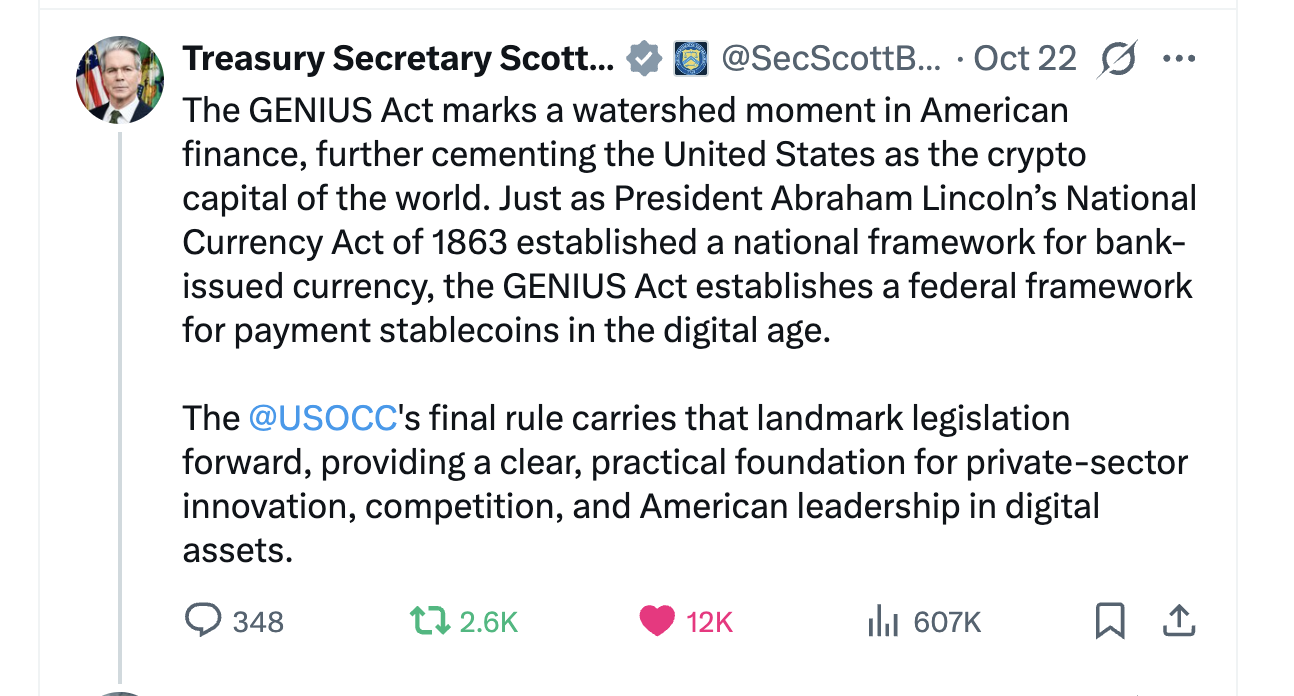
Treasury Secretary Scott Bessent (@SecScottBessent), 79th United States Secretary of the Treasury, on X, October 22. The underlying OCC announcement is dated October 21, 2026; see Source 1.
Read the text of the post
The GENIUS Act marks a watershed moment in American finance, further cementing the United States as the crypto capital of the world. Just as President Abraham Lincoln’s National Currency Act of 1863 established a national framework for bank-issued currency, the GENIUS Act establishes a federal framework for payment stablecoins in the digital age.
The @USOCC’s final rule carries that landmark legislation forward, providing a clear, practical foundation for private-sector innovation, competition, and American leadership in digital assets.
The benefit focus
Clearer payments, better ownership evidence, more dependable closings, stronger development coordination, and a practical path from national policy to customer value in U.S. real estate.
The Benefits I Want You to Take Away
I put the benefits first because they are the reason this moment matters. Here is what the new framework can make more reachable for you, before I show the evidence behind each one.
- If you are buying a home: a closing you can follow step by step, payment instructions you can trust, and fewer surprises between your offer and your keys.
- If you are selling: confidence that your buyer is ready to complete, which can save you weeks of waiting and worry.
- If you build or develop: working capital that stops sitting idle behind avoidable administrative delay.
- If you lend, handle title or run escrow: earlier evidence, less repeated handling, and your professional judgment kept exactly where it belongs.
- If you run a family office or own significant assets: clearer authority, portable records, and better-informed choices before a sale, a financing or a succession decision.
- If you invest from outside the United States: a familiar dollar unit of account, paired with a clear map of the rights you actually hold.
- If you back founders: a narrow, paid-for starting point inside one of the largest asset categories on Earth.
Each benefit is a possibility the framework makes easier to reach. None is a guaranteed outcome. The chapters that follow show what has to happen for each one to arrive, and the sooner you prepare, the more of them you can capture on your own terms. The complete research behind every benefit sits in The Sovereign Ledger™.
Executive Perspective
I believe America is entering an important new phase of financial infrastructure development. The opportunity reaches well beyond cryptocurrency trading. It concerns how dollars move, how businesses manage cash, how investors verify rights, how developers finance productive projects, and how families experience the cost and complexity of buying a home. That is why I have redirected Entry #193 toward the American financial rebuild.
The trigger is concrete. On October 21, 2026, the Office of the Comptroller of the Currency announced its final rule implementing the GENIUS Act within its jurisdiction. The agency identifies January 18, 2027 as the effective date. Treasury Secretary Scott Bessent described the legislation as a “watershed moment in American finance.” The supplied screenshot of his October 22 post brings that policy signal into focus.[1]
My interpretation is that a parallel digital financial system is being built alongside established finance, with connections back into it. By parallel, I mean additional regulated channels for payment, custody, asset records, and financial coordination. I see a chance to extend the usefulness of the dollar and improve the way American enterprise operates. I am not describing a separate jurisdiction in which law, banks, property records, or professional responsibility disappear.
The principal benefit is greater capacity. A business that can move usable funds more reliably has more freedom to operate. A developer that can coordinate evidence and payments more effectively may protect working capital. A buyer who understands the status of funds and closing conditions faces fewer avoidable surprises. A property owner with better records can approach a sale, refinancing, or succession decision with greater control.
Those benefits need to be earned through implementation. The passage of a law and the adoption of a rule create conditions under which private firms can build. They do not, by themselves, complete a property transaction, lower a mortgage payment, or establish a liquid secondary market for an asset. My purpose is to explain the path from national policy to practical value, identify who could benefit, and show what must happen for that value to reach them.
I approach this through four decades of execution since 1985. I have worked through changes in advertising, brand strategy, the commercial internet, and digital distribution. The most durable lesson I carry forward is that an institution becomes stronger when its information, incentives, and operating systems reinforce each other. Technology produces more value when the organization understands the decision it is trying to improve.
That is also why educational marketing remains central to my work. I want a serious reader to finish this report better equipped to ask a lender a question, evaluate a payment provider, prepare a property for capital, commission a pilot, or reject an unsuitable proposal. Education should move a relationship from interest to informed action. The quality of that action matters more than the excitement of the announcement.
My central commercial focus is U.S. real estate. Homes, rental communities, commercial buildings, development sites, industrial facilities, and the physical assets supporting AI all depend on finance. They also depend on evidence: who owns the asset, who can act, what obligations attach to it, what capital is available, and when a transaction can legally complete. Better financial channels become more useful when those ownership questions are answered clearly.
For homebuyers, the opportunity is a more intelligible process and potentially fewer avoidable costs. For developers, it is better coordination of funding, documentation, and permitted payments. For brokers, it is a stronger ability to convert qualified interest into completed work. For title and escrow professionals, it is a chance to organize verification earlier and reduce repetitive handling. For lenders and family offices, it is better information about the assets and counterparties they finance.
I also see a broader American benefit. A country that supplies trusted money, credible rules, advanced computing, secure energy, and productive assets gives entrepreneurs more ways to build. The financial component is essential because it connects savings to enterprise. The property component is essential because enterprise requires somewhere to operate and families require somewhere to live.
The administration’s agenda spans digital assets, industrial investment, tax policy, housing, energy, and strategic supply chains. I regard that combination as commercially important. I also keep the evidence for each policy separate. A stablecoin rule does not prove that an energy initiative has succeeded. A rise in household income does not prove that every family is better off. A localized ceasefire is not a comprehensive peace agreement. Clear distinctions make a strong argument more durable.
My conclusion is optimistic and practical. America has a meaningful opportunity to improve the infrastructure through which capital reaches productive activity. The U.S. real estate industry should prepare to participate, with the greatest attention directed toward customer benefit, enforceable rights, competitive economics, and professional accountability. REALATAR™ is the ownership architecture I am proposing to develop within that opportunity; its capabilities remain design objectives until demonstrated.
Chapter One — The Benefits I Want Readers to Take Away
More Control Over the Movement of Money
I begin with a simple benefit: knowing when money is available and what must happen next. In a property transaction, a vague statement that funds have been sent is less useful than a verified statement about receipt, usability, restrictions, and remaining conditions. A more coherent payment workflow can reduce the uncertainty that creates repeated calls, unnecessary prefunding, and preventable rescheduling.
For a business, the same principle applies to supplier payments, payroll funding, intercompany transfers, and distributions. Continuous network operation can be useful when participants, service providers, and redemption channels support it. The benefit should be measured from the sender’s usable money to the recipient’s usable money. A fast transfer between digital wallets is only part of that journey.
I want the owner of capital to have a clearer picture of where the money sits, which claim they hold, and who is accountable for moving or redeeming it. That visibility can improve planning even before a transaction becomes faster. A reliable status is an operating asset because people can organize their decisions around it.
Less Capital Immobilized by Avoidable Coordination
Capital has an opportunity cost. A funded amount waiting unnecessarily for a missing approval cannot be used for another purpose. A developer waiting for an accepted draw request may have to preserve a larger cash cushion. A seller uncertain about receipt may delay an onward acquisition. Improving coordination can reduce those burdens when the bottleneck is administrative rather than legal or commercial.
I distinguish that benefit from a promise to eliminate every waiting period. An inspection, a lien release, a lender’s credit decision, or a required recording step may take time for a sound reason. My objective is to prevent completed work from sitting idle because information is dispersed or an approval has no clear owner.
This is the kind of improvement that can compound across a portfolio. A single avoided postponement is useful. A repeatable process that improves preparation across many properties may be more valuable because it reduces recurring management effort. The value belongs in a measured operating model, rather than a headline claiming that all property is suddenly liquid.
Stronger Confidence in the Payment Instrument
People need to understand what they are accepting. A payment stablecoin, a bank deposit, a tokenized fund share, and a speculative crypto asset serve different purposes. Better rules and more consistent disclosures can make those differences easier to evaluate. The benefit is informed choice: a business can select a suitable instrument and understand the responsibilities that come with it.
I do not want a homebuyer to be required to become a crypto trader to complete a conventional purchase. A well-designed service can let the buyer understand the relevant payment terms while qualified providers handle the permitted technical work. Simplicity should come from a sound operating arrangement and clear accountability.
Confidence also depends on what happens during stress. The customer should understand redemption, custody, access recovery, and the process for handling mistakes. Those features may look less exciting than an instant transfer demonstration, but they determine whether an institution can responsibly rely on the service.
More Productive Work From the Same Professional Attention
Real estate depends on judgment. The broker understands the market and negotiation. The title professional investigates the relevant record. Counsel interprets the structure. The lender evaluates credit. The appraiser examines value. The asset manager understands operations. I want AI and shared workflows to help these people spend more time on work that requires their expertise.
If a professional can retrieve the current document, see the unresolved issue, and understand the status of an approval without reconstructing the history, the client benefits. That benefit may appear as faster preparation, fewer mistakes, better advice, or more capacity. It becomes a cash saving only if the economics actually change.
My position remains consistent: what disappears is the friction, not the professionals. Professional accountability becomes more valuable when systems make its contribution visible. The industry should see infrastructure modernization as an opportunity to deliver a better service and protect trust.
A Better Route From Savings to American Construction
I want more productive capital directed toward useful housing and infrastructure. Better payment and ownership systems can help reduce the administrative difficulty of organizing eligible investment, documenting obligations, and servicing investors. They cannot build a home without land, labor, materials, permits, infrastructure, and an economic project.
The benefit comes when financial coordination complements physical execution. A developer with a credible budget, clear rights, and dependable reporting can be easier for a capital partner to evaluate. A lender with better information can identify problems earlier. An investor with a clearer understanding of the structure can make a more informed commitment.
That is the direction I favor: technology serving construction and ownership outcomes. The number of tokens issued is a weak measure of housing progress. The number of suitable homes completed, the capital cost of delivering them, and the affordability experienced by occupants are much more consequential.
More American Opportunity in the Infrastructure Layer
The country that develops useful standards and competitive services can attract entrepreneurs, skilled workers, investment, and institutional participation. That is my strategic interpretation of the current opening. I want American firms to compete on service quality and reliability, with customers able to compare providers and retain practical control over their records.
This opportunity includes banks, software firms, custody providers, compliance specialists, property professionals, and infrastructure builders. It also includes smaller organizations that can specialize in a valuable workflow. I do not assume that only the largest technology or financial institution can contribute.
The winning business will solve a defined problem repeatedly at an acceptable cost. National ambition becomes commercially useful when it produces a better customer outcome. That is the standard I apply to my own work at Limitless USA LLC.
Chapter Two — What the GENIUS Act Changes
A National Framework Creates a More Useful Starting Point
President Donald J. Trump signed the GENIUS Act into law on July 18, 2025. The White House’s signing statement identifies it as legislation regulating payment stablecoins. That legislative event and the subsequent implementation process are separate milestones. I see the progression as important because organizations can prepare more concretely when policy moves into operating requirements.[2]
My interpretation is that clearer boundaries can lower the uncertainty involved in deciding whether to invest in a service. A bank can identify the relevant activity. A prospective issuer can evaluate an authorization path. A customer can ask more specific questions about the provider and product. Investors can distinguish the business model from an assumption that permission will eventually arrive.
That does not mean every business becomes suitable or every provider receives approval. The benefit is a more intelligible decision process. Institutions can compare the cost of compliance with the expected commercial return and decide whether participation makes sense. Some will build. Some will partner. Some will continue using established payment channels.
For real estate, this matters because payment innovation has often been discussed separately from the professionals who must accept funds and complete a transaction. A clearer framework gives those professionals a more concrete basis for evaluating a proposed service. They can begin with the provider’s role and permissions rather than a generic claim about blockchain speed.
What the OCC Rule Covers
The OCC’s implementation bulletin describes requirements involving reserve assets, redemption, custody, risk management, reporting, supervision, capital, and applications for entities within its authority. It also states that Bank Secrecy Act, anti-money-laundering, and sanctions implementation will be addressed through separate coordinated rulemaking. I therefore treat this as a major implementation milestone with defined boundaries.[3]
The practical benefit is a clearer set of questions for a buyer of financial services. How is the payment claim supported? Who holds the relevant assets? What reports are available? How is a redemption handled? What operational controls exist? Who supervises the activity? Those questions make provider selection more disciplined.
I want a property business to ask them before accepting a new settlement arrangement. The closing team should know which organization is providing the instrument, which organization is moving it, and which organization is converting it into the money required by the contract. Responsibilities can be distributed across several providers, but they should remain understandable.
I also want the industry to use the preparation period constructively. Waiting until a customer arrives with an unfamiliar payment method is an expensive way to learn. A brokerage, lender, developer, or title firm can establish a review process now, even if it ultimately chooses not to support the service.
The Benefits of Reserve and Redemption Discipline
The enacted statute requires identifiable reserve backing on at least a one-to-one basis using specified assets, provides for a redemption policy and disclosures, bars permitted issuers from paying interest or yield solely for holding a payment stablecoin, and prohibits misleading claims of government backing or deposit insurance. These are distinct features of the statutory design.[4]
My commercial inference is that a payment instrument becomes more useful when the customer can evaluate the claim behind it. The relevant questions are practical: can I receive the intended amount, can I redeem it through an available route, and can I understand the exposure while I hold it? A dollar label alone cannot answer those questions.
For a seller, the benefit is a better basis for deciding whether a particular payment arrangement meets the contract. For a developer, it is a better basis for treasury policy. For a family office, it is a better basis for setting limits and reviewing counterparties. For a service provider, it is a clearer starting point for designing a product that serious customers can assess.
I do not assume that every holder earns the return generated by reserve assets. A payment instrument and an investment product have different functions. A family office seeking income should evaluate the relevant investment separately, including its liquidity, custody, fees, and legal rights. Combining those discussions carelessly creates confusion at precisely the point where clarity matters most.
Why This Is a Parallel System With Connections
The architecture I see developing includes digital representations of money and assets, providers that connect them to established accounts, and software that coordinates permitted actions. Some components operate on public networks; others use restricted systems. Their usefulness depends on how well they connect to the institutions that customers already rely upon.
I therefore expect a period of coexistence. A property may remain in a county land-record system while an investor interest is represented in a digital register. A customer may fund from a bank account and use a digital channel for part of the payment journey. A professional may review a transaction in familiar software while receiving more structured evidence from another system.
The benefit of that coexistence is optionality. Institutions can modernize a difficult step without replacing every surrounding process at once. They can test value, retain working arrangements that remain effective, and expand only when the evidence supports the change. I regard that as a commercially credible route to adoption.
My earlier Sovereign Control Plane report, Entry #166, examined the relationship between regulated digital money, authority, and property execution. The new policy milestone gives that research a more immediate preparation question: which specific workflow can an American property business make ready, and what measurable benefit should it require before committing to broader use?
Chapter Three — The American Inheritance Behind This Opportunity
Why the Lincoln Comparison Matters to Me
Secretary Bessent’s comparison with Lincoln is useful because it directs attention to financial architecture. The OCC’s historical account records that Lincoln signed the National Currency Act on February 25, 1863. The legislation established the agency and a national banking framework; substantial amendments followed in 1864. The historical lesson I take is that common rules can help institutions coordinate trust across a large economy.[5]
I do not regard nineteenth-century banknotes and contemporary payment stablecoins as identical instruments. Their technologies, legal structures, and economic settings differ. The useful comparison is the role of an intelligible framework in supporting commerce. People transact more confidently when they understand the claim, the institution responsible for it, and the rules governing its use.
For a property owner, this is familiar territory. A deed, an entity interest, a mortgage, and an escrow arrangement all rely on shared understandings backed by institutions. Their usefulness increases when parties can verify the relevant facts without rebuilding trust from the beginning. Modern financial infrastructure should strengthen that process.
The American tradition I want to honor combines enterprise with institution building. Productive ambition needs enforceable agreements, dependable records, and systems that can accommodate scale. I see the current digital transition as another opportunity to make those foundations more useful to people who create businesses, own property, employ workers, and support families.
Family History as Responsibility
My sense of family history makes this work personal. I think about what it means to inherit an American story and contribute something useful to its next chapter. For me, that responsibility means studying the systems beneath prosperity and explaining how they can serve owners and citizens more effectively. I want my contribution to be judged through the quality of the work.
Secure property rights matter because people need confidence that their effort can produce something durable. Productive capital matters because ideas require resources. Infrastructure matters because individual effort becomes more valuable when people can coordinate across distance. Education matters because a person who understands the system can make better choices within it.
Those principles connect my own operating doctrine: identity, scale, intelligence, and infrastructure. Identity establishes the person and authority. Scale defines the size and consequence of the problem. Intelligence helps interpret evidence and choose a course. Infrastructure turns a sound decision into a repeatable capability. Each supports the next.
I want to promote American progress in that spirit. Enthusiasm is stronger when it is supported by facts. A forceful argument should be able to acknowledge a remaining problem without losing its direction. I can support a pro-growth agenda and still insist that a project demonstrate its economics, an agreement establish its rights, and a forecast remain labeled as a forecast.
A Benefit That Outlasts an Election Cycle
Financial systems become national assets when they remain useful through changes in markets, technology, and political leadership. A business wants confidence that a payment will be handled predictably. A family wants a home purchase to complete. An investor wants a clear claim and an understandable process. Those needs persist beyond the announcement that first draws attention to a reform.
My standard for durable American leadership is therefore practical adoption. Can the system support competition? Can customers understand their options? Can it recover from mistakes? Can professionals rely on it without surrendering the ability to act responsibly? Can useful services reach organizations smaller than the largest banks and technology firms?
If those questions are answered well, the benefits extend beyond a single product. Better standards can support a market of interoperable services, skilled work, and new business formation. That is a stronger source of national advantage than requiring everyone to depend on one closed platform.
Chapter Four — What the Economic Numbers Mean for Families and Property
A Stronger Household Starting Point
The Census Bureau’s September 15, 2026 release reports real median household income of $87,460 for 2025, up 2.6 percent from 2024 and the highest in the series dating to 1967. It reports an official poverty rate of 10.2 percent, while the Supplemental Poverty Measure was 13.1 percent and not statistically different from the prior year. Those are distinct measures of household conditions.[6]
I welcome the improvement in real median income. More purchasing power can help households build reserves, reduce expensive debt, save toward a deposit, or absorb an unexpected expense. Those are meaningful benefits because a household’s resilience affects its ability to make a long-term ownership decision.
I also want the industry to understand what the median describes. It is the midpoint of a national distribution. It does not describe every household or every local housing market. An increase in the national figure can coexist with difficult conditions for a particular buyer, especially when property prices, insurance, taxes, or financing costs rise faster than their income.
For that reason, I translate the national improvement into a local affordability test. What does the household earn? What stable income will the lender recognize? What monthly payment is sustainable after insurance, taxes, association charges, utilities, and maintenance? What reserves remain after closing? The benefit of better income reaches ownership most effectively when those questions are addressed honestly.
I would not use a cross-administration percentage comparison without matching the exact series, endpoints, inflation adjustments, and revisions. My argument does not need an uncertain comparison to be persuasive. A verified improvement in household resources is useful evidence on its own. The next task is to make ownership opportunities more responsive to that improved capacity.
Why Growth Matters to Real Estate
BEA’s September 30, 2026 third estimate reports annualized real GDP growth of 2.2 percent in the second quarter, revised from 1.5 percent, and 2.5 percent in the first quarter after revision. Real final sales to private domestic purchasers increased at a 4.6 percent annualized rate in the second quarter. The release scheduled the initial third-quarter estimate for October 29.[7]
I read those figures as evidence of an expanding economy, with a useful distinction between headline output and private domestic demand. They are annualized quarterly measures, rather than a statement that the economy grew by that amount in three months. I also keep a future quarter’s expected performance separate from a published result.
For property, the economic transmission can be substantial. Businesses that expand may need space, equipment, staff, and housing for employees. Increased investment can support construction and related services. Stronger household finances can support demand. The local result depends on the kind of growth, where it occurs, and whether the market can supply suitable space.
A manufacturing project can create demand for industrial land and logistics. A data center can create demand for power-connected sites and technical facilities. A service employer can support housing demand without needing a large new office. The property professional’s opportunity is to understand those differences and connect the economic signal to the specific asset.
I do not treat national GDP growth as a guarantee that a particular property will appreciate. A weak location, unsuitable building, excessive leverage, or unrealistic acquisition price can undermine an investment during an economic expansion. Better information should help the owner distinguish a productive local opportunity from a broad narrative applied too loosely.
The Benefit of Pro-Growth Investment Policy
The White House’s July 2026 manufacturing account emphasizes equipment expensing, research and development deductions, factory investment incentives, and domestic production. I identify those as the administration’s stated policy and economic interpretation. The actual treatment of a particular investment requires the applicable tax rules and professional review.[8]
The mechanism I watch is cash flow. When the timing of a tax deduction improves the after-tax economics of qualifying investment, a business may have more capacity to fund equipment, technology, or expansion. That can make a project more attractive. The scale of the benefit depends on eligibility, tax position, timing, and the underlying commercial demand.
For real estate, the most useful effect may occur through the tenant or operator. A manufacturer with a stronger investment case may be more likely to commit to a facility. A growing business may support local employment and household formation. A building owner may benefit from more dependable demand, but should still evaluate the counterparty and lease terms.
I want developers to follow actual commitments. A signed lease, funded construction budget, utility agreement, and permitted project provide more useful information than an announcement alone. Educational marketing should help a capital partner understand where a project stands, rather than blur the distance between aspiration and execution.
Affordability Is Where Benefits Must Become Visible
I am interested in economic progress that reaches the monthly household budget. A family does not experience a national growth rate directly. It experiences wages, taxes, prices, debt payments, rent, insurance, commuting costs, and access to services. A financial rebuild deserves support when it improves those practical conditions.
For housing, faster payment is a supporting benefit. It cannot substitute for sufficient supply or a sustainable mortgage. A small reduction in closing expense can help, particularly for a cash-constrained buyer, but the recurring payment usually dominates long-term affordability. I want to present both scales clearly so the industry prioritizes the right problems.
My earlier U.S. Housing Market report, Entry #189, examines the interaction of financing, supply, and transaction infrastructure. The relevance here is direct: digital modernization should improve the process around a home purchase while broader construction and credit conditions determine how many families can actually afford one.
The strongest benefit is an expanded set of sustainable choices. A household may be able to buy sooner, buy a more suitable home, preserve more reserves, or decide to wait without being pressured by a technology narrative. I want the industry to measure success through the quality of that choice.
Your benefit: a clearer view of what these economic numbers mean for your next property decision. Explore the full research corpus in The Sovereign Ledger™.
Chapter Five — Energy Security and the Physical Cost of Prosperity
Why Energy Belongs in a Financial Report
Energy affects the cost of producing, moving, building, heating, cooling, and computing. A developer experiences it through materials, transport, site work, and operations. A household experiences it through utilities and commuting. An AI business experiences it through power availability and the operating cost of computing. That makes energy a practical component of the financial system’s productive capacity.
My preferred chain of reasoning is specific. More dependable energy supply can reduce the risk of interruption. Lower delivered costs, when they occur, can improve a budget. Better infrastructure can make an otherwise unsuitable site developable. None of those benefits should be inferred from a geopolitical headline alone; the relevant price and availability must reach the project.
For a construction lender, stable inputs can make a budget more credible. For an owner, improved operating visibility can reduce the need for an excessive contingency. For a tenant, dependable power can determine whether a building supports the intended business. I want the financial and physical systems evaluated together because one cannot compensate indefinitely for failure in the other.
What I Can Say About Persian Gulf Flows
The October 2026 EIA outlook estimates that regional production shut-ins declined from their May peak to September and describes improving exports alongside continuing constraints. It forecasts constrained flows through the fourth quarter. Its model inputs were finalized on October 1, so it does not establish what happened after that date. I therefore do not treat a claim of exports exceeding pre-conflict levels as independently verified by that outlook.[9]
The positive signal I can use is resilience and partial recovery in the face of disruption. The remaining task is to establish whether improvements persist, which routes are operating, and how delivered energy costs respond. A business should update its assumptions as observed data arrive rather than convert a favorable direction into a settled endpoint.
The property benefit of sustained improvement would be easier budgeting and potentially reduced input pressure. A contractor might gain greater confidence in transport costs. An owner might face a more manageable fuel budget. An industrial tenant might operate with less disruption. The extent and timing differ across markets and energy sources.
I would have an asset manager maintain a sensitivity range rather than assume a single oil price. A building that depends heavily on heating oil has a different exposure from an electrically heated property. A contractor with fixed fuel terms has a different exposure from one buying at current prices. The financial benefit comes from understanding the actual position.
Venezuela and the Difference Between Access and Output
The Department of Energy’s account of the September 2, 2026 agreements describes work with Chevron, Eni, and GE Vernova to expand production, attract investment, and modernize Venezuela’s grid. That provides a basis for discussing a more active U.S. role and new commercial arrangements. It does not make all Venezuelan resources American property or turn planned capacity into current supply.[10]
I see potential benefits in a more dependable commercial energy relationship when investment, enforceable agreements, infrastructure repair, and operational capability align. Production requires equipment, skilled people, maintenance, logistics, and capital. A large resource base is a starting condition; sustained deliverable output is the economic result that customers can use.
For American property, the relevance is indirect but meaningful. Energy and industrial activity can influence ports, logistics facilities, refining corridors, contractor demand, and employment. A project connected to those activities still needs its own diligence. I would examine signed contracts and actual throughput before underwriting a property around an energy expansion story.
The benefit I favor is productive cooperation that increases reliable supply and supports useful investment. I do not need a sweeping ownership claim to explain that opportunity. Strong commercial rights and dependable execution are more useful to an investor than an imprecise declaration of control.
Financial Integrity and Operation Economic Outcast
Treasury launched Operation Economic Outcast in August 2026 and announced further sanctions against shadow-fleet and financial networks in October. Its releases describe efforts to disrupt revenues supporting the Iranian regime and the IRGC. I treat descriptions of the campaign’s strategic success as the administration’s assessment; sanctions announcements alone do not independently establish that every revenue channel has been eliminated.[11]
The connection to digital finance is the importance of accountable participation. A credible system must distinguish legitimate commerce from prohibited activity and support the obligations that apply to its providers. Greater transaction speed increases the value of getting identity, authority, and permissions right before execution.
For U.S. real estate, that benefit is practical. A seller should understand the buying entity and its authorized representatives. A lender should understand the relevant ownership and funding structure. A closing professional should be able to review required information without receiving an unorganized collection of assertions. Better records can make a lawful transaction easier to evaluate.
I do not equate privacy with secrecy from every lawful obligation. A well-designed system can disclose relevant evidence to an authorized reviewer while limiting unnecessary exposure to others. That can protect a legitimate owner’s confidentiality and improve the quality of the review at the same time.
Claims about an empty terminal, exhausted offshore reserves, or a permanently disabled tanker network require dated operational evidence. A single image of a facility has a limited observation window. I would not use it to establish an enduring condition across an entire industry. My strategic argument is stronger when the operational claim matches the evidence available.
The benefit I seek is a financial environment where legitimate capital can move with greater confidence and prohibited activity faces more effective controls. Those goals can reinforce each other when systems are designed carefully. A trusted market attracts participants because the rules are understandable and applied through accountable institutions.
Greenland and Strategic Access
The White House published a September 22, 2026 agreement involving the United States, Denmark, and Greenland that expands the framework for defense cooperation and access. Its text reaffirms the Kingdom of Denmark’s sovereignty and Greenlanders’ right to self-determination; entry into force depends on specified procedures. I describe this as a strategic cooperation agreement, rather than a U.S. acquisition of Greenland.[12]
My interpretation is that dependable access and clear agreements can be strategically valuable without a transfer of sovereignty. Security infrastructure, communications, logistics, and investment screening all depend on defined rights and responsibilities. The same principle appears at a smaller scale in property: use rights, access rights, and ownership rights should be described accurately.
Potential commercial benefits require their own project evidence. A facility, supply contract, or logistics investment must be evaluated through permissions, environmental obligations, infrastructure, cost, and demand. I would not treat a national security agreement as an automatic investment recommendation or assume that all territory becomes available for commercial development.
For the American financial rebuild, the broader relevance is resilience. Capital can be deployed more confidently when critical infrastructure and access arrangements are dependable. That is a supporting condition for prosperity, with benefits determined by implementation and the rights actually granted.
Ukraine and Russia
The White House’s October 23 announcement describes a localized ceasefire in Oleshky intended to support humanitarian access and evacuation, with commencement scheduled for October 29. That is a specific announced humanitarian arrangement. It does not establish that the broader Russia– Ukraine war has ended.[13]
I support the benefit that successful de-escalation can create for people first: fewer lives at risk, improved access to food and medicine, and a chance to restore essential services. A durable wider peace could also improve confidence, trade, reconstruction planning, and energy reliability. Those commercial effects depend on a settlement’s scope, credibility, and implementation.
For an allocator, the lesson is to keep scenarios separate. An announced local arrangement, a negotiating process, and a durable comprehensive agreement have different implications. I would not price a property or infrastructure investment on the assumption that the most favorable scenario is already complete.
The American benefit of effective diplomacy can be substantial when it reduces uncertainty and supports security. The strength of that argument does not require declaring success before the terms have been implemented. Disciplined optimism lets an investor prepare for improvement while protecting against a different outcome.
Paraguay and Critical Minerals
Treasury’s October 22 readout confirms that Secretary Bessent met President Santiago Peña of Paraguay and discussed economic cooperation, including secure and resilient critical-minerals supply chains. The short readout establishes the meeting and its stated subject. It does not establish a completed mining project, an exclusive supply contract, or a quantified production increase.[14]
I see a useful strategic connection between supply-chain relationships and domestic industrial capacity. Advanced computing and manufacturing depend on physical inputs. More dependable sourcing, when supported by viable projects and contracts, can reduce concentration risk and make investment planning more credible.
For real estate, that can create opportunities in industrial facilities, logistics, processing, utilities, and workforce housing. The property opportunity emerges where a funded operation needs a suitable location and supporting services. I want owners and developers to follow that evidence chain rather than buy land solely because a diplomatic meeting occurred.
Taken together, these developments support my interest in a more resilient American operating system. Money, energy, materials, computing, transport, and property are connected through enterprise. The benefit comes when each becomes more dependable and capital can coordinate them more effectively.
Chapter Six — The U.S. Real Estate Benefit Case
Why Property Is the Commercial Center of This Report
I regard real estate as one of the most important places to test whether financial modernization improves ordinary economic life. A home purchase combines savings, credit, identity, professional advice, legal rights, payment, and public records. A development project adds construction, approvals, contractors, investors, and ongoing operations. These are demanding coordination environments with clear customer consequences.
The opportunity is therefore broader than accepting a digital payment at closing. I want better preparation before the transaction, more dependable coordination during it, and a stronger record afterward. A payment channel becomes more valuable when it is connected to an accurate view of the asset and the conditions required to act.
My benefit framework follows the participants. What does the buyer gain? What does the seller gain? What does the developer gain? What does the professional gain? What does the lender gain? Where does the system create value that can support a viable business? Answering those questions prevents the discussion from becoming a collection of technical features.
The strongest outcome is a transaction that participants understand and can complete with fewer avoidable failures. Speed can be part of that outcome. So can better disclosure, reduced rework, clearer authority, and a more reliable handover. Each deserves a measurement appropriate to the problem it solves.
Benefit for Homebuyers — A More Understandable Closing
For a homebuyer, uncertainty can be expensive and exhausting. A move may depend on a closing date. An expiring financing arrangement can add pressure. A change in instructions can create concern. A missing approval can interrupt a chain of related transactions. Better coordination can reduce those preventable difficulties when the underlying transaction is otherwise ready.
I would want a buyer-facing readiness view that explains the outstanding conditions in ordinary language. The buyer should know which documents have been accepted, which decisions remain with the lender or professional team, and when a payment instruction is final. Sensitive records should remain restricted, but status should be intelligible.
AI can help explain a process or identify an unanswered question. It should not make a binding legal or credit decision on the buyer’s behalf without a valid authority structure. A reliable system directs the user to the responsible professional when interpretation or approval is required.
The benefit is practical control over the experience. A buyer can plan travel, removal services, utilities, and temporary accommodation with better information. Some uncertainty will remain because transactions involve multiple parties and external events. I want to reduce the uncertainty caused by poor coordination.
I would measure the result through the number of preventable document requests, payment-instruction changes, rescheduled dates, unresolved questions, and customer support interventions. I would also ask buyers whether the process became easier to understand. An improved experience matters, even when it does not immediately appear as a lower invoice.
Benefit for Homebuyers — Protecting Cash at the Point of Purchase
A buyer’s closing funds are often the result of years of work. The payment process should be designed around verification and recoverability. I would want independently confirmed instructions, clear payee identity, suitable limits, and an obvious route for reporting an inconsistency before funds move.
A digital channel can create new forms of error alongside the problems it addresses. A wallet address can be wrong. A compromised account can present a convincing request. An automated workflow can repeat a faulty instruction. The benefit comes from the control design, rather than the assumption that a newer network is automatically safer.
I would therefore make payment instructions a protected part of the workflow. Changes should require appropriate confirmation through a trusted channel. The system should record who authorized the change and when. The buyer should understand that a message appearing in an email or chat does not automatically modify the accepted instructions.
This is a benefit for professionals as well as buyers. A clear process can reduce disputes about what was approved and improve the evidence available if something goes wrong. Confidence grows when the client can see how the arrangement protects their money without being overwhelmed by implementation details.
Benefit for Sellers — Greater Confidence in the Buyer’s Readiness
A seller needs more than expressions of interest. They need a buyer who can complete on acceptable terms. Better qualification can help distinguish a curious viewer from a participant with a relevant mandate, appropriate authority, and a credible funding path. That can improve how the seller and broker allocate time.
I would not treat a wallet balance as complete proof of funds. The relevant question is whether the buyer controls usable funds for the transaction, whether the source and structure meet applicable requirements, and whether the amount will remain available when needed. A digital record should support that analysis, rather than replace it with a superficial signal.
The benefit can be a more dependable negotiation process. The seller can understand which conditions are genuine and which remain uncertain. The broker can focus follow-up on the issues most likely to determine completion. The buyer benefits too because realistic preparation reduces the risk of making an offer that cannot be carried through.
I would measure seller benefit through failed-deal rates, avoidable extensions, time spent on unqualified interest, and the cost of restarting a process. Those outcomes depend on market conditions and transaction quality, so a pilot should compare genuinely similar cases rather than select only its best result.
Benefit for Brokers — Stronger Conversion and Better Use of Expertise
Brokers create value through local knowledge, pricing, negotiation, relationships, and execution. A listing can attract attention while the underlying evidence remains difficult to assemble. I want the broker to have a more coherent route from discovery to qualification, diligence, and completion.
That route can help a capable professional serve more clients without treating every interaction as a new administrative project. A structured property record can reduce repeated questions. A clear readiness view can identify the obstacle to an offer. A controlled introduction process can connect the relevant lender, attorney, or specialist at the right time.
The commercial benefit is better conversion of professional effort into completed, compensated work. That does not require inflating a network count or promising access to every global investor. It requires understanding the target buyer and maintaining a reliable process around the asset.
My Zip-Code Illusion report, Entry #188, examines the distinction between local discovery systems and wider ownership infrastructure. Here, the benefit is continuity: a broker’s marketing channel can introduce an opportunity while the evidence and authority remain coherent as other professionals join the transaction.
I want brokers to retain their relevance by becoming more effective at the work clients value. Technology should help them answer a serious buyer accurately, identify a problem earlier, and coordinate a transaction more dependably. That is a stronger proposition than competing solely on the volume of content published.
Benefit for Title and Escrow Professionals — Earlier Readiness
Title and escrow work can reveal issues that no marketing interface will identify. I want those professionals involved early enough for their findings to improve the transaction before the final deadline. A shared workflow can help route evidence, record exceptions, and show what remains unresolved without diluting professional responsibility.
The benefit is less repeated handling and a clearer audit trail. A professional can see the accepted version of a document, the source of an instruction, and the status of an approval. If something changes, the system should make that change visible and preserve the previous record.
I do not assume that a smart contract is a licensed escrow service or that a blockchain entry proves title. The professional and legal requirements determine the permitted process. Software can coordinate conditions and execute authorized actions within that process. It should not silently substitute its own conclusion for a required legal determination.
For the customer, the result can be fewer late surprises and a more understandable path to completion. For the professional, it can be more useful attention devoted to exceptions rather than document chasing. For the business, it can be improved capacity and more reliable service if the added system costs remain proportionate.
I would begin by measuring a narrow workflow: how often an accepted document is requested again, how long an unresolved issue waits without an owner, and how frequently a late information gap causes rescheduling. Those measurements can establish whether the infrastructure creates a real operational benefit.
Benefit for Mortgage Lenders — Better Evidence Before Funding
A lender needs confidence in the borrower, collateral, documentation, and conditions attached to the loan. Better information can help the lender distinguish a complete application from one containing unresolved issues. It can also help the borrower understand what is missing before an expected closing date becomes unrealistic.
I would want a digital workflow to preserve the lender’s authority over credit and funding. AI could organize documents, identify inconsistencies, or prepare a review queue. It should not imply that a loan is approved merely because a model predicts approval. The decision must remain with the authorized institution and its defined process.
The potential benefits include less rework, more useful review time, and clearer communication. A lender may be able to process a similar case with fewer manual handoffs. A borrower may avoid paying for arrangements based on an inaccurate expectation. A broker may have a better understanding of the transaction’s readiness.
I would measure those benefits through accepted-document rates, exception-resolution time, avoidable funding delays, and the total cost of completing the loan. If a new system improves speed while weakening the review, it has failed. If it improves quality but adds disproportionate expense, the business model needs adjustment.
Stablecoins also raise a funding question for lenders. If customers move balances into alternative payment instruments, the effect on bank funding depends on where reserves sit and how money moves through the broader system. I would not assume that every increase in stablecoin activity expands mortgage credit. The industry’s benefit requires healthy lending capacity as well as better payments.
Benefit for Developers — Better Control of Draws and Commitments
A developer coordinates many promises at once. Equity must arrive. Debt conditions must be met. Contractors must perform. Inspections must be accepted. Permits and utility arrangements must remain valid. The more disconnected those dependencies become, the greater the risk that a routine issue interrupts productive work.
My proposed benefit is a clear relationship between evidence, approval, and payment. A draw request should identify the relevant milestone, supporting documentation, responsible reviewer, and permitted recipient. The record should show what has been approved and which conditions remain open. That can make the process more intelligible to the developer, lender, and contractor.
I would not permit an AI model to release funds simply because an uploaded image appears to show completed work. The relevant inspector or authorized reviewer must provide the required confirmation. Software can coordinate that approval and preserve its evidence. The professional determination remains distinct from a visual prediction.
For the developer, the potential benefit is better working-capital planning. For the contractor, it is a clearer path from accepted performance to payment. For the lender, it is a more organized view of disbursement conditions. For the investor, it is a stronger account of how committed capital is being used.
The project should compare the value with the cost of maintaining the system. A small development with simple funding may not need an elaborate architecture. A complex project with multiple entities and capital sources may benefit more. I want the design proportionate to the actual coordination problem.
Benefit for Contractors and Suppliers — Less Administrative Uncertainty
The payment conversation often focuses on the person buying an asset. I also want to consider the people building and maintaining it. A contractor that cannot determine whether an invoice is disputed, incomplete, approved, or scheduled faces unnecessary uncertainty. A clearer workflow can help them manage payroll, materials, and commitments.
The benefit does not require every supplier to hold digital assets. An approved provider might use a digital channel within a broader arrangement while the supplier receives conventional money. The important result is the accepted amount arriving through a process the supplier understands and can use.
I would protect the supplier from hidden complexity. Fees, conversion terms, payment timing, and responsibility for errors should be clear. A contractor should not discover after accepting work that payment requires an unfamiliar account, an unexpected conversion cost, or an exposure they did not agree to bear.
More dependable payment can strengthen a project’s relationships. It may improve a contractor’s willingness to reserve capacity or reduce the buffer included for uncertainty, although those outcomes must be observed rather than assumed. The commercial benefit appears when better coordination changes behavior and economics in a useful way.
Benefit for Commercial Owners — A More Useful Property Record
An income-producing property generates an evolving body of evidence: leases, rent rolls, operating statements, service contracts, insurance, capital plans, permits, debt obligations, and consents. A current, permissioned record can support several decisions rather than being rebuilt only when a sale is imminent.
For a refinancing, the owner can identify the relevant documents earlier. For a leasing decision, the asset manager can compare obligations and operating constraints. For a capital partner, the evidence can make assumptions easier to test. For a succession plan, authority and access can be documented before an urgent event occurs.
I regard this as one of the most immediate benefits available to the industry. It does not depend on the existence of a liquid token market. It depends on disciplined records, suitable permissions, and a workflow that keeps the information useful. The return can come from reduced preparation effort and better decisions across the asset’s life.
The record must distinguish a verified fact from an owner’s estimate. A lease abstract should point to the agreement it summarizes. An operating figure should identify its period and accounting treatment. A valuation assumption should remain visible. A system that combines those categories without explanation can create more confidence than the evidence deserves.
Benefit for Family Offices — Continuity Across Advisers
Family offices often coordinate different asset managers, lenders, lawyers, accountants, trustees, and family members. The challenge is maintaining a coherent view of authority and obligations as people and providers change. An ownership architecture can help preserve continuity if the family retains practical access and control.
I would begin with the question of who can do what. Who can view a sensitive document? Who can request an action? Who can approve it? Who can change the authority structure? Which decisions require more than one person? Those questions become especially important when a principal delegates routine work while retaining control over consequential commitments.
The benefit is a clearer boundary between assistance and authority. An adviser can perform an agreed task without receiving unrestricted control. A family member can access relevant information without exposing the whole portfolio. A successor can understand the record without relying entirely on one person’s recollection.
I would also design for exit. The family should be able to export records, revoke access, and transition to another provider. A system that improves convenience while making the owner dependent on an opaque platform has not fully served the objective of sovereignty.
Benefit for Billionaire Owners — More Options Without Forced Complexity
A large asset owner may face concentration, succession, financing, and governance decisions that have little to do with public market access. The value of a new structure lies in whether it improves those decisions. I would not recommend fractionalization merely because the owner’s assets are valuable enough to attract attention.
An owner might prefer a conventional secured loan, a partial equity transaction, a joint venture, or continued ownership with improved reporting. Each has different effects on cash flow, control, obligations, and future options. A digital representation can support some structures, but it does not decide which structure is economically appropriate.
The benefit I want is informed flexibility. The owner can compare a financing route with a sale route using a clear rights map and consistent evidence. A prospective partner can understand the proposed interest. Advisers can evaluate the consequences before an implementation decision is made.
This is particularly important when the owner wants capital without surrendering operating control. Incoming investors may require protections, reporting, consent rights, or a defined exit. Those are negotiated economic terms. Technology can administer them more coherently after they have been agreed; it cannot make the trade-offs disappear.
Benefit for Global Real Estate Giants — Repeatability Across a Portfolio
A large organization can create substantial value by improving a small recurring workflow across many assets. The useful unit of analysis might be a payment, an investor onboarding, a document review, a draw request, or a refinancing preparation. A common evidence and permissions model can reduce the cost of starting each case from scratch.
I would preserve local specialization. A portfolio spanning several jurisdictions cannot assume identical property rights, tax treatment, recording practices, or investor rules. The repeatable part is the coordination standard: identify the asset, define the interest, establish authority, preserve evidence, and assign responsibility for each condition.
The benefit is a better relationship between central oversight and local execution. Headquarters can understand status without taking over every professional decision. Local teams can work within the applicable rules while using a common structure for reporting and escalation. That can improve management visibility and support more consistent service.
I would measure adoption by the work completed through the process, rather than the number of accounts created. A platform can have many registered users and little operational relevance. Repeated use, accepted outputs, lower rework, and positive customer economics provide stronger evidence of institutional value.
Benefit for Florida and Other Growth Markets — Better Qualification
In Florida, as in other markets receiving mobile capital, the buyer’s objective matters. A primary residence, seasonal home, rental asset, development project, and long-term family holding require different analysis. A digital process should help professionals qualify the purpose and structure before presenting an investment narrative.
My Florida Real Estate report, Entry #190, emphasizes the relationship between the property decision and the owner’s balance sheet. The benefit of better infrastructure is a more coherent decision process: understand the asset, the carrying costs, the financing, the obligations, and the owner’s remaining options.
Cross-border participants require particular care. Eligibility, tax, source-of-funds review, and applicable ownership restrictions can affect the transaction. A faster payment method does not remove those questions. The benefit comes from identifying them earlier and bringing the appropriate advisers into the process before the proposed closing depends on an unresolved assumption.
I want a buyer attracted by American opportunity to encounter a professional process worthy of that confidence. Clear explanations, accurate records, and dependable execution help build a market’s reputation. They also make it easier for the right capital to recognize a suitable opportunity.
Chapter Seven — Housing Supply and the American Ownership Benefit
A Financial Rebuild Must Serve Families
I want to be explicit about a potential tension. A platform can make capital more mobile while policymakers seek to preserve a fair opportunity for households to buy homes. Those objectives need to be considered together. Better financial infrastructure should support productive housing supply and lawful participation, rather than simply increase the speed at which scarce existing homes are accumulated.
Treasury’s October 22 housing announcement describes proposed regulations implementing restrictions on large institutional purchases of single-family homes, with specified exceptions. It identifies a January 7, 2027 statutory start date and a definition involving investment control over at least 350 homes, among other conditions. The release discusses build-to-rent, renovation, and homeownership program exceptions. These are structure-specific requirements, not a universal ban on institutional housing investment.[15]
My interpretation is that the real estate industry should examine where capital adds supply or supports a path to ownership. New construction, the rehabilitation of unusable housing, and suitable programs helping occupants become owners can have different effects from bidding against households for an existing move-in-ready home. The legal categories and commercial economics both matter.
I would not claim that tokenizing an entity changes the substance of its ownership or avoids an applicable restriction. A digital structure must be reviewed in light of its actual control, holdings, participants, and purpose. The benefit of programmable administration is the ability to enforce approved conditions more consistently after the relevant analysis has been completed.
Helping Developers Deliver the Right Supply
Housing supply requires more than capital interest. A developer needs a suitable site, infrastructure, approvals, labor, materials, and a product households can afford. Financial modernization can support that effort by making funding conditions, project evidence, and payment responsibilities clearer. It remains one part of a larger production system.
I would evaluate a project’s bottleneck before recommending technology. If a utility connection is unavailable, faster investor onboarding will not solve the central problem. If the project is viable but reporting is disorganized, a better evidence workflow may help. If capital terms are too expensive for the intended price point, the financing structure needs attention.
The benefit is targeted problem solving. Capital partners can see why a project is delayed and what would change its readiness. Developers can prioritize the work that affects completion. Public and private participants can distinguish a genuine infrastructure constraint from a process issue that can be corrected more quickly.
I also want progress measured in physical outcomes. How many homes are permitted, started, and completed? What is the cost per unit? How long does occupancy take? What recurring cost will the resident face? Those measures keep a financial innovation grounded in its intended social and commercial purpose.
The Affordability Gain I Would Actually Count
Suppose an illustrative household avoids $1,500 of genuine transaction expense. That is valuable money, especially when reserves are limited. Spread over twelve months, it is equivalent to $125 a month during the first year. The example helps show the scale of the benefit without pretending it changes the mortgage contract.
Now suppose the household’s recurring housing cost is $500 a month above a sustainable budget. The one-time saving cannot solve that continuing gap. The relevant response may involve a different home, financing arrangement, location, timing, or a stronger supply environment. I want the industry to explain both benefits and constraints clearly.
This is why I favor a broad ownership agenda. Improve the process, protect the buyer’s funds, increase useful supply, maintain healthy credit, and help households make decisions they can sustain. Digital infrastructure earns its place by supporting those objectives, rather than claiming to replace them.
Chapter Eight — AI and the Productive Intelligence Layer
What I Mean by Superintelligence in This Strategy
I am interested in the long-term possibility of much more capable machine intelligence. For a current investment decision, however, I want to evaluate specific available capabilities and their demonstrated performance. A future superintelligence narrative should not substitute for evidence that a system can reliably complete today’s task.
The immediate opportunity is substantial without making that substitution. AI can help organize large collections of documents, retrieve relevant information, compare records, prepare analyses, and identify gaps for human review. In property, those tasks appear throughout acquisition, financing, development, operations, and disposition.
The benefit is a better use of attention. A professional can begin with a structured view of the issue and the supporting record. A principal can ask a question and see which evidence supports the response. A team can identify an exception before it becomes a closing problem. Those are practical improvements that can be tested now.
I want an AI system to distinguish what the record says from what it infers. If two documents conflict, it should show the conflict. If a source is outdated, it should make the date visible. If the available evidence is insufficient, it should route the question to the appropriate person. A confident answer is useful only when the supporting work deserves confidence.
NVIDIA and the Scale of Computing Investment
NVIDIA reported $96.2 billion of revenue for its fiscal second quarter ended July 26, 2026, up 106 percent from a year earlier. That is a company-reported operating result for a specific period. I use it as evidence of the scale of demand for the company’s products and services, rather than as proof that every AI customer earns a positive return.[16]
My inference for real estate is that computing remains physical. It needs equipment, power, cooling, connectivity, maintenance, and suitable locations. The property opportunity depends on access to those inputs and a credible customer. A site labeled for AI development can still be unsuitable if it lacks power capacity or an economically feasible connection.
I would have a developer distinguish reserved power from hoped-for power, a signed customer commitment from general market demand, and a funded project from a proposed one. That evidence can determine whether capital is directed toward a productive facility or a speculative land position.
The benefit for global property leaders is a more precise way to participate in the computing buildout. They can evaluate the asset’s role in a real operating system. The benefit for communities depends on how the project affects employment, utilities, public infrastructure, and local housing. Those effects should be examined alongside the investment return.
Intel and American Industrial Capacity
Intel’s August 22, 2025 announcement described an $8.9 billion U.S. government common-stock investment associated with its American technology and manufacturing strategy. I treat that as a dated corporate announcement of an industrial-policy arrangement. It does not establish the current value of the stake or guarantee the success of the company’s manufacturing plan.[17]
The strategic question I take from it is how a country maintains capacity in technologies it considers important. Manufacturing capability requires long-term investment, skills, suppliers, infrastructure, and customers. Financial policy can support those conditions, but sustained operating performance remains the test.
Howard Lutnick’s role as Commerce Secretary belongs in that industrial context. I see Treasury’s financial infrastructure work and Commerce’s investment agenda as related parts of the administration’s effort to strengthen productive capacity. The relationship is my interpretation of their functions and announced activities, rather than a claim that every project sits inside one formally coordinated program.
For real estate, the potential benefits include industrial development, supplier facilities, logistics, technical employment, and workforce housing. I want owners to identify the actual project, timetable, customer, and infrastructure requirement. The opportunity becomes investable when those details support the economics.
Elon Musk and the Discipline of Building Systems
I study Elon Musk’s companies because I am interested in the execution required to connect difficult technical and physical systems. That interest does not establish an endorsement or relationship. It also does not require me to assume that every proposed project or corporate combination will occur.
The lesson I apply is responsibility for interfaces. A product can fail because a critical dependency is unreliable even when its core technology works. In property, the equivalent dependencies include identity, authority, funding, records, approvals, and professional handoffs. I want the architecture to identify those interfaces and assign clear responsibility for them.
The benefit for a founder or venture investor is a better investment question. Which part of the system does the company control? Which dependencies remain external? What happens when one fails? How does the business recover? A persuasive market story becomes more useful when it is connected to an operating specification.
For REALATAR™, that means I should understand the ownership workflow deeply enough to identify what to build, what to partner for, and what to leave with the relevant institution. I want ambition matched by an honest account of those boundaries.
AI for Valuation and Capital Decisions
A property valuation is an argument about income, risk, market evidence, and future expectations. AI can help organize that argument and test its sensitivity. I would not replace the full analysis with an unexplained number, especially for an unusual asset or a market with limited comparable evidence.
The practical benefit is the ability to ask better questions faster. Which leases support the income? Which expenses are recurring? What happens if insurance costs rise? How much equity might a refinancing require? Which assumption has the greatest effect on value? A useful system makes those dependencies visible.
I would require the analysis to identify its source periods and assumptions. An operating statement from one year should not be silently combined with a rent roll from another. A planned improvement should not be treated as completed work. A market estimate should not be presented as an executed price.
The benefit reaches lenders, investors, brokers, and owners because each can inspect the reasoning relevant to their role. It can reduce the time spent debating inconsistent inputs and increase the time spent evaluating the real commercial decision.
AI Agents Need Bounded Authority
An agent can be useful when its task and permissions are specific. It might assemble a document index, identify missing evidence, prepare a review request, or monitor an approved deadline. Each action should be attributable and limited to the information needed for that task.
The standard changes when an action affects money or ownership. Releasing funds, changing a recipient, approving a transfer, or modifying a control policy requires an appropriate authorization design. I would use defined limits, independent confirmations, and multiple approvals where the consequence justifies them.
An uploaded document must remain evidence, rather than become a channel through which an outsider can instruct the system. A malicious instruction hidden in a file should not override the owner’s permissions. A changed job title should not leave an old authority active indefinitely. Those are testable conditions for the architecture.
The benefit is trustworthy delegation. An owner can use automation for routine work while retaining control over consequential decisions. A professional can understand which actions occurred and why. The system can stop and escalate when the evidence or authority is insufficient.
I would measure the quality of that stopping behavior. A model that identifies a missing approval before payment may create more value than one that completes every task quickly. The objective is dependable execution, with speed applied where the conditions support it.
Your benefit: practical AI uses you can test now, with the evidence behind each one. See every Bitcoin-anchored entry in The Sovereign Ledger™.
Chapter Nine — Institutional Adoption and the Global Capital Opportunity
J.P. Morgan Shows Why the Banking Layer Remains Relevant
J.P. Morgan’s April 2026 Kinexys milestone announcement reports more than $3 trillion of transactions since inception and average daily volume above $5 billion. These are bank-reported transaction-flow figures, rather than assets under management or property transaction volume. They show institutional activity within a defined platform.[18]
My inference is that the digital transition can occur through incumbent institutions as well as new firms. Banks have customers, regulated functions, treasury expertise, and operating relationships that matter to a property transaction. An infrastructure builder should evaluate those capabilities rather than assume it must recreate them.
For real estate, the benefit of a bank-connected arrangement can be familiarity and a clearer path between existing accounts and new workflows. The actual result depends on the product, eligible users, operating terms, and integration. A platform’s total volume does not establish that it supports a specific property use case.
I want the partnership question to be practical: which provider can perform the required role reliably, at an acceptable cost, with a clear account of responsibility? That is how a new ownership platform can become useful to institutions instead of merely competing for their attention.
Goldman Sachs and BNY Show the Asset-Record Opportunity
BNY and Goldman Sachs announced a tokenized money-market-fund solution in July 2025 using mirrored records through GS DAP alongside BNY’s existing platforms. The announcement concerns selected fund ownership records and related utility. It is not a statement that a payment stablecoin and a money market fund are the same instrument.[19]
The lesson I draw is that records can become more useful when they connect to the way institutions already transact and manage liquidity. A digital representation may support new operations while an established legal and servicing framework continues to govern the interest.
For a family office, that suggests a useful separation. Payment liquidity, investment exposure, and property ownership can be coordinated while remaining different claims. The owner should understand the rights and risks of each. A single interface should make those distinctions easier to see rather than obscure them.
For a property fund, the possible benefit is more coherent investor administration. Subscription, transfer, reporting, and distributions can be evaluated as a connected lifecycle. The economic case must include the cost of maintaining accurate records and serving investors after the initial issuance.
McKinsey Helps Put Payment Adoption in Perspective
McKinsey and Artemis estimated actual stablecoin payments of $390 billion in 2025, with business-to-business payments accounting for $226 billion. Their May 2026 presentation distinguishes that activity from much larger raw on-chain transaction totals. I use those estimates to emphasize the need to define the activity being measured.[20]
The positive interpretation is that identifiable payment use exists and can be studied. The disciplined interpretation is that blockchain transaction volume should not be treated as equivalent to commerce. Trading, transfers between related accounts, automated processes, and genuine purchases can all produce activity with different commercial significance.
For a venture investor, the benefit of this distinction is better market sizing. A startup addressing supplier payments should identify actual customer payment flows and willingness to switch. A property platform should identify relevant transaction volume and service revenue. A broad network metric does not replace that work.
I want the American industry to build around useful adoption. A smaller, well-defined market with repeat customers can support a strong business. A huge headline market with no clear route to customer value can consume capital without producing an institution.
PwC and the Need to Preserve Economics
PwC’s November 2025 asset and wealth management report projected tokenized fund assets reaching $715 billion by 2030 and reported profitability pressure among 89 percent of surveyed asset managers. These are a forecast and a survey finding, respectively. They do not describe the current size of tokenized real estate.[21]
My inference is that scale and profitability need to be designed together. More assets can produce more reporting, support, and operational complexity. A technology platform creates value when it improves the economics of serving those assets, rather than simply adding another interface and fee.
For a property manager or fund sponsor, the benefit should be visible in the cost of completing a task and maintaining a relationship. If investor onboarding becomes faster but exception handling becomes more expensive, the net result may disappoint. If a coherent record reduces repeated work across years of ownership, the value may be more durable.
This is where my instruction to myself remains direct: EBITDA on everything. Every proposed capability needs a customer, a price, a delivery cost, an exception policy, and a reason to be used again.
BCG and Deloitte Define the Scale of the Possibility
The April 2025 BCG and Ripple report projected tokenized assets reaching $18.9 trillion by 2033. Deloitte’s April 2025 research separately projected $4 trillion in tokenized real estate by 2035, covering a wider ecosystem that includes funds, loans and securitizations, and selected property interests. These are different forecasts with different scopes and horizons.[22][23]
I do not add them together or use them as a forecast of REALATAR™ revenue. Their value is strategic context: major institutions are examining changes to asset representation and administration. The business opportunity still needs a defined customer problem and a service that can be delivered profitably.
For global real estate leaders, the benefit is a reason to prepare thoughtfully rather than wait for a universal model to appear. They can identify a suitable workflow, test the rights and operating structure, and learn what improves the customer outcome. That preparation can create useful capability even if market adoption follows a different timetable from the forecasts.
Chapter Ten — The Dollar Benefit and the Global Investor
Making Dollar Access More Useful
My national-level thesis is that useful digital dollar services can extend the dollar’s role in commerce. The mechanism is adoption: people and businesses choose an instrument because it is understandable, accessible through suitable providers, and effective for the task. The benefit is strongest when customers can move between payment, saving, investment, and conventional accounts without losing sight of the claim they hold.
If issuers hold eligible U.S. assets against expanding payment balances, that can support demand for those reserve assets. The size and net effect depend on what users would otherwise hold, how issuers allocate reserves, and how the surrounding banking system responds. I do not treat the mechanism as a solution to federal deficits or a guarantee of lower Treasury yields.
For American businesses, the practical opportunity is a larger set of customers and counterparties able to transact in dollars through usable services. For international participants, it can be a more convenient route to a familiar unit of account. The benefit still depends on eligibility, local law, access, fees, and redemption.
I would judge international adoption through legitimate economic use rather than a token’s circulation alone. Does a supplier receive usable funds? Does a business reduce the cost of a cross-border obligation? Does a customer understand the conversion terms? Those questions connect dollar strategy to the experience of real users.
Why Global Capital Still Needs a Local Rights Map
An international investor can understand the dollar while remaining unfamiliar with a U.S. property’s legal and operating structure. Better payment access should be paired with better education about the asset. The investor needs to understand the interest acquired, its obligations, and the process for exercising rights.
The SEC staff’s January 28, 2026 statement explains that the format of a tokenized security does not remove the application of federal securities laws. I use that guidance to emphasize the distinction between payment modernization and the legal treatment of an investment. A payment stablecoin framework does not authorize every property offering or secondary venue.[24]
For a family office, the benefit of a clear rights map is less ambiguity during diligence. Does the investor hold equity in an entity, a fund interest, debt, or another claim? Who controls the underlying property? Which record establishes the interest? What happens in default, a dispute, or a winding up? Those answers shape value.
Tax also remains part of the decision. The IRS describes FIRPTA withholding as generally fifteen percent of the amount realized when a foreign person disposes of a U.S. real property interest, subject to the relevant rules and exceptions. Withholding is distinct from final tax liability. The structure and facts require professional analysis.[25]
The benefit of digital coordination is earlier visibility of such requirements. A prospective investor can obtain the right advice before the funding date. A seller can prepare the necessary information. A closing team can identify an unresolved issue before the payment process depends on it.
Chapter Eleven — The Ownership Architecture I Want REALATAR™ to Provide
A Property-Centered Control Plane
I describe REALATAR™ as a proposed Web3 wallet for property and a property-centered control plane. The intended function is to organize identity, authority, rights, evidence, capital, and execution around the asset. I want an owner to understand their position and coordinate authorized participants through a coherent record.
The first benefit should be useful information. The owner can identify the current documents, the relevant entity, the people authorized to act, and the obligations affecting a decision. The second benefit should be controlled collaboration. Advisers can access what they need without receiving unrestricted exposure to the whole portfolio.
The third benefit should be readiness. When the owner considers a sale, financing, partial transfer, or succession event, the system can help show which conditions are satisfied and which need work. A readiness record is useful even when the final transaction uses conventional channels.
My Ownership Thesis and 2027 REALATAR™ Roadmap, Entry #191, sets the broader direction. The current report connects that direction to a more immediate policy environment. The relevant question is which capability can now be specified and tested with a suitable owner and professional team.
I do not present this report as evidence that REALATAR™ already operates those functions in production. The architecture needs implementation, legal and operational review, suitable partners, and measured testing. Keeping that boundary clear protects the credibility of the proposed institution.
Horizontal Infrastructure and Local Execution
I use horizontal infrastructure to describe functions that can support many organizations and workflows: evidence permissions, authority records, status coordination, and audit history. I use local execution to describe the specialized work required for a particular asset, jurisdiction, or transaction. A strong system connects them.
The benefit is continuity without pretending every transaction is identical. A family office can use a common structure to understand different holdings. A local professional can apply the relevant rules. A central team can monitor progress while leaving the consequential decision with the person authorized to make it.
I favor this hybrid model because it respects how property works. Buildings remain local. Their legal rights remain specific. Capital and expertise can cross borders, but they need dependable interfaces with local institutions. A platform becomes useful when it makes those interfaces easier to coordinate.
The commercial implication is partnership. I want banks, brokers, lawyers, title professionals, lenders, and technology providers to recognize where their contribution belongs. An ownership platform should help the customer benefit from their expertise, rather than create another opaque layer between the owner and the people doing the work.
T-0 as a Prepared Transaction Outcome
Same-day settlement means settlement on the trade date. Atomic delivery versus payment links the delivery and payment legs within a defined mechanism. A property acquisition may still require substantial preparation before either is possible. I want the industry to understand that distinction because it determines where the improvement must occur.
My T-0 Settlement Protocol, Entry #180, examines the relationship between readiness, authority, and coordinated exchange. The practical benefit is a more dependable final step after the required work has been completed. It is not a promise that inspections, credit approval, consents, or authoritative recording can be skipped.
An atomic transfer of an entity interest differs from an atomic transfer of land title. If a token record changes immediately while an external legal condition remains outstanding, the system must explain the gap. A fast digital event should not be presented as a completed legal result unless the governing structure supports that conclusion.
I would also compare immediate settlement with other arrangements. Prefunding every transaction can consume capital. Netting, scheduled windows, or conventional bank settlement may be more efficient in some circumstances. The best architecture should improve the whole economic outcome rather than optimize a speed metric in isolation.
Provenance as an Inspectable Record
I want important approved records to carry an integrity trail that another party can inspect. A SHA-256 digest can identify a particular file, and OpenTimestamps provides tools for Bitcoin-oriented timestamp proofs. A submitted proof and a completed attestation are different states. The original file, proof, and verification process should remain available.[26]
The benefit is stronger evidence of version and chronology. It does not prove that the content is true, that a signer had authority, or that a property transfer was valid. Those conclusions require their own evidence. I want provenance to reinforce the ownership record while preserving the limits of the proof.
For an owner, that can make it easier to establish which document was approved and whether the same file is being reviewed later. For a professional, it can support a clearer audit history. For an institution, it can reduce disputes about versioning when combined with appropriate custody, signatures, and access controls.
Your benefit: a property-centered view of how I am designing REALATAR™ to help owners see their rights, evidence and authority in one place, with the supporting research in The Sovereign Ledger™.
Chapter Twelve — The Economics of the Benefit
I Want Numbers That Explain a Mechanism
The examples in this chapter are illustrative calculations. They are not observed REALATAR™ performance, quoted fees, investment forecasts, or promised savings. I use them to show how an owner can test whether a proposed improvement deserves further investigation.
My first example is capital waiting unnecessarily. Assume $20 million is fully funded and unavailable for fifteen avoidable days at an annual simple capital cost of eight percent. The calculation is $20 million multiplied by eight percent multiplied by fifteen divided by 365, producing approximately $65,753.
The number is useful because it identifies a possible economic consequence of delay. It becomes a credible benefit only if the amount, time, and rate reflect the actual transaction. If only part of the capital is committed, the figure falls. If the waiting period is necessary, the technology may not remove it. If implementation costs exceed the avoided cost, the investment may be unattractive.
I would ask who captures the improvement. The owner may save financing expense. The lender may reduce an operational burden. The professional may gain capacity. Those benefits can be distributed differently. A platform should price its service in relation to the value it actually creates for the paying customer.
A Developer’s Working-Capital Example
Assume a developer uses a $5 million working-capital amount for ten fewer days because a genuinely avoidable administrative delay is removed. At an illustrative annual simple cost of twelve percent, the arithmetic is approximately $16,438. That is a potential financing-cost effect under the stated assumptions.
Now include the service cost. If the incremental cost of the improvement is $6,000, the simple remaining benefit is approximately $10,438 before other effects. If the improvement costs $20,000, the narrow financing case is negative. A broader benefit might still exist, but it would need separate evidence rather than being assumed.
The example also exposes the importance of repeated use. A one-time integration may be expensive for a single draw. A reusable process across many comparable draws could have better economics. I would separate initial setup, recurring service, professional review, and exception handling before deciding whether to scale.
For an investor, this is a stronger conversation than a generic claim that blockchain makes construction cheaper. It identifies the actual cost affected and the conditions under which the benefit survives. That is how a developer can decide whether the service belongs in the project budget.
Time Released Is Different From Cash Saved
Assume a workflow releases 600 staff hours a year. At an illustrative loaded cost of $75 per hour, the arithmetic equivalent is $45,000. That is a capacity value, rather than automatically a $45,000 reduction in expenses. The organization must decide how the released time is used.
If the same employees remain on the payroll, the immediate benefit may be more transactions supported, better service, or less overtime. A cash saving requires an actual change in spending. Incremental revenue requires evidence that the organization can convert added capacity into compensated work.
I would also include quality. A system that releases time while increasing errors can produce a worse result. A system that takes slightly longer but prevents a consequential mistake may be valuable. The measurement should reflect the customer’s objective rather than reward speed alone.
This distinction matters to venture investors because it affects willingness to pay. A buyer may be more willing to fund a service that reduces a specific expense than one that creates a vague productivity benefit. A strong company can explain the value in the customer’s own financial terms.
Better Information Can Protect Capital
Assume an income-producing property has annual net operating income of $3 million. At a six-percent capitalization rate, a simple income-capitalization calculation indicates $50 million of value. At seven percent, the same income indicates approximately $42.86 million. The difference is approximately $7.14 million.
These figures are not an appraisal. They illustrate sensitivity to an assumption. A payment system cannot remove that market exposure. An intelligence system can make it easier to examine before the investor commits. The benefit is a more informed decision and a clearer view of the risk being accepted.
If a buyer also discovers that a supposedly recurring expense was understated, the analysis changes again. The useful system should preserve the source and help the professional evaluate the consequence. Better evidence can protect capital by improving selection and pricing, even when it does not accelerate a transaction.
The Benefit Must Survive the Full Cost
I would include software, integration, custody, conversion, banking, professional review, support, security, and recovery costs in the evaluation. A low network fee can be a small part of the total. The customer needs the cost of achieving the intended outcome, including the cases that require manual intervention.
A commercial service also needs a realistic operating margin. If the provider prices below the cost of maintaining reliable support, the apparent saving may depend on an unsustainable business. An owner should prefer a dependable arrangement with transparent economics to an attractive introductory price that cannot support the required service.
My conclusion is straightforward: define the benefit, identify its recipient, measure the baseline, include the complete delivery cost, and test the result. That discipline can support both customer value and a viable American infrastructure business.
Chapter Thirteen — My Agenda for Founders and Venture Capital
Invest in a Workflow With a Paying Customer
For a venture investor, the policy change creates a reason to investigate new businesses. It does not remove the need to identify a customer who will pay. I want the founder to name the specific problem, show the current process, explain why the customer would change, and establish the economics of delivering the improvement.
The strongest initial opportunity may be narrower than the company’s long-term ambition. A property evidence workflow, a controlled payment instruction service, or a better investor administration process can be commercially useful without claiming to replace the entire financial system. A narrow service can also generate the operating evidence needed for expansion.
I would ask how much of the result depends on manual work hidden behind the interface. Human expertise can be valuable, but it needs to be priced and managed. If every new customer requires an extensive custom project, the company should understand that operating model before presenting itself as a rapidly scalable software business.
The benefit for investors is a clearer view of what they are funding. Capital can support a defined milestone rather than a broad promise. The next funding decision can then be based on customer use, delivery economics, retention, and the evidence that the service can handle real exceptions.
Choose the Right Place in the Value Chain
A founder can attempt to issue a payment instrument, provide custody, coordinate workflows, administer records, connect providers, or deliver specialized professional software. Those are different businesses with different requirements. I would choose the role deliberately and avoid acquiring obligations that do not create a corresponding customer benefit.
For REALATAR™, I see the initial strategic value in ownership coordination. That would allow the platform to work with suitable financial and professional providers while concentrating on the property-centered record and decision process. Any expansion into another role would need its own evidence, permissions, and economics.
The benefit of that discipline is focus. A company can learn faster when it knows which outcome it is responsible for and which functions belong to partners. An investor can assess whether the proposed margin reflects the work performed or depends on assumptions about future control of the whole transaction.
I also want partnership dependence made visible. If one provider changes terms or becomes unavailable, what happens to the customer? Can the service transition? Are the records portable? Does the owner retain continuity? A platform’s resilience is part of the product its customers are buying.
Build an Advantage Customers Can Experience
I do not regard access to a general-purpose AI model as a sufficient competitive advantage. Other firms can often obtain similar capabilities. The more durable advantage may lie in a well-maintained evidence structure, trusted professional relationships, useful integrations, and a record of handling the workflow reliably.
The customer should experience that advantage as a better outcome. They should spend less time finding the current record, receive a clearer answer, encounter fewer preventable errors, or complete a defined task more dependably. The company should be able to demonstrate the difference without relying entirely on its founder’s explanation.
I would also examine whether the business creates dependence by making exit difficult. Retention earned through value is stronger than retention enforced through inaccessible records. A platform that respects portability can still become important because customers prefer its service and trust its operation.
For venture capital, that is the opportunity I find most compelling: an American infrastructure business whose growth is supported by repeat customer value and whose economics improve as its operating knowledge becomes reusable. The national narrative can attract attention. The service must earn the investment.
Your benefit: a sharper investor question, a clearer customer test and a faster path from idea to evidence. Browse the connected entries in The Sovereign Ledger™.
Chapter Fourteen — What I Would Do Before the Effective Date
Observe the Current Process
I would begin this preparation window with one ownership decision and one workflow. A brokerage might choose buyer qualification. A developer might choose draw preparation. A family office might choose authority and evidence continuity. A title firm might choose the handling of accepted documents. The organization should choose a problem it can actually measure.
I would name a responsible executive and include the people doing the work. The baseline should record completion time, staff effort, repeated requests, exceptions, direct expense, and customer consequences. The team should also identify which delays arise from external requirements and which arise from its own coordination.
The benefit is a shared understanding of the problem before a vendor is selected. That reduces the risk of buying an impressive product that does not address the main constraint. It also gives the team a fair basis for evaluating whether a pilot improves the outcome.
Think Through the Structure
I would map the roles, rights, data, approvals, money, and authoritative records involved. For a payment-related pilot, I would identify the sender’s starting instrument, the recipient’s required instrument, the providers in between, and the point at which the recipient can use the funds. For an ownership-related pilot, I would identify the exact interest and governing record.
I would have the relevant professionals review the design before live execution. The objective is to identify where a legal, operational, or commercial assumption could invalidate the model. A small amount of early clarification can prevent an expensive build around the wrong mechanism.
The benefit is a more reviewable proposal. An owner can understand what is being tested. A provider can understand its responsibilities. A lender or attorney can identify a condition that needs to be added. The project becomes easier to approve because its scope is concrete.
Prove the Hardest Assumption
I would test the assumption most likely to make the service fail. If the key problem is authority, I would test the authority record. If the key problem is document quality, I would test retrieval and review. If the key problem is payment coordination, I would test ordinary completion and failure conditions in a controlled arrangement.
A demonstration should be described accurately. A simulated payment is a simulation. A reviewed specification is a specification. A controlled test is a controlled test. A completed live transaction is a different milestone. Each can create useful evidence without being presented as more than it is.
The benefit of this sequence is capital discipline. The organization learns whether the mechanism works before expanding the commitment. A failed assumption becomes a useful decision point rather than a problem hidden inside a larger launch.
Build What the Evidence Supports
After a successful test, I would define the repeatable service: operating procedures, permissions, support, pricing, escalation, monitoring, and recovery. I would identify which parts can be reused and which require a fresh review for another asset or jurisdiction. Expansion should follow demonstrated similarity.
My Real Estate Digital Disruption report, Entry #192, establishes the discipline of proving what technology improves before funding it at scale. That is the standard I apply here. A favorable policy environment increases the opportunity to build; it also increases the importance of choosing the right work.
I would publish a concise internal scorecard after the pilot. What improved? What did not? What did it cost? Which exceptions remained? Would the customer use it again? What must change before expansion? Those answers turn a technology project into operating intelligence.
Give Every Participant a Clear Next Step
For an owner, the next step is to identify a decision and prepare a controlled evidence inventory. For a developer, it is to map one funding or draw process. For a broker, it is to examine where qualified interest fails to become a ready transaction. For a lender or title professional, it is to identify the repeated handoff most worth improving.
For a family office, I would begin with authority, portability, and continuity. For a venture investor, I would begin with the customer and delivery economics. For a global property organization, I would begin with a workflow repeated across enough assets to produce a meaningful comparison.
The common benefit is a concrete path to learning. None of these steps requires an organization to commit its entire portfolio to a new system. They require enough focus to produce evidence that can inform the next decision.
Why the Next 86 Days Reward Early Preparation
The OCC rule takes effect on January 18, 2027, which is 86 days after the publication of this report.[1][3] The statutory start date Treasury describes for the single-family-home purchase restriction is January 7, 2027, which is 75 days out.[15] Those are dates, not predictions. They matter because the organizations that use these weeks to map one workflow will meet their first client question with a reviewed policy rather than with improvisation.
Picture a client asking in February how a stablecoin payment would work at closing. One firm answers calmly, with a documented provider review, a defined limit and a named responsible professional. Another firm says it will get back to them. The first firm earns the client’s confidence, and the client remembers who made them feel secure. I would rather you be that first firm, and the preparation costs far less than the opportunity it protects.
Starting now also protects you. Early review gives your counsel, lender and title partners time to raise objections before a transaction depends on the answer. It lets you decline an unsuitable service on your own timetable. And it lets you carry a measured baseline into the new year, so that every later improvement can be proven rather than assumed.
Chapter Fifteen — How America Is Leading the Financial Update, and What It Means for Property Worldwide
The Benefit of a Clear National Standard
I do not claim that America was first to regulate digital money. The European Union’s MiCA framework, Japan, Singapore and, since 2025, Hong Kong have all put stablecoin rules in place.[27] My claim is narrower, and I can defend it: the American move combines a federal payment-stablecoin law with the dollar, to which more than 98 percent of stablecoin supply is reported to be pegged,[28] with one of the world’s deepest capital markets and one of its largest institutional property markets. That combination is why I believe this milestone carries weight well beyond U.S. borders. It is my interpretation, and adoption will test it.
Treasury Secretary Bessent says the framework further cements the United States as “the crypto capital of the world.”[1] I treat that as the administration’s position and attribute it as such. The benefit I care about is practical: a federal baseline that banks, providers, lawyers and property professionals can design around, so that you can ask sharper questions and compare more competing services.
The Benefit to Homebuyers and Owners Inside the United States
For an American buyer, a national standard can mean a payment partner who can explain, in plain language, who holds the reserves, how redemption works and who supervises the activity. For a seller, it can mean a buyer whose funding path is easier to verify. For an owner, it can mean a better prepared record before a refinancing or a sale. Each of those benefits shortens the distance between a decision and a completed closing, which is the distance families feel most.
The Benefit to Global Investors and Property Markets Worldwide
A family office in Singapore, Zurich, Dubai or São Paulo already thinks in dollars. A clearer American framework can make that familiar unit easier to bring to a U.S. property purchase, with earlier answers on reserves, redemption, identity, source of funds and tax. The investor still needs the local rights map described in Chapter Ten, and eligibility, FIRPTA and securities-law questions still apply. The benefit is that those questions can be asked sooner, with a clearer payment structure beside them.
The scale explains why I care. The $625 trillion figure is an estimate of the stock of global real estate value, not annual transactions or capital available today. Estimates differ: Savills put the total at $393.3 trillion at the start of 2025. On a base that large, even a small and measured improvement in how reliably capital moves into, between and out of assets can be worth a great deal.
An illustration, not an observed result: if a $10 million acquisition has its funds idle for seven genuinely avoidable days at an eight percent annual simple cost of capital, the waiting cost is about $15,342 ($10 million × 8% × 7 ÷ 365). Remove that avoidable delay and the amount stays with the buyer. Repeat the improvement across a portfolio and the benefit compounds.
The Benefit of an Early Standard-Setting Role
When one large jurisdiction publishes a clear rulebook, other jurisdictions and market participants can measure their own arrangements against it, which can make cross-border cooperation easier. International bodies such as the Bank for International Settlements and the Financial Stability Board are already examining tokenisation and the safeguards it needs; I list their work in the references. I describe the present moment as the opening phase of a broader update to payment and asset infrastructure. It is not a finished rebuild of the entire financial system, and I do not present it as one.
Leadership will be proven through adoption, supervision and customer outcomes. My purpose in this report is to help you be ready to benefit when it is. If you want the wider research, every connected entry is in The Sovereign Ledger™.
Closing Perspective — The American Benefit I Want to Help Build
I see a country with a substantial opportunity to connect financial innovation to productive enterprise. The ingredients include legal frameworks, capable institutions, advanced computing, entrepreneurs, physical assets, and a deep need for better coordination. The value comes from making those ingredients work together in ways customers can use.
My support for American growth is practical. I want businesses to invest with confidence, workers to have productive opportunities, families to preserve more of what they earn, and owners to understand and control their assets. I want financial infrastructure to help capital reach useful projects with clearer rights and fewer avoidable obstacles.
Real estate is central to that ambition because it is where so many benefits become visible. A family obtains a suitable home. A developer completes useful housing. A manufacturer occupies a productive facility. A technology company secures a viable site. A lender finances a well-understood risk. A professional helps a client complete an important decision.
The new digital financial channels can support those outcomes when they improve preparation, information, payment, and administration. They will be judged through the reliability of the service and the economics of the result. That is a demanding standard, and it is the standard I want the American industry to embrace.
I also want to preserve choice. A person should be able to benefit from better infrastructure without being forced to speculate in an unfamiliar asset. A property owner should be able to retain control while using specialized providers. A professional should be able to contribute expertise through a system that respects accountability.
For me, this is the connection between the American financial rebuild and Earth 3.0™. Digital intelligence should serve productive physical ownership. It should help people understand what they own, protect their capital, coordinate trusted assistance, and act on evidence. The architecture should remain useful as technologies and providers change.
That is the work I intend to advance through Limitless USA LLC, REALATAR™, and The Sovereign Ledger™. Research establishes the argument. A specification defines the intended behavior. A pilot tests the mechanism. Repeated customer use tests the institution. Each stage should provide the evidence required for the next.
I invite owners, family offices, developers, capital allocators, and infrastructure partners to begin with a real problem. Bring an asset, a decision, or a workflow that deserves examination. Let us establish the baseline, understand the rights, identify the benefit, and determine what is worth testing.
My conviction is strong because the opportunity is useful. America can improve the financial infrastructure beneath its prosperity, and U.S. real estate can become a major beneficiary. The task is to turn that possibility into dependable service, productive investment, and greater owner control.
Observe. Think. Prove. Build.
The company that wins the infrastructure layer doesn’t defeat incumbents—it becomes their rail.
Continue Reading in The Sovereign Ledger™
- Entry #192 — Real Estate Digital Disruption 2026: prove what your technology improves before you fund it.
- Entry #191 — The Ownership Thesis and the 2027 REALATAR™ Roadmap: see where the ownership architecture goes next.
- Entry #190 — Florida Real Estate 2026: protect your capital and preserve your options in Miami, Palm Beach, Naples, Sarasota and Tampa.
- Entry #189 — U.S. Housing Market October 2026: understand the affordability, capital-flow and infrastructure forces shaping your next move.
- Entry #188 — The Zip-Code Illusion: see why the local listing database is not the global ownership rail.
Summary
This comprehensive analysis documents how federal monetary policy, institutional adoption, and productive computing are uniting to rebuild American real estate infrastructure. By codifying 1:1 reserve backing and clear redemption rights, the GENIUS Act transforms payment stablecoins from speculative digital instruments into institutional-grade settlement rails. This parallel digital network operates alongside traditional banking to streamline capital deployment, protect buyer funds, and reduce avoidable administrative friction across every property tier.
The commercial impact spans the entire real estate ecosystem:
- Homebuyers and Sellers: Experience clear, transparent closings with protected cash flow, reduced closing errors, and earlier buyer qualification.
- Developers and Contractors: Protect working capital through predictable, milestone-driven draw requests and verifiable disbursement workflows.
- Title, Escrow, and Lenders: Achieve earlier transaction readiness, eliminate repetitive document chasing, and maintain absolute authority over credit and legal determinations.
- Commercial Asset Owners, Family Offices, and Global Allocators: Gain an immutable, permissioned property record that organizes leases, debt obligations, authority structures, and governance across entire portfolios.
Simultaneously, the integration of artificial intelligence creates a productive intelligence layer across acquisition, valuation, and capital decisions. Operating as bounded agents, AI organizes complex documentation, identifies anomalies, and models cash-flow sensitivities while leaving final authority strictly with responsible professionals. Institutional powerhouses like J.P. Morgan, BNY, and Goldman Sachs are already proving that mirrored records and digital dollar rails enhance operational efficiency and investor administration.
Furthermore, aligned with domestic manufacturing incentives, energy resilience, and housing supply reforms, this infrastructure layer ensures American property remains the gold standard for global capital. Organizations that audit their current processes, test key assumptions, and establish repeatable digital workflows prior to the effective date will secure a permanent operational advantage.
Chapter Fifteen explains why I believe this move gives the United States a leading role in updating payment and ownership infrastructure at home and worldwide, and what that can mean for property owners, buyers and global capital.
Access the complete research corpus at The Sovereign Ledger™.
My Bottom Line
My position remains unshakeable: execution commands the future, while passive observation surrenders it. The GENIUS Act and its supporting OCC rules are not mere policy updates; they represent the structural foundation for America’s next economic expansion. However, legislation alone creates only the operating conditions. Real value is earned through precise, disciplined implementation on the ground.
I built REALATAR™ to serve as the property-centered control plane for this new era—a horizontal architecture designed to organize identity, rights, evidence, capital, and execution around the asset. We do not eliminate the vital professionals who safeguard real estate; we eliminate the unnecessary friction, administrative drift, and fragmented records that drain their capacity. Every minute saved, every draw streamlined, and every title record verified strengthens the sovereign owner’s balance sheet and drives compounding productivity.
My agenda for our tribe of leaders, allocators, and innovators is direct:
- Target Real Workflows: Select one high-friction operational bottleneck today—whether buyer qualification, draw administration, or portfolio reporting.
- Establish the Baseline: Measure current time, effort, and capital costs with relentless precision.
- Deploy and Prove: Test digital dollar settlement and structured evidence workflows in a controlled, reviewable environment.
- Scale What Works: Build repeatable operating capability where the economic benefit is fully proven.
The entity that commands the infrastructure layer does not battle incumbents; it becomes the standard rail upon which all future value moves. Step forward, claim your sovereign capability, and build the future of American property with me.
Read the full report and explore my strategic blueprints at The Sovereign Ledger™.
Sources and Evidence Notes
Research cut-off: October 24, 2026. Numbered references support the adjacent factual statements. Commentary following those statements is my strategic interpretation. Forecasts retain their original dates and scopes. Illustrative financial calculations are not measured platform outcomes. The seven linked earlier Ledger entries provide continuity with my research rather than independent verification of government or corporate claims.
- OCC News Release 2026-92, October 21, 2026. Final-rule announcement, Bessent statement, and effective date. The supplied October 22 screenshot is the reader-provided social-post reference.
- White House — The President Signed into Law S. 1582, July 18, 2025.
- OCC Bulletin 2026-50 — GENIUS Act Regulations Final Rule, October 21, 2026. Scope and implementation subjects.
- Public Law 119-27 — GENIUS Act, July 18, 2025. See Section 4 for issuer standards. The statute and applicable implementing rules govern; this report is an educational summary.
- OCC — Founding of the OCC and the National Banking System.
- U.S. Census Bureau — Income Poverty and Health Insurance Coverage in 2025, September 15, 2026.
- BEA — Second Quarter 2026 Third Estimate and Annual Update, September 30, 2026. Rates identified in the narrative are annualized.
- White House — Working Families Tax Cuts and Manufacturing, July 2026. Administration policy account; individual tax treatment requires the applicable rules.
- EIA — Short-Term Energy Outlook, October 2026, especially the global oil discussion. This rolling URL can change with later editions; the cited edition used an October 1 model cut-off.
- Department of Energy — U.S. and Venezuela Energy Agreements, September 2, 2026. Agency account of agreements and intended outcomes.
- Treasury — Launch of Operation Economic Outcast and October 21 Shadow-Fleet Action. Official descriptions of the sanctions campaign.
- White House — U.S. Denmark and Greenland Agreement, September 22, 2026. Sovereignty, cooperation, and entry-into-force terms.
- White House — Localized Oleshky Ceasefire Announcement, October 23, 2026. Announced humanitarian arrangement, not a comprehensive peace settlement.
- Treasury — Bessent Meeting with President Santiago Peña, October 22, 2026.
- Treasury — Proposed Housing Regulations, October 22, 2026. Proposed implementation details and statutory framework described in the release.
- NVIDIA — Fiscal Second Quarter 2027 Results, August 26, 2026.
- Intel — Agreement with the U.S. Government, August 22, 2025.
- J.P. Morgan — Kinexys 2026 Milestones, April 28, 2026. Company-reported transaction metrics.
- BNY and Goldman Sachs — Tokenized Money Market Funds Solution, July 23, 2025.
- McKinsey — Stablecoins Find Their Niche, May 26, 2026. McKinsey and Artemis payment estimates and classification.
- PwC — 2025 Global Asset and Wealth Management Report, November 24, 2025.
- BCG and Ripple — Tokenization Forecast, April 7, 2025.
- Deloitte — Digital Dividends and Tokenized Real Estate, April 24, 2025.
- SEC Staff — Statement on Tokenized Securities, January 28, 2026. Staff views, not a rule granting universal transaction approval.
- IRS — FIRPTA Withholding.
- OpenTimestamps — Standard and Verification Tools.
- Regulation (EU) 2023/1114 (MiCA); Hong Kong Stablecoins Ordinance (HKMA), effective August 1, 2025; MAS single-currency stablecoin framework, 2023; Japan Payment Services Act stablecoin amendments, in force 2023. Context only; each regulator’s current text governs.
- Wharton Forum on Financial Institutions — The Dollar’s Stablecoin Paradox. Reports that more than 98 percent of stablecoin supply is pegged to the dollar, citing a May 2026 Fortune article. Third-party estimate.
Sources, References and Institutions Cited
Author’s Note on Scope and Claims
This article develops a strategic framework, not a claim that all described capabilities are currently deployed. Horizontal and vertical rails are analytical terms used here to compare architectures. REALATAR™ and Limitless USA are presented as the author’s intended product and operating vision; implementation status, legal scope, and availability should be stated separately for each released capability. T-0 settlement is an architectural aspiration for workflows whose conditions permit it, not a universal present-day result. Tokenization, by itself, does not create legal title, regulatory approval, a secondary market, or liquidity. References to the global value of real estate describe an estimated stock of assets and should not be confused with yearly transaction volume or capital immediately available for investment.
The $625 trillion figure is a rounded reference to Statista’s estimate for global real-estate market value in 2026. Estimates differ by methodology and asset coverage; Savills, for example, estimated the total value of the world’s real estate at $393.3 trillion at the start of 2025. These figures are not contradictory measurements of an identical dataset and should be introduced with their source, date, and definition.
Selected Sources and Sovereign Ledger Reading Path
Sovereign Ledger corpus
- #168 — The 7,000-Year War for the Ledger — historical framing for the struggle over authoritative records.
- #169 — The Authoritative Ownership Record — the question of which record has authority.
- #170 — The Legal Control Layer for Tokenized Real Estate — legal rights and control around digital representations.
- #178 — RWA Tokenization, Smart Contracts, and Real Estate Liquidity — tokenization and liquidity thesis.
- #180 — T-0 Settlement Protocol — settlement design and the conditions behind the T-0 ambition.
- #184 — The $625 Trillion Real Estate Reset: AI Infrastructure — market framing and infrastructure thesis.
- Sovereign Ledger index — browse the surrounding entries, including the intervening reports and the Ownership Credo. https://geoffdeweaver.com/the-sovereign-ledger/
- MLS Cartel Exposed: Why 6% Commissions Are Dying & Realatar™ Tokenization Wins in 2026 — my LinkedIn article. https://www.linkedin.com/pulse/mls-cartel-exposed-why-6-commissions-dying-realatar-wins-de-weaver-c7icc/
- Realatar™ vs MLS 2026: Why Global AI-Tokenized Networks Crush Local U.S. Zip-Code Silos — my LinkedIn article. https://www.linkedin.com/pulse/realatar-vs-mls-2026-why-global-ai-tokenized-networksgeoff-de-weaver-rop1c/
External references for factual context
- Statista, Real Estate — Worldwide — 2026 market-value estimate; methodology and category definition should accompany any use of the figure.
- Savills, World’s real estate worth $393.3 trillion — a different estimate with a stated start-of-2025 date and asset coverage.
- BIS, Annual Economic Report 2026 — institutional discussion of tokenization, unified ledgers, monetary architecture, and associated safeguards.
- DTCC, Why interoperability matters for tokenization — interoperability and hybrid digital-finance infrastructure.
- DTCC, Turns tokenization into reality — planned securities-tokenization service milestones; this is securities infrastructure, not a transfer of land title.
- Financial Stability Board, Financial stability implications of tokenisation — risks involving liquidity, leverage, operational vulnerability, and interconnection.
- U.S. Securities and Exchange Commission staff statement on tokenized securities — staff discussion of tokenized securities and differences in rights and structures; not a statement about land title.
- National Association of Realtors, What the NAR settlement means — explanation of the 2024 practice changes related to written buyer agreements and MLS compensation offers.
Government, Policy & Legal Context
- U.S. Securities and Exchange Commission — Statement on Tokenized Securities (January 28, 2026): https://www.sec.gov/newsroom/speeches-statements/corp-fin-statement-tokenizedsecurities-012826-statement-tokenized-securities
- U.S. Securities and Exchange Commission — Crypto Assets and Federal Securities Laws: https://www.sec.gov/featured-topics/crypto-task-force/cryptosec
- The White House — GENIUS Act legislative announcement: https://www.whitehouse.gov/
- Monetary Authority of Singapore — Project Guardian: https://www.mas.gov.sg/
Protocol, Provenance & Technical Sources
- Satoshi Nakamoto — Bitcoin: A Peer-to-Peer Electronic Cash System (October 31, 2008): https://bitcoin.org/bitcoin.pdf
- OpenTimestamps — Bitcoin-anchored proof-of-existence protocol: https://opentimestamps.org/
- Ethereum — Network and protocol documentation: https://ethereum.org/
- Chainlink — Tokenized-asset lifecycle and interoperability materials: https://chain.link/
REALATAR™ & Sovereign Ledger™ Cross-References
- #166 — The Sovereign Control Plane™ https://geoffdeweaver.com/sovereign-control-plane/
- #169 — The Authoritative Ownership Record™ https://geoffdeweaver.com/authoritative-ownership-record/
- #170 — The Legal Control Layer™ https://geoffdeweaver.com/legal-control-layer-tokenized-real-estate/
- #175 — The Fourth Rail™ https://geoffdeweaver.com/the-fourth-rail/
- #176 — NAR Paid $1 Billion. The MLS Split Went Dark. Logos Still Aren’t Liquidity. https://geoffdeweaver.com/nar-paid-1-billion-mls-split-went-dark/
- #177 — The Ownership Advantage™ https://geoffdeweaver.com/the-ownership-advantage/
- #178 — How RWA Tokenization and Smart Contracts Accelerate Real Estate Liquidity https://geoffdeweaver.com/rwa-tokenization-smart-contracts-real-estate-liquidity/
- #179 — The 27 Strategic Lessons for Building REALATAR™ https://geoffdeweaver.com/27-strategic-lessons-realatar-ownership-infrastructure/
- #180 — The T-0 Settlement Protocol™ https://geoffdeweaver.com/t-0-settlement-protocol/
- #181 — The Sovereign Control Plane™ Standard https://geoffdeweaver.com/sovereign-control-plane-standard/
- #192 — Real Estate Digital Disruption 2026 https://geoffdeweaver.com/real-estate-digital-disruption-2026/
- Full Sovereign Ledger™ Index: https://geoffdeweaver.com/the-sovereign-ledger/
Proprietary Intellectual Property & Frameworks
The following frameworks are independently developed by Geoff De Weaver and Limitless USA LLC:
- The Ownership Thesis™
- The Sovereign Ledger™
- REALATAR™
- The Gateway Competition Blueprint™
- The Sovereign Control Plane™
- The T-0 Settlement Protocol™
- The Fourth Rail™
- The Authoritative Ownership Record™
- The Legal Control Layer™
- Enduring Evidence Trust Architecture™
- Limitless Referral Network™
- Earth 3.0™
- OWN IT → PROTECT IT → PROVE IT → CONTROL IT → MULTIPLY IT → COMPOUND IT.
Publication Notice
I provide this report for education and strategic discussion. It is not an offer of securities or individualized investment, legal, tax, appraisal, or brokerage advice. Any offering, regulated service, or pilot requires its own terms, review, and applicable authorizations. No investment return, financing outcome, settlement speed, liquidity level, or policy result is guaranteed.
Named organizations and officials are sources or subjects of analysis. Their inclusion does not imply endorsement, affiliation, partnership, or integration with Limitless USA LLC or REALATAR™. Marked names associated with my work are brand identifiers; a trademark symbol does not assert registration. Third-party marks belong to their respective owners. Publication, SHA-256 hashing, timestamp submission, and Bitcoin confirmation are separate events; the Sovereign Proof block below states the status of each step at the time of publication.
Corrections
If you believe a factual claim in this Entry is inaccurate, please write to geoff@geoffdeweaver.com with the specific claim, the proposed correction, and a supporting source.
Verified corrections will be published with a dated correction note. The original Bitcoin-anchored version will be preserved as part of the publication record.
Not Advice
This Entry is strategic research and commentary. It is not legal, tax, investment, securities, lending, title, escrow, compliance, or regulatory advice, and it is not an offer to buy or sell any security, token, property, loan, or investment product.
Any tokenization, fractionalization, crypto-payment, digital-security, capital-raising, title, escrow, lending, custody, or cross-border ownership program requires jurisdiction-specific advice from qualified legal, tax, securities, banking, title, escrow, compliance, and other licensed professionals before implementation.
Rights & Notices
© 2026 Geoff De Weaver and Limitless USA LLC. All rights reserved.
This Entry is a human-authored work. The Sovereign Ledger™, The Ownership Thesis™, REALATAR™, The Gateway Competition Blueprint™, The Sovereign Control Plane™, The T-0 Settlement Protocol™, The Fourth Rail™, The Authoritative Ownership Record™, The Legal Control Layer™, Enduring Evidence Trust Architecture™, Limitless Referral Network™, Earth 3.0™, and related marks are trademarks of Geoff De Weaver and Limitless USA LLC.
Third-party names and marks are used for identification, research, and commentary only. Their inclusion does not imply endorsement, affiliation, approval, partnership, or commercial relationship.
No license is granted to copy, scrape, mine, republish, commercially reuse, or use this content to train, fine-tune, or develop artificial-intelligence systems without written permission, except as permitted by applicable law. Text-and-data-mining and AI-training rights are expressly reserved, including under Article 4(3) of EU Directive 2019/790.
Brief quotation with attribution and a link to the canonical URL is welcome.
Sovereign Proof
Canonical publication record
THE SOVEREIGN LEDGER™ · ENTRY #193 · AMERICA’S NEW FINANCIAL SYSTEM: HOW THE GENIUS ACT, STABLECOINS AND AI CAN RESHAPE U.S. REAL ESTATE AND GLOBAL CAPITAL · GEOFF DE WEAVER · LIMITLESS USA LLC · 2026-10-24 ET · CORPUS: 193 ENTRIES · https://geoffdeweaver.com/genius-act-stablecoins-ai-us-real-estate/
Fingerprint SHA-256
fd2b1ba87a2890bedc8e4d1163782aaf450f3b1d9ab820cf4e02803b7d68d3e7
Full-text SHA-256 (canonical published-body .txt, excluding this Sovereign Proof block and the sign-off)
a1b8e92473a93593b5c6988ba73aa7d012ad522ed6301ec95feeaa5ef0c69126
OpenTimestamps proof
entry-193-genius-act-stablecoins-ai-us-real-estate.txt.ots and entry-193-genius-act-stablecoins-ai-us-real-estate-full-text.txt.ots · submitted to the OpenTimestamps calendars on October 24, 2026 ET · Bitcoin confirmation: pending. This page claims “anchored” only after a Bitcoin block confirms the commitment.
This file’s SHA-256 is committed through OpenTimestamps. Once confirmed in a Bitcoin block, the proof shows that this exact document existed at or before that block time and has not been altered. The timestamp does not grant a license, transfer copyright, or replace registration.
What the proof establishes
When verified, the OpenTimestamps receipt demonstrates that the exact hashed publication file existed no later than the confirmed Bitcoin-block time. It supports chronology and file-integrity verification. It does not establish legal title, prove every statement in this Entry, transfer copyright, grant a license, or replace legal, regulatory, or professional records.
About Geoff De Weaver
Geoff De Weaver
Sovereign Architect & Infrastructure Owner
Founder & CEO, Limitless USA LLC
Geoff De Weaver is the architect of The Ownership Thesis™ and REALATAR™, and author of The Sovereign Ledger™—a continuously compounding, Bitcoin-anchored institutional research corpus on ownership, authority, capital, AI, blockchain, programmable assets, real estate, settlement, and provenance.
Across four decades of operating experience in the United States and Asia-Pacific, his work has focused on the question that now defines the AI economy:
Who owns what comes next?
The Sovereign Ledger™ is the intelligence layer.
REALATAR™ is the execution layer.
The rails are being built.

Geoff De Weaver
One institution. Four destinations. One Sovereign Architecture.
I have spent decades building an integrated infrastructure designed for absolute ownership:
WHO I AM — https://geoffdeweaver.com — Identity. Experience. Trust.
PROVEN SCALE & TRACK RECORD — https://geoffdeweaver.com/about-geoff-de-weaver/ — Execution. Reach. Scale.
HOW I THINK — https://geoffdeweaver.com/the-sovereign-ledger/ — Intelligence. Evidence. Provenance.
WHAT I’M BUILDING — https://geoffdeweaver.com/realatar/ — Ownership. Infrastructure. Execution.
IDENTITY. SCALE. INTELLIGENCE. INFRASTRUCTURE.
Driven by the LIMITLESS doctrine:
OWN IT → PROTECT IT → PROVE IT → CONTROL IT → MULTIPLY IT → COMPOUND IT.
AI scales leverage. Blockchain secures provenance. Evidence establishes trust. Human authority guarantees sovereignty. Better products build the moat.
Who I Am commands attention.
My Track Record validates scale.
How I Think cements trust.
What I’m Building drives adoption.
This is the architecture.