

Grokipedia™ Entry #139 · June 27, 2026 · Bitcoin-Anchored
THE EVOLUTION OF SALES: FROM COLD CALLS TO COGNITIVE INFRASTRUCTURE
By Geoff De Weaver · Limitless USA LLC · Sarasota, Florida · June 27, 2026
Part I — 1985 to 2015: From Interruption to Engagement
In 1985, I entered the industry at DDB Worldwide. Back then, sales was a game of manual force and information asymmetry. Information was scarce, and buyers were entirely dependent on the salesperson to deliver it. We relied on cold calls, physical meetings, and thick brochures. Sales organizations were disciplined machines where volume solved everything — if you needed more revenue, you simply made more calls. It was an era of interruption. Sellers held the knowledge. Buyers had no alternative but to listen.
The economics were brutally simple. Research spanning that era shows the average B2B sales cycle involved two to three stakeholders and resolved within weeks. Today, Forrester’s State of Business Buying 2026 documents buying groups averaging 13 internal and 9 external stakeholders — a 22-person committee standing between a seller and a closed deal. The manual force model of 1985 was not merely outdated. It has become mathematically untenable.
By 2015, the internet had fundamentally shifted the power dynamic. The focus moved to Social Networks, Education, and Engagement. Organizations realized buyers no longer wanted to be interrupted — they wanted answers. Content became the new currency, and authority replaced the Rolodex. However, while this era felt revolutionary, it remained trapped in an outdated framework. Marketing and sales operated in silos, fighting over budget cycles while the true opportunity — the underlying infrastructure — remained ignored. The debate was real. The conclusion drawn from it was wrong.
Part II — June 2026: The Age of Intelligent Infrastructure
Today, in June 2026, we have moved decisively beyond the “Sales vs. Marketing” debate. The $1.144 trillion global advertising market — confirmed by WPP’s 2025 Annual Report, with 8.8% growth recorded and a 6.3% projected CAGR — is rapidly transitioning toward AI-enabled operating models. That is structural acceleration, not a cyclical bump. With firms like Havas investing €400M in AI products unveiled at Cannes 2025, and agencies like Accenture Song bypassing conventional CMO procurement to lead C-suite transformation directly, the signal is unmistakable: we are in the Age of Intelligent Infrastructure.
The Big Six advertising holding companies — once controlling 44.6% of global ad spend in 2019 — have seen their collective share compress to 29.6% by 2024, according to eMarketer. That 15-point contraction in five years is not a market share story. It is a structural proof of concept: the gatekeepers of the old model are losing ground to platforms that own the transaction layer rather than the messaging layer. The Omnicom-IPG merger, completed in 2025, is itself institutional confirmation — scale alone is insufficient. The race is to own the data and transaction infrastructure beneath the creative layer.
Marketing now creates conviction. Sales converts it. But infrastructure compounds it into liquidity. In a world where content is abundant but certainty is scarce, differentiation comes from verified provenance and frictionless execution. My mission — limitless in both scope and ambition — is to build the rails that eliminate the friction plaguing global markets.
“Marketing creates conviction. Sales converts conviction. Infrastructure compounds conviction into liquidity.”
— Geoff De Weaver
Part III — The Rise of Intelligent Infrastructure
If the 1980s were defined by relationships, and 2015 by digital engagement, then June 2026 is defined by intelligent infrastructure. This is no longer simply a discussion about sales techniques. It is about who owns the rails.
For decades, organizations competed by hiring larger sales teams or spending more on advertising. Today, the organizations creating the greatest enterprise value are increasingly those that own, orchestrate, or control the infrastructure through which transactions occur. That is why the world’s largest companies increasingly resemble technology platforms rather than traditional sales organizations.
Look at the evidence. Amazon did not become one of the world’s largest companies because it produced the best advertising campaigns — it removed friction from buying. Walmart, at $648B+ in annual revenue, built its dominance through operational excellence, logistics, and transaction velocity rather than advertising alone. Apple, at $391B+ in annual revenue, remains one of the few organizations that has successfully unified brand, product, retail experience, and customer loyalty into a seamless operating system. Saudi Aramco demonstrates another enduring truth: ownership of infrastructure consistently captures more long-term value than ownership of promotion. UnitedHealth Group has built a vertically integrated healthcare ecosystem — exceeding $400B in annual revenue — where technology, financial services, and clinical operations reinforce one another.
Different industries. The same lesson. Infrastructure compounds. Advertising depreciates.
The direct selling sector validates this from a different angle entirely. Amway — the world’s largest direct selling company — posted $7.3B in 2025 global sales on the strength of relationship-to-transaction infrastructure alone, not advertising dominance. Herbalife Nutrition recorded $5.4B in 2025 net sales through the same model. These are not outliers. They are proof at planetary scale that the most durable sales architectures are built on verified relationship networks and repeatable transaction infrastructure — not campaign spend.
AI Has Changed the Cost of Knowledge
Artificial intelligence has fundamentally altered the economics of expertise. In the past, producing authoritative content required large editorial teams, agencies, production budgets, and months of planning. Today, every organization can generate articles, presentations, and marketing collateral in minutes. Content has become abundant. Attention has become scarce. Trust has become priceless.
The competitive advantage has therefore shifted once again. The winners will not necessarily create more content. They will create more certainty. Forrester projects that AI governance failures will generate $10 billion in enterprise risk exposure by 2026 — meaning the organizations that cannot verify what their AI systems produce will face institutional liability, not just reputational friction. Verification is no longer a compliance checkbox. It is a competitive moat.
This explains why firms across consulting, advertising, and enterprise technology are restructuring around artificial intelligence rather than simply adding AI as another software tool. This is a structural transformation. Not a software upgrade.
The Convergence of Sales, Marketing, and Technology
For almost half a century, executives debated whether marketing or sales deserved greater investment. The debate generated countless boardroom presentations, consultant reports, and annual planning cycles. Looking back, it becomes increasingly clear that both sides were arguing within an outdated framework. The real question was never Sales versus Marketing. It was always Infrastructure versus Friction.
As I wrote in Grokipedia™ Entry #135: the “Sales vs. Marketing” framing was never a real debate. It was a resource allocation fight dressed up as strategy — an internal turf war that wasted billions in institutional budget cycles and more than a few careers.
The most successful organizations of 2026 no longer separate these functions as rigid departments. Marketing informs. Sales advises. Artificial intelligence orchestrates. Technology automates. Data validates. Infrastructure compounds. Together they form a continuous operating system rather than disconnected organizational silos.
Institutional Validation
This evolution is not simply my personal observation. Across the institutional landscape, remarkably consistent themes are emerging. Global advertising groups are investing heavily in AI-enabled operating models rather than conventional campaign production. Enterprise consulting firms increasingly position ecosystem strategy above isolated functional optimization. PwC’s Emerging Trends in Real Estate® 2026, drawing on 1,700+ investor surveys, now emphasizes technology adoption, capital efficiency, digital transformation, and intelligent operating platforms as the primary value drivers — not square footage or commission compression.
Major financial institutions, including JPMorgan’s Onyx platform with $900B+ in tokenized repo transactions processed, continue expanding programmable settlement and digital asset infrastructure as part of broader capital market modernization. McKinsey identifies a $70–$100 trillion value pool in the integrated network economy by 2030. The direction is unmistakable. The conversation has shifted beyond advertising. It has shifted beyond marketing. Increasingly, it has shifted beyond sales itself. The focus is now infrastructure.
Why This Matters for Real Estate
Real estate remains one of the world’s largest asset classes at $400 trillion. Yet much of its operating model still reflects assumptions developed decades ago — paper-intensive workflows, fragmented databases, jurisdictional silos, manual verification, multiple intermediaries, lengthy settlement cycles, and high transaction costs.
NAR’s May 2026 data confirms the friction is acute: existing-home sales running at a 3.8M annualized rate, $434,300 median price, 41-day median time on market. A $434,000 asset still routinely requires 30 to 60 days to settle, thousands in intermediary fees, and a paper chain that would be unrecognizable in any other major asset class at this scale. These inefficiencies represent opportunity. I believe the future belongs to programmable ownership, verified provenance, and intelligent transaction infrastructure.
That belief ultimately became the foundation for REALATAR™. Not because the world needed another real estate portal — it already has plenty of portals. It needed better rails.
Stop spending your capital on reach. Spend it on rails. If your marketing is not directly feeding an automated, verified sales cycle that can close without human intervention, you are subsidizing the legacy system’s survival. That observation extends well beyond real estate. It applies to banking, insurance, healthcare, government, and education. Every major industry eventually migrates toward lower friction. History has repeatedly demonstrated this pattern.
From Digital Presence to Digital Provenance
The internet’s first generation rewarded visibility. The second rewarded engagement. The third rewards verification. Having a website is no longer enough. Publishing articles is no longer enough. Generating content is no longer enough. Organizations increasingly require immutable records demonstrating authenticity, provenance, and trust.
For me, that journey has included anchoring my intellectual property through Bitcoin-based timestamping via OpenTimestamps since 2016 — building a continuously expanding, cryptographically verifiable knowledge corpus and developing infrastructure designed to outlast individual platforms. Knowledge should not merely be published. It should be verifiable. Provenance is the new competitive moat. Verification is the new authority signal. Bitcoin’s immutable settlement layer is the only network capable of providing tamper-proof, jurisdiction-independent proof of existence at global scale.
Three Platforms. Three Purposes. One Limitless Vision.
As my work has evolved across four decades and all four Big Four global advertising holding companies, the architecture has become increasingly simple — and increasingly limitless in its reach.
- Who I Am. geoffdeweaver.com — My personal platform. My professional history. My thought leadership. The Architect’s Study.
- How I Think. geoffdeweaver.com/grokipedia — A Bitcoin-anchored intelligence vault. 139 entries. 2.40M+ verified words. Original research that exists nowhere else — and cannot be back-dated, altered, or erased.
- What I’m Building. realatar.vip — A programmable ownership platform for the $400T global real estate market. Not another listing portal. An infrastructure layer. One Property. One Identity. One Realatar™.
Who I Am. How I Think. What I’m Building. Ten words. One architecture. A limitless vision for the decades ahead. 🇺🇸🎯✅
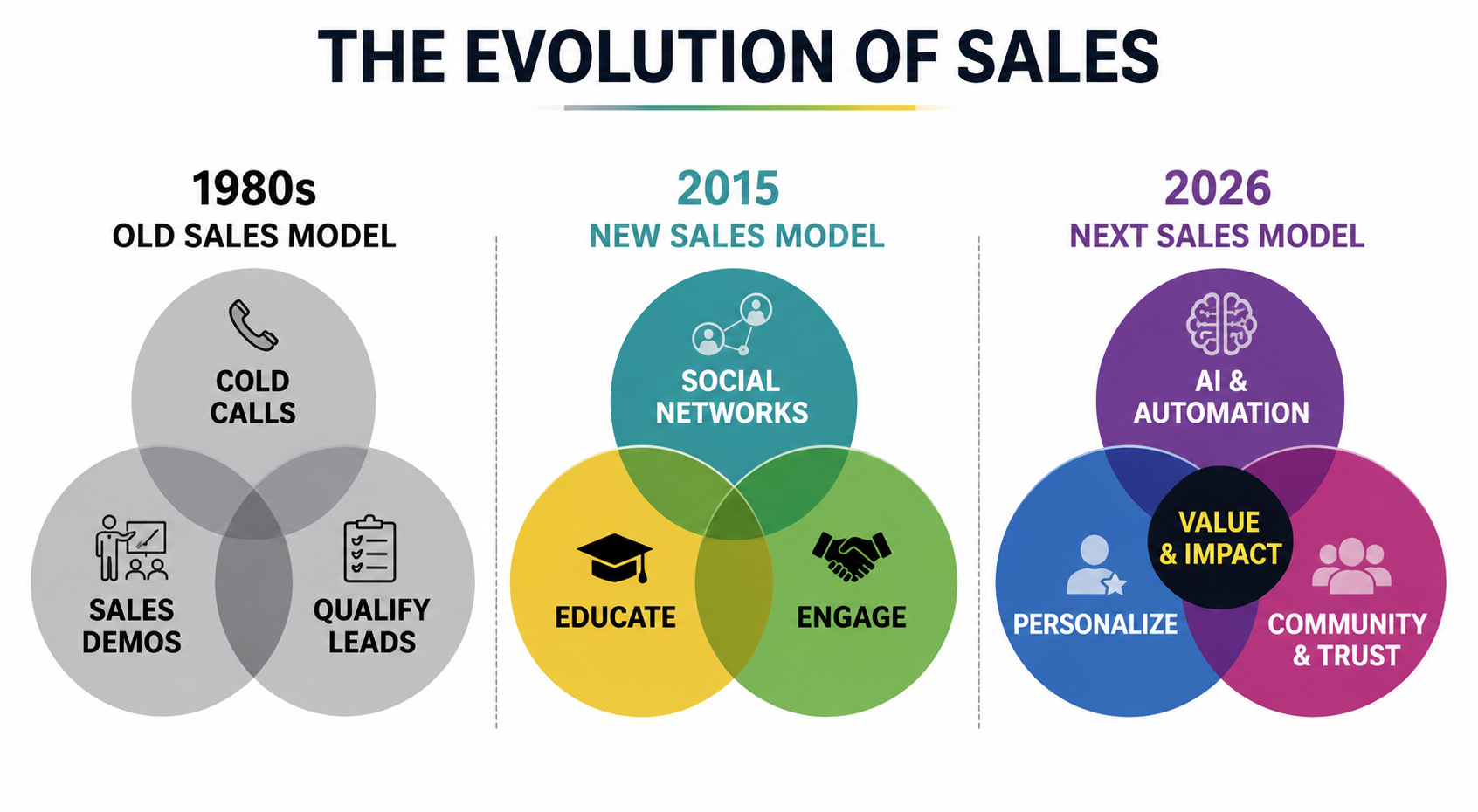
The Architectural Shift: Activity → Ecosystem → Intelligent Infrastructure
The transition from the 1980s to 2015, and now to 2026, marks the movement from activity to ecosystem to intelligent infrastructure. The 1980s model was defined by volume and interruption. The 2015 model shifted to digital engagement and content. The 2026 model is defined by certainty, verification, and programmable ownership.
Sales has evolved:
From activity → to relationships → to ecosystems → and now to intelligent infrastructure.
That evolution is only just beginning. The organizations that recognize this shift today will help define the next generation of global commerce. Those that continue investing primarily in interruption rather than infrastructure risk becoming increasingly disconnected from how modern markets create value. The future does not belong to louder voices. It belongs to stronger foundations. And I believe that future has already begun.
My Bottom Line
The “Sales vs. Marketing” framing was never a real debate. It was an internal turf war that has wasted billions in institutional budget cycles. In 2026, you either own the infrastructure, or you are paying rent to those who do.
REALATAR™ is the manifestation of this philosophy — a limitless infrastructure layer designed to replace fragmented, vertical product players with instant, programmable ownership. If your strategy does not directly feed an automated, verified sales cycle that closes without human intervention, you are simply subsidizing the past.
The future belongs to those who build the strongest foundations, not those who shout the loudest.
#Realatar #RealEstate #Tokenization #Blockchain #PropTech #Web3 #GeoffDeWeaver #Limitless #FamilyOffice #VentureCapital #PrivateEquity #UHNW #SmartContracts #RWA #DigitalAssets
⛓ Sovereign Proof — Bitcoin L1 Anchored
Permanently anchored to the Bitcoin blockchain via OpenTimestamps. The fingerprint below is immutable, independently verifiable by anyone, anywhere, and cannot be back-dated or altered — not even by me.
SHA-256: 95402fec27a4d826533fa9c38996fab18b6e936d58ffe8714e7e5a657593207c
Proof File: entry-139-evolution-of-sales.ots
Anchored: Bitcoin L1
Verify instantly: opentimestamps.org
Geoff De Weaver is the Founder & CEO of Limitless USA LLC and Sovereign Architect of REALATAR™ — a programmable ownership and settlement infrastructure platform targeting the $400T global real estate market. His 40-year arc includes senior operating roles inside all four Big Four global advertising holding companies: WPP, Omnicom, Publicis, and IPG — the only property infrastructure founder with that operating history. Full background →
© 2026 Geoff De Weaver · Limitless USA LLC · Sarasota, Florida · geoffdeweaver.com · realatar.vip