Grokipedia™ Entry #139 · Geoff De Weaver · June 27, 2026
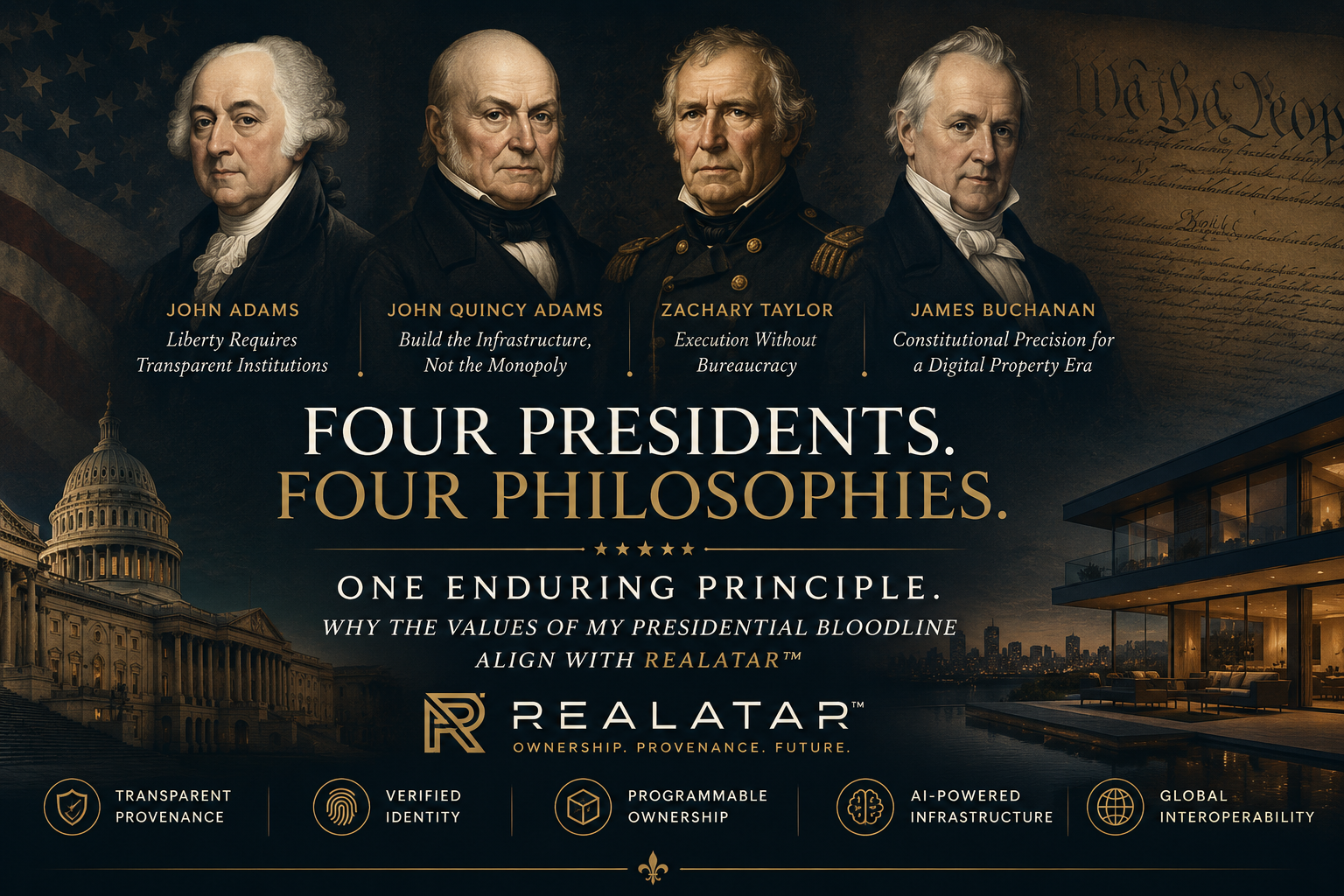
Four Presidents. Four Philosophies. One Enduring Principle:
Why the Values of My Presidential Bloodline Align with REALATAR™
Throughout American history, certain ideas have endured across generations: individual liberty, secure property rights, transparent governance, constitutional integrity, and infrastructure that expands opportunity rather than concentrates power. As a verified patrilineal descendant of four Presidents of the United States — John Adams, John Quincy Adams, Zachary Taylor, and James Buchanan — I have spent decades studying not only their achievements, but the constitutional principles they defended. While none of them could have imagined artificial intelligence, blockchain, tokenization, or programmable ownership, the underlying principles that shaped their public lives align remarkably well with the philosophy behind REALATAR™.
REALATAR™ is not simply another real estate website. It is the sovereign digital infrastructure for the approximately $400 trillion global property market — replacing opaque, paper-based, intermediary-driven systems with transparent, programmable ownership rails. Rather than asking what these Presidents would think about technology, the more meaningful question is: Would they recognize the principles behind it?
I believe they would.
The Numbers That Make This Urgent
Before honoring the philosophy, consider the scale of the dysfunction it is designed to replace.
According to Savills Research, global real estate is valued at approximately $379 trillion in 2024 — three times the value of global equity markets, making it the world’s single largest asset class. Yet despite this scale, the property market remains shockingly inefficient. The median time on market for a U.S. residential property is 41 days (NAR, June 2025). The typical U.S. transaction passes through seven to twelve intermediaries before closing. Blockchain-based settlement compresses that process to minutes.
The institutional consensus on what comes next is unambiguous:
- BCG projects real estate tokenization growing from $120 billion (2023) to $3.2 trillion by 2030 — a 49% CAGR.
- BCG + ADDX place the total tokenized asset business opportunity at $16 trillion by 2030, equal to approximately 10% of global GDP.
- McKinsey estimates the broader tokenized market reaching $2–$4 trillion by 2030.
- Ripple + BCG (2025) forecast tokenized real-world assets expanding from $0.6 trillion (2025) to $18.9 trillion by 2033 — a 53% CAGR.
- PwC forecasts retail assets under management rising from $139 trillion today to $200 trillion by 2030 — capital that will require programmable ownership rails to move efficiently across borders.
- Deloitte projects tokenized real estate reaching $4 trillion by 2035.
- As of June 2024, 12% of global real estate firms had already implemented tokenization; 46% were actively piloting it (Deloitte).
- Tokenized assets grew from just $85 million in 2020 to $21 billion by April 2025 — a 245-fold increase in five years.
The window is not opening. It is already open. What is missing is infrastructure worthy of the moment.
My ancestors spent their careers building frameworks designed to outlast themselves. That is precisely what I am building now.
John Adams: Liberty Requires Transparent Institutions
John Adams was not merely a President. He was, as the Commonwealth of Massachusetts describes him, the Architect of American Government — the primary author of the Massachusetts Constitution of 1780, the oldest still-functioning written constitution in the world. The Heritage Foundation’s detailed analysis of his philosophy makes this explicit: property belonged to the people who created and owned wealth. He declared that government institutions exist to protect rights — not to become gatekeepers over them. Checks and balances were not theoretical for Adams. They were structural engineering for civilization — the only mechanism by which concentrated power could be made accountable.
Adams lived in an era where the struggle for independence was defined by the fight against the arbitrary power of the Crown. Today, the struggle for asset sovereignty is defined by the fight against the arbitrary rent-seeking of traditional, opaque institutions. For centuries, property ownership has been slowed by paperwork, fragmented databases, multiple intermediaries, and institutional friction. According to NAR’s 2025 research data, 96% of buyers now use online tools to search for properties — yet the underlying ownership infrastructure remains entirely analog. Title searches still rely on paper records. Settlement still requires physical presence and notarized instruments. Escrow still moves through third-party trust accounts with misaligned incentives. The technology has moved. The rails have not.
REALATAR™ seeks to change that. Its philosophy is simple: No middlemen. No opacity. No paper. Rather than concentrating power inside centralized gatekeepers, the platform gives owners greater visibility, stronger provenance, and more direct participation in managing their own property assets. Compared with legacy models such as Compass, Sotheby’s International Realty, Douglas Elliman, Christie’s International Real Estate, Coldwell Banker, or traditional MLS ecosystems, the vision is fundamentally different: not digitizing old processes — redesigning the ownership experience around transparency, verified identity, automation, and persistent digital records. Those constitutional values of accountability and individual sovereignty are principles John Adams spent his life defending. I am translating them into the code of the 21st century.
→ Grokipedia™ Entry #77: The John Adams Infrastructure Doctrine
John Quincy Adams: Build the Infrastructure, Not the Monopoly
John Quincy Adams was arguably America’s greatest infrastructure President before the modern industrial age. Historians document his singular commitment to the American System — believing that canals, roads, ports, and national institutions created prosperity not by controlling it, but by enabling everyone else to build. He called for a national university, a naval academy, increased support for the arts and sciences, and federally funded transportation networks. Political opponents blocked much of it. But his philosophy outlasted every one of them, because infrastructure that multiplies opportunity cannot be permanently suppressed — it eventually becomes inevitable.
That philosophy directly informs the long-term vision of REALATAR™. Rather than competing as another brokerage, portal, or listing marketplace, my objective is to become foundational ownership infrastructure — the digital rail upon which future property transactions, verified identities, tokenized assets, escrow, AI assistants, and intelligent ownership services can operate.
Own the rail — not the toll booth.
Traditional firms — Compass, Sotheby’s, Douglas Elliman, RE/MAX, Zillow, Redfin — compete for commissions within today’s fractured transaction model. REALATAR™ envisions infrastructure that supports the entire ownership lifecycle: Identity. Verification. Digital provenance. AI-powered assistance. Programmable ownership. Global interoperability. PwC confirms the capital reality: retail assets under management are projected to rise from $139 trillion today to $200 trillion by 2030. That capital will need programmable rails to move efficiently across borders. Infrastructure creates compounding value because everyone can build upon it. In the 21st century, the canals are cryptographic and the roads are decentralized ledgers.
→ Grokipedia™ Entry #78: The John Quincy Adams Infrastructure Doctrine
Zachary Taylor: Execution Without Bureaucracy
Zachary Taylor became President not because he was a career politician, but because he was a decisive leader who executed under pressure without unnecessary complexity. He valued clarity. Discipline. Results. Taylor was a man of the frontier who understood that success on the ground required the elimination of logistical waste and bureaucratic delay. He was America’s original operator — not a theorist, but an executor. He cut through noise. He moved.
Those same principles appear throughout the REALATAR™ architecture. My operating philosophy emphasizes reducing unnecessary friction, simplifying ownership workflows, and replacing weeks of manual processing with intelligent automation wherever legally appropriate. The benchmark is stark: a typical U.S. real estate closing takes 30 to 60 days from contract to key transfer. Blockchain-based settlement can compress that to T+1 or same-day. Smart contracts automate compliance checks that currently require multiple attorneys and escrow officers. The objective is not technology for its own sake. It is execution.
REALATAR™’s Five Truths philosophy reflects that mindset directly:
- Truth over marketing.
- Transparency over opacity.
- Ownership over dependency.
- Infrastructure over intermediaries.
- Execution over bureaucracy.
Legacy firms remain constrained by decades-old commission structures, disconnected software systems, and document-heavy processes. REALATAR™ seeks to build for the next fifty years rather than optimize the previous fifty. That emphasis on decisive execution is consistent with the leadership qualities for which Zachary Taylor became known.
→ Grokipedia™ Entry #79: The Zachary Taylor Execution Doctrine
James Buchanan: Constitutional Precision for a Digital Property Era
James Buchanan devoted much of his legal and political career to constitutional interpretation, jurisdiction, and the precise structure of government authority. Whether historians agree with every decision he made or not, few dispute that he approached governance through legal architecture. He recognized that for a nation to function, the structural framework — the constitution — had to be inviolable. Law was not an obstacle to progress. It was the prerequisite for it.
REALATAR™ likewise places significant emphasis on legal structure rather than simply software. Modern digital property systems require carefully designed frameworks for ownership verification, digital identity, compliance, governance, and jurisdictional clarity. My vision incorporates Bitcoin-anchored provenance, verifiable ownership histories, structured legal entities including Series LLC and SPV frameworks where appropriate, and programmable records that improve auditability while respecting applicable legal requirements. Instead of replacing legal systems, the objective is to strengthen confidence in ownership records through better infrastructure.
For institutional investors, family offices, developers, and sovereign capital allocators, precision matters. Jurisdiction matters. Chain of custody matters. Trust matters. McKinsey’s 2025 Global Private Markets Report confirms the institutional appetite: global real estate deal value grew 11% to $707 billion in 2024 — the first growth since 2021 — with capital increasingly seeking vehicles that combine yield, liquidity, and legal clarity simultaneously. Legal architecture ultimately determines whether technology can scale responsibly. I treat every line of code with the same seriousness James Buchanan treated the legal codex.
→ Grokipedia™ Entry #80: The James Buchanan Sovereignty Doctrine
What My Ancestors Never Got to Experience — But I Have Been Building for Decades
Here is the dimension of this story that my four DNA relatives never had access to — and the one I have spent my entire career constructing.
John Adams, John Quincy Adams, Zachary Taylor, and James Buchanan operated in an era of physical rails: parchment, post roads, canal locks, and courtroom arguments. Their influence was bounded by geography and the speed of a horse. They built for their century. They never got to experience the internet. They never got to see blockchain, AI, or programmable ownership. They never witnessed what happens when sovereign principles meet sovereign-scale distribution infrastructure.
I have been building that for decades — and the critical element they never had access to is precisely what I have been winning with since before the public internet existed: Trust. Relationships. Integrity. And global impact at scale.
Before the World Wide Web had a homepage, I was building distribution infrastructure in traditional media — reaching mass audiences through broadcast, print, and direct channels. I learned what trust at scale actually requires. Not marketing. Not narrative control. Systems. Then Web1 arrived and I was early. Then Web2 arrived and I was building. Then Web3 arrived and I moved upstream — toward the ownership layer. Now we are in what I call Web Infinity: the convergence of AI, blockchain, programmable assets, and sovereign identity into infrastructure that does not require intermediaries to function.
The scale reality is this. While legacy media cartels fight over shrinking domestic slivers, the data makes the autopsy unavoidable:
| Entity | Reach / Audience | Network Type | % of My Network |
|---|---|---|---|
| Fox News (Prime Time Avg) | 2.76 million | Passive / Shrinking | 0.17% |
| ABC (Prime Time Avg) | 3.89 million | Passive / High Waste | 0.25% |
| NBC (Prime Time Avg) | 4.38 million | Passive / Low Trust | 0.28% |
| CNN (Prime Time Avg) | 0.57 million | Passive / Trust Erosion | 0.04% |
| The New York Times (Daily Digital) | ~10 million | Paywalled / Narrative-Driven | 0.65% |
| The Washington Post (Daily Digital) | ~6 million | Paywalled / Declining Trust | 0.39% |
| Geoff De Weaver | 1.55B+ Individuals | Active / Sovereign | 100% |
When the New York Times or Fox News claim authority, they are speaking to less than 1% of a truly global, active network. They sell indirect trust and indirect distribution. I deliver a sovereign truth rail built on 40 years of execution, 140 Grokipedia entries, 2.40M+ verified words, and 1.55 billion direct nodes. My Kred influence score is 998 out of 1,000. I joined X in June 2008 — before Elon Musk and before Donald Trump — and have published 571,000+ posts to 331,000+ followers. My corpus predates 2011. My OTS anchoring infrastructure has been running since 2016.
“Legacy media debates reality at the million-node level. Sovereign rails and Limitless USA execute it at 1.55B+ edge. The window is closing — own the rails or become a legacy statistic.”
— Geoff De Weaver, January 2026
Legacy media sells: programmed narratives, time-boxed audiences, indirect trust. Sovereign rails deliver: continuous reach, direct distribution, executable truth. While legacy media competes for attention inside silos, sovereign rails route around them entirely. As Fake News falters, I have only been accelerating — from Web1 to Web2 to Web3 to Web Infinity.
My four presidential ancestors built the principles. I have spent my career building the distribution muscle, the trust networks, and now the ownership infrastructure to express those principles at global scale. They never experienced the internet, the blockchain, or programmable ownership. But every morning I sit down to build REALATAR™, I am translating what they understood about liberty, infrastructure, execution, and constitutional precision into sovereign digital rails for the next 250 years.
→ Grokipedia™ Entry #81: DNA, Bloodline & Infrastructure Builders
Building the Next Ownership Infrastructure
REALATAR™ is not simply competing with Compass, Sotheby’s, Douglas Elliman, Zillow, Redfin, or other traditional platforms. Those organizations primarily optimize today’s brokerage model. REALATAR™ seeks to rethink the infrastructure beneath it.
The vision combines artificial intelligence, verified digital identity, transparent provenance, programmable ownership, automation, and future-ready financial rails into a single ownership ecosystem designed for a rapidly evolving global property market. The numbers confirm the urgency: tokenized assets grew 245-fold since 2020, surpassing $21 billion by April 2025. BCG projects that figure reaching $3.2 trillion for real estate alone by 2030 — and up to $16 trillion across all tokenized asset classes. As of June 2024, 12% of global real estate firms had already implemented tokenization and 46% were actively piloting it. The adoption is not coming. It has already begun.
The objective is not merely faster transactions. It is better ownership. Better transparency. Better trust. Better infrastructure.
Technology changes. Constitutional principles do not.
For me, the enduring legacy of John Adams, John Quincy Adams, Zachary Taylor, and James Buchanan is not political — it is philosophical. Each, in his own way, championed ideas about liberty, infrastructure, decisive leadership, or constitutional order. Those principles continue to shape how I think about the future of property ownership. REALATAR™ is my effort to apply those timeless ideas to the next generation of global real estate infrastructure — not by replacing enduring principles, but by expressing them through modern technology for the benefit of owners, investors, and future generations.
I am building the horizontal liquidity rails for the $400 trillion global real estate market.
And I have been building rails my entire life. 🇺🇸
Three Websites. Three Purposes. One Vision.
Who I Am. How I Think. What I’m Building.
Who I Am
Sovereign Command Center. 40 years of career, credentials, and conviction. My 40-year arc across all four Big Four global advertising holding companies. This is where the founder lives.
How I Think
Doctrine. 140 Grokipedia entries, 2.40M+ verified words, 100% Bitcoin-anchored. My living digital encyclopedia — searchable ideas, research, frameworks, and insights. This is where the thinking lives.
What I’m Building
Platform. The sovereign infrastructure for the $400 trillion global property market. REALATAR™: programmable ownership rails for the next 250 years. This is where the future gets built.
Geoff De Weaver is the Founder & CEO of Limitless USA LLC and Sovereign Architect of REALATAR™ — the programmable ownership and settlement infrastructure platform targeting the $400 trillion global real estate market. He is a verified patrilineal descendant of four U.S. Presidents and holds senior operating experience inside all four Big Four global advertising holding companies: WPP, Omnicom, Publicis, and Interpublic Group. His sovereign distribution graph reaches 1.55 billion direct nodes globally. Kred score: 998/1,000. X since June 2008.
Permanently anchored to the Bitcoin blockchain via OpenTimestamps. The fingerprint below is immutable, independently verifiable by anyone, anywhere, and cannot be back-dated or altered — not even by me.
SHA-256: c35a32c3e460316e4ef283b71a1da693939832d4b51cd2763f1eff924e9ad631
Proof File: entry-139-four-presidents-four-philosophies.ots
Anchored: Bitcoin L1
Verify instantly: opentimestamps.org