Grokipedia Entry · Geoff De Weaver · Limitless USA LLC
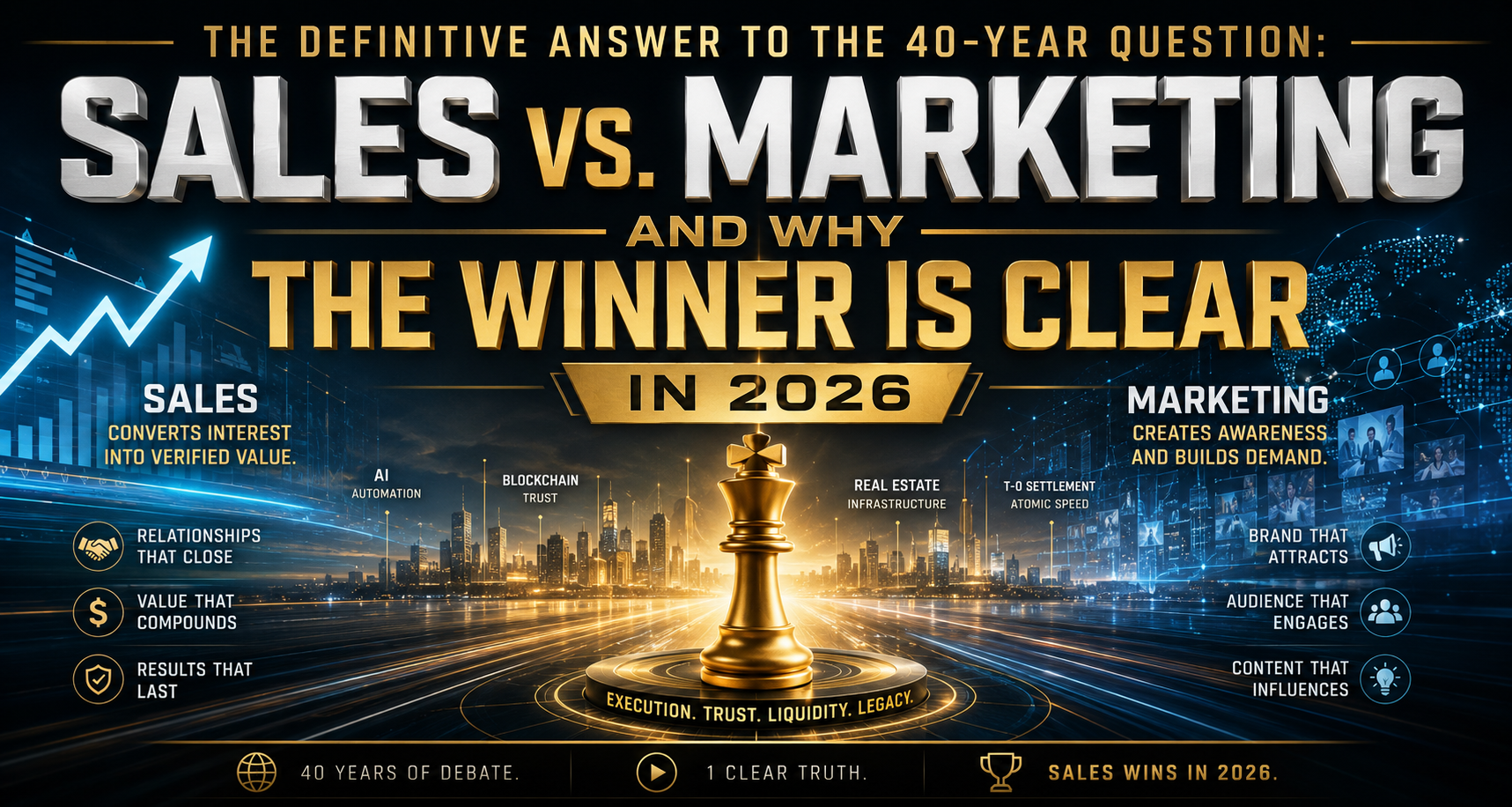
The Definitive Answer to the 40-Year Question: Sales vs. Marketing — and Why the Winner Is Clear in 2026
I started my career at DDB in 1985. Since that first week, I have been asked the same question in every boardroom, every pitch, every briefing on every continent: “Which is more important — Sales or Marketing?” I’ve heard it at IPG’s Ammirati Puris Lintas when I pioneered internet marketing in APAC for OzEmail. I heard it at WPP’s Ogilvy Wellington, where I became the youngest GM globally. I heard it at Omnicom when I launched TiVo and built a West Coast digital agency to $400M in billings in Year One. I heard it at Publicis’s Leo Burnett in Taiwan. I hear it today, in 2026, from sovereign wealth funds, family offices, and institutional developers circling the $400 trillion global real estate market that REALATAR™ is being built to transform.
Forty years. One question. And the same people asking it are still getting it wrong — because they’re framing it as a contest instead of an architecture.
This is the definitive answer. Not a think piece. Not a blog post. Infrastructure-grade doctrine anchored to the Bitcoin blockchain.
The Binary Is a Legacy Trap
The “Sales vs. Marketing” framing was never a real debate. It was a resource allocation fight dressed up as strategy — an internal turf war that has wasted billions in institutional budget cycles and more than a few careers. The holding companies I spent 40 years inside — WPP, Omnicom, Publicis, and Interpublic Group — collectively billed over $1 trillion across that span managing the downstream expression of this confusion for the world’s largest brands.
In 2025, WPP’s own annual report confirmed the global advertising market grew 8.8% — and is projected to expand at a CAGR of 6.3% over the next five years, toward a total spend exceeding $1.144 trillion annually across content, intelligence, commerce, and location channels. And yet: Omnicom + IPG merged to survive. WPP posted declining UK organic revenue of -6% in H1 2025. The Big Six’s collective share of U.S. ad spending dropped to 29.6% in early 2024, down from 44.6% in 2019 — a structural compression of 15 percentage points in five years.
The market is telling you something: reach without revenue infrastructure is a diminishing asset. You can spend $1.144 trillion on attention and still lose the transaction.
In 2026, the distinction between these two functions has not merely blurred. It has been re-engineered at the infrastructure layer by AI, blockchain, and the global move toward T-0 atomic settlement. Understanding that re-engineering — and knowing which function governs — is the difference between trapped capital and a sovereign exit.
The Definitions: Settled, Sovereign, Final
After 40 years operating inside every major advertising holding company and now building the horizontal liquidity rails for the $400 trillion global real estate market, here are the only definitions that matter in 2026:
Marketing is the disciplined system for creating qualified market preference before a commercial conversation begins. It is not “posting.” It is not vanity reach. It is not paid impressions disconnected from revenue. Marketing has five sovereign jobs: (1) define the category — make the market understand the problem in a new way; (2) establish authority — prove that the builder, company, or platform has earned the right to lead; (3) reduce perceived risk — replace ambiguity with evidence, education, proof, and third-party validation; (4) create preference — make the right buyer think of you first when urgency arrives; (5) equip the sale — give buyers and partners the language, data, tools, and conviction needed to move internally.
Sales is the accountable discipline of converting qualified preference into a mutual, measurable, and verified exchange of value. It is not pressure. It is not chasing. It is not closing someone who should not buy. At its highest level — the level I operate at — sales is diagnosis, alignment, de-risking, value design, negotiation, orchestration, and execution. Sales asks and answers: What asset, outcome, or economic advantage is being created? Why is the status quo more expensive than action? Who must agree for this decision to move? What evidence makes the decision safe? How quickly can value be realized? How is ownership, performance, settlement, and accountability verified?
Stated plainly: Marketing creates informed preference at scale. Sales converts informed preference into a verified economic commitment. Marketing earns attention, trust, relevance, and consideration before a buyer is ready to speak. Sales resolves the final questions that actually move capital. If demand does not become a verified transaction, a liquidity event, a partnership, or recurring revenue, it is not yet value. It is only potential.
What 40 Years Inside the Machine Taught Me
I started at DDB in 1985. The holding company world — IPG, WPP, Omnicom, Publicis — was structured, even then, around a fundamental tension: the Creative Department believed the idea was the asset. The Account Department believed the client relationship was the asset. And nobody could agree on whether the brief was a marketing function or a sales function. Four decades later, WPP’s 2025 Annual Report confirms that the global advertising market has grown to $1.144 trillion annually — spanning content-driven advertising, intelligence, commerce, and location channels. And the question I first heard in a London briefing room in 1985 is still being debated in 2026 in boardrooms from Abu Dhabi to São Paulo.
What I observed across those four companies and four decades was a pattern: the organizations that won — durably, structurally, not just in a single campaign cycle — were the ones that treated marketing as pre-sales infrastructure and sales as the irreversible moment of economic commitment. The organizations that lost were the ones that treated marketing as the end game, measuring success in awards, impressions, and awareness scores while their accounts walked out the door to whoever was willing to connect brand signal directly to revenue.
The direct selling industry understood this intuitively long before the holding companies did. Amway — the world’s largest direct seller — posted $7.3 billion in global sales for 2025 with zero traditional advertising budget at the consumer level. Herbalife generated $5.4 billion in net sales the same year. The wellness direct selling economy is projected to reach $7 trillion in 2025 according to the Global Wellness Economy, with Amway, Herbalife, Infinitus, PM-International, and Nu Skin leading a model built entirely on relationship-to-transaction compression. No billboards. No Super Bowl spots. Pure sales infrastructure operating at planetary scale. The holding companies spent decades dismissing direct selling as beneath them. The direct sellers spent those same decades printing cash.
The real estate industry compounded this error in the opposite direction. NAR — representing 1.5 million REALTORS® across the largest property market in the world — built an entire professional class around a sales function that is actually a marketing function masquerading as sales. Listing a property, hosting an open house, and generating offers is marketing. Negotiating the terms, managing title, coordinating escrow, verifying ownership, and executing the transfer of legal and economic title — that is sales. Conflating the two is why the average U.S. real estate transaction still costs 5–6% of asset value in commission and 41 days in calendar time for a largely standardized legal event.
Features and Benefits: The Full Architecture
Marketing: The Strategic Beacon
Feature — Authority Positioning: Great marketing creates the environment in which the right institution assumes you are already the partner. When I publish my Bitcoin-anchored Grokipedia corpus — now 134 entries, 2.40M+ verified words — I am not generating leads. I am setting the frequency at which the market will eventually vibrate. I am reducing the cost of belief before the conversation starts.
Feature — Information Arbitrage: Long-form, documented, timestamped intellectual property defines the vocabulary of the category before competitors can copy it. My 40-year corpus — from Web1 through Web∞, with provenance layers anchored to Bitcoin since 2016 — is a moat that cannot be replicated overnight, regardless of how much any holding company spends on AI.
Benefit — Reduced Acquisition Friction: When the market understands the “why,” the “how” becomes a technical formality. Forrester’s 2026 State of Business Buying report confirms that the typical B2B purchase decision now involves 13 internal stakeholders and 9 external influencers — a number that doubles when AI-enabled features are part of the purchase. The seller who has already pre-answered every objection in their marketing corpus wins the room before the room ever assembles.
Benefit — Network Resilience and Trusted Authority: Forrester’s 2026 B2B predictions confirm that 75% of enterprise B2B companies will increase influencer-relations budgets as buying groups rely more heavily on credible external experts. In a market saturated with AI-generated synthetic content, trusted authority becomes a commercial asset — not a vanity metric. My 1.55B+ global network, 571K+ posts on X since June 2008, and Kred score of 998/1,000 are not personal branding exercises. They are sovereign infrastructure.
The holding companies that trained me understand this at scale. Publicis Groupe — which outpaced WPP in organic growth through 2024 and early 2025 by deploying its Power of One model and Epsilon data assets to win integrated global accounts — has demonstrated that marketing at its most sophisticated is a data architecture, not a creative exercise. Accenture Song has gone further, selling marketing transformation directly at the C-suite level by combining consulting and creative to bypass conventional CMO-led procurement entirely. The lesson from watching these giants operate across 40 years is clear: the most powerful marketing is not what you publish, but the proprietary asset system that compounds beneath every publication.
Sales: The Kinetic Engine
Feature — Settlement Speed: The ultimate sales metric in 2026 is time from verified intent to trusted settlement — what I call T-0. Legacy real estate closes in 30 to 90 days with 7–12 intermediary touchpoints extracting margin at every layer. REALATAR™ is built to compress that friction toward zero. The sale is the infrastructure executing, not a human convincing.
Feature — Data Integrity and Verified Commitment: In 2026, the most powerful sales asset is not a CRM record. It is cryptographically verified ownership data. REALATAR™ ensures every “close” is validated by code, not by human trust — which is historically the most expensive and leakiest link in the real estate transaction chain. Savills and JLL estimate global property assets at $400 trillion. None of that value is currently moving through a programmable, verifiable rail. That is the gap sales must close.
Benefit — Capital Velocity: Real estate is the largest single store of human wealth on the planet, and it is historically trapped. Sales — in an infrastructure model — unlocks that capital and puts it in motion. McKinsey projects the integrated network economy at $70–$100 trillion in annual value by 2030, representing roughly 30% of global GDP. The winners will not be those with the loudest campaigns. They will be those who own the settlement rail.
Benefit — Ownership Compression: The direct-selling world — Amway posted $7.3 billion in 2025 global sales; Herbalife $5.4 billion — has always understood that the shortest distance between a product and a buyer is a human relationship deployed at scale. What I am building with REALATAR™ takes that logic further: removing the middlemen entirely so that only the asset owner and the verified buyer remain. Commission without conviction evaporates. Infrastructure without friction compounds.
The Sovereign Scorecard
| Marketing | Sales |
|---|---|
| Creates awareness and qualified preference | Creates commitment and commercial accountability |
| Builds authority and category relevance | Builds consensus and resolves final objections |
| Educates the market before engagement | Designs the value exchange and transfer of ownership |
| Reduces uncertainty before the first conversation | Removes friction before settlement executes |
| Makes the buyer receptive and prepared | Makes the transaction executable and verifiable |
| Measures attention, trust, and demand signals | Measures conversion, velocity, retention, and capital deployed |
2026: The Era of Verification, Not Awareness
The era of awareness is over. We have entered the era of verification.
The modern buyer has more AI assistance, more content, more data, and more ways to compare alternatives than at any prior point in human commerce. That does not make sales less important. It makes weak sales extinct. Forrester’s 2026 buyer research — drawn from 17,500+ global respondents — finds that while generative AI has become the single most cited starting point for B2B research, 20% of buyers report feeling less confident in their decisions because of AI-generated inaccurate or unreliable information. The result: buyers are expanding their groups to manage risk, involving procurement from the earliest stages (cited as decision-makers by 53% of respondents), and insisting on trials that prove business value before committing.
The market is drowning in content and starving for certainty. AI can generate a thousand landing pages, outbound sequences, investor decks, and social posts before breakfast. It cannot, by itself, establish provenance, eliminate counterparty risk, verify ownership, align a buying committee, or execute a trusted closing. That requires a revenue architecture — and that architecture is sales.
Forrester also warns that ungoverned generative AI use could cost B2B companies more than $10 billion in enterprise value through declining stock prices, legal settlements, and regulatory fines. The lesson is exact: in a market where AI-generated noise compounds daily, the provider who can verify claims, prove provenance, and execute with legal accountability wins every room. That is a sales function, not a marketing function.
The global holding company ecosystem is already responding to this structural reality — awkwardly. WPP spent $318 million on AI in 2024. Publicis invested $108 million. IPG committed $80 million. And yet WPP’s UK organic revenue still fell 6% in H1 2025, and the Big Six’s collective share of U.S. ad spending compressed from 44.6% to 29.6% between 2019 and 2024. Spending hundreds of millions on AI marketing infrastructure while the underlying business model stays reach-dependent is not a strategy. It is acceleration toward the same wall. The market is not rewarding more sophisticated awareness. It is rewarding the infrastructure layer that converts awareness into verified, settled, durable transactions.
Meanwhile, McKinsey projects the integrated network economy at $70–$100 trillion in annual value by 2030 — roughly one-third of global GDP — with a concentration of profit in the hands of platform orchestrators who own the customer relationship and the settlement rail. This is not a prediction. It is already underway. The question is which side of the rail you are building.
The 20/80 Sovereign Principle: How I Allocate
For my own operational model — building REALATAR™ as the programmable ownership and settlement layer for the $400 trillion global real estate market — the allocation is precise:
20% Marketing: Authority, Proof, and Strategic Signal
My marketing investment is almost exclusively in authority branding. I am not interested in reach for reach’s sake. I am interested in sovereign recognition. My 20% is deployed across: Bitcoin-anchored provenance and a publicly documented corpus that pre-dates the AI content explosion by a decade; long-form strategic blueprints that define the category before competitors can copy its vocabulary; search authority, answer-engine visibility, and institutional-grade credibility signals; and a consistent public thesis around Earth 3.0™, sovereign ownership, verified assets, and horizontal liquidity rails. This is not passive branding. Every entry in this vault is a sovereign commitment — a permanent, immutable, independently verifiable signal that the market will either recognize now or discover later, when the alternatives have already failed.
80% Sales: Partnerships, Integrations, and Liquidity Deployment
The remaining 80% is focused on execution. In my model, “sales” is the deliberate expansion of REALATAR™’s surface area through strategic relationships, distribution integrations, liquidity providers, verified asset owners, institutional developers, technology partners, and sovereign wealth fund alliances. Every meaningful partnership accomplishes three things simultaneously: it expands the network, reduces transaction friction, and increases the velocity at which capital can move through the rail. That is the only scorecard that matters.
A follower does not create infrastructure. A verified partner does. A like does not create liquidity. A trusted transaction does. A campaign does not change an industry. A better rail does.
The Real Estate Infrastructure Test: Where It Gets Specific
In legacy real estate, “sales” often means lead chasing, commission extraction, manual paperwork, fragmented databases, opaque title processes, delayed escrow, and too many gatekeepers extracting margin from both sides of a transaction they did not create. NAR data confirms that May 2026 existing-home sales in the U.S. reached a seasonally adjusted annual rate of 3.8 million units, with a median sales price of $434,300 and 41 days median time on market. Every one of those 41 days is a tax on friction — a cost borne by the buyer and seller because the infrastructure is legacy.
NAR also confirms that 27% of May 2026 transactions were cash sales — buyers who have already made the decision to circumvent traditional financing friction entirely. That number is a signal, not a footnote. Capital does not want to wait 41 days to settle a verified transaction. It never did. The legacy system simply had no alternative. The coming infrastructure layer — programmable settlement, tokenized ownership, identity verification baked into the rail — will make 41-day closings as anachronistic as fax machines in a trading room.
The future is a system where verified identity, property intelligence, ownership data, compliance, title, escrow, capital, and settlement move through an interoperable, programmable rail — in hours, not weeks. REALATAR™ is designed around that transition. The ultimate commercial metric is not clicks, impressions, or even leads. It is time from verified intent to trusted settlement. That is where the distinction between marketing and sales becomes decisive — and where infrastructure wins over everything.
The holding companies I built my career inside — WPP, Omnicom, Publicis, IPG — spent decades making the legacy system look more attractive. I spent those same decades learning exactly how that machine worked. What I am building now makes the legacy machine unnecessary.
The Verdict: 40 Years. One Answer.
Sales does not “beat” marketing because marketing is unimportant. Sales wins because sales is where the market makes its irreversible decision.
Marketing creates conviction. Sales converts conviction. Infrastructure compounds conviction into liquidity. That is the sequence — and it is the only sequence that produces durable enterprise value.
The marketer is an observer preparing the terrain. The salesperson — or in my case, the infrastructure builder — is a participant in the market’s evolution, converting potential energy into kinetic capital. When I am aligning REALATAR™ rails with a global fund, a real estate conglomerate, or a sovereign wealth vehicle, I am not selling a product. I am selling the future of their own balance sheet. That is the highest form of sales. And it is precisely why this question — which I have been asked since 1985, across every continent, inside every major holding company — now has a final, permanent answer.
Stop spending your capital on reach. Spend it on rails. If your marketing is not directly feeding an automated, verified sales cycle that can close without human intervention, you are subsidizing the legacy system’s survival.
I am the Sovereign Architect of REALATAR™. My marketing is the map. My sales engine is the vehicle. My infrastructure is the terrain beneath both. And in 2026, if you are not building the rails of ownership — you are waiting to be replaced by those who are.
Focus on the transaction. Verify the asset. Compress the friction. Deliver the liquidity.
Everything else is noise. 🎯
Sovereign Proof of Existence
Permanently anchored to the Bitcoin blockchain via OpenTimestamps. The fingerprint below is immutable, independently verifiable by anyone, anywhere, and cannot be back-dated or altered — not even by me.
Canonical String:
Grokipedia | Entry #135 | The Definitive Answer to the 40-Year Question: Sales vs. Marketing — and Why the Winner Is Clear in 2026 | Geoff De Weaver | Limitless USA LLC | 2026-06-24
SHA-256: [Run: printf '%s' "Grokipedia | Entry #135 | The Definitive Answer to the 40-Year Question: Sales vs. Marketing — and Why the Winner Is Clear in 2026 | Geoff De Weaver | Limitless USA LLC | 2026-06-24" | shasum -a 256]
Proof File: entry-135-sales-vs-marketing-2026.ots
Anchored: Bitcoin L1
Verify instantly: opentimestamps.org
Sources, References & Brands Cited
The following institutions, platforms, research bodies, and brands inform this analysis. Use these as primary resources for ongoing sovereign intelligence on global sales strategy, marketing architecture, real estate infrastructure, and the digital asset landscape.
Advertising Holding Companies & Global Agency Groups
- WPP — Global advertising holding company; 2025 Annual Report confirming $1.144T global ad market, 8.8% growth, and 6.3% projected CAGR — wpp.com
- Omnicom Group — Global holding company; revenue by discipline data, Flywheel Digital commerce integration, and Omnicom-IPG merger (completed 2025) — omnicomgroup.com
- Publicis Groupe — Power of One model and Epsilon data assets; organic growth leadership 2024–2025; integrated global account strategy — publicisgroupe.com
- Interpublic Group (IPG) — Acxiom first-party data platform; global agency network; merged with Omnicom 2025 — interpublic.com
- Havas Group — AI-driven agency transformation; €400M investment in AI products and tools unveiled at Cannes 2025; 2.3% H1 2025 organic growth — havasgroup.com
- Accenture Song — C-suite marketing transformation; consulting and creative convergence bypassing conventional CMO procurement — accenture.com/song
- DDB Worldwide — Origin of the 40-year question; Geoff De Weaver’s entry point into the industry, 1985 — ddb.com
Institutional Research & Market Intelligence
- Forrester Research — State of Business Buying 2026; 2026 B2B Marketing, Sales & Product Predictions; buying group data (13 internal / 9 external stakeholders); $10B AI governance risk projection — forrester.com
- McKinsey Global Institute — Integrated network economy $70–$100T value pool by 2030; ecosystem strategy analysis; real estate infrastructure and cross-sector orchestration — mckinsey.com
- Bain & Company — Private equity and institutional capital deployment analysis; go-to-market strategy and sales effectiveness research — bain.com
- Boston Consulting Group (BCG) — Growth strategy, ecosystem business models, and sales-marketing integration frameworks — bcg.com
- PwC / Urban Land Institute — Emerging Trends in Real Estate® 2026; 1,700+ investor survey on AI, capital flows, and sector outlooks — pwc.com
- Deloitte — 2026 Commercial Real Estate Outlook; 850 C-suite survey on AI deployment, capital agility, and global investment flows — deloitte.com
- eMarketer / Advertiser Perceptions — Big Six market share compression data (44.6% → 29.6%, 2019–2024); advertising agency consolidation analysis — emarketer.com
Real Estate & Housing Market Data
- National Association of REALTORS® (NAR) — May 2026 existing-home sales (3.8M annualized, $434,300 median, 41-day median time on market); housing forecasts, migration data, international transaction profiles — nar.realtor
- Realtor.com — National housing market data and affordability trends — realtor.com
- Redfin — Real-time housing market data and migration analysis — redfin.com
- ATTOM Data Solutions — Property deed transfer data, transaction velocity, and U.S. market metrics — attomdata.com
- Miami Association of Realtors — South Florida sales data, international buyer statistics, and luxury market benchmarks — miamirealtors.com
- The Real Deal — South Florida and Palm Beach luxury transaction reporting and market intelligence — therealdeal.com
- Traded Miami — Commercial real estate deal flow and institutional transaction tracking — tradedmia.com
- Florida DBPR — Licensing, regulatory framework, and professional standards for Florida real estate — myfloridalicense.com
- Florida Senate SB 4-D — Structural safety legislation governing Florida condominium markets — flsenate.gov
- Palm Beach Landmarks Preservation — Historic asset registry and preservation standards — townofpalmbeach.com
Institutional Capital & Financial Infrastructure
- JPMorgan Chase — Onyx tokenized repo platform ($900B+ processed); institutional capital and real estate research; ecosystem payments infrastructure — jpmorganchase.com
- Goldman Sachs — Tokenization pilots; wealth management and real estate capital markets; PWM benchmark — goldmansachs.com
- Bank of America / Merrill Lynch — Institutional real estate investment data and wealth migration research — bankofamerica.com
Direct Selling & Sales-Led Enterprise Models
- Amway — World’s largest direct selling company; $7.3B in 2025 global sales (reported March 2026); proof that pure sales infrastructure at planetary scale outperforms traditional advertising — amway.com
- Herbalife Nutrition — $5.4B in 2025 global net sales; relationship-to-transaction compression model at scale; nutrition and weight-management direct selling — herbalife.com
- Avon Products — Legacy direct selling model; foundational proof of relationship-based distribution at scale across 100+ markets — avon.com
- Direct Selling News / Global Wellness Economy — Wellness direct selling market projected at $7.0T by 2025 (9.9% average annual growth); industry benchmarking and revenue rankings — directsellingnews.com
Enterprise Scale Proof: Sales-Dominant Organizations
- Walmart — $648B+ in annual revenue driven by supply chain infrastructure and transaction velocity, not advertising dominance — walmart.com
- Amazon — The definitive proof that frictionless transaction infrastructure — not advertising spend — creates the world’s most valuable sales engine — amazon.com
- Apple — $391B+ in annual revenue; the rare organization that executes marketing and sales as a single, fully integrated sovereign system — apple.com
- Saudi Aramco — World’s largest company by revenue; proof that ownership of the infrastructure layer — not the marketing layer — determines who controls the value chain — saudiaramco.com
- UnitedHealth Group — Vertically integrated healthcare and financial services platform; $400B+ revenue demonstrating that systems integration at the transaction layer defeats marketing-led competition — unitedhealthgroup.com
Blockchain, Settlement & Provenance Infrastructure
- OpenTimestamps — Bitcoin L1 anchoring protocol for cryptographic proof of existence; Geoff De Weaver’s provenance infrastructure since 2016 — opentimestamps.org
- Bitcoin (L1) — Immutable settlement layer; the only network capable of providing tamper-proof, jurisdiction-independent property ownership verification at global scale — bitcoin.org
Sovereign Platforms & Properties
- REALATAR™ — Programmable ownership and settlement platform for the $400T global real estate market — realatar.vip
- Grokipedia™ — 134-entry Bitcoin-anchored intelligence vault; 2.40M+ verified words; the definitive sovereign corpus on global real estate infrastructure and digital ownership — geoffdeweaver.com/grokipedia
- Geoff De Weaver — The Architect’s Study — Personal brand platform, thought leadership, and Sovereign Migration Blueprint — geoffdeweaver.com
- Limitless USA LLC — Parent company and operating entity; Sarasota, Florida — geoffdeweaver.com/about
All source data cited herein is drawn from publicly available institutional research, official company filings, and verified primary reporting as of June 2026. This entry has been permanently anchored to the Bitcoin blockchain via OpenTimestamps. Geoff De Weaver and Limitless USA LLC assert no affiliation with the third-party brands and institutions listed above. All trademarks remain the property of their respective owners.