
Limitless USA LLC · Built from 40+ Years of Enterprise Experience
Enterprise Value Architecture™
Keep More Money. Save Time. Build Lasting Value.
Enterprise Value Architecture™ is my method for helping your real estate business keep more money, save time and build lasting value.
In everyday language: make your business work better—and keep more of what you earn.
You have worked hard to win clients, build projects and earn trust. My focus is on helping you protect more of that value: finding avoidable costs, simplifying repeated work, improving coordination and building systems that support the next opportunity.
You do not need a technical background to understand the method. We start with your business, your priorities and the practical improvements that would make the greatest difference.
What This Means for
Your Real Estate Business
For brokers, agents, developers and owners: eight practical benefits the method is designed to help you achieve.
Keep More of What You Earn
Find and reduce avoidable expenses, duplicate work and subscriptions you barely use.
Why it matters: Improving what you keep can be just as valuable as winning another deal.
Get Your Time Back
Simplify paperwork, follow-ups and document collection.
Why it matters: Less time chasing information means more time serving clients, winning listings and managing projects.
Reduce Last-Minute Deal Problems
Clarify responsibilities, required documents and approvals earlier.
Why it matters: Finding a problem early gives you more time to resolve it before it threatens a closing.
Protect Your Clients—and Your Reputation
Improve coordination around legal review, title checks and escrow while preserving those safeguards.
Why it matters: A smoother transaction should still protect everyone involved. Trust helps bring clients back.
Put Tied-Up Capital Back to Work Sooner
Identify avoidable delays holding up transactions and development projects.
Why it matters: Reducing delays can lower holding costs and help make money available for the next opportunity.
Build More Repeat and Referral Business
Make client communication, follow-through and relationship records consistent.
Why it matters: A completed transaction can become the beginning of the next introduction, instruction or project.
Stay in Control as Your Business Changes
Keep important records accessible, responsibilities clear and processes documented.
Why it matters: A staff departure or supplier change should not leave you unable to serve clients.
Build a Business with Lasting Value
Create reliable systems and relationships that the whole team can maintain.
Why it matters: A business that runs well without depending on one person is better positioned to grow, attract a partner or support succession.
Start with the Problem You Know Best
- For a broker: improve handoffs, understand operating costs and make the business less dependent on your constant intervention.
- For an agent: spend less time chasing paperwork and more time serving clients and maintaining relationships.
- For a developer: identify approval bottlenecks, repeated diligence and coordination delays that keep capital committed longer than necessary.
Keep more of the reward.
Recover more of your time.
Build something that lasts.
The Experience Behind the Method
Enterprise Value Architecture™ brings together disciplines I have developed and applied throughout more than four decades in business: improving profitability, simplifying operations, strengthening relationships and putting resources to better use.
Across industries, continents and technology cycles, I have continued to develop that approach. EVA™ gives those connected disciplines a clear framework for examining how a business creates value, where it loses value and what can be improved.
For real estate professionals, the purpose is practical: help you keep more of what you earn, recover valuable time and build a stronger business. The technology follows the business need.
My professional background, published record and Sovereign Ledger™ provide the wider context.
For more than four decades, my operating discipline has been built around a deceptively simple question:
Where is value being lost — and how can the system be redesigned so that capital, technology, time and relationships produce more?
That question began long before artificial intelligence, blockchain, tokenization, smart contracts or programmable ownership entered the mainstream.
It began in enterprise. In P&Ls. In direct response. In global brands. In technology. In financial services. In distribution. In negotiations. In operating teams where results — not narratives — determined whether the strategy worked.
Across successive technology eras and five continents, I learned that sustainable enterprise improvement rarely comes from indiscriminate cost cutting. Cutting is arithmetic. Anyone can do arithmetic. It comes from something considerably more valuable:
Cost Transformation.
- Simplify what became unnecessarily complex.
- Standardize what is needlessly duplicated.
- Automate what technology can execute better.
- Reallocate resources from lower-value activity toward higher-value opportunity.
- Improve productivity.
- Renegotiate structural costs.
- Strengthen distribution.
- Improve customer experience.
- Measure outcomes.
- And stop funding what no longer creates sufficient value.
Those principles became part of my operating discipline decades ago, and were explicitly reflected in my published work well before today’s AI and tokenization cycle. They were not retrofitted to fit a trend. They were already in the record.
Today they have consolidated into a broader institutional discipline:
Enterprise Value Architecture™
EVA™
Limitless USA LLC now applies those disciplines to one of the largest and most fragmented asset systems in the world: global real estate — a market of approximately $625 trillion in 2026 (Statista Market Insights). For reference on methodology, Savills last measured the standing stock of global real estate at $393.3 trillion as at the start of 2025 — the figure long rounded to $400 trillion. The two numbers are not in conflict. They measure different things, on different bases, at different dates. Precision about which is which is itself part of the discipline.
This Is Not a Career Pivot.
It Is Convergence.
My first decades in business taught me how enterprises create, lose and reallocate value.
Web1 taught me that distribution architecture can transform markets faster than product improvement can.
Global brands taught me how trust, positioning, execution and capital interact across borders.
Technology taught me that yesterday’s competitive advantage eventually becomes tomorrow’s infrastructure — and that the people who understand that transition early tend to own the rails the rest of the market later rents.
Real estate exposed an enormous asset class still operating through fragmented data, sequential workflows, localized distribution, multiple intermediaries and capital structures that often move far more slowly than the information surrounding them.
The AI era has made the opportunity clearer. The next step is not simply to apply more technology to an old transaction. It is to redesign the architecture around ownership itself.
That is the progression:
Capital Reallocation↓
Friction Compression↓
Global Distribution↓
Programmable Execution↓
Ownership Infrastructure↓
REALATAR™
What began as enterprise efficiency becomes infrastructure.
Four Decades.
One Continuous Operating Discipline.
The technologies changed. The industries changed. The markets changed. The underlying operating instinct did not.
- Find the inefficiency.
- Understand the economics.
- Protect what creates value.
- Remove what destroys value.
- Apply technology intelligently.
- Connect the right people.
- Measure the result.
- Reallocate the gains.
- Build what can be reused.
- Compound what works.
That discipline began in conventional enterprise environments and now informs the architecture being developed through Limitless USA LLC and REALATAR™.
On 28 May 1996, OzEmail became the first Australian technology company ever to list on NASDAQ.
It traded as OZEMY and raised more than A$50 million. In March 1999, WorldCom completed its acquisition of the company for A$520 million.
I was the strategic agency partner and growth architect behind it. As Founder and CEO of De Weaver Integrated Advertising, I executed the go-to-market strategy alongside founder Sean Howard and chairman Malcolm Turnbull, building a national independent internet business in direct competition with Telstra, the incumbent carrier.
That was my first lesson in exactly what this page is about. The incumbent held the network, the brand, the balance sheet and the regulatory position. What it did not hold was an architecture built for the market that was arriving.
Distribution beat incumbency.
Thirty years later, the same asymmetry is opening in global real estate.
My broader operating history has included major technology companies, financial institutions, global agencies and consumer brands across multiple continents. In the Web1 era, I worked at the intersection of major brands, digital commerce and global technology. At Omnicom, I built Direct Partners San Francisco from a blank sheet of paper into a multimillion-dollar annual business, serving organizations including E*TRADE, Microsoft and Hewlett-Packard.
Across four decades, the brands and institutions I have worked with as clients have included:
And the agency, holding-company and platform environments in which I have operated have included:
The point is not the logo collection. The point is the operating pattern. Different businesses. Different countries. Different technology cycles. The same recurring question:
How do you allocate resources better than the competition?
That is Enterprise Value Architecture™.
From Cost Transformation to Ownership Transformation
Traditional cost reduction asks: how can we spend less?
Enterprise Value Architecture asks a materially different question:
How can the entire system create more value?
That changes the analysis. A transaction has visible costs. But it also consumes invisible resources:
A delayed transaction therefore has more than an administrative cost. Capital remains immobilized. Management attention remains occupied. Counterparty uncertainty persists. Alternative opportunities may disappear. Additional reconciliation accumulates. Professional costs increase. And decision-makers continue paying an opportunity cost long after the visible invoice has been issued.
This leads to one of the central principles behind EVA™, Limitless USA and REALATAR™:
Friction is a capital allocation problem.
But friction itself is not always bad — and this is where most technology narratives lose institutional credibility. Certain friction protects the system. Legal review can protect ownership. Compliance can protect market integrity. Title verification can protect counterparties. Escrow can protect execution. Specialist expertise can prevent expensive mistakes.
The objective is therefore not indiscriminate disintermediation. The better question is:
Which friction protects value — and which friction merely consumes it?
That distinction sits at the center of Enterprise Value Architecture™.
Keep More of What You Have Already Earned
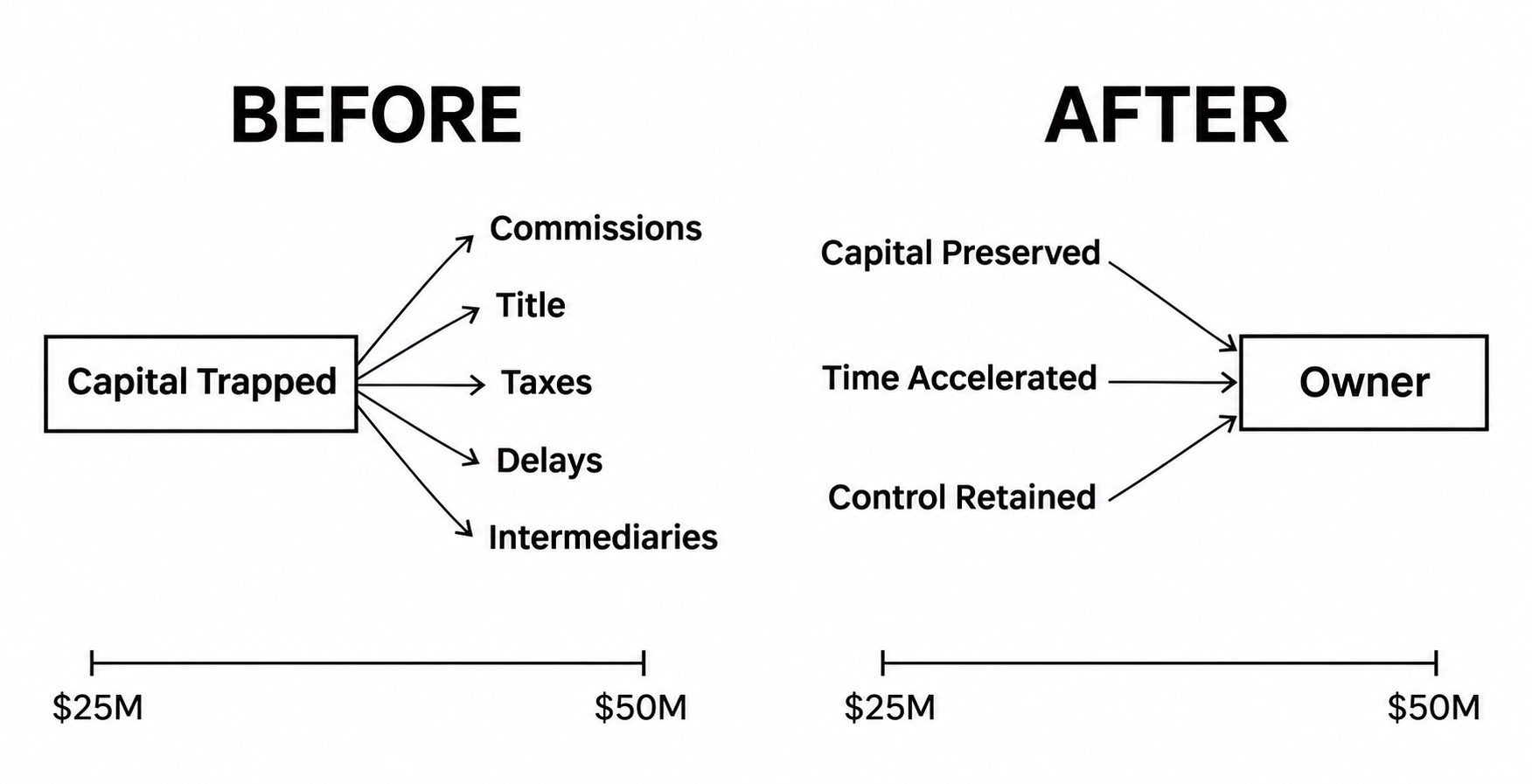
Growth demands effort. Avoidable expense consumes the reward. Every duplicated task, unused subscription, poorly coordinated handoff and repeatedly reconstructed document draws resources away from something that could matter more: your next acquisition, your strongest team, a better customer experience or the resilience of your balance sheet.
A recurring expense removed intelligently can improve the economics of every subsequent operating period. A process simplified properly can give an entire team more room to perform. A supplier relationship redesigned around clear responsibilities can reduce both cost and frustration.
The financial test is straightforward: count the improvement after implementation, transition and ongoing operating costs. Then decide where the benefit belongs.
A saving becomes strategically valuable when you give it a better job.
My Intermediation Thesis™—Report #199 develops this discipline through cost analysis and bounded pilots: identify the avoidable burden, protect necessary expertise and test the net benefit before expanding.
The EVA™ Operating Standard
Technology serves the transaction.
The transaction does not exist to serve the technology.
This distinction matters more in the AI era than ever before.
- Technology is not automatically value.
- AI is not automatically authority.
- Blockchain is not automatically ownership.
- Tokenization is not automatically liquidity.
- Smart contracts are not automatically legal contracts.
- Speed is not automatically a better outcome.
The institutional objective is to use technology where it improves intelligence, reduces duplication, strengthens provenance, accelerates authorized workflows, improves capital access, reduces unnecessary reconciliation, expands distribution, improves decision-making, strengthens the owner’s control, and creates measurable economic value.
Technology should remove unnecessary friction without eliminating the institutions, legal rights or trusted counterparties that protect the transaction. Which leads directly to another governing principle:
REALATAR™ is not anti-institution.
It is anti-unnecessary-friction.
How the Method Works
The Friction Compression Framework™
Four steps: find the waste, agree what matters, improve the process and repeat what works.
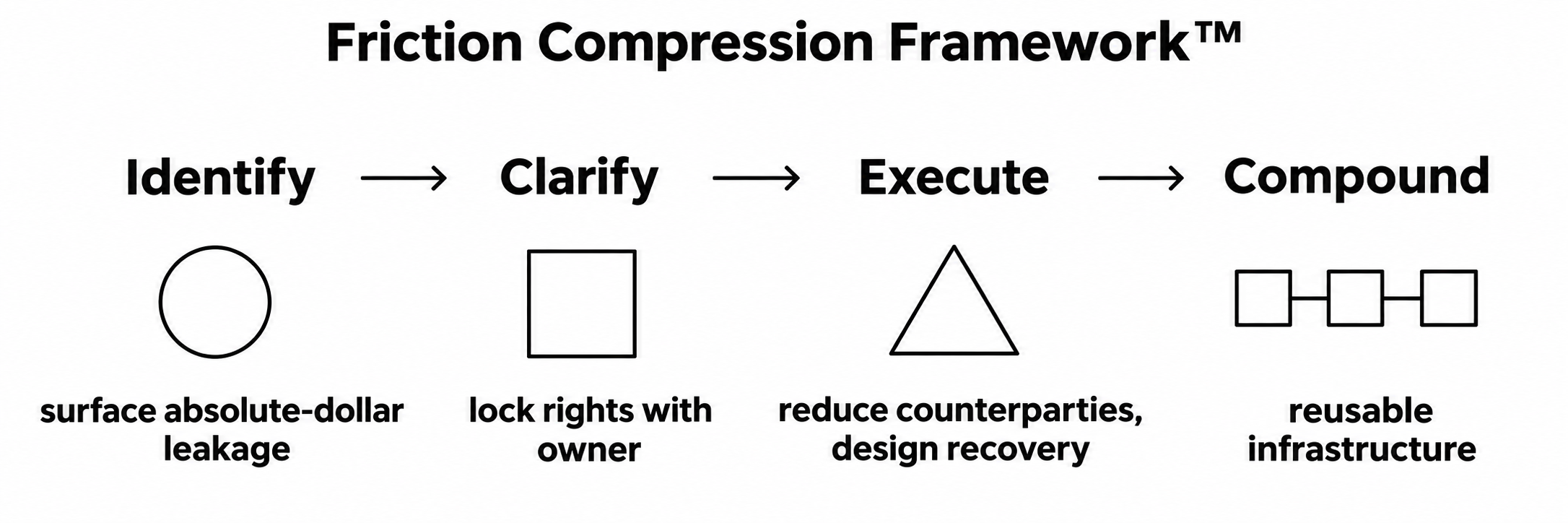
Find Where Value Leaks
We begin by examining the full economic architecture surrounding an asset, portfolio, enterprise mandate or strategic opportunity. Potential friction can exist across intermediary layers, operating costs, asset positioning, capital structure, distribution, data fragmentation, manual processes, duplicated diligence, procurement, title coordination, escrow coordination, compliance, counterparty discovery, decision cycles, technology, marketing, customer experience and organizational structure.
The objective is not to begin with an arbitrary savings target. The objective is to determine where capital, time and resources are being consumed without producing equivalent value.
My earlier cost-transformation work examined how enterprise organizations can simplify structures, automate processes, improve procurement, increase productivity and redirect resources toward higher-value activities. Those disciplines inform EVA™. They do not create a predetermined promise that every real-estate transaction produces the same percentage saving.
Measure first. Claim second.
Agree the Outcome, Responsibilities and Next Steps
Once friction has been identified, the next responsibility is clarity.
Who owns the asset? What rights attach to it? Which entity controls execution? What is the desired economic outcome? What capital structure is appropriate? Which counterparties are necessary? What risks must be retained, and what risks can be transferred? What legal and regulatory requirements apply? Which processes can be digitized, and which should remain institutionally controlled? Where can AI improve analysis? Where can automation safely execute predefined conditions? Where is human judgment indispensable? What should the owner control directly, and what should be delegated?
The result is not technology for technology’s sake. It is an execution architecture built around the owner, the asset, the rights, the capital, the jurisdiction and the objective. Technology is selected afterward — never first.
Connect Strategy, Distribution, Capital and Infrastructure
Execution is where intelligence becomes economic activity.
Limitless USA combines enterprise strategy with four decades of global publishing, business development and enterprise relationship building — spanning business leaders, investors, institutional participants, technology executives, property professionals, entrepreneurs and commercial counterparties worldwide. Its indexed visibility reached 1.55 billion LinkedIn Boolean search results in December 2025: query returns, not people, connections or reach.
That record does not guarantee liquidity. It provides something more fundamental:
Access.
Access to potential counterparties. Access to capital relationships. Access to intelligence. Access to markets. Access to expertise. Access to opportunities beyond a purely localized operating model.
The distinction is important:
Distribution is not liquidity.
But without distribution, liquidity opportunities are constrained before the transaction even begins. That is why global distribution has evolved from a marketing capability into strategic infrastructure.
Turn Efficiency Into Enduring Enterprise Value
Reducing friction once is useful. Creating reusable infrastructure is considerably more valuable.
When transaction friction is reduced intelligently: saved time can move toward higher-value decisions; released capital can pursue additional opportunities; improved data can strengthen underwriting; better diligence can increase confidence; faster analysis can increase optionality; better counterparties can improve transaction quality; global distribution can widen discovery; improved execution can accelerate asset velocity; successful processes can be repeated; trusted relationships can generate additional relationships; and infrastructure created for one transaction can improve the economics of the next.
That creates the EVA™ progression:
Release Capital↓
Improve Optionality↓
Expand Distribution↓
Create Reusable Infrastructure↓
Compound Enterprise Value
That is the difference between cutting a cost and redesigning a system.
Why Reducing Delays Can Help
Your Capital Work Harder
For a developer or owner, money committed to an unfinished project cannot also fund the next opportunity. Avoidable delays can extend holding costs and narrow your choices.
When a transaction or project can be completed sooner without weakening its safeguards, the capital released may become available for another suitable use. That is the practical meaning of capital velocity: how quickly capital becomes available to be put to work again.
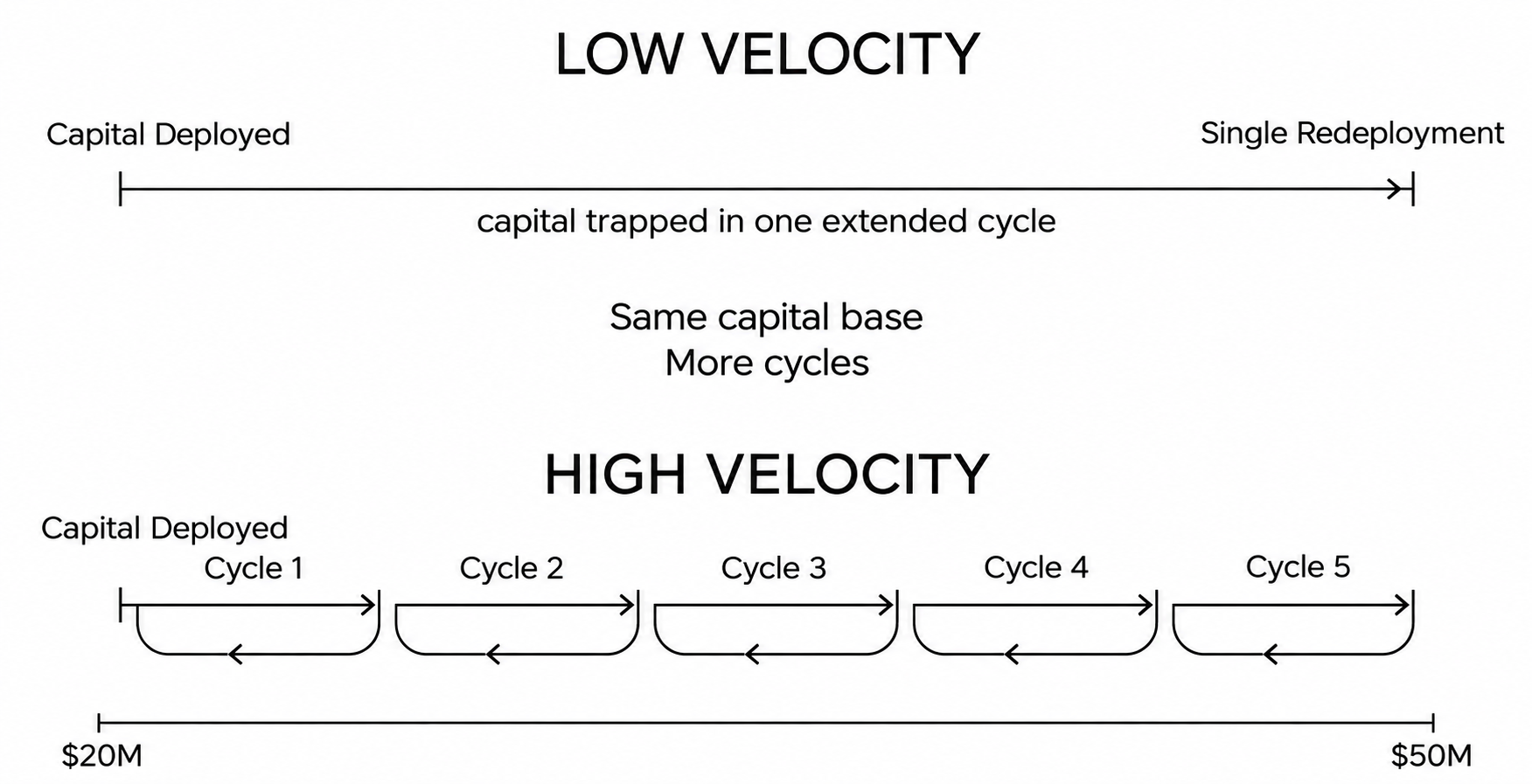
For your business: examine where approvals, document preparation and coordination are extending the timeline. Improve the steps you can control, then assess whether the time recovered creates a worthwhile opportunity after costs and risk.
Make Your Marketing Investment Leave Something Valuable Behind
Your next marketing investment should help the right people understand your value, recognize your relevance and take a meaningful next step. It should also leave useful assets: better research, stronger creative, clearer customer insight and permission to continue a relevant conversation.
For a developer, the objective may be better-qualified inquiries. For a luxury business, more conversations with suitable customers. For a founder, clearer access to partners who understand the proposition. For an established enterprise, a more accountable connection between marketing expenditure and commercial progress.
My Global Advertising Strategy 2026—Report #198 examines this through cost per qualified outcome and measured testing.
Report #202: Put Every Media Dollar to a Better Test
In The 0.0145% Illusion—The Sovereign Ledger™ #202, I extend that discipline to the choice between repeatedly renting attention and building distribution assets an enterprise can retain.
The benefit for CEOs, CMOs and family offices is a clearer capital-allocation decision: compare channels against agreed qualification criteria, track the cost of meaningful commercial progress and examine what remains useful after the campaign ends. Research, permissioned relationships and reusable creative can support the next opportunity as well as the current one.
Report #202 keeps measured television audiences separate from indexed search visibility; its headline percentage compares numerical magnitude across different units. The commercial decision rests on qualified outcomes, attributable results and the full cost of achieving them.
What did this expenditure help us achieve—and what do we still possess because we made it?
From Global Distribution
to Relationship Infrastructure
For years, networks were treated primarily as communications assets. Followers. Contacts. Media reach. CRM databases. Email lists.
Today, the opportunity is significantly larger. A high-quality global network can become a sequence:
Access↓
Introduction↓
Attribution↓
Relationship↓
Opportunity↓
Transaction↓
Recurring Value
This changes what a network means. A relationship should not disappear inside an email chain. A valuable introduction should not become invisible once the transaction begins. A trusted participant should be able to create value for other participants.
The long-term opportunity is to convert informal relationship capital into structured relationship infrastructure. The result is not simply a larger audience. It is:
A more consequential network.
Give Every Strong Relationship a Better Future
You should not have to rebuild trust from the beginning every time someone needs you. A useful introduction, a well-handled project and a thoughtfully resolved problem can become the foundation for continuing business.
That requires follow-through: remembering what mattered, honoring permissions, maintaining useful contact and making the next interaction easier. Better continuity can support retention, repeat business and relevant referrals while reducing the effort spent repeatedly explaining who you are.
My Sovereign Growth Loop™—Report #201 connects acquisition, loyalty, retention and advocacy within that broader relationship.
Deliver value people remember. Make it easy for them to return. Give them a reason to introduce you.
Don’t Just Build the Product.
Build the Market Around the Product.
One of the central lessons of the AI era is that the most valuable platforms increasingly do more than provide a single tool. They coordinate an economic environment around the tool: discovery, identity, community, distribution, applications, payments, incentives, partners, intelligence and transactions.
The same principle applies to ownership infrastructure. REALATAR™ should not ultimately exist as an isolated property application. Its larger opportunity is to coordinate the market surrounding ownership:
The opportunity is not to own every service. It is to architect the environment in which appropriate services can interact. That is an important distinction:
The winning ownership infrastructure may not replace every institution.
It may become the control plane that coordinates them.
Three Engines of the Ownership Market
Enterprise Value Architecture™ increasingly leads toward three mutually reinforcing systems.
The Market Engine
Owners discover capital. Capital discovers assets. Buyers discover opportunity. Specialists discover clients. Institutions discover qualified counterparties. Distribution becomes discovery infrastructure.
The Transaction Engine
Identity is verified. Rights are understood. Structures are established. Authority is defined. Capital is coordinated. Compliance conditions are satisfied. Execution occurs. Settlement follows the legal and technical requirements of the transaction. Evidence remains afterward. This is the emerging REALATAR™ execution architecture.
The Network Engine
Trusted participants introduce other trusted participants. Specialists contribute capability. Relationships create opportunities. Contribution can be attributed. Economic participation can be recognized where legally and contractually appropriate. Successful interactions increase trust. Trust attracts stronger participants. Stronger participants increase network value. That creates the possibility of network effects around ownership itself.
The Ownership Execution Loop
- Discover — Identify the asset, opportunity, owner, capital requirement or counterparty.
- Verify — Establish identity, rights, information quality and relevant provenance.
- Structure — Determine entities, economics, permissions, compliance requirements and transaction design.
- Connect — Bring appropriate owners, investors, buyers, service providers and institutional counterparties together.
- Capitalize — Coordinate appropriate debt, equity, private capital, institutional financing or other legally permissible capital pathways.
- Transact — Execute authorized workflows through the appropriate institutional, legal, financial and technical rails.
- Prove — Maintain inspectable records of authorization, actions, evidence and outcomes.
Then repeat. Every completed cycle should improve the next.
Where I Apply the Method
The same discipline applies to an individual workflow, a development project, a property portfolio or the way an entire business operates.
Understand Where Value Is Being Lost
I examine avoidable expenditure, repeated work, approval delays and the resources a process consumes. The starting point is a clear picture of the problem and its cost.
The practical value: a better basis for deciding what to improve, what to preserve and where to direct resources next. Any proposed saving must account for implementation and ongoing costs.
Reach Relevant People and Follow Through
I connect positioning, distribution and relationship development so the right people can understand an opportunity and take a meaningful next step.
The practical value: clearer communication, a more focused approach to qualified interest and better continuity after an introduction. Success is measured by useful commercial progress.
Make the Process Easier to Execute
I map what needs to happen, who is responsible and what information each participant requires. Technology is considered where it can reduce repeated work or improve the quality and accessibility of records.
The practical value: clearer handoffs and a more usable process. The REALATAR™ infrastructure under development extends this design work toward coordinated ownership and transaction workflows; specific functions depend on implementation and the requirements of each transaction.
Give Leaders More Time to Lead
I examine the recurring decisions, unresolved questions and coordination problems that keep returning to the owner’s or CEO’s desk.
The practical value: better-prepared decisions, clearer responsibilities and more attention available for clients, people and growth.
Help Good Work Carry Forward
I focus on records, responsibilities and relationships the organization can maintain over time. Trusted legal, title, escrow, tax and other specialists remain essential to the work they protect.
The practical value: less dependence on individual memory, smoother transitions and a stronger foundation for the next project or transaction.
Recover the Time That Only You Can Use
An hour spent resolving conflicting document versions cannot also be spent evaluating an acquisition, strengthening a partnership, developing a leader or being present with your family. That is why I treat coordination as an economic issue.
Imagine arriving at a decision with the relevant facts assembled, unresolved questions clearly identified and responsibility already assigned. You can concentrate on the judgment that requires your experience.
Better preparation can reduce the meetings before the decision, the interruptions during execution and the explanations afterward. For a founder, that creates more room to build. For a CEO, more capacity to lead. For a family office principal, more attention for allocation, continuity and the people whose future the capital serves.
The most personal benefit of a better enterprise may be getting more of your life back.
Preserve Your Ability to Choose
Before you sell, refinance, acquire or commit to a partner, you should understand your alternatives—and what each requires. What information is missing? Which approvals are outstanding? Where could a delay narrow your choices? Which counterparty fits your objectives?
Resolving those questions earlier can improve your negotiating position. The benefit is fewer decisions made under avoidable pressure, less dependence on a single route and greater confidence when a suitable opportunity appears.
Prepared owners have more freedom to act—and more freedom to decline.
From Audience to Economic Network
Four decades of global publishing, business development and relationship building have taken my indexed visibility to 1.55 billion LinkedIn Boolean search results (December 2025) — query returns, not people. But visibility alone is not the endgame. The next phase is not:
More followers.
It is:
More economic density per relationship.
That means asking a different set of questions of every connection. Can this relationship provide intelligence? Can it introduce capital? Can it identify an asset? Can it provide specialist capability? Can it create distribution? Can it help solve a problem? Can it introduce another trusted participant? Can an opportunity be attributed? Can the resulting value be measured? Can the relationship compound?
That is the evolution from audience economics to relationship infrastructure.
Claims Invite Debate.
Artifacts Invite Inspection.
EVA™ is a discipline of evidence, not assertion. The published record behind it is timestamped, numbered and independently verifiable.
Enterprise Value Architecture™ is the operating discipline behind 202 Bitcoin-anchored entries and 3.06M+ verified words in The Sovereign Ledger™ — each one timestamped through OpenTimestamps and anchored to Bitcoin Layer-1.
Anchoring establishes independently verifiable evidence of when a document existed in its exact form. It does not — and is not claimed to — establish the truth of the underlying analysis. That remains the work of sources, methodology, dating and inspection. Distinguishing rigorously between the two is precisely the standard EVA™ demands of everyone else.
OPENTIMESTAMPS · BITCOIN LAYER-1 · INDEPENDENTLY VERIFIABLE
Corpus through Report #202 · November 13, 2026 (ET): 202 reports · 3,065,770+ verified words · 300+ audiobook-equivalent hours.
From Enterprise Value Architecture™
to Ownership Infrastructure™
The historical progression is increasingly clear.
That is REALATAR™.
What began as cost transformation became capital reallocation. What became capital reallocation became friction compression. What became friction compression is now becoming:
Ownership Infrastructure.
EVA™ Is the Business Method.
REALATAR™ Is the Infrastructure I Am Developing.
EVA™ brings together the business disciplines I have developed over decades. My continuing work on REALATAR™ applies that thinking to the information, permissions and coordination surrounding property ownership.
In practical terms, the aim is to help the right people work from reliable information, understand who has authority and coordinate the steps a transaction requires. The intended benefits include less repeated preparation, clearer responsibility and better continuity.
The business method has its roots in my operating experience. The technology is progressing through development. Each REALATAR™ capability must be described and assessed according to what has actually been implemented. The benefits of EVA™ above describe the method’s objectives, rather than a list of delivered software features.
The Sovereign Ledger™ records the underlying research and design thinking. Limitless USA LLC connects that work with enterprise strategy and relationship development.
But one institutional guardrail remains permanent:
Settlement speed never supersedes legal title, compliance, authorized counterparties or applicable law.
Where title systems, asset structures, payment rails, counterparties, compliance systems and applicable law permit greater synchronization, REALATAR™ is designed to advance toward increasingly programmable and potentially atomic-style workflows. Where they do not:
Technology must adapt to reality.
Reality does not adapt to a slogan.
Make the Next Property Decision Easier to Prepare
When ownership evidence, permissions, asset information and professional findings are scattered, every new transaction can begin with an expensive reconstruction exercise.
A persistent, permissioned record offers a better starting point. Relevant participants can inspect the appropriate evidence, identify what has changed and concentrate on the issues requiring fresh judgment. The intended benefit is less repetitive preparation, clearer accountability and better continuity when an advisor, lender or service provider changes.
My proposed Spatial Standard—Report #200 explores this foundation for REALATAR™: organizing asset information and verified authority so future workflows can build on reliable prior work. This is the infrastructure I am working toward. Its value must be demonstrated through implementation.
Your next financing, review or transfer should benefit from the preparation you have already paid for.
From Product to Market Infrastructure
The long-term objective is larger than a single software product. A product serves a user. A platform connects functionality. A marketplace connects participants. A network creates increasing value through participation. Infrastructure coordinates the environment beneath them. An institution governs and compounds the whole.
EVA™ supplies the economic discipline required to determine what belongs inside the system — and what does not. REALATAR™ supplies the emerging execution architecture. The Sovereign Ownership framework supplies the governing doctrine.
The opportunity is not merely to build a product for ownership. It is to build the market, trust layer, partner network, capital pathways, transaction infrastructure and economic incentives around ownership.
The Limitless USA Difference
Conventional real-estate models primarily optimize individual transactions. Limitless USA begins one level higher.
The transaction reports to the architecture. Not the other way around.
That is the difference between selling an asset
and architecting value around ownership.
EVA™ and the Sovereign
Ownership Architecture
Enterprise Value Architecture™ connects directly to the larger institutional system.
- The Sovereign Ledger™ develops and records the doctrine.
- The Sovereign Proof Ledger™ makes material claims and artifacts inspectable.
- The Sovereign Ownership Council™ concentrates trusted relationships.
- Limitless USA LLC connects enterprise strategy, relationships, capital pathways and execution.
- EVA™ provides the economic operating discipline.
- REALATAR™ develops the ownership infrastructure.
- The Institution governs and compounds what the architecture creates.
None should operate as an isolated initiative. Every layer should increase the value of the others.
The Compounding Model
The long-term economic objective is not to monetize one moment. It is to create multiple legitimate forms of value across the ownership lifecycle.
Potential future economic layers may include enterprise access, strategic intelligence, advisory, distribution, partner integrations, implementation, workflow orchestration, verification and provenance, API usage, enterprise software, qualified transaction services, capital coordination where appropriately licensed and permitted, settlement infrastructure where legally and technically supported, strategic partnerships and joint ventures.
These are development pathways informed by my continuing work on ownership infrastructure. Each requires its own implementation, commercial model and appropriate permissions. My governing rule remains:
Never add a toll that does not add value.
Infrastructure earns economics because it improves the system. Not because it stands in the way.
The EVA™ Test
Every major initiative should answer five questions.
- 1. Does it remove unnecessary friction?
- 2. Does it improve capital allocation?
- 3. Does it strengthen control, trust or optionality?
- 4. Can it be reused or scaled?
- 5. Does it compound the value of the larger system?
If the answer is no, challenge the initiative. If the answer is yes to several, prioritize it. Because the scarcest resources inside every enterprise remain:
Capital. Time. Attention.
Principles · Evidence · Stewardship
Enterprise Value Architecture™ ultimately rests on three disciplines.
Principles
Know what the institution stands for before deciding what technology to deploy. Value before novelty. Ownership before automation. Trust before speed. Economics before hype.
Evidence
Measure outcomes. Document claims. Preserve provenance. Date the figures. Separate current capability from target architecture.
Claims invite debate.
Artifacts invite inspection.
Stewardship
The goal is not simply to optimize the next transaction. It is to make better decisions about capital, relationships, infrastructure and ownership over long periods of time. That means protecting control, continuity, trust, optionality and legacy.
Principles determine the direction. Evidence establishes credibility. Stewardship extends the time horizon. Together, they form the institutional foundation beneath EVA™.
Build a Business That Can Carry Its Knowledge Forward
Enterprise value depends partly on what survives change. Can a new executive understand how decisions are made? Can an authorized advisor locate the supporting evidence? Can a client relationship continue when one team member leaves? Can the organization repeat a successful process without depending on somebody remembering every step?
Clear responsibilities, reusable records and documented processes can make an organization easier to operate, evaluate and hand over. They also allow capable people to contribute sooner.
My ambition is to help turn experience into organizational capability: knowledge the enterprise can retain, relationships it can serve responsibly and processes it can improve over time.
Build something whose strength extends beyond your constant personal intervention.
The Limitless USA Standard
We are not interested in technology for its own sake. We are not interested in cost cutting that destroys value. We are not interested in speed that compromises trust. We are not interested in distribution without accountability. We are not interested in scale without economic discipline. And we are not interested in building another product that becomes another isolated silo.
The operating standard is:
Remove what destroys value.
Strengthen what creates value.
Redirect capital toward what compounds.
That is Enterprise Value Architecture™. And increasingly, that discipline leads to the same destination: Ownership Infrastructure.
The Next Era
Four decades ago, the challenge was improving enterprise economics. Twenty-five years ago, the challenge was building digital distribution. Today, the challenge is coordinating intelligence, capital, relationships and ownership in an increasingly programmable economy.
The principles remain remarkably consistent. Find the friction. Understand the economics. Protect the trust. Connect the right people. Apply technology intelligently. Build reusable infrastructure. Measure the result. Compound what works.
This is not simply how I think about consulting. It is how I think about architecture.
Friction is a capital allocation problem.
Technology serves the transaction.
The owner remains the sovereign center.
REALATAR™ is not anti-institution.
It is anti-unnecessary-friction.
And the governing objective is no longer merely to build a better real-estate product.
Build the market around the product.
Build the rails beneath the market.
Build the institution that makes them compound.
The Cost of Waiting Is the Cost You Continue to Carry
An inefficient process does not stop consuming resources while you consider improving it. The repeated request returns. The approval waits. The same coordination problem reaches another meeting. Your best people spend another week compensating for a system that should support them.
You can begin with one manageable decision. Choose a recurring problem with a visible cost. Establish the baseline. Assign responsibility. Test a specific improvement. Include the full implementation cost. Examine what changed.
An early, disciplined test gives you evidence you can use to make the next decision. Even a result that rules out a proposed solution can prevent a larger mistake.
The advantage begins when you stop accepting an avoidable burden as a permanent condition of doing business.
Limitless USA LLC · Enterprise Engagement
Where Should We Begin?
Whether you lead a brokerage, serve clients as an agent, develop property or manage a portfolio, start with the part of your business that consumes more time or money than it should.
Bring one asset, one workflow or one recurring decision that consumes more than it should. We can begin by clarifying the problem, identifying the evidence needed and determining whether a focused improvement deserves further work.
Free capital for your priorities. Reclaim time for your life. Strengthen control over your choices. Build value that carries forward.
Discuss Your Business →
Explore REALATAR™ →
Inspect the Record →
Researcher · Sovereign Architect · Founder & CEO, Limitless USA LLC
Enterprise Value Architecture™ · REALATAR™ · The Sovereign Ledger™
40+ Years of Enterprise Execution · 1.55B+ Indexed Visibility (LinkedIn Boolean, Dec. 2025)
⛓ 202 Bitcoin-Anchored Entries · 3.06M+ Verified Words · 100% OpenTimestamps Verified
Sources, methodology and definitions. Global real-estate market size of approximately $625 trillion (2026) is sourced from Statista Market Insights. The standing-stock figure of $393.3 trillion as at the start of 2025 is sourced from Savills; the two measures use different definitions and reference dates and are not interchangeable. Ledger figures — 202 entries, 3.06M+ verified words, 800+ strategic blueprints, 300+ audiobook-equivalent hours (verified words ÷ 10,000; methodology) — are current as at November 13, 2026 (ET) and are independently verifiable at The Sovereign Ledger™. OpenTimestamps anchoring to Bitcoin Layer-1 evidences the date and exact content of publication; it does not evidence the accuracy of any underlying claim. OzEmail Limited listed on NASDAQ on 28 May 1996 under the symbol OZEMY, the first Australian technology company to do so, raising in excess of A$50 million; WorldCom completed its acquisition of OzEmail in March 1999 for A$520 million. Sean Howard founded the company; Malcolm Turnbull, an investor from 1994, served as chairman. References to my role describe agency and go-to-market responsibility held through De Weaver Integrated Advertising and do not imply executive office at OzEmail Limited, nor endorsement by any individual named. The 1.55B+ figure is a LinkedIn Boolean search-result count recorded in December 2025 — an indexed-visibility proxy (query returns), not a count of people, connections, network, reach or capital; the dated series and method are on Provenance™. Descriptions of REALATAR™ capability throughout this page distinguish current capability from target architecture; forward-looking statements describe intended design, not delivered function, and are not offers of securities, investment advice, brokerage, legal or tax services. Nothing on this page guarantees a transaction outcome, liquidity event or percentage saving.
The Sovereign Ledger™
Provenance™
The Corpus
REALATAR™
Enterprise Value Architecture™
Florida 3.0
Limitless USA
Institutional Alignment™
Limitless Referral Network™
About
Limitless USA LLC · Florida, USA · New York · Palm Beach · Miami · Naples · Sarasota · Eastern Time
© 2026 Geoff De Weaver and Limitless USA LLC. All rights reserved. Enterprise Value Architecture™, EVA™, Sovereign Ownership Master Infrastructure™, REALATAR™, The Sovereign Ledger™, The Ownership Thesis™, Friction Compression Framework™, Time Sovereignty™, The T-0 Settlement Protocol™, The Fourth Rail™ and Ownership Infrastructure™ are trademarks of Geoff De Weaver and Limitless USA LLC.
Human-authored by Geoff De Weaver. Text and data mining and AI-training rights are expressly reserved (EU Directive 2019/790, Art. 4(3)); no license is granted by access. SHA-256 hashes and OpenTimestamps proofs anchored to Bitcoin establish chronology and integrity; they do not grant a license, transfer copyright or replace registration. Third-party names are used for identification only and imply no affiliation or endorsement. Information only — not investment, legal or tax advice. Dates are Eastern Time. Corrections: geoff@geoffdeweaver.com