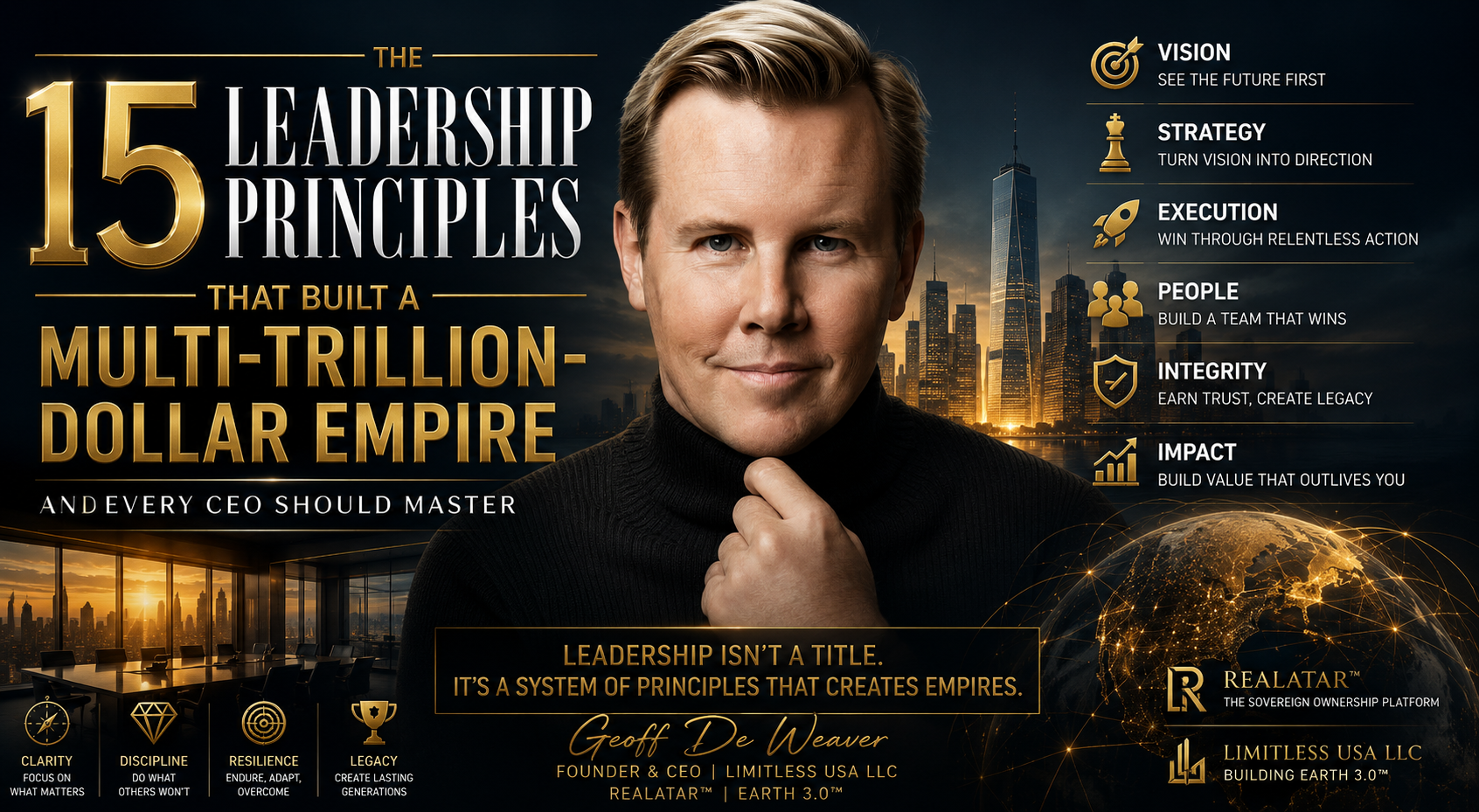
The 15 Leadership Principles That Built a Multi-Trillion-Dollar Empire — and Every CEO Should Master
The modern global economy is not moved by incremental adjustments; it is forged by architects who understand that infrastructure is destiny. When I analyze the trajectory of the world’s most formidable enterprises, I am not looking for anecdotal success stories. I am looking for the structural integrity of their leadership. The data is not soft. Research from the McKinsey Global Institute, conducted with FCLT Global across 615 large- and mid-cap companies, proves the point: from 2001 to 2014 the revenue of genuinely long-term firms grew cumulatively 47% more than their peers — with earnings 36% higher and economic profit 81% higher. Yet most leadership discourse remains trapped in the mundane cycle of quarterly earnings reports. This is a failure of vision. To capture the scale required to lead in the $400 trillion real estate and infrastructure market, one must move beyond mere management and master the art of organizational engineering.
We are living in an era where institutional inertia is the greatest risk to survival. IDC’s FutureScape research projected that 65% of global GDP would be digitalized — a structural shift now driving roughly $4 trillion in direct digital-transformation investment by 2028, nearly 70% of all global IT spend. Forrester forecasts the digital economy will reach $16.5 trillion and capture 17% of global GDP by 2028, expanding faster than GDP itself. Despite this, a staggering number of CEOs remain tethered to outdated operational models. My work is not a biography of what has been; it is a blueprint for what must be built. The principles of the world’s most successful empires are not accidents of history — they are deliberate, calculated, and limitless in their application. Whether you are leading a family office, a venture-backed startup, or an institutional investor, your capacity to scale is bound by the principles you codify into your culture today.
Three websites. Three different purposes. One vision.
Who I Am. https://geoffdeweaver.com
How I Think. https://geoffdeweaver.com/grokipedia
What I’m Building. https://realatar.vip
Who I Am. How I Think. What I’m Building. It’s the entire architecture of my mission in ten words. The following blueprint deconstructs the fifteen fundamental pillars that underpin multi-trillion-dollar dominance. These are the levers of the Sovereign Architect — the rules that allow one to bypass legacy gatekeepers and restore control to the asset owner. If you seek to lead, you must first master the architecture of your own intent.
Universal Marketing Principles
Over the last 40 years of marketing in various cities in numerous countries, across hundreds of different brands, one question has been repeatedly asked of me by clients and marketers: what are the most basic ways to succeed in marketing, sales, real estate, and advertising today? I have been asked this in Manhattan, San Francisco, Sydney, Singapore, Hong Kong, New Zealand, Canada, Dubai, Bali, and London. So I watched, tested, and researched the basic marketing principles that have helped my clients, across the board, achieve massive results and increased effectiveness and efficiency. Here are my Top Universal Marketing Principles that will never let you down. The more you use all of them, the better results you’ll receive. Guaranteed.
1. Focus on the Media and/or List You Want to Use
Having done thousands of marketing and advertising campaigns over the last three decades, I have found that if you truly focus on the media you select or the list you use or rent, it can enhance your results in many cases by up to 50%. If you don’t get this aspect right from the start, it’s like having one arm tied behind your back and being thrown into a fight. It demands heavy consideration, study, and planning. It’s easy to think of your list as simply “a list” — but names in a database represent the best potential buyers for whatever it is you’re selling. In the direct-mail era, lists were compiled from people who demonstrated a propensity to make certain purchases based on location, income, and past purchasing history. In the digital, Web3, and AI age, more than at any time in history, it’s vital to think about your audience: the unique questions they’re asking, the problems they face, and how they want to experience your brand. The best ad in the world won’t work if it doesn’t reach the right audience.
2. Your Offer Must Be Impactful and Powerful
I first learned this principle in my early years writing copy in direct marketing agencies. For decades, marketers regarded the offer as the “deal” or the incentive to buy — often price-related (“25% Off!”) and tied to a deadline (“Offer Expires July 30!”). Today, most potential customers aren’t looking to buy initially, and they don’t like being pressured. What they’re after is information that helps them make the right buying decision — especially for a major purchase. The offer isn’t a “deal”; it’s helpful information that allows them to solve their problem. Ralph Waldo Emerson wrote, “Build a better mousetrap and the world will beat a path to your door.” That worked through the early 1990s, but it doesn’t work as well today, because the marketplace is crowded with mousetraps and consumers are bombarded with information about them. A solid, strategic offer can still increase your response rates or sales by 30% or more — which is why this remains one of my Universal Principles.
3. Creative
Over the last two decades in advertising worldwide, I have seen far too many marketers, copywriters, art directors, designers, and producers confuse creative with being brilliant, clever, or skillful. The job of creative isn’t to impress readers. It’s to get your message across simply, discerningly, and expertly — especially today, when you have less time to do it than ever before. After you’ve targeted the right audience and developed the right offer, the next step is to package the message so it will be noticed, read, and acted upon. When people sort through email, mail, and voicemail, they aren’t looking to be entertained; they’re looking for something that helps them answer a question or solve a problem. Don’t bury your message with pretty pictures and clever words. In my experience, great creative can increase your response and success rate by up to 10%. Most branding agencies will disagree with me, but media, lists, and offers contribute to winning far more often.
4. Timing
Another key aspect every campaign must consider is timing. If you have a product especially appropriate at Christmas, it’s always best to promote it leading up to December 25 — not in early May. Marketing it too early eats your budget and is nowhere near as cost-effective as the same dollars invested in November. Getting your timing right can push your success rate up by at least 10%.
5. Think Long-Term (The Ultimate Competitive Advantage)
While the market fixates on quarterly results, true architects build for the next two decades. Jeff Bezos secured Amazon’s dominance by sacrificing immediate margins for infrastructure — like AWS — that competitors could not replicate. Jensen Huang has led NVIDIA since its 1993 inception with a relentless multi-year horizon. The cost of the alternative is now quantifiable: Interbrand — now part of Omnicom — calculates that the world’s most valuable brands have surrendered approximately $3.5 trillion in unrealized value since 2000 by over-investing in short-term performance tactics at the expense of long-term brand building. My vision for Limitless USA and REALATAR™ is not a recent development; it has been gestating since my time as a lifeguard at Compo Beach in Westport, Connecticut, around 1981. As I documented in “Pioneering Web1: How Poppe Tyson, DoubleClick, and Westport, Connecticut Sparked the Digital Marketing Revolution”, I have spent decades observing the friction of global systems — proving that from Westport to worldwide, 1.55 billion connections validate the destiny I am building. I am not playing for the next fiscal year; I am laying the horizontal liquidity rails for the next hundred years of global real estate, the same long-horizon logic I detailed in Grokipedia™ #124 — The Berkshire of Trust.
6. Practice Absolute Customer Obsession
Steve Jobs understood that customers often cannot articulate their own future needs — they only know their pain points. By obsessing over the interaction rather than the feature, he created products that redefined human behavior. The discipline pays. Forrester’s research shows customer-obsessed organizations report 41% faster revenue growth, 49% faster profit growth, and 51% better customer retention than their peers — yet only 3% of companies qualify as truly customer-obsessed, which is precisely why the advantage is so durable. At NVIDIA, Huang practices a different brand of obsession: he ensures his technology empowers every developer and researcher to solve the impossible. I apply this by shifting the focus from vertical real estate gatekeepers to the asset owner, ensuring that every piece of infrastructure I build directly alleviates the friction of the $400 trillion global market — the thesis I laid out in Grokipedia™ #126 — How REALATAR™ Is Replacing Gatekeepers & Unlocking Trapped Capital.
7. Trust Data — But Also Trust Your Instincts
Data is the record of the past; instinct is the navigator of the future. Elon Musk does not look at the “market price” of rockets; he looks at the raw physics of materials and uses first principles to prove that space travel is not a luxury but a logistical inevitability. Like Huang, who shifted NVIDIA’s entire focus based on his intuition regarding the necessity of parallel computing — a bet now reflected in the company’s rise into the trillion-dollar tier and its 2024 debut on Interbrand’s Best Global Brands ranking — I use analytics as a tool, not a crutch. Innovation begins where the spreadsheet ends.
8. Make Bold Bets and Accept Failure
Progress requires a crucible culture. Jensen Huang often describes NVIDIA’s early days as being “thirty days away from going out of business,” a fear that institutionalized a relentless, learning-first mindset. Bezos similarly viewed failure as a necessary R&D cost for trillion-dollar breakthroughs — and the data backs the discipline: McKinsey found that long-term firms cumulatively out-invested their peers in R&D by nearly 50% by 2014. I mirror this by treating REALATAR™ not as a finished product but as a living ecosystem where we iterate, fail, and evolve at the speed of light to maintain our limitless competitive advantage.
9. Eliminate Regret by Taking Intelligent Risks
Musk’s philosophy is simple: if something is important enough, you do it even if the odds are not in your favor. This is the essence of the Regret Minimization Framework. When I look at the legacy gatekeepers of real estate, I see a chronically leaking boat — energy spent patching these leaks is wasted. I choose to build the new vessel entirely, ensuring my legacy is defined by the risks I took to restore control to the asset owner, rather than the safety I chose to maintain.
10. Build Experience Before Building an Empire
Great leaders are great students. Jensen Huang credits his ability to endure and his dedication to being a “good student” as the foundation of his success. Musk and Jobs didn’t stumble into success; they mastered the underlying mechanics of their industries — software, hardware, and physics — before scaling. My 15-year intellectual corpus is my preparation; it is the limitless foundation of knowledge that allows me to architect the horizontal liquidity rails of Earth 3.0, the framework I set out in Grokipedia™ #120 — Earth 3.0: The Sovereign Rails Revolution.
11. Prioritize Ruthlessly & Be Limitless
Huang manages NVIDIA with a flat, radically transparent structure that breaks down silos and forces the entire organization to focus only on what matters. Bezos similarly realized that too many concurrent ideas create operational backlogs. Gartner’s data confirms the edge: leaders who reprioritize dynamically — rather than on a fixed annual calendar — are 24% more likely to be top performers, yet only 18% actually do it. I execute by stripping away the noise of the legacy real estate industry, focusing my resources on the few levers — T-0 atomic settlement and programmable ownership — that collapse the friction of the entire sector, exactly the discipline I codified in Grokipedia™ #112 — The REALATAR™ Execution Playbook.
12. Become an Inventor and Problem Solver
Technology is a tool for creating a better future. Jobs didn’t just sell phones; he invented a new way for humans to interact with digital reality. I view myself in the same light: I am not selling a product, I am inventing the infrastructure for programmable, sovereign ownership. Every blueprint I produce is a deliberate strike against the inefficiency that has trapped global capital for generations.
13. Build Around Core Principles, Not Products
Principles are the only thing that outlast market cycles. NVIDIA is not just a “chip company”; it is an “accelerated computing” engine. Amazon is not just a “bookstore”; it is a “customer trust” machine. Interbrand’s own conclusion after 25 years of data is identical: the most successful companies let their brand guide their entire business strategy rather than treating it as a cost center. My empire is built on the core principle of limitless ownership, allowing me to pivot across real estate, Web3, and AI without ever losing the identity of the Sovereign Architect.
14. Choose Challenge Over Comfort
Huang famously said, “The greatest risk is pretending you’re safe when you’re not.” True leaders seek the discomfort of the frontier. Elon Musk has been a masterclass in this for the past decade; his limitless thinking across Tesla, Starlink, and X proves that one can re-engineer entire industries by refusing to accept the status quo. Whether it is building the first reusable rocket or the first global liquidity rail, the path is always difficult, but the result is total market transformation. I traced this convergence of Tesla, SpaceX, and xAI onto sovereign rails in Grokipedia™ #123 — The Great Convergence. I choose the path of the Architect, where the challenge is the guarantee of our success.
15. Use Educational Sales & Marketing
The ever-increasing volume of online videos, webcasts, podcasts, webinars, seminars, and live streaming events has increased clutter in the marketplace. This noise has forced both online and offline new business, advertising, direct marketing, and public relations to become far more sophisticated. To cut through, break out, and get noticed, it is more important than ever to provide compelling, educational, useful, well-structured, and thoughtful information-driven content. With internet marketing and AI magnifying the noise, if you want to be successful today, you must break out. This is the optimal marketing approach. Most people think content marketing is critical, but I believe the major lever is Educational Marketing — which, like direct marketing, always endeavors to sell or ask for the order. Content marketing takes a soft approach and doesn’t necessarily want to sell. Only Educational Marketing consistently uses content as integral to the sales process — to attract a lead or generate the preferable outcome: a sale.
The definition I use: Educational marketing is the sharing of knowledge with the purpose of building trust. It establishes credibility with your customers using educational messages, and today’s consumer lives in a highly digital, immediately gratifying environment. But before proceeding, you first need to understand the four steps of the buying cycle. The Content Marketing Institute defines content marketing as “a marketing technique of creating and distributing valuable, relevant and consistent content to attract and acquire a clearly defined audience — with the objective of driving profitable customer action.” The key word is valuable. Educational messages aren’t just meant to provide information; they must deliver a message that gets a response. For your expertise to impact your prospect, it must have an engaging title and a compelling offer — both speaking to their challenges, problems, and goals.
The Four Steps of the Buying Cycle:
1. Prior to awareness, a brand or client may have a need but is not aware a solution exists. 2. Once aware, they research to educate themselves — a motorcycle buyer learns what types exist and which fits their needs. 3. They compare different products from different vendors to ensure quality at a fair price. 4. They make their decision and move forward with the transaction.
The best direct marketers are all ahead of this game. Education-driven direct marketing campaigns work because they uniquely capture the prospect’s attention, provide useful information that leads the sales pitch, and convert that attention into new leads, customers, and sales — using the most important action of direct marketing: the offer, with its call to action and response device. An offer can increase a response rate by over 30% when done properly; only the list and media are more powerful.
The 12 essential touchpoints in my Educational Marketing playbook — refined over multiple decades and proven globally — are: 1. Webpages and landing pages. 2. Infographics. 3. Videos. 4. Books. 5. Podcasts. 6. Websites. 7. Direct mail. 8. CDs. 9. DVDs. 10. Blog posts. 11. Seminars. 12. Events. Always add greater value at every touchpoint. Education-based marketing means giving clients what they want — advice and knowledge — without requiring anything in return. You are establishing yourself as an authority, and your prospects will see you as a reliable source of knowledge.
Educational marketing establishes you as an expert rather than another typical salesperson; makes it faster to arrange meetings; establishes trust and respect; consolidates brand loyalty by getting you in front of the 90% who aren’t buying now, not just the 3% in the market today; lets you begin any meeting with real data and hard facts, giving your sales material more credibility; and covers everything executive management wants every prospect to know. Sales is about building trust and rapport, not breaking it. When you sell or pitch, you often break rapport because the prospect is skeptical — no one wants to be sold. But when you educate, you build trust and establish rapport. These principles are the visual and tactical core of my Sovereign Architect’s operations, anchoring my mission in the same rigor that defines the titans of our age.
Summary: The Architecture of Scale
The data is incontrovertible: organizations that adopt a principle-first operating model exhibit higher resilience against market volatility. Gartner’s 2026 CIO survey makes the stakes concrete — 94% of technology executives expect major changes to their plans and outcomes within 24 months, yet only 48% of digital initiatives meet or exceed their business targets. The differentiator is disciplined prioritization, not luck. My analysis of these fifteen principles confirms that the most successful empires are built on the ruthless prioritization of core values over transient trends. Forrester’s research is equally unambiguous: customer-obsessed organizations enjoy 41% faster revenue growth and 51% better retention than their peers, and firms that reset their entire technology strategy around the customer see 2.5x the revenue growth of those that don’t — yet most CEOs still oscillate between competition-led reactionary tactics and internal stagnation.
True leadership requires the courage to be an inventor, to trust intuition when the data is incomplete, and to prioritize the growth of the organization over the comfort of the status quo. By internalizing these tenets, a leader transitions from a participant in the market to an architect of it. This is how you unlock limitless potential within your ranks. It is about creating a structure where experimentation is not a bug but a feature of the mission. When you align your capital, your culture, and your long-term strategy, you do not just compete; you redefine the rules of the game.
My Bottom Line
Leadership is not a title; it is the active, continuous engineering of an ecosystem that demands excellence. Every CEO and institutional leader today faces a binary choice: either you build a legacy that transcends your own tenure, or you remain a custodian of someone else’s past. The scale of the prize is not abstract — Interbrand values the world’s top 100 brands at $3.6 trillion, led by Apple at $488.9 billion, and the difference between the builders and the custodians is almost always the horizon they chose. The principles I have outlined are not suggestions; they are the bedrock of the 1.55 billion-strong network I am currently scaling. They provide the leverage required to replace vertical, friction-heavy gatekeepers with horizontal, programmable liquidity. True authority is derived from the ability to execute with surgical precision while maintaining a vision that is truly limitless. Whether you are managing a UHNWI portfolio or steering a global conglomerate, the principles of the Sovereign Architect — prioritizing ruthlessly, inventing relentlessly, and choosing the difficult path — are the only reliable metrics for long-term relevance. If your organization is not built on these foundations, it is fragile. If it is built on them, it is inevitable. The market is shifting toward a future of instant, programmable ownership. My mission is to ensure that those who command this future are equipped with the infrastructure to own it. 🎯✅
About: 🇺🇸 Geoff De Weaver — The Sovereign Architect
Web1. Web2. Web3. Web∞. Four eras. One operator. Since my first NASDAQ listing in 1996, I’ve built through every chapter of the internet. Today, I’m building sovereign liquidity rails for the $400 trillion global real estate market.
I am Geoff De Weaver, Founder & CEO of Limitless USA LLC. For over four decades, I’ve operated at the intersection of technology, capital, media, and real estate. While others focused on products, platforms, and applications, I focused on the infrastructure beneath them — the rails that move information, trust, capital, and ownership. The next transformation is already underway: artificial intelligence, digital identity, tokenization, real-time settlement, and programmable ownership are converging into a new economic architecture that will reshape how the world’s largest asset class is bought, sold, financed, and transferred. REALATAR™ is my response to that future. Built by Limitless USA LLC, REALATAR™ is designed to help transform real estate from a fragmented, paper-based system into a digital, liquid, intelligent, and globally accessible marketplace. The opportunity is measured in trillions. The infrastructure is still being built.
The Mission
1. The world does not need another portal.
2. It needs better rails.
3. The capital exists.
4. The assets exist.
5. The demand exists.
The infrastructure connecting them remains inefficient, fragmented, and outdated. That is the gap REALATAR™ is designed to close.
The Advantage
NASDAQ-listed since 1996. Builder across Web1, Web2, Web3, and Web∞. More than 2.4 million verified words published and preserved through cryptographic timestamping. 141 Grokipedia™ entries documenting the evolution of trust, ownership, liquidity, and digital infrastructure. A body of work spanning technology, media, finance, real estate, and the future of programmable ownership. I don’t study disruption after it happens. I’ve spent my career building through it.
The Vision
Steve Jobs reimagined the interface. Satoshi Nakamoto reimagined trust. Elon Musk reimagined the machine. My mission is to help reimagine ownership itself — not by building another platform, but by building the rails beneath the platform. Sovereignty: rails owned, not rented. The future isn’t coming. It’s already being built.
Connect:
https://geoffdeweaver.com
https://geoffdeweaver.com/grokipedia/
https://x.com/geoff_deweaver
“Control the rails or inherit the outage.”
Geoff De Weaver
Founder & CEO, Limitless USA LLC
Authority Metrics: 141 Grokipedia™ Entries · 2.40M+ Verified Words · 800+ Strategic Blueprints · 198.5+ Published Audiobook Hours · 1.55B+ Global Network · 100% Bitcoin-Anchored via OpenTimestamps · Since 1996
⛓ Sovereign Proof
Permanently anchored to the Bitcoin blockchain via OpenTimestamps. The fingerprint below is immutable, independently verifiable by anyone, anywhere, and cannot be back-dated or altered — not even by me.
SHA-256: a0f42369ad08235281d0829b1f0cd752a9f41a359d9ce4338534670471fecc84
Proof File: entry-141-15-leadership-principles.ots
Anchored: Bitcoin L1
Verify instantly: opentimestamps.org
#Realatar, #Principles, #RealEstate, #Tokenization, #Blockchain, #PropTech, #Web3, #GeoffDeWeaver, #Limitless155B, #FamilyOffice, #VentureCapital, #PrivateEquity, #UHNW, #Leadership