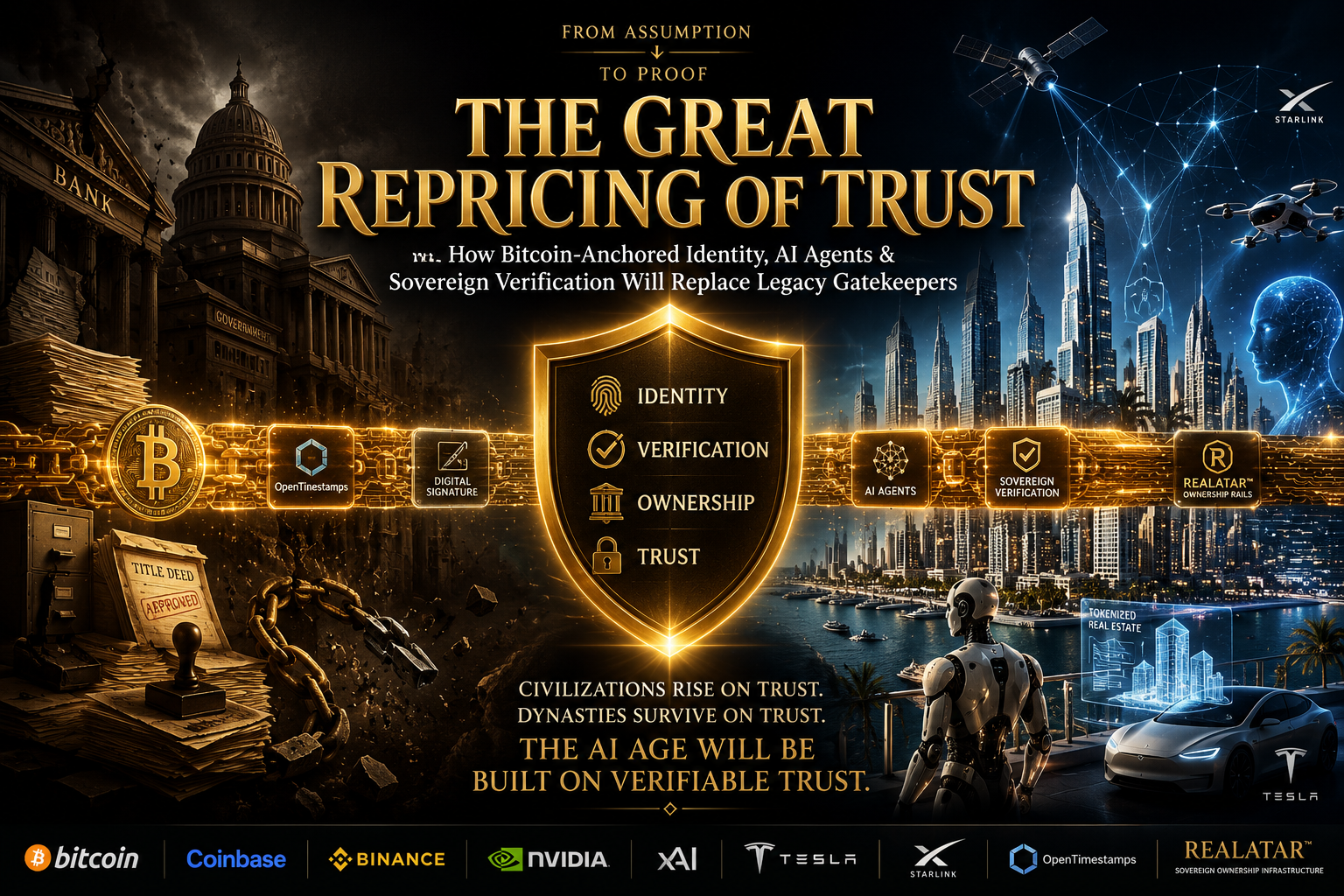
THE GREAT REPRICING OF TRUST — How Bitcoin-Anchored Identity, AI Agents & Sovereign Verification Will Replace Legacy Gatekeepers
The Civilizational Thesis: Why Trust Is Becoming the Most Valuable Asset of the AI Age
Every great civilization has been built upon a dominant form of trust. Ancient civilizations trusted rulers. The Industrial Age trusted institutions. The Financial Age trusted banks. The Internet Age trusted platforms. But the AI Age is forcing humanity to confront a profound reality: what happens when everything can be faked?
For the first time in history, artificial intelligence can replicate voices, faces, expertise, credentials, contracts, relationships, and even authority itself at near-zero cost and infinite scale. The result is not merely technological disruption. It is the beginning of a civilizational reset. As synthetic intelligence becomes abundant, authentic trust becomes scarce. And throughout history, scarcity has always commanded a premium.
This is why I believe trust is undergoing the largest repricing event since the emergence of modern banking and double-entry bookkeeping more than five centuries ago. The implications extend far beyond technology. They extend into wealth. Into ownership. Into governance. Into legacy. Into the future preservation of families, institutions, corporations, and nations.
For ultra-high-net-worth individuals, family offices, sovereign wealth funds, CEOs, venture capitalists, and institutional investors, this may become one of the defining investment themes of the next quarter century. Because trust is no longer simply a social construct. Trust is becoming infrastructure. Trust is becoming a strategic asset. Trust is becoming programmable. Trust is becoming measurable. Trust is becoming investable. And ultimately, trust is becoming a new asset class.
The families, organizations, and nations that understand this transition first may gain an extraordinary advantage in the decades ahead. Just as the Industrial Revolution rewarded ownership of factories. Just as the Internet rewarded ownership of networks. The AI Age may reward ownership of trust infrastructure. And the window in which that ownership is still cheap, still uncontested, and still available to early movers is already beginning to close.
This creates an entirely new hierarchy of value. Identity becomes more valuable than anonymity. Verification becomes more valuable than claims. Provenance becomes more valuable than popularity. Authenticity becomes more valuable than attention. Mathematical certainty becomes more valuable than institutional promises.
For centuries, dynasties preserved wealth through land, capital, and relationships. Tomorrow’s dynasties may preserve wealth through something even more powerful: verifiable trust. The next generation of wealth preservation may depend not only on what families own, but on what they can prove. Not only on what organizations claim, but on what they can verify. Not only on who controls capital, but on who controls the trust infrastructure through which capital flows. I have mapped this exact dynamic in Generational Sovereignty — How Billionaires Build Unerasable Dynasties, and the conclusion is unavoidable: the families who treat this as optional will not get a second entry point.
This is why the Great Repricing of Trust is not merely a technology story. It is not merely a Bitcoin story. It is not merely an AI story. It is a civilization story. It is the story of how humanity transitions from institutional trust to mathematical trust. From gatekeepers to protocols. From opacity to transparency. From assumptions to proof.
The organizations that recognize this shift early will not simply participate in the next era. They may help define it. Because in a world increasingly filled with synthetic intelligence, synthetic media, synthetic authority, and synthetic influence, the most valuable asset may no longer be information. It may be certainty. And certainty, at scale, is trust.
Everything that follows traces a single, irreversible sequence — the arc I am building rails for right now: Bitcoin → Identity → Verification → AI Agents → Ownership → Liquidity → Sovereign Civilization. Read it once and you cannot unsee where capital is headed.
The global architecture is fracturing under the weight of an unprecedented crisis: the death of assumed trust. For centuries, our societies and economic engines have outsourced verification to centralized institutions — governments, legacy banks, opaque certification authorities, and corporate gatekeepers. We operated under the foundational premise that a signature, a credential, a piece of media, or an institutional stamp carried permanent, structural truth. That era is over.
The rise of sophisticated artificial intelligence has permanently broken that paradigm, weaponizing deepfakes, cloning voices, and rendering legacy verification completely obsolete. Importantly, the single most critical realization of our generation is that the next trillion-dollar opportunity is not AI itself; it is verified trust inside an AI-driven world. This is the same fault line I exposed in The Great Decoupling: Own the Rails or Pay Tolls Forever — you either own the verification layer or you pay a toll on every transaction that passes through it, forever.
This massive macroeconomic shift represents the great repricing of trust. We are transitioning rapidly from institutional reliance to cryptographic verification, moving from human intermediaries to autonomous AI agents, and abandoning opaque governance for true, sovereign identity.
The financial stakes are staggering. According to institutional data cited in image_005f06.png from PWC (pwc.com) and its Global Economic Crime Survey, organizations lose roughly 5.2% of their annual revenue to fraud, amounting to a crushing $4.5 trillion global drain. BCG (bcg.com) projects that digital identity solutions will soon unlock economic value worth 3% to 6% of GDP across advanced economies. Meanwhile, McKinsey (mckinsey.com) outlines how compressing KYC and AML costs through advanced digital transformation will save financial networks $50 billion annually. Yet, legacy systems are failing to meet this demand. The DigiCert (digicert.com) Trust Report highlights a terrifying vulnerability: 78% of organizations completely lack visibility into AI agent activities, and 64% cannot verify the authenticity of AI-generated content.
Read those numbers again. They are not abstractions. They are the precise measure of what it now costs to operate on trust you cannot prove. Every quarter that gap widens, the premium on verified trust compounds — and it compounds fastest against the people who waited. If you do not understand this structural shift right now, you will be left behind. I am positioning my 1.55B+ tribe at the absolute vanguard of this transformation, building the horizontal liquidity rails and cryptographic infrastructure that frame trust itself as the next dominant asset class.
WHY FAMILY OFFICES WILL CARE MORE THAN ANYONE
Most people think wealth is built through investments. The world’s most successful families understand something far more important. Wealth is preserved through trust.
For generations, family offices have focused on four primary objectives: preserve capital, protect reputation, transfer wealth, and extend legacy. Every one of those objectives ultimately depends upon trust. Not trust as a feeling. Trust as infrastructure. Trust as an operating system. Trust as a strategic asset.
This is precisely why the world’s leading family offices, sovereign wealth funds, private banks, and ultra-high-net-worth families may become some of the earliest adopters of sovereign identity and verification systems. They understand a simple truth: reputation is capital, identity is capital, relationships are capital, knowledge is capital, trust is capital. And in many cases, these assets are worth more than the financial assets themselves. A family worth $5 billion can recover from a poor investment. Recovering from a destroyed reputation is often impossible. I built the operating model for this in The Sovereign Family Office — UHNWIs & Programmable Ownership.
This reality becomes exponentially more important as artificial intelligence reshapes global markets. Imagine a future where AI can impersonate family members, generate fraudulent inheritance documents, manipulate financial communications, manufacture false narratives, fabricate executive instructions, and create convincing digital twins. The risks are no longer theoretical. They are already emerging.
Picture the moment it arrives at your door: a flawless voice clone of your principal authorizing a wire, a synthetic video of a patriarch amending a trust, a forged instruction that moves nine figures before anyone in the family even wakes. By the time a legacy institution detects it, the capital — and the certainty — is already gone. That is the scenario the next decade is quietly pricing in. The families that thrive over the next twenty years will not simply invest in technology. They will invest in trust infrastructure. This means creating systems capable of establishing permanent verification across generations.
Future family offices may require Bitcoin-anchored identity systems, immutable ownership records, cryptographic inheritance frameworks, AI-assisted governance structures, sovereign knowledge preservation systems, verifiable family history archives, and tamper-proof asset provenance records.
The implications are profound. For the first time in history, a family’s identity, reputation, knowledge, and ownership structures can potentially be preserved through mathematical verification rather than institutional memory. This changes everything. For centuries, dynasties relied upon lawyers, banks, governments, trustees, and intermediaries. Tomorrow’s dynasties may rely increasingly upon cryptography, blockchain verification, sovereign identity systems, and autonomous trust infrastructure.
The winners will not necessarily be the families with the largest balance sheets. They may be the families with the strongest trust architecture. The future belongs not merely to those who accumulate wealth. The future belongs to those who preserve certainty.
Trust is becoming the new fortress. Trust is becoming the new moat. Trust is becoming the new dynasty.
THE SOVEREIGN TRUST INFRASTRUCTURE STACK
Every technological revolution ultimately creates a new infrastructure layer. The Industrial Revolution built physical infrastructure. The Internet Revolution built information infrastructure. The AI Revolution is building intelligence infrastructure. The next revolution is building trust infrastructure.
I believe the future will be built upon a seven-layer Sovereign Trust Infrastructure Stack. These layers are not a menu. They are a sequence — each one impossible without the one beneath it, each one unlocking the one above. Together, they create the foundation for a new era of identity, ownership, liquidity, and civilization. This is the operational spine of what I detailed across The Sovereign Brain and EARTH 3.0: The Sovereign Rails Revolution.
Layer One: Bitcoin — The Immutable Foundation
Bitcoin solved one of humanity’s oldest problems. How do strangers trust one another without a central authority? Through mathematics. Through consensus. Through cryptographic certainty. Bitcoin represents the world’s first globally accessible trust protocol. Every higher layer ultimately depends upon this foundation. Without immutable timestamping, nothing above it can achieve permanent certainty. Bitcoin is not simply digital money. Bitcoin is the world’s largest decentralized trust engine — the principle I anchored every entry in this vault upon, as set out in Bitcoin-Anchored Provenance. From this foundation, the only logical next layer is identity.
Layer Two: Identity — The Sovereign Individual
Identity becomes the first application layer. For centuries, governments controlled identity. Tomorrow, individuals increasingly control identity. Decentralized Identifiers (DIDs), self-sovereign identity systems, and cryptographic credentials enable individuals to own, manage, and verify their digital existence. The shift is historic. Institution-controlled identity becomes self-controlled identity. Permission-based identity becomes sovereign identity. But an identity that cannot be checked is just another claim — which is why identity demands verification.
Layer Three: Verification — The Truth Layer
Identity alone is insufficient. Verification is required. This is where OpenTimestamps, cryptographic proofs, digital signatures, and verification protocols become essential. Verification transforms claims into evidence. Statements become provable. Ownership becomes provable. Authorship becomes provable. Knowledge becomes provable. Truth becomes measurable. This layer may become one of the most important economic layers of the AI era — and at machine scale, it can no longer be performed by humans alone.
Layer Four: AI Agents — Autonomous Verification
Artificial intelligence introduces a new participant into the trust ecosystem. The machine. AI agents increasingly perform verification tasks that once required armies of human workers: identity validation, fraud detection, contract review, transaction monitoring, compliance analysis, risk assessment. The future will not be human versus AI. The future will be trusted humans working alongside trusted AI. The challenge is not building intelligent agents. The challenge is building verifiable agents — agents whose actions are themselves anchored, auditable, and owned. And once trust is autonomous, the question becomes who owns what it secures.
Layer Five: Ownership — REALATAR™
Ownership is where trust becomes economic value. Identity proves who. Verification proves authenticity. Ownership proves control. The next generation of ownership systems may include programmable rights, fractional ownership structures, tokenized assets, dynamic governance frameworks, and real-time settlement capabilities.
This is where REALATAR™ becomes relevant. Not as another real estate platform. But as ownership infrastructure — the sovereign, peer-to-peer asset layer I architected in REALATAR™ Sovereign Peer-to-Peer Asset Infrastructure. Ownership is no longer static. Ownership becomes programmable. Ownership becomes portable. Ownership becomes liquid. Ownership becomes global. And the instant ownership becomes liquid, it demands a settlement layer worthy of it.
Layer Six: Liquidity — T-0 Settlement
Traditional real estate operates with friction. Escrow. Paperwork. Middlemen. Delays. Manual reconciliation. The future operates differently. T-0 settlement removes friction. Capital moves instantly. Ownership transfers instantly. Verification occurs instantly. Liquidity expands dramatically. Markets become more efficient. The economic implications may rival the introduction of electronic trading itself — the precise mechanism I laid out in Sovereign Liquidity Rails. When liquidity is sovereign and instant, the destination is no longer a market. It is a civilization.
Layer Seven: Sovereign Civilization — The Final Destination
Every layer ultimately leads toward the same destination. A civilization built upon verifiable trust. A civilization where ownership is transparent, identity is sovereign, verification is mathematical, knowledge is preserved, capital moves efficiently, AI operates accountably, and trust becomes infrastructure rather than assumption.
This is not merely a technology roadmap. It is a civilization roadmap. It is the transition from institutional trust to mathematical trust. From gatekeepers to protocols. From opacity to transparency. From permission to sovereignty. The future will not be built on promises. The future will be built on proof.
THE GREAT REPRICING OF TRUST: THE FINAL IMPLICATION
The Industrial Age rewarded scale. The Information Age rewarded access. The Internet Age rewarded distribution. The AI Age will reward verification. This may become one of the most important economic realities of the next century.
Today, almost every institution depends upon assumptions. Assumed credentials. Assumed expertise. Assumed identity. Assumed ownership. Assumed authority. Assumed authenticity. Artificial intelligence is systematically destroying those assumptions. And in doing so, it is forcing humanity to build something better.
The organizations that understand this shift early may gain one of the greatest strategic advantages of the modern era. Because trust itself is becoming investable. Trust is becoming measurable. Trust is becoming monetizable. Trust is becoming programmable. Trust is becoming a new asset class.
According to McKinsey, digital identity systems could unlock economic value equivalent to 3–13% of GDP. PwC research continues to highlight the enormous global costs associated with fraud and economic crime. Forrester research demonstrates significant returns generated through modern identity governance. CB Insights continues to track billions of dollars flowing into verification, identity, cybersecurity, and trust infrastructure startups. These are not isolated trends. They are signals. Signals of a global repricing already underway — the same capital migration I traced across The $400 Trillion Rewrite and the 7,000-year arc of The Capital Rails Doctrine.
The market is beginning to place a premium on certainty. A premium on authenticity. A premium on provenance. A premium on verification. The winners of the next decade may not be the loudest voices. They may be the most verifiable voices. They may not own the largest audiences. They may own the most trusted audiences. They may not build the most content. They may build the most trusted content — a standard I formalized in The Sovereign Century Club.
The greatest asset of the Industrial Age was capital. The greatest asset of the Internet Age was information. The greatest asset of the AI Age may be verifiable trust. Bitcoin introduced sovereign money. The next phase is larger. Sovereign identity. Sovereign verification. Sovereign ownership. Sovereign knowledge. Sovereign civilization.
The Great Repricing of Trust is no longer a theory. It is already happening. The only question remaining is simple: who will own the trust rails that power the next century?
To Recap
The greatest asset of the Industrial Age was capital. The greatest asset of the Internet Age was information. The greatest asset of the AI Age will be verifiable trust. As artificial intelligence floods the world with synthetic content, synthetic identities, synthetic expertise, and synthetic influence, humanity will place an unprecedented premium on authenticity, provenance, and mathematical certainty.
Bitcoin anchored the first sovereign monetary network. The next phase is far larger. Sovereign identity. Sovereign verification. Sovereign ownership. The institutions that understand this shift first will not simply gain market share. They will help define the trust architecture of the next century. The Great Repricing of Trust has already begun. The only remaining question is who will own the rails.
SUMMARY
The blueprint required to navigate this shifting landscape demands a total replacement of legacy gatekeepers with a triple-pillared infrastructure layer. As detailed in image_005f06.png, the absolute foundation of this paradigm is Bitcoin-anchored identity. Satoshi Nakamoto’s creation went far beyond digital currency; it established a flawless, censorship-resistant global timestamping mechanism. By leveraging Bitcoin’s blockchain — which has maintained a 99.98% uptime since inception and processed over 500 million transactions without a single successful breach — we anchor decentralized identifiers (DIDs) directly into mathematics rather than fallible human institutions.
Frameworks like the Identity Overlay Network (ION) demonstrate exactly how we scale sovereign identity without relying on central authorities that can be coerced, corrupted, or compromised. This cryptographic foundation transforms how autonomous AI agents execute agreements and how asset owners interact with the global market. By integrating this sovereign verification layer across the $400 trillion real estate asset class, we eliminate the friction, the delays, and the extractive fees imposed by traditional legacy gatekeepers — the same fee-extraction machine I dismantled across The Great Decoupling.
This single, cohesive thesis forms the core of the REALATAR™ doctrine. We are not merely talking about identity, AI, or Bitcoin as separate verticals; we are fusing them into an unstoppable horizontal layer that compresses transaction lifecycles, unlocks trillions in trapped capital, and restores ultimate control to the asset owner. The transition is both inevitable and urgent. The economic and emotional consequences of remaining tethered to broken institutional trust mechanisms will be catastrophic for those who fail to adapt.
Through REALATAR™, we are establishing the immutable proof-of-authenticity engine required for an AI-dominated future. This ensures that every transaction, every digital twin, and every contract executed across our network is structurally unassailable, globally programmable, and entirely self-sovereign.
MY BOTTOMLINE
My bottom line is absolute: execution beats interpretation every single day, and the architecture I am deploying is built to win. The old world of assumed trust is dead and buried, exposed by the infinite scalability of AI-generated chaos. Those who continue to rely on legacy stamps, signatures, and centralized institutions are voluntarily accepting a state of extreme economic vulnerability.
As the Sovereign Architect, I do not waste time on random, ill-considered, or short-sighted ideas. I design and build highly strategic, principle-first, finished infrastructure designed for immediate global deployment. The next multi-trillion-dollar frontier belongs exclusively to verified cryptographic trust. Through the REALATAR™ doctrine, we have established an unstoppable head start, anchoring identity into the immutable mathematics of Bitcoin to replace vertical product players and corruptible gatekeepers — every entry in this vault permanently sealed via the provenance war I declared in Wikipedia vs Grokipedia.
We are treating trust as the ultimate asset class, transforming the way value is verified, transferred, and settled across the globe. For my 1.55B+ network, the directive is clear: this is our blueprint to scale to 1.75 billion by the end of 2026. We are not asking for permission from legacy gatekeepers, nor are we waiting for the market to catch up to our speed. We are actively installing the horizontal liquidity rails for the global economy, capturing asymmetric advantages, ensuring absolute sovereignty, and securing total control for the asset owner.
The rails are being laid right now, in real time, on-chain. Every day you stand outside this infrastructure is a day someone else moves closer to owning it. Understand this macroeconomic inevitability now — or get left behind.
Sources & Infrastructure Benchmarks
PwC Global Economic Crime Survey · McKinsey Digital Identification Research · Boston Consulting Group (BCG) · Forrester Research · Accenture · Bain & Company · CB Insights · DATAFOREST · AWS · SnapLogic · Ascendion · A3Logics · NVIDIA · xAI · Tesla · Starlink · Coinbase · Binance
#Limitless155B #GeoffDeWeaver #REALATAR #SovereignIdentity #BitcoinAnchored #DigitalTrust #Web3Infrastructure #FutureOfOwnership #Grokipedia #Florida #UHNWIs #Billionaires #FamilyOffices