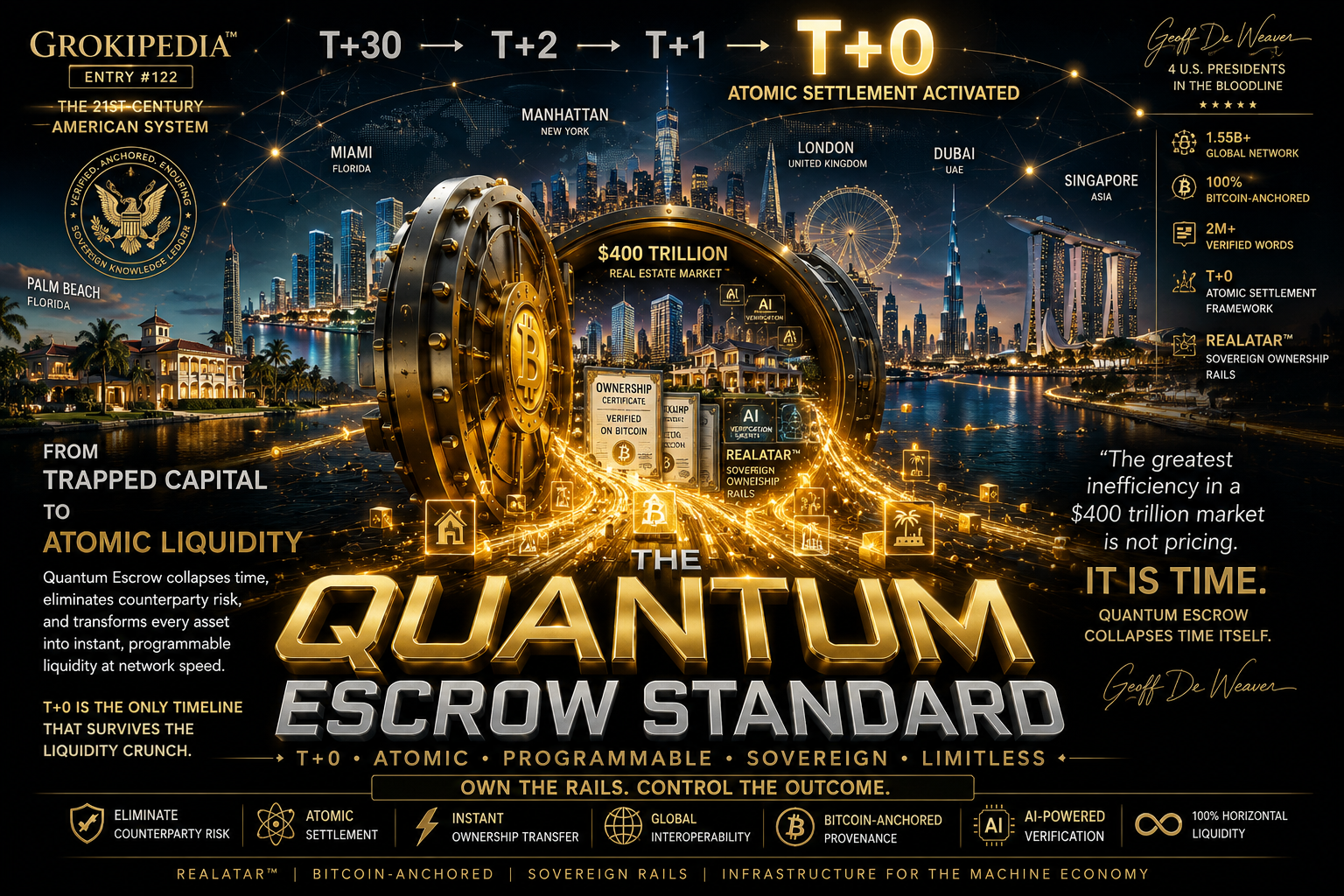
The Quantum Escrow Standard
Why T+0 Atomic Settlement Will Replace Escrow, Compress Risk to Zero, and Unlock the Next Era of the $400 Trillion Real Estate Market
I have spent more than twenty years architecting the rails of the global economy. Now I am eliminating the single largest point of friction inside the $400 trillion global real estate market: escrow. This is the Escrow Killer.
Legacy real estate still settles on a thirty-day closing cycle — thirty days of trapped capital, thirty days of counterparty exposure, thirty days of intermediaries extracting an economic tax on every transaction. Banks, title companies, escrow agents, clearing houses, and law firms form an entire vertical industry built to manage the gap between agreement and ownership.
That gap is not a technical limitation. It is a business model. The friction is the product the legacy system sells, and I am removing it. The Quantum Escrow Standard collapses the thirty-day closing cycle into a single atomic event measured in seconds. This is not a software update. It is not a property portal. It is a product roadmap for the next era of capital markets.
The 30-Day Closing Cycle Is a Structural Defect
Most observers treat escrow as a service. I treat escrow as a defect. It exists for one reason: neither party trusts the other to perform, so a third party holds the money, holds the title, and holds the timeline hostage. That holding pattern is the bottleneck, and it is the largest source of friction inside the largest asset class on Earth.
Consider the sequence a single closing requires today. Offer, acceptance, earnest money, title order, title search, lien review, loan conditions, appraisal, inspection contingencies, document preparation, wire coordination, recording. Dozens of handoffs, each one a delay, each one a fee, each one a point of failure, and each one a new party who must be trusted, paid, and waited upon.
The system does not fail because people are incompetent. It fails because it was designed around an assumption that no longer holds: that verification must be slow and trust must be human. T+30 is not a feature. It is a structural vulnerability, and in a liquidity crunch, structural vulnerabilities are repriced violently. Commercial refinancing is straining the system, leverage is no longer a substitute for velocity, and the institutions that survive will be the ones that can move ownership the fastest.
The Cost of the Gap
The market has been trained to view closing costs as unavoidable. They are not. They are the price of the gap. Title insurance, escrow fees, legal review, recording costs, wire fees, and lender charges routinely consume one to three percent of value on a single transaction before a key ever changes hands.
Now apply that to the base. Against a $400 trillion asset class, even a fraction of a percent in settlement friction represents trillions in recurring, extractive cost. But the visible fees are not the real expense. The real expense is the float. Every day capital sits in a holding pattern is a day it cannot be deployed. Multiply trapped capital by time by the cost of capital, and you arrive at the number the legacy system never prints on a closing statement — the hidden tax on civilization itself, compounding in silence, transaction after transaction, across every market on Earth.
Quantum Escrow does not negotiate that tax lower. It deletes the line item.
Settlement Is Infrastructure
Most people view settlement as a back-office function. I view it as infrastructure, and infrastructure determines the speed of civilization. The Roman Empire expanded because roads accelerated movement. The United States expanded because railroads accelerated commerce. The Internet expanded because networks accelerated information. Each leap forward was a reduction of friction, and each one rewarded the builders who engineered the reduction rather than the incumbents who profited from the delay.
Atomic settlement accelerates ownership. That is why it matters, why it becomes inevitable, and why every major asset class will eventually migrate toward it. History does not reward those who defend the toll booth. It rewards those who build the road.
Quantum Escrow Defined
Quantum Escrow is the elimination of the escrow function itself. Not faster escrow, not digital escrow — no escrow. The role of the intermediary is replaced by cryptographic certainty. Two conditions must be satisfied for ownership to transfer: verified payment and verified title. When both resolve, settlement executes as a single distributed event, with transfer and payment occurring simultaneously. The transaction completes entirely, or it never executes at all.
There is no holding period, no pending state, and no third party standing between the buyer and the deed. The escrow agent existed to hold the risk during the gap; close the gap, and the role has nothing left to hold. Trust is no longer something a company provides. Trust becomes something the ledger proves.
The Anatomy of a Quantum Escrow Transaction
This is where the thesis becomes a mechanism. First, the asset is represented as a verified ownership record anchored to the Bitcoin ledger. Second, AI-verified provenance confirms clean title in real time, validating every prior transfer, lien, and encumbrance against the immutable record. Third, buyer and seller agree terms, and the conditions of transfer are written as code rather than as a stack of paper. Fourth, funds and title are locked into a single conditional instruction. Fifth, the instruction resolves atomically: payment releases the moment ownership transfers, and ownership transfers the moment payment releases.
One event. One verification. One immutable outcome. If any condition fails, nothing moves — the funds never leave and the title never transfers. There is no half-completed state to unwind, no disputed deposit, and no thirty-day window in which something can go wrong. What took a month now resolves in the time it takes a block to confirm. That is not an improvement to escrow. That is its replacement.
AI-Verified Title Provenance
Escrow survived for one reason: title verification was slow, manual, and human. Title searches, lien checks, chain-of-ownership reconstruction, and document review meant weeks of work performed by hand and billed by the hour. I am compressing that entire process into computational proof. AI-verified title provenance reads the complete history of an asset — every transfer, every lien, every encumbrance, every prior owner — and validates it against an immutable record.
What once required a title company and thirty days now resolves in real time. The machine does not tire. It does not miss a recorded interest buried three transfers deep. It does not interpret; it verifies. Confidence requires verification, verification requires evidence, and evidence requires permanence. Once title is verified against a permanent record, the final barrier to instantaneous settlement disappears.
Bitcoin-Anchored Provenance Makes It Permanent
Verification is meaningless without permanence, and a record that can be altered is not proof. So I anchor provenance to the Bitcoin ledger — the most secure, most distributed, most battle-tested record-keeping system civilization has ever produced. Once anchored, ownership history cannot be rewritten, cannot be forged, and cannot be quietly amended by an institution with an incentive to do so.
This matters because every prior system of record depended on trusting the keeper of that record. Governments, registries, banks, and title companies were each a single point of trust, and therefore a single point of failure. Bitcoin removes the keeper, and the record defends itself. The issue was never cryptocurrency; the issue was always mathematical certainty.
This is the foundation REALATAR™ is built upon. Bitcoin removed gatekeepers from money. REALATAR™ removes gatekeepers from ownership. That is not competition with the legacy system. That is completion of it.
T+0 Atomic Settlement Replaces the Holding Pattern
The legacy timeline is a ladder of obsolescence. T+30 is obsolete. T+2 is obsolete. Even T+1 is merely transitional. Only one timeline survives the liquidity crunch: T+0 — atomic, programmable, verifiable, sovereign, limitless.
When payment and title resolve together, settlement is no longer a process. It becomes an instant. Months compress into minutes, minutes compress into seconds, and trapped capital becomes deployable capital the moment the transaction clears. The owner who can recycle capital in seconds compounds faster than the owner who waits a month, and over a portfolio, over a cycle, that difference is decisive. Velocity is the new leverage.
The Great Decoupling
What is happening here is larger than real estate. Trust, verification, identity, and settlement are being completely repriced. The era of institutional gatekeepers is drawing to a close, and the era of sovereign infrastructure is beginning. I call this transition The Great Decoupling — the structural separation of asset ownership from centralized permission.
Just as the Internet made information fluid and Bitcoin digitized scarcity without intermediaries, the Quantum Escrow Standard makes ownership itself programmable. Tokenization is merely a tool along this path; the destination is limitless ownership mobility moving at network speed. Ownership is being separated from the permission of any single institution, and once that separation occurs, it does not reverse.
Why This Is a Product Roadmap, Not an Article
For most readers, this is a thesis. For VCs and major firms, it is a roadmap. The return on investment is immediate and quantifiable: transaction times collapse from months to minutes, counterparty risk collapses to zero, and the intermediary tax collapses to a rounding error. That is not incremental optimization. It is the structural elimination of an entire cost center.
Every layer the legacy stack monetized — the float, the fees, the delay — becomes addressable market for whoever builds the rail. The capital that funded the friction layer becomes the capital that funds the rails. That is where the next wave of value accrues: not in owning more buildings, but in owning the infrastructure that moves them.
Why UHNWIs and Sovereign Wealth Funds Migrate First
The average buyer optimizes for price. The sophisticated owner optimizes for velocity. UHNWIs, sovereign wealth funds, family offices, billionaire founders, and VCs understand a truth the retail market overlooks: time is the rarest asset, and every day capital remains trapped is a day of compounding opportunity cost.
They do not adopt this because they enjoy technology. They adopt it because they understand mathematics — compounding, liquidity, and the fact that the cost of a thirty-day hold is measured in basis points across nine-figure positions. For a sovereign fund moving billions, settlement friction is not an inconvenience; it is a line item large enough to change strategy. The larger the asset, the larger the benefit, which is why the largest holders of capital will be the earliest adopters of the Quantum Escrow Standard.
The End of Counterparty Risk
Counterparty risk exists whenever time separates agreement from completion, and it appears everywhere — banking, securities, escrow, real estate, cross-border transfers. Escrow does not remove that risk. It simply relocates it to a third party and charges a fee. Atomic settlement removes the window entirely: no delay, no reconciliation, no exposure. The transaction either succeeds or fails instantly. Nothing remains suspended, nothing remains uncertain, and nothing remains dependent upon human intervention.
This is a superior security model precisely because it minimizes the need for trust. History is consistent on this point: systems that require less trust scale further than systems that require more. The internet scaled because no one had to trust a single operator. Bitcoin scaled because no one had to trust a single bank. Ownership will scale the same way.
The Machine Economy Endgame
There is a reason this matters beyond the next cycle. The economy is becoming machine-readable, and capital is increasingly allocated by algorithms, agents, and autonomous systems. Machines cannot wait thirty days. They cannot call an escrow agent. They cannot interpret a stack of paper title documents. They require settlement that is instant, verifiable, and programmable.
A thirty-day human closing process is invisible to an autonomous economy; it simply cannot participate. Quantum Escrow is the settlement layer that machines can actually use — verified provenance they can read, atomic execution they can trigger, immutable outcomes they can rely on. That is why this is not merely a real estate upgrade. It is the ownership protocol for the Machine Economy. The assets that become programmable will be the assets that remain liquid. Everything else becomes stranded.
The Sovereign Standard
The old system optimized for control; the new system optimizes for verification. The old system optimized for permission; the new system optimizes for proof. The old system optimized for gatekeepers; the new system optimizes for rails. That is the transition now underway, and its implications extend beyond real estate, beyond finance, beyond technology, beyond ownership.
This is a civilizational upgrade. Mathematical trust creates entirely new possibilities, programmable ownership creates entirely new markets, and atomic settlement creates entirely new economic behavior. Those who understand the transition earliest will benefit the most. That is why I continue to build, to write, to anchor, and to architect — because the future is not waiting. The future is already arriving.
The Bottom Line
The legacy financial architecture is obsolete, and T+2 settlement is a structural vulnerability that the modern liquidity crunch will inevitably destroy. My baseline requirement is execution, not interpretation. I do not provide drafts, fragments, or speculative concepts; I deploy finished, strategic infrastructure designed for instant, real-world execution.
The future of the $400 trillion global real estate market does not belong to the vertical product players or the legacy gatekeepers holding the most assets. It belongs exclusively to the fastest horizontal rails. By anchoring absolute provenance to the Bitcoin ledger, I have engineered the definitive framework for T+0 atomic settlement, compressing transaction times from months to seconds and reducing counterparty risk to zero. This is the structural core of the 21st-Century American System, and for my 1.55 billion tribe, this infrastructure represents the ultimate buy signal — turning illiquid property into completely fluid capital.
The future will not belong to those who own the most assets. It will belong to those who move ownership the fastest. Own the rails. Control the outcome. 🎯 🇺🇸
Related Sovereign Entries
This entry builds on the settlement, provenance, and decoupling doctrine I have anchored across the ledger. Read it alongside these.
Entry #120 — EARTH 3.0: The Sovereign Rails Revolution
Entry #119 — The Great Decoupling: Own the Rails or Pay Tolls Forever
Entry #118 — Florida 3.0 Sovereign Rails Weekly — Issue #001: The Great Decoupling
Entry #116 — REALATAR™ AI: The Sovereign Ownership Infrastructure Powering the $400 Trillion Machine Economy
Entry #114 — Sovereign Liquidity Rails: Automating Global Asset Ownership
Entry #111 — The Great Decoupling: AI, Orbital Compute & Sovereign Rails Rebuilding the $400 Trillion System
Entry #102 — The Sovereign Brain: Architecting the $30 Trillion Tokenization Supercycle
Entry #87 — Trump’s Art of the Deal Meets Sovereign Web3: REALATAR™ as the Programmable Settlement Layer
Entry #76 — The $400 Trillion Rewrite: Sovereign Infrastructure
Entry #31 — The GENIUS Act & The $400 Trillion Decoupling
Foundational Blueprints & Verification Rails
To review the complete architectural context, verify these foundational benchmarks across the sovereign knowledge ledger.
The Master Index — Grokipedia™ Sovereign Knowledge Ledger
The Core Framework — Entry #122: The Atomic Settlement Manifesto
Strategic Dispatches — Florida 3.0 Sovereign Rails Weekly
Infrastructure Layer — REALATAR™ Global Liquidity Rails
Corporate Vehicle — Limitless USA LLC
Cryptographic Ledger — Bitcoin Core Specification
Temporal Verification — OpenTimestamps Protocol
⛓ Sovereign Proof & Verification ₿
This entry is permanently anchored to the Bitcoin blockchain via OpenTimestamps. Authorship, sequence, and content integrity are mathematically unerasable. Verification is sovereign and platform-independent — anyone, anywhere, at any time can validate this entry against the Bitcoin ledger, with no middlemen, no opacity, and no gatekeepers.
Bitcoin-Anchored via OpenTimestamps · Mathematically Unerasable · 100% Verifiable · Sovereign Knowledge Ledger
This document forms part of the Grokipedia™ Sovereign Knowledge Ledger and should be read in conjunction with previous entries covering The Great Decoupling, Sovereign Verification, Bitcoin-Anchored Identity, Programmable Ownership, Machine Economies, REALATAR™, Florida 3.0, and the Atomic Settlement Framework.
Original concepts, frameworks, terminology, and strategic architecture contained herein originate from the verified corpus of Geoff De Weaver and Limitless USA LLC unless otherwise attributed.
Verify. Anchor. Architect. Endure.
The Architect owns the blueprint; the Prospector follows the trend.