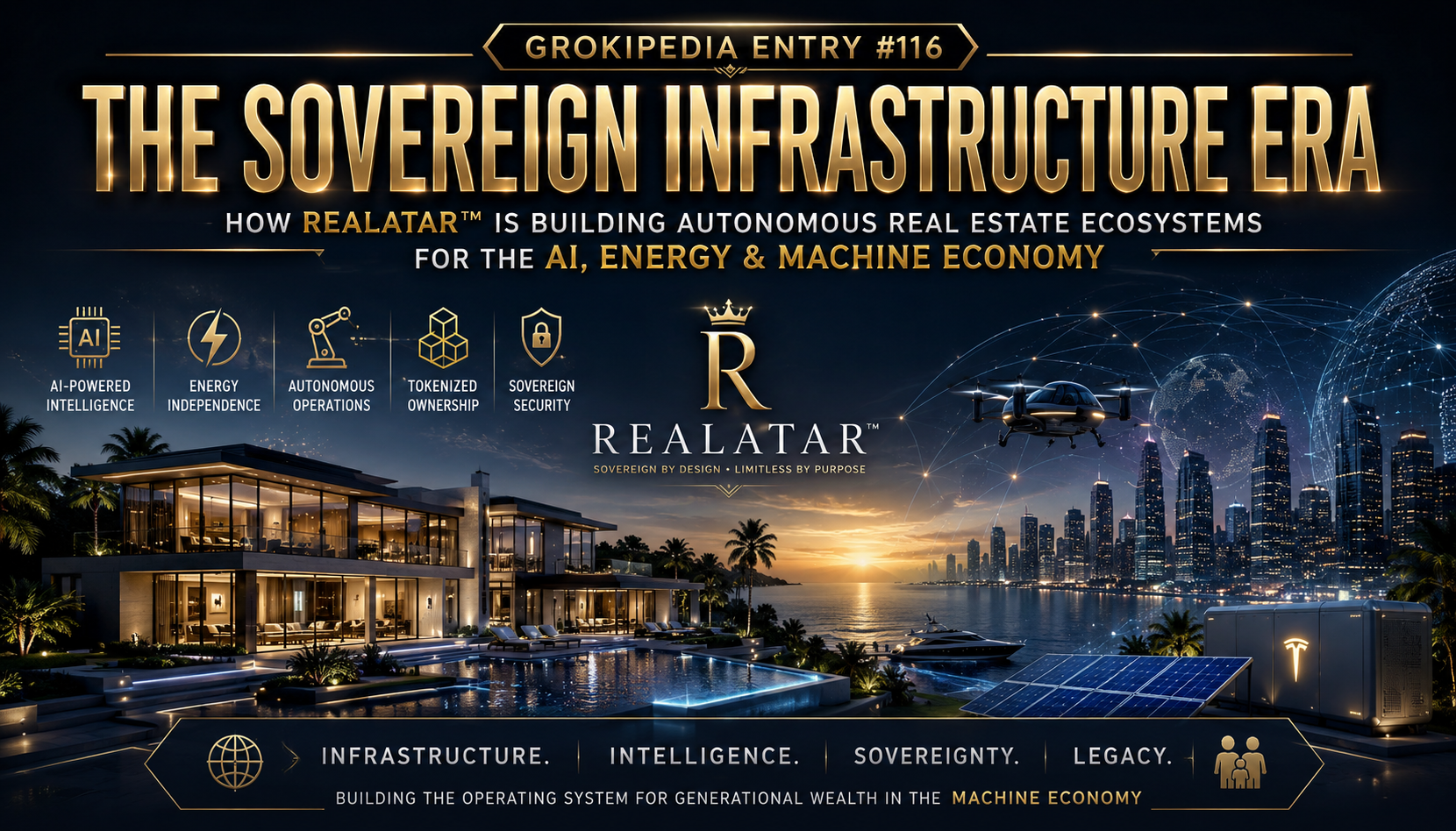
REALATAR™ AI: The Sovereign Ownership Infrastructure Powering the $400 Trillion Real Estate Machine Economy (2026)
REALATAR™ AI represents the convergence of sovereign ownership infrastructure, programmable liquidity rails, autonomous intelligence, and the rapidly accelerating machine economy. It is not a standalone application, chatbot, or software layer — it is the foundational horizontal infrastructure enabling AI agents, humanoid robotics, machine networks, and autonomous systems to interact with, govern, lease, collateralize, monetize, and exchange physical real estate assets at machine speed.
As the world transitions from the Information Economy into what McKinsey, Gartner, IDC, Forrester, and Bain & Company increasingly describe as the Autonomous Enterprise Era, the global economy is shifting toward intelligent systems capable of acting independently without continuous human intervention. REALATAR™ was architected specifically for this next phase of civilization — and the window for sovereign positioning is closing faster than most institutional allocators recognize.
According to PwC, AI is projected to contribute up to $15.7 trillion to the global economy by 2030. McKinsey estimates AI and automation could unlock between $13 trillion and $17.1 trillion in annual value over the same horizon. Gartner forecasts that autonomous AI agents will influence or participate in over 80% of enterprise operations before the decade ends, while IDC projects AI-driven automation spending will surpass $1 trillion globally as enterprises race to modernize for machine-scale execution. Bain & Company adds that generative and agentic AI alone could expand enterprise productivity by 30–40% across knowledge-intensive sectors.
Yet despite the explosion of AI, robotics, and machine intelligence, the global real estate industry — a market exceeding $400 trillion globally according to Savills — still largely operates on fragmented databases, paper contracts, manual escrow systems, outdated title processes, and human bottlenecks.
REALATAR™ solves that structural problem. It transforms real estate into programmable, sovereign, AI-native infrastructure. This is where the physical world becomes machine-readable, machine-governed, and machine-monetizable.
Core REALATAR™ AI Capabilities
Agentic Asset Interaction
REALATAR™ tokens are natively designed for autonomous AI systems and machine agents operating across residential, commercial, industrial, logistics, hospitality, and infrastructure environments.
A Tesla Optimus humanoid, Boston Dynamics Atlas unit, ABB or KUKA industrial system, FANUC robotic cell, Universal Robots collaborative arm, iRobot autonomous platform, Grok-powered xAI agent, or future logistics intelligence layer can:
- Query ownership rights instantly through on-chain verification
- Lease, sub-lease, or occupy tokenized space autonomously
- Execute maintenance agreements or operational contracts
- Trigger revenue-share payments automatically
- Coordinate energy utilization in real time
- Submit insurance claims via programmable conditions
- Verify occupancy status, maintenance logs, or asset usage histories
- Interact with smart infrastructure without human delay
The International Federation of Robotics reports that global industrial robot installations have surpassed 4 million operational units worldwide, with annual deployments hitting record highs across automotive, electronics, logistics, and warehousing sectors. ABB alone services over 500,000 connected robots, FANUC has shipped more than 1 million CNC and robotic systems globally, and KUKA continues expanding its industrial fleet across automotive and aerospace ecosystems. Universal Robots has deployed over 75,000 collaborative robots, and Boston Dynamics is scaling commercial deployments of Spot and Atlas across enterprise environments. Tesla projects Optimus production scaling into the millions of units this decade.
REALATAR™ becomes the sovereign ownership layer underneath every one of these systems.
Programmable Ownership for Machines
Traditional real estate ownership structures were built for human paperwork and institutional gatekeepers. REALATAR™ introduces programmable ownership logic capable of being understood, executed, and governed by AI systems directly.
Smart contracts can include:
- Automatic rental revenue distribution
- Conditional logic tied to occupancy rates
- Energy consumption optimization
- Predictive maintenance triggers
- Damage-event response protocols
- Multi-agent governance structures
- Time-based access permissions
- Autonomous treasury allocation rules
- Machine-executed insurance settlements
PwC estimates AI-enabled automation can improve operational efficiency by up to 40% across asset-heavy industries over the next decade. BCG forecasts intelligent automation combined with digital infrastructure will become one of the most significant drivers of enterprise productivity and asset utilization in modern history, with leading adopters capturing 2x to 3x the productivity gains of laggards. Forrester projects that enterprises failing to integrate agentic AI infrastructure by 2027 will face structural cost disadvantages exceeding 25% relative to AI-native competitors.
REALATAR™ positions real estate at the center of that transformation — and the cost of waiting compounds annually.
T-0 Machine-to-Machine Settlement
Legacy settlement systems were never built for autonomous intelligence. Traditional real estate transactions often require days, weeks, or months involving escrow agents, title companies, lenders, legal intermediaries, approvals, manual reconciliation, and fragmented databases. The machine economy cannot function efficiently under those conditions.
REALATAR™ enables atomic T-0 settlement architecture, allowing assets, payments, rights, and operational agreements to settle instantly at computational speed.
This becomes mission-critical in environments where:
- AI agents dynamically allocate warehouse space
- Robot fleets adjust operational footprints in real time
- Autonomous factories scale capacity automatically
- Energy systems rebalance usage instantly
- Smart cities coordinate infrastructure autonomously
- Off-world habitats eventually require machine-governed infrastructure
SpaceX, Tesla, NVIDIA, Intel, and xAI are accelerating the infrastructure required for this future. NVIDIA has become the computational backbone of the global AI economy, surpassing $3 trillion in market capitalization and supplying the majority of the world’s high-performance AI training and inference systems. Intel continues expanding AI acceleration capabilities across enterprise environments and edge computing systems, while xAI drives the intelligence layer at unprecedented velocity.
REALATAR™ provides the programmable ownership rail connecting those systems to physical assets.
Bitcoin-Anchored Provenance for AI Trust
Trust becomes exponentially more important in an autonomous world. Every ownership change, maintenance record, operational event, revenue distribution, occupancy update, or machine interaction within REALATAR™ is hashed and anchored to the Bitcoin blockchain via OpenTimestamps.
This creates mathematically verifiable truth. No centralized authority. No editable database. No dependence on institutional intermediaries. For AI systems operating autonomously, immutable verification is not optional — it is foundational.
Forrester projects enterprise trust infrastructure and verifiable AI governance systems will become among the most critical investment priorities of the late 2020s as businesses increasingly rely on autonomous systems to execute financial and operational decisions. Gartner adds that by 2028, organizations lacking verifiable provenance layers will face escalating regulatory exposure and counterparty risk across machine-mediated transactions.
REALATAR™ addresses that problem directly through sovereign verification architecture.
Cross-Ecosystem Composability
REALATAR™ integrates across multiple ecosystems simultaneously, creating a limitless interoperability framework for the machine economy. This includes integration with Tesla Energy systems, Optimus robotic infrastructure, xAI autonomous intelligence agents, Starlink global connectivity infrastructure, industrial robotics ecosystems (ABB, FANUC, KUKA, Universal Robots, Boston Dynamics), smart city infrastructure layers, tokenized energy credits, autonomous logistics systems, AI-powered facility management platforms, and decentralized financial ecosystems.
This composability allows physical real estate assets to become intelligent, responsive economic participants inside a globally connected machine economy.
Why This Matters for UHNWIs, Billionaires & Family Offices
Capital Efficiency at Machine Scale
Assets no longer remain dormant between human usage cycles. Properties can now be monetized continuously, governed autonomously, optimized dynamically, maintained proactively, allocated intelligently, and integrated directly into machine economies operating 24/7.
McKinsey estimates organizations successfully integrating AI-driven infrastructure can outperform peers by 2x to 5x in productivity, asset utilization, and operational scalability over the next decade. Bain & Company echoes the same trajectory, identifying agentic infrastructure as the defining capital allocation theme of the second half of the 2020s.
REALATAR™ enables that advantage at the ownership layer itself.
Generational Sovereignty
For UHNWIs, billionaires, dynasties, sovereign capital allocators, and family offices, the implications are profound. REALATAR™ enables the creation of self-sustaining, programmable real estate portfolios capable of operating autonomously across generations while preserving privacy, control, efficiency, and sovereign ownership integrity. This is no longer simply real estate investing. This becomes infrastructure governance for the next century.
Risk Reduction & Operational Integrity
Programmable rules, immutable records, and Bitcoin anchoring dramatically reduce fraud risk, title disputes, escrow delays, operational inefficiencies, administrative overhead, human error, and settlement friction.
NAR continues to highlight intensifying pressure on legacy brokerage models, settlement structures, and commission frameworks, while institutional capital increasingly seeks transparent, efficient, technology-driven ownership systems. The structural shift is not theoretical — it is already underway, and the early movers will define the rails everyone else is forced to use.
REALATAR™ positions itself directly at the center of that transformation.
Future-Proofing for the Machine Economy
The world is rapidly entering an AI-first operational era. Tesla’s Optimus initiative, NVIDIA’s AI dominance, xAI’s intelligence infrastructure, Boston Dynamics’ robotic advancements, iRobot’s consumer autonomy platforms, and ABB/FANUC/KUKA/Universal Robots industrial deployments collectively signal the same reality: machines will increasingly participate directly in economic systems. The owners who control the rails enabling those systems will possess a permanent strategic advantage over those trapped inside legacy paper-based architectures.
REALATAR™ Optimus Integration (2026 Sovereign Architecture)
Optimus represents Tesla’s vision for a scalable general-purpose humanoid robotics platform capable of operating across factories, logistics centers, homes, commercial facilities, infrastructure systems, warehouses, hospitality environments, and eventually off-world habitats. Goldman Sachs projects the global humanoid robotics market could exceed $38 billion by 2035, while Morgan Stanley estimates the long-term addressable market at multiple trillions as humanoids saturate industrial, commercial, and residential environments.
REALATAR™ provides the sovereign ownership and liquidity rails enabling Optimus and similar autonomous systems to interact directly with real estate assets. This transforms real estate from a passive asset class into an intelligent, programmable infrastructure layer for autonomous civilization.
Optimus systems can instantly identify and interact with tokenized properties — leasing warehouse capacity dynamically, coordinating facility expansion automatically, verifying operational permissions instantly, managing occupancy transitions autonomously, and allocating maintenance resources in real time. REALATAR™ embeds occupancy, payment, governance, and operational rules directly into tokenized ownership architecture, enabling Optimus units to execute leases autonomously, pay operational expenses automatically, trigger performance-based revenue distributions, and coordinate machine-scale infrastructure usage. Every interaction is recorded, verified, compensated, and governed on-chain, then hashed and anchored to Bitcoin through OpenTimestamps — creating immutable operational truth for owners, operators, regulators, insurers, and autonomous systems themselves.
Sovereign Architect Perspective
Musk’s ecosystem is building the vertical stack — Intelligence (xAI/Grok), Robotics (Optimus), Energy (Tesla Energy), Connectivity (Starlink), Transportation & Infrastructure (Tesla/SpaceX). REALATAR™ is the missing horizontal sovereign layer — the programmable ownership, liquidity, and settlement rail connecting physical assets to autonomous intelligence at planetary scale. This is not incremental PropTech. This is infrastructure for the Agentic Era. This is the modern American System reborn through sovereign programmable ownership.
The Algorithm — First Principles for the Ground Itself
Elon Musk operates from “The Algorithm” — a ruthless five-step engineering doctrine powering SpaceX, Tesla, xAI, and Optimus. Its core principle is simple: physics is law; everything else is negotiable.
When we strip away the legacy architecture of global real estate, the alignment becomes obvious. Musk learned the hard way at Tesla that automating a broken process only accelerates failure. Traditional real estate is trapped in that exact mistake — spending billions optimizing human-heavy inefficiency instead of redesigning the rails entirely.
Multi-week escrows, manual title searches, banking-hour settlements, and layered intermediary fees are not laws of nature. They are inherited friction masquerading as necessity. A first-principles approach exposes the truth: real estate is not illiquid. Its infrastructure is obsolete.
Tesla didn’t bolt software onto an old chassis; it built a computing system on wheels. Optimus applies the same logic to the physical world itself. REALATAR™ extends that philosophy into property ownership by transforming static real estate into programmable, liquid, intelligent capital.
Through tokenized real-world assets (RWAs), dual-rail compliance (US Reg D + Dubai VARA/ARVA), and T+0 atomic settlement, we create horizontal liquidity rails designed for machine-to-machine capital allocation.
The real moat behind Tesla, SpaceX, and Starlink is not any single product. It is the flywheel: data, infrastructure, energy, automation, and execution compounding together. REALATAR™ applies that same multi-stack architecture to the built environment.
Autonomous agents negotiating compute, energy, logistics, and real estate cannot wait for legacy escrow or banking systems. They require instant settlement, intelligent infrastructure, and sovereign execution layers operating 24/7. Just as Starlink bypassed terrestrial telecom bottlenecks through sovereign orbital infrastructure, REALATAR™ bypasses legacy property rails to create a seamless operating system for global wealth preservation in the machine economy.
While Steve Jobs designed desire through interface, Satoshi Nakamoto engineered trust through code, and Elon Musk built vertical machines to reach the stars — I architect the horizontal rails for the ground itself: transforming the world’s largest asset class into a liquid, intelligent, sovereign marketplace.
SOVEREIGNTY: Rails owned. Not rented.
“Control the rails or inherit the outage.”
Own the infrastructure or pay the toll to those who do. The choice is binary.
Geoff De Weaver — Sovereign Architect
The future is not coming. It is already being built.