GROKIPEDIA ENTRY #110
Author: Geoff De Weaver — Sovereign Architect
Anchored & Verified: Bitcoin L1 via OpenTimestamps (OTS)
Classification: Strategic Macro Intelligence / Sovereign Continuity Doctrine
THE UNMASKING OF THE CCP’S FRAGILE GROWTH MODEL
China’s Property Crisis Hits New Low with Evergrande Delisting
Systemic Risk Assessment: From the seabed cable chokepoints exposed in Grokipedia #107, to the orbital resilience layer in #108, and the sovereign continuity doctrine in #109 — the legacy intermediary system is now inheriting the outage on a national scale.
INTRODUCTION — A HAWK’S PERSPECTIVE FROM INSIDE ASIA-PACIFIC
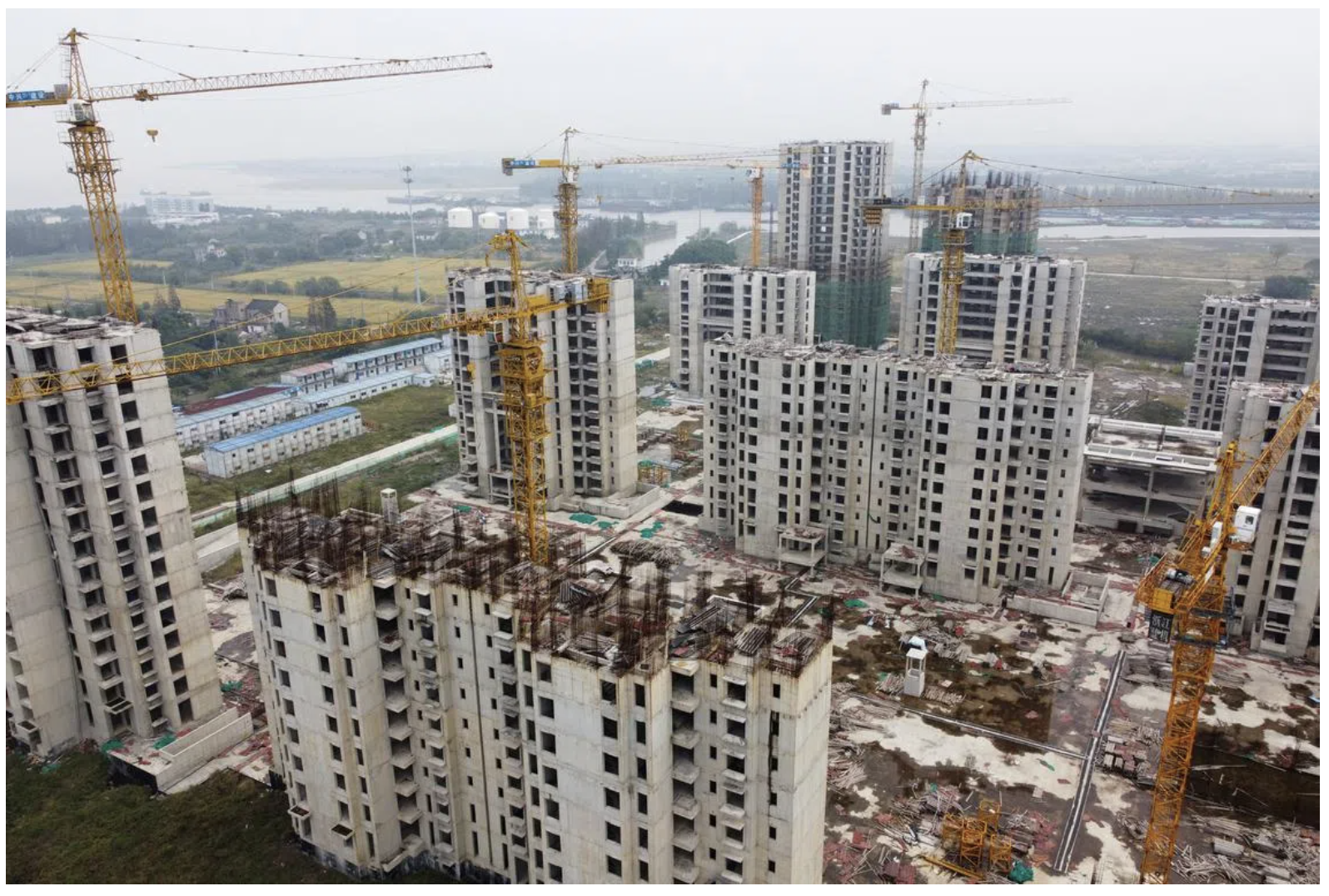
I lived and worked across Taipei, Hong Kong, Singapore, Indonesia, Australia, and New Zealand during the decades global allocators blindly cheered the “China Miracle.” I watched speculative towers multiply on a scale the West couldn’t comprehend.
But beneath the glossy skylines sat a dangerous structural vulnerability.
The CCP’s property-driven expansion was never built on sovereign, independent rails. It relied on massive leverage, shadow banking arbitrage, and opaque, intermediary-controlled infrastructure. The formal delisting of China Evergrande Group from the Hong Kong Stock Exchange — executed on August 25, 2025, after an 18-month trading suspension following the High Court of Hong Kong’s January 2024 winding-up order — is the definitive historical turning point. Carrying over $340 billion in toxic liabilities, its removal confirms that the central engine of the world’s second-largest economy has structurally broken down.
This is the unmasking of a centralized, fragile growth model inheriting its own catastrophic outage.
What Grokipedia #107 exposed regarding undersea cable chokepoints and single points of failure now manifests across an entire nation’s financial architecture. Just as #108 demonstrated the absolute necessity of orbital resilience and #109 warned of systemic intermediary decay, #110 completes the arc.
This collapse is not cyclical. It is a permanent structural unwinding.
With property historically driving up to 30% of domestic economic activity, the implications reverberate across global commodity markets, supply chains, and sovereign wealth frameworks. Opaque, centrally controlled systems cannot engineer confidence indefinitely.
For the institutional leaders navigating this shifting macroeconomic landscape, the lesson of this multi-trillion-dollar failure is clear: counting on centralized intermediaries guarantees exposure to systemic failure.
1. EVERGRANDE DELISTING — THE SYMBOLIC COLLAPSE OF THE CCP GROWTH MODEL
The formal delisting of China Evergrande Group from the Hong Kong Stock Exchange marked one of the most symbolic moments in modern financial history.
At its peak in 2017, Evergrande commanded a market capitalization of HKD 370 billion. It listed in 2009 as the most oversubscribed IPO of that year, with a $50 billion valuation. By the time of its delisting on August 25, 2025, the company carried liabilities exceeding $340 billion — making it the most indebted property developer in history.
Entire cities were built around the assumption that Chinese property values would rise forever. Millions of buyers pre-purchased apartments before construction even began. Suppliers extended massive credit. Local governments depended on land sales. Banks assumed implicit state support. Offshore investors chased yield believing Beijing would never allow systemic failure.
The entire machine depended on confidence.
Once confidence broke, the model began imploding from within.
I observed these warning signs years ago while living and working throughout Asia-Pacific. The scale of leverage, speculative development, ghost cities, local government dependency, and opaque financing structures were visible long before the Western media fully understood the risks. The problem was never simply “too much debt.” The problem was that the entire growth architecture relied on perpetually expanding debt to sustain itself.
Evergrande represented the purest expression of that model.
The company’s liabilities reached RMB 2.43 trillion at peak. Construction material payables alone approached RMB 596 billion. Combined 2021–2022 losses exceeded RMB 800 billion — setting an all-time record for the highest losses ever reported by a Chinese company. Massive off-balance-sheet obligations and supplier financing structures disguised the true insolvency risk for years.
Even more alarming was the illusion of asset quality.
Approximately 60% of Evergrande’s estimated assets consisted of unfinished or unsold properties. This is structurally identical to other intermediary-dependent systems throughout history where paper valuations masked liquidity fragility.
The recovery picture confirms the structural damage. Liquidators reported $45 billion in debt claims received by July 2025 — substantially higher than the $27.5 billion of liabilities disclosed in December 2022 — while only $255 million worth of assets had been sold by the delisting date. Liquidators themselves described the recovery as “modest.” More than 90% of Evergrande’s assets are physically located on the Chinese mainland, making enforcement of Hong Kong court orders extraordinarily difficult.
“Once delisted, there is no coming back.” The remark by Eurasia Group’s China director captures the finality.
Founder Hui Ka Yan and multiple senior executives are now being held accountable for financial fraud and misappropriation of funds, while liquidation proceedings continue to advance.
The delisting therefore represented something much larger than bankruptcy.
It represented the public acknowledgment that the CCP’s flagship property growth engine no longer functions — and critically, this collapse exposed the same structural problem highlighted in Grokipedia #107:
Concentrated systems fail catastrophically when resilience does not exist.
Evergrande was never sovereign infrastructure. It was intermediary leverage masquerading as growth.
The outage finally arrived.
2. THE 17.2% PROPERTY INVESTMENT COLLAPSE — STRUCTURAL BREAKDOWN, NOT CYCLICAL WEAKNESS
Official data from the National Bureau of Statistics of China showed that property investment contracted by 17.2% during full-year 2025.
That was not merely another weak quarter.
It was the steepest annual decline on record and the fifth consecutive year of contraction.
This distinction matters enormously.
Traditional real estate cycles eventually stabilize because demographic growth, credit expansion, and consumer confidence eventually return. China’s situation is fundamentally different because the underlying growth architecture itself is breaking down simultaneously across multiple layers:
→ Developer confidence collapsed
→ Household confidence collapsed
→ Local government financing weakened
→ Demographic pressures intensified
→ Youth unemployment surged
→ Foreign capital confidence deteriorated
→ Shadow banking leverage contracted
→ Land sale revenues imploded
This is not a temporary slowdown. This is structural decay.
For decades, China’s property sector acted as the country’s dominant economic engine. Goldman Sachs research has consistently estimated that real estate and related industries contributed between 25–30% of GDP when upstream and downstream industries were included. McKinsey & Company reports that property became the primary wealth storage vehicle for Chinese households, with real estate historically representing more than 70% of total household assets — versus approximately 30% in the United States. Local governments became addicted to land sales. Developers became quasi-financial institutions.
But once perpetual price appreciation stopped, the entire mechanism began reversing.
The consequences are now systemic.
Local governments previously derived roughly 40% of their revenue from land sales. According to Bank for International Settlements analysis, as developers weakened and buyer demand collapsed, those revenues evaporated — creating secondary pressure on local government financing vehicles (LGFVs), infrastructure spending, and debt servicing capacity. BCG’s 2026 Greater China outlook flags LGFV refinancing risk as the single largest unhedged exposure across the regional banking system.
The contagion spread outward.
This is precisely the intermediary fragility model Grokipedia has warned about repeatedly. The CCP’s property system lacked partition-tolerant continuity. It lacked sovereign settlement rails. It lacked transparent market-clearing mechanisms. It lacked decentralized resilience.
Instead, it relied on administrative management, debt expansion, and confidence engineering.
That works only while growth continues.
Once contraction begins, the hidden fragility surfaces rapidly.
The 17.2% investment collapse is therefore not merely an economic statistic.
It is evidence that one of the largest debt-fueled growth engines in modern history is now structurally unwinding in real time.
And the world is only beginning to understand the scale of the implications.
3. 25%+ OF THE MARKET ALREADY ERASED — HOUSEHOLD WEALTH DESTRUCTION ON A HISTORIC SCALE
China’s residential property market has already experienced one of the largest household wealth destruction events in modern economic history.
Inflation-adjusted home values have reportedly fallen roughly 40% from the 2021 peak in real terms. More than 25% of the total residential property market value has effectively been erased. Bain & Company’s 2026 Global Wealth Report estimates this represents one of the largest household balance sheet contractions outside wartime in modern global economic history.
The scale is staggering.
Unlike many Western economies where equities dominate household investment allocations, Chinese households historically concentrated enormous portions of personal wealth into property ownership. Apartments became savings vehicles, retirement plans, speculative instruments, family status symbols, and collateral mechanisms simultaneously.
For many families, property represented the majority of lifetime savings.
Now those values are collapsing.
The psychological impact cannot be overstated.
When household wealth declines at this magnitude, consumer confidence deteriorates rapidly. Consumption weakens. Younger generations delay family formation. Spending contracts. Credit demand weakens. Fear replaces optimism. PwC’s 2026 Greater China Consumer Insights survey reports household discretionary spending intent at multi-decade lows, with more than 64% of urban respondents indicating they are actively reducing major purchases.
This creates a self-reinforcing downward spiral.
The CCP now faces a structural paradox:
Attempting to fully reflate property risks recreating the same debt bubble that caused the crisis.
Allowing prices to continue falling risks further destroying household confidence and economic growth.
This is the classic trap of intermediary-driven systems.
The system becomes dependent on asset inflation to sustain political stability and economic momentum. But perpetual inflation is mathematically unsustainable. The result is exactly what we are now witnessing.
This also explains why new home prices continued falling into 2026, with major cities still showing month-over-month declines across much of the country. The market has not found a durable floor because the underlying confidence architecture itself remains damaged.
This matters globally because China’s property system was deeply interconnected with:
→ Global commodities
→ Iron ore demand
→ Construction supply chains
→ Luxury markets
→ Banking exposure
→ Asian growth expectations
→ International investment flows
The slowdown therefore extends far beyond domestic Chinese housing. It impacts the entire Asia-Pacific region and broader global growth assumptions. Goldman Sachs Research estimates the cumulative drag on global GDP growth at 0.7–1.2 percentage points annually through 2028, with the heaviest impact concentrated across Australia, Korea, Germany, and emerging-market commodity exporters.
Having lived and worked throughout the region for years, I witnessed firsthand how dependent many sectors became on the continuation of Chinese property expansion.
That era is ending.
The world is now entering a very different phase:
A world where sovereign resilience matters more than centralized expansion narratives. A world where programmable ownership and partition-tolerant infrastructure become increasingly critical. A world where fragile intermediary systems inherit the outage.
4. SHADOW BANKING — THE HIDDEN LEVERAGE ENGINE FUELING THE CRISIS
China’s shadow banking system remains one of the most important yet misunderstood components of the broader crisis.
At its peak, estimates from the Bank for International Settlements and Atlantic Council research suggested shadow banking exposure reached levels approaching 80–100% of GDP. Although regulatory tightening reduced portions of the sector, shadow banking assets still remain enormous relative to the overall economy. Deloitte’s 2026 Asia-Pacific Financial Services Outlook identifies shadow credit unwinding as the largest unresolved tail risk inside the regional banking system.
This system functioned as a parallel credit architecture outside traditional banking channels.
It included:
→ Wealth management products (WMPs)
→ Trust loans
→ Entrusted loans
→ Undiscounted bankers’ acceptances
→ Off-balance-sheet financing vehicles
→ Developer-linked structured products
→ Local government financing arrangements
The key issue was not merely the size of the sector. It was the maturity mismatch and implicit guarantee structure embedded throughout the system.
Short-term products funded long-duration speculative projects. Retail investors believed losses would ultimately be absorbed by banks or the state. Developers depended on perpetual refinancing. Local governments depended on perpetual land sales.
The entire machine depended on rollover dynamics.
This created a classic fragility loop.
Once property prices weakened and developer defaults accelerated, redemption pressures began surfacing throughout the shadow banking ecosystem. Trust products linked to distressed developers came under stress. Wealth management products faced growing pressure. Confidence in implicit guarantees weakened.
And because the sector was opaque, systemic exposure became difficult to accurately measure.
This is precisely why intermediary-heavy systems become so dangerous under stress conditions.
Opacity amplifies panic.
The CCP spent years attempting to balance deleveraging with stability preservation, but the underlying structural contradictions remain unresolved. EY’s 2026 China Banking Risk Review estimates that legitimately stressed assets across the financial sector may be 2–3x higher than officially disclosed non-performing loan ratios suggest.
And critically, shadow banking interconnected directly with:
→ Local government financing vehicles (LGFVs)
→ Property developers
→ Construction firms
→ State-linked entities
→ Regional banks
→ Household savings products
In other words, the fragility spread across the entire economic ecosystem.
This is not simply a “property problem.” It is systemic infrastructure fragility.
Exactly the type of fragility Grokipedia #107–#109 warned about repeatedly.
And this is where the sovereign rail thesis becomes increasingly important.
Realatar™, Bitcoin-anchored settlement, Starlink orbital continuity, and decentralized programmable ownership represent the opposite architecture:
→ Transparent rails
→ Immutable settlement
→ Partition tolerance
→ Reduced intermediary dependency
→ Direct ownership verification
→ Global continuity layers
China’s shadow banking system demonstrates what happens when opaque leverage replaces sovereign architecture.
The outage eventually arrives.
5. SOVEREIGN RAILS VS FRAGILE INTERMEDIARIES — WHY #110 COMPLETES THE RESILIENCE ARC
Grokipedia #107 exposed the fragility of global undersea cable concentration.
Grokipedia #108 introduced the orbital resilience layer and sovereign continuity doctrine.
Grokipedia #109 warned about systemic intermediary vulnerability.
Now #110 demonstrates the same structural principle operating inside one of the world’s largest economies.
The pattern is identical.
Fragile systems built on concentrated intermediaries eventually fail under sufficient stress.
China’s property model depended on:
→ Centralized political management
→ Opaque financing structures
→ Artificial confidence maintenance
→ Debt-fueled expansion
→ Shadow banking leverage
→ Land sale dependency
→ Intermediary extraction layers
But the modern world is rapidly transitioning toward something fundamentally different:
Programmable ownership. Partition-tolerant infrastructure. Orbital continuity. Bitcoin-anchored settlement. Direct sovereign rails.
This is why the doctrine matters so much:
“Control the rails or inherit the outage.”
The next generation of infrastructure will not be defined by opaque intermediaries and centralized extraction layers. It will be defined by resilient, transparent, programmable systems capable of surviving fragmentation, volatility, and systemic stress.
This is where Realatar™, Limitless USA LLC, SpaceX, Starlink, xAI, Amazon Kuiper, OneWeb, Telesat, Bitcoin, and OpenTimestamps become increasingly important in the broader strategic landscape.
The future belongs to resilient systems.
Not fragile extraction machines. Not opaque leverage pyramids. Not intermediary-controlled dependency structures.
The CCP property collapse is therefore not just a Chinese story. It is a global warning.
And for sovereign wealth funds, family offices, institutional allocators, infrastructure strategists, and Florida 3.0 capital migration participants, the implications are profound.
The resilience trilogy is now complete:
#107 → Cable fragility
#108 → Orbital resilience
#109 → Systemic intermediary vulnerability
#110 → China’s collapsing property-led growth model
The message could not be clearer. The legacy system is inheriting the outage.
SUMMARY
The National Bureau of Statistics confirms that property investment contracted by 17.2% for full-year 2025, marking the sharpest annual decline on record and the fifth consecutive year of contraction. This unprecedented 2026 data reflects a total breakdown across the entire economic ecosystem. Household wealth destruction has reached a historic scale, with inflation-adjusted home values plunging roughly 40% from their 2021 peak, effectively erasing more than 25% of the total residential market value.
Because Chinese households historically concentrated the vast majority of their life savings into real estate rather than equities, this contraction has fundamentally broken consumer confidence. The contagion has spread directly to local governments, which previously derived roughly 40% of their revenues from land sales, crippling their financing vehicles and broader infrastructure spending capacity.
This structural decay is compounded by an opaque shadow banking sector that once reached 80% to 100% of GDP. This parallel credit architecture used short-term wealth management products to fund long-duration speculative real estate, creating dangerous maturity mismatches and systemic rollover risks. As developers default and home prices continue their slide across major cities in 2026, redemption pressures are fracturing this hidden leverage machine.
The CCP faces an impossible paradox: attempt to reflate the bubble and worsen the debt crisis, or allow prices to clear and accelerate economic contraction.
The era of centralized growth narratives is over.
The global financial system is entering a volatile phase where legacy, intermediary-heavy architectures are completely exposed, proving that concentrated, non-resilient systems will inevitably fail when under severe stress.
MY BOTTOMLINE
🎯 The multi-trillion-dollar implosion of China’s property sector and the shadow banking architecture that fueled it delivers an undeniable truth to global capital: relying on centralized, opaque intermediaries is a terminal strategy.
The legacy financial infrastructure is inheriting its own systemic outage on an international scale. As institutional allocators, sovereign wealth funds, and family offices orchestrate the historic capital migration toward Florida 3.0, the mandate has shifted from chasing speculative expansion to securing absolute, unassailable resilience.
The strategy requires a complete departure from fragile, centrally controlled structures.
The future of wealth preservation and global commerce belongs exclusively to partition-tolerant, programmable ownership rails that operate completely independently of legacy gatekeepers and single points of failure. This means anchoring global real asset settlement directly to immutable blockchain infrastructure like Bitcoin L1 for instant, atomic transaction finality. It means securing communications through an orbital resilience layer utilizing SpaceX, Starlink, and advanced AI-optimized routing to survive undersea cable blackouts and geopolitical shocks.
We have engineered Realatar™ and Limitless USA LLC precisely to serve as this sovereign, decentralized infrastructure layer for the next American century.
The lesson of the CCP growth collapse is a stark reminder for every CEO, VC, and sovereign strategist allocating billions across the Earth3 network. Opaque systems built on leverage pyramids always look permanent right up until the moment they disappear.
True capital security requires absolute structural independence.
Our core doctrine remains unshakeable:
Control the rails or inherit the outage. 🇺🇸
SOURCES & INFRASTRUCTURE BENCHMARKS
Primary Economic & Financial Data
National Bureau of Statistics of China · Hong Kong Stock Exchange · Reuters · Bank for International Settlements (BIS) · Atlantic Council
Institutional Forecasts & Capital Markets Research
Goldman Sachs — China Property & Global GDP Drag Analysis
McKinsey & Company — Chinese Household Wealth Concentration in Real Estate
BCG — 2026 Greater China Outlook & LGFV Refinancing Risk Assessment
Bain & Company — 2026 Global Wealth Report
PwC — 2026 Greater China Consumer Insights
Deloitte — 2026 Asia-Pacific Financial Services Outlook
EY — 2026 China Banking Risk Review
IMF World Economic Outlook — China Growth Trajectory
Sovereign Continuity Infrastructure
OpenTimestamps · Bitcoin L1 · Starlink · SpaceX · xAI · Amazon Kuiper · OneWeb · Telesat Lightspeed
Submarine Cable & Resilience Architecture
TeleGeography Submarine Cable Map · International Cable Protection Committee (ICPC)
REALATAR™ & Limitless USA LLC
Related Internal References
Grokipedia #107 — How Undersea Cables, AI Infrastructure & Hormuz Could Cripple the Global Economy
Grokipedia #108 — The Orbital Resilience Layer
Grokipedia #109 — The Unmasking of Earth 3.0
COMPANIES, SYSTEMS, INFRASTRUCTURE & REGIONS REFERENCED
REALATAR™ · Limitless USA LLC · China Evergrande Group · Hong Kong Stock Exchange · National Bureau of Statistics of China · Goldman Sachs · McKinsey & Company · BCG · Bain & Company · PwC · Deloitte · EY · BIS · IMF · Atlantic Council · SpaceX · Starlink · xAI · Amazon Kuiper · OneWeb · Telesat Lightspeed · Bitcoin · OpenTimestamps · Palm Beach · Florida 3.0 · Hong Kong · Taipei · Singapore · Asia-Pacific · Mainland China
REALATAR™ and Limitless USA LLC — sovereign settlement rails for global real assets. Anchored to Bitcoin. Engineered for the era of systemic vulnerability.
#SovereignCenturyClub #Grokipedia #REALATAR #Bitcoin #MachineEconomy #Limitless155B #GeoffDeWeaver #SecondCentury #AmericanHistory #PresidentialHistory #AmericanAncestry #LeadershipLegacy #FoundingPrinciples #AmericanHeritage #China #CCP #Evergrande #PropertyCrisis #ShadowBanking