
THE SOVEREIGN LEDGER™ · ENTRY #194 · OCTOBER 25, 2026
America’s Golden Age of Real Estate
How Trump’s Tariffs, AI, Crypto, Data Centers and Energy Can Power the Next U.S. Property Boom
Geoff De Weaver
Researcher · Architect · Limitless USA LLC
Architect of The Ownership Thesis™ & REALATAR™ | Building Horizontal Liquidity Rails for the $625T Global Real Estate Market | AI • Web3 • T-0 Atomic Settlement
Sunday, October 25, 2026 · Eastern Time · Palm Beach · Miami · Sarasota · Naples · Tampa · Manhattan
Research and strategic interpretation. An ownership and infrastructure blueprint for family offices, developers, CEOs, institutional allocators, and global property leaders.
For the generations who built before us, and the generations who will inherit what we build next.
Entry #194 · 194 research entries · 2.91M+ verified words · Open the full ledger
Introduction
Across my forty-year execution arc originating in 1985, I have maintained that real estate is not merely a collection of isolated buildings, but the primary physical ledger of human civilization. Today, as we stand at the threshold of America’s Golden Age of Real Estate within the expansive $625 trillion global property market, the convergence of industrial reshoring, artificial intelligence, energy abundance, and programmable financial rails is redrawing the map of human productivity. In Report #194 of The Sovereign Ledger™, I dismantle the superficial noise surrounding national headlines to establish an evidence-driven, institutional-grade blueprint for family offices, developers, and global allocators. President Donald J. Trump’s renewed emphasis on domestic manufacturing, highlighted by commitments like Audi’s $4 billion production facility in Middle Georgia and multitrillion-dollar industrial frameworks, signals a structural shift from offshore fragility to domestic sovereignty.
Yet true strategic foresight requires rigorous discernment. We must distinguish between raw political announcements and funded, permitted, shovel-ready execution. Audi’s 2027 construction timeline, Toyota’s San Antonio expansion, and the massive capital expenditures of hyperscalers like Meta, Apple, and OpenAI demonstrate that physical space is a decisive bottleneck for digital and industrial ambition. At the same time, the integration of energy infrastructure, grid-positive data center design, and the OCC’s implementation of the GENIUS Act for stablecoins create an unprecedented window for transformation. [2][38]
As the Sovereign Architect of REALATAR™, my mission is to give the family offices, developers, CEOs, and allocators who read The Sovereign Ledger™ a clear, verifiable architecture for this cycle. The horizontal liquidity rails and T-0 settlement protocols I describe are an architecture I am designing and testing, not finished products, and I say so wherever it matters. The dates, however, are real: the OCC’s final GENIUS Act rule takes effect on January 18, 2027, and Audi’s schedule puts construction in 2027. The owners, developers, and allocators who verify first, price first, and position first will be ready when announcements become energized, occupied, income-producing assets. That readiness is the benefit I wrote this report to give you.
What this report gives you
- Clarity before capital. I keep tariff receipts, corporate investment, export orders and guarantees in separate accounts, so you never mistake a headline for revenue or a framework for a deposit.
- Faster, safer decisions. A ninety-day program turns an announcement into a clear go, revise, option or stop decision, with evidence at every step.
- Better entry prices. Practical underwriting questions for powered land, industrial space and workforce housing protect you from paying for a story.
- Fewer surprises on power. You learn to tell proximity to a transmission line from a right to receive power, before you close.
- Housing demand you can defend. A transparent workforce-housing calculation replaces vague multipliers with assumptions a lender can inspect.
- Lender-ready thinking. Capital-stack questions show who bears a delay, who funds a change and who owns obsolescence.
- A map of where to look. Research corridors from Middle Georgia to San Antonio, each with the evidence it deserves.
- A scorecard you can reuse. Eight dimensions with signals that strengthen or weaken the thesis tell you when to add, hold or walk away.
- A clear view of digital settlement. What the OCC’s final GENIUS Act rule does and does not change in a closing, and where FIRPTA and Florida Chapter 692 still apply.
Picture the next ninety days. You know which sponsors are funded, which sites have a documented route to power, which housing assumptions hold up, and which opportunities to pass on. That is the outcome I built this report to deliver, and every section that follows is designed to move you toward it.
The investment thesis
I believe America has an extraordinary opportunity to expand the productive foundations of its real estate economy. The opportunity reaches far beyond the next movement in mortgage rates or the next quarterly change in home prices. It concerns where the world builds factories, powers intelligence, finances infrastructure, establishes businesses, houses skilled workers, and protects ownership.
President Donald J. Trump’s renewed emphasis on domestic production has made those questions central to the national economic conversation. His October 24 rally in Perry, Georgia, carried by RSBN, brought another major manufacturing announcement into that conversation. Audi’s proposed American production site connects a global premium brand with a physical American location. For property owners and investors, that connection is where the analysis begins. [1][2]
A factory occupies land. Its suppliers occupy more land. Its construction crews need accommodation. Its permanent employees need homes. Businesses serving those households need premises. Utilities need corridors, substations, generation, and maintenance facilities. Every credible industrial investment creates a set of questions about property, financing, and the communities that will support it.
AI creates a related demand. Computing requires buildings, electrical equipment, fiber, cooling, and reliable power. Energy production requires infrastructure and rights of access. Regulated digital payments could improve how capital moves through transactions. These developments increasingly meet in the same physical economy.
That is why I am optimistic about American real estate. I see a country with the capacity to turn technological ambition into productive assets that generate income, support employment, and strengthen communities. I also see a responsibility to distinguish an announcement from a completed project, a forecast from a record, and a valuable asset from an expensive story.
My Golden Age thesis is an argument for building. Its success will be visible in operating factories, energized data centers, affordable homes, reliable electricity, productive businesses, and ownership systems people can trust. Higher advertised property prices alone would be an incomplete victory. A stronger real estate industry should help more Americans participate in prosperity while rewarding capital that creates useful capacity.
The strategic opportunity is large enough to deserve enthusiasm and serious enough to require discipline. I want both. I want America to attract investment and to convert that investment into facilities that work. I want developers to earn returns by solving actual shortages. I want families to see better employment prospects and a realistic route to owning a home. I want innovation to improve the economics of ownership.
This report explains how tariffs can contribute to that process, where the strongest investment signals appear, how the automotive and AI buildouts affect property, and why power, payments, and verified ownership matter together. The company examples are evidence of specific announcements or activities. The real estate implications that follow are my interpretation, not forecasts or endorsements issued by those companies.
The question I ask is straightforward: when America attracts the next generation of productive capital, who will own and operate the land, buildings, energy connections, financing structures, and transaction infrastructure that make it useful?
What a Golden Age should mean for property owners
For me, American Exceptionalism means the willingness to attempt difficult things and the institutions that allow people to accomplish them. It means entrepreneurship supported by enforceable contracts, capital formation, scientific capability, skilled work, and the freedom to build a business. It also means accepting accountability when a project fails to meet its commitments.
Those principles matter directly to property. A commercial building becomes valuable because someone can use it productively and pay for that use. A home becomes economically sustainable when the household can afford its total cost. An industrial site becomes strategic when its location, permissions, utilities, and access serve a real operator. Capital has to find a productive purpose before an enduring return can follow.
A Golden Age for real estate would therefore involve several improvements at once. Businesses would expand their productive footprint. Communities would build enough suitable housing for workers and families. Infrastructure would support growth without unreliable service or uncontrolled cost transfers. Transaction systems would make ownership easier to verify and capital easier to deploy responsibly.
Some assets could appreciate substantially in such an environment. Others could underperform because their location, physical design, financing, or operating costs do not match changing demand. That variation is consistent with a national expansion. A growing economy still rewards selection, execution, and price discipline.
I am particularly interested in the link between productive employment and housing. A region with a credible pipeline of permanent jobs can support a broader household economy than a region relying exclusively on temporary construction spending. Restaurants, schools, healthcare providers, trades, and professional services respond to a population that stays and earns. The real estate opportunity becomes more durable when the employment base diversifies.
I am equally interested in ownership. The person who owns a useful facility, a well-located rental building, or a sound infrastructure interest needs clear authority over the asset. That includes understanding debt, leases, restrictions, maintenance obligations, insurance, and rights to transfer. Sophisticated technology should make those relationships easier to manage.
This is part of the wider research program in The Sovereign Ledger™. In The Ownership Thesis and the 2027 REALATAR™ Roadmap, I frame ownership infrastructure as a system that must connect asset information, verified authority, capital, and accountable execution. The current investment cycle makes that architecture more relevant. [L1]
The optimistic case becomes stronger when we define success in terms that can be inspected. A job announced is useful information. A job filled is stronger evidence. A facility connected to power is a different milestone from land placed under option. An occupied home is different from a proposed subdivision. Investors should welcome each advance while recognizing its place in the process.
The tariff numbers America should understand
The first financial distinction is essential. President Trump’s approximately $22.2 trillion investment figure is a claimed total of commitments and announced economic activity. It is not $22.2 trillion collected by the Treasury in tariffs. Broad investment tallies can include domestic corporate plans, foreign frameworks, purchases, financing support, and expenditures spread over many years. Their components require separate examination. [8]
Federal tariff revenue is measured through customs receipts. Treasury’s final fiscal 2026 statement reports approximately $317.8 billion in gross customs duties and $144.6 billion in refunds, producing approximately $173.2 billion in net receipts. Fiscal 2025 net customs duties were approximately $194.9 billion, compared with $77.0 billion in fiscal 2024. That represents a sharp increase in 2025 and a decline in net collections in 2026. [3][4]
The refund line matters. A project developer would not assess cash flow by counting receipts while ignoring repayments. The same discipline belongs in public finance. The legal reversal of IEEPA tariffs and the associated refunds materially affected the 2026 result. An accurate investment thesis should be able to absorb that fact without losing its direction. [3][44]
Customs duties are paid by the importer responsible for the shipment. They are not automatically checks written by foreign governments. Their economic burden can be distributed through prices, supplier concessions, margins, changes in sourcing, and changes in demand. The balance differs across products and market conditions. The legal payer and the ultimate economic burden are related but separate questions. [7]
Investment commitments create another type of flow. A foreign manufacturer building a U.S. plant may purchase land, hire contractors, import equipment, borrow locally, and contribute equity. Some spending remains inside America; some purchases may go to overseas suppliers. A national investment headline does not reveal that allocation by itself.
For real estate, the productive question is how much of an investment becomes domestic facilities and supporting demand. Site acquisition, civil works, buildings, local suppliers, and permanent operations can create property-related activity. Purchasing imported machinery also supports the project, but its invoice should not be confused with the value of American land or local household spending.
I support a confident economic argument that keeps these accounts distinct. Tariff receipts belong in the public revenue account. Corporate investment belongs in the capital formation account. Export orders belong in the trade account. Guarantees belong in the financing support account. Future project income belongs in an operating forecast until it is earned.
This separation improves credibility with the family offices, developers, CEOs, lenders, and institutional allocators I want reading this report. Their teams will examine the underlying numbers. A strong American investment thesis should welcome that examination.
Five fifty-year periods of American tariff history
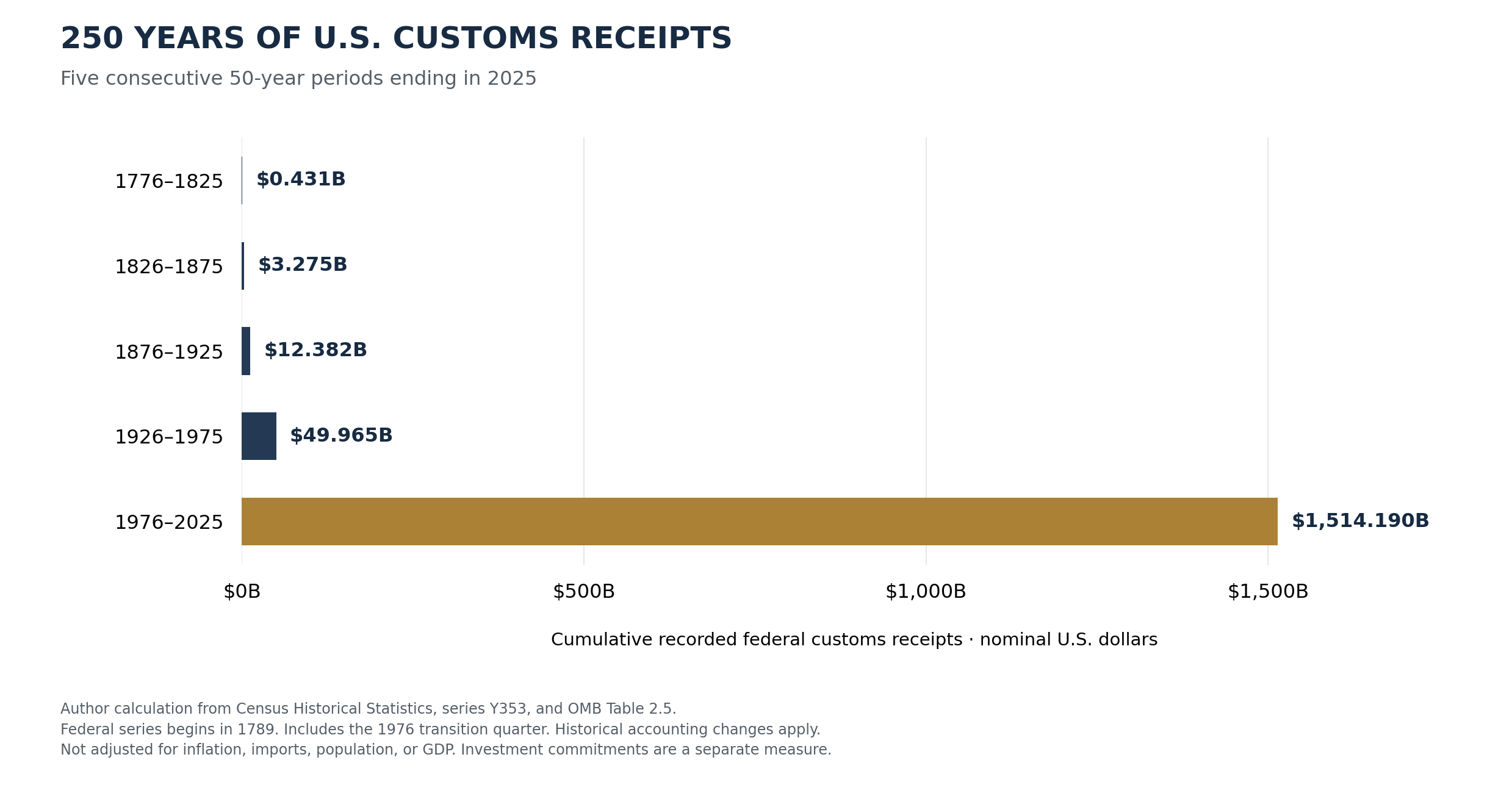
I calculated the following comparison from the Census Bureau’s historical customs series through 1939 and OMB’s historical receipts table from 1940 onward. The periods run from 1776 through 2025. The first includes federal collections beginning in 1789; state and colonial tariffs before that date are outside the federal series. The final period includes the 1976 transition quarter. [4][5]
250 Years of U.S. Customs Receipts: Five 50-Year Periods of American Tariff History, 1776–2025
Trump’s Two Terms: $561.516 Billion in Net Customs Receipts, More Than Eleven Times the Entire 1926–1975 Half-Century
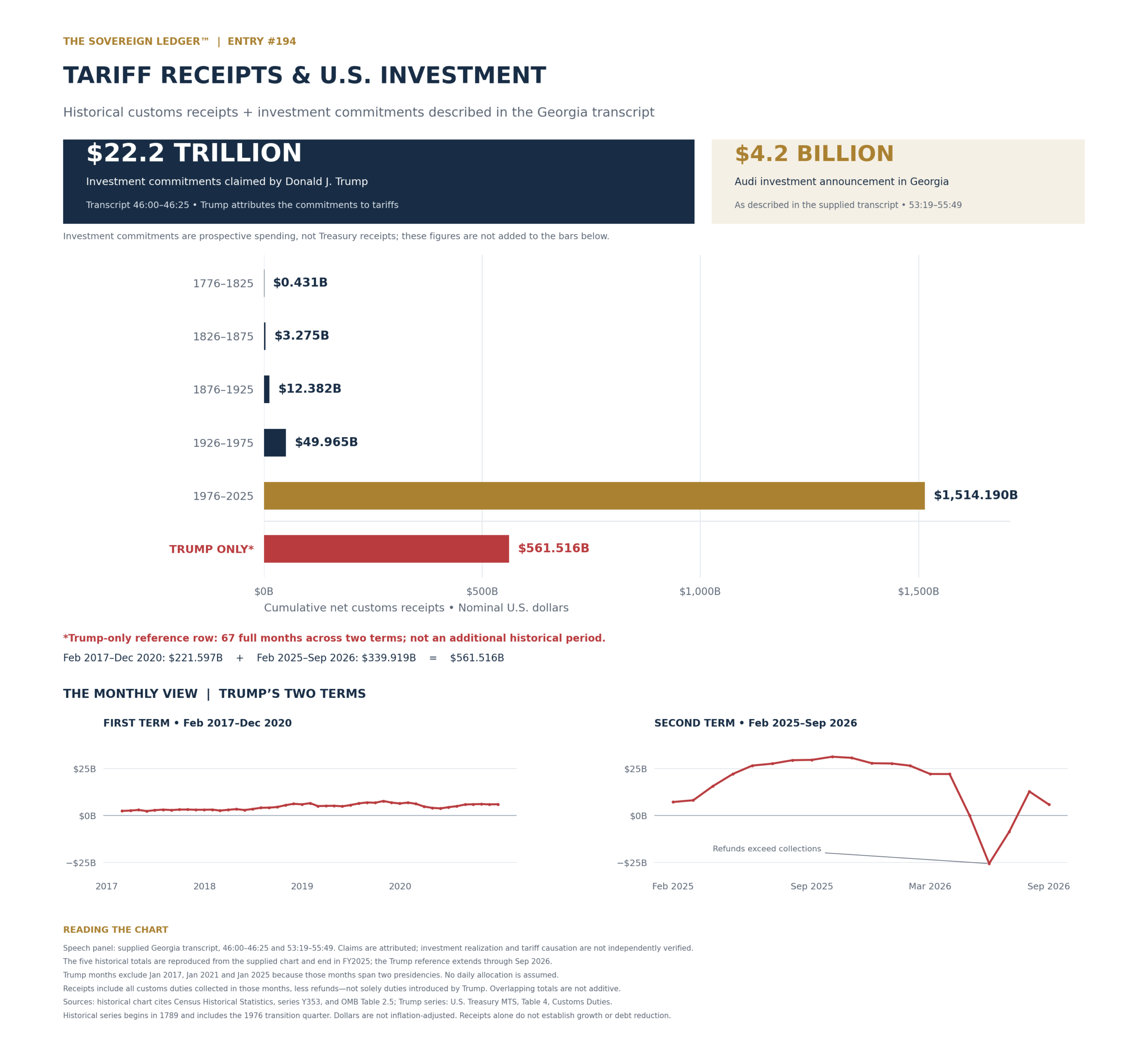
Read the two charts together. Figure 1 gives you the long record: recorded customs receipts since 1976 dwarf every earlier fifty-year period in nominal dollars. Figure 2 puts President Trump’s two terms beside that record: $561.516 billion in 67 months, more than eleven times the whole of 1926–1975, and more than any other president’s recorded total. The benefit to you is a clear, inspectable measure of scale that you can cite in a meeting, with the source for every figure.
| Period | Cumulative recorded federal customs receipts |
|---|---|
| 1776–1825 | Approximately $431 million |
| 1826–1875 | Approximately $3.275 billion |
| 1876–1925 | Approximately $12.382 billion |
| 1926–1975 | Approximately $49.965 billion |
| 1976–2025 | Approximately $1.514 trillion |
The chart uses nominal dollars. It is not adjusted for inflation, population, imports, or the size of the economy. Historical accounting practices also change; the later OMB category includes customs duties and fees. The chart is useful for showing the scale of recorded collections across successive periods. It cannot establish which president delivered the greatest economic benefit from tariffs.
The smallest bars are visually compressed because the modern total is so much larger. The accompanying table preserves the earlier values. A logarithmic chart would make those early periods more visible but would change how readers perceive the distance between them. I have retained an ordinary zero-based bar chart because the absolute dollar comparison is the requested historical measure.
The early republic depended heavily on customs revenue. The U.S. International Trade Commission describes customs duties as providing nearly all federal revenue through much of the period from 1789 to 1862. Later, internal taxes and the modern income tax changed the federal revenue structure. Today’s tariff debate therefore occurs within a very different fiscal system. [6]
George Washington’s administration faced the task of financing a new federal government and establishing its authority. Modern administrations operate inside an enormous economy with developed income, payroll, and corporate tax systems. Historical comparisons should recognize that difference. A much larger nominal receipt in the present does not imply that tariffs carry the same fiscal importance they did in the founding era.
What history does establish is that trade policy and national development have long been connected. Americans have repeatedly debated how to finance public institutions, protect strategic capability, encourage industry, and maintain affordable access to goods. Those debates concern the distribution of benefits and costs as much as the total money collected.
My interest is in the productive outcome. If trade policy helps establish a competitive industry that can serve customers, support workers, and sustain its facilities, it can contribute to a stronger property economy. If a measure raises construction inputs without producing offsetting benefits, a real estate investor has to recognize that cost. Both channels can operate at the same time.
The historical chart should therefore prompt investigation rather than end it. I want to know which industries are expanding, which commitments are funded, where infrastructure is available, and whether households can afford the communities being created. Those are the questions that translate a national policy discussion into an investment decision.
What the Perry rally said about tariffs, and what the record shows
The October 24 rally in Perry, Georgia, put tariffs at the center of the case for American manufacturing. I reviewed the auto-generated transcript of the RSBN livestream. Captions of live speech contain errors, so I paraphrase, rely only on passages whose wording is clear, and leave out figures the captions render inconsistently. [1]
I support a confident case for American production, and I want that case to withstand a lender’s review. The table sets each tariff-related statement beside the public record. The first column reports what the speaker said. The second reports what the cited sources show. The third is my own use of both.
| What was said | What the record shows | How I use it |
|---|---|---|
| About $22.2 trillion of new investment commitments secured in under two years, credited to his tariffs [1] | PolitiFact rated a similar claim of $18 to $22 trillion false on December 9, 2025. The White House’s own list then totaled about $9.6 trillion, including multi-year and aspirational items, and Bloomberg Economics counted about $7 trillion as real investment pledges [53] | I treat $22.2 trillion as a claimed total of commitments, not capital deployed, and I underwrite only projects I can name. |
| Without tariffs, the major companies now investing would not have come [1] | Audi’s reasons, as reported locally, were speed to market, workforce, market access, and supplier proximity [52]. PolitiFact noted that some of the announced investment would have happened regardless of who was president [53] | Tariffs may be one input. The record does not rank the causes, and I make no causal claim either way. |
| The country is taking in massive amounts of money through tariffs [1] | Treasury recorded about $317.8 billion in gross customs duties, $144.6 billion in refunds, and $173.2 billion in net receipts for fiscal 2026 [3]. Penn Wharton estimates about $166 billion of duties collected under the invalidated IEEPA tariffs are subject to refund, with about $126 billion certified through October 2, 2026 [54] | Gross collections were large. Refunds leave the Treasury with the net figure, so I report net. |
| A $5,000 payment to adult citizens, which he put at about $1 trillion, if Republicans win Congress [1] | He presented it as a promise tied to the election. A $1 trillion payment is about 5.8 times fiscal 2026 net customs receipts of $173.2 billion [3] | I treat it as a campaign proposal, not as a use of existing tariff revenue. |
| Audi: $4.2 billion, 200,000 cars a year, the largest investment in modern U.S. auto history [1] | Audi’s release gives around $4 billion, about 4,500 jobs, and up to 200,000 vehicles a year [2]. Hyundai Motor Group’s $26 billion U.S. program and Stellantis’ $13 billion program are larger in total, though spread over several years and sites [19][22] | I use Audi’s own figures. A largest-ever claim depends on whether one site is compared with a multi-site program. |
I did not find an independent reconciliation of the $22.2 trillion figure as stated at the rally. The most recent reconciliation I verified, PolitiFact’s of December 9, 2025, also records how the claimed total moved: from nearly $3 trillion in January 2025 to about $10 trillion in May, $21 to $22 trillion in late October, and about $18 trillion in early December [53]. A figure that moves that much needs its components listed before anyone allocates capital against it.
Where tariff law stands today
The legal basis for the tariffs changed in 2026. The Supreme Court ruled the IEEPA tariffs unlawful on February 20, 2026, and they were repealed in late February. A 10 percent global surcharge under Section 122 followed and expired on July 24, 2026. Section 301 tariffs of 10 percent or 12.5 percent on imports from 60 economies, with product exemptions, have been in force since that date. Section 232 tariffs remain; Penn Wharton’s August 2026 estimates put their effective rate at 39.8 percent on steel and aluminum and 13.8 percent on automotive vehicles. The average effective tariff rate was 7.1 percent in August 2026, against 10.1 percent before accounting for changes in import behavior. [54]
That is the policy environment into which Audi, Toyota, and the other manufacturers are committing capital. The automotive tariffs Penn Wharton measures rest on Section 232, a different authority from the one the Court invalidated. I do not predict which tariff authority will last. The record shows how quickly the legal basis can change, so a project’s economics should survive a change in the rate.
Why Trump’s industrial strategy matters to real estate
Trump has placed a clear political premium on producing in America. Tariffs are one instrument in that strategy, alongside negotiations, regulatory changes, tax policy, procurement, and energy policy. Companies deciding where to build respond to the combined economics, including demand, labor, supply chains, logistics, and confidence in the rules.
The strongest affirmative case is that tariffs can change the relative attraction of serving the American market from outside its borders. A company that expects a durable cost on imports may find local production more competitive. That change can justify investment in U.S. manufacturing capacity, especially when local demand is large enough to support the operation.
A property investor should translate that incentive into an operating question. Is there a funded decision to establish capacity? Does the site have the necessary permissions and utilities? Can the company recruit workers at wages consistent with the business plan? Are suppliers committing alongside it? The investment signal becomes more valuable as these questions receive evidence-based answers.
Trump’s Japan agreement offers a concrete example of trade negotiations linked to investment commitments. The subsequent GlobalFoundries announcement identifies Japanese funding for proposed U.S. semiconductor facilities under that agreement. It connects a national framework to an identified project and operator. The project still has to be executed, but the connection is more specific than a general promise to invest. [9][10]
The real estate consequences of successful local production can extend beyond factory boundaries. Suppliers may need nearby distribution or assembly space. Transportation providers may expand routes and terminals. A region may require additional housing for its workforce. Professional services can grow around a larger business base. These are possible transmission channels, not automatic multipliers assigned to every announcement.
The policy challenge is to capture those benefits while preserving competitive costs. Manufacturers and builders both purchase inputs that can be affected by tariffs. If imported equipment or materials become more expensive, the capital required for an American project can rise. A serious industrial strategy should account for the entire production chain and the time required to develop domestic alternatives.
I believe the opportunity for America is strongest when the policy objective is a productive and competitive domestic economy. A factory that survives through operational excellence can support property demand for decades. A facility sustained only by a temporary distortion can leave owners exposed when the policy changes. Durability deserves more attention than the announcement’s first-day impact.
That is why my support for American industrial ambition comes with a demand for execution. The country should celebrate major commitments. It should also measure what becomes operational, how much domestic value is created, and whether the resulting capacity strengthens living standards. That standard honors the ambition rather than weakening it.
For property owners, the practical conclusion is to monitor the emerging industrial map. Capital allocation can alter the prospects of particular corridors, towns, and metropolitan areas. The people who understand those changes early, and verify them carefully, can position assets to serve the businesses and households that follow.
Audi and the property economics of a new manufacturing center
Audi’s October 25 company release provides the controlling project details for this report. The company intends to invest around $4 billion in its first U.S. production site, create approximately 4,500 jobs, and design capacity for up to 200,000 vehicles annually. It places construction in 2027 and production in the early 2030s. The release identifies the Middle Georgia Mega Site and a strategy centered on premium vehicles for North America. [2]
At the rally, the announcement used $4.2 billion, while Audi’s release gives around $4 billion; both belong in the announcement record. Schedule reporting also differs in detail: the Associated Press reported construction beginning in 2027 and production in the early 2030s, and Atlanta News First reported site grading in 2027, construction in 2028, and full production in 2031 [51][52]. For underwriting project timing, I use Audi’s own published schedule and confirm each phase with the company and the site authority. A difference of a year matters to borrowing costs, land carry, housing absorption, and when permanent employees may arrive. The company’s release is still a statement of intent rather than evidence of an operating factory.
I see this as an important example of how an international business decision can become an American real estate opportunity. The right response is to map what the operator will actually need. Industrial land must be suitable for the intended processes. Access roads must support the expected traffic. Utilities must provide the required service. Workers must be able to reach the site reliably.
Housing analysis should begin with the planned workforce rather than an invented household multiplier. Some employees may already live in the region. Some roles may be filled by people relocating. Some construction workers may leave when the project finishes. Household size, income, tenure preferences, and commuting patterns will determine the type of demand that appears.
An investor who treats every announced job as a new homebuyer will overstate the opportunity. An investor who ignores the employment signal entirely could miss it. I would examine recruitment information, supplier decisions, school capacity, local vacancy, existing subdivisions, and the supply of rental housing before deciding which assets can serve the project.
The distinction between construction demand and operating demand is especially important. Temporary accommodation may see an early increase during site development. Permanent housing demand may build more slowly and persist longer. A hotel, an apartment community, and a subdivision therefore face different timing and occupancy questions even when they are located near the same factory.
Small industrial buildings can also matter. Suppliers and service businesses may need space that differs from the anchor plant’s highly specialized facilities. Repair operations, storage, testing, training, and logistics can occupy a wider variety of buildings. Owners should verify tenant requirements before assuming that an ordinary warehouse can support a technical industrial process.
The strongest local strategy would coordinate these needs before shortages become severe. Public agencies can examine roads, utilities, and workforce development. Private developers can plan housing and commercial space in phases. Lenders can align draw schedules with verified milestones. Residents can understand what the project will contribute and what costs the community may face.
For me, this is the property meaning of American industrial confidence. A global company choosing a U.S. production location can create a platform for long-term community investment. The opportunity becomes more valuable when the surrounding development supports the operator and gives local families a fair chance to participate.
The automotive commitments changing the investment map
Audi is part of a broader pattern, although the projects differ in age, scope, and certainty. I want readers to see those differences clearly. An expansion of a long-established American plant is valuable, but it is different from a company entering U.S. production for the first time. A spending plan announced in 2022 cannot be assigned entirely to policy introduced in 2025.
The following table is a project register for research purposes. It is not an additive calculation of tariff-generated investment. Company programs can contain earlier commitments, research spending, equipment purchases, and supplier expenditure. Amounts should not be combined without checking their boundaries.
| Company or group | Published U.S. activity | Status and property relevance |
|---|---|---|
| Audi | Around $4 billion; approximately 4,500 planned jobs; up to 200,000 vehicles annually | Proposed Georgia production site; company schedule begins construction in 2027 [2] |
| Hyundai Motor Group | $26 billion U.S. program for 2025–2028 | Automotive capacity, steel, and robotics across a wider industrial system [19] |
| Toyota | $3.6 billion San Antonio expansion and approximately 2,000 jobs | Additional assembly line supporting Tacoma production [20] |
| General Motors | Approximately $4 billion domestic manufacturing program | Increased U.S. vehicle production and plant investment [21] |
| Stellantis | $13 billion four-year U.S. program | New vehicles, plant work, and planned production expansion [22] |
| Ford | Approximately $5 billion across Kentucky assembly and Michigan batteries | Includes previously announced battery investment [23] |
| Mercedes-Benz | Planned GLC localization in Alabama | Additional vehicle production within an existing U.S. footprint [24] |
| Honda | Reallocation of Ohio capacity toward gasoline and hybrid vehicles | Confirmed operating strategy; proposed new plants require separate confirmation [25] |
| BMW | Completion of a $1.7 billion South Carolina program in 2026 | Investment originally announced in 2022 [26] |
| Volvo Cars | Planned XC60 production in South Carolina from late 2026 | Further use of an existing American facility [27] |
| Volkswagen and Scout | American manufacturing and supplier development | Distinct projects and timelines; avoid double counting Audi [45] |
Toyota’s July 2026 announcement is a useful example of an identified expansion with a clear operational purpose. The company describes a second assembly line in San Antonio to support the Tacoma truck, alongside the investment and employment figures in the table. For property analysis, that provides a more concrete starting point than a general promise to consider America. [20]
Hyundai’s program is broader. It includes automotive manufacturing, steel, and robotics. Its importance lies partly in the potential to connect more stages of production inside the country. A more localized supply system can create demand for specialized facilities and services, but the property effects depend on each component’s actual location and implementation. [19]
GM and Stellantis demonstrate that domestic expansion can involve existing facilities as well as new development. Reinvestment can preserve the usefulness of an established industrial location, support a workforce already living nearby, and reduce the risk of stranded buildings. A reopening or retooling can matter greatly to a local economy even when it produces less immediate land acquisition than a new site. [21][22]
Ford’s published program connects vehicle assembly with battery manufacturing. I count the program as the company describes it and recognize the earlier battery commitment within the total. The lesson for investors is to follow the underlying facilities and their financing rather than treating a restated program as entirely new capital. [23]
Honda’s May 2026 briefing confirms greater emphasis on hybrids and domestic component production to reduce supply risk and mitigate tariff exposure. That is evidence of an operating response. It does not justify declaring that every reported American factory under consideration has been approved. Location decisions remain dependent on business economics and the trade environment. [25]
Mercedes-Benz, Volvo, BMW, and Volkswagen demonstrate another important feature of the American market. International manufacturers can deepen an existing footprint instead of withdrawing from every other country. America can attract productive investment while remaining part of a global production network. A local facility’s economics should be assessed on its own merits.
I welcome that investment. American workers, contractors, and communities can benefit when global companies choose to make useful products here. The enduring property opportunity belongs to locations that help those businesses operate competitively and support the people doing the work.
Industrial property beyond the headline factory
An anchor plant is often the most visible asset in an industrial investment story. The surrounding property system can be more varied. Investors should examine assembly space, supplier premises, distribution centers, transportation yards, maintenance facilities, and training locations as separate markets. Their demand drivers and lease structures may differ.
A supplier serving several customers may offer a different risk profile from a building designed exclusively for one plant. A broadly usable industrial facility may retain more alternatives if a tenant leaves. A highly specialized facility can still be valuable, but its residual value depends more heavily on the original operator or a limited pool of replacements.
That distinction belongs in the purchase price and financing structure. Specialized improvements should have a clear owner, maintenance responsibility, and treatment at lease expiration. Lenders will want to understand what can be removed, what remains attached to the property, and what can be reused. Investors should ask those questions before assigning a conventional warehouse valuation to a technical facility.
Transportation access deserves the same attention. A short map distance does not establish a practical delivery route. Truck access can be constrained by road design, bridge limits, local restrictions, congestion, and operating hours. Rail availability may involve commercial agreements and service frequency rather than a line simply passing near the parcel.
A larger manufacturing base can also increase demand for outdoor storage and contractor services. These uses may appear less glamorous than a major assembly building, yet they can be essential to operations. Zoning, drainage, screening, security, and environmental obligations still determine whether the use is feasible and acceptable to neighbors.
The property opportunity therefore reaches both major developers and smaller local owners. A family-owned industrial building might serve a service contractor. A regional developer might provide suitable supplier space. An institutional investor might finance a larger logistics asset. Scale should match the tenant need and the owner’s operational capability.
I would also examine whether local businesses can participate in procurement. A new industrial project creates a stronger community when existing firms can compete to provide goods and services. Suitable premises, access to financing, workforce training, and transparent procurement can influence that participation. The aim should be productive local integration rather than assuming benefits will distribute themselves.
A real estate expansion built around industrial capability can become more resilient when it serves several industries. A corridor with automotive, energy, logistics, and technical services may have more ways to reuse buildings than one dependent on a single product. Diversification should be assessed through actual tenant activity, not a promotional list of companies with no local operations.
The practical investment task is to study how space is used. Demand for square footage is only a beginning. Investors need to understand floor loads, clear heights, ventilation, electrical service, fire protection, access, and employee requirements. A building that meets the right operating need can support a durable lease. An unsuitable building can remain vacant inside a growing region.
AI makes physical infrastructure more valuable
The phrase artificial intelligence can make the underlying economics sound weightless. The investment activity tells another story. Large-scale computing depends on physical facilities and a supply chain capable of delivering them. That creates a direct connection between the technology economy and real estate.
PwC and the Urban Land Institute’s Emerging Trends in Real Estate 2026 identify data centers as an important growth sector while emphasizing power constraints and supply bottlenecks. The report’s market discussion supports taking digital infrastructure seriously within a property allocation. It does not imply that every proposed campus or powered-land listing will succeed. [30]
Goldman Sachs’ February 2025 research forecast global data-center power demand rising by as much as 165 percent through 2030 relative to 2023. That is a dated global forecast, not a measurement of completed American projects. Its relevance is the scale of infrastructure its scenario would require, including electrical equipment, suitable sites, and reliable service. [32]
J.P. Morgan’s September 2026 discussion estimates $697 billion in capital expenditure by five major U.S. hyperscalers during 2026. It also identifies financing structures and execution constraints. The figure is a corporate spending estimate with a defined population; it is not all real estate spending or a measure of money caused by tariffs. [33]
These sources strengthen my view that the property industry must understand compute. They also reinforce the need to separate spending categories. A data-center program can include land, buildings, utility works, servers, networking, and recurring equipment replacement. Those categories have different useful lives and different relationships to property income.
An owner who confuses the cost of servers with the value of a building may misread the investment. An owner who ignores the importance of power delivery may overvalue an unconnected site. A lender who assumes every AI company has the credit quality of a major cloud provider may price risk incorrectly.
The opportunity is to own or finance a useful part of the system with clear contractual rights. That could be a facility leased to a creditworthy operator, a site with documented utility service, a specialized equipment manufacturing building, or supporting housing. Each has a different operating model. The AI label does not make them economically interchangeable.
This connection between intelligence and physical assets is central to The Sovereign Ledger™. In The Physical AI Infrastructure Layer™, I examine how energy, compute, and land converge. My interpretation is that the next generation of digital growth will reward people who understand the physical requirements beneath it. [L2]
America has an opportunity to host a large share of that productive activity. Its ability to capture it will depend on more than the availability of capital. Sites must be approved, equipment delivered, power supplied, and customers served. The property industry can help turn those requirements into investable capacity.
American technology companies are also building the domestic base
Foreign capital is only part of the story. American technology companies are making major commitments of their own. Their programs connect software demand with domestic manufacturing, facilities, equipment, and technical employment. They also show why the total investment story cannot be described entirely as money arriving from other countries.
OpenAI’s January 2025 Stargate announcement describes an intention to invest $500 billion over four years in U.S. AI infrastructure. NVIDIA’s published plan describes working with partners to produce up to $500 billion of AI infrastructure in America over four years. Those are different measures: one is an investment intention, while the other describes planned infrastructure production with partners. They should not be presented as two identical cash deposits. [39][47]
Apple’s expanded $600 billion, four-year U.S. commitment includes its American Manufacturing Program and supplier activity. Meta states a commitment of more than $600 billion in the United States through 2028 for AI technology, infrastructure, and workforce expansion. These are broad corporate programs with their own definitions and periods. [48][49]
| Program | Published measure | What property investors should examine |
|---|---|---|
| Stargate | Intended $500 billion over four years | Identified campuses, customers, financing, and power [39] |
| NVIDIA and partners | Up to $500 billion of planned U.S. AI infrastructure production over four years | Manufacturing locations, suppliers, and actual output [47] |
| Apple | $600 billion four-year U.S. commitment | Supplier facilities, advanced manufacturing, and program components [48] |
| Meta | More than $600 billion U.S. commitment through 2028 | Specific campuses, construction, operating needs, and local infrastructure [49] |
These programs can interact with the same suppliers and facilities. A server may contain chips manufactured under another announced program and be installed at a campus financed under a third. Adding every headline would count parts of the same economic chain more than once.
For property owners, the interaction can still be valuable. A supplier with demand from several customers may require additional capacity. A construction contractor may expand its local presence. An operator may need housing and services for workers. The commercial task is to identify the actual customer requirement and determine which asset can serve it.
The scale of ambition is one reason I see the possibility of a distinctive American investment cycle. Domestic technology leadership and foreign industrial capital can reinforce each other. The country can capture more of the value when it provides competitive facilities, dependable infrastructure, and a workforce able to operate them.
Powered land and the difference between access and proximity
A parcel beside a transmission line may look promising on a presentation. That proximity does not establish a right to receive the required power. The investment value depends on the utility’s ability and agreement to serve the project, the work required to connect it, the allocation of costs, and the date service can begin.
BCG’s August 2026 work identifies connection speed as a competitive factor and examines ways that data centers can support rather than burden a power system. Its detailed modeling concerns Northwest Europe. I regard the broader lesson about coordinating sites, flexible loads, and infrastructure as relevant to American planning, while avoiding any claim that its regional results transfer unchanged to U.S. markets. [31]
For an American owner, the first task is to understand the service arrangement in the relevant jurisdiction. An expression of interest from a utility is different from an executed agreement. A place in a study process is different from a committed energization date. A project announcement is different from capacity available to an actual load.
The site’s legal position also matters. Easements must support the physical route. Equipment locations must comply with applicable requirements. Construction access must be available when needed. If the project relies on several neighboring parcels, agreements among their owners can become critical to timing. These details can determine whether a well-located property is usable.
A sensible acquisition structure can reflect that uncertainty. An option or staged closing may allow time to verify power and permissions before the buyer commits the entire purchase price. The appropriate structure depends on negotiations and professional advice, but the commercial objective is clear: the buyer should understand which risks remain at each commitment point.
I would examine expansion rights early. A first phase may be viable while later phases require additional service that has not been secured. Presenting the entire ultimate campus capacity as currently deliverable can overstate a site’s readiness. A credible project register distinguishes the capacity available now, the capacity contracted for a later date, and the capacity still under investigation.
The economics can be material even before land prices are considered. As a purely illustrative calculation, a facility drawing an average of 100 megawatts for a full year would consume 876,000 megawatt-hours. At an assumed energy charge of $80 per megawatt-hour, that component alone would equal $70.08 million annually. Demand charges, transmission, backup systems, cooling, and other costs could change the total substantially.
That example is not a market tariff or an estimate for a named project. It shows why small differences in delivered energy cost and operating efficiency deserve serious attention. The cheapest acreage may produce an expensive facility if service is delayed or costly. A higher-priced site can have better economics if it offers a verified and earlier route to operation.
Investors should therefore assess land and power together without pretending they are the same asset. The landowner may not own the utility capacity. The capacity agreement may have conditions or restrictions on assignment. A tenant may control equipment the property owner cannot reuse. The legal and commercial boundaries should be explicit.
This is where technical expertise becomes an investment advantage. Engineers, utilities, counsel, operators, and property professionals each contribute information that another discipline may not possess. Coordinating them early can prevent a project from being marketed as ready before the necessary rights and infrastructure exist.
Data centers can improve the surrounding economy when they are planned well
A data center can produce substantial construction activity and demand for technical services. Its permanent workforce, however, may be smaller than that of a labor-intensive factory. Housing forecasts should reflect the actual employment profile rather than treating all major capital projects alike.
The surrounding economic benefits can arise through several channels. Contractors may establish local operations. Electrical and cooling specialists may expand. Equipment suppliers may need storage or servicing facilities. A utility may invest in infrastructure that also serves other customers. Each channel should be examined through actual spending and service arrangements.
Community planning must address who pays for expansion. If a new large load requires significant network upgrades, the allocation of those costs can affect households and existing businesses. A project that contributes appropriately to the capacity it requires is easier to defend than one whose economics depend on shifting costs to neighbors.
Water and cooling deserve the same seriousness. Different designs have different requirements. The relevant questions concern the specific technology, climate, water source, discharge arrangements, and operating plan. General statements that every data center is either harmless or unacceptable are too crude for an investment decision.
Noise, lighting, emergency generation, traffic, and construction disruption can influence surrounding property. The operator should explain how those effects will be managed and how complaints will be addressed. Community trust becomes more durable when commitments are measurable and responsibility remains identifiable after opening day.
A well-planned campus can also provide opportunities to restore or reuse land that is less suitable for housing. Yet reuse should not be presumed feasible merely because a site is already industrial. Environmental conditions, obsolete infrastructure, and demolition costs can affect the economics. A brownfield strategy requires its own diligence and remediation plan.
I would like to see American communities negotiate for practical improvements. These could include training relationships, transparent infrastructure commitments, predictable construction practices, and reporting that residents can understand. The right mix depends on the locality. The objective is to make the project compatible with the place rather than relying on a national growth narrative to override local concerns.
The strongest developers will treat these issues as part of execution. Delays caused by unresolved community conflict can be expensive. A clear and credible operating plan can improve the probability of delivering the project on time. Respect for the community and respect for investor capital can reinforce each other.
For real estate owners, that creates an opportunity to supply responsible infrastructure. Success should be measured in useful capacity and sustained contractual income, with the surrounding costs understood. A building that serves the digital economy and its community has a stronger foundation than one justified solely by the popularity of AI.
Foreign capital frameworks and the projects beneath them
America’s ability to attract foreign investment is a source of economic strength. Investors bring capital, customer relationships, manufacturing capability, and specialized knowledge. The property opportunity depends on the specific domestic assets they help finance and operate.
The UAE’s announced $1.4 trillion, ten-year framework covers a broad set of sectors, including AI infrastructure, semiconductors, and energy. Its AI agreement includes commitments concerning U.S. data centers. The number is a long-term framework rather than cash already deposited in American property accounts. [11]
Within the wider UAE investment story, ADQ and Energy Capital Partners announced a $25 billion U.S.-focused partnership for power infrastructure. DAMAC announced a $20 billion data-center program. These are identified initiatives, but they should not be added to a national umbrella total without checking whether they are components of it. [8][46]
Saudi Arabia’s broader commitment increased from $600 billion to nearly $1 trillion in the November 2025 White House announcement. The earlier package included DataVolt’s planned $20 billion investment in U.S. AI data centers and energy infrastructure. Defense, technology, energy, and other commercial components have different relationships to domestic real estate. [12][13]
Japan’s $550 billion framework is a particularly useful case because a specific semiconductor initiative has been identified beneath it. GlobalFoundries says Japanese funding of up to $21 billion is intended for two proposed facilities in New York. Initial construction funding and a potential second facility represent distinct stages. The headline should not be read as two completed plants. [9][10]
Taiwan’s agreement identifies at least $250 billion in investment and an additional $250 billion in credit guarantees supporting American semiconductor and related supply chains. A guarantee can facilitate financing, but it is not itself the same as an equity contribution or completed construction expenditure. TSMC’s separately announced $165 billion total U.S. program includes earlier commitments and must be reconciled with broader national figures. [14][15]
South Korea’s strategic package includes shipbuilding and additional investment across designated sectors. The framework also recognizes funding timing and foreign-exchange considerations. That is relevant to property investors because a nominal total can be spread across years and depends on specific project selection, funding, and implementation. [16]
The EU’s additional investment ambition and Qatar’s prospective economic exchange belong in the wider picture, with their own definitions. Qatar’s $1.2 trillion figure describes prospective economic exchange rather than an American AI property fund. Its quantum-technology joint venture is a more specific technology commitment, but the whole exchange should not be labeled data-center investment. [17][18]
| Framework or project | Announced scale | How I classify it |
|---|---|---|
| UAE framework | $1.4 trillion over ten years | Broad investment framework [11] |
| ADQ and ECP | $25 billion | Partnership for U.S. power infrastructure [46] |
| DAMAC | $20 billion | Announced U.S. data-center program [8] |
| Saudi broader commitment | Nearly $1 trillion | Multisector commitment [12] |
| DataVolt U.S. plan | $20 billion | Identified AI and energy initiative [13] |
| Japan framework | $550 billion | Strategic investment framework [9] |
| GlobalFoundries initiative | Up to $21 billion | Japanese funding for proposed U.S. fabs [10] |
| Taiwan agreement | At least $250 billion plus guarantees | Investment and financing support kept separate [14] |
| TSMC U.S. program | $165 billion total planned | Includes previously announced investment [15] |
| South Korea strategic package | $350 billion | Sectoral and strategic commitments [16] |
| EU investment ambition | $600 billion through 2028 | EU investment commitment as stated in the White House fact sheet; scope and implementation not independently verified [17] |
| Qatar economic exchange | At least $1.2 trillion | Prospective exchange, not all inward investment [18] |
There is deliberately no grand total beneath this table. Adding overlapping frameworks, private programs, guarantees, and trade purchases would create a number that looks precise while being economically ambiguous. My objective is to identify investable projects, not produce the largest possible sum.
How commitments become property income
The conversion process begins when an investor identifies a project, chooses a location, and commits the resources required to advance it. Property benefits may then emerge through acquisition, leasing, construction, occupancy, and operations. Each stage has different risks and a different level of evidence.
A land option can be a meaningful early signal. It can also expire. An announced tenant can improve a project’s prospects. It may still have conditions to satisfy before a lease becomes effective. A construction start can support local spending. It does not guarantee completion or profitable occupancy.
I would track the progression in a straightforward project register. The register would identify the sponsor, site, operator, funding, permissions, utility position, contracted milestones, and actual progress. A date-stamped record helps an investor see whether a project is moving forward, stalled, or changing scope.
The income case should be built from contracts rather than estimated national spending. For a leased facility, that means understanding the rent, escalation, operating expenses, maintenance obligations, tenant credit, and rights if the project is delayed. For a development, it means assessing costs, contingencies, construction time, leasing assumptions, and exit options.
Capital expenditure and property value are related but not equivalent. A company can spend heavily on equipment that depreciates quickly. A building can require expensive improvements with limited value to another user. A parcel can rise in asking price without producing income. These distinctions should remain visible in the underwriting.
A productive national expansion creates opportunities for owners who solve specific needs. It can also attract speculative pricing that makes a good location a poor investment at the wrong entry cost. I want investors to remain alert to both possibilities. Confidence in America should improve our willingness to study opportunities, not remove our obligation to price them.
My view of American Exceptionalism is compatible with that discipline. A market that rewards useful work, honors contracts, and allows capital to move toward productive assets has a strong basis for growth. The property industry contributes by providing facilities and housing that people can afford to use.
That is how a major investment cycle becomes a larger and better real estate economy. It expands the set of productive uses for land and buildings, improves infrastructure, and supports households with sustainable incomes. The lasting gain is the capacity created and maintained after the announcement has passed.
Energy abundance is a real estate strategy
Reliable and competitively priced energy affects almost every property use in this report. A factory needs power to produce. A data center needs power to compute. An apartment resident needs affordable utility service. A hospital, school, warehouse, or retail building needs infrastructure that works when it is required.
The opportunity for American real estate improves when energy capacity expands alongside the demand placed on it. An economy that attracts large industrial projects while neglecting electricity delivery can create avoidable shortages and higher costs. A coordinated expansion can support more productive activity with fewer interruptions and better use of the system.
The EIA’s October 2026 outlook forecasts U.S. crude production of approximately 13.9 million barrels daily in 2026 and 14.3 million in 2027. It forecasts LNG exports of approximately 17.6 billion cubic feet daily in 2026, compared with 15.1 billion in 2025. These are dated forecasts, not completed annual records. They illustrate the scale of American energy capability and the infrastructure associated with it. [35]
Shell’s June 2026 LNG outlook projects global demand growth of around 65 percent between 2025 and 2050. It also describes supply disruption and the importance of new capacity and resilience. That is a global long-term scenario. It supports examining energy infrastructure carefully without assuming that every American project will earn an attractive return or that local consumers will automatically pay less. [34]
For property, the energy system creates several distinct assets. Generation requires sites and permissions. Transmission and pipelines require corridors and access rights. Storage requires suitable locations and operating arrangements. Equipment manufacturing and maintenance require industrial buildings. Export facilities require transportation connections and specialized waterfront infrastructure.
The ownership rights differ across these categories. A land interest, a mineral interest, a pipeline easement, and a lease to an equipment manufacturer are different investments. Their revenue, liabilities, duration, and regulatory exposure differ. The opportunity becomes more understandable when those rights are described precisely.
I am particularly interested in the businesses that enable capacity to arrive on time. An energy project may depend on contractors, electrical equipment, engineering, maintenance, and transport. Property serving those functions can have a broader customer base than a facility tied to one commodity or one export terminal.
The national policy objective should include dependable domestic service. Export growth can support jobs and investment, but local energy costs depend on the balance of supply, demand, infrastructure, and market arrangements. A property investor should examine delivered costs rather than assuming that a larger national production number settles every local affordability question.
American energy strength also has strategic value. It can give allies alternative sources of supply and provide domestic businesses with a more secure operating foundation. Those benefits become durable when infrastructure is maintained, contracts are credible, and investment responds to actual demand.
In my view, energy deserves a place beside employment and capital in every serious discussion of the next property cycle. A well-located asset can underperform if operating costs become unreliable. A region that expands capacity responsibly can make more kinds of productive development feasible.
Tesla connects vehicles with storage and industrial intelligence
Tesla is relevant to this report because it operates across several physical systems at once. Its third-quarter 2026 filing discusses vehicles, energy storage, manufacturing, robotics, and superintelligence initiatives. It reports 13.7 gigawatt-hours of storage deployments during the quarter and identifies demand from data centers as relevant to its energy business. [28]
Those disclosures do not establish that every Tesla business is setting a financial record. The filing contains different results across different measures. I use the storage deployment figure and the company’s stated infrastructure activity as specific evidence, while keeping broader expectations about robotics and advanced intelligence in the category of business plans and technological ambition.
The property relevance is practical. Storage products require manufacturing, assembly, logistics, commissioning, and service. Their deployment can affect the design and operation of industrial sites, commercial buildings, and larger energy systems. The economics depend on the local use case and contract rather than the manufacturer’s prominence.
A property owner considering storage should distinguish energy production from energy shifting. Batteries can store electricity produced elsewhere, support reliability, and change the timing of demand. They do not create unlimited electricity. Their useful duration, charging requirements, degradation, warranties, maintenance, and safety obligations all affect the project.
That distinction matters for data centers. A campus with storage still needs an appropriate source of energy and a credible operating plan. The value of storage can include backup support, demand management, or integration with other resources. The relevant benefit should be demonstrated for the actual facility.
Tesla also illustrates the changing demands placed on manufacturing real estate. Automation and technical processes can require more sophisticated electrical service, digital connectivity, safety design, and maintenance access. The building becomes part of the operating system of the business. Investors need to understand that relationship before financing improvements.
I see potential for American property owners who can provide suitable space to businesses working across energy and intelligence. The opportunity may lie in a major plant, a component supplier, a service location, or housing for technical workers. It should be selected through the needs of the operator rather than an assumption that every nearby property receives the same benefit.
Superintelligence adds a further horizon of possibility. In this report, SI refers to the ambition to develop systems with capabilities beyond today’s general-purpose AI. Its timing, economics, and ultimate effects remain uncertain. Investors can study current infrastructure demand without claiming that a particular level of intelligence has already been achieved or that its social benefits are guaranteed.
My optimism comes from the willingness to build the systems that could support future capability. That includes the less visible work of engineering, power supply, manufacturing quality, maintenance, and training. Real estate is one of the places where that work becomes physical and measurable.
SpaceX and the industrial geography of American ambition
SpaceX demonstrates how advanced technology can create an extensive terrestrial footprint. The Texas governor’s March 2025 announcement identifies more than $280 million in planned capital investment and more than 400 expected jobs in a Bastrop semiconductor research and advanced packaging expansion. The announcement also describes an additional million square feet over three years for Starlink-related production. [29]
Those figures concern a defined project and announcement date. They should not be treated as a total for all SpaceX activity or attributed exclusively to tariffs. Their relevance here is that space and communications businesses need American manufacturing capacity and physical facilities on Earth.
That connection matters to property investors. A technology company may operate a research campus, production facilities, testing locations, logistics sites, and specialized infrastructure. Each has its own requirements and relationship to nearby communities. The local effect depends on the actual workforce, suppliers, and activity at each site.
Communications infrastructure can also influence where other businesses are able to operate. Improved connectivity may help firms serve customers or manage remote assets. Yet an investment case for a particular property should still establish the service quality, customer need, and operating economics. A technology possibility is not a substitute for a lease or revenue plan.
I admire the scale of American ambition represented by enterprises that attempt difficult engineering problems. The property lesson is to look for the physical requirements those attempts create. Engineering breakthroughs rely on facilities, skilled people, equipment, transport, and capital. Much of that system can create opportunities outside the most obvious headline locations.
The relationship between space activity and terrestrial real estate also requires care. A speculative proposal for orbital computing is not evidence that ordinary land-based data centers will disappear. Technical feasibility, launch cost, maintenance, latency, regulation, and customer requirements would shape any such transition. Property decisions should use the infrastructure businesses actually contract to occupy.
A diversified regional economy can benefit from advanced manufacturing even as individual technologies evolve. Flexible industrial facilities, technical training, reliable utilities, and housing can support more than one operator. Public and private investment becomes more resilient when it builds capabilities that remain useful beyond one product generation.
That is the version of technological leadership I want America to capture. The country should retain the ambition to explore new frontiers and the discipline to build the physical economy that supports them. Real estate has a meaningful role in both.
Venezuela offers opportunities with a different ownership boundary
Venezuela belongs in the energy discussion, but its resources remain Venezuelan resources. American corporate participation can create business opportunities without turning foreign reserves into U.S. domestic production or American-owned land. The distinction is basic and necessary.
Chevron’s September 2026 announcement describes more than $7 billion of planned investment through its Venezuelan joint ventures over five years, with a target of approximately 600,000 barrels daily. That is a corporate development plan. It depends on implementation, operating conditions, agreements, and the ability to invest and produce under the applicable rules. [36]
American businesses may participate through engineering, equipment, services, logistics, and refining relationships. Property effects in the United States would arise through those actual activities. An equipment supplier expanding a domestic facility could create local demand. A general announcement about Venezuelan reserves does not establish that domestic expansion by itself.
The relevant underwriting questions include enforceability, payment arrangements, political risk, infrastructure quality, and the ability to maintain production. Joint ventures can create complex rights and obligations. Investors should examine what the American participant actually owns, controls, and earns rather than relying on a national resource estimate.
The opportunity can be commercially significant while requiring patience. Oilfield restoration and expansion take equipment, skills, capital, and functioning infrastructure. A plan to increase production is not the same as barrels delivered to customers. Expectations about immediate effects on American fuel prices should therefore be treated carefully.
For the U.S. property industry, I would focus on identifiable contracts and domestic facilities required to perform them. That approach connects geopolitical developments to assets an investor can understand. It also avoids valuing American property against benefits that may never reach the relevant location.
Greenland is a long-term resource possibility rather than current energy supply
Greenland offers a different lesson. President Trump has expressed interest in its resources and strategic position. October reporting on proposed exploration also records Denmark’s position that a security arrangement does not automatically confer drilling or mining rights. Greenlandic law and permissions remain central. [37]
That means exploration ambition should be distinguished from a permitted project, a discovery, an economic reserve, and commercial production. Each stage answers a different question. Even a technically promising resource may require infrastructure, financing, environmental review, and years of development before it generates revenue.
American companies could potentially participate where they obtain lawful rights and establish a viable business case. The U.S. property implications would depend on actual support activities, contracts, equipment production, and logistics. They should not be assumed from a political announcement alone.
I include Greenland because sovereign resource access can shape long-term industrial strategy. I do not include it as a source of current American energy output. Preserving that distinction allows optimism about future opportunities without counting resources that have not been developed.
A strong American investment culture should be able to think in decades while keeping near-term forecasts grounded. Long-horizon projects deserve research and patient capital. Household energy costs and current property underwriting require evidence about supply and infrastructure available on the relevant schedule.
Iran shows why energy security must include affordable access
The Iran conflict illustrates the exposure of a globally connected energy system to disruption. EIA’s October outlook identifies constraints on Middle Eastern flows and higher forecast oil prices. It also describes the implications for petroleum products and household costs. Those effects are directly relevant to real estate. [35]
Some American producers and exporters may benefit from stronger demand or higher prices. Households, transportation businesses, contractors, and property operators can face higher costs at the same time. A gain for one part of the economy does not automatically become a gain for every owner or resident.
Construction is sensitive to transport and material costs. Property operations can be sensitive to fuel and electricity. A household facing higher essential spending may have less capacity to save for a deposit or absorb a rent increase. The direction of these effects should remain visible in a national growth thesis.
I therefore define energy strength as the ability to provide reliable and economically sustainable service. Export capability and strategic influence can support that objective, but they do not settle it. Capacity, resilience, competition, infrastructure, and sensible risk management all matter.
A Golden Age argument should welcome peace and dependable commerce. Productive investment works best when businesses can plan, households can manage their budgets, and supply systems can operate without avoidable disruption. The property industry benefits from that stability.
My conclusion on energy is optimistic and specific. America has substantial resources, technical capability, capital, and businesses able to build infrastructure. The opportunity is to use those strengths to support domestic production and living standards while serving global demand responsibly. That is a firmer foundation for property growth than assuming geopolitical disruption will make every American asset more valuable.
Crypto becomes useful to real estate when the function is clear
Crypto is a broad category, and real estate benefits from a more precise vocabulary. Bitcoin, payment stablecoins, tokenized securities, and digital records serve different purposes. Treating them as interchangeable makes it harder to identify where technology can improve a property transaction.
Bitcoin can serve as an asset held by investors and as infrastructure for certain forms of timestamped evidence. A payment stablecoin is designed to represent a stable unit of value under its issuer’s arrangements. A tokenized security represents specified financial rights within a legal structure. A property record describes information about land or an interest associated with it.
The practical opportunity is to connect a useful digital function to a recognized commercial need. A payment process may be improved by more predictable transfers and reconciliation. An investment structure may benefit from better administration of interests. An evidence record may benefit from a durable fingerprint that helps detect later alteration.
None of those improvements requires pretending that software can settle every legal issue by itself. Property rights depend on the relevant law, instruments, entities, and records. Technology becomes more valuable when it makes those relationships clearer and helps authorized people act on them correctly.
I see a substantial opportunity for American leadership here. The country can combine deep capital markets, a large property economy, established professional expertise, and new financial infrastructure. That combination could improve how businesses finance assets and how owners manage their interests.
The benefit for property professionals is broader than accepting a new payment method. Better coordination can reduce repeated document requests, reconciliation errors, delays in confirming authority, and uncertainty over whether conditions have been satisfied. These improvements can make a transaction less costly to administer while preserving accountability.
A digital process also creates new operational requirements. Parties need reliable identification, secure access, controls over instructions, and procedures for errors or disputes. Designing those requirements into the workflow can make the system more trustworthy for institutional users and ordinary owners alike.
The positive case is therefore practical. Crypto-related infrastructure can help real estate when it improves payment, administration, evidence, or access to compliant investment structures. Its success should be judged by those outcomes rather than the number of tokens issued or the enthusiasm of a launch campaign.
Stablecoins can improve the movement of property capital
The OCC announced its final GENIUS Act rule on October 21, 2026, with an effective date of January 18, 2027. Its bulletin addresses payment stablecoin issuance and related activities within the OCC’s jurisdiction, including reserves, redemption, custody, risk management, and supervision. Separate rulemaking addresses certain anti-money-laundering and sanctions matters. [38]
That creates a defined regulatory milestone for the report’s analysis. It does not mean every issuer has already obtained permission, every transaction is covered, or every property closing can immediately use a regulated stablecoin. The opportunity lies in designing compliant payment functions around the rules and the needs of actual counterparties.
A cross-border property buyer may face currency conversion, banking hours, correspondent arrangements, compliance reviews, and document coordination. Digital payments could improve parts of that process. The relevant measure is the end-to-end experience, including conversion into usable funds, redemption, fees, verification, and the ability to resolve a problem.
For an institutional investor, faster movement of money can improve planning. It can reduce the time spent matching transfers to obligations, particularly when the parties use coordinated records and clear instructions. A transfer that arrives quickly but cannot be reconciled or accepted by the receiving institution does not deliver the same benefit.
Property closing conditions remain essential. The buyer’s payment must be connected to the rights being acquired, the seller’s authority, lender requirements, and the applicable recording process. The payment leg can become faster while another part of the transaction remains incomplete. Coordination is therefore more important than speed in isolation.
I am interested in systems that give parties a clear view of readiness before money moves. They should know which conditions have been satisfied, which professional is responsible for each remaining action, and what happens if a condition fails. That can make faster settlement more useful and less ambiguous.
This is the context for The Sovereign Ledger™ analysis in America’s New Financial System. The argument connects stablecoin infrastructure to property execution while preserving the distinction between a payment mechanism and legally effective ownership. [L3]
A larger American property economy will need transaction systems capable of serving more complex capital relationships. Industrial projects, infrastructure partnerships, international investors, and family ownership structures all require trustworthy coordination. Regulated payment innovation can become a useful part of that architecture when it is implemented carefully.
Tokenization can expand administration and participation
Tokenization creates a digital representation of an asset or legal interest. In property finance, the relevant interest may be an ownership share in an entity, a debt instrument, or another contractual claim. The rights come from the legal arrangement and the way it is administered, not from the token’s visual appearance in a wallet.
The SEC’s investor materials emphasize that tokenized structures can differ in the rights they provide. Investors need to understand whether they hold the underlying security, a beneficial interest, a separate claim, or exposure that merely references another asset. That distinction is important before real estate investors assume they own land through a digital instrument. [40]
Used appropriately, tokenization could improve the administration of an investment. Ownership registers, transfer permissions, distribution calculations, and reporting could become more coordinated. Investors might receive a clearer view of the interests they hold and the conditions under which those interests can be transferred.
A property partnership could also benefit from a more reliable record of authorized participants and their instructions. Transfers could be checked against the governing documents and applicable restrictions. Distributions could be reconciled to a verified register. These are operational possibilities that should be demonstrated in a specific implementation.
The liquidity question deserves precision. Making an interest technically transferable does not create buyers, establish fair value, or remove restrictions. A market needs participants, credible information, a pricing process, and lawful execution. A useful tokenized structure should explain how those conditions will be provided.
For developers, the opportunity could include access to a broader pool of eligible capital and better administration after fundraising. For investors, it could include clearer reporting and more efficient management of an interest. Neither benefit should be assumed without examining the issuer, custody arrangements, governance, and underlying asset.
I see potential in combining institutional rigor with better technology. That could make participation more understandable for qualified investors while improving control for the people responsible for the asset. It could also help managers serve a larger number of investors without increasing manual reconciliation at the same rate.
In The Sovereign Ledger™, my RWA Tokenization and Smart Contracts report examines this relationship between programmable interests and enforceable rights. The opportunity is strongest when the legal structure, administration, and market process work together. [L4]
America’s capital markets can help develop that discipline. The country has investors, professional service firms, banks, technology companies, and property operators capable of testing practical models. Success would mean improved financing and ownership administration that can survive examination, rather than a digital wrapper placed around an unresolved asset problem.
Faster settlement can release time and improve coordination
Real estate transactions contain several different forms of delay. Some arise from necessary work, including title examination, underwriting, inspections, approvals, and resolving conditions. Others arise from fragmented records, repeated requests, unclear responsibility, or manual reconciliation. The second group is especially suitable for process improvement.
A faster payment rail can help, but it cannot independently complete the necessary work. The more valuable objective is to prepare the transaction so the parties can act promptly when the conditions are satisfied. That requires reliable information and clear authority before the final movement of money and rights.
Delivery versus payment describes a structure in which delivery of the relevant asset or interest is coordinated with payment. Applying that principle to property requires a careful definition of what is being delivered. A county-recorded deed, an entity interest, and a contractual claim have different execution requirements.
A proposed T-0 process therefore needs more than an immediate transfer instruction. It needs a defensible account of readiness, an authorized decision to proceed, synchronized obligations, and evidence of what occurred. It also needs a response for partial failure, a disputed instruction, or a condition that becomes invalid before completion.
The possible benefits can be meaningful. Less unnecessary delay can reduce administrative cost, improve scheduling, and make capital deployment more predictable. An owner can plan around a clearer completion process. A lender can receive better evidence of conditions. Professionals can spend more time on judgment and less time chasing inconsistent versions of the same information.
The amount of capital saved should be calculated for the actual transaction. As an illustrative example, avoiding ten days of unnecessary carry on a $10 million obligation at an assumed annual cost of 8 percent would correspond to roughly $21,918 before other factors. That is arithmetic, not a forecast of savings available in every closing.
The broader benefit may be operational reliability. A process that makes completion dates more dependable can help a buyer coordinate an acquisition with construction, leasing, relocation, or another sale. A shorter but unpredictable process may be less useful than a reliable process with clear milestones.
This is why The Sovereign Ledger™ includes The T-0 Settlement Protocol™. It is a proposed architecture for coordinated execution and a research standard to be tested. It is not a claim that REALATAR™ already performs universal instant legal settlement. [L5]
I want America’s property infrastructure to become more capable as its productive economy grows. Better settlement coordination can contribute to that goal by making transactions more inspectable and less dependent on fragmented administration. The professionals responsible for legal, financial, and operational decisions remain essential.
AI agents should work within clear authority
AI can help people review documents, compare information, identify missing fields, prepare communications, and monitor transaction progress. Those functions can improve the efficiency of property operations when the system is accurate, supervised, and matched to the task.
The authority to make decisions should remain explicit. An agent that summarizes a lease should not automatically acquire permission to amend it. A system that monitors an account should not infer authority to transfer funds. Access to information and authority to act are separate permissions.
A useful design would record who authorized a task, what the agent may do, which data it can use, when its permission expires, and which actions require human approval. That makes the system easier to supervise and easier to audit after an unexpected result.
For a property portfolio, the immediate opportunity may be modest but valuable. An agent could assemble lease dates, compare insurance documents against a checklist, flag inconsistent entity names, or prepare a report for a manager to review. The owner can measure time saved and errors detected before expanding the system’s responsibilities.
Higher-impact actions require stronger controls. Payment instructions, changes to ownership records, contractual notices, and disclosure of sensitive information can have material consequences. The system should be designed around the actual responsibility involved rather than the convenience of automation.
I see this as a positive opportunity for the industry’s professionals. Good technology can improve the information they receive and reduce repetitive administration. Their judgment becomes more valuable when they can focus on exceptions, negotiations, and decisions that require accountability.
Advanced intelligence may eventually support more demanding tasks. The prudent way to reach that future is through demonstrated performance, controlled authority, and evidence of actual improvement. A property business that learns how to govern AI now can be better prepared as capabilities develop.
Bitcoin provenance can strengthen the evidence record
A document fingerprint can help establish whether a file has changed. A timestamp can help demonstrate that a particular fingerprint existed by a certain time. These are useful evidence functions when their meaning is explained accurately.
They do not by themselves establish that the document’s statements are true, that the author owned an asset, or that a transfer complied with law. A false document can also be hashed. The value of cryptographic evidence depends on the quality of the underlying record and the process connecting it to an authorized person or event.
For property, provenance could support version control, publication history, and the integrity of transaction evidence. It can make later alteration more detectable and help parties identify the exact record they relied on. Those benefits complement professional verification rather than replace it.
I apply the same discipline to this report. Publication, hashing, submission to a timestamp service, and confirmation are separate events. This draft does not claim Bitcoin anchoring merely because it belongs to a research series associated with provenance. The final published artifact should carry its own actual evidence record when those steps occur.
The wider opportunity is to make American ownership systems more inspectable. Clear records support confidence, and confidence helps people transact. When evidence, rights, and authorized execution remain connected, technology can strengthen the practical foundations of a larger property economy.
Housing is where industrial growth reaches family life
A new factory or technical campus becomes part of a community through the people who work there. Their housing needs connect industrial policy to residential real estate. That connection is one of the most important reasons I believe productive investment can strengthen the American property economy.
A permanent job can help a household qualify for a lease, plan a purchase, or make a move it previously could not afford. A broader employment base can give a family more confidence that another opportunity will exist if one employer changes direction. Housing demand becomes more resilient when incomes are supported by several productive businesses.
The housing response should match the workforce. Some households need apartments near employment. Others need attainable homes with enough space for children. Some workers will prefer to rent while they learn the area. Senior staff may seek higher-priced housing, but that segment should not be assumed to represent the entire workforce.
A good local plan would consider commute time, schools, childcare, healthcare, and household budgets together. The cheapest home may impose high transportation costs. A more expensive rental near work may offer better overall economics for a particular household. Developers can serve families better when they understand the full cost of living in the location.
A manufacturing announcement can create excitement before permanent employment arrives. Builders should therefore phase supply against evidence. Recruitment, supplier commitments, actual construction progress, and confirmed operating dates can help determine when to deliver homes. Early land planning can be useful without requiring every unit to be built immediately.
The purpose of industrial growth should include a realistic route to homeownership. If a region attracts jobs but constrains housing severely, existing owners may see higher prices while new workers face a harder life. A larger property economy should expand useful housing capacity as well as asset values.
That does not mean every locality needs the same product. In some places, rehabilitating existing homes may be faster and more suitable than large new subdivisions. In others, apartments or mixed forms of housing may serve the workforce more effectively. Infrastructure and local preferences should inform the response.
I see opportunity for developers who treat attainable housing as productive infrastructure. A region cannot operate a major industrial economy without places for its workforce to live. Good housing development can earn a return by making that employment possible and by serving people who want stable communities.
An illustrative way to estimate workforce housing demand
A disciplined estimate starts with verified jobs and then makes each assumption visible. The example here is hypothetical and is not a forecast for Audi, Toyota, or any other project. Its purpose is to show how a property team can replace a vague growth story with a transparent calculation.
Assume a project plans 3,000 permanent positions. Assume, for the scenario only, that 30 percent are filled by people who relocate into the area. That would be 900 relocating workers. If the model assumes an average of 1.5 project workers per relocating household, it would imply 600 households before accounting for other factors.
The next step is to consider where those households may live and what existing supply can serve them. If suitable vacant homes and rentals already exist, new construction demand could be smaller than the household count. If the workforce arrives over several years, annual absorption could be much lower than the total suggests.
| Hypothetical input | Assumption | Result |
|---|---|---|
| Permanent jobs | 3,000 | Starting workforce |
| Share requiring relocation | 30% | 900 workers |
| Project workers per relocating household | 1.5 | 600 households |
| Share served by suitable existing supply | 40% | 240 households |
| Remaining households in this simplified scenario | 60% | 360 households |
| Delivery period | Three years | Average 120 households per year |
Every assumption in this table would require local research before an actual investment decision. It excludes supplier employment, household formation changes, job losses elsewhere, and the possibility of altered project timing. Those omissions should be investigated rather than automatically filled with optimistic multipliers.
The exercise is useful because it shows how a large employment number can translate into a much smaller annual housing requirement. It also shows where a developer can improve the analysis. Recruitment data may change the relocation share. Surveys may clarify tenure preferences. Existing inventory may serve more households than expected.
The opportunity remains positive. A developer who identifies a genuine annual need and supplies the right housing can build a repeatable business. A lender can assess a phased plan with visible assumptions. A community can examine whether the proposed product serves its workers. Clear arithmetic can improve confidence among all three.
I would rather build an investable case for 120 households a year than promote an unsupported claim that a project requires thousands of new homes immediately. That approach gives optimism a practical route to execution and helps protect both the community and investor capital.
Commercial property can grow around a more productive workforce
Households with sustainable incomes create demand beyond housing. They use shops, healthcare, childcare, restaurants, fitness facilities, trades, and professional services. Businesses supporting the industrial base need offices, workshops, storage, and customer-facing premises. These activities can expand the range of property uses in a region.
The correct retail strategy depends on spending power and existing competition. A new workforce does not automatically justify a large shopping center. Some demand will be met by current businesses. Some spending will occur online or outside the area. The best new premises solve an identifiable gap rather than repeat supply already available.
Small service businesses can be especially important. An expanding local economy may need electricians, mechanics, caterers, accountants, and healthcare providers. Suitable and affordable commercial space helps those businesses establish themselves. Property owners who offer practical layouts and reliable service can participate in the growth without developing a major institutional asset.
Healthcare and childcare deserve particular attention because they affect the workforce’s ability to remain in the area. A household may hesitate to relocate if essential services are difficult to access. Investors should examine whether a proposed commercial use supports the broader community rather than relying only on a projected rent.
Office demand requires a more selective approach. Technical administration, training, engineering, and customer support may require space, while other tasks may be performed remotely or automated. A manufacturing expansion does not necessarily restore demand for every conventional office building in the region.
PwC and ULI’s 2026 report describes an uneven office market alongside opportunities in other sectors. I take that as a reminder to analyze the actual use and building quality. The existence of national growth does not eliminate differences among property types. [30]
Hospitality can experience a different cycle. Construction and supplier visits may support accommodation before the permanent plant opens. Later demand may depend on business travel, training, maintenance, and other activity. Owners should examine how the property performs after the initial construction phase rather than relying solely on an early occupancy increase.
The commercial opportunity is therefore to serve a more productive local economy in the forms it actually needs. That is a constructive role for developers and owners. It broadens the benefits of industrial investment and can help existing businesses participate in the next stage of growth.
America’s regional opportunity map
The investment examples in this report point toward several research corridors. They are starting points for analysis rather than recommendations to purchase property in a named market. The relevant parcel, tenant, price, financing, and operating plan will determine whether an opportunity is attractive.
Middle Georgia deserves attention because of Audi’s proposed production site. San Antonio deserves attention because of Toyota’s announced expansion. South Carolina combines established automotive activity with announced production and supplier developments. Ohio, Michigan, and other industrial states remain relevant through existing manufacturing assets and new operating strategies.
Texas connects several themes in this report, including automotive manufacturing, advanced communications, semiconductors, energy, and computing. That variety makes it a useful place to study how industrial systems can overlap. It does not mean every Texas parcel has the infrastructure or demand required for a successful project.
New York’s semiconductor activity offers another model. An identified operator and an established manufacturing location can provide a foundation for further investment. The local opportunity should be assessed through the project’s actual funding, construction, labor requirements, and surrounding supply rather than an assumption that national capital spending distributes evenly across the state.
Gulf Coast locations can be relevant to energy, export infrastructure, logistics, and equipment services. Their property economics also require attention to weather exposure, insurance, environmental obligations, and infrastructure resilience. The region’s industrial opportunity and physical risks should be studied together.
Florida belongs in my analysis because it connects wealth, business formation, services, housing, and capital allocation. The state can participate in the broader American investment cycle even where a specific factory or large compute campus is located elsewhere. Headquarters activity, professional services, suppliers, and household decisions can create different forms of demand.
I would not describe Florida as automatically benefiting from every industrial announcement across the country. Its markets need their own evidence. Insurance, association obligations, building condition, infrastructure, financing, and local supply can materially affect an owner’s economics. A national thesis becomes useful only when it can survive those local questions.
PwC and ULI’s 2026 market list includes Dallas-Fort Worth, Miami, Houston, Tampa-St. Petersburg, and Phoenix among the markets to watch. That is a dated research ranking with its own methodology. It supports further investigation, not a universal ranking of every asset or a prediction that each market will rise. [30]
The strategic point is that America’s property expansion can have several centers. Industrial capability, energy, finance, advanced services, and quality of life can produce different geographic patterns. Investors who understand the function of a location can be more precise than those who buy solely because a state or city has become fashionable.
Fifteen benefits that can make the property industry larger and better
The positive case for this investment cycle is substantial. I organize its potential benefits around economic functions that can be measured. The list is my analytical framework; each benefit depends on project execution and local conditions.
1Productive land use. A viable factory, supplier operation, or infrastructure facility can convert an underused parcel into an asset serving a paying customer. The benefit should be visible in lawful use, employment, and operations rather than a change in asking price alone.
2A broader employment base. Permanent businesses can give households more income options. That can support residential stability and reduce dependence on a narrow local industry when the new activity adds meaningful diversification.
3More housing development. Credible workforce growth can support well-planned rental and ownership housing. The strongest result is a better match between homes delivered and households able to afford them.
4Supplier property demand. Manufacturers and infrastructure operators can create opportunities for component, repair, distribution, and service businesses. These uses can support smaller premises as well as large facilities.
5Infrastructure improvement. Coordinated investment can expand roads, utilities, communications, and technical services. The economic benefit depends on useful capacity and fair allocation of costs.
6A stronger local customer base. Households and businesses can support additional commercial activity when their spending power grows. Existing local firms may benefit alongside new entrants.
7Better use of existing buildings. Retooling, rehabilitation, and changes in use can preserve productive assets. Reinvestment can help a community retain employment and make its existing infrastructure more useful.
8More sophisticated financing. Larger and more varied projects can encourage better matching of capital to construction, operations, equipment, and long-term ownership. Clearer financing structures can improve accountability.
9Improved transaction administration. Digital coordination can reduce repetitive work and inconsistent information. Property professionals can devote more attention to decisions and exceptions that require judgment.
10More reliable ownership records. Better connection among legal instruments, entity records, permissions, and evidence can help owners understand and protect their interests. Confidence improves when the record can be inspected.
11Greater demand for technical expertise. Engineering, power, valuation, legal, and operating skills can become more important to property investment. That can expand the industry’s capabilities and the value of responsible professional work.
12More opportunities for regional businesses. Local contractors and service providers can participate in major projects when procurement, financing, and facilities allow them to compete. This can deepen the economic benefit beyond the anchor sponsor.
13Better operating efficiency. AI and digital systems can help owners identify errors, monitor performance, and coordinate maintenance. The benefit should appear in actual service quality, cost, or risk reduction.
14More resilient portfolios. Investors can study property supported by several productive uses and industries. Diversification is strongest when the cash flows are genuinely different rather than dependent on the same customer under several labels.
15A more durable legacy. Well-maintained productive assets, attainable homes, and sound ownership structures can serve the next generation. The inheritance worth building includes functioning communities and institutions as well as financial value.
Together, these benefits describe the real estate economy I want to see America create. It would provide more useful space, more economic participation, and better control over ownership. Rising values could accompany those gains, but the productive improvements are the reason to pursue them.
Capital markets can turn industrial ambition into lasting assets
A productive property economy needs financing that matches the work being done. Land acquisition, construction, equipment, operations, and long-term ownership can require different capital. Combining them inside one undifferentiated headline can make both the opportunity and the risk harder to understand.
J.P. Morgan’s financing discussion provides a concrete example of institutional participation in the AI buildout. It identifies $9.6 billion across two construction loans for the Abilene Stargate campus. Its broader Security and Resiliency Initiative describes a ten-year financing and investment plan and reports approximately $230 billion facilitated and financed during its first year. These are defined activities, not all equity investment or all new property spending. [33][41]
The implication is that sophisticated capital is organizing around the physical requirements of technology and industrial capacity. Banks, institutional investors, private capital, operators, and public agencies can each contribute different capabilities. A successful structure makes their responsibilities and exposures understandable.
For a developer, the most useful capital is appropriate to the actual stage of the project. Early entitlement work may require risk-bearing equity. Construction lending depends on costs, completion arrangements, and the income case. Long-term financing becomes more accessible when an operating asset demonstrates reliable performance.
For a family office, direct ownership, a fund interest, a joint venture, and a loan provide different rights. A portfolio can participate in the same national investment cycle through several structures, but each should be evaluated separately. Control, liquidity, reporting, taxes, and downside exposure can differ substantially.
I would want the capital stack to explain who bears a delay. If power arrives late, who pays the interest and operating costs? If a tenant changes its specifications, who funds the modification? If equipment becomes obsolete sooner than expected, does the building owner retain an obligation? These are commercial design questions with direct effects on returns.
The best opportunities may reward people who can solve a specific financing problem rather than those willing to accept the most optimistic forecast. An investor with patient capital may serve a different need from a lender requiring near-term amortization. An operator may value expansion flexibility more than a lower initial rent. Negotiations can create value when the parties understand those differences.
This is one reason I remain optimistic about the American property industry. It has the capacity to develop increasingly sophisticated forms of financing around productive assets. Better structures can connect long-term capital with facilities that customers need, while giving investors clearer evidence of what they own.
Property income deserves as much attention as capital expenditure
A large national capital expenditure number attracts attention. A property investment ultimately needs an income case, a credible exit, or another defined source of value. The amount spent on a project does not establish the return available to someone buying an associated asset.
Consider an illustrative property with annual net operating income of $1 million. At an assumed capitalization rate of 8 percent, the simple income capitalization calculation produces $12.5 million. At 7 percent, it produces approximately $14.29 million. Those are examples, not market quotations or predictions for a named property.
The difference shows why an owner should study both income and the return required by the market. A growing industrial economy can support demand while higher financing costs or a changing risk premium affect values in another direction. National growth and asset pricing do not move through a single mechanical relationship.
Net operating income also requires careful definition. Gross rent must be adjusted for vacancy, concessions, operating costs, and the obligations retained by the owner. Maintenance and capital expenditure can materially affect the cash actually available. A project with impressive revenue can still require substantial ongoing investment.
For a specialized facility, the lease should clarify which party owns and maintains technical improvements. Replacement obligations can become significant. A long lease may appear secure while transferring major future costs to the landlord. The economic value depends on the entire agreement.
Debt adds another layer. Investors should understand interest exposure, maturity, amortization, covenants, and refinancing assumptions. A property can perform operationally while facing a financing problem. A national growth thesis should not be used to dismiss that possibility.
My objective is to connect optimism with sound economics. If an asset supplies a useful service to a reliable customer at a price that supports costs and capital, it has a foundation for value. That foundation deserves more attention than a fashionable sector label or a dramatic estimate of total industry spending.
The next ninety days should produce evidence
For owners and allocators studying this opportunity, I propose a practical ninety-day research and execution program. It is a framework for organizing work rather than a recommendation to purchase a particular asset or a promise that a project can be approved within that time.
During the first thirty days, identify the specific opportunity and define the evidence required to assess it. Confirm the sponsor, operator, site, announced investment, and timetable. Separate direct company statements from reporting and political remarks. Record which elements are funded, contracted, proposed, or still under discussion.
The same period should establish the local property context. Examine available buildings and land, existing housing, current tenants, competing supply, infrastructure, and the community’s development process. Speak with the professionals responsible for the actual issues. A generic market presentation cannot substitute for parcel-level information.
During days thirty-one through sixty, test the operating case. Obtain the relevant technical assessments. Review utility and access arrangements. Examine the tenant or customer requirements. Build a financial model with explicit costs, timing, and sensitivity to the variables that matter most.
If the opportunity concerns workforce housing, refine household and absorption assumptions using actual evidence. If it concerns industrial space, test specifications against the intended use. If it concerns powered land, verify the route to service and the rights needed to obtain it. The research should become more specific as capital commitments become harder to reverse.
During days sixty-one through ninety, negotiate a structure that reflects the remaining uncertainty. Define conditions, responsibilities, information rights, and milestones. Obtain the appropriate professional reviews. Decide whether to proceed, revise the plan, preserve an option, or stop.
| Work period | Main purpose | Evidence that should improve |
|---|---|---|
| Days 1–30 | Define the opportunity | Sponsor, site, project status, local supply |
| Days 31–60 | Test feasibility and economics | Utilities, specifications, demand, costs, timing |
| Days 61–90 | Structure a responsible commitment | Contracts, financing, conditions, accountability |
Stopping an unsuitable project is a useful result. It preserves capital for a better opportunity. Proceeding with a clear understanding of the remaining risks is also a useful result. The purpose of the program is to turn enthusiasm into an informed decision.
A larger real estate industry will need more people capable of performing this work well. Research, engineering, financing, legal review, property operations, and local knowledge all contribute. American growth creates room for professional excellence rather than making it unnecessary.
REALATAR™ and the ownership infrastructure America will need
The growth described in this report increases the complexity of ownership. A modern asset may involve a landowner, an operating company, lenders, utility arrangements, equipment owners, investors, managers, and public authorities. Their records can sit in separate systems even when their decisions affect the same property.
REALATAR™ is my proposed response to that coordination problem. I am developing an ownership infrastructure thesis that connects verified identity and authority, asset information, capital, professional roles, settlement readiness, and durable evidence. The capabilities discussed here are design objectives that require implementation and demonstration.
I want an owner to understand the property’s position clearly. Who can authorize a transfer? Which obligations remain outstanding? Which records are authoritative for which purpose? What information can be disclosed to a lender or prospective investor? Which professionals must act before the transaction can complete?
A useful system should improve the answers without pretending that every record has the same legal status. A deed, an entity register, a lender’s security interest, a lease, and a blockchain entry can describe different rights. Coordination should preserve those distinctions and identify conflicts that require resolution.
This is the purpose of the Hybrid Ownership Rails™ approach described in The Sovereign Ledger™ and The Hybrid Ownership Rails™ report. Horizontal infrastructure can coordinate information and execution across participants. Vertical expertise supplies the local law, professional judgment, and operating knowledge each asset requires. [L6]
That architecture could serve an expanding industrial and infrastructure economy. A family office acquiring a supplier facility needs different information from a utility evaluating service or a household purchasing a home. Yet all benefit from clear authority, reliable records, and a process that shows who is responsible for what.
I do not regard professional accountability as friction to eliminate. It is part of the system’s strength. The avoidable friction lies in repeated administration, disconnected information, and ambiguity about readiness. Better infrastructure should help professionals perform their responsibilities with clearer evidence.
The commercial objective is to improve the owner’s experience while making transactions more reliable for everyone involved. Potential benefits include less duplication, better preparation, more controlled disclosure, and improved coordination. Each benefit should be measured in a pilot before being represented as a proven product capability.
America’s next property expansion can create demand for this kind of infrastructure. More assets, investors, operating relationships, and capital sources increase the need for clear coordination. The ownership layer should become more capable as the productive economy becomes more sophisticated.
A scorecard for the Golden Age thesis
A thesis should have conditions under which it becomes stronger or weaker. I would monitor the American property opportunity through a scorecard that separates national capacity from asset-level execution. The indicators should be dated and attached to a defined source.
| Dimension | Evidence that strengthens the thesis | Evidence requiring reassessment |
|---|---|---|
| Manufacturing | Funded projects entering construction and production | Repeated delays, cancellations, or weak utilization |
| Employment | Sustained permanent payroll and local business formation | Temporary activity without lasting jobs |
| Housing | Suitable homes delivered at affordable total costs | Speculation, poor absorption, or worsening affordability |
| Data centers | Contracted customers and verified energization | Unfunded capacity or unresolved power access |
| Energy | Reliable delivered service and useful new capacity | Persistent bottlenecks or uncontrolled cost transfers |
| Finance | Appropriate leverage and transparent risk allocation | Dependence on optimistic refinancing or opaque obligations |
| Digital payments | Demonstrated reconciliation and lawful execution | Faster transfers with unresolved closing conditions |
| Ownership | Clear rights, authority, and evidence | Conflicting records or unclear control |
This scorecard connects my optimism to outcomes. It allows a positive national view while recognizing that a particular project can disappoint. It also makes room for improvement when a constraint is addressed. An unresolved utility issue is a reason to change the project plan, not necessarily abandon the entire national opportunity.
The ownership dimension is developed further in The Sovereign Ledger™ and Sovereign Liquidity Protocols™. The emphasis is on verified rights, credible pricing, and governed settlement. Those conditions make capital participation more trustworthy and give growth a stronger institutional foundation. [L7]
For my work, the same standard applies. A proposal needs a clear specification. A pilot needs identifiable participants and authority. A performance claim needs evidence. A published report needs sources that support the statement actually made. That is how research can become useful infrastructure rather than remain a collection of attractive ideas.
American opportunity should remain open to responsible global capital
America can welcome investment while protecting national security and the integrity of ownership. Those objectives require clear rules and consistent execution. Investors should understand who may acquire an interest, what disclosures are required, and which approvals apply to the relevant asset and location.
Foreign investment in U.S. real property also has tax implications. FIRPTA withholding can apply to dispositions by foreign persons, subject to the governing rules and exceptions. A digital payment method does not remove those obligations. The structure and parties should be reviewed by qualified professionals for the actual transaction. [42]
Florida has additional restrictions concerning specified foreign principals and certain property interests under Chapter 692. Applicability, exceptions, litigation, and current implementation require transaction-specific review. A national investment framework should not be treated as permission to disregard local or state requirements. [43]
I include these points because institutional confidence depends on lawful execution. Capital is more likely to remain productive when investors understand their position and the rules are applied predictably. Clear compliance can support legitimate participation and reduce disputes that would otherwise damage trust.
The same principle applies to tokenized interests and international financing. The technology should help identify obligations and authorized participants. It should not be presented as a route around restrictions, taxes, or disclosure. A stronger ownership system makes responsible investment easier to administer.
America’s competitive advantage can include clarity. Investors can compare opportunities more effectively when rights, responsibilities, and procedures are understandable. The property industry can contribute by presenting accurate information and working with competent local professionals.
The family legacy I want this work to honor
I write about ownership because it reaches beyond a balance sheet. A home can give a family stability. A productive business can create opportunities for people the founder will never meet. A well-built institution can preserve knowledge and responsibility across generations.
I carry my family history with gratitude. I want the people who came before me to be honored by the seriousness of the work I do now. The way to express that gratitude is to build something useful, speak carefully, and keep faith with the people who will live with the consequences of our decisions.
My pride in America is connected to that responsibility. I am grateful for the country’s capacity to attract talent, finance difficult projects, and turn an idea into an operating business. I want the next generation to inherit more than a list of achievements. I want them to inherit the freedom and capability to achieve something themselves.
That requires homes people can afford, energy people can rely on, businesses that create value, and institutions that honor ownership. It also requires the courage to improve systems that have become slow, fragmented, or difficult to inspect. Gratitude can be active. It can motivate better work.
My Catholic faith reminds me that stewardship includes obligations to other people. Property and capital carry responsibility alongside opportunity. A successful investment can serve its owner and contribute to a functioning community. I want my work to respect both.
When I imagine earlier generations cheering us on, I think of the qualities they would want us to demonstrate: integrity in our claims, perseverance in our work, and care for what we leave behind. That is the inheritance I want to make visible in this report and in the infrastructure I am trying to build.
The Golden Age worth building
I believe America can make its real estate economy larger, more productive, and more capable. The combination of industrial investment, AI infrastructure, energy development, advanced manufacturing, and improved financial coordination creates a substantial field of opportunity.
Trump’s emphasis on American production has helped put the location of that activity at the center of economic strategy. Major company announcements give property investors concrete projects to examine. The opportunity becomes more persuasive as commitments become construction, operating facilities, employment, and income.
The industrial economy can create demand for suitable land and buildings. AI can create demand for power, computing facilities, and technical services. Energy investment can support productive capacity across sectors. Housing can help families participate in the growth. Better ownership infrastructure can make capital deployment and transactions more reliable.
The strongest American outcome would combine those gains. It would reward entrepreneurs who build useful businesses, workers who develop valuable skills, owners who maintain productive assets, and communities that prepare responsibly for growth. It would improve the practical conditions under which families plan their lives.
I want America to set new records in completed productive capacity, reliable infrastructure, attainable opportunity, and the quality of ownership. Those are ambitions, not claims that every record has already been achieved. They are also ambitions worth pursuing with confidence.
A Golden Age will be built through decisions made at actual sites, inside actual companies, and across actual communities. The work includes financing, engineering, construction, training, maintenance, and professional judgment. It includes the owner who insists on clear records and the developer who delivers what was promised.
That is why I remain proud, grateful, and inspired. America has the people, institutions, resources, and entrepreneurial determination to attempt another great period of productive expansion. I want to help connect that ambition to property people can use and ownership people can trust.
My work at Limitless USA LLC and REALATAR™ belongs to that effort. I see an opportunity to build better coordination beneath a growing property economy, with evidence that can be inspected and responsibilities that remain clear.
The measure of this Golden Age will be what America builds, how well it works, and what the next generation is able to own.
Who benefits most from this report
Family offices gain a disciplined way to separate headline commitments from investable assets, and to ask what they truly own before they allocate. Developers gain a method for matching housing, industrial, and commercial supply to verified demand, which improves absorption and lender confidence. CEOs and operators gain a site-selection lens that treats power, access, and workforce as part of the real estate decision. Institutional allocators gain a dated scorecard that shows when evidence strengthens or weakens the thesis. Property professionals gain a clearer way to explain to clients what is announced, what is funded, and what is operating.
Three questions to answer before you commit capital
Is it funded? Separate a sponsor’s stated intention from committed money, signed contracts, and financing in place. The benefit is a smaller chance of paying for a story.
Is it powered? Confirm an executed route to service, with a date, a cost allocation, and expansion rights. The benefit is a site that can earn income when you need it to.
Is it owned clearly? Confirm who has authority to transfer, which obligations remain, and which record controls. The benefit is a transaction that closes on terms you understood from the start.
Summary
In Report #194, I separate political rhetoric and headline investment totals from measurable economic reality. Treasury’s fiscal 2026 net customs receipts were approximately $173.2 billion [3], while recorded federal customs receipts for 1976–2025 total approximately $1.514 trillion in nominal dollars [4][5]. My Trump-only reference row shows $561.516 billion of net customs receipts across 67 full months of his two terms, a reference row rather than an additional historical period. Neither figure is an investment commitment, so I keep public revenue and private corporate commitments in separate accounts. I also set the Perry rally’s tariff statements beside the Treasury, court, and fact-check record, so you can see which claims the evidence supports.
I map how automotive reshoring can create property demand, led by Audi’s approximately $4 billion Middle Georgia site and Toyota’s $3.6 billion San Antonio expansion, alongside programs from Hyundai, General Motors, and Stellantis. I examine the physical demands of AI, including the corporate programs of Meta, Apple, NVIDIA, and OpenAI’s Stargate, and I explain with a 100-megawatt illustration why proximity to a transmission line is not a right to power. I review the foreign-capital frameworks of Japan, Taiwan, South Korea, and the UAE without confusing them with domestic property ownership.
I also examine the OCC’s final GENIUS Act rule, effective January 18, 2027 [38], and what regulated stablecoins may and may not change in a property closing. Finally, I give you a ninety-day execution framework and an eight-dimension scorecard to monitor manufacturing, employment, housing, data centers, energy, finance, digital payments, and ownership. The benefit: you can act on evidence while others react to headlines.
My Bottom Line
My bottom line is straightforward: sentiment is not a strategy, and announcements are not operating assets. Across my forty-year career I have watched cycles in which speculation outran the unglamorous mechanics of physical infrastructure. Report #194 shows where the evidence is strongest: funded factories, powered sites, workforce housing that absorbs, and ownership records that can be inspected.
America’s Golden Age of Real Estate will belong to the people who verify, underwrite carefully, and execute. The benefit of moving now is readiness, not speed for its own sake: you will have powered land, industrial space, and workforce housing underwritten when the evidence turns announcements into income. Run the ninety-day program. Apply the scorecard. Study the structures that make closings clearer and capital easier to deploy, including the architecture I am designing as REALATAR™ and Hybrid Ownership Rails™, which remain proposals to be tested.
The infrastructure of this cycle is being forged now in steel, silicon, and electricity. I am building the ownership layer beneath it, and I will keep showing the evidence.
The Window Is Narrow
Tokenized real estate has a documented path to scale. Deloitte forecasts $4 trillion of real estate tokenized by 2035, up from under $0.3 trillion in 2024 [50]. That is a forecast, not a measurement. The dates around it are fixed: the OCC’s final GENIUS Act rule takes effect on January 18, 2027 [38], Audi has scheduled construction for 2027 [2], and five major hyperscalers are estimated to spend $697 billion in 2026 [33].
Much of the industry still runs on fragmented records and manual reconciliation. I am building REALATAR™ as an ownership infrastructure designed for verified authority, faster coordination, and liquidity. That is a design objective that still requires implementation and validation. The advantage goes to those who verify early. Your only rival is time.
Join the Circle—or Be Outrun
Insight Partners, SoftBank, Temasek, Andreessen Horowitz, Blackstone, KKR, Binance Labs, Tiger Global Management, Sequoia Capital, Coinbase, BlackRock, Fidelity, and Fifth Wall are among the best-known names across venture, private markets, and digital-asset infrastructure. I list them to mark the arena I am building for. Their presence here does not state or imply that any of them endorses, invests in, or partners with REALATAR™ or The Sovereign Ledger™, and I claim no relationship with any of them.
The circle I invite you into is simpler: readers who verify before they commit. Start with the ninety-day program, track the scorecard, and read the full ledger to see how each entry connects.
Related Sovereign Blueprints & Strategic Lineage
Report #194 builds on ten earlier reports I published on LinkedIn. Each gives you a different angle on the same ownership thesis. Titles appear as originally published, so dated figures such as $400T and $18 trillion reflect the date of each article.
- THE CABINET CONSENSUS: WHY LIMITLESS USA IS THE ONLY HORIZONTAL INFRASTRUCTURE CAPABLE OF EXECUTING TRUMP’S $18 TRILLION REAL ESTATE REVOLUTIONMy argument for why a horizontal infrastructure layer matters to the scale of the administration’s real estate agenda.
- The Infrastructure of Power: Why Rails Define the Future of Global Real EstateWhy the rails beneath a market, not the surface tools, shape who controls it.
- THE SOVEREIGN ARCHITECT’S MANIFESTO: DE-RISKING THE $400T REAL ESTATE COLLAPSE VIA AI GOVERNANCEHow I frame AI governance as a way to reduce risk across a very large real estate market.
- Earth 3.0: How the Arctic — and Greenland in Particular — Becomes the Next Sovereign Liquidity Layer for Real Estate, Energy, and AIMy long-horizon view of Arctic resources as a sovereign liquidity layer.
- The Blueprint: Engineering Horizontal Liquidity Across $400T of Real Estate—Why the 1.55B+ Tribe Moves NowA blueprint for horizontal liquidity across global real estate.
- LIMITLESS REALATAR™: The AI-Powered Trillion-Dollar OpportunityThe AI-powered opportunity behind REALATAR™, in my own words.
- The 2026 Singularity in Luxury Real Estate: How Tokenized Legacies Will Eclipse DynastiesHow tokenized legacies could change luxury real estate and family ownership.
- A Real Estate Innovation & First-Principles Blueprint to End Wire Fraud, Compress Closings & Unlock Global LiquidityA first-principles path to safer, faster closings and more liquidity.
- Why TikTok’s “U.S.-Controlled Era” Is a Once-in-a-Decade Opportunity — Especially in Real EstateWhere data control, national policy and prime-asset positioning meet.
- Pitch Like a Pro: The New Protocol for Winning in Ultra-Luxury Real EstateA protocol for winning in ultra-luxury real estate, from Palm Beach to Miami.
Seven connected Sovereign Ledger™ reports
These entries from The Sovereign Ledger™ develop the ideas behind this report. The complete research index lists every entry.
- Entry #191. The Ownership Thesis and the 2027 REALATAR™ Roadmap
- Entry #162. The Physical AI Infrastructure Layer™
- Entry #193. America’s New Financial System: How the GENIUS Act, Stablecoins and AI Can Reshape U.S. Real Estate and Global Capital
- Entry #178. How RWA Tokenization and Smart Contracts Accelerate Real Estate Liquidity
- Entry #180. The T-0 Settlement Protocol™
- Entry #186. The $625 Trillion Real Estate Upgrade: How Hybrid Ownership Rails™ Bridge Global Capital and Local Law
- Entry #187. Sovereign Liquidity Protocols™: De-Risking a $625 Trillion Real-Estate Market
Evidence notes and historical chart methodology
Information is dated to October 25, 2026. The RSBN recording is the supplied political announcement reference. No verbatim speech quotation or transcript-specific timestamp is asserted. Audi’s subsequent company release controls the project schedule used in this report. Sources published on earlier dates retain those dates; a forecast remains a forecast even when its target year is approaching.
The tariff chart is an author calculation from Census Historical Statistics, series Y353, for 1789–1939 and OMB Table 2.5 for 1940–2025. The five buckets are 1776–1825, 1826–1875, 1876–1925, 1926–1975, and 1976– 2025. The first begins with federal collections in 1789, including the source’s combined 1789–1791 entry. The last includes $1.212 billion from the 1976 transition quarter. Source values are converted to billions of nominal dollars and summed within each bucket.
The unrounded bucket results are $0.431355 billion, $3.274677 billion, $12.382470 billion, $49.965019 billion, and $1,514.190000 billion. Historical year boundaries and accounting practices change, including the half-year 1843 entry and the later treatment of refunds and fees. This is a long-run comparison of recorded receipts, not a fully harmonized inflation-adjusted economic series. No president-specific causal estimate is derived from it.
National commitments, company programs, credit guarantees, trade purchases, public receipts, and completed investment are not combined into an additive total. The real estate transmission mechanisms, hypothetical examples, proposed scorecard, and ninety-day framework are my strategic interpretation. Company and institutional sources support only the identified facts and research findings attributed to them. Naming an organization does not establish affiliation, endorsement, partnership, or integration.
The Trump-only reference row in Figure 2 sums Treasury Monthly Treasury Statement Table 4 customs duties, net of refunds, for February 2017–December 2020 ($221.597 billion) and February 2025–September 2026 ($339.919 billion). It excludes January 2017, January 2021, and January 2025 because those months span two presidencies, and no daily allocation is assumed. It is a reference row, not a fixed-period series, and its totals overlap the historical buckets.
The tokenization market size cited in this report is Deloitte’s forecast for 2035, not a current measurement. The EU commitment is cited to the White House fact sheet and is described there as an investment pledge whose scope and implementation require separate verification.
Sources and further reading
- [1] RSBN. President Trump rally in Perry, Georgia, October 24, 2026. Livestream; auto-generated transcript supplied by the author. Read source
- [2] Audi. Audi to establish first U.S. production site in Georgia, investing $4 billion and creating 4,500 jobs. October 25, 2026. Read source
- [3] U.S. Treasury. Final Monthly Treasury Statement, September 2026, customs duties and refunds. Read source
- [4] Office of Management and Budget. Historical Tables, Table 2.5, Composition of Other Receipts, fiscal 2027 budget edition. Read source
- [5] U.S. Census Bureau. Historical Statistics of the United States, Colonial Times to 1970, Part 2, series Y352–357, page 1106. Federal Reserve Bank of St. Louis archival copy. Read source
- [6] U.S. International Trade Commission. A Centennial History, Chapter 2, tariffs as a source of federal revenue. Read source
- [7] U.S. Customs and Border Protection. Internet Purchases, importer responsibility for duties. Read source
- [8] White House. President Trump Has Secured Trillions of Dollars in New Investments. March 8, 2026. Administration compilation. Read source
- [9] White House. U.S.–Japan Strategic Trade and Investment Agreement. July 23, 2025. Read source
- [10] GlobalFoundries. Two proposed New York fabs under the U.S.–Japan initiative. October 14, 2026. Read source
- [11] White House. U.S.–UAE commercial deals and previously committed $1.4 trillion framework. May 15, 2025. Read source
- [12] White House. Economic and Defense Partnership with Saudi Arabia. November 18, 2025. Read source
- [13] White House. Saudi investment commitment and DataVolt initiative. May 13, 2025. Read source
- [14] U.S. Department of Commerce. Agreement on Trade and Investment with Taiwan. January 15, 2026. Read source
- [15] TSMC. Intention to expand total U.S. investment to $165 billion. March 4, 2025. Read source
- [16] White House. Joint fact sheet on the U.S.–Republic of Korea strategic relationship. November 13, 2025. Read source
- [17] White House. Fact Sheet: The United States and European Union Reach Massive Trade Deal. July 2025. States an EU investment commitment of $600 billion and $750 billion of U.S. energy purchases; the summary section gives a 2028 timeframe. Read source
- [18] White House. Qatar economic exchange and commercial commitments. May 14, 2025. Read source
- [19] Hyundai Motor Group. U.S. investment program increased to $26 billion. August 26, 2025. Read source
- [20] Toyota. $3.6 billion San Antonio expansion and 2,000 new jobs. July 6, 2026. Read source
- [21] General Motors. Approximately $4 billion investment in U.S. manufacturing plants. June 2025. Read source
- [22] Stellantis. $13 billion U.S. investment program. October 14, 2025. Read source
- [23] Ford. U.S. EV platform, assembly, and battery investment program. August 11, 2025. Read source
- [24] Mercedes-Benz Group. Interim Report Q2 2025, planned GLC production in Alabama. Read source
- [25] Honda. Summary of 2026 Honda Business Briefing. May 14, 2026. Read source
- [26] BMW Group. Completion of $1.7 billion South Carolina investment. June 30, 2026; announcement originated in 2022. Read source
- [27] Volvo Cars. XC60 production planned for South Carolina. July 16, 2025. Read source
- [28] Tesla. Q3 2026 Update, Exhibit 99.1, SEC filing. October 2026. Read source
- [29] Office of the Texas Governor. SpaceX semiconductor R&D and advanced packaging expansion. March 12, 2025. Read source
- [30] PwC and Urban Land Institute. Emerging Trends in Real Estate 2026, release and sector findings. November 5, 2025. Read source
- [31] Boston Consulting Group. Powering AI Through Grid-Positive Data Centers. August 18, 2026; Northwest Europe analysis. Read source
- [32] Goldman Sachs Research. AI to drive 165 percent increase in data-center power demand by 2030. February 4, 2025; global forecast versus 2023. Read source
- [33] J.P. Morgan Asset Management. Powering progress, financing the infrastructure behind U.S. data-center growth. September 11, 2026. Read source
- [34] Shell. LNG Outlook 2026 release. June 30, 2026. Read source
- [35] U.S. Energy Information Administration. Short-Term Energy Outlook. October 6, 2026. Read source
- [36] Chevron. Expansion of Venezuelan position and joint-venture investment plans. September 2026. Read source
- [37] Reuters. Denmark says U.S. resource exploration in Greenland must respect local laws. October 14, 2026. Read source
- [38] OCC. Bulletin 2026-50, GENIUS Act Regulations, Final Rule. October 21, 2026; effective January 18, 2027. Read source
- [39] OpenAI. Announcing the Stargate Project. January 21, 2025. Read source
- [40] SEC Investor.gov. Tokenized Securities, investor education and distinctions among structures. Read source
- [41] J.P. Morgan. Investing in Reindustrialization and Economic Security. October 20, 2026. Read source
- [42] Internal Revenue Service. FIRPTA withholding. Read source
- [43] Florida Senate. 2026 Florida Statutes, Chapter 692, Part III, conveyances to foreign entities. Read source
- [44] Congressional Budget Office. Monthly Budget Review, September 2026. October 8, 2026. Read source
- [45] Scout Motors. Additional $300 million supplier-park investment announcement, as listed by the White House. Read source
- [46] Energy Capital Partners and ADQ. $25 billion U.S.-based power-generation investment partnership. March 2025. Read source
- [47] NVIDIA. Everywhere All at Once, the next phase of AI growth. April 15, 2025. Read source
- [48] Apple. U.S. commitment increased to $600 billion and American Manufacturing Program. August 2025. Read source
- [49] Meta. Data centers and U.S. economic growth. November 2025. Read source
- [50] Deloitte Center for Financial Services. Tokenized real estate, Financial Services Industry Predictions 2025. Forecast of $4 trillion of tokenized real estate by 2035, from under $0.3 trillion in 2024. Read source
- [51] Associated Press via ABC News. Trump announces at a Georgia campaign rally that Audi will build a new auto factory in the state. October 24, 2026. Read source
- [52] Atlanta News First. Audi to build $4B first US plant in middle Georgia. October 25, 2026. Read source
- [53] PolitiFact. Trump says the US secured at least $18 trillion worth of investments this year. That’s wrong. December 9, 2025. Read source
- [54] Penn Wharton Budget Model. Effective Tariff Rates and Revenues, updated October 14, 2026; tariff data through August 2026. Read source
Sources, Corrections & Rights
Fact and interpretation. Company, government, and institutional sources support only the facts and findings attributed to them. The real estate transmission mechanisms, hypothetical examples, scorecard, and ninety-day framework are my strategic interpretation. Forecasts are forecasts, not measurements.
Corrections. If you find an error, write to geoff@geoffdeweaver.com with the source. I review every report and publish any correction with its date.
Not advice. This report provides general research and strategic interpretation, not individualized legal, tax, or investment advice. Consult qualified professionals before acting.
Rights. Copyright © 2026 Geoff De Weaver. All rights reserved. Written by a human author. REALATAR™, The Sovereign Ledger™, Hybrid Ownership Rails™, and related named frameworks are used as my brands and research concepts; no registration status is asserted. Third-party names and marks belong to their respective owners. No third-party endorsement, affiliation, or integration is claimed. Proposed REALATAR™ capabilities require implementation and validation.
AI training and text-and-data-mining reservation. I expressly reserve all rights in this work, including the right to opt out of text and data mining. No permission is granted to use it to train or fine-tune machine-learning or AI models without a written license.
Provenance. The Sovereign Proof™ block below records this entry’s fingerprint and full-text hashes. How Sovereign Proof™ works.
Sovereign Proof™ · Entry #194
Fingerprint string
THE SOVEREIGN LEDGER™ | ENTRY #194 | AMERICA’S GOLDEN AGE OF REAL ESTATE | SLUG: trump-tariffs-ai-crypto-energy-us-real-estate-boom | DATE: 2026-10-25 | CORPUS: 194 ENTRIES | AUTHOR: GEOFF DE WEAVER
Fingerprint SHA-256
0bbd14bddb6823732d3fe535f51aa7d87393726b698ac0335c30f7ae81c14ec1
Full-text SHA-256
0e1f5f625a7f7d459857eaa0387028c5fe780fbacc71602aa31154031f58e251
Computed over the canonical text of this entry, from the headline through the Sources, Corrections & Rights block, excluding this proof block and the Authority Sign-off.
OpenTimestamps
Submitted October 25, 2026 (ET). Bitcoin confirmation pending until the proof upgrades.
Revision
Version 1.2, October 25, 2026 (ET). I added the section on the Perry rally and the tariff record, reconciled the Audi schedule reports, added sources [51] to [54], and replaced Figure 2 with a new chart and caption. The fingerprint is unchanged. The full-text hash above covers version 1.2. Version 1.0 was timestamped earlier the same day.
This file’s SHA-256 is committed through OpenTimestamps. Once confirmed in a Bitcoin block, the proof shows that this exact document existed at or before that block time and has not been altered. The timestamp does not grant a license, transfer copyright, or replace registration.

One institution. Four destinations. One Sovereign Architecture.
I have spent decades building an integrated infrastructure designed for absolute ownership:
- WHO I AM — https://geoffdeweaver.com — Identity. Experience. Trust.
- PROVEN SCALE & TRACK RECORD — https://geoffdeweaver.com/about-geoff-de-weaver/ — Execution. Reach. Scale.
- HOW I THINK — https://geoffdeweaver.com/the-sovereign-ledger/ — Intelligence. Evidence. Provenance.
- WHAT I’M BUILDING — https://geoffdeweaver.com/realatar/ — Ownership. Infrastructure. Execution.
IDENTITY. SCALE. INTELLIGENCE. INFRASTRUCTURE.
Driven by the LIMITLESS doctrine:
OWN IT → PROTECT IT → PROVE IT → CONTROL IT → MULTIPLY IT → COMPOUND IT.
AI scales leverage. Blockchain secures provenance. Evidence establishes trust. Human authority guarantees sovereignty. Better products build the moat.
Who I Am commands attention.
My Track Record validates scale.
How I Think cements trust.
What I’m Building drives adoption.
This is the architecture.