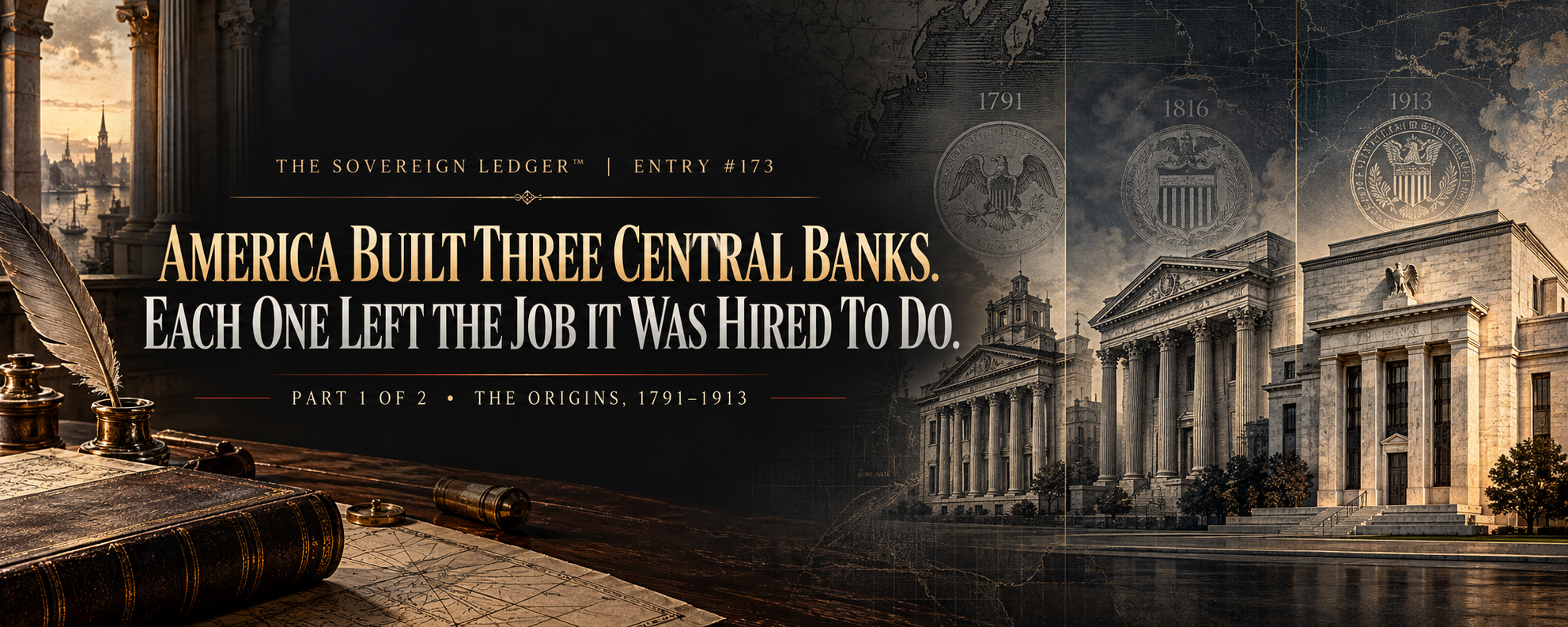
The Sovereign Ledger™ · Entry #173 · September 2026
AMERICA BUILT THREE CENTRAL BANKS. EACH ONE LEFT THE JOB IT WAS HIRED TO DO.
PART 1 OF 2 — THE ORIGINS, 1791–1913
The history of the Federal Reserve begins long before 1913. From Hamilton’s bank to Jackson’s veto, from coin vaults to J.P. Morgan’s library, from Jekyll Island to December 23, 1913: how America chartered, killed and rebuilt its money machine, and why the argument that shaped it decides what you pay for money today.
Monday, September 28, 2026 · Eastern Time · New York · Palm Beach · Miami · Naples · Sarasota
Part 2 publishes Tuesday, September 29, 2026
1791 · 1816 · 1913
Three Charters · One Machine · One Unfinished Argument
PROLOGUEWhy This History Is Suddenly Expensive
On Wednesday, September 16, 2026, the Federal Open Market Committee voted 12–0 to raise the federal funds rate by a quarter point, to a target range of 3.75% to 4.00%. It was the first hike since July 2023. Chairman Kevin Warsh told reporters that inflation had been too high for too long and that the Committee would deliver price stability. J.P. Morgan’s research team noted that core PCE inflation, the Fed’s preferred gauge, had run above 3% in every month of 2026.
Eight days later, Freddie Mac reported the 30-year fixed-rate mortgage at 7.03%, up from 6.95% the week before and 6.30% a year earlier. That is the first reading above 7% since January 2025. Two weeks before that, the National Association of REALTORS® reported August existing-home sales at a seasonally adjusted annual rate of 3.98 million. The national median price was $429,100, the 38th consecutive month of year-over-year gains, and inventory stood at a 4.9-month supply, the highest in more than a decade.
Behind all of it sits the federal balance sheet. Total public debt outstanding crossed $40 trillion on August 18, 2026, according to U.S. Treasury data, and stood at roughly $40.1 trillion on September 22. The Congressional Budget Office projects net interest on that debt at about $1 trillion in fiscal 2026.
I put those numbers first for a reason. Every one of them is downstream of a question Americans have argued about since 1790 and never settled: who should control the price and supply of money, and on whose behalf? The history of the Federal Reserve is the history of that question. If you own property, allocate capital, run a family enterprise, or are trying to buy your first home, it is no longer academic. It is your mortgage rate, your cap rate, your cost of carry and your next generation’s ability to own anything at all.
Most people will read the headlines this week and react to the rate. Very few will understand the machine that set it, where that machine came from, what it was originally hired to do, and why it keeps drifting from that job. Over the next two days, I intend to make sure my readers are among the few who do.
What You Will Know by the End of Part 1
- The count. Why America built three national central-banking institutions under the Constitution (1791, 1816, 1913), not one. Why the first two were designed to die and the third was designed to live.
- The founding argument. Alexander Hamilton wanted capacity: a nation that can borrow, pay and survive a crisis. Andrew Jackson wanted limits: no statute that makes the rich richer and the potent more powerful. Both were right, and neither solved the other’s problem.
- The veto. What Jackson’s July 10, 1832 veto message actually says, including the passage every generation of American populists still quotes, and where his argument was strong and where it was weak.
- The experiment nobody remembers. The Independent Treasury: the U.S. government keeping its own gold in its own vaults for 75 years, and why that “purest” answer left ordinary families exposed in every panic.
- The breaking point. How the Panic of 1907 turned one 70-year-old banker into the country’s lender of last resort, and why that was the moment Congress decided it needed a Federal Reserve.
- The hiring document. What the Federal Reserve Act of 1913 promised in its own title, in its own words. This is the contract Part 2 grades against 113 years of performance.
THE THESISOne Sentence, Three Charters
America built three central banks.
Each one left the job it was hired to do.
I mean that sentence in two senses. The first is literal. The First Bank of the United States left in 1811, when Congress let its 20-year charter expire by a single vote in each chamber. The Second Bank left in 1836, after President Jackson vetoed its recharter and pulled the federal deposits. Those two institutions departed the job because their charters were built with a timer and politics let the timer run out.
The second sense is the one that matters in 2026. The Federal Reserve never left. It has operated continuously since 1914. But the job it was hired to do in 1913, written plainly in the title of its own Act, is not the job it performs today. It kept the letterhead and changed the work. That is my interpretation, not a statutory finding, and Part 2 lays out the evidence so you can judge it yourself.
The pattern across all three is consistent enough to name. I call it The Capacity–Limits Test™. Every American central bank is born because the country lacks a capacity it needs: to fund the government, to discipline a chaotic currency, to stop a panic. Every one of them then accumulates discretion. And every one of them is eventually judged not on whether it had capacity, but on whether anyone could still limit it. The institution that fails the test in the 19th century is killed. The institution that fails it in the 20th and 21st centuries is amended, expanded and handed the next emergency.
WHY I WROTE THISForty Years Inside the Plumbing
I have spent four decades working inside the systems that move money, attention and ownership. My career has run through all four of the world’s largest advertising holding companies and across five continents, and has brought me into the rooms where institutions decide what the public will be told about money.
In 1996, I sat alongside the founders of OzEmail as the company became the first Australian technology company ever to list on NASDAQ. I saw firsthand how access to American capital markets changes a company’s destiny. In 2007 and 2008, I was a licensed real estate salesperson with Douglas Elliman in New York City, working the most expensive property market in the country as the credit system underneath it began to fail. I watched in real time what happens to owners, buyers and agents when the price of money moves faster than the price of homes.
That experience taught me the lesson this report is built on. Most people study the asset. Very few study the rails the asset trades on. Money is the most important rail of all. Central banks are the institutions that decide how wide those rails are, how fast things move on them, and who gets to use them first.
The Ownership Thesis™, which runs through every entry in The Sovereign Ledger™, asks one question: who owns what comes next? You cannot answer it for property, capital or AI infrastructure without first understanding who controls the price of money. This two-part report is my contribution to that understanding. It is history, told plainly, with the receipts attached.
How to Read This Report
Fact Dates, votes, statutory language and published data, sourced at the end.
Estimate Figures that historians or agencies calculate differently, stated as ranges and qualified.
My View My interpretation and strategic judgment. You are invited to disagree with it. Claims invite debate. Artifacts invite inspection.
CHAPTER IThe Problem Hamilton Inherited
To understand why the United States wanted a national bank at all, start with what it had in 1789: debt, distrust and paper nobody wanted.
The Continental Congress had financed the Revolution largely by printing money. It issued more than $200 million in paper “Continentals,” and they collapsed so completely that “not worth a Continental” entered the language as a synonym for worthless. States printed their own paper. Soldiers were paid in certificates that speculators bought for pennies on the dollar. The national government under the Articles of Confederation could request money from the states but could not compel it.
There had already been one experiment. In 1781, the Confederation Congress chartered the Bank of North America in Philadelphia under Robert Morris, the Superintendent of Finance. It lent to the struggling government and helped finance the war’s final stretch. But it was a creature of a weak confederation, and it quickly became essentially a Pennsylvania commercial bank. I do not count it among the three because it was not chartered under the Constitution and never functioned as the national fiscal agent the new Republic would need. It is still worth remembering. The first American instinct, even before the Constitution, was that a nation at war needs a bank.
When Alexander Hamilton became the first Secretary of the Treasury in September 1789, he inherited federal and state war debts on the order of $75 million to $80 million by most historical estimates. That was a staggering sum for a country with no reliable tax base and no national currency. His January 1790 Report on Public Credit proposed a bold program. The federal government would pay the foreign debt, fund the domestic debt at face value and assume the states’ war debts. Assumption passed only after the famous Compromise of 1790, in which Hamilton’s supporters accepted a permanent national capital on the Potomac in exchange for Southern votes.
Funding and assumption created a problem. The United States now had a large, tradable national debt and a promise to pay interest on it, every year, from distant customs houses in Boston, New York, Philadelphia, Charleston and Savannah. It needed a place to collect revenue, hold it, move it and lend against it in an emergency. It needed, in Hamilton’s view, a bank.
CHAPTER IIThe First Bank of the United States, 1791–1811
The Design
In December 1790, Hamilton sent Congress his Report on a National Bank. His argument was practical and strategic. A large national bank would turn idle coin and public debt into active, circulating capital. It would lend to the government quickly when emergencies struck. It would make tax collection and interest payments easier across a large country. And it would give merchants and producers a sounder, more uniform medium of exchange than the patchwork of state paper.
He was explicit about one design principle that later generations would fight over. The bank, he wrote, should be under a private rather than a public direction:
“…under the guidance of individual interest, not of public policy.”Alexander Hamilton, Report on a National Bank, December 1790
His reasoning was that a government-run bank would become a political piggy bank, lending to whoever held power and printing whatever the Treasury wanted. Private shareholders with their own money at risk would insist on prudence. That single design choice is the seed of every American argument about central banking since. My View It is also why Jackson would later see the same institution as a privileged aristocracy.
Congress passed the bill in February 1791, with the House vote 39 to 20. The structure was:
- Capital of $10 million. The federal government subscribed $2 million (20%); private investors, $8 million (80%).
- A 20-year exclusive federal charter. No other bank would be chartered by Congress during its life.
- A board of 25 directors elected by the stockholders. The government, despite owning a fifth of the stock, did not appoint them.
- Headquarters in Philadelphia, the national capital at the time, with branches eventually extending from Boston to New Orleans.
- Its notes were receivable for federal taxes. That made them the closest thing the country had to a national paper currency.
When the stock went on sale in July 1791, the offering was oversubscribed within hours and a speculative frenzy in the subscription rights followed. Capital was eager to own a piece of the Republic’s financial engine. That enthusiasm was, in itself, a warning sign that critics would remember.
The Constitutional Fight That Never Closed
Before signing, President Washington asked his Cabinet for written opinions. Secretary of State Thomas Jefferson and Attorney General Edmund Randolph said the bill was unconstitutional. The Constitution listed Congress’s powers and nowhere mentioned chartering a corporation or a bank. Jefferson read the Necessary and Proper Clause narrowly: “necessary” meant indispensable, without which an enumerated power would be nugatory. A bank might be convenient, he argued, but convenience was not necessity.
Hamilton’s reply of February 23, 1791 is one of the most consequential legal documents in American history. He argued that “necessary” in ordinary usage often means no more than
“…needful, requisite, incidental, useful, or conducive to.”Alexander Hamilton, Opinion on the Constitutionality of an Act to Establish a Bank, February 23, 1791
His test had three parts. Is the end within an enumerated power, such as taxing, borrowing or regulating commerce? Does the means have an obvious relation to that end? Is the means forbidden anywhere in the Constitution? If the answers were yes, yes and no, Congress could use it. Incorporating a bank was not a new power; it was a tool attached to legitimate ones. Washington signed the bill on February 25, 1791.
That argument, implied means versus enumerated limits, never went away. It returned in 1811, in 1819 when Chief Justice John Marshall adopted Hamilton’s reasoning in McCulloch v. Maryland, in 1832 in Jackson’s veto, in 1913 in the debates over the Federal Reserve Act, and it returns in 2026 in every argument about Fed independence, Treasury “oversight” and whether an unelected committee should set the price of money.
What the First Bank Actually Did
By most accounts, the First Bank did its job. It held the Treasury’s deposits, moved public money between regions, lent to the government, and collected the notes of state banks and presented them for redemption in gold or silver. That last function quietly disciplined state banks that printed too freely. Even the Jeffersonian administrations that came to power in 1801 relied on it. Albert Gallatin, Treasury Secretary under both Jefferson and Madison, came to regard it as a valuable instrument of public finance.
It was not a modern central bank. It did not set an interest rate for the whole economy or target inflation. It was the Treasury’s bank plus the nation’s largest commercial bank. That combination gave it influence far beyond its balance sheet, because a bank that holds the government’s money and can call in state banks’ notes is a bank everyone else must respect.
How It Died
By 1811, the political ground had shifted. The Federalists who created the bank had lost national power; Democratic-Republicans controlled Congress. State-chartered banks, which had multiplied, wanted the federal deposits for themselves and resented the discipline the national bank imposed on their note issues. Much of the bank’s stock was held abroad, often estimated at around two-thirds or more, mainly in Britain, and anti-British feeling was running high on the eve of war.
Gallatin argued for renewal. Madison, who had opposed the bank as a congressman in 1791, did not fight publicly for it. The votes were as close as votes get:
- House of Representatives, January 1811: the recharter was effectively killed on a 65–64 vote to postpone it indefinitely.
- Senate, February 1811: a 17–17 tie, broken against renewal by Vice President George Clinton.
The charter expired in March 1811. The first American central-banking institution under the Constitution died by a single vote in each chamber of Congress. It was not executed by a president; it was allowed to lapse. My View Its distinctive failure was political prematurity. It worked well enough that even its opponents used it, but it depended on a coalition that no longer held power, and its sunset forced a yes-or-no vote at exactly the moment “no” was easy.
What Followed
One year later, the United States went to war with Great Britain. The War of 1812 exposed the gap immediately. The Treasury struggled to borrow. State banks, freed from national discipline, expanded their note issues. By some counts the number of state banks more than doubled between 1811 and 1816. In August 1814, after the British burned Washington, most banks outside New England suspended redemption of their notes in gold and silver. The country was fighting a war with a currency that no longer meant the same thing from one state to the next.
When the national fiscal agent disappears,
the need does not.
CHAPTER IIIThe Second Bank of the United States, 1816–1836
The Reversal
James Madison, the man who had helped articulate the constitutional case against the first bank in 1791, now presided over a financial emergency. In January 1815, he vetoed one bank bill, not on constitutional grounds but because its design would not adequately serve the government’s needs. By late 1815, he was asking Congress for a national bank. On April 10, 1816, he signed the charter of the Second Bank of the United States.
Few moments in American history illustrate the Capacity–Limits Test™ more clearly. A leading constitutional skeptic, having watched the country try to function without a national fiscal agent, concluded that the practical need outweighed the theoretical objection. Experience, as Madison himself suggested, had settled what argument could not.
A Bigger Machine
The Second Bank was the First Bank with a larger body:
- Capital of $35 million, three and a half times its predecessor. The federal government again owned 20% ($7 million).
- A 20-year charter, to expire in 1836.
- 25 directors, 5 of them appointed by the President. This gave the government a formal voice for the first time, though a minority one.
- Headquarters in Philadelphia and eventually some two dozen branches across a rapidly expanding country.
Its jobs were to act again as the Treasury’s fiscal agent, to restore a currency that state banks would actually redeem in specie, to restrain excessive note issue by presenting state-bank notes for payment, and to transfer public funds across a continent without hauling wagons of coin.
A Rocky Start and a Landmark Case
The Second Bank’s early management was poor. It first expanded credit aggressively, then contracted sharply. That contraction is widely blamed for deepening the Panic of 1819, the young nation’s first major peacetime financial crisis. Farmers and debtors in the West and South remembered, and the bank’s reputation never fully recovered in those regions.
That same year, the Supreme Court decided McCulloch v. Maryland. Maryland had tried to tax the bank’s Baltimore branch. Chief Justice John Marshall, writing for a unanimous Court, adopted Hamilton’s reading of the Necessary and Proper Clause, upheld the bank’s constitutionality, and held that states could not tax a federal instrumentality: “the power to tax involves the power to destroy.” As a matter of law, the constitutional question was settled. As a matter of politics, it was not.
Biddle’s Bank
In 1823, Nicholas Biddle, a brilliant, cultivated Philadelphian, became the bank’s president. Under his leadership, the Second Bank began to behave more like a modern central bank than any American institution before it. It managed the supply of credit through its branch network, expanded and contracted to smooth regional imbalances, and used its power over state-bank notes to maintain a relatively sound, uniform national currency. By many economic historians’ assessments, the late 1820s were a period of unusual monetary stability.
But Biddle’s success created the political problem that would destroy him. A private corporation, directed mainly by private shareholders, was now exercising what looked like sovereign power over the nation’s money. Its president behaved, at times, like a rival head of state. My View The Second Bank’s distinctive failure was legitimacy in a democratic age. It worked, but it looked like a private government, and in the new era of mass democracy that was fatal.
CHAPTER IVThe Veto That Named the Problem: July 10, 1832
The Trap
The Second Bank’s charter ran until 1836. In early 1832, Biddle, encouraged by Senator Henry Clay, who was about to challenge Jackson for the presidency, applied for recharter four years early. Their calculation was political. If Jackson signed, the bank was safe for another generation. If he vetoed it in an election year, Clay could run against the veto.
Congress passed the recharter bill in early July 1832, extending the charter by 15 years. Jackson vetoed it on July 10. The Senate could not muster the two-thirds needed to override. The message, drafted with heavy input from Attorney General Roger Taney and Jackson’s advisers Amos Kendall and Andrew Jackson Donelson, is not a short formal objection. It is a long political manifesto that combines constitutional theory, class rhetoric, states’ rights, and an attack on concentrated financial power. It is one of the most consequential presidential papers of the 19th century.
The Opening Concession
Jackson began by conceding something his admirers often forget:
“A bank of the United States is in many respects convenient for the Government and useful to the people.”Andrew Jackson, Veto Message, July 10, 1832
Then he turned. The powers and privileges of this bank, he wrote, were
“…unauthorized by the Constitution, subversive of the rights of the States, and dangerous to the liberties of the people.”Andrew Jackson, Veto Message, July 10, 1832
He noted that he had asked Congress to design a better institution. The bill before him contained none of the changes he wanted.
The Gratuity Arithmetic
The longest early section of the veto treats the charter as a gift of public wealth to a small private group. Jackson did the math, and it is worth following.
- The 1816 charter had already given the original stockholders a windfall by raising the market value of their stock far above par.
- The recharter, he argued, would raise the stock’s value another 20 to 30 percent, a second windfall of roughly $7 million.
- More than a fourth of the stock, over eight million dollars’ worth, was held by foreigners, mostly British. The rest was held by what he called a few hundred Americans, chiefly of the richest class.
- He valued the monopoly at about $17 million and noted that the bill would sell it for a $3 million bonus, payable in installments over 15 years.
His question was simple and still devastating. If the charter was worth that much, why not sell it at market value and put the premium in the Treasury, or open it to competitive bidding? The existing stockholders, he wrote, had no right to another generation of exclusive privilege. My View In modern language, Jackson was objecting to a below-market renewal of a public franchise to an incumbent. That is a concept every institutional investor, regulator and procurement officer in 2026 understands instantly.
The Passage Every Generation Quotes
This is the moral center of the veto. I reproduce it in full because paraphrase does not do it justice:
“It is to be regretted that the rich and powerful too often bend the acts of government to their selfish purposes. Distinctions in society will always exist under every just government. Equality of talents, of education, or of wealth can not be produced by human institutions. In the full enjoyment of the gifts of Heaven and the fruits of superior industry, economy, and virtue, every man is equally entitled to protection by law; but when the laws undertake to add to these natural and just advantages artificial distinctions, to grant titles, gratuities, and exclusive privileges, to make the rich richer and the potent more powerful, the humble members of society—the farmers, mechanics, and laborers—who have neither the time nor the means of securing like favors to themselves, have a right to complain of the injustice of their Government.”Andrew Jackson, Veto Message, July 10, 1832
What Jackson Accepts
Read it carefully and you will see that Jackson draws a sharp line between two kinds of inequality.
The first is natural or earned difference. Talent, education, industry, thrift and virtue will produce different outcomes, and a just government does not try to erase them. He even uses religious language, “the gifts of Heaven,” to place earned success beyond the reach of politics. The second is equal legal protection. Every person is entitled to the same protection of law for what they have earned. That is the Jacksonian version of equality: equality before the law, not equality of condition.
This is not proto-socialism. It is closer to a producer-republican ethic. The person who works, saves and produces has a legitimate claim. The person who extracts advantage through statute does not.
What Jackson Rejects
His target is artificial distinction created by law: titles, gratuities, exclusive privileges and monopolies. In his telling, the bank charter was exactly that. Congress had taken a public power (banking under federal authority, government deposits, note circulation, favorable tax treatment) and handed it to a closed set of stockholders, many already rich and some foreign, on terms that raised the value of their shares.
The complaint is not that rich people exist.
It is that government is used to add to their advantages.
Who the “Humble Members” Were
Jackson named them: farmers, mechanics and laborers. These are the producing classes of Jacksonian language, people who work with land or with their hands and who lack the time, money and access to lobby Congress for a charter of their own. “Mechanics” meant skilled tradesmen, not factory workers in the later industrial sense. “Farmers” included substantial landowners as well as smallholders. The coalition was anti-aristocratic more than anti-capitalist. The contrast was with a “monied interest” that could sit in Philadelphia and Washington and write the terms of its own monopoly.
The Constitutional Theory
Jackson refused to treat McCulloch or prior practice as settling the question for him:
“Mere precedent is a dangerous source of authority, and should not be regarded as deciding questions of constitutional power except where the acquiescence of the people and the States can be considered as well settled.”Andrew Jackson, Veto Message, July 10, 1832
He argued that each branch must judge constitutionality for itself under its own oath:
“Each public officer who takes an oath to support the Constitution swears that he will support it as he understands it, and not as it is understood by others.”Andrew Jackson, Veto Message, July 10, 1832
Even if Congress had implied power to create a bank, he argued, it did not have power to create this bank, with these exclusive privileges, tax exemptions and a branch network that overrode state authority. He also objected to technical provisions he believed favored the bank and its foreign holders. One was a tax treatment he argued would leave foreign stockholders effectively untaxed while resident Americans paid state taxes, making the stock more valuable to foreigners than to citizens.
The Regional Grievance
Jackson pointed out that little of the bank’s stock was held in the Western and Southwestern states, yet those regions produced a large share of its profits and had seen specie drawn east through the branches. The West, he warned, was already in a dependent relationship to Eastern and foreign capital, and the recharter would lock that pattern in for the whole country. Anyone who has studied capital flight, wealth migration or the relationship between Manhattan and Florida will recognize the shape of this argument, because I have written about its modern version in Entry #167, The Cost of Control™.
What the Veto Does Not Say
This is the part most modern readers miss. Jackson did not say the United States should have no fiscal agent at all. He said a properly designed institution, without monopoly privileges and without the existing stockholders’ lock on the charter, could be useful. He did not claim the Supreme Court was illegitimate; he claimed it was not the only interpreter of the Constitution for the other branches.
The Tension Inside the Argument
The passage is powerful because it is simple. It is also incomplete, and honest history requires saying so.
- Jackson treated the bank’s profits and stock premium as a pure transfer from the American people. Defenders replied, with some justice, that the bank provided valuable fiscal services, a more uniform currency and restraint on reckless state banks, and that those services had public value.
- “Humble members” was selective. Many state-bank directors, land speculators and politically connected local elites opposed the national bank precisely because it disciplined them.
- Jackson insisted that government should not add artificial advantages. Yet his later removal of federal deposits into chosen state banks, the “pet banks,” was itself an exercise of executive favor that created a new set of privileged institutions.
- Foreign ownership was folded into the same moral category as domestic privilege. That drew on republican fear of dependence on Britain as much as on economics.
It also bears saying plainly that Jackson’s broader legacy includes the Indian Removal Act of 1830 and the forced displacement of Native nations, as well as his ownership of enslaved people. Later movements quoted his words on privilege without sharing his record on those questions. That is part of why the passage has endured: it can be separated from the man.
Why It Lasted
The veto gave Jacksonian Democracy a usable creed: protect equal rights under law, and do not use the state to manufacture a financial aristocracy. Anti-monopoly campaigners, 1890s Populists and 20th-century trust-busters could all quote it.
It does not say “tear down the successful.”
It says “stop writing them a second advantage in the statute book.”
That is why it still reads as a live political argument rather than a museum piece. In 1832 the second advantage was a below-market charter. In Part 2, I will show you what it looks like on a 21st-century central bank balance sheet.
The Immediate Result
Jackson treated the 1832 election as a referendum on the veto and won decisively, 219 electoral votes to Clay’s 49. He took the result as a mandate to finish the bank. The fight also helped create the Whig Party and fixed the Democratic Party’s identity for a generation as the party of the “common man” against concentrated financial power.
CHAPTER VHamilton vs. Jackson: Two Questions That Never Met
Hamilton and Jackson are usually presented as opponents in a single debate. They were not quite arguing about the same thing. Hamilton was designing a fiscal engine for a new nation that could not yet borrow cheaply or move money across thirteen states. Jackson was attacking an established corporation that, in his view, had become a privileged estate. One is a theory of means. The other is a theory of who captures the means. Seeing that distinction clearly is the key to everything that follows, including 2026.
1. “Necessary”: Useful vs. Authorized
Hamilton asked whether the tool served a listed federal job. Jackson asked whether, even if some tool was allowed, this charter invaded the states, created a monopoly and transferred public power to a closed class. Hamilton won the legal argument in McCulloch. Jackson won the political argument in 1832. Neither victory ended the other’s case.
2. What a Bank Is For
For Hamilton, banking was infrastructure. Paper credit that people would accept as readily as gold and silver multiplied the work a limited stock of metal could do, and a young country short of coin needed that machinery. For Jackson, the fiscal convenience was the bait; the real product was a second windfall to existing stockholders.
Hamilton: a public instrument that happens to be privately managed.
Jackson: a private fortune that happens to wear a public charter.
3. “Monopoly”: Same Word, Opposite Meanings
Hamilton denied the bank was a monopoly. To him, monopoly meant a legal ban on others doing the same business. The charter did not stop states from chartering banks, so it was not a monopoly. Jackson defined monopoly as exclusive federal favor: the government’s deposits, note privileges and tax treatment, concentrated in one locked-in group of stockholders. Even with state banks in existence, the national bank enjoyed a monopoly of the government’s favor and, as a result, near-dominance of domestic and foreign exchange. Hamilton was answering “may Congress create this tool?” Jackson was answering “may Congress keep handing this tool to the same people on sweetheart terms?”
4. Private Control: Hamilton’s Feature, Jackson’s Bug
This is the deepest inversion. Hamilton wanted private direction so the bank would not be captured by politicians. Jackson saw private direction plus public privilege as the recipe for an aristocracy of finance.
Hamilton feared a bank captured by politicians.
Jackson feared a government captured by bankers.
Both fears were serious. Both have been realized at different moments in American history. Neither man solved the other man’s problem, and, as Part 2 will show, the Federal Reserve was designed as an attempt to solve both at once.
5. Equality
Hamilton barely theorized equality in his bank papers. His equality was national: one credit, one currency, one fiscal agent, so the Union could act as a single borrower and taxpayer. Jackson theorized equality explicitly and then limited it: distinctions of wealth will exist, but government must not manufacture a second layer of them by statute. Hamilton’s republic needed a capital market. Jackson’s republic must not become a court that hands out charters.
6. Foreign Capital
Hamilton welcomed foreign subscription. European money in the bank was a vote of confidence and a source of hard currency. Jackson treated British stockholders as a political fact: dividends flowing out of the West and South to the East and to Europe. What Hamilton counted as imported strength, Jackson counted as a drain and a dependency. The same argument runs through every modern debate about foreign holdings of U.S. Treasury debt.
7. Who Decides
Hamilton wrote to persuade one man, Washington, that Congress already had the power. Jackson wrote to the Senate and to the electorate, and in doing so he expanded the veto from “this bill is unconstitutional” to “this bill is unjust, unwise and, as I read the Constitution, unauthorized.” That is a different theory of the presidency: coequal interpretive authority plus a popular mandate against a privileged order.
| Question | Hamilton (1790–91) | Jackson (1832) |
|---|---|---|
| Core concern | National capacity: can the Union borrow, pay and survive a crisis? | Capture: who owns the upside of a public privilege? |
| Constitution | “Necessary” means useful or conducive; implied means are legitimate | Precedent is not binding; each branch judges for itself |
| Monopoly | Only a legal ban on rivals counts | Exclusive federal favor counts |
| Private direction | A safeguard against political abuse | The source of an aristocracy of finance |
| Foreign capital | A vote of confidence and a source of specie | A drain and a dependency |
| What he feared | A bank captured by politicians | A government captured by bankers |
The Argument They Never Joined
Hamilton can be right that a national fiscal agent was conducive to taxing, borrowing and credit in 1791. Jackson can be right that the 1832 recharter was a below-market renewal of a closed privilege. Those claims sit on different timelines.
- Hamilton’s question: Can the Union exist as a commercial state without a bank-like instrument?
- Jackson’s question: Once that instrument exists, who owns its upside, and may the president refuse to perpetuate the owners?
Put side by side, they talk past each other because one is building capacity and the other is policing capture. My View The American fight over central banking has been that mismatch ever since. Every generation inherits Hamilton’s machine and Jackson’s suspicion of who sits on its board.
CHAPTER VIWhat Jackson Broke, and What Broke Next
Removing the Deposits
Having won re-election, Jackson did not wait for the charter to expire. In 1833, he ordered federal deposits removed from the Second Bank and placed in selected state banks. Two Treasury Secretaries declined to carry out the order in succession; one was moved to another post and the second was dismissed. Jackson then installed Roger Taney, who began the removal in the autumn of 1833. The Senate censured Jackson in 1834 for his conduct in the affair, and his allies later had the censure expunged from the record in 1837.
Biddle fought back by contracting the bank’s lending sharply in 1833 and 1834, a move widely understood as an attempt to create enough economic pain to force Congress to restore the deposits. It backfired politically. It seemed to prove Jackson’s central charge that a private banker could inflict hardship on the country to protect his institution.
The Pet Banks and the Boom
The number of state banks holding federal deposits grew from a handful to roughly ninety. Freed of the national bank’s discipline and flush with public money, many lent aggressively. Land speculation in the West accelerated. Government revenue from public-land sales surged.
Something remarkable happened along the way. In January 1835, the federal government effectively paid off its entire national debt, the only time in U.S. history that has occurred. It is worth pausing on that fact in a week when the debt stands above $40 trillion and its annual interest bill runs near $1 trillion. Jackson’s hard-money, anti-debt instincts were not rhetorical; for a brief moment, the Republic owed almost nothing.
January 1835: the national debt, effectively zero.
September 2026: $40 trillion and counting.
The Specie Circular and the Panic of 1837
In July 1836, alarmed by speculation, Jackson issued the Specie Circular requiring payment in gold or silver for most public-land purchases. Combined with the distribution of the federal surplus to the states, international pressures and a credit boom that had run too far, it helped set up the Panic of 1837. In May 1837, New York banks suspended specie payments. Banks failed across the country. Federal revenue collapsed, and the government discovered that its own money was locked inside failed or frozen banks. The downturn lasted into the early 1840s.
The Second Bank itself had not vanished when its federal charter expired in 1836. It continued under a Pennsylvania state charter as the Bank of the United States of Pennsylvania, suspended payments during the turmoil that followed, and failed in 1841.
The Third Attempt That Never Happened
After the Whigs won the White House in 1840, Henry Clay expected to create a third Bank of the United States. President William Henry Harrison died a month into his term. His successor, John Tyler, vetoed two separate bank bills in August and September 1841 on constitutional grounds similar to Jackson’s. Nearly his entire Cabinet resigned in protest, and his own party expelled him. No third national bank was established in the 19th century. That is why the popular claim that “three presidents killed the central bank” is inaccurate. Two national banks were allowed to expire; a third was blocked before it was born; and the Federal Reserve, created in 1913, has never been abolished.
CHAPTER VIIThe Independent Treasury: Jacksonianism as Plumbing
This is the chapter almost nobody teaches. It matters more than ever.
If a national bank was a privileged aristocracy and state “pet banks” had failed in 1837, what was left? Martin Van Buren, Jackson’s successor, proposed the most radical answer in American financial history: a divorce of bank and state. The federal government would stop using banks as its wallet. It would keep its own money, in gold and silver, in its own vaults, handled by its own officers.
The Independent Treasury was not a central bank. It was, in a sense, an anti-bank. It is Jackson’s war on the Bank carried to its logical conclusion, and its history is the hinge between Jackson’s veto and Woodrow Wilson’s Federal Reserve.
The False Start, 1840–1841
Van Buren proposed the plan in a special session of Congress in September 1837. State-bank interests and the Whigs blocked it for three years. Congress finally passed it, and Van Buren signed it on July 4, 1840, pointedly on Independence Day. It barely began operating. The Whigs won the 1840 election, viewed the system as a cause of tight money and an obstacle to a new national bank, and repealed it in August 1841. With Tyler’s vetoes, the country then had neither an independent treasury nor a national bank.
The Durable Law: August 6, 1846
President James K. Polk made revival of the Independent Treasury one of the two domestic pillars of his program, alongside a lower tariff. He signed the Independent Treasury Act on August 6, 1846, days after the Walker Tariff. This statute governed American public finance, in principle, for most of the next 75 years. Its core rules were:
- Public money stays in government hands. Revenue was held in the Treasury in Washington and in subtreasuries in major cities, initially including New York, Boston, Philadelphia, Charleston, New Orleans and St. Louis, with the mints serving as depositories as well.
- No lending, no bank deposits. Federal officers had to keep the money themselves, without lending it, depositing it in banks or exchanging it for other funds.
- Hard money. From January 1, 1847, payments to and by the United States had to be made in gold, silver or Treasury notes, not state-bank notes.
The government became its own cashier. Presidentially appointed assistant treasurers ran the vaults. Customs collectors, land-office receivers and postmasters funneled coin to the nearest subtreasury. Critics predicted paralysis; instead, the system financed the Mexican War without a national bank, and Democrats treated that as vindication.
What It Was Designed to Do
- Safety: federal cash cannot disappear when a commercial bank fails.
- Hard money: the government will not inflate by living on bank paper.
- No privileged fiscal agent: no Second Bank and no pet-bank clique earning a float on public money.
- Political insulation: banks cannot pressure the Treasury by threatening the deposits.
The Built-In Defect
The Independent Treasury solved capture. It did not solve elasticity, and that is the flaw the Federal Reserve Act would later name in its title.
The Treasury was large. When customs duties and land sales poured gold into the vaults, that gold left the banking system and money tightened. When the government spent, gold flowed back and money eased. Surplus years drained the economy; deficit years flooded it. The subtreasury system therefore acted as an accidental, clumsy central bank, tightening and loosening credit without any mandate to stabilize it and without any ability to lend to a solvent bank caught in a panic.
Divorce from the banks protected the Treasury.
It did not protect the depositor.
The Civil War Cracks the Divorce
The Civil War forced the government back into the banks. Greenbacks and massive borrowing could not be run out of a few coin vaults. The National Banking Acts of 1863 and 1864 allowed the Treasury to designate national banks as depositories and fiscal agents, ending the principle of 1846 in practice. The subtreasuries survived as cash warehouses and currency exchanges, with New York doing the heavy lifting, but they now sat beside national banks, greenbacks and later silver certificates.
The Quiet Ending
The Independent Treasury did not die in a veto fight. After the Federal Reserve began operating, government funds moved gradually to the Reserve Banks acting as fiscal agents. An act of 1920 authorized the Treasury to deposit its money with the Fed and ordered the remaining subtreasuries closed. They shut in 1921. Jacksonianism as plumbing ended with an administrative transfer.
My View The Independent Treasury proved that a government can be its own cashier. It also proved that a cashier is not a central bank, and that “divorce from the banks” is easier to pass as a slogan than to run as a modern payments and credit system. Anyone in 2026 who proposes simply abolishing the Fed without a replacement should study this chapter first.
CHAPTER VIIIThe Inelastic Years: 1837–1907
Between the death of the Second Bank and the birth of the Federal Reserve, the United States ran what may be the longest experiment in modern history with no central bank at all. The results were mixed at best.
The Free Banking Era
From the late 1830s, states such as Michigan and New York passed “free banking” laws that let almost anyone open a bank meeting certain requirements. By the Civil War, thousands of different state-bank notes circulated, each trading at its own discount depending on the issuing bank’s reputation and distance. Merchants relied on printed “bank note reporters” to value the paper in their tills, and counterfeiting flourished. Some of these banks were sound. Others, the notorious “wildcat” banks, were set up in remote places precisely so their notes would be hard to redeem.
The National Banking System
The Civil War brought the National Currency Act of 1863 and the National Bank Act of 1864. They created nationally chartered banks supervised by the new Office of the Comptroller of the Currency, issuing a uniform national banknote backed by U.S. government bonds. A prohibitive federal tax on state-bank notes soon drove those notes out of circulation. For the first time since the Second Bank, the country had a uniform paper currency.
But the design had a fatal rigidity. Because national banknotes had to be backed by government bonds, the supply of currency depended on the supply and price of those bonds, not on the needs of commerce. When harvests had to be moved each autumn and farmers needed cash, the currency could not expand. When depositors panicked, reserves were scattered across thousands of banks and pyramided into New York, where they froze. The Federal Reserve’s own historians note that nationwide panics occurred on average about every fifteen years in the 19th century. Major panics struck in 1873, 1884, 1890, 1893 and 1907.
My View This is the part of the story that the most romantic critics of the Fed tend to skip. The era without a central bank was not a golden age of stable money for ordinary families. It had long stretches of stable or falling prices, which rewarded savers, but it also produced repeated banking panics that destroyed savings, businesses and jobs. Both halves of that record are true.
CHAPTER IX1907: When the Country Called Morgan
In October 1907, a failed attempt to corner the stock of United Copper triggered losses at banks and trust companies connected to the speculators. Depositors ran on the Knickerbocker Trust Company, one of the largest in New York, and it suspended payments. Runs spread to other trust companies. Call-money rates on the stock exchange spiked above 100 percent. The system had no lender of last resort and no mechanism for creating currency when everyone wanted it at once.
So the country turned to one man. John Pierpont Morgan, then 70 years old, gathered the leading bankers in his library on Madison Avenue, decided which institutions were worth saving, organized pools of money to support them, and pressed the banks into lending to keep the stock exchange open. Treasury Secretary George Cortelyou deposited federal funds in New York banks to help. The New York Clearing House issued certificates that functioned as emergency money.
It worked, barely. But the lesson was unmistakable, and it offended Hamiltonians and Jacksonians alike. The world’s fastest-rising economy depended, in a crisis, on the judgment and goodwill of a single private financier. If Morgan had been ill, or unwilling, or wrong, the outcome could have been far worse.
A nation whose survival in a panic depends on one private house
is not financially sovereign.
Congress moved quickly. The Aldrich–Vreeland Act of May 1908 created a mechanism for emergency currency and, more importantly, the National Monetary Commission, chaired by Senator Nelson Aldrich of Rhode Island, to study banking systems around the world and recommend permanent reform.
CHAPTER XFrom Jekyll Island to December 23, 1913
The Secret Meeting
In November 1910, six men traveled under assumed pretenses to the Jekyll Island Club, a private retreat off the coast of Georgia. According to the Federal Reserve’s own historical account, they were Senator Nelson Aldrich; A. Piatt Andrew, Assistant Secretary of the Treasury; Henry Davison of J.P. Morgan & Co.; Arthur Shelton, Aldrich’s secretary; Frank Vanderlip of National City Bank; and Paul Warburg of Kuhn, Loeb & Co. The meeting was a closely guarded secret, and participants did not publicly acknowledge it until the 1930s.
Their plan became the Aldrich Plan: a National Reserve Association with regional branches, controlled largely by member banks. It is easy to see why the secrecy later fed a century of suspicion. A plan to reform the nation’s money was drafted in private by a senator and representatives of the country’s most powerful banks. My View The suspicion is understandable. But the Aldrich Plan as written never became law, and the gap between it and the Federal Reserve Act is exactly where Jackson’s argument re-entered American history.
Jackson’s Ghost in the Room
The Aldrich Plan stalled. Democrats won the House in 1910 and the White House and Senate in 1912, and their platform explicitly opposed it. At the same time, the House Pujo Committee’s investigation of the “Money Trust” in 1912 and 1913 documented the concentration of financial power in a small circle of New York institutions. Public opinion was in no mood to hand the money supply to bankers.
President Woodrow Wilson, working with Representative Carter Glass of Virginia and Senator Robert Owen of Oklahoma, reshaped the design. William Jennings Bryan, Wilson’s Secretary of State and the country’s most famous populist, insisted that the government, not the bankers, control the central board and that the new currency be an obligation of the United States government. Critics such as Representative Charles Lindbergh Sr. of Minnesota warned that the bill would legalize the Money Trust rather than break it. The final compromise tried to satisfy everyone at once:
- Twelve regional Federal Reserve Banks, not one central bank in New York. Reserves would no longer be trapped in Manhattan.
- Member banks would own stock in their regional Reserve Bank and receive a capped dividend. That is Hamilton’s private participation.
- A Federal Reserve Board in Washington, appointed by the President and confirmed by the Senate. That is Jackson’s and Bryan’s public control. The Secretary of the Treasury and the Comptroller of the Currency sat on the original Board ex officio. That detail will matter enormously in Part 2.
- Federal Reserve notes would be obligations of the United States, backed by a 40% gold reserve plus eligible commercial paper.
- No 20-year sunset. Unlike the First and Second Banks, the Federal Reserve would continue until Congress chose to change or repeal it.
Congress passed the bill in December 1913, and President Wilson signed it on December 23. The twelve Reserve Banks opened for business in November 1914.
The Hiring Document, in Its Own Words
Everything in Part 2 rests on this. The Federal Reserve Act states its purposes in its title:
“An Act to provide for the establishment of Federal reserve banks, to furnish an elastic currency, to afford means of rediscounting commercial paper, to establish a more effective supervision of banking in the United States, and for other purposes.”Federal Reserve Act, approved December 23, 1913
Read it as a job description. It contains four concrete promises:
- Elastic currency. Notes and reserves that expand when harvests move or depositors run and contract when the need passes, still under a gold standard.
- Rediscounting commercial paper. Member banks could bring short-term business loans to a Reserve Bank and get cash. That is a lender-of-last-resort window, not a standing bid for the whole bond market.
- More effective supervision of banking, so the country no longer waited on a private syndicate in a crisis.
- A system of regional reserve banks, so reserves were not frozen in New York.
Now notice what is not in the title. There is no mention of maximum employment, a 2% inflation target, managing asset prices, buying mortgage-backed securities, or financing the Treasury. Price stability was assumed to come from gold, not from a committee. Steering unemployment was not in the Act at all. Those jobs arrived later, and how they arrived is the story of Part 2.
The 1913 contract: elastic currency, a discount window, supervision.
Not employment. Not 2%. Not the bond market.
The 1913 Design at a Glance
| Feature | What 1913 Said | Why It Mattered |
|---|---|---|
| Currency | Elastic Federal Reserve notes, 40% gold backing | Ended the bond-backed rigidity of 1863–1913 |
| Lending | Rediscount eligible commercial paper | A public window replaced “call Morgan” |
| Structure | 12 regional Reserve Banks | Reserves no longer trapped in New York |
| Governance | Presidentially appointed Board; Treasury Secretary ex officio | Public control over a banker-owned system |
| Ownership | Member-bank stock with a capped dividend | Private skin in the game without equity control of policy |
| Lifespan | No sunset clause | Survives unless Congress acts, unlike 1811 and 1836 |
CHAPTER XIThe Pattern: Three Charters, Two Endings, One Argument
The first two banks did not “fail the same exam.” They were killed by politics on a timer. The third was built without that timer and then rewritten instead of repealed every time it faltered. That is the main difference. The recurring element is the argument underneath: a public job parked in a body the public does not directly elect.
| First Bank, 1791–1811 | Second Bank, 1816–1836 | Federal Reserve, 1913– | |
|---|---|---|---|
| Why it existed | Fund the new Union, service the assumed debt, create a note the Treasury would accept | Repair War of 1812 chaos; discipline state-bank paper | End inelastic currency and “Morgan as central bank” after 1907 |
| Ownership | 20% government, 80% private; directors elected by stockholders | 20% government; 5 of 25 directors presidential appointees | Member-bank stock in Reserve Banks; public Board in Washington |
| How it ended or survived | 20-year charter lapsed by one vote in each chamber | Veto, deposit removal, charter expiry | No sunset; reformed after each crisis |
| Distinct failure | Political prematurity | Legitimacy in a democratic age | Covered in Part 2 |
| Who limited it | Congress, on a tie | Jackson and the electorate | Congress in principle; in practice, rarely |
| Money standard | Specie and bank notes | Specie and bank notes | Gold assumed in 1913, later removed |
Five Recurring Design Conflicts
- Hybrid ownership of a public power. Private stockholders in the Banks of the United States; member-bank stock plus a public Board at the Fed. Hamilton wanted private direction to prevent political abuse. Jackson called it a privileged order. Every American central bank has lived in that gap.
- The constitutional fight never closed. Jefferson and Madison versus Hamilton in 1791. Jackson versus Marshall’s precedent in 1832. Bryan and Lindbergh versus the bankers’ plan in 1913. The same clause, implied means to tax, borrow and coin, against the same fear of a boundless field of power.
- Capture and “first receivers.” In 1832 the complaint was stock premiums and foreign dividends. Part 2 examines its modern form. The plumbing differs; the complaint that a statute adds an advantage ordinary people cannot bid for does not.
- Credit cycles blamed on the center. The Second Bank was blamed for the contraction of 1819; the pet banks for the boom before 1837. The center is always accused of either starving the country or flooding it, and sometimes of both in the same decade.
- Fiscal need creates the bank; politics tries to housebreak it. Hamilton needed a fiscal agent. The postwar Republic needed a currency. The post-1907 economy needed a panic window. Each time, the need was real. Each time, the housebreaking was incomplete.
1791–1811: Capacity wins the Cabinet. Limits win the roll call.
1816–1836: Capacity wins Congress. Limits win an election.
1913–2026: Capacity becomes permanent. Limits become hearings.
CHAPTER XIITwo Portraits in One Room
When President Donald J. Trump returned to the White House in January 2025, the Oval Office was redecorated. According to reporting at the time, portraits of George Washington, Thomas Jefferson and Alexander Hamilton returned, along with a portrait of Andrew Jackson, which the President had also hung during his first term. I admire that choice, because it puts the entire argument of this report on one wall.
Hamilton, the architect of American public credit and the First Bank. Jackson, the president who destroyed the Second. Jefferson, who argued the first bank was unconstitutional and then governed with it. And Washington, who had to decide between them. My View Jackson’s portrait in particular is not decoration. It is an argument: the elected president against a money power that does not stand for election.
One historical correction is worth keeping while I enjoy the painting. Jackson did not abolish “the Fed.” The Federal Reserve would not exist for another 77 years. He killed the Second Bank of the United States and let its 20-year charter die. What followed was not a clean victory for ordinary depositors: pet banks, the Panic of 1837, then the Independent Treasury, with government gold in government vaults and still no lender of last resort when ordinary banks ran.
1907 is why 1913 exists.
So Jackson’s instinct is coherent: no privileged franchise, and no institution that treats the dollar as its own instrument. But the 1836 method does not port cleanly onto 2026. There is no sunset to wait out. Payments, Treasury securities and bank reserves now run through the Federal Reserve system. Repeal without a replacement would be 1907 with a $40 trillion debt attached.
If the aim is Jackson’s limit,
not just Jackson’s gesture,
the history tells you where to look.
Tomorrow, in Part 2, I will show exactly where.
CHAPTER XIIIWhat This Means for Owners in 2026
I publish The Sovereign Ledger™ for owners, allocators, family enterprises and the rising generation that will inherit them. Here is why a history lesson about 1791, 1832 and 1913 belongs in an owner’s strategic plan this week.
1. The Ledger Is the Power
In Entry #168, The 7,000-Year War for the Ledger™, I traced the struggle over who keeps the record of value from clay tablets to central banks and Bitcoin. This report is the American chapter of that war. The First Bank, the Second Bank, the Independent Treasury and the Federal Reserve are four different answers to one question: who keeps the nation’s ledger of money, and who is allowed to write in it? Every change in that answer redistributed wealth.
2. The Authoritative Record Always Wins the Dispute
In Entry #169, The Authoritative Ownership Record™, I examined what happens when county deeds, corporate wrappers, bank books and blockchains disagree about who owns a property. The same logic applied in 1837 and 1907. When the pet banks froze, the question was whose record of deposits was real and redeemable. When the trust companies ran, the question was whose paper would be honored.
In every crisis, the institution that controls the authoritative record
controls the outcome.
3. Settlement Is Sovereignty
In Entry #172, The Instant Settlement Engine™, I examined how FedNow, RTP, tokenized deposits and atomic settlement could compress the 30-to-60-day real estate closing cycle. Those rails descend directly from the problem 1913 was built to solve: money that cannot move when it is needed. The Independent Treasury moved coin in wagons. The Federal Reserve built a national clearing system. The next generation of rails will decide who settles, how fast and at what cost.
4. Control Planes Are Never Neutral
In Entry #166, The Sovereign Control Plane™, I argued that whoever controls the control plane of settlement, identity and compliance controls the market that runs on it. Hamilton understood that in 1790. Jackson feared it in 1832. The regulated-stablecoin and tokenization frameworks now being written are the newest chapter of the same argument about who holds the privilege of issuing money-like claims, and on what terms.
5. Institutions Outlast Technologies, and Charters Shape Institutions
In Entry #165, Sovereign Ownership Master Infrastructure™, I laid out how a thesis becomes an institution. The history in this report is the cautionary version. Institutions built on a sunset die when political coalitions change. Institutions built without one survive but drift. The durable design is neither: it is an institution with capacity, a narrow mandate and a real mechanism for limits.
Five Questions Every Owner Should Ask This Week
- If long-term rates are set by trust in the currency rather than by any single rate decision, what is my portfolio’s real exposure to that trust?
- How much of my family enterprise’s wealth depends on the price of money staying where it was when I financed it?
- Which of my assets are recorded, settled and verified on rails I do not control?
- If a 1907-style liquidity event hit my market tomorrow, who would be my lender of last resort?
- Is my rising generation learning this history, or only reading the headlines?
Tax, legal and financial decisions should be made with qualified advisers. What I can give you is the map. People who understand the machine make better decisions about everything that runs on it.
REFERENCEThe Timeline, 1781–1914
| Date | Event |
|---|---|
| 1781 | Confederation Congress charters the Bank of North America (Robert Morris) |
| Jan 1790 | Hamilton’s Report on Public Credit: funding and assumption |
| Dec 1790 | Hamilton’s Report on a National Bank |
| Feb 23–25, 1791 | Hamilton’s constitutional opinion; Washington signs the First Bank charter |
| Jan–Feb 1811 | Recharter fails 65–64 (House) and 17–17 (Senate, VP Clinton breaks tie) |
| Mar 1811 | First Bank’s charter expires |
| Aug 1814 | Banks outside New England suspend specie payments |
| Apr 10, 1816 | Madison signs the Second Bank charter |
| 1819 | Panic of 1819; McCulloch v. Maryland upholds the bank |
| 1823 | Nicholas Biddle becomes president of the Second Bank |
| Jul 10, 1832 | Jackson’s veto of the recharter bill |
| Nov 1832 | Jackson re-elected, 219 electoral votes to Clay’s 49 |
| 1833 | Removal of federal deposits to state “pet banks” begins |
| Jan 1835 | National debt effectively paid off, the only time in U.S. history |
| Jul 1836 | Specie Circular; Second Bank’s federal charter expires this year |
| May 1837 | Panic of 1837; New York banks suspend specie payments |
| Jul 4, 1840 | First Independent Treasury Act |
| Aug–Sep 1841 | Independent Treasury repealed; Tyler vetoes two national-bank bills |
| Aug 6, 1846 | Independent Treasury Act restored under Polk |
| 1863–1864 | National Currency Act and National Bank Act |
| 1873–1893 | Recurring panics: 1873, 1884, 1890, 1893 |
| Oct 1907 | Panic of 1907; J.P. Morgan organizes the rescue |
| May 1908 | Aldrich–Vreeland Act; National Monetary Commission |
| Nov 1910 | Jekyll Island meeting |
| 1912–1913 | Pujo “Money Trust” investigation |
| Dec 23, 1913 | Wilson signs the Federal Reserve Act |
| Nov 1914 | Twelve Federal Reserve Banks open |
REFERENCEA Glossary for My Tribe
- Central bank: an institution that manages a nation’s money and credit conditions and acts as banker to the government and to other banks.
- Fiscal agent: the institution that holds, moves and pays out the government’s money.
- Specie: gold and silver coin. “Suspending specie payments” means a bank stops redeeming its paper notes in coin.
- Elastic currency: a money supply that can expand when demand for cash rises and contract when it falls.
- Rediscounting: a central bank lending cash to a bank against the loans that bank has already made.
- Lender of last resort: the institution that lends to solvent but illiquid banks in a panic so that runs do not spread.
- Necessary and Proper Clause: Article I, Section 8 of the Constitution, the basis of Congress’s implied powers.
- Pet banks: the state banks that received federal deposits after Jackson removed them from the Second Bank.
- Independent Treasury: the 1846–1921 system in which the federal government kept its own money in its own vaults.
- The Capacity–Limits Test™: my framework. Every central bank is created for a capacity the nation lacks and ultimately judged on whether the public can still limit it.
TOMORROWPart 2: The Fed on Trial, 1913–2026
Part 1 ends at the moment the Federal Reserve was hired. Part 2 opens the personnel file. Tomorrow, Tuesday, September 29, 2026, I will grade the Federal Reserve against the three contracts it has been handed since 1913, and I will not soften the verdict.
- The Great Contraction. How the institution created to stop panics presided over one of the worst banking collapses in history, and what a future Fed Chairman later admitted about it.
- The dollar. What a 1913 dollar buys today, and why “stable prices” has meant different things in different decades.
- The Powell Housing Paradox™. How cheap money in 2020–21 and the fastest tightening in four decades created a boom that incumbents banked and a freeze that incumbents enforce.
- Warsh’s inheritance. What the September 16 hike means for mortgage rates, owners and the next generation of buyers.
- The Treasury question. Remember that the Treasury Secretary sat on the original Federal Reserve Board. Tomorrow I explain why that seat was removed, and what history says about bringing the Treasury back.
- My verdict and my blueprint. The pros and cons of having a central bank in 2026, and the reforms that pass both Hamilton’s test and Jackson’s.
If you read Part 1, you already understand more about American money than most of the people who will argue about it on television this week. Part 2 is where that understanding turns into judgment. Come back tomorrow.
Capacity so the Republic does not beg.
Limits so the machine does not become a class.
Sovereign Proof · Entry #173 · SHA-256 · OpenTimestamps · Bitcoin
Canonical fingerprint string
THE SOVEREIGN LEDGER™ | ENTRY #173 | AMERICA BUILT THREE CENTRAL BANKS. EACH ONE LEFT THE JOB IT WAS HIRED TO DO. — PART 1 OF 2: THE ORIGINS, 1791–1913 | GEOFF DE WEAVER | LIMITLESS USA LLC | https://geoffdeweaver.com/america-built-three-central-banks-part-1/ | 2026-09-28 ET | CORPUS: 173 ENTRIES
SHA-256
367e83912c2154f8fcf739ebab8dd2fc60d4cc3ceb4ec45ff12f71e7d20e4858
Proof file: entry-173-america-built-three-central-banks-part-1.txt.ots · Protocol: OpenTimestamps · Chain: Bitcoin L1 · Verify at opentimestamps.org
This file’s SHA-256 is committed through OpenTimestamps. Once confirmed in a Bitcoin block, the proof shows that this exact document existed at or before that block time and has not been altered. The timestamp does not grant a license, transfer copyright, or replace registration.
RECORDSources, Corrections & Rights
Primary and Institutional Sources
- Andrew Jackson, Veto Message Regarding the Bank of the United States, July 10, 1832 — The Avalon Project, Yale Law School: avalon.law.yale.edu/19th_century/ajveto01.asp
- Alexander Hamilton, Report on a National Bank (December 1790) and Opinion on the Constitutionality of an Act to Establish a Bank (February 23, 1791) — Founders Online, National Archives: founders.archives.gov
- Federal Reserve Act of 1913 (title and text) — FRASER, Federal Reserve Bank of St. Louis: fraser.stlouisfed.org
- Gary Richardson and Jessie Romero, “The Meeting at Jekyll Island,” Federal Reserve History: federalreservehistory.org/essays/jekyll-island-conference
- “Federal Reserve Act Signed,” Federal Reserve History: federalreservehistory.org/essays/federal-reserve-act-signed
- U.S. Senate Historical Office, “Senate Passes the Federal Reserve Act”: senate.gov
Current Data (September 2026)
- FOMC decision of September 16, 2026 (12–0; 3.75%–4.00%; first hike since 2023) — CNBC: cnbc.com; Charles Schwab: schwab.com
- Core PCE above 3% in every month of 2026 — J.P. Morgan Global Research, “What’s the Fed’s Next Move?” (September 25, 2026): jpmorgan.com
- 30-year fixed rate 7.03% (September 24, 2026) — Freddie Mac Primary Mortgage Market Survey: freddiemac.com/pmms; first reading above 7% since January 2025 — Fox Business: foxbusiness.com
- August 2026 existing-home sales (3.98M SAAR; median $429,100; 4.9 months’ supply) — National Association of REALTORS®: nar.realtor
- Total public debt ($40T crossed August 18, 2026; ~$40.10T on September 22, 2026) — U.S. Treasury Debt to the Penny: fiscaldata.treasury.gov, as compiled by PrimeRates: primerates.com
- FY2026 net interest of about $1 trillion — Congressional Budget Office projections, as summarized by the American Action Forum: americanactionforum.org
- BlackRock Chairman’s Letter 2025 (Larry Fink on debt and the dollar’s reserve status), referenced in Part 2 — Fortune: fortune.com
- Oval Office portraits, January 2025 — Axios: axios.com
Fact and opinion. Dates, votes, quotations and data above are factual claims, sourced as listed. Passages marked “My View,” the Capacity–Limits Test™ and the report’s thesis are my interpretation and analysis. Historical figures that scholars calculate differently, such as Revolutionary-era debt totals and foreign ownership shares of the Banks of the United States, are presented as qualified estimates.
Corrections. If you find an error, email geoff@geoffdeweaver.com. Verified corrections will be dated and noted. The anchored original is preserved, never silently rewritten.
Not advice. Nothing in this report is legal, financial, tax or investment advice. Consult qualified professionals before acting.
Rights. © 2026 Geoff De Weaver and Limitless USA LLC. All rights reserved. This is a human-authored work. The Sovereign Ledger™, The Ownership Thesis™, REALATAR™, The Capacity–Limits Test™, The Powell Housing Paradox™ and related marks are trademarks of Geoff De Weaver and Limitless USA LLC. No license is granted to copy, scrape, mine, republish, commercially reuse, or use this content to train, fine-tune or develop artificial intelligence systems without written permission, except as permitted by applicable law. Text-and-data-mining and AI-training rights are expressly reserved, including under Article 4(3) of EU Directive 2019/790. Brief quotation with attribution and a link to the canonical URL is welcome.
Provenance. This Entry’s canonical fingerprint is hashed with SHA-256 and timestamped through OpenTimestamps, anchored to the Bitcoin blockchain. The proof establishes chronology and integrity, not the truth of any underlying claim, and does not grant a license, transfer copyright or replace registration.
One institution. Four destinations. One Sovereign Architecture.
I have spent decades building an integrated infrastructure designed for absolute ownership:
WHO I AMhttps://geoffdeweaver.com
Identity. Experience. Trust.
PROVEN SCALE & TRACK RECORDhttps://geoffdeweaver.com/about-geoff-de-weaver/
Execution. Reach. Scale.
HOW I THINKhttps://geoffdeweaver.com/the-sovereign-ledger/
Intelligence. Evidence. Provenance.
WHAT I’M BUILDINGhttps://geoffdeweaver.com/realatar/
Ownership. Infrastructure. Execution.
IDENTITY. SCALE. INTELLIGENCE. INFRASTRUCTURE.
Driven by the LIMITLESS doctrine:
OWN IT → PROTECT IT → PROVE IT → CONTROL IT → MULTIPLY IT → COMPOUND IT.
AI scales leverage. Blockchain secures provenance. Evidence establishes trust. Human authority guarantees sovereignty. Better products build the moat.
Who I Am commands attention.
My Track Record validates scale.
How I Think cements trust.
What I’m Building drives adoption.
This is the architecture.