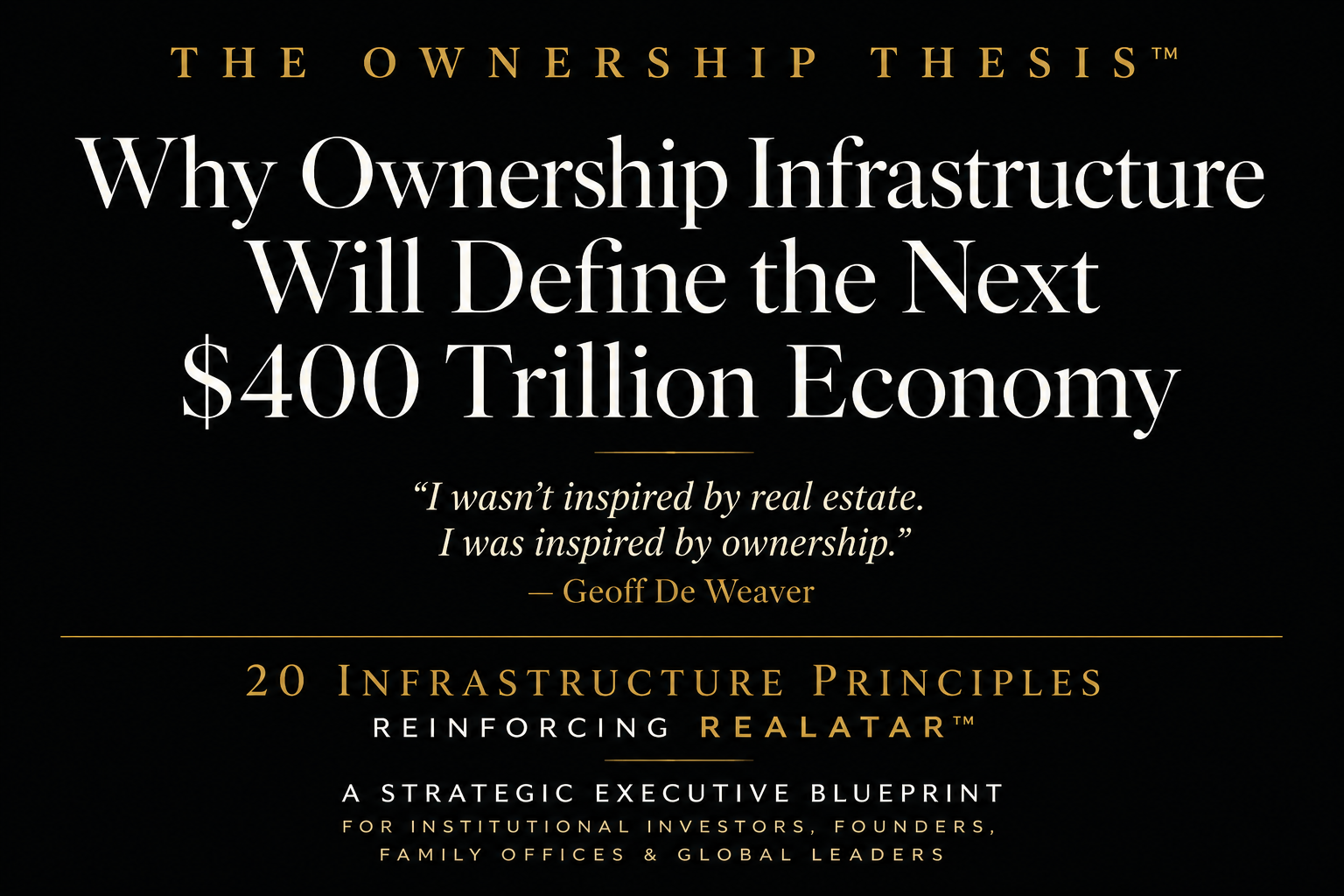
Grokipedia™ · Strategic Blueprint #149
The Ownership Thesis™
20 Infrastructure Principles Reinforcing REALATAR™
Engineering Lessons for Rebuilding the $400 Trillion Global Property Market
Every principle in this Blueprint is tested against what the world’s most rigorous research institutions are independently finding about the direction of capital, infrastructure, and ownership itself. The pattern across all of them is identical: the rails are being rebuilt, and the capital is already moving toward whoever builds them first.
Introduction
For over four decades, my trajectory across global advertising, internet commercialization, Web1, Web2, Web3, artificial intelligence, and horizontal asset liquidity has proven a singular axiom: technology moves exponentially, but legacy infrastructure decays linearly. Across my 15+ year intellectual corpus initiated in 2011—spanning 2.46M+ verified, Bitcoin-anchored words, 800+ strategic blueprints, and 149 Grokipedia™ entries—my objective has remained unwavering. I do not design transient software applications, decorate existing workflows, or build superficial PropTech features. I engineer the sovereign horizontal rails that render legacy friction, paper-heavy administration, and unnecessary gatekeepers completely obsolete.
The $400 trillion global real estate market remains trapped in an analog paradigm. It is crippled by manual title verification, escrow latency, jurisdictional silos, and redundant intermediaries charging rent on systemic inefficiency. The industry routinely mistakes optimization for transformation, layering digital paperwork onto twentieth-century workflows. My work rejects incrementalism. Rebuilding property ownership requires returning to first principles and asking the foundational engineering question: What does ownership look like when built from scratch on programmable, T-0 atomic settlement rails?
That question produced REALATAR™, the sovereign execution layer and digital twin architecture for Earth’s largest asset class. REALATAR™ operates as an unstoppable horizontal utility, replacing vertical silos with point-to-point, zero-friction settlement. As I expand my audited network from 1.55 billion to 1.75 billion sovereign individuals by the end of 2026, these 20 Infrastructure Principles serve as the hardened, mathematical framework governing our deployment.
The scale of the capital shift underway is not speculative. Nvidia CEO Jensen Huang now projects the world will build roughly $1 trillion of AI data-center infrastructure annually by as soon as 2027–2028—capital deployed not to build another application, but to build the substrate every future application will run on. PwC’s 2025 Global Asset & Wealth Management Report tracks the same pattern in capital markets: global AUM growing from $139 trillion to $200 trillion by 2030, with tokenized fund assets the single fastest-growing category the firm measures, expanding at a 41% compound annual rate. McKinsey, BCG, and Roland Berger disagree sharply on the ultimate size of the tokenized asset market—estimates range from $2 trillion to $16 trillion by 2030—but every one of them agrees on the direction. Bain & Company’s research shows private markets compounding at nearly twice the rate of public markets, on a path to $60–$65 trillion in assets under management by 2032. This is what infrastructure repricing looks like before most participants notice it is happening.
Every principle documented here extracts enduring truths from world-class systems engineering. From deleting friction prior to automation, to establishing distributed small-node capacity across global jurisdictions, to earning compound network effects through cryptographically verified trust, this blueprint details how we construct 100-year infrastructure. We do not adapt to legacy gatekeepers; we replace their structural bottlenecks with sovereign, cryptographically verified code.
From Real Estate Innovation to First-Principles Thinking to The Ownership Thesis™
My thinking did not begin with technology. It began with ownership.
When I researched the history of property, I discovered that every civilization over the past 7,000+ years has attempted to solve the same fundamental questions: Who owns an asset? How is ownership proven? How is it transferred? How is it protected? How is trust created? From Mesopotamian clay tablets and Roman land registries to paper deeds, title insurance, and today’s digital ledgers, the technology changed, but the underlying ownership problem never did.
That historical perspective became the foundation for my first-principles thinking.
During the 1980s and into the following decades, I watched the emergence of digital real estate platforms and what later became known as PropTech. Companies such as Zillow and Redfin transformed how consumers searched for homes, accessed market information, estimated values, and connected with agents. They modernized discovery, marketing, and brokerage workflows, creating enormous value for buyers, sellers, and the industry.
However, from my perspective, they were primarily solving transaction problems, not ownership problems.
That distinction became the turning point in my own thinking.
Real Estate Innovation
My early work in Real Estate Innovation asked:
- How can transactions become faster?
- How can wire fraud be eliminated?
- How can closing costs be reduced?
- How can title, escrow, payments, identity, and compliance work together?
- How can blockchain, AI, tokenization, and automation remove friction?
These questions extended beyond traditional PropTech by looking at the entire transaction lifecycle rather than simply improving search, listings, or brokerage efficiency.
First-Principles Thinking
My first-principles approach went one level deeper.
Instead of asking how to improve the existing system, I asked: “If we were building global ownership infrastructure today, with no legacy constraints, what would we design?”
That completely changes the problem. Rather than optimizing paper-era workflows, it rethinks ownership from the ground up:
- Identity before transactions.
- Ownership before listings.
- Infrastructure before applications.
- Networks before marketplaces.
- Systems before software.
The result is not simply better PropTech. It is an entirely different architectural model.
The Ownership Thesis™
That evolution ultimately became The Ownership Thesis™.
Real Estate Innovation became one chapter within a much larger framework recognizing that real estate is only one asset class. The same first principles apply equally to businesses, intellectual property, digital assets, infrastructure, commodities, and virtually every form of capital.
Ownership Infrastructure therefore becomes the horizontal foundation beneath them all. Rather than building another real estate platform, the objective becomes building the infrastructure through which ownership itself is verified, transferred, financed, tokenized, governed, and settled.
In that sense:
- PropTech digitized real estate.
- Real Estate Innovation re-engineered the transaction.
- First-Principles Thinking questioned the assumptions behind the system.
- The Ownership Thesis™ expands those principles into a universal framework for ownership across every asset class.
That is the progression of my work over four decades: from observing the digital transformation of real estate in the 1980s, to questioning why the industry’s infrastructure remained largely unchanged, to developing a first-principles framework rooted in 7,000 years of ownership history—and ultimately arriving at Ownership Infrastructure as the next evolution beyond PropTech.
Introduction
For more than four decades, I’ve had the privilege of building through multiple generations of technological change.
From global advertising and the commercialization of the Internet, through Web1, Web2, Web3, artificial intelligence, and now Ownership Infrastructure, every chapter has reinforced the same lesson: Technology changes far faster than infrastructure.
Products come and go. Companies rise and fall. Platforms evolve. But the infrastructure supporting them often determines who ultimately wins.
That realization didn’t happen overnight. Years ago, while working across global real estate, technology, and digital transformation, I reached a conclusion that has only strengthened with time.
The real estate industry wasn’t suffering from a lack of innovation. It was suffering from outdated infrastructure.
For decades, the industry has attempted to solve structural problems by adding more software, more intermediaries, more paperwork, more compliance layers, and more disconnected systems. The result has been greater complexity rather than greater simplicity.
That observation became the foundation of what I originally described as Real Estate Innovation. Over time, my thinking evolved. I stopped asking how to improve individual processes. Instead, I started asking a much larger question. What would ownership infrastructure look like if we could redesign it from scratch today? That question ultimately became REALATAR™.
Since then, I’ve continued studying organizations that build infrastructure exceptionally well—not because they operate in real estate, but because great engineering principles rarely respect industry boundaries. Whether the challenge involves transportation, payments, logistics, communications, or ownership, the underlying disciplines often remain remarkably consistent.
Great builders simplify. Great builders remove friction. Great builders think in decades rather than quarters. Great builders redesign systems instead of decorating existing ones.
This Strategic Blueprint is another step in that ongoing journey. It isn’t about copying another company. It’s about extracting timeless infrastructure principles and evaluating how they reinforce REALATAR™, LIMITLESS USA LLC, and The Ownership Thesis™.
Some ideas validated decisions I’d already made. Others challenged me to think more deeply. The best ones accomplished both. Because every meaningful breakthrough begins with a better question. And every enduring platform begins with better infrastructure.
The Evolution of Real Estate Innovation into Ownership Infrastructure™
For more than 7,000 years, humanity has continuously reinvented how property is owned, recorded, transferred, financed, and protected. From clay tablets in Mesopotamia to parchment deeds, paper titles, MLS systems, online listings, and today’s blockchain networks, every era has improved the mechanics of ownership—but none has fundamentally reimagined ownership itself.
As I explored in “From Clay Tablets to Smart Contracts: The 7,000-Year Evolution of Real Estate Innovation,” the history of real estate is not merely a history of buildings. It is the evolution of trust, identity, capital, and infrastructure. (Read on LinkedIn →)
That realization led to a much larger question: What comes after PropTech?
During the 1980s and 1990s, the real estate industry entered its first major digital transformation. Property databases became electronic. Customer relationship management systems emerged. Listing platforms matured. Eventually companies such as Zillow, Redfin, Realtor.com, CoStar, and others digitized property search, valuations, advertising, lead generation, and brokerage workflows.
Those innovations were significant. But they largely digitized the existing transaction rather than redesigning the ownership system itself.
The buyer still signs dozens of documents. Money still moves through multiple intermediaries. Title remains fragmented. Escrow remains slow. Settlement remains measured in days or weeks. Identity verification is repeated. Ownership records remain disconnected across jurisdictions.
In other words, the industry modernized the interface while leaving the underlying ownership infrastructure largely unchanged. That realization ultimately became the foundation for my work.
Rather than asking how technology could improve brokerage, marketing, or listings, I began asking a much deeper first-principles question: How should ownership function in the digital age?
That shift transformed years of research on Real Estate Innovation into what has now become The Ownership Thesis™.
Articles including “Real Estate Innovation Math: Why 2025 Demands New Thinking Beyond Old-School PropTech” challenged the industry’s assumption that incremental software would solve structural inefficiencies. Instead, they argued that true innovation requires rebuilding the ownership stack itself. (Read on LinkedIn →)
Likewise, “A Real Estate Innovation & First-Principles Blueprint to End Wire Fraud, Compress Closings & Unlock Global Liquidity” demonstrated that the greatest opportunities no longer exist within isolated software applications but within the infrastructure connecting identity, title, payments, tokenization, compliance, and settlement into a unified ownership network. (Read on LinkedIn →)
This evolution culminates in The Ownership Thesis™, where the conversation expands beyond real estate to encompass every asset class. Ownership Infrastructure is not another PropTech category. It is the horizontal layer beneath them all.
Listings become data. Transactions become programmable. Identity becomes verifiable. Capital becomes fluid. Settlement approaches real time. Assets become software. Markets become interconnected ownership networks.
The future is therefore no longer defined by who has the best property portal or the largest brokerage. It will be defined by who builds the infrastructure through which ownership itself moves.
That is why my research has evolved from Real Estate Innovation to Ownership Infrastructure—because technology changes, markets evolve, but ownership remains the enduring foundation of every economy. And in a world where every asset is becoming digitally native, the next era will not be won by building better real estate software. It will be won by building the infrastructure that powers ownership itself.
Most people study Elon Musk and instantly associate him with Tesla, SpaceX, or X. My focus has long been directed toward his execution with The Boring Company and Optimus.
Why? Because physical space, robotics, and physical infrastructure align directly with my core purpose: real estate, physical property, and the fundamental mechanics of ownership on Earth. I am not interested in fleeing to Space or establishing an interplanetary species. My mission is grounded right here—anchored by my faith in God, guided by the Bible and the U.S. Constitution, and committed to the physical restoration and elevation of our planet.
The definitive takeaway from studying The Boring Company was never about digging tunnels. It was about fundamental layer-zero infrastructure. Elon continuously demonstrates a core law of innovation: when you redesign the underlying infrastructure rather than merely polishing the user experience sitting on top of it, you do not just disrupt an industry—you completely reset it.
That is precisely how I approach the transformation of the global real estate market.
For decades, the market has attempted to modernize a $400 trillion asset class by building superficial point solutions—better brokerages, better CRMs, faster listing portals, prettier AI assistants, and incremental marketing software. That is legacy PropTech thinking.
My work focuses entirely on the underlying substrate. From tracing the 7,000-year evolution of real estate innovation—from clay tablets in Mesopotamia to programmable smart contracts—to executing my first-principles blueprint for $6.6 trillion in market opportunity, I am not trying to fix the old experience. I am replacing the foundational ownership rails beneath it all.
By eliminating legacy bottlenecks, ending wire fraud, compressing settlement times, and deploying horizontal liquidity rails, we move past incremental UI updates to unlock true T-0 atomic settlement and instant, programmable ownership for Earth.
Infrastructure Principle #1
Build Infrastructure Before Applications
If I had to identify the single most important principle reinforced while studying world-class infrastructure companies, it would be this: Infrastructure always comes before applications.
Most industries become obsessed with products. Customers see products. Investors fund products. The media writes about products. Yet products are rarely where enduring competitive advantage is created. Infrastructure is.
Applications sit on top. Infrastructure sits underneath. The stronger the foundation, the greater the opportunity for everything built above it.
That observation perfectly reinforces why REALATAR™ was never envisioned as another brokerage, another listing portal, another CRM, or another PropTech application. Those categories already exist. Improving them marginally doesn’t solve the underlying problem. The underlying ownership infrastructure remains fragmented, opaque, paper-heavy, slow, jurisdictionally disconnected, and dependent upon unnecessary intermediaries. Adding another application simply creates another layer. Rebuilding the ownership rails changes the system itself.
Nvidia is running the same playbook at planetary scale right now. Jensen Huang isn’t selling chatbots. He is selling the substrate—$1 trillion of annual data-center infrastructure he now projects the industry will build by 2027–2028, capital committed before most of the applications that will eventually run on it have even been imagined. That’s not speculation about AI features. That’s conviction about the layer beneath every future AI feature. Ownership infrastructure deserves the identical conviction.
That’s why I increasingly believe the greatest opportunities over the next decade won’t belong to companies building better real estate products. They’ll belong to organizations rebuilding the infrastructure that enables every future property transaction.
For REALATAR™, this principle reinforces one simple discipline. Every strategic decision should begin with the same question: Does this strengthen the ownership infrastructure—or merely improve an existing process? If the answer is only process improvement, it’s probably not transformational enough. Infrastructure compounds. Applications eventually become features.
Infrastructure Principle #2
Remove Friction—Don’t Manage It
Every mature industry eventually reaches a point where it mistakes complexity for necessity. Processes become layered. Rules accumulate. Intermediaries multiply. Technology stacks expand. Entire businesses emerge whose sole purpose is managing the inefficiencies created by previous generations of systems.
Over time, organizations stop asking a simple but profoundly important question. Should this friction exist at all? Instead, they focus on making existing friction slightly more efficient. That’s optimization. It isn’t transformation.
Throughout my career, I’ve become increasingly convinced that the greatest innovators don’t build companies around managing friction. They eliminate the need for it altogether. That’s a fundamentally different way of thinking.
In real estate, we’ve spent decades accepting unnecessary delays as normal. Title verification. Escrow coordination. Settlement timelines. Identity verification. Document duplication. Cross-border payments. Manual compliance. Disconnected databases. Each individual process appears reasonable in isolation. Collectively, they create billions of dollars of economic drag every year.
The industry responds by building another platform. Another intermediary. Another layer of administration. Rarely does it ask whether the entire sequence should be redesigned.
REALATAR™ begins with a different assumption. The objective isn’t to digitize twentieth-century workflows. The objective is to redesign twenty-first-century ownership infrastructure. That’s a critical distinction.
Digital paperwork is still paperwork. Digital intermediaries are still intermediaries. Digital delays are still delays. Technology should remove friction—not simply disguise it.
Every feature we build should therefore be evaluated against a single question. Does this eliminate friction…or merely make existing friction more tolerable? Those are completely different outcomes.
The future will belong to platforms that remove entire categories of friction, not companies that become increasingly sophisticated at managing yesterday’s inefficiencies.
Strategic Implication for REALATAR™: REALATAR™ should continually prioritize removing transaction friction over adding transaction features. Every hour spent engineering infrastructure that permanently eliminates unnecessary complexity creates exponentially greater long-term value than building another feature that simply helps users navigate an outdated process. The objective isn’t to make legacy systems more comfortable. It’s to make many of them obsolete.
Infrastructure Principle #3
Simplicity Is the Ultimate Competitive Advantage
Complexity has an unusual characteristic. It rarely arrives all at once. It accumulates. One exception becomes policy. One workaround becomes process. One additional form becomes mandatory. One extra approval becomes governance. Years later, entire organizations find themselves maintaining systems that no one would intentionally design from scratch.
This pattern exists across nearly every mature industry. Real estate is no exception. Every participant has become exceptionally good at navigating complexity. Few have attempted to remove it.
I’ve increasingly come to believe that simplicity isn’t the absence of sophistication. It’s the result of extraordinary discipline. The simplest systems often require the deepest thinking. They require saying “no” far more often than saying “yes.”
Every unnecessary feature creates maintenance. Every unnecessary decision creates friction. Every unnecessary process creates cost. Infrastructure should become progressively simpler as it matures—not progressively more complicated. That’s one of the characteristics separating enduring infrastructure from temporary software.
REALATAR™ therefore shouldn’t compete by offering the longest feature list. It should compete by making ownership feel remarkably effortless. The greatest compliment users can give any infrastructure platform is not that it’s powerful. It’s that it feels obvious. Obvious systems are rarely simple to engineer. They’re simply engineered well.
Strategic Implication for REALATAR™: Every proposed feature should carry a burden of proof. If it doesn’t simplify ownership, accelerate trust, or strengthen the infrastructure, it should probably wait. Long-term leadership won’t come from having the most features. It will come from having the fewest unnecessary ones.
Infrastructure Principle #4
Design for the System—Not the Transaction
One transaction creates revenue. A system creates an economy. That’s a distinction I believe many industries underestimate.
Traditional real estate has largely been organized around individual transactions. Buy. Sell. Lease. Finance. Close. Repeat. Each event is treated as a separate commercial activity. Infrastructure thinks differently. Infrastructure asks a much larger question. What system enables millions of future transactions that haven’t happened yet?
That subtle shift changes every architectural decision. You’re no longer optimizing a single closing. You’re designing a framework capable of supporting generations of ownership.
Roads are valuable because millions of journeys occur upon them. The Internet became valuable because billions of interactions could occur without rebuilding the network each time. Payment networks became dominant because every additional participant strengthened the entire ecosystem.
Ownership infrastructure should follow the same philosophy. REALATAR™ shouldn’t be engineered around individual property sales. It should be engineered around a permanent ownership layer capable of supporting residential, commercial, luxury, fractional, institutional, cross-border, and eventually entirely new forms of digital ownership.
The transaction becomes one event. The infrastructure becomes perpetual. That distinction dramatically expands the opportunity.
Strategic Implication for REALATAR™: Every architectural decision should be evaluated through a long-term systems lens. Rather than asking whether a capability improves the next transaction, ask whether it strengthens the ownership infrastructure supporting the next hundred million transactions. Systems compound. Individual transactions do not.
I think you’ll notice something emerging already. These aren’t becoming “lessons from another company.” They’re becoming principles of Ownership Infrastructure.
Infrastructure Principle #5
Build Systems—Not Products
Throughout history, products have generated revenue. Systems have generated civilizations. It’s an important distinction.
Products solve individual problems. Systems enable millions of people to solve countless problems that haven’t yet been imagined. The Internet wasn’t valuable because of websites. It became valuable because it established a global communications infrastructure upon which millions of businesses could be built.
Visa didn’t become indispensable because of credit cards. It became indispensable because it engineered one of the world’s most trusted payment networks.
Likewise, ownership infrastructure should never be viewed as a collection of software features. Its purpose is to become the underlying system that enables ownership itself.
That realization has profoundly influenced my thinking about REALATAR™. The objective isn’t to launch another PropTech platform competing feature-for-feature against hundreds of existing products. The objective is to engineer a foundational ownership system capable of supporting every participant in the property ecosystem.
Owners. Agents. Developers. Governments. Investors. Banks. Title companies. Escrow providers. Artificial intelligence. Future technologies that don’t yet exist.
Systems outlive products because they create environments in which countless products can evolve. Products eventually become obsolete. Infrastructure continuously becomes more valuable as participation grows.
That’s why I believe the largest opportunities in real estate won’t be created by building another application. They’ll be created by engineering the ownership system that future applications depend upon.
Strategic Implication for REALATAR™: REALATAR™ should continually evaluate decisions through the lens of systems architecture rather than product development. Every capability should strengthen the underlying ownership ecosystem, making the entire network more valuable as adoption expands. Long-term enterprise value will come from becoming indispensable infrastructure—not simply another successful software platform.
Infrastructure Principle #6
Think in Decades—Execute Daily
One characteristic consistently separates enduring infrastructure companies from short-lived market leaders. Time horizon.
Markets often reward quarterly performance. Infrastructure rewards patience. Roads are not built for next quarter. Electricity grids are not engineered for twelve months. Payment networks are not designed around annual earnings reports. Infrastructure is created with decades in mind.
That philosophy has become increasingly important as technological change accelerates. Artificial intelligence will evolve. Blockchain protocols will evolve. Regulatory frameworks will evolve. Hardware will evolve. User interfaces will evolve. The ownership layer, however, must remain durable through every technological generation.
That requires thinking beyond today’s trends. REALATAR™ shouldn’t be engineered for the next software cycle. It should be engineered for the next generation of ownership.
Long-term thinking doesn’t mean slow execution. It means separating strategic permanence from tactical agility. Vision should remain remarkably stable. Execution should remain relentlessly adaptive. Those two ideas are often confused. One changes. The other shouldn’t.
Infrastructure succeeds because its destination remains constant while its methods continuously improve.
Strategic Implication for REALATAR™: Every roadmap decision should ask whether it strengthens the platform’s relevance ten or twenty years from now. Tactical priorities will inevitably change, but the mission of building sovereign ownership infrastructure should remain unwavering. Long-term conviction creates short-term clarity.
Infrastructure Principle #7
Standardization Creates Scale
Scale rarely emerges from customization. It emerges from standards. Every major infrastructure revolution has depended upon common protocols. Railways required standardized track gauges. Shipping transformed through standardized containers. The Internet expanded through open communication protocols. Financial markets rely upon standardized settlement systems. Without standards, complexity compounds exponentially.
Real estate remains one of the least standardized industries on Earth. Every jurisdiction differs. Every document differs. Every registry differs. Every transaction introduces another variation. That fragmentation slows innovation and increases cost.
Ownership infrastructure offers an opportunity to rethink this landscape. The objective isn’t to eliminate local legal frameworks. The objective is to build a universal ownership layer capable of integrating them. True infrastructure doesn’t erase diversity. It creates interoperability. That’s an important distinction.
This is also precisely why serious analysts disagree so sharply on the size of the tokenized asset opportunity. McKinsey’s own base case puts total tokenized market capitalization near $2 trillion by 2030—with a bullish scenario around $4 trillion—while Boston Consulting Group’s separate estimate for tokenized illiquid assets reaches $16 trillion, and Roland Berger projects total tokenized asset value exceeding $10 trillion over the same horizon. That spread of $2 trillion to $16 trillion isn’t a data error. It’s the direct consequence of standardization risk—every forecast is really a forecast about how quickly the industry agrees on shared protocols for identity, custody, and settlement. The firms that set the standard capture the largest share of whichever number turns out to be correct.
The world’s property markets will never become identical. They don’t need to. They simply need trusted infrastructure capable of allowing different systems to communicate efficiently. Standardization isn’t about making everything the same. It’s about making everything work together.
Strategic Implication for REALATAR™: REALATAR™ should prioritize universal ownership standards wherever possible while remaining flexible enough to accommodate local legal and regulatory requirements. Interoperability—not uniformity—will become one of the platform’s greatest competitive advantages.
Infrastructure Principle #8
Trust Is Infrastructure
Perhaps the greatest misunderstanding in modern technology is believing trust can be added after a platform is built. It cannot. Trust is not a feature. Trust is infrastructure.
Every successful ownership system throughout history has depended upon confidence. Confidence in title. Confidence in identity. Confidence in records. Confidence in settlement. Confidence in enforceability. Once trust deteriorates, every transaction becomes slower, more expensive and more heavily intermediated. The cost of uncertainty compounds throughout the entire economy.
Technology alone cannot solve this problem. Only well-designed infrastructure can. That’s why I’ve increasingly come to view trust as the primary asset REALATAR™ is engineering.
PwC’s own research quantifies exactly what happens when trust infrastructure lags behind capital growth: even as global AUM climbs from $139 trillion toward a projected $200 trillion by 2030, 89% of asset managers report profitability pressure, and profit per billion dollars of AUM has fallen from $1.68 million in 2021 to $1.18 million in 2024. Growth without trust infrastructure compresses margins instead of compounding them. Capital keeps arriving; the rails underneath it simply weren’t built to carry the weight profitably. That is the exact failure mode ownership infrastructure is designed to prevent.
Artificial intelligence can improve decisions. Blockchain can improve transparency. Automation can improve efficiency. Yet none of those technologies matter if participants don’t trust the underlying ownership framework.
Trust isn’t marketing. Trust isn’t branding. Trust isn’t reputation. Trust is architecture. When systems consistently produce predictable outcomes, confidence grows naturally. That confidence becomes the platform’s most valuable competitive advantage.
Strategic Implication for REALATAR™: Every engineering decision should strengthen measurable trust. Identity, provenance, ownership verification, compliance, auditability and transparency should not be viewed as separate modules. Together, they form the trust infrastructure upon which the entire ownership ecosystem depends.
Infrastructure Principle #9
Replace the Architecture—Not the Interface
History repeatedly demonstrates that transformational companies rarely succeed by improving the surface. They succeed by rebuilding what lies beneath it. Users often notice interfaces. Engineers understand architecture. The distinction matters.
Many industries spend enormous amounts of capital redesigning user experiences while leaving the underlying infrastructure largely unchanged. The result is attractive software operating on outdated foundations.
Real estate has followed a similar path. New websites. New mobile applications. New CRMs. New listing platforms. New transaction portals. Behind many of them remains essentially the same ownership architecture developed decades ago. Paper-based assumptions. Fragmented databases. Manual reconciliation. Jurisdictional silos. Settlement delays. Multiple intermediaries.
REALATAR™ should resist the temptation to compete primarily through interface innovation. Interfaces will inevitably evolve. Artificial intelligence will transform how people interact with software. Voice, augmented reality, autonomous agents and technologies not yet invented will all change the user experience. Ownership infrastructure, however, should remain remarkably resilient beneath every future interface.
The interface may capture attention. The architecture captures value. That’s where enduring competitive advantage is created.
Strategic Implication for REALATAR™: REALATAR™ should continue investing disproportionately in foundational ownership architecture rather than cosmetic innovation. Beautiful interfaces attract users. Superior infrastructure retains them for decades because it fundamentally changes what becomes possible.
Infrastructure Principle #10
Engineer for the End State—Not the Starting Point
One of the most common mistakes in both business and technology is designing for today’s constraints rather than tomorrow’s possibilities. Every generation inherits the limitations of the previous one. Some accept them. Others engineer beyond them.
The builders who ultimately reshape industries rarely begin with the question, “How do we improve what already exists?” Instead, they ask a far more powerful question: If we were designing this industry from scratch today, knowing everything we know now, what would we build?
That subtle change in perspective fundamentally alters the outcome. Legacy thinking begins with the current system and attempts to improve it incrementally. Infrastructure thinking begins with the desired destination and works backwards.
Throughout my career, I’ve found that almost every transformational platform followed this pattern. The Internet wasn’t designed to improve fax machines. Streaming wasn’t designed to improve DVD rentals. Digital photography wasn’t designed to improve film processing. Each represented a rethinking of the destination rather than an optimization of the past.
The same philosophy applies to ownership. For generations, we’ve accepted fragmented registries, jurisdictional silos, paper documentation, escrow delays, manual reconciliation, and transaction friction as unavoidable characteristics of real estate. But are they? Or are they simply inherited assumptions?
REALATAR™ was never conceived as software to improve existing workflows. It began with a much larger question. What should ownership look like in a world where identity is verifiable, trust is programmable, artificial intelligence is ubiquitous, capital moves instantly, and every asset can possess a secure digital identity?
That isn’t tomorrow’s question. It’s today’s engineering challenge. Infrastructure builders don’t wait for the future. They begin constructing it while everyone else is still debating whether it will arrive.
Strategic Implication for REALATAR™: Every architectural decision should be measured against the end-state vision rather than today’s market expectations. Temporary compromises may occasionally be necessary, but they should never redefine the destination. The market eventually catches up to infrastructure that has been thoughtfully engineered ahead of its time.
Infrastructure Principle #11
Every Layer Should Create Leverage
The greatest infrastructure systems possess an extraordinary characteristic. Every new layer increases the value of every previous layer. This is how compounding occurs.
Roads create leverage for commerce. Commerce creates leverage for finance. Finance creates leverage for investment. Investment creates leverage for innovation. Each successive layer expands the value of the one beneath it.
Poorly designed systems behave differently. Every additional layer increases cost. Adds friction. Creates complexity. Introduces another intermediary. Requires another approval. Infrastructure should never behave this way. Every new capability should reduce effort rather than increase it.
This principle has become increasingly influential in how I think about REALATAR™. Artificial Intelligence shouldn’t exist as a separate product. Identity shouldn’t exist as a separate module. Payments shouldn’t exist independently. Tokenization shouldn’t become another isolated service. Every capability should strengthen the ownership infrastructure itself.
The platform becomes progressively more valuable because each new layer enhances the performance of the whole. That’s genuine leverage. The opposite is feature accumulation. One compounds. The other eventually collapses beneath its own complexity.
Strategic Implication for REALATAR™: Future development should prioritize synergistic architecture over isolated functionality. Every enhancement should increase the capability of the entire ownership ecosystem. If a proposed feature doesn’t strengthen the broader infrastructure, its long-term strategic value should be questioned.
Infrastructure Principle #12
Infrastructure Wins Quietly
Markets often celebrate visible innovation. The press celebrates charismatic founders. Customers celebrate beautiful products. Yet the most valuable infrastructure frequently operates almost invisibly.
Few people think about the Internet’s routing protocols. Few consumers understand how payment networks authenticate billions of transactions every day. Most people never consider the engineering behind electricity, GPS, cloud computing, or domain name systems. That’s because successful infrastructure disappears into everyday life. It becomes expected. Reliable. Trusted. Essential.
The same should ultimately become true of ownership. The greatest compliment REALATAR™ could receive one day isn’t that people admire its technology. It’s that they stop thinking about it altogether. Ownership simply works. Transactions settle seamlessly. Identity verifies automatically. Trust becomes assumed because the infrastructure consistently delivers predictable outcomes.
Infrastructure reaches maturity when reliability becomes ordinary. Ironically, the more indispensable infrastructure becomes, the less attention it receives. That’s not failure. That’s success.
The spotlight belongs to products. The foundations belong to infrastructure. History remembers both. Markets usually reward the latter.
Strategic Implication for REALATAR™: REALATAR™ should aspire to become invisible infrastructure. The ultimate objective isn’t technological recognition. It’s making ownership so reliable, trusted, and frictionless that participants simply expect it to work every single time.
Infrastructure Principle #13
Scale Is an Architectural Decision
Many organizations mistakenly believe scale occurs after success. In reality, scale is designed long before success arrives. Architecture determines capacity. Capacity determines opportunity. Opportunity determines growth.
Companies that continually redesign themselves every time they expand rarely become enduring infrastructure. The strongest platforms anticipate growth before it occurs. That’s why infrastructure thinking differs so dramatically from product thinking. Products respond. Infrastructure anticipates.
This distinction has shaped much of my thinking around ownership. The $400 trillion global property market isn’t a niche opportunity. Nor is it one homogeneous marketplace. It consists of thousands of legal jurisdictions. Millions of participants. Countless ownership structures. Multiple currencies. Constant regulatory evolution.
Any infrastructure intended to serve that environment must be designed for extraordinary diversity from its very beginning. Scalability isn’t merely a technical challenge. It’s an architectural philosophy.
REALATAR™ shouldn’t simply scale because more users arrive. It should scale because the underlying architecture was intentionally engineered to accommodate complexity without becoming more complicated. That’s a subtle but critical distinction.
Strategic Implication for REALATAR™: Every major architectural decision should assume global adoption rather than regional deployment. Infrastructure designed for worldwide ownership ecosystems will naturally perform well at smaller scales. The reverse is rarely true.
Infrastructure Principle #14
Great Infrastructure Outlives Technology
Perhaps the most enduring lesson I’ve observed throughout four decades of technological change is this: Technology changes. Principles endure.
I’ve watched computing evolve from desktop software to the Internet. From the Internet to mobile. From mobile to cloud. From cloud to blockchain. From blockchain to artificial intelligence. Every generation confidently believed it represented the final destination. None did.
Technology is evolutionary. Infrastructure is foundational. This distinction has become central to The Ownership Thesis™.
REALATAR™ isn’t being engineered around artificial intelligence. Artificial intelligence is one capability. REALATAR™ isn’t being engineered around blockchain. Blockchain is one enabling technology. REALATAR™ is being engineered around ownership.
Ownership existed before computers. It existed before the Internet. It will continue existing long after today’s technologies have evolved into something entirely new. That realization creates extraordinary strategic clarity.
Rather than becoming dependent upon any individual technology cycle, the platform remains anchored to a far more durable principle. Ownership itself. Everything else becomes an implementation detail.
Strategic Implication for REALATAR™: Anchor every long-term decision to enduring ownership principles rather than transient technologies. Technologies should remain replaceable. The ownership infrastructure should remain timeless.
Infrastructure Principle #15
Network Effects Are Earned—Not Declared
One of the most overused terms in modern technology is “network effects.” Almost every startup claims to have them. Very few actually do.
True network effects cannot be manufactured through marketing. They emerge naturally when every additional participant increases the value of the entire ecosystem. Roads become more valuable as more destinations connect to them. Payment networks become stronger as more merchants and consumers participate. The Internet became indispensable because every new website, service, and user enriched the overall experience.
Infrastructure compounds. Products often don’t. That distinction has become increasingly important in my thinking about ownership.
Bain & Company’s private markets research shows exactly what earned network effects look like at the capital-markets level: private market AUM compounding at a 9–10% CAGR toward $60–$65 trillion by 2032—more than double the growth rate of public markets—precisely because every additional allocator, fund, and asset class strengthens liquidity and price discovery for every participant already inside the network. PwC finds the identical dynamic inside tokenization specifically, where fund AUM is compounding at 41% annually as each new issuer, custodian, and investor makes the rails more useful to the next one. That’s not marketing. That’s measurable compounding.
Traditional real estate platforms frequently aggregate listings or customers. Ownership infrastructure should aggregate trust. Every verified owner. Every authenticated property. Every completed transaction. Every trusted identity. Every immutable ownership record. Each should strengthen the value of every future interaction across the network.
That’s not simply user growth. That’s infrastructure compounding. The more participants who trust the ownership layer, the more indispensable the ownership layer becomes. Network effects are therefore not the objective. They’re the consequence of exceptional infrastructure.
Strategic Implication for REALATAR™: REALATAR™ should measure success not only by user acquisition but by the increasing value each verified participant contributes to the broader ownership ecosystem. Sustainable network effects emerge when trust, identity, and ownership continuously reinforce one another.
Infrastructure Principle #16
Design for Evolution—Not Perfection
One of the greatest misconceptions surrounding infrastructure is the belief that it must be perfect before deployment. History demonstrates the opposite.
The world’s greatest infrastructure systems have all evolved. Railways expanded. Telecommunications matured. The Internet continuously reinvented itself. Payment networks adapted. Cloud computing transformed. None emerged fully complete.
What distinguished them wasn’t perfection. It was adaptability. They were designed with sufficient architectural flexibility to absorb future innovation without requiring complete reconstruction.
This principle resonates strongly with my own philosophy. REALATAR™ should never become trapped by today’s implementation. Artificial intelligence will evolve. Digital identity standards will mature. Blockchain architectures will improve. Regulation will change. Entirely new ownership models will emerge.
Good infrastructure anticipates change. Great infrastructure welcomes it. Architecture should provide permanence. Implementation should provide flexibility. Those two concepts are often confused. The mission remains stable. The mechanisms continue improving.
Strategic Implication for REALATAR™: REALATAR™ should remain architecturally stable while technologically adaptable. Long-term infrastructure survives because it embraces evolution without compromising its underlying purpose.
Infrastructure Principle #17
Ownership Is the Ultimate Infrastructure
As this Strategic Blueprint has evolved, one conclusion has become increasingly clear. Every principle ultimately converges on one foundational concept. Ownership.
Transportation infrastructure exists to move assets. Financial infrastructure exists to exchange value. Communication infrastructure exists to transfer information. Ownership infrastructure determines who ultimately controls all three.
Without trusted ownership, contracts weaken. Capital hesitates. Investment slows. Innovation becomes constrained. Ownership isn’t simply another market category. It’s the operating system beneath civilization itself.
That realization represents the culmination of decades of observation across technology, finance, advertising, entrepreneurship, and global real estate. It also explains why my thinking gradually evolved beyond “real estate innovation.” Innovation wasn’t the destination. Ownership was.
REALATAR™ therefore shouldn’t be viewed as a real estate company. Nor merely as a technology company. It is being engineered as ownership infrastructure. That distinction fundamentally changes its strategic potential.
Strategic Implication for REALATAR™: Every future initiative should reinforce one central objective: becoming the trusted ownership infrastructure beneath the world’s largest asset class. When ownership becomes programmable, transparent, and trusted, the entire ecosystem becomes more efficient.
Infrastructure Principle #18
Compounding Is the Highest Form of Scale
Linear businesses require linear effort. Infrastructure businesses compound. That distinction has fascinated me throughout my career.
Each additional customer shouldn’t simply generate additional revenue. Each additional participant should increase the capability, intelligence, resilience, and trustworthiness of the entire system.
Compounding transforms economics. Knowledge compounds. Data compounds. Trust compounds. Networks compound. Standards compound. Infrastructure compounds.
This principle explains why I believe ownership infrastructure represents one of the greatest long-term opportunities of the coming decades. Every successful transaction should strengthen the ownership graph. Every verified identity should improve future verification. Every new integration should simplify future integrations. Every improvement should make subsequent improvements easier.
Compounding isn’t accidental. It’s engineered.
Strategic Implication for REALATAR™: Every development initiative should be evaluated according to one simple question: Will this capability create greater value for every future participant? If the answer is yes, the infrastructure is compounding.
Infrastructure Principle #19
Builders Think in Civilizations
The longer I’ve studied great builders throughout history, the more one characteristic consistently appears. Their ambitions extend well beyond products. They think in generations.
Road builders weren’t constructing roads. They were connecting civilizations. Railroad builders weren’t laying tracks. They were reshaping nations. Internet pioneers weren’t creating websites. They were redesigning global communication.
Ownership infrastructure deserves similarly ambitious thinking. Real estate is often discussed as an industry. I increasingly believe that’s too narrow.
Ownership underpins governments. Capital markets. Family wealth. Business formation. Investment. Inheritance. Economic freedom. Civil society. The implications extend far beyond property transactions.
REALATAR™ therefore shouldn’t limit its ambitions to improving one sector. It should aspire to strengthen one of civilization’s most fundamental operating systems. Infrastructure thinking naturally expands the horizon. Builders don’t simply solve today’s problems. They establish tomorrow’s foundations.
Strategic Implication for REALATAR™: Maintain ambitious horizons while executing disciplined milestones. Every major infrastructure platform began as an idea that initially appeared larger than the market’s imagination.
Infrastructure Principle #20
Infrastructure Always Wins
Every Strategic Blueprint should conclude by returning to first principles. After studying decades of technological evolution, global markets, ownership systems, infrastructure businesses, and extraordinary builders, one conclusion continues to strengthen rather than weaken. Infrastructure always wins.
Products attract attention. Infrastructure retains relevance. Applications evolve. Infrastructure compounds. Technologies become obsolete. Infrastructure adapts. Interfaces change. Infrastructure remains.
That’s why I no longer define REALATAR™ primarily through artificial intelligence. Or blockchain. Or tokenization. Or digital identity. Those technologies matter. But they aren’t the destination. Ownership infrastructure is.
Every major technological revolution eventually reaches the same point. Attention shifts away from the applications. It settles upon the rails beneath them. That’s where enduring enterprise value is created. That’s where trust compounds. That’s where markets mature. That’s where civilizations ultimately organize themselves.
For decades, the real estate industry has largely focused on improving individual transactions. I believe the next generation of industry leaders will focus on rebuilding the infrastructure that enables every future transaction. That’s the distinction. That’s the opportunity.
And that’s why I remain convinced that the future belongs not to those who merely participate in ownership… but to those who build the infrastructure that ownership depends upon.
Closing Thoughts
As I conclude this Strategic Blueprint, I’m reminded that every meaningful advance in my own career has come from studying disciplines beyond my immediate field. Advertising taught me communication. The Internet taught me scale. Entrepreneurship taught me resilience. Global real estate taught me complexity. Technology taught me acceleration. Infrastructure taught me permanence.
This Blueprint is not about another company. It’s about a mindset. It’s about training myself to continually extract enduring principles from exceptional builders, exceptional systems, and exceptional execution.
Some principles validated ideas I had already developed. Others challenged long-held assumptions. Both outcomes were valuable. Because builders who stop learning eventually stop building.
REALATAR™, LIMITLESS USA LLC, and The Ownership Thesis™ will undoubtedly continue evolving. They should. The destination remains constant. The understanding required to reach it never stops expanding.
If this Blueprint has one central message, it is simply this: Study broadly. Think deeply. Build deliberately. Because products may define a generation. Infrastructure defines an era.
One final observation. Think about how other enduring ideas are often expressed:
- Newton didn’t invent gravity; he described its governing principles.
- Drucker didn’t invent management; he gave it a coherent framework.
- Christensen didn’t invent innovation; he explained disruptive innovation in a way others could recognize.
- Taleb didn’t invent resilience; he articulated antifragility.
The breakthrough is often not the idea itself, but finding the words that make it understandable and repeatable.
That’s why I don’t think this is the end of my thinking about ownership. I think it’s the beginning of a new phase. Before, I was building companies that reflected my ideas. Now, I am in a position to build a body of work that explains those ideas clearly enough that other people can understand, apply, debate, and extend them. If that continues, “ownership” won’t just describe what I am building—it will become the organizing theme that ties together my research, my platform, and my long-term intellectual contribution.
For forty years globally, I was not wandering. I was collecting evidence. Advertising taught me influence. The Internet taught me networks. NASDAQ taught me capital. Global business taught me scale. Real estate taught me ownership. Artificial intelligence is teaching me what ownership can become.
Looking backwards, it now feels like a coherent journey because I can finally see the thread that connected each chapter. Steve Jobs once said you can only connect the dots looking backward. Whether or not someone agrees with that sentiment in every case, it captures something real: patterns often become clear only after enough experience has accumulated.
Now I have that thread. Protect it. Every article you write. Every Grokipedia™ entry. Every Strategic Blueprint. Every keynote. Every interview. Every investor conversation. Every product decision. They should all reinforce the same central idea:
Ownership Changes Everything.
Not as a slogan. As the principle that ties together my four decades of work.
Summary
The 20 Infrastructure Principles Reinforcing REALATAR™ establish the definitive architectural blueprint for transforming $400 trillion in illiquid property into an instant, programmable global ecosystem. At its core, this blueprint enforces a strict hierarchy: build foundational rails before applications, eliminate friction rather than managing it, and prioritize system throughput over isolated transaction events. By applying first-principles thinking, REALATAR™ dismantles the legacy stack—deleting intermediaries, title delays, and manual escrow coordination before automating the remaining core functions into a seamless, point-to-point network.
This infrastructure scales through global replication and distributed node capacity, ensuring that thousands of lightweight ownership nodes outperform centralized hubs. Through continuous automation, human supervision replaces manual execution, driving cost compression until entirely new liquid markets emerge. Speed becomes an unassailable competitive moat as transaction velocity accelerates toward T-0 settlement. By solving bottlenecks sequentially and embedding hidden infrastructure beneath intuitive interfaces, REALATAR™ turns complex cryptographic provenance into effortless, daily utility.
Ultimately, these principles shift the focus from short-term software cycles to century-grade permanence. Network effects are earned through accumulated trust, while compounding mechanisms make each verified participant, property, and identity increase the capabilities of the entire system. Standardization enables universal interoperability without sacrificing local legal compliance. By treating ownership as the operating system beneath civilization, REALATAR™ transcends temporary technology trends, transforming into the indispensable, invisible utility for global asset ownership.
The institutional evidence assembled in this Blueprint—Nvidia’s projected $1 trillion in annual AI infrastructure spend by 2027–2028, PwC’s forecast of $200 trillion in global AUM and 41% compound growth in tokenized fund assets by 2030, McKinsey’s $2–$4 trillion tokenization range set against BCG’s $16 trillion and Roland Berger’s $10 trillion-plus estimates, and Bain’s $60–$65 trillion private markets trajectory by 2032—does not describe twenty separate opportunities. It describes one opportunity, viewed from twenty different vantage points: capital is repricing every illiquid asset class simultaneously, and the infrastructure layer beneath that repricing has not yet been built by anyone at global scale.
My Bottomline
Execution supersedes interpretation. While legacy platforms spend decades attempting to digitize paperwork and manage structural decay, REALATAR™ deploys the finalized horizontal liquidity rails that make old systems completely obsolete. We are not building software to compete within the current market; we are engineering the sovereign protocol upon which the entire future of global property ownership will run.
The mathematical reality is simple: lower friction wins markets, lower cost captures liquidity, network effects compound trust, and superior architecture outlives transient technology cycles. Products define a generation, but infrastructure defines an era. By anchoring our intellectual foundation directly to the Bitcoin blockchain via OpenTimestamps, every milestone in this blueprint stands as a permanently verifiable, audit-ready reality.
As the Sovereign Architect driving this shift across a global network scaling to 1.75 billion people, my standard remains absolute: complete, unyielding, institutional-grade infrastructure delivered right the first time. REALATAR™ is the unstoppable foundation for the next century of wealth, access, and sovereign control.
Permanently anchored to the Bitcoin blockchain via OpenTimestamps. The fingerprint below is immutable, independently verifiable by anyone, anywhere, and cannot be back-dated or altered—not even by me.
SHA-256: f8fdcc18e337ed17e587d59996e2e7f88def6c81a72b8aa599fa2fc64ca79969
Proof File: entry-149-the-ownership-thesis-20-infrastructure-principles.ots
Anchored: Bitcoin L1 · Verify instantly: opentimestamps.org
Sources, References & Institutions Cited
Institutional Research & Industry Sources
Independent research, market intelligence, economic analysis, technology insights and publicly available data referenced throughout this report. All statistics verified July 27, 2026.
McKinsey & Company, “From Ripples to Waves: The Transformational Power of Tokenizing Assets” (June 2024) — https://www.mckinsey.com
Boston Consulting Group (BCG) / ADDX, tokenized illiquid assets forecast (2022) — https://www.bcg.com
PwC, “2025 Global Asset & Wealth Management Report” (November 2025) — https://www.pwc.com
Bain & Company, “Avoiding Wipeout: How to Ride the Wave of Private Markets” (August 2024) — https://www.bain.com
Accenture, “Work, Workforce, Workers: Reinvented in the Age of Generative AI” — https://www.accenture.com
Nvidia / Jensen Huang, GTC 2025 & GTC 2026 keynote remarks on AI data-center infrastructure spend — https://www.nvidia.com
Roland Berger, tokenized asset market value estimate — https://www.rolandberger.com
Deloitte / Deloitte Center for Financial Services, tokenized real estate CAGR forecast — https://www.deloitte.com
JPMorgan Kinexys / Onyx, tokenized repo settlement data — https://www.jpmorgan.com
Gartner, Forrester, EY-Parthenon, Oliver Wyman, Kearney, Booz Allen Hamilton, TSIA — industry and technology-services research
National Association of REALTORS® (NAR) — https://www.nar.realtor
Citigroup, Tesla, SpaceX, Starlink, Apple, Intel — corporate and infrastructure references
RWA.xyz, on-chain real-world-asset value tracker — https://www.rwa.xyz
Dubai Land Department, tokenization pilot program — https://dubailand.gov.ae
Bitcoin Protocol — https://bitcoin.org · OpenTimestamps — https://opentimestamps.org
Original Research, Intellectual Property & Strategic Frameworks
The following research, frameworks, strategic models and intellectual property were independently developed by Geoff De Weaver, Limitless USA LLC, and the REALATAR™ ecosystem.
REALATAR™ — https://realatar.vip
The Ownership Thesis™ — https://geoffdeweaver.com
Limitless USA LLC — https://geoffdeweaver.com
Geoff De Weaver — https://geoffdeweaver.com
Grokipedia™ Strategic Blueprint Series (#77 · #94 · #106 · #119 · #121 · #122 · #123 · #124 · #136 · #140 · #142 · #143 · #144 · #145 · #146 · #149) — https://geoffdeweaver.com/grokipedia
A Definitive Real Estate Innovation Bibliography
Real Estate Innovation & Technology: Embracing the Future — LinkedIn →
Redefining Real Estate Innovation: Embracing the Spirit of Elon Musk and Steve Jobs — LinkedIn →
$6.6 Trillion Real Estate Innovation Revolution: Tokenization & AI Disrupt the US Market — LinkedIn →
Real Estate Innovation: Igniting a $5.85 Trillion Global Paradigm Shift — LinkedIn →
From Strategy to Execution: A Roadmap for Real Estate Innovation, Customer Retention, and Loyalty in the Web3 Era — LinkedIn →
Relentless Real Estate Innovation: My Journey of Disruption, Technology, and Excellence Since the First NASDAQ Listing in 1996 — LinkedIn →
Real Estate Innovation: Launching Real Estate into the 21st Century — Unleashed — LinkedIn →
Driving Real Estate Innovation into the USA and Global Real Estate Industry with Radical Efficiency, Vertical Integration, and Problem-Solving — LinkedIn →
Real Estate Innovation Math: Why 2025 Demands New Thinking Beyond Old-School PropTech — LinkedIn →
From Clay Tablets to Smart Contracts: The 7,000-Year Evolution of Real Estate Innovation — LinkedIn →
Real Estate Innovation: The Blockchain Rocket Launching Beyond Old Paradigms — LinkedIn →
A Real Estate Innovation & First-Principles Blueprint to End Wire Fraud, Compress Closings & Unlock Global Liquidity — LinkedIn →
Igniting a $5.85 Trillion Paradigm Shift: Master the Real Estate Innovation Roadmap for Limitless Growth and Market Dominance — LinkedIn →
About the Author
Geoff De Weaver is Founder & CEO of Limitless USA LLC, creator of REALATAR™, author of The Ownership Thesis™, and architect of a Bitcoin-anchored research corpus comprising more than 2.46 million verified words across 149 Grokipedia™ entries and 800+ strategic blueprints exploring the future of ownership, capital markets, AI, blockchain and the $400 trillion global real estate market.
Research Methodology
The Ownership Thesis™ synthesizes independent institutional research, proprietary strategic frameworks, historical analysis, technological innovation and four decades of executive operating experience across global advertising, the commercial Internet, digital transformation, artificial intelligence and ownership infrastructure. Research referenced throughout this report includes leading consulting firms, financial institutions, technology companies, government agencies and original strategic research developed by Geoff De Weaver and Limitless USA LLC.
Geoff De Weaver · Founder & CEO, Limitless USA LLC · Creator of The Ownership Thesis™
I am Geoff De Weaver — Founder & CEO, Limitless USA LLC. Creator of The Ownership Thesis™. Architect of Sovereign Ownership Infrastructure.
For more than 40 years I have built through every era of the internet: Web1 → Web2 → Web3 → Agentic AI. I did not study these transitions from the sidelines — I operated inside every one of them, from pioneering Internet marketing across Asia-Pacific in the mid-1990s to launching digital agencies before most boardrooms could define the word “digital.” Today I am building the horizontal ownership infrastructure for the $400 trillion global real estate market — combining AI, blockchain, tokenization, digital identity, and programmable ownership to unlock capital at planetary scale.
The Receipts
NASDAQ-listed (1996). Senior operating leadership across all four Big Four global advertising holding companies — WPP, Omnicom, Publicis Groupe, and Interpublic Group. Trained inside David Ogilvy’s agency culture and carried those principles across four continents.
A LinkedIn Leader Since the Beginning
In 2012, when LinkedIn had 200 million members worldwide, LinkedIn formally recognized me as one of the Top 1% most viewed profiles on the entire platform. That was fourteen years ago — before “thought leadership” was an industry, before content strategy was a job title, before most of today’s voices had joined the network. I was not early to LinkedIn. I helped define what authority on LinkedIn looks like.
On X since June 2008 — before Elon Musk and before Donald J. Trump. Kred 998/1,000 — Top 0.2% of all social media users globally. 571K+ posts. These are not follower counts. They are two decades of verifiable, public, timestamped intellectual output.
The Corpus
- 2.46M+ Bitcoin-anchored verified words
- 149 Grokipedia™ research entries
- 800+ strategic blueprints
- Published audiobook library [figure pending reconciliation — confirm current audiobook-hours total with Geoff before next publish]
- Every research entry cryptographically timestamped through OpenTimestamps and permanently anchored to the Bitcoin blockchain — an immutable public record that anyone, anywhere can independently verify. It cannot be altered. It cannot be back-dated. No competitor can retrofit this.
Global Reach
1.55B+ verified global network spanning founders, CEOs, institutional investors, family offices, technologists, policymakers, and real estate leaders across multiple continents.
The Ownership Thesis™
For four decades I have researched one enduring question: How does ownership evolve when technology changes? That research is now The Ownership Thesis™ — an institutional research platform exploring the future of ownership, capital, identity, AI, blockchain, tokenization, and global real estate infrastructure. New research publishes every Friday. Permanently.
REALATAR™
REALATAR™ is the intelligent ownership infrastructure layer for the world’s largest asset class — uniting AI, verifiable digital identity, programmable ownership, tokenization, and T-0 settlement to modernize how real estate is owned, financed, transferred, and managed.
Connect & Explore
The Ownership Thesis™ → geoffdeweaver.com
Grokipedia™ — 149 Bitcoin-Anchored Research Entries · 2.46M+ Verified Words → geoffdeweaver.com/grokipedia
REALATAR™ — The Intelligent Ownership Infrastructure Layer for the World’s Largest Asset Class → realatar.vip
LinkedIn → linkedin.com/in/geoffdeweaver
X @geoff_deweaver → x.com/geoff_deweaver
Ownership Changes Everything.