Grokipedia™ Entry #137 · June 25, 2026 · geoffdeweaver.com/grokipedia
The Portal Repricing: Why REALATAR™, Limitless USA LLC and I Have Been Sounding the Alarm for a Decade
By Geoff De Weaver | Founder & CEO, Limitless USA LLC | Sovereign Architect of REALATAR™ & Earth 3.0™
The public markets are currently narrating a story of industry correction, but the mainstream media is reading the wrong page. When Compass eclipsed Zillow in market capitalization — confirmed in Q1 2026 when Compass reported revenue of $2.70 billion after its Anywhere acquisition, delivering over $250 million in cost synergies within 82 days — the industry heralded it as a victory for the traditional brokerage model. I see it as something far more profound: the early tremors of a seismic revaluation of the entire global property portal ecosystem. And the possibilities exposed by this shift are, quite simply, limitless.
For over two decades, Zillow, REA Group, Rightmove, and PropertyGuru have operated as the unchallenged gatekeepers of global property discovery. These entities built their massive valuations on a captive model — one where agents, sellers, and developers were forced to pay a “toll” for access to the front door of the property market. This was a moat built entirely on the absence of alternatives, not on superior technological infrastructure.
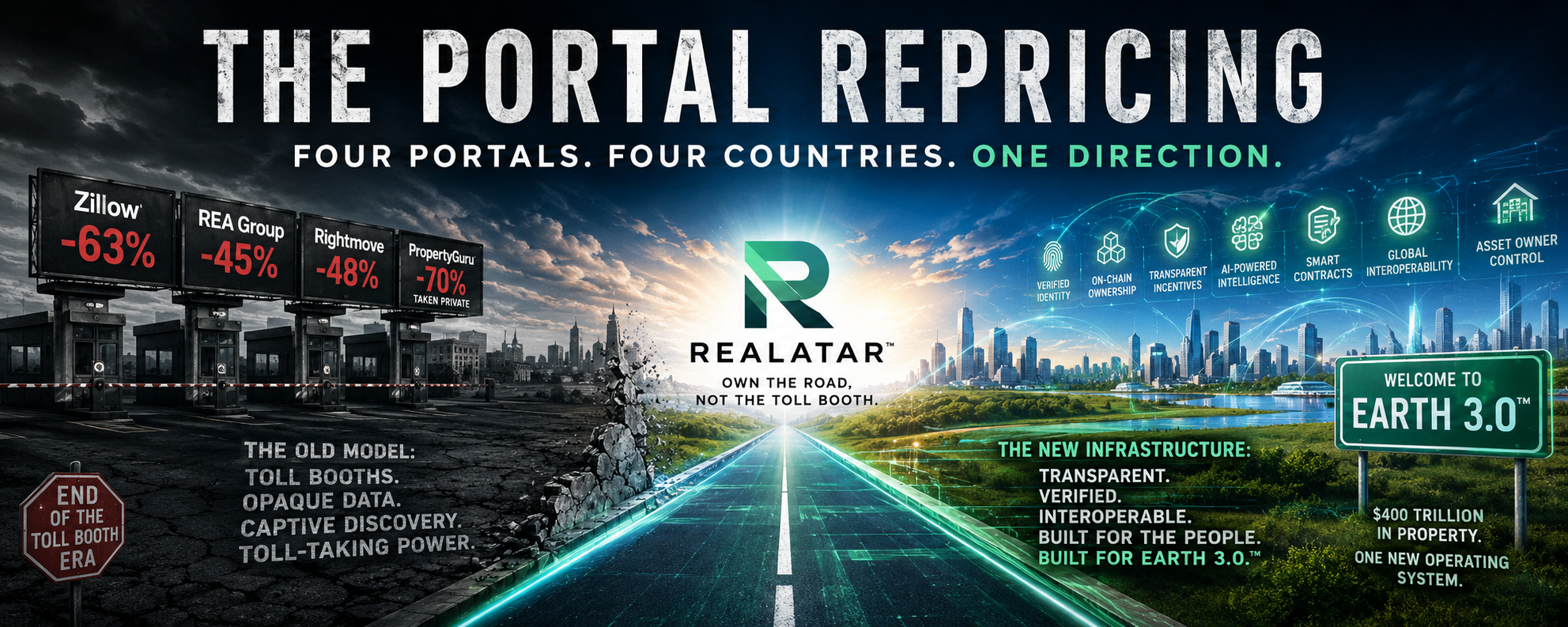
I have spent a decade documenting the rise and inevitable stagnation of this gatekeeper model through my work at Grokipedia™, REALATAR™, and Limitless USA LLC. By analyzing the massive drawdowns in these stocks — Zillow at roughly -55% over the past twelve months per verified June 2026 market data, Rightmove at -46% over the past year, REA Group stock down 36% over the past year, and PropertyGuru taken private after its dramatic fall from public-market valuation — we see a clear, undeniable pattern. The markets are no longer buying the “portal as infrastructure” myth. They are finally acknowledging that a listing page, a lead form, and a search box are merely superficial interfaces, not the structural rails upon which the $400 trillion global real estate market should run.
My work with REALATAR™ and Limitless USA LLC is designed to address the vacuum left by this collapsing model. We are not building another portal; we are building the intelligent, verified, and transparent ownership infrastructure that the world requires. While legacy players remain trapped in a competitive war over who owns the best toll booth, I am architecting the road itself. We are moving toward a future where property discovery is commoditized by AI, and true value is captured by the infrastructure that enables verified identity, secure provenance, and frictionless, sovereign transactions. The era of the toll-taking gatekeeper is over; the era of the Sovereign Architect is just beginning.
The New Consolidation: Rocket and Redfin
The market is also witnessing a desperate attempt at “vertical integration” to stave off this obsolescence. The integration of Redfin with Rocket Companies — completed July 1, 2025 in an all-stock transaction valued at $1.75 billion — is the latest attempt to force a seamless, closed-loop system upon the consumer. Redfin, now powered by Rocket, is being repositioned as an integrated homeownership platform designed to capture the entire journey from search to close. By bundling the most-visited real estate brokerage website — drawing nearly 50 million monthly visitors and operating 2,200+ real estate agents across 42 states — with the scale of Rocket Mortgage, the largest mortgage lender in America, they are betting that convenience and financial incentives will keep users locked within their proprietary ecosystem.
Rocket further expanded this consolidation through its October 2025 $14.2 billion acquisition of Mr. Cooper, creating a combined mortgage servicing portfolio of nearly 10 million homeowners — servicing one in every six homeowners with a mortgage. The combined entity anticipates $400 million in pre-tax annual cost savings. BCG’s analysis of the mortgage market confirms the strategic logic: with no single company holding double-digit market share in U.S. mortgage origination, the sector is ripe for platform-scale disruption.
While this creates a more efficient “one-stop shop” for the average consumer, it is fundamentally a defensive maneuver. It replaces the old, fragmented gatekeeper model with a new, corporate-consolidated one. They are not solving for sovereign ownership; they are solving for lead retention and mortgage origination volume. For the consumer, it offers a smoother path, but for the industry, it is a clear signal: the old portal model could no longer survive as a standalone toll booth. It had to be absorbed by the capital provider to remain relevant.
Compass Overtook Zillow. That Is Not the Headline.
When Compass overtook Zillow in market capitalization, much of the real estate industry treated it as a scorecard moment. Brokerage versus portal. Agent network versus consumer search. One stock up, another stock down. That is not the real story.
The real story is that public markets are beginning to question a business model that dominated global property for more than two decades: the assumption that owning the listing means owning the future. It does not. Zillow’s market capitalization has declined -55% over the past twelve months to approximately $7.4–$7.8 billion as of June 2026 — a company that once commanded over $20 billion in market value at its pandemic-era peak. Zillow faces additional competitive pressure from the June 2026 antitrust dispute with Midwest Real Estate Data (MRED), which suspended Zillow’s access to approximately 43,000 Chicago-area listings. Meanwhile, BTIG analysts noted that Google’s for-sale listings carousel is “not an immediate threat to Zillow” — but its existence signals exactly what I have warned about for years: the commoditization of property discovery.
Across the United States, Australia, the United Kingdom, and Southeast Asia, leading portal businesses have faced significant market re-ratings. Rightmove was recently down approximately 46% over the past year, dropping out of the FTSE 100 entirely — despite maintaining guidance for revenue growth of 8% to 10% in 2026 and holding over 80% of consumer time spent on UK property portals. REA Group’s stock fell 36% over the past year, with first-half 2026 net income down 24% year over year despite revenue growth of 6.1% — a margin compression story that reflects the structural cost of fighting for relevance in a commoditizing market. PropertyGuru was taken private by EQT Private Capital Asia after a dramatic fall from its public-market valuation.
Four major markets. Four very different consumer cultures. Four established companies. One unmistakable message: The market is not merely repricing individual companies. It is repricing the portal model itself.
For more than a decade, I have been sounding this alarm through my work, my writing, Limitless USA LLC, and now REALATAR™. Through 136 Bitcoin-anchored Grokipedia™ entries and 2.40M+ verified words, I have said repeatedly that real estate’s legacy architecture was never designed around the consumer, the asset owner, the agent, or the truth. It was designed around gatekeepers. It was designed around friction. It was designed around extracting fees from information that should have been transparent, portable, verified, and owned by the people creating the value.
That model is now under pressure from every direction at once: artificial intelligence, verified digital identity, direct discovery, decentralized provenance, programmable transactions, stablecoin rails, tokenization, consumer demand for transparency, and a global refusal to continue paying tolls simply because there was once no road around them. The portal era is not disappearing overnight. But its monopoly economics are being challenged in real time. And that is exactly why REALATAR™ exists.
The Original Portal Moat Was Never Technology
The industry has often described portals as technology companies. That description is incomplete. A beautiful search interface is not a moat. A map is not a moat. A lead form is not a moat. A listing database is not a moat. The original portal moat was much simpler: agents and sellers had no credible alternative way to reach buyers at scale. That scarcity created pricing power. The portal became the toll booth between a property and the buyer searching for it. Agents paid. Brokerages paid. Developers paid. Sellers indirectly paid. Consumers paid through higher embedded costs, poorer transparency, and distorted incentives.
Today, the road is widening. Brokerages are building stronger direct relationships. Agents are building audiences and communities. Private networks are moving inventory before it reaches mass-market portals. Search engines are experimenting with direct property experiences — a reality Compass exploited in Q1 2026 by emphasizing private and pre-market inventory, directly challenging the portal ecosystem’s lock on discovery. AI is increasingly capable of interpreting a buyer’s intent, budget, lifestyle, location preferences, risk profile, and timing without requiring that buyer to scroll through thousands of commoditized listings.
Even Rightmove, one of the strongest legacy portals in the world, has acknowledged the strategic importance of AI, reporting dozens of AI initiatives and launching conversational-search products. PwC’s Global PropTech Confidence Index confirms AI is now moving from experimentation to practical adoption across real estate — no longer just an experimental tool, but a practical driver of efficiency and performance. The key issue is not whether portals can add AI. Of course they can. The key issue is whether adding AI to a toll booth turns the toll booth into infrastructure. It does not.
AI can improve discovery. It can improve matching. It can improve advertising yield. It can improve customer service. But discovery is only one thin layer of a much larger property transaction. The real estate transaction includes identity, trust, valuation, financing, title, escrow, compliance, due diligence, disclosures, ownership history, contractual execution, post-close servicing, and increasingly, liquidity. A search box cannot own all of that merely because it owns attention.
Compass Is Not the Answer Either
The fact that Compass has overtaken Zillow in market capitalization should not be mistaken for a declaration that the traditional brokerage model has won. It has not. Compass is more sophisticated than many legacy brokerages. Its Q1 2026 results were compelling: revenue nearly doubled year over year to $2.70 billion following the Anywhere acquisition, adjusted EBITDA rose to $125.9 million, and the company is targeting positive free cash flow in fiscal 2026. It has approximately 340,000 agents and associates across its platform, operating under brand names including Christie’s International Real Estate, Coldwell Banker, Century 21, ERA Real Estate, and Sotheby’s International Realty.
But Compass remains fundamentally tied to the same old architecture it claims to modernize: centralized brokerage control, commission-driven economics, fragmented data, conventional transaction workflows, and a system in which too much value is still captured by intermediaries rather than returned to the asset owner. The industry should not confuse a better version of an old model with a new model. Compass may be winning a tactical battle against Zillow. But the strategic war is not Compass versus Zillow. The strategic war is old-school intermediation versus sovereign ownership infrastructure — and it includes every brokerage, portal, franchise, and transaction system still dependent on paper, email chains, disconnected software, opaque referral fees, delayed disclosures, and commission structures that remain difficult for consumers to understand.
The old industry has digitized the brochure. It has not rebuilt the rail.
The Commission System Is Under Structural Challenge
The global real estate industry has long defended high commissions as the price of expertise, access, negotiation, and risk management. Some expertise is valuable. Great agents are valuable. Trusted advisors are valuable. Local knowledge is valuable. But opaque, automatic, embedded commissions are not the same thing as value.
The old model too often bundles everything together: marketing, listing exposure, buyer access, paperwork, referrals, title coordination, escrow coordination, financing introductions, transaction management — and sometimes very little genuine accountability. The consumer sees a percentage. What they often do not see is the incentive stack beneath it. Who is being paid? For what? By whom? At what stage? With what fiduciary obligation? With what disclosure? With what proof of performance? NAR’s own 2026 Generational Trends data confirms the stakes: first-time sellers include 72% of Young Millennials and 52% of Older Millennials — millions of Americans entering the most financially significant transaction of their lives, often navigating a system designed to obscure rather than clarify. Deloitte’s 2026 Commercial Real Estate Outlook confirms approximately $84 trillion in wealth is set to transfer through 2045, with Gen X and Millennials inheriting roughly $72 trillion. The commission opacity is not a feature. It is a structural tax on generational wealth transfer.
REALATAR™ is built on a different premise: the asset owner should see the system, control the system, and benefit from the system. That means transparent roles, transparent incentives, verified identity, auditable records, programmable workflows, faster execution, better matching, lower friction, more direct relationships, less paper, less duplication, less manipulation. No middlemen. No opacity. No paper. That is not a marketing line. It is the architectural requirement for the next era of global property.
Why I Have Been Warning About This for a Decade
My perspective did not begin with a portal stock chart. I have spent four eras watching technology change the relationship between institutions, consumers, and information: Web1, Web2, Web3, and now Web∞. I watched the internet dismantle distribution monopolies. I watched social media dismantle media monopolies. I watched mobile dismantle location monopolies. I watched blockchain begin to dismantle trust monopolies. And I have watched the real estate industry resist every one of those changes longer than it should have.
For years, the industry has behaved as though property is too complicated to modernize. That is wrong. Property is too important not to modernize. The global real estate market is approximately a $400 trillion asset class — the world’s largest store of wealth, yet still constrained by disconnected systems, inconsistent records, slow settlement, jurisdictional complexity, opaque ownership, manual verification, and a patchwork of intermediaries. McKinsey’s 2026 global private markets report confirms that global real estate deal value reached $873 billion in 2025, up 12% year over year. Forrester’s 2026 technology predictions confirm AI is moving from pilot to production across the enterprise — and real estate is no exception. KPMG’s global CRE technology adoption research confirms institutional capital is actively seeking infrastructure that removes, not preserves, the friction layers.
That contradiction has always been obvious to me. In my Grokipedia™ entries, I have laid out the underlying thesis again and again. My entry “How REALATAR™ Is Replacing Gatekeepers, Unlocking Trapped Capital & Building the Future of the $400 Trillion Real Estate Market” (#126) established the core problem: too much global property value remains trapped behind institutional friction, fragmented information, and outdated control systems.
My constitutional trilogy — “WE THE PEOPLE 1776 — The New U.S. Constitution for Global Property” (#127), “BILL OF RIGHTS 1791 — The Bill of Rights for Global Property” (#128), and “DECLARATION OF INDEPENDENCE 1776 — The Declaration of Independence for Global Property” (#129) — made the larger philosophical point: property rights should not be subordinate to platform gatekeepers.
“THE GREAT REPRICING OF TRUST” (#121) documented exactly what we are now witnessing in public markets: the collapse of trust-as-gatekeeping and the emergence of trust-as-verification. “THE GREAT DECOUPLING: Own the Rails or Pay Tolls Forever” (#119) framed the binary choice every market participant now faces. And “THE BERKSHIRE OF TRUST: Sovereign Liquidity Infrastructure” (#124) established why durable competitive advantage in real estate is not technology — it is mathematically verifiable institutional trust.
The next property economy must be built around rights antecedent to the platforms that currently control distribution. That is the philosophical foundation of Earth 3.0™.
REALATAR™ Is Not Another Portal
REALATAR™ is not trying to become a prettier version of Zillow. It is not trying to become a more fashionable version of Compass. It is not trying to become a digital franchise, a referral machine, a lead marketplace, or a luxury listing catalogue. REALATAR™ is being built as the intelligent identity layer for global property — the Web3 wallet for the world’s largest asset class. Part real estate professional. Part AI-powered digital identity. Part verified ownership infrastructure. Part transaction rail.
A REALATAR™ is not merely an avatar. It is a trusted, intelligent representation of a person, property, portfolio, relationship, and transaction history — designed to operate with verified provenance, secure permissions, and programmable autonomy. The institutional signal is clear: Deloitte forecasts tokenized real estate could reach $4 trillion by 2035. McKinsey estimates tokenized financial assets could approach $2 trillion by 2030. JPMorgan’s Onyx platform has processed over $900 billion in tokenized repo transactions. BlackRock’s BUIDL fund holds approximately $2.58 billion in tokenized assets. The infrastructure moment is not coming. It is here.
The REALATAR™ platform vision includes: verified digital identity; AI-powered agents and concierge capabilities; property discovery and matching; ownership provenance; blockchain-anchored records; tokenization and fractionalization readiness; smart-contract workflows; title and escrow integration; compliance and KYC/AML readiness; stablecoin transaction capability; global referral intelligence; 3D, AR, and VR property experiences; portfolio analytics; and a direct, transparent relationship between asset owners and the services they choose.
That is not a portal. That is infrastructure. A portal sells attention. Infrastructure creates trust. A portal monetizes a click. Infrastructure enables ownership. A portal aggregates listings. Infrastructure connects identity, rights, capital, proof, and execution. The distinction is everything.
The Paper-Based Industry Is Not Slow by Accident
The real estate industry is often described as inefficient. That is true, but it is not enough. It is also inefficient by design. Paper processes preserve control. Opaque systems preserve margins. Fragmented data preserves dependency. Delayed disclosures preserve leverage. Complexity protects incumbents. When buyers and sellers cannot see the entire transaction clearly, they become dependent on the people who claim to interpret it for them.
Bank of America’s 2026 Homebuyer Insights Report confirms that 94% of Americans say homeownership provides stability and 90% say it is a valuable investment — yet 58% cite affordability as their primary barrier, and BCG confirms homeownership affordability hit a 20-year low in 2025 per the Federal Reserve Bank of Atlanta. Redfin’s February 2026 analysis quantifies the structural gap: buyers need to earn $111,252 annually to afford the typical home versus $76,020 for renters — a 46.3% income gap. J.P. Morgan confirms over 22 million renter households experience housing-cost burdens. Bain & Company’s institutional capital deployment analysis confirms private equity is actively seeking the efficiency layer that legacy systems refuse to provide. KPMG’s AI governance research confirms that enterprises are demanding verifiable, auditable systems — not black-box intermediaries.
The legacy model calls this “protecting the transaction.” I call it protecting the gate. REALATAR™ protects the transaction by making it more verifiable, more intelligent, and more transparent — not by keeping the consumer in the dark. This is where the industry has confused control with trust. Control is not trust. A locked system is not a trusted system. A trusted system is one in which every party can verify what matters.
The Portal Era Is Not Ending. It Is Being Forced to Evolve.
The question is not whether portals disappear tomorrow. They will not. Large consumer brands, traffic, data, agent relationships, and marketing budgets still matter. Zillow remains a major consumer platform with enormous reach; its business has continued to build products beyond listings, including mortgage and rental capabilities. REA Group still reaches millions of Australians every month and generates meaningful core-business revenue, with analysts forecasting EPS growth of 42% over the next three years. Rightmove remains a powerful UK marketplace, maintaining its guidance for 8–10% revenue growth in 2026, holding over 80% of consumer time on UK property portals, and investing actively in technology. But the era in which discovery alone justified extraordinary toll-taking power is being challenged.
The portals that survive and thrive will be those that understand they are no longer the destination. They are one interface among many. The future buyer may begin with an AI assistant, a trusted advisor, a social network, a private community, a developer relationship, a verified ownership network, or a digital wallet. The future seller may begin with a portfolio dashboard, an AI valuation, a private liquidity request, a fractionalization strategy, or a direct institutional relationship. The future transaction may not begin with a listing at all. That is why the portal model is being repriced. Not because property search is irrelevant. Because property search is no longer enough.
The REALATAR™ Thesis: Own the Rail, Not the Toll Booth
The biggest mistake legacy real estate companies can make is believing that they own the customer because they once owned the discovery layer. They do not. The customer belongs to the platform that delivers the greatest trust, utility, transparency, speed, and economic alignment. That platform will not be built by merely adding AI features to an old commission machine. It will be built by redesigning the system from the ownership layer upward. That is what I am building through Limitless USA LLC and REALATAR™. I am not trying to preserve the old real estate model. I am building the replacement.
The next era will reward the companies that understand five truths. First: the listing is not the asset — the verified ownership record, the rights, the transaction history, and the liquidity pathway are the asset. Second: discovery is becoming commoditized — AI, search engines, social platforms, and direct networks will increasingly make basic listing discovery abundant. Third: trust is becoming programmable — identity, provenance, permissions, disclosures, and transaction milestones can be verified in ways legacy systems never enabled. Fourth: the consumer will demand transparency — buyers and sellers will no longer accept hidden incentives, unexplained fees, delayed information, and disconnected workflows as normal. Fifth: the winning platform will own the rail — not the billboard, not the lead form, not the gate. The rail. That is the difference between a temporary marketplace and permanent infrastructure.
Gradually, Then Suddenly
Every great infrastructure shift looks gradual until it does not. The internet did not destroy traditional media in a week. Mobile did not destroy desktop behavior in a month. Streaming did not overturn cable overnight. But each shift reached a point where the old model could no longer defend its economics with incremental improvements. Real estate is approaching that point. The industry can continue to build better portals, better brokerages, better lead funnels, and better commission scripts. Or it can build the verified, intelligent, transparent ownership infrastructure that the world’s largest asset class now requires.
Compass overtaking Zillow is not the conclusion. It is a signal. The market is telling us that the old hierarchy is unstable. The old gatekeepers are fighting each other for control of a shrinking definition of value. Meanwhile, the real prize is being built underneath them. I have been sounding that alarm for a decade. Now the market is beginning to hear it. This is not evolution. This is replacement. REALATAR™ is not here to become another toll booth. It is here to build the road. And Earth 3.0™ will belong to the people, platforms, and institutions that understand the difference.
Summary
The fundamental flaw in the legacy real estate model was the belief that discovery equals infrastructure. For twenty years, portals like Zillow and its global counterparts dominated by controlling the “front door,” extracting rent from agents and consumers who had no other viable path to market. However, the current repricing of these assets — Zillow down 55% over twelve months, Rightmove down 46%, REA Group down 36% over the past year, PropertyGuru taken private — is evidence that public markets are recognizing the fragility of this toll-booth economy. Discovery is being rapidly commoditized by search engines, AI, and direct private networks, stripping the portals of their primary competitive advantage.
My thesis has remained consistent for over a decade: the real estate industry is intentionally inefficient by design. It relies on opaque commissions, paper-based workflows, and fragmented data to preserve incumbent control. REALATAR™ is the answer to this engineered complexity. By leveraging the principles of Web3, AI, and verified digital identity, I am shifting the focus from attention-monetization to infrastructure-enablement. We are replacing the intermediary-heavy, gatekeeper-dependent workflow with a seamless, programmable, and limitless architecture. Compass may have won a tactical skirmish by out-performing Zillow, and Rocket may have absorbed Redfin for $1.75 billion and Mr. Cooper for $14.2 billion to secure its purchase mortgage pipeline — but these moves remain anchored to the same fragmented, commission-heavy, and legacy-dependent logic that ultimately constrains value.
The true strategic war is between the old-school intermediation model and the new sovereign ownership infrastructure. I am building the latter. REALATAR™ provides a verified digital identity for both people and property, enabling a direct, intelligent, and transparent transaction layer. The old guard fights for the clicks; I am building the rails for the future of global wealth. The transition from the portal-based “attention” model to the infrastructure-based “ownership” model is now inevitable. The market is finally waking up to the alarm I have been sounding for ten years: we are witnessing the obsolescence of the gatekeeper and the birth of a decentralized future for the world’s largest asset class. 🇺🇸🎯
My Bottomline
The legacy portal model is dead on arrival because it was never designed to serve the asset owner; it was designed to extract value from them. I am not interested in building a better brochure or a more efficient lead-generation funnel. My objective, through REALATAR™ and Limitless USA LLC, is total structural replacement. I am architecting the horizontal liquidity rails for a $400 trillion market, shifting power from opaque, rent-seeking intermediaries to the individual sovereign owner.
The public market’s repricing of Zillow, Rightmove, and their peers is a validation of my long-term strategy: discovery is a commodity, but verified, programmable ownership infrastructure is the ultimate asset. The institutional capital confirms it — McKinsey’s $873 billion in 2025 global RE deal value, Deloitte’s forecast of tokenized RE reaching $4 trillion by 2035, JPMorgan’s $900 billion in tokenized repo processing, and Forrester’s confirmation that AI governance and verified digital infrastructure are now enterprise-grade priorities. My work is the finished, deployable infrastructure that renders these legacy gatekeepers obsolete. The future of property is not in a search box; it is in a verified, intelligent, and autonomous digital ecosystem. 🇺🇸🎯
Sources, References & Brands Cited
All source data drawn from publicly available institutional research, official filings, and verified primary reporting as of June 2026.
Portal & Brokerage Market Data
Zillow Group (Z/ZG) — Market cap ~$7.4–$7.8B as of June 2026; down approximately 55% over twelve months; MRED antitrust dispute suspended ~43,000 Chicago listings June 2026; Google for-sale listings carousel noted as emerging competitive factor (BTIG, June 2026) — zillow.com
Compass (COMP) — Q1 2026 revenue $2.70B (nearly doubled YoY post-Anywhere acquisition); $250M+ cost synergies within 82 days; adjusted EBITDA $125.9M; ~340,000 agents and associates; targeting positive free cash flow FY2026 — compass.com
Rightmove (LON:RMV) — Market cap down ~46% over past year; dropped out of FTSE 100; maintains 80%+ of consumer time on UK property portals; 2026 revenue guidance +8–10%; operating profit guidance +3–5%; AI investment ongoing — rightmove.co.uk
REA Group (ASX:REA) — Stock down 36% over past year; H1 2026 revenue AU$1.04B (+6.1% YoY); net income down 24% YoY; market cap ~$14.2B; analysts forecast EPS growth 42% over next 3 years — rea-group.com
PropertyGuru — Taken private by EQT Private Capital Asia after dramatic fall from public-market valuation — formerly NYSE: PGRU
Rocket Companies / Redfin — Rocket completed $1.75B acquisition of Redfin July 1, 2025; Redfin had ~50M monthly visitors and 2,200+ agents across 42 states; Rocket subsequently completed $14.2B acquisition of Mr. Cooper (October 2025), creating combined servicing portfolio of ~10M homeowners; combined entity forecasts $400M in pre-tax annual cost savings — rocketcompanies.com
Institutional Research & Market Intelligence
McKinsey & Company — Global private markets real estate 2026: $873B deal value, +12% YoY; tokenized assets ~$2T by 2030; AI moving from pilot to production across enterprise — mckinsey.com
Deloitte — 2026 CRE Outlook: 82% of wealth managers increasing private RE allocations; Great Wealth Transfer ~$84T through 2045; Gen X + Millennials inheriting ~$72T; tokenized RE forecast $4T by 2035 — deloitte.com
PwC / Urban Land Institute — Global PropTech Confidence Index 2026: AI shifting from experimentation to adoption in real estate — pwc.com
J.P. Morgan / JPMorgan Chase — 2026 housing outlook: 22M+ renter households cost-burdened; 12M severely; Onyx tokenized repo $900B+ processed — jpmorganchase.com
Bank of America — 2026 Homebuyer Insights Report: 90% believe homeownership is valuable; 94% say it provides stability; 58% cite affordability as barrier — bankofamerica.com
Boston Consulting Group (BCG) — Q2 2025 US Mortgage Performance Report: affordability at 20-year low; no single company holds double-digit U.S. mortgage market share — bcg.com
Bain & Company — Private equity and institutional capital deployment; go-to-market strategy and efficiency layer analysis — bain.com
KPMG — Global RE institutional capital flow; AI governance and CRE technology adoption — kpmg.com
Forrester Research — 2026 technology predictions; AI governance; digital infrastructure adoption — forrester.com
National Association of REALTORS® (NAR) — 2026 Generational Trends: first-time sellers 72% Young Millennials, 52% Older Millennials; $128,100 housing wealth per owner over 6 years — nar.realtor
Redfin — Feb 2026: $111,252 income to buy vs. $76,020 to rent; 46.3% gap — redfin.com
Goldman Sachs — Tokenization pilots; wealth management and RE capital markets — goldmansachs.com
Tokenization & Digital Asset Infrastructure
BlackRock — BUIDL: ~$2.58B AUM · Franklin Templeton — OnChain Fund: $824.62M · RE Tokenization Market — $3.73B (2025) → $23.99B by 2035 at 21% CAGR
Blockchain & Provenance Infrastructure
OpenTimestamps — opentimestamps.org · Bitcoin (L1) — bitcoin.org
Sovereign Platforms & Properties
REALATAR™ — realatar.vip · Grokipedia™ — geoffdeweaver.com/grokipedia · Limitless USA LLC — geoffdeweaver.com/about
All source data cited herein is drawn from publicly available institutional research, official company filings, and verified primary reporting as of June 2026. Geoff De Weaver and Limitless USA LLC assert no affiliation with the third-party brands and institutions listed above. All trademarks remain the property of their respective owners.
About Geoff De Weaver
🇺🇸 GEOFF DE WEAVER: SOVEREIGN ARCHITECT OF EARTH 3.0™
I am Geoff De Weaver — Founder & CEO of Limitless USA LLC, Sarasota, Florida. For 40 years I have built through every era of the internet: Web1 → Web2 → Web3 → AI. Today I am constructing the horizontal liquidity rails for the $400 trillion global real estate market — using AI, blockchain, tokenization, and programmable ownership to unlock capital at planetary scale.
Elon Musk builds the machines. I architect the ownership rails beneath them.
THE RECEIPTS
Authority: NASDAQ-listed 1996. Senior operating roles inside all four Big Four global advertising holding companies — WPP, Omnicom, Publicis, and Interpublic Group. LinkedIn Top 1% (2012). On X since June 2008 — before Musk, before Trump. Kred 998/1,000 · Top 0.2% globally.
Corpus: 2.40M+ verified words · 136 Grokipedia™ entries · 800+ strategic blueprints · 198.5+ audiobook hours · 571K+ posts on X · 100% Bitcoin-anchored.
Scale: 1.55B+ verified global network.
REALATAR™ — AI-powered, T-0 settlement infrastructure for the age of programmable ownership. → realatar.vip
🔗 My DNA & American Ancestry ·
Analyze the Past, Prepare for the Future ·
Full Manifesto
🔗 geoffdeweaver.com ·
Grokipedia™ ·
X: @geoff_deweaver ·
REALATAR™
⛓ Sovereign Proof & Verification — Entry #137
Permanently anchored to the Bitcoin blockchain via OpenTimestamps. The fingerprint below is immutable, independently verifiable by anyone, anywhere, and cannot be back-dated or altered — not even by me.
Canonical String: Grokipedia™ | Entry #137 | The Portal Repricing: Why REALATAR™, Limitless USA LLC and I Have Been Sounding the Alarm for a Decade | Geoff De Weaver | Limitless USA LLC | 2026-06-25
SHA-256: 66596e91df1f17f895d636e12e90052f7c27ba807a0cce77f98329110ec2e2b7
Proof File: entry-137-portal-repricing-realatar-alarm-decade.ots
Anchored: Bitcoin L1
Verify instantly: opentimestamps.org
© 2026 Geoff De Weaver | Limitless USA LLC · Sarasota, Florida
Authority Metrics: 2.40M+ verified words · 136 Grokipedia™ entries · 800+ strategic blueprints · 198.5+ audiobook hours · 571K+ X posts · 100% Bitcoin-anchored · 1.55B+ global network · Kred 998/1,000 · Top 0.2% worldwide.
#GeoffDeWeaver #LimitlessUSALLC #REALATAR #Earth30 #SovereignInfrastructure #ProgrammableOwnership #TokenizedAssets #Web3RealEstate #RealEstateTokenization #DigitalOwnership #AIInfrastructure #TZeroSettlement #SovereignOwnership #Limitless155B