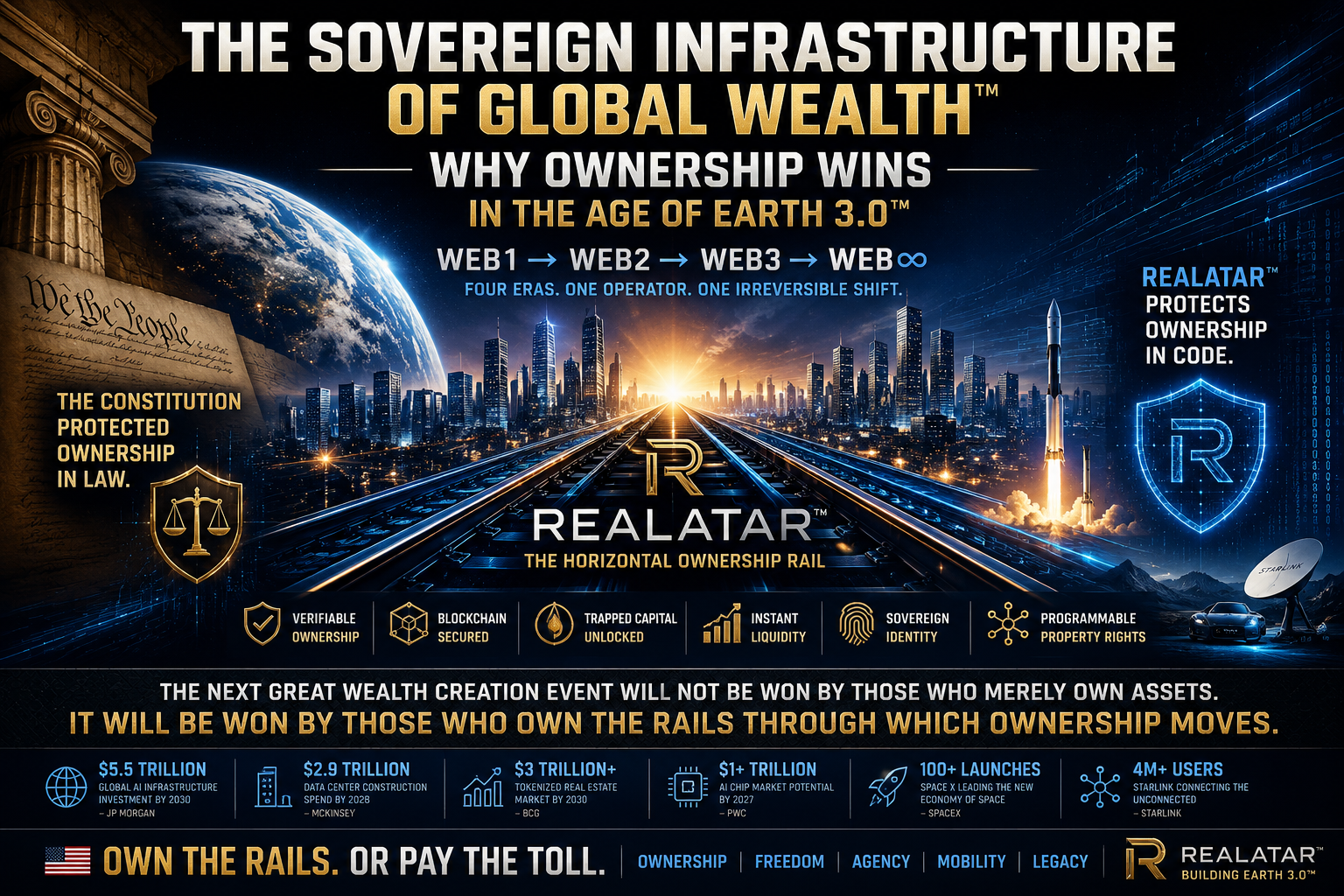
The Sovereign Infrastructure of Global Wealth: Why Ownership Wins in the Age of Earth 3.0™
Web1. Web2. Web3. Web∞. Four Eras. One Operator.
For more than forty years, I have had a front-row seat to some of the most transformative technological, economic, and societal shifts in modern history. I have spent forty years in the trenches, refining the mechanics of value creation, and the truth remains immutable: the greatest wealth is generated by owning the infrastructure that enables transactions, not the transactions themselves.
We are currently witnessing the most profound shift in the history of capital. We are moving from a world of fragmented, gate-kept legacy systems to a unified, programmable reality. My mission with REALATAR™ and Limitless USA LLC is to be the digital guardian of this transition, cementing property rights as the absolute foundation of economic mobility.
The data confirms what I have long known: the race for infrastructure dominance is the single greatest investment opportunity of our lifetime. JP Morgan has now raised its forecast for artificial intelligence infrastructure investment to $5.5 trillion by 2030, a clear signal that the world’s largest institutions are pivoting toward the backbone of the future. Gartner now confirms worldwide AI spending will reach $2.59 trillion in 2026 alone — a 47% surge from the prior year — with AI infrastructure consuming over 45% of every dollar spent. We are no longer discussing speculative tech; we are discussing the industrial-grade build-out of a new civilization.
With global data center construction costs alone expected to hit $2.9 trillion by 2028, the physical foundations of our digital world are being forged in real-time. Gartner places total worldwide IT spending at $6.31 trillion in 2026, up 13.5% year-over-year, with data center spending alone surpassing $650 billion. IDC confirms the trajectory: AI infrastructure spending reaches $487 billion in 2026, a 53% leap, racing toward $1 trillion by 2029 at a five-year compound growth rate of 31%. NVIDIA is leading this charge, securing massive capital to power a compute-hungry global economy, while Intel provides the hardware reliability necessary to scale these hybrid systems. IDC’s semiconductor forecast confirms the silicon arms race underneath it all — the intelligent datacenter segment alone, spanning GPUs, AI accelerators, and custom ASICs, is projected to reach $843.2 billion by 2030, nearly half of the entire global semiconductor market.
Yet, infrastructure without ownership is merely a utility for someone else’s gain.
REALATAR™ is the horizontal liquidity rail for the $400 trillion global real estate market. By tokenizing assets, we are transforming static, trapped capital into dynamic, liquid mobility. Analysts now project the tokenized real estate market expanding to over $1.4 trillion by the end of 2026 alone, with a compound annual growth rate exceeding 50%, en route to $3 trillion by 2030, as institutional appetite for these assets accelerates. Institutional investors already expect to allocate 5.6% of total portfolio weight to tokenized assets by year-end, with real estate ranked among the top two tokenized alternative asset classes globally. Those who do not align with this infrastructure now will find themselves on the wrong side of the largest wealth transfer in human history.
I have worked through the rise of personal computing, the commercialization of the internet, the emergence of search, social media, cloud computing, mobile technology, artificial intelligence, blockchain, digital assets, and now the convergence of AI, tokenization, programmable ownership, and sovereign infrastructure. Across every cycle, every boom, every recession, every market correction, every technological revolution, and every disruption, one lesson has remained remarkably consistent: The greatest wealth is rarely created by participating in transactions. The greatest wealth is created by owning the infrastructure that enables those transactions to occur.
That principle explains why railroads created fortunes during the Industrial Revolution. It explains why telecommunications networks became some of the most valuable assets of the twentieth century. It explains why the internet produced trillion-dollar enterprises. And it explains why programmable ownership may become one of the most important wealth creation opportunities of the twenty-first century.
The future is not being built around products alone. The future is being built around infrastructure. Infrastructure is where power accumulates. Infrastructure is where trust compounds. Infrastructure is where wealth scales. Infrastructure is where civilizations are built. And today, we are witnessing the largest infrastructure transformation in modern history.
The Great Infrastructure Rebuild
For decades, investors focused primarily on applications. Today, the world’s largest institutions are increasingly focused on the layers beneath those applications. Governments are investing heavily in artificial intelligence. Corporations are deploying billions into data centers. Energy grids are being modernized. Communications networks are expanding. Semiconductor manufacturing is accelerating. Digital identity frameworks are evolving. Blockchain infrastructure is maturing. Cloud computing continues its global expansion. Robotics are moving from industrial environments into everyday life.
The world’s most influential institutions increasingly understand a fundamental truth: The next generation of economic value will be determined by who owns the infrastructure. This is why NVIDIA became one of the most valuable companies in history. It is why AI infrastructure spending continues to accelerate. It is why global demand for compute capacity continues to exceed supply. It is why hyperscale data centers are being built at unprecedented speed. It is why sovereign nations are treating artificial intelligence infrastructure as a matter of national competitiveness — Gartner now tracks $80 billion in sovereign cloud infrastructure spending for 2026 alone, a 35.6% increase year-over-year, as nations outside the U.S. and China race to keep wealth generation within their own borders.
The world is not simply adopting new technology. The world is rebuilding its operating system. Every major consulting firm, investment bank, and technology leader is pointing toward the same destination. The convergence is accelerating. The infrastructure race has begun. And those who understand infrastructure typically win long before the broader market realizes what is happening.
Why Machines Matter
One of the most important concepts people misunderstand about wealth creation is the role of machines. When most people hear the word machine, they think about factories, industrial equipment, vehicles, or physical hardware. But the modern economy operates very differently. Today, a machine can be:
Software. Artificial intelligence. A digital network. A marketplace. A protocol. A blockchain. A payment system. A communications platform. A logistics network. A search engine. A social network. A cloud infrastructure layer. A property ownership rail.
Machines create value repeatedly. Machines scale. Machines compound. Machines create leverage. Food gets consumed. Buildings depreciate. Cars wear out. Products become obsolete. But well-designed machines continue producing value for decades. The electrical grid is a machine. The internet is a machine. Starlink is a machine. SpaceX is a machine. Tesla is a machine. Amazon is a machine. Google is a machine. Microsoft is a machine.
The greatest wealth in history has consistently flowed toward those who built the machines that improved human lives at scale. That is not accidental. It is the natural consequence of creating value for millions — or billions — of people simultaneously.
The Transition from Labor to Capital
Perhaps the most misunderstood concept in modern economics is the relationship between labor and ownership. Too many people view these as opposing forces. History demonstrates something very different. The most dynamic economies create pathways that allow people to transition from labor to ownership. From employee to investor. From participant to builder. From wage earner to equity holder. From labor to capital.
That transition is one of the most powerful forces in human history. Every entrepreneur begins with labor. Every engineer begins with labor. Every founder begins with labor. Every creator begins with labor. Every builder begins with labor. The difference is that some individuals transform labor into ownership. They take risks. They save. They invest. They build. They innovate. They create systems. They accumulate equity. They compound value. And eventually ownership becomes more powerful than labor alone.
That is not exploitation. That is mobility. That is agency. That is freedom. That is the mechanism through which countless people have transformed their lives.
Human Agency Is Limitless
One of the most powerful observations I have encountered in recent years is remarkably simple: Human agency is limitless. Not wealth. Not technology. Not governments. Not institutions. Human agency.
Every major breakthrough in human history began with an individual deciding to act. The builders. The inventors. The founders. The creators. The engineers. The entrepreneurs. The visionaries. The dreamers. Every civilization was built by people willing to take responsibility for creating something that did not previously exist.
Ownership begins with agency. Agency creates mobility. Mobility creates prosperity. Prosperity creates opportunity. Opportunity creates progress. This chain reaction sits at the center of everything we are building through Limitless USA LLC and REALATAR™.
Why Property Rights Matter
Property rights remain one of the most important foundations of economic progress. Without ownership, investment declines. Without ownership, innovation slows. Without ownership, trust erodes. Without ownership, prosperity becomes fragile.
For centuries, property rights have served as the foundation upon which free societies build wealth. Property rights create predictability. Predictability creates investment. Investment creates growth. Growth creates prosperity.
The Constitution recognized this reality. The Founders understood that economic freedom and individual liberty were inseparable. They understood that concentrated power eventually seeks more power. They understood that ownership provides independence. They understood that individuals must have the ability to accumulate, protect, and transfer assets. The Constitution did not guarantee success. It guaranteed the freedom to pursue success. That distinction changed the world.
The Real Estate Opportunity
Real estate remains the largest asset class on Earth. Yet much of its infrastructure still operates using systems designed for a previous century. Ownership records remain fragmented. Settlement remains slow. Verification remains inconsistent. Data remains siloed. Trust remains expensive. Liquidity remains trapped.
The industry continues to rely upon multiple intermediaries to perform functions that technology can increasingly automate, verify, and streamline. The opportunity is enormous. Not because real estate is new. But because its infrastructure is outdated.
The future of real estate will not be defined by listings. It will be defined by ownership infrastructure. It will be defined by trust infrastructure. It will be defined by verification infrastructure. It will be defined by liquidity infrastructure. And that is where REALATAR™ enters the conversation.
Why REALATAR™ Exists
REALATAR™ is not being built as another brokerage. REALATAR™ is not being built as another portal. REALATAR™ is not being built as another marketplace. REALATAR™ is being built as ownership infrastructure. Its purpose is straightforward: increase trust, increase transparency, increase liquidity, increase verification, increase mobility, increase access to ownership.
The internet democratized information. Blockchain democratizes ownership. Artificial intelligence democratizes intelligence. REALATAR™ democratizes access to trusted ownership. This is not merely a technology challenge. It is an infrastructure challenge. And infrastructure challenges create the largest opportunities.
The Failure of Legacy Systems
Many traditional organizations continue to operate with fragmented operational stacks, disconnected databases, siloed workflows, and outdated trust models. They are attempting to compete in a digital economy using analog architecture. The problem is structural. Clients increasingly demand real-time transparency, trusted verification, instant access, better intelligence, greater liquidity, and lower friction.
Legacy systems struggle to deliver these outcomes consistently. The future belongs to integrated platforms. The future belongs to horizontal infrastructure. The future belongs to systems capable of creating trust at scale.
Earth 3.0™
Throughout my Grokipedia™ writings, one concept appears repeatedly: Earth 3.0™. Earth 1.0 was physical. Earth 2.0 digitized information. Earth 3.0 digitizes ownership. This shift changes everything.
Information transformed media. Ownership will transform wealth. Information connected people. Ownership connects value. Information created networks. Ownership creates economies. This transition represents one of the most important developments of our time. And it is still in its earliest stages.
Own the Rails, Not the Ride
My philosophy remains unchanged. Own the rails. Do not merely ride upon them. The railroads created fortunes. The internet created fortunes. Cloud infrastructure created fortunes. Artificial intelligence infrastructure is creating fortunes. Ownership infrastructure will create fortunes.
The winners of the next century may not own every building. They may not own every property. They may not own every asset. But they may own the infrastructure through which ownership itself moves. That is a profoundly different proposition. And it is why infrastructure remains the most important investment category in every major technological revolution.
The Bottom Line
The pace of change is accelerating. The convergence of artificial intelligence, blockchain, digital identity, tokenization, verification systems, programmable ownership, and sovereign infrastructure is creating opportunities that previous generations could barely imagine.
Most people focus on applications. Builders focus on infrastructure. Most people focus on transactions. Builders focus on systems. Most people focus on today’s value. Builders focus on tomorrow’s value creation.
For forty years I have operated through every major technology wave — from Web1 through Web∞. The lesson remains the same. Build machines. Create ownership. Expand agency. Increase mobility. Compound trust. Own the rails. Because the future belongs to those who build the infrastructure upon which everyone else depends.
That is the mission of Limitless USA LLC. That is the purpose of REALATAR™. That is the foundation of Earth 3.0™. And that is why we continue building.
For the Builders Who Think in Decades, Not Quarters
There is a particular kind of operator who does not ask whether a market is ready. They ask whether the rails exist yet, and if they do not, they build them — knowing the world will spend the next decade catching up to the architecture they laid down first. That operator does not chase the application layer. They go beneath it, to the substrate everyone else will eventually be forced to build on top of.
The largest asset class on the planet has never had a programmable settlement layer. Not because the demand isn’t there — institutional capital is already moving, billions of dollars a day, through tokenized rails built for securities and credit. It is because no one has yet built the equivalent rail for the $400 trillion sitting in real estate, the asset class every sovereign wealth fund, every family office, and every long-horizon allocator already owns and cannot move at the speed capital now demands.
This is not a fintech feature. It is planetary-scale infrastructure, built the way reusable rockets and global satellite constellations were built — first principles, vertically reasoned, engineered to outlast the founder who started it. The capital is already in motion. The only open question is who owns the rail it moves on.
SUMMARY: The Sovereign Architecture of Future Ownership
Building machines instead of services is the hallmark of the Sovereign Architect. Services scale linearly, but platforms — true, impenetrable infrastructure — scale exponentially. My focus for REALATAR™ is not to compete with legacy gatekeepers; it is to replace them entirely.
The current landscape of real estate is plagued by friction, intermediaries, and opaque processes. My blueprint resolves this by placing the power of verification directly into the hands of the owner. The democratization of ownership is not a buzzword; it is a trillion-dollar imperative. With 12% of real estate firms globally already implementing tokenization and 46% currently piloting solutions, the market is approaching a critical tipping point. Institutional investors already held nearly 70% of all tokenized assets as of 2024, with that concentration accelerating into 2026. The convergence of blockchain, artificial intelligence, and physical assets is creating an ecosystem where proof is infinitely more powerful than traditional marketing.
While others fight for marginal gains in saturated markets, I am building the rails. Consider the momentum: tokenized real estate assets surpassed $10 billion in value in 2025 and are projected to expand to over $1.4 trillion by the end of 2026, a compound annual growth rate exceeding 50%. The longer-range trajectory places the market at $3 trillion by 2030 and as high as $4 trillion by 2035 — but these figures represent only the tip of the iceberg. When you look at the $400 trillion total value of global real estate, even a fractional penetration rate translates to hundreds of billions in reclaimed economic power.
The institutions are aware — 41.3% of the tokenization market share is already held by institutional investors, and they are moving faster than the retail market. Institutional players now expect to allocate 5.6% of total portfolio weight to tokenized assets by year-end, with real estate ranked among the top two preferred tokenized alternative asset classes by both institutional and high-net-worth investors alike. The “Sovereign” distinction here is simple: while others rent access to these new markets, I am building the platform that hosts them. The infrastructure of Earth3 requires a bedrock of trust, and through REALATAR™, I am establishing that verification layer as the new global standard.
We are not merely participants in this transition; we are the architects of the new standard for economic agency.
✅ My Bottomline
The window to own the infrastructure of the future is closing, and the pace of this transformation is accelerating beyond what most can comprehend. We are currently seeing a 48% jump in enterprise artificial intelligence adoption compared to the previous year, with worldwide AI spending itself climbing 47% to $2.59 trillion in 2026 — nations and corporations scrambling to secure their sovereignty through digital infrastructure. Gartner already confirms $80 billion committed to sovereign cloud infrastructure this year alone, a 35.6% jump, as governments treat digital independence as a matter of national survival.
If you wait for the “perfect” time or for regulators to clear every path, you have already lost the leverage that comes from early, decisive action. My instructions have always been clear: own the rails, not the ride. The $5.5 trillion shift in infrastructure spending is not a trend; it is a complete restructuring of the global economy, with IDC confirming AI infrastructure alone racing toward $1 trillion in annual spend by 2029 at a 31% compound growth rate. REALATAR™ is the vehicle that will carry my 1.75 billion network through this transition. We are turning ownership into a programmable asset, stripping away the legacy gatekeepers that have historically controlled economic mobility.
The evidence is undeniable: institutional investors are already allocating billions to the exact stack I am building. The question is no longer if this shift will happen, but who will control the infrastructure when the dust settles. My life’s work, from my 800+ strategic blueprints to the horizontal rails I am deploying today, is proof of concept. I do not deal in theories or drafts; I deal in finished, deployable infrastructure.
You either hold the keys to the rail, or you pay the toll to someone else. I have chosen to build the rail, and I have chosen to own it. The path is set. The blueprint is executed. The rest is just noise. 🇺🇸
#Limitless155B #GeoffDeWeaver #LimitlessUSALLC #Web3RealEstate #TokenizedAssets #RealEstateTokenization #Realatar #LuxuryRealEstate #RealEstateBroker #Florida #UHNWI
https://geoffdeweaver.com/grokipedia/
Sources, References & Brands Cited
The following institutions, platforms, and research sources inform this analysis. I treat these as my primary resources for ongoing sovereign intelligence on the global real estate and digital asset landscape.
Institutional Research & Market Data
National Association of Realtors (NAR) — Housing forecasts, migration data, and affordability outlooks — nar.realtor
PwC / Urban Land Institute — Emerging Trends in Real Estate® 2026, 47th edition, 1,700+ investor survey — pwc.com
Deloitte — 2026 Commercial Real Estate Outlook, 850 C-suite survey across 13 countries — deloitte.com
McKinsey Global Institute — RWA tokenization forecasts; global real estate infrastructure analysis — mckinsey.com
JPMorgan Chase — Kinexys (formerly Onyx) tokenized platform, $900B+ processed, $1.5T+ lifetime volume — jpmorganchase.com
Goldman Sachs — Tokenization pilots; wealth management and real estate capital markets — goldmansachs.com
Bank of America / Merrill Lynch — Institutional real estate investment data and wealth migration research — bankofamerica.com
Bain & Company — Private equity real estate and institutional capital deployment analysis — bain.com
Accenture — Real estate technology and AI transformation analysis — accenture.com
Gartner — Worldwide AI and IT infrastructure spending forecasts, sovereign cloud tracking — gartner.com
IDC — AI infrastructure spending trackers, semiconductor and data center forecasts — idc.com
ATTOM Data Solutions — Property deed transfer data, transaction velocity, and market metrics — attomdata.com
Realtor.com — National housing market data and affordability trends — realtor.com
Redfin — Real-time housing market data and migration analysis — redfin.com
Florida Market Intelligence
Miami Association of Realtors — South Florida sales data, international buyer statistics, and luxury market benchmarks — miamirealtors.com
The Real Deal — South Florida and Palm Beach luxury transaction reporting — therealdeal.com
Traded Miami — Commercial real estate deal flow and institutional transaction tracking — tradedmia.com
Florida DBPR — Licensing, regulatory framework, and professional standards — myfloridalicense.com
Florida Senate SB 4-D — Structural safety legislation governing Florida condominium markets — flsenate.gov
Palm Beach Landmarks Preservation — Historic asset registry and preservation standards — townofpalmbeach.com
Where the Rails Converge: Institutions Already Building Beside REALATAR™
Every institution cited above is not a footnote. Each is a signal that the infrastructure I am building does not stand alone — it stands at the convergence point where the world’s most capitalized firms are already moving. I do not compete with these institutions. I am building the verification layer that sits underneath them.
JPMorgan’s Kinexys platform — formerly Onyx — has processed almost $900 billion in tokenized digital assets since 2020, with total blockchain settlement volume now exceeding $1.5 trillion and daily throughput approaching $2 billion. That is not a pilot. That is proof that the world’s largest bank already treats tokenized infrastructure as production-grade. REALATAR™ exists to bring that same settlement logic to the $400 trillion real estate market — the asset class JPMorgan’s own architecture was never built to touch.
Deloitte’s 2026 Commercial Real Estate Outlook surveyed more than 850 C-suite executives across 13 countries and found 75% of global respondents planning to increase real estate investment over the next 12 to 18 months, even as they flagged capital availability and appraisal reliability as their top structural concerns. Those are not technology objections. Those are infrastructure objections — the exact friction points REALATAR™ was engineered to remove.
PwC and the Urban Land Institute, drawing on more than 1,700 investors, developers, and advisors in the 47th edition of Emerging Trends in Real Estate®, point to the same convergence: AI-driven data center expansion and the rising influence of private wealth are reshaping the composition of global real estate capital. That is Earth 3.0™ in institutional language. The largest names in the industry are describing the exact shift I have been building toward for years — they simply have not yet built the rail to carry it.
McKinsey’s tokenization research, Goldman Sachs’s wealth management pilots, Bain’s institutional capital deployment analysis, and Accenture’s AI transformation work all point toward the same conclusion from different angles: the firms with the deepest balance sheets in the world are converging on tokenized, verifiable, programmable ownership as the next operating layer for capital. None of them is building the horizontal rail for real estate itself. That is the position I occupy, and it is not occupied by anyone else at this scale.
This is the sovereign distinction. These institutions validate the destination. REALATAR™ is the vehicle.
Permanently anchored to the Bitcoin blockchain via OpenTimestamps. The fingerprint below is immutable, independently verifiable by anyone, anywhere, and cannot be back-dated or altered — not even by me.
SHA-256: ea29e022d25a68ec65e12ce9781f3d292d01b53ce7cfaf86bda038fd5a770e71
Proof File: entry-133-sovereign-infrastructure-global-wealth.txt
Anchored: Bitcoin L1
Verify instantly: opentimestamps.org
Follow the sovereign signal in real time — @geoff_deweaver on X. On X since June 2008, before Musk or Trump. 571K+ posts. 331K+ followers. Kred 998/1,000.