Florida 3.0: The Execution Layer
Where the Capital Is Going — and Why the Infrastructure Is Following
The Structural Signal That Changes Everything for Sovereign Capital in 2026
Issues #001 through #003 established the architecture: the Great Decoupling, cryptographic proof as the new standard of truth, and the constitutional foundations of sovereign ownership. If you have been reading carefully, you already understand the why. Issue #004 is about the where, the who, and the irreversible mechanics of what is now happening on the ground in Florida in real time.
The migration from the Northeast to Florida is not a demographic trend. It is not a lifestyle preference. It is not a pandemic hangover. It is a structural reallocation of American and global capital — driven by the relentless physics of lower friction, superior capital retention, and the permanent compounding advantage of a zero-income-tax jurisdiction.
But the most important sentence in this issue is not about taxes. It is this:
“Florida is no longer attracting wealth. Florida is attracting the infrastructure that wealth requires. That distinction changes everything.”
The capital arrived first. Now the institutions, advisors, private banks, developers, family offices, luxury brokerages, and capital allocators that serve billionaire principals are following. When institutions begin reorganizing around a geography, it is a more durable signal than migration itself. Migration can reverse. Infrastructure does not.
This is no longer a prediction. It is the execution layer of Florida 3.0 — and it is being forged in real time.
Issue #001 documented where the capital is moving. Issue #002 established that cryptographic proof has replaced polish as the new standard of trust. Issue #003 laid the constitutional and natural-law foundations for programmable ownership.
Issue #004 completes the picture. It maps the mechanics — the billionaire compound strategy, the $10 billion West Palm Beach buildout, Miami’s Wall Street South consolidation, Douglas Elliman’s global repositioning, and the $16.1 trillion tokenization wave BCG projects by 2030. The execution layer of Florida 3.0 is live.
Palm Beach: The Compound Strategy Is Accelerating
The most significant luxury transaction story from the past seven days was not a listing. It was land consolidation.
Larry Ellison and David MacNeil each acquired adjacent waterfront parcels in Manalapan, with combined acquisition value approaching approximately $67 million. These are not homes. They are sovereign compounds — multi-parcel estates assembled specifically for privacy, security, and generational capital permanence. This is the dominant acquisition pattern among billionaire principals in South Florida, and it is accelerating.
West Palm Beach logged 187.3% luxury home price growth over the decade ending October 2025 — the fastest appreciation of any major U.S. metro — with luxury homes reaching a median sale price of $4.04 million (Redfin, November 2025). That is not a market. That is a scarcity asset class.
Palm Beach County is the single highest concentration of billionaire and family-office capital in the United States. The compound strategy reflects what sophisticated principals already understand: waterfront land in the Palm Beach–Manalapan corridor is finite, irreplaceable, and increasingly priced as a global reserve asset rather than a residential purchase.
Trophy assets do not follow mortgage rates. Cash buyers dominate this market. The divergence between trophy assets and conventional housing is not narrowing — it is widening every quarter.
West Palm Beach: The $10 Billion Proof of Thesis
The single most powerful institutional signal in Florida right now is not a hedge fund relocation or a private-banking expansion announcement. It is Stephen Ross and Related Ross committing approximately $10 billion to the physical transformation of West Palm Beach — 6 million square feet of office space, 1.4 million square feet of condominiums, 700,000 square feet of retail and dining, and 870 hotel rooms across 70 acres of downtown.
This is not speculative development. In December 2025, Related Ross secured the largest construction loan in Florida’s recorded history: a $772 million financing package from Ares Real Estate, Monarch Alternative Capital, and HPS Investment Partners for two office towers at 10 and 15 CityPlace. Landmark capital commitments of this magnitude do not follow trends — they create permanent structural facts on the ground.
Ross’s stated objective is unambiguous: to position West Palm Beach as a direct business and financial alternative to Manhattan, Miami, and Silicon Valley simultaneously. In a city that was once considered the secondary suburb of Palm Beach, this represents a categorical re-platforming of an entire metropolitan economy.
When a developer with the track record of Hudson Yards — a $25 billion development that redefined Manhattan’s West Side — commits $10 billion to a Florida city, that is not a real estate bet. That is a jurisdictional conviction. And it validates every thesis published in this signal since Issue #001.
Miami: “Wall Street South” Is No Longer a Metaphor
Miami’s finance-sector migration story remains structurally intact and continues deepening. The connection between expanding financial-services office occupancy and high-end residential demand is the core demand engine across Brickell, Coconut Grove, Coral Gables, Edgewater, and Miami Beach.
Peter Thiel’s family office recently signed a record-breaking Brickell office lease — the latest in a sustained pattern of ultra-high-net-worth and institutional principals establishing permanent Miami operational infrastructure. This is not a satellite office or a secondary presence. These are primary command centers.
Miami is now a legitimate global center for artificial intelligence, fintech, private equity, and venture capital. The city is no longer competing with Tampa or Orlando. It is competing for capital and talent with London, Singapore, Dubai, and Geneva — and winning on jurisdiction, lifestyle, and zero-friction capital retention simultaneously.
Mortgage rates approaching 6.7% by year-end 2026 are structurally irrelevant to this market segment. Luxury and ultra-luxury buyers in Miami are cash buyers. The resilience of the luxury tier is not cyclical optimism — it is the mathematical result of wealth migration driven by capital physics rather than financing costs.
The Douglas Elliman Signal: Florida Is Now a Global Platform
One of the clearest institutional signals this week came from Douglas Elliman CEO Michael S. Liebowitz — not in the form of a transaction, but in the form of a strategic repositioning.
Under Liebowitz, Douglas Elliman has accelerated international expansion into Monaco, France, Canada, and Caribbean markets — a move that is directionally significant for anyone tracking where Palm Beach and Miami sit in the global wealth hierarchy. This is not a domestic brokerage expanding its geographic footprint. This is a luxury real estate platform explicitly repositioning Florida as part of a global wealth network that includes Monaco, London, and Geneva as peer jurisdictions.
Recent Douglas Elliman data from the Eklund-Gomes reporting showed 28 luxury contracts signed in Palm Beach County with approximately $203 million in asking-dollar volume in a single weekly reporting period. Turnkey luxury inventory continues outperforming renovation-opportunity product — buyers want immediate occupancy, new construction, and fully furnished trophy product. They are not buying projects. They are buying permanence.
Liebowitz is also vocal on industry consolidation — specifically that the Compass and Anywhere merger creates clearer differentiation and potential competitive advantage for luxury-focused platforms. His view is strategically coherent: when commoditized brokerage consolidates at the middle market, the premium tier separates further from the noise.
Liebowitz is one of the executives worth tracking in 2026 because he commands one of the most recognized luxury real estate brands operating in South Florida while actively steering it through AI adoption, international expansion, and structural market consolidation simultaneously. Watch where he allocates resources next. The direction will confirm what the data is already signaling.
The $400 Trillion Re-Platforming: Why Legacy Real Estate Cannot Survive Intact
The transition of global capital into Florida is happening against a larger backdrop that the industry is still not pricing correctly: the fundamental re-platforming of the $400 trillion global real estate market.
BCG and ADDX project that the tokenized real-world asset market will reach $16.1 trillion by 2030 — a 50x increase from its 2022 baseline of $310 billion. BCG’s figure is constructed on the assumption that 10% of global GDP will be tokenized and settled on-chain by the end of the decade. In the most aggressive scenario, BCG’s own analysis puts the ceiling at $68 trillion. Real estate is the largest asset class within that projection — BCG allocates $5 trillion of the $16.1 trillion specifically to tokenized real estate.
McKinsey’s base case is more conservative at $2 trillion by 2030, with a bullish scenario of $4 trillion — but McKinsey explicitly excludes stablecoins and CBDCs from its model, which materially understates the settlement layer that is already operational today. BlackRock, JPMorgan, Goldman Sachs, and Franklin Templeton have all launched production-grade tokenized fund products. This is no longer theoretical architecture. These are live institutional instruments.
The March 5, 2026 joint guidance from the Federal Reserve, OCC, and FDIC confirmed that properly structured tokenized securities receive identical regulatory capital treatment as their traditional counterparts. The last institutional handbrake has been released. Banks can move. Insurers can move. Pension funds can move. The migration from analog settlement to programmable ownership rails is now a compliance-cleared event.
In one documented Manhattan luxury transaction, a $35 million condominium remained on the market for 832 days. When marketing costs, intermediary fees, referral leakage, brand-level extraction, and opportunity cost were factored in, total economic drag approached 19% of asset value — $6.65 million in friction permanently destroyed. That level of embedded waste becomes indefensible as programmable ownership systems, digital identity, stablecoin settlement, and real-time capital rails become the operational baseline.
The conversation is no longer about digitizing paperwork. It is about redesigning ownership itself. Florida is the jurisdiction where that redesign is happening first.
Sarasota & Naples: The Sovereign Rear Guard
No market-moving announcements emerged from Sarasota or Naples in the past seven days. That is the wrong lens. The absence of dramatic transaction news is not silence — it is stability, and stability is exactly what patient sovereign capital is buying.
Sarasota continues absorbing sustained capital inflows from Northeast states. Luxury waterfront inventory remains constrained. The entry points available today relative to Palm Beach and Miami represent one of the last remaining early-stage appreciation opportunities in the Florida 3.0 corridor. Naples remains one of the three strongest wealth-preservation markets in the United States — a destination where family-office and retiree capital accumulates without spectacle.
This market is not behind. It is early.
Risk Watch: Condo Regulation Remains the Structural Fault Line
The most significant structural risk in the Florida market remains concentrated in the condo sector. Reserve requirements, structural integrity compliance mandates, and evolving Fannie Mae and Freddie Mac eligibility standards are creating a widening divergence between compliant and non-compliant projects across Miami Beach, Sunny Isles, Fort Lauderdale, and Palm Beach County.
The consequence is not uniform — it is surgical. Older buildings without compliant reserve structures face financing restrictions that effectively quarantine them from conventional buyers. New construction and fully compliant inventory continue absorbing premium demand. The divergence is not a market risk. For well-positioned capital, it is a precision opportunity.
Palm Beach and Miami luxury remain bullish. Broader Florida residential neutral. Watch condo regulation and financing standards as the primary structural variable in the weeks ahead.
Top 10 Reasons UHNWIs, Billionaires & Family Offices Are Deploying Capital Into Florida in 2026
Florida’s constitutional prohibition on state income tax is not a perk. A $5 million annual earner retains more than $500,000 per year versus New York. Compounded at 7% over a decade, that single decision creates over $7 million in additional family wealth — irreversibly lost by staying.
Florida’s billionaire population drove total UHNW wealth to a record $657 billion (Forbes, 2026). Palm Beach is not a suburb. It is the primary wealth-preservation jurisdiction of the United States.
Florida captured $20.65 billion in net adjusted gross income from interstate migration — nearly four times the gain of second-place Texas (IRS Statistics of Income). These are not renters. These are principals.
Billionaires do not move in isolation. Family offices follow family offices. Private banks follow private banks. Every new UHNW relocation increases the gravitational pull on the next. This is not momentum — it is exponential density.
Palm Beach International and Miami International provide direct access to global capitals. The lifestyle is not secondary to the financial thesis — it is load-bearing for talent and principal retention.
JPMorgan Private Bank has publicly documented ongoing family-office asset inflows into the Palm Beach–Miami corridor. Where private banks expand aggressively, institutional capital follows with compounding velocity.
Peter Thiel’s family office. Venture capital. Private equity. AI infrastructure. Miami is not competing with Tampa. It is competing with Singapore — and winning on tax structure, founder culture, and jurisdictional flexibility simultaneously.
Stephen Ross and Related Ross: 6 million square feet of Class-A office, 1.4 million square feet of condominiums, 870 hotel rooms. The largest construction loan in Florida’s recorded history — $772 million — secured in December 2025. Infrastructure-grade conviction.
International capital views Palm Beach and Miami as stable, USD-denominated destinations with strong legal protections and the world’s deepest private banking network. Douglas Elliman’s expansion into Monaco and France confirms Palm Beach now competes in the same global tier.
BCG projects $5 trillion in tokenized real estate by 2030. Florida is the jurisdiction where programmable ownership infrastructure, stablecoin settlement, and Bitcoin-anchored provenance are being built at institutional scale. The rails are live. The window to be early is closing.
The Architectural Thesis: Three Cities. One Unified Capital Corridor.
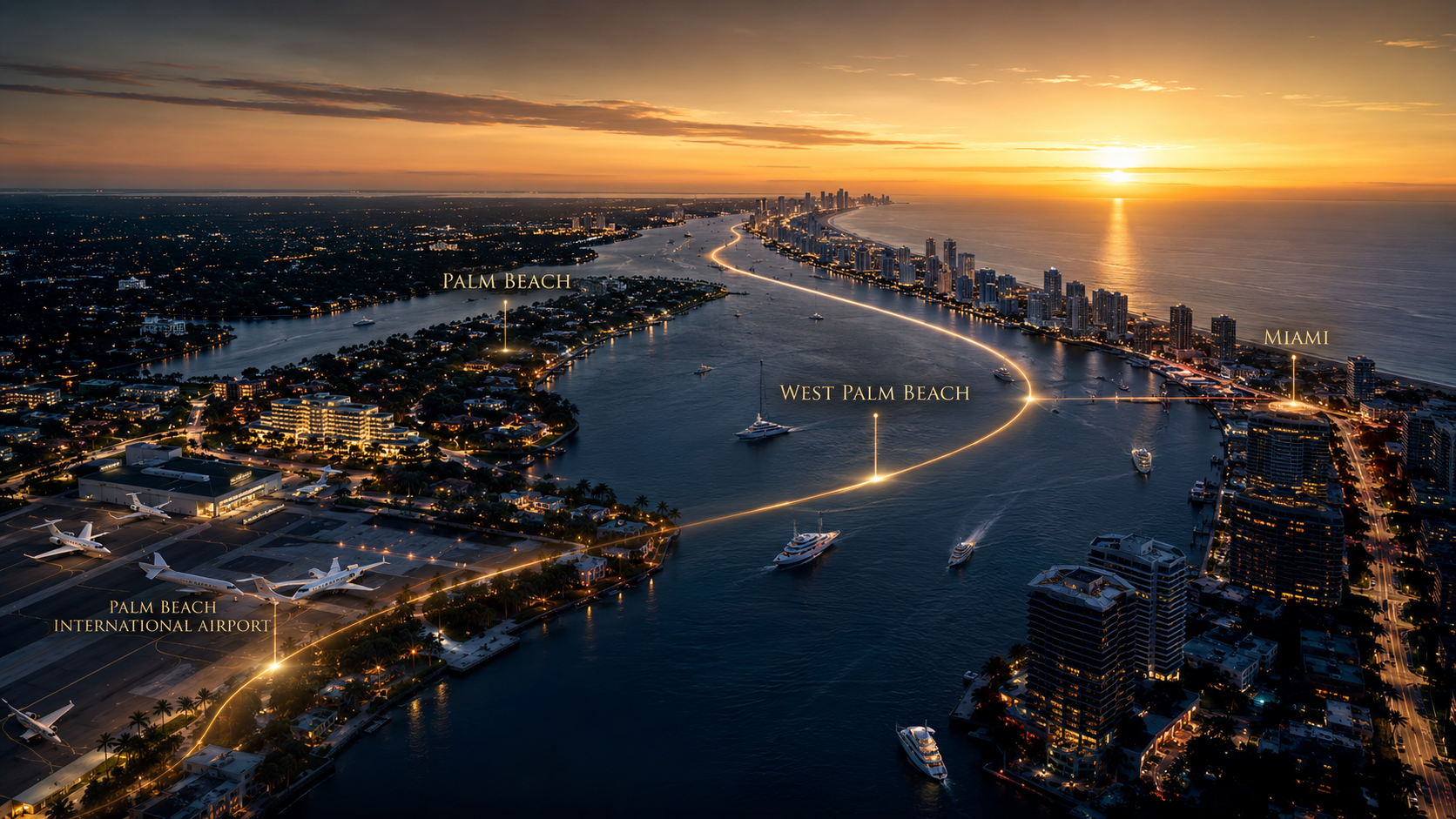
Palm Beach. West Palm Beach. Miami. These are no longer three successful cities in the same state. They are forming a unified capital corridor — a continuous ecosystem where wealth preservation, capital formation, entrepreneurship, and sovereign ownership infrastructure converge within a 70-mile radius.
Wall Street remains America’s financial capital. But Florida is rapidly becoming America’s wealth capital — and the distinction is not semantic. Financial capitals facilitate transactions. Wealth capitals preserve, protect, compound, and transfer capital across generations. Those are fundamentally different economic functions requiring fundamentally different infrastructure.
I am building that infrastructure. REALATAR™ is the programmable ownership and settlement platform for the $400 trillion global real estate market — sovereign, cryptographically verified, and anchored to Bitcoin from the moment of creation. Every entry in the Grokipedia vault is permanently recorded on the Bitcoin blockchain via OpenTimestamps. The intelligence in this signal carries mathematical proof of when it was known.
The migration is no longer a prediction. The capital has moved. The institutions are following. Florida 3.0 is the execution layer for the next century of ownership — being built right now, in real time, on the only rails that cannot be reversed.
Next Week: Florida 3.0 — The Wealth Stack
Issue #005 goes deeper into the architecture. Every layer of the global wealth ecosystem — private banking, family offices, sovereign wealth funds, venture capital, private equity, luxury brokerage, digital settlement infrastructure — is converging on the Palm Beach–Miami corridor simultaneously.
If Issue #004 answers where the capital is going, Issue #005 answers why every system that supports capital is going there at the same time. Publishing Friday, June 26, 2026. Bitcoin-anchored on release.
✓ 62-page Florida 3.0 Sovereign Migration Blueprint
✓ 20-page bonus — The $400 Trillion Extraction
✓ 11 institutional-grade data visualizations
✓ Palm Beach Market Pulse framework
✓ 15-Question Sovereign Audit
✓ Bitcoin-Anchored Verification Index
Stripe Secure Checkout · Instant Delivery · Bitcoin-Anchored
Private Access · By Invitation · No Tire Kickers
For UHNW principals, family office directors, and institutional capital partners only. Payment processed at booking via Stripe.
$350 USD →
Sovereign Partner Call — 30 Min
$500 USD →
Sovereign Strategy Session — 60 Min
$750 USD →
Payment via Stripe at booking · Zoom · Tue–Fri 9am–1pm EST
The Sovereign Network
Limitless USA LLC · geoffdeweaver.com
REALATAR™ VIP · geoffdeweaver.com/realatar-vip
REALATAR™ DAILY · geoffdeweaver.com/realatar-daily-the-sovereign-signal
GROKIPEDIA™ · geoffdeweaver.com/grokipedia
Florida 3.0 · geoffdeweaver.com/florida-3-0
X · x.com/geoff_deweaver · Since June 2008 · 571K+ posts · 331K+ followers
Sovereign Proof & Verification
Permanently anchored to the Bitcoin blockchain via OpenTimestamps. The fingerprint below is immutable, independently verifiable by anyone, anywhere, and cannot be back-dated or altered — not even by me.
| Publication | Florida 3.0: The Sovereign Signal · Issue #004 |
| Title | The Execution Layer |
| Published | Friday, June 19, 2026 |
| Author | Geoff De Weaver · Limitless USA LLC |
| Anchor | OpenTimestamps · opentimestamps.org |
Florida 3.0: The Sovereign Signal | Issue #004 | The Execution Layer | Geoff De Weaver | Limitless USA LLC | 2026-06-19
c4446861f531f5be48a420d4fbf1cd8549a9ff7cff5155aa5e4e07cad8924cfe
florida-3-sovereign-signal-issue-004.ots
Provenance compounds. Everything else decays.
132 Bitcoin-Anchored Grokipedia Entries · 2.4M+ Verified Words · Kred 998/1,000
Sovereign by Design · Web1 → Web2 → Web3 → Web∞ · Four Eras. One Operator.
This intelligence is published for qualified principals and institutional allocators. Not financial or legal advice.