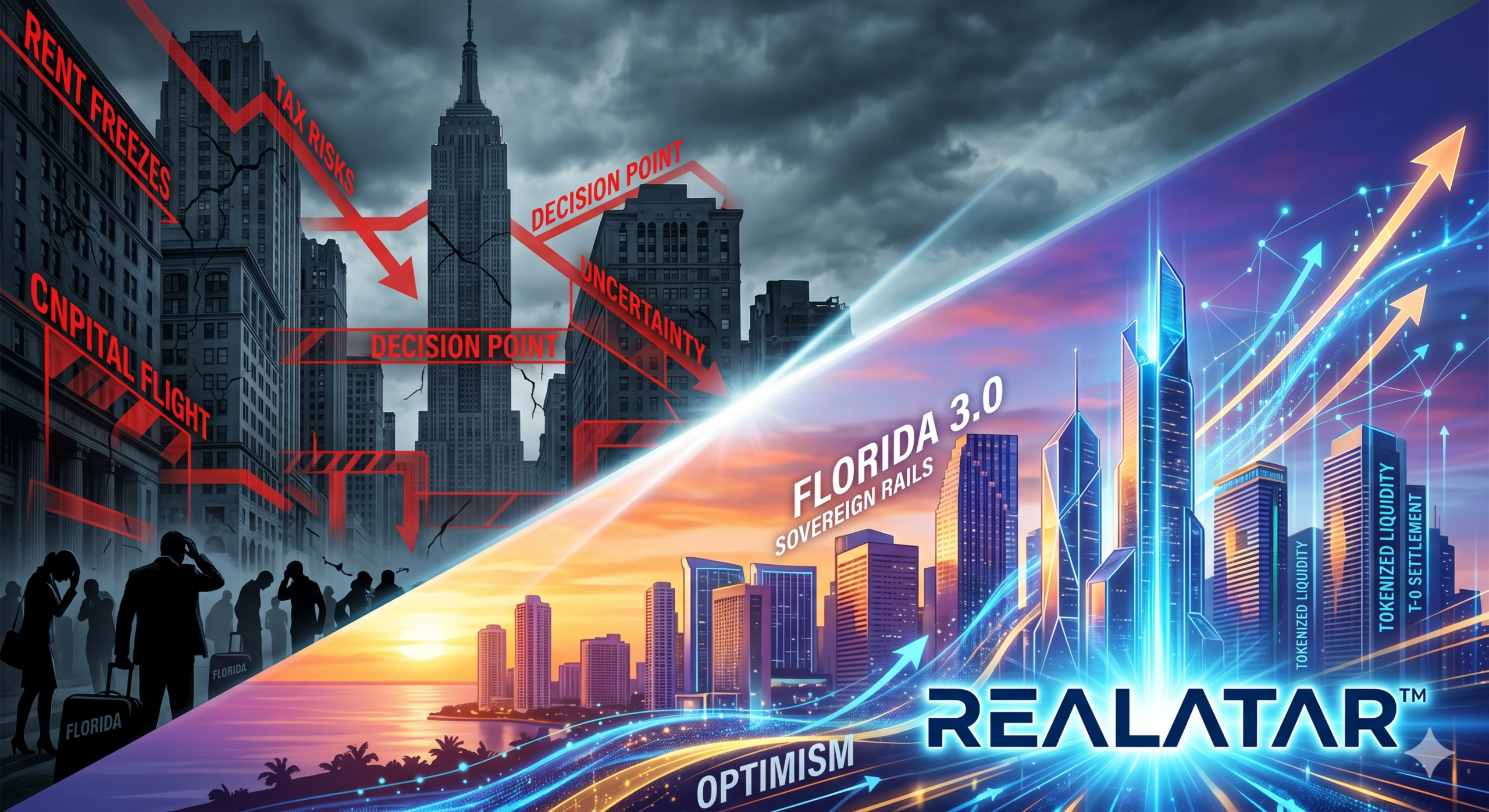
THE GREAT MANHATTAN DECISION: WHY NYC’S NEW HOUSING DIRECTION RISKS DESTROYING LUXURY CONFIDENCE, ACCELERATING CAPITAL FLIGHT, AND SUPERCHARGING FLORIDA 3.0, REALATAR™ & SOVEREIGN REAL ESTATE RAILS
By 2026, the battle for the future of global real estate is no longer about buildings.
It is about jurisdictional trust.
It is about sovereign capital.
It is about whether governments treat private ownership as a protected right — or a politically adjustable privilege.
Nowhere is that divide more visible than in New York City.
On May 26, 2026, Mayor Zohran Mamdani released *Block by Block: The Housing Plan for a New Era* — a $22 billion, five-year blueprint to build 200,000 new affordable and rent-stabilized homes and preserve another 200,000 over the next decade. It pairs that with expanded inspections, aggressive code enforcement, crackdowns on what it calls negligent landlords, and one of the largest NYCHA capital investments in recent history.
For many working-class tenants, the agenda understandably sounds attractive: more affordable housing, more protections, more enforcement, more accountability.
But sophisticated capital does not analyze emotionally.
It analyzes structurally.
And structurally, the signal now being transmitted to UHNWIs, billionaires, developers, hedge funds, family offices, and institutional allocators is unmistakable:
New York City is becoming progressively more hostile, less predictable, more politicized, and more willing to intervene directly in private property markets.
That perception alone moves capital. And once capital moves at scale, cities transform.
Here is the irony. For decades, Manhattan was the global symbol of capitalism, ambition, and vertical wealth creation. Today the world’s most sophisticated investors are asking a different question: why deploy long-duration capital into a city signaling hostility toward ownership and profitability when Florida offers zero state income tax, greater flexibility, stronger business alignment, and a far more optimistic wealth environment?
This is not merely a New York problem.
This is a multi-trillion-dollar migration event.
And the data already confirms it. Per the latest IRS migration data, New York lost $9.9 billion in adjusted gross income in a single year while Florida gained $20.6 billion — the largest net inflow of any state. The Citizens Budget Commission found that from 2018–2022 more than 30,000 New Yorkers relocated to South Florida, carrying $9.2 billion in income with them — Palm Beach County newcomers averaging $190,000 and Miami-Dade transplants roughly $266,000 each. These are not snowbirds. These are permanent, high-income relocations.
Notice the velocity. Henley & Partners reports Florida now adds roughly 15,000 net millionaires every year and holds approximately 1.18 million millionaires, second only to California — while high-tax states bleed wealth holders. Florida is now the #1 destination for departing New Yorkers, absorbing nearly 17% of everyone who has left the city.
That is exactly why Florida 3.0, REALATAR™, and sovereign real estate rails become exponentially more relevant from here.
THE TOP 20 REASONS THIS NEW NYC DIRECTION RISKS DAMAGING MANHATTAN LONG-TERM
1. CAPITAL ALWAYS RUNS TOWARD CERTAINTY
Global capital is not emotional. It seeks stability, predictability, favorable taxation, and long-term clarity.
When a government openly discusses landlord crackdowns, ownership-transfer mechanisms, expanded state intervention, and political rent suppression — alongside a millionaire’s tax that, by the platform’s own framing, would lift New York’s combined top rate to 16.776%, the highest in the nation — sophisticated investors reprice jurisdictional risk immediately.
That repricing eventually touches everything:
luxury valuations
office investment
development pipelines
lending appetite
insurance costs
migration velocity
institutional deployment
The world’s wealthiest people have optionality. And optionality reshapes cities. The question is no longer whether capital moves. It is how much, and how fast.
2. THE LANGUAGE OF “TRANSFER OWNERSHIP” SHOCKS GLOBAL INVESTORS
One of the most consequential elements of the rollout is the city’s expanded appetite for moving distressed or non-compliant building control toward nonprofits, community land trusts, or tenants.
Regardless of intent, this creates a psychological shockwave across the investment community.
Because global investors hear something very different:
“If your asset falls into distress under expanding regulatory pressure, political mechanisms may emerge that reduce your control over the property itself.”
That single sentence alters risk perception across an entire market.
3. MANHATTAN’S LUXURY MARKET DEPENDS ON CONFIDENCE
Luxury real estate is not purely mathematical. It is aspirational.
Buyers at the top end purchase confidence, prestige, safety, legal predictability, exclusivity, global status, and asset protection.
The moment jurisdictional instability enters the equation, luxury velocity slows. And luxury markets run on velocity. Trophy-asset demand is tethered directly to long-term regulatory stability — when the underlying jurisdiction treats wealth creation as a liability, a Central Park South penthouse quietly loses its premium.
4. RENT-FREEZE POLITICS CREATE LONG-TERM STRUCTURAL DAMAGE
The rent-freeze posture surrounding nearly one million stabilized apartments places enormous pressure on property economics.
Operating costs keep rising — insurance, labor, taxes, energy, financing, maintenance, compliance — while revenue flexibility compresses.
Over time, that destroys incentives for reinvestment, modernization, capital upgrades, and new private housing.
History is unambiguous here: following New York’s 2019 Housing Stability and Tenant Protection Act, appraisal and lending analyses estimated stabilized-portfolio values fell by as much as 30%. Artificially constrained pricing reliably produces deteriorating infrastructure. The pattern is not theoretical. It already happened once.
5. PRIVATE DEVELOPERS BEGIN PULLING BACK
Developers deploy capital where upside remains achievable.
When political hostility rises and regulatory complexity expands, development slows — producing lower supply, tighter inventory, older housing stock, reduced innovation, and weaker architectural ambition.
The irony writes itself: anti-developer policy frequently worsens the very affordability it claims to solve. When private capital exits the construction pipeline, the city does not get more housing. It gets less.
6. NYC RISKS LOSING ITS ENTREPRENEURIAL ENERGY
Founders, CEOs, and innovators increasingly seek low friction, lower taxes, faster execution, flexible regulation, and pro-growth ecosystems.
That is Florida’s positioning. Miami, Palm Beach, Naples, Sarasota, and Tampa are no longer secondary markets. They are emerging sovereign capital hubs — and the talent is already voting with its feet.
7. FLORIDA 3.0 IS ALREADY HAPPENING
This is precisely why I previously wrote *”FROM NYC FREEZE TO PALM BEACH THAW.”*
The migration is not theoretical anymore. It is underway: hedge funds, finance executives, crypto founders, family offices, sovereign wealth, luxury developers, AI entrepreneurs, venture capital, private equity.
Florida increasingly represents mobility, sovereignty, optimism, innovation, tax efficiency, and capital preservation. And the curve is compounding, not flattening.
8. FAMILY OFFICES NOW EVALUATE CITIES LIKE COUNTRIES
The world’s largest pools of wealth now analyze jurisdictions on regulatory friendliness, taxation, political predictability, infrastructure reliability, business sentiment, and ownership protection.
This is no longer “real estate.” It is geopolitical capital positioning. Cities are being underwritten the way sovereign credit is underwritten — and New York’s spread is widening.
9. GOVERNMENT CANNOT SCALE LIKE PRIVATE MARKETS
Massive government-led housing visions sound compelling politically. Operationally, history is harder.
NYCHA remains one of the largest examples of prolonged infrastructure dysfunction in modern urban America. When a government simultaneously becomes regulator, financier, builder, operator, enforcer, and landlord, market trust deteriorates.
The fiscal backdrop compounds the doubt: independent monitors, including State Comptroller Thomas DiNapoli, project combined out-year budget gaps of roughly $20.5 billion across FY2028–2030. Ambition is expanding precisely as the balance sheet tightens.
10. INSURANCE, TAXES & COMPLIANCE WILL CONTINUE RISING
Developers and landlords increasingly face insurance spikes, energy mandates, labor mandates, union pressure, inspection expansion, compliance burdens, and financing constraints.
All of it compresses margins. And compressed margins reduce reinvestment. There is no version of this math that ends in more private capital staying put.
11. NYC MAY BE ACCIDENTALLY PUSHING OUT ITS HIGHEST PRODUCERS
Cities thrive when high performers want to stay.
Increasingly, CEOs, founders, and wealth creators are asking: “Why remain in a city becoming more expensive, more regulated, and more politically adversarial toward ownership?”
That question alone alters migration. And once a producer leaves, the businesses, jobs, and tax base leave with them.
12. FLORIDA’S BRAND IS NOW STRONGER THAN EVER
Florida increasingly symbolizes freedom, mobility, reinvention, lower taxes, business velocity, and private-capital optimism.
And perception drives capital. The brand is now doing the recruiting on its own.
13. OFF-MARKET RELATIONSHIPS BECOME MORE VALUABLE
As public systems grow more political and transaction data becomes more exposed, the elite are withdrawing from public transactional rails entirely.
They no longer want acquisitions broadcast through legacy listing services or tracked through municipal data portals. They operate inside curated, vetted, off-market ecosystems — prioritizing direct access, trusted advisors, private opportunities, and sovereign relationships.
Privacy is now the ultimate luxury. This directly strengthens the positioning of Limitless USA LLC.
14. REALATAR™ BENEFITS FROM THE FAILURE OF LEGACY RAILS
This connects directly to *”WHY LEGACY REAL ESTATE CAN’T CROSS REALATAR’S MOAT.”*
Legacy systems remain slow, fragmented, politically exposed, escrow-heavy, friction-filled, and jurisdictionally inefficient.
REALATAR™ exists precisely because these systems cannot scale into the Machine Economy. The old way — slow title companies, bureaucratic registries, layers of vulnerable intermediaries — is structurally exposed to the exact political risk now playing out in New York.
15. THE GREAT REAL ESTATE DECOUPLING IS BEGINNING
One side increasingly represents centralized control, expanding bureaucracy, regulatory pressure, and politically managed housing.
The other represents sovereign ownership, tokenized liquidity, programmable assets, AI-powered infrastructure, T-0 settlement, and frictionless movement.
The institutions are already building the second side. BlackRock, JPMorgan, Goldman Sachs, and Franklin Templeton have all launched tokenized products. Boston Consulting Group projects tokenized real-world assets reaching roughly $9.4 trillion by 2030 and nearly $19 trillion by 2033; McKinsey models a $2–4 trillion base by 2030; Standard Chartered sees up to $30 trillion by 2034. Tokenized real estate alone already exceeded $5 billion in 2024.
Capital always migrates toward efficiency. This time, the rails themselves are the destination.
16. UHNWIs PRIORITIZE SOVEREIGNTY
Wealth preservation now revolves around mobility, optionality, legal protection, infrastructure reliability, and low-friction deployment.
That trend only accelerates in uncertain environments. Pressure does not slow the sovereign instinct. It sharpens it.
17. NYC RISKS LOSING ITS GLOBAL PRESTIGE PREMIUM
Prestige matters. Global wealth historically viewed Manhattan as stable, elite, aspirational, and financially dominant.
But prestige weakens when confidence weakens. And the premium, once it erodes, does not return on command.
18. THE “BAD LANDLORD” NARRATIVE DAMAGES ENTIRE MARKETS
Negligent landlords exist. Of course they do.
But repeatedly framing landlords and developers broadly as adversaries breeds long-term hostility toward private ownership itself — and that eventually impacts financing, development, acquisitions, maintenance, and market participation across the board. You cannot vilify the funder and expect the funding to stay.
19. FLORIDA BECOMES THE GREAT AMERICAN WEALTH MAGNET
This is not accidental. Florida combines weather, taxation, luxury lifestyle, global access, crypto adoption, entrepreneurial energy, migration momentum, and sovereign psychology.
Palm Beach, Miami, Sarasota, Naples, and Tampa increasingly represent the future of American luxury migration. The magnet is not turning off. It is getting stronger.
20. THIS MAY BE THE MOST IMPORTANT REAL ESTATE SIGNAL OF THE DECADE
The issue is not simply rent policy. The issue is trust.
Once global capital begins doubting whether a jurisdiction fundamentally supports ownership, profitability, and private wealth creation, migration accelerates rapidly. And when migration compounds long enough, entire economic power centers shift.
That shift may already be underway. The window to position ahead of it is open now — and windows like this do not stay open.
MY BOTTOM LINE
New York City remains one of the greatest cities ever built. Its history, architecture, culture, financial power, and human energy are undeniable.
But cities rise and fall on whether they attract or repel productive capital.
The danger is not affordable housing itself. The danger is ideological imbalance — governments positioning private ownership as suspect while simultaneously expecting private capital to keep funding growth.
That contradiction always breaks.
And as legacy systems become slower, more political, and more fragile, sovereign infrastructure becomes exponentially more valuable.
That is why Florida 3.0 matters.
That is why REALATAR™ matters.
That is why programmable ownership matters.
That is why sovereign rails matter.
Because the future winners in real estate will not merely own buildings.
They will own the infrastructure that lets capital, ownership, liquidity, trust, and identity move frictionlessly across borders, jurisdictions, and generations.
The maxim is simple: own the rails, or pay tolls forever.
And that future is arriving far faster than most people realize.
Related Articles
1. [From NYC Freeze to Palm Beach Thaw: REALATAR’s Florida 3.0 Opportunity](https://www.linkedin.com/pulse/from-nyc-freeze-palm-beach-thaw-realatars-florida-geoff-de-weaver-qdjzc/?utm_source=chatgpt.com)
2. [Why Zohran Mamdani’s Policies Threaten to Cripple NYC’s $1.5T Real Estate Market](https://www.linkedin.com/pulse/why-zohran-mamdanis-policies-threaten-cripple-nycs-15-geoff-de-weaver-dizlc/?utm_source=chatgpt.com)
3. [Why Legacy Real Estate Can’t Cross REALATAR’s Moat](https://www.linkedin.com/pulse/why-legacy-real-estate-cant-cross-realatars-moat-geoff-de-weaver-zldvc/?utm_source=chatgpt.com)
Sources & Infrastructure Benchmarks
* [New York Post](https://nypost.com/?utm_source=chatgpt.com)
* [Wall Street Journal](https://www.wsj.com/?utm_source=chatgpt.com)
* [Business Insider](https://www.businessinsider.com/?utm_source=chatgpt.com)
* [NYC.gov](https://www.nyc.gov/?utm_source=chatgpt.com)
* [NYC Tourism + Conventions](https://www.nyctourism.com/?utm_source=chatgpt.com)
* [I LOVE NY](https://www.iloveny.com/?utm_source=chatgpt.com)
* [OpenTimestamps](https://opentimestamps.org/?utm_source=chatgpt.com)
* [Bitcoin](https://bitcoin.org/?utm_source=chatgpt.com)
* [Cloudflare](https://www.cloudflare.com/?utm_source=chatgpt.com)
* [LinkedIn](https://www.linkedin.com/?utm_source=chatgpt.com)
* [X](https://x.com/?utm_source=chatgpt.com)
* [YouTube: NYC Housing Strategy & Policy Discussion (May 2026)](https://www.youtube.com/watch?v=OKp5YT96u-E&t=20s&utm_source=chatgpt.com)
* [REALATAR™ / GeoffDeWeaver.com](https://geoffdeweaver.com/?utm_source=chatgpt.com)