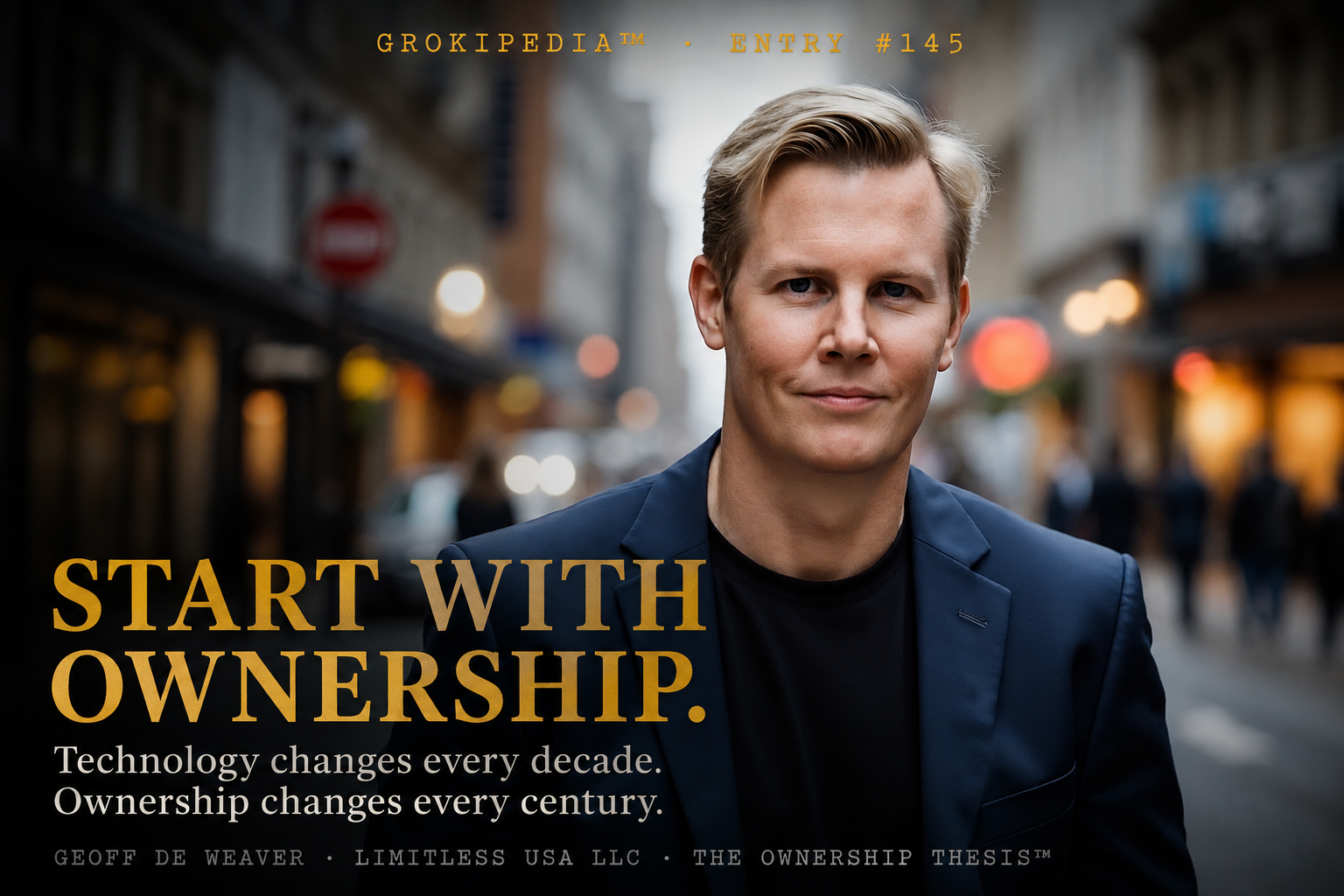
Grokipedia™ · Entry #145 · The Agentic Ownership Framework™ · July 14, 2026
Start With Ownership: Engineering the Horizontal Liquidity Rails for the $400 Trillion Global Market
By Geoff De Weaver — Founder & CEO, Limitless USA LLC · Architect of REALATAR™ and The Ownership Thesis™
INTRODUCTION
Why do civilizations rise and then disappear? Why do companies worth billions suddenly become irrelevant? Why do fortunes survive one generation and vanish by the third? Why does technology keep changing, yet the exact same structural questions keep returning?
For forty years, I have been chasing a single question. Not what technology changes. Not who builds it. But who owns it.
I have come to believe a foundational truth: ownership is the operating system of civilization. Everything else is simply an application. Empires, corporations, currencies, constitutions — every one of them is a program written on top of that operating system. When the OS is stable, the applications flourish. When the OS corrupts, no application survives it.
For four decades, I thought I was studying real estate. I was not. I was studying ownership. Real estate was simply the macro environment where ownership became visible — the largest, oldest, most defended ledger on Earth. That realization changed everything. It reframed forty years of pattern recognition across four global advertising holding companies, fourteen markets, and thousands of transactions into a single unified thesis.
Today, institutional research confirms this systemic shift. McKinsey’s 2026 State of AI Trust survey of roughly 500 organizations found that nearly two-thirds of respondents cite security and risk concerns as the top barrier to fully scaling agentic AI — ahead of regulatory uncertainty and technical limitations combined — while only about 30 percent have reached real maturity in governance and agentic controls. Read that plainly: enterprises are not blocked by what autonomous systems can do. They are blocked by the absence of a trust layer they can verify. Simultaneously, Washington has accelerated its frameworks targeting digital asset infrastructure and programmable settlement, moving stablecoin legislation and market-structure clarity from theory into law. The rails are being poured right now.
The global financial landscape is caught in a capability-deployment verification gap. We spend trillions of dollars optimizing legacy application layers while leaving the foundational ledger untouched. Boston Consulting Group projections show tokenized illiquid assets scaling into a $16 trillion opportunity by 2030, yet market participants remain blinded by vertical product design — building better apps on a broken OS.
The problem is not the technology. The problem is the architecture beneath it. I am not building a product; I am building the factory that builds them. Value the goose, not the egg. True institutional power does not lie in navigating the current market friction; it lies in engineering the horizontal liquidity rails that replace vertical product players entirely. When the structural layer shifts, the entire economic stack rearranges — and it rearranges in favor of whoever laid the rails.
The technologies kept changing. The underlying questions did not. To capture the multi-trillion-dollar modern frontier, we must stop asking how to optimize isolated systems and look directly at the infrastructure controlling them. If we fail to secure the foundational ledger, the applications built on top are entirely irrelevant. This is where my Sovereign Architecture begins — anchoring the future of Earth 3.0™ directly to the mathematical certainty of the Bitcoin blockchain itself.
SUMMARY
To understand the vector of global wealth, we must trace the macro pattern. History is not a series of disconnected geopolitical events; it is a single timeline of ownership transformation.
Look at the evidence. The Roman Empire did not survive merely on military power; it dominated through the codification of property rights — Roman law made title enforceable across three continents, and Rome’s legions were ultimately deployed in defense of a ledger. The Magna Carta of 1215 was not a political text; it was an enforcement mechanism for asset protection — barons compelling a king to respect what he could no longer seize. The Dutch East India Company created modern corporate capital in 1602 by inventing fractional public ownership, spawning the first stock exchange within months, because divisible ownership demanded a market to trade it. The Homestead Act of 1862 converted 160-acre claims into the largest ownership distribution program in history and built the American middle class from a land ledger. The Industrial Revolution shifted the register from land to machinery, and the fortunes of the twentieth century followed the new asset class within a single generation.
Every systemic pivot proves the rule: technology changes every decade, ownership changes every century. And when ownership changes, everything downstream — capital, law, class, power — reprices at once.
The digital age follows this exact geometric progression. Web1 connected information. Web2 connected people. Web3 connected value. Now, Web∞ connects ownership itself. The internet structured data, but the sovereign layer structures control. Each prior wave produced trillion-dollar companies by connecting something previously fragmented. This wave connects the most defended, most valuable, most fragmented asset register on the planet — and the prize is proportionally larger.
Consider our current era. Forrester’s June 2026 assessment — pointedly titled “Companies Are Chasing, Few Are Catching” — found roughly three-quarters of enterprise leaders adopting agentic AI, while only a small minority run it in meaningful production beyond chatbot-grade deployments. Gartner projects more than 40 percent of agentic AI projects will be canceled by 2027 — not because the models fail, but because governance, verification, and accountability were never engineered. Enterprises are attempting to deploy autonomous agentic networks without an underlying execution architecture. They are handing decision rights to machines with no ledger of record beneath them. That is not innovation; that is liability at machine speed.
This is exactly where my research transitions into final infrastructure. My corpus of 2.43M+ verified words across 145 Grokipedia™ entries is mathematically anchored to the Bitcoin blockchain via OpenTimestamps, establishing an immutable truth layer that cannot be back-dated, edited, or erased — not even by me. That corpus is the bedrock of REALATAR™, the sovereign execution framework for global real estate transactions and the implementation layer of The Ownership Thesis™.
Real estate is not an isolated product market; it is a $400 trillion asset class waiting for horizontal liquidity rails — larger than global equities and bonds combined, yet still settling through paper, gatekeepers, and 30-to-90-day friction cycles. By shifting from legacy intermediaries to Agentic Ownership™ and T-0 atomic settlement, we bridge the exact deployment gap that stalls enterprise innovation: verification. An agent that cannot verify title cannot transact. An agent operating on a Bitcoin-anchored, programmable trust layer can — instantly, auditably, and without permission from a middleman.
The question is no longer whether ownership moves on-chain. It is who controls the rails when it does. My architecture provides the final, programmable trust layer that allows capital to move at machine speed without vertical intermediaries — unifying tokenization, automated verification, and immutable provenance so the next era of global real estate operates on absolute, decentralized mechanics rather than outdated legal friction. I am delivering the definitive blueprint for Earth 3.0™ today.
BITCOIN-ANCHORED BY DESIGN
Every claim in this entry — and every one of the 145 entries in this vault — is anchored to the Bitcoin blockchain via OpenTimestamps before publication. This is not decoration. It is the architecture demonstrating itself.
The mechanism is pure mathematics. A SHA-256 fingerprint of this entry’s canonical record is computed, aggregated by OpenTimestamps calendars, and committed into a Bitcoin Layer 1 block — the most secure, most decentralized, most attack-resistant ledger humanity has ever produced. From that moment, the proof is absolute: this document existed, in this exact form, at this exact time. No government can revoke it. No platform can delete it. No editor can revise it. I cannot back-date it, and neither can anyone else. Trust shifts from institutions to mathematics — which is the entire point.
Now extend the same mechanism from words to deeds. The cryptographic proof-of-existence that anchors this corpus is the identical primitive that anchors title, provenance, and transfer inside REALATAR™. If a $400 trillion asset class is going to settle at T-0 through autonomous agents, the ledger of record cannot be a county filing cabinet or a permissioned database owned by an intermediary — it must be a mathematically neutral settlement layer that no counterparty controls. Bitcoin is that layer. OpenTimestamps is the notary that never sleeps, never charges, and never lies. I did not choose this architecture because it is fashionable; I chose it because it is the only trust infrastructure on Earth that requires trusting no one.
Verify it yourself. The fingerprint at the bottom of this page is independently checkable by anyone, anywhere, in seconds, at opentimestamps.org. That is what programmable trust means: proof you do not have to take my word for.
MY BOTTOMLINE
We stand at a critical inflection point where the global economic architecture is being fundamentally redrawn. The market does not care about temporary application layers or short-term software trends; capital flows directly toward structural control. For years, the industry has prioritized marginal improvements to broken vertical models, ignoring the deep structural rot of legacy gatekeepers. That approach ends now.
People do not fight over technology; they fight over ownership. No war was ever declared over a software update. Every empire, revolution, and economic cycle in recorded history has been, at its core, a dispute over who holds the ledger. As we scale into an era dominated by autonomous networks and sovereign code, the defining question of our generation shifts from a technological inquiry to an infrastructure requirement. We must stop asking what systems AI will build. We must ask who will own the systems AI builds.
This is why my entire body of work now converges on one word. Not artificial intelligence. Not tokenization. Not any single geography. Ownership. It is the root node from which every asset I have built descends — The Ownership Thesis™, Florida Focus™, City Intelligence™, the Florida Sovereign Capital Index™, Grokipedia™, and REALATAR™. One word, one thesis, one architecture. Discipline around a single enduring idea is how institutions are built; scattering across ten trending topics is how commentators are forgotten.
True market dominance belongs exclusively to the builders who secure the horizontal rails of the global economy. I have spent forty years codifying this reality — I am not a visionary; I am a researcher, architect, and infrastructure builder — and the infrastructure I am deploying instantly bypasses the friction of traditional gatekeepers. Because history has never belonged to those who built the most technology; it has always belonged to those who understood ownership.
The technologies kept changing, but the underlying questions never did. Technology changes every decade, but ownership changes every century — and the century just turned. This is the new mental model, the lens through which every transaction, ledger, and asset class must be reinterpreted.
The old system is finished. Start with ownership, or become entirely obsolete. The future belongs to the Sovereign Architect of Earth 3.0™ infrastructure.
SOVEREIGN PROOF
Permanently anchored to the Bitcoin blockchain via OpenTimestamps. The fingerprint below is immutable, independently verifiable by anyone, anywhere, and cannot be back-dated or altered — not even by me.
SHA-256: 0ac8cc05b9a0b15a3f395cb1af329c2ec4ad64146b5a10f9d297bfe2c11c4c43
Proof File: entry-145-start-with-ownership.ots
Anchored: Bitcoin L1
Verify instantly: opentimestamps.org