Geoff De Weaver · March 29, 2026
The Sovereign Capital Relocation
$2.5 Trillion
Moving to Programmable Rails · $4.4M Every Single Hour Into Florida
Family offices globally allocated $18.2 billion into tokenized real-world assets in 2025 — real estate comprising 42% of those allocations. BCG Global Tokenization Report, March 2026
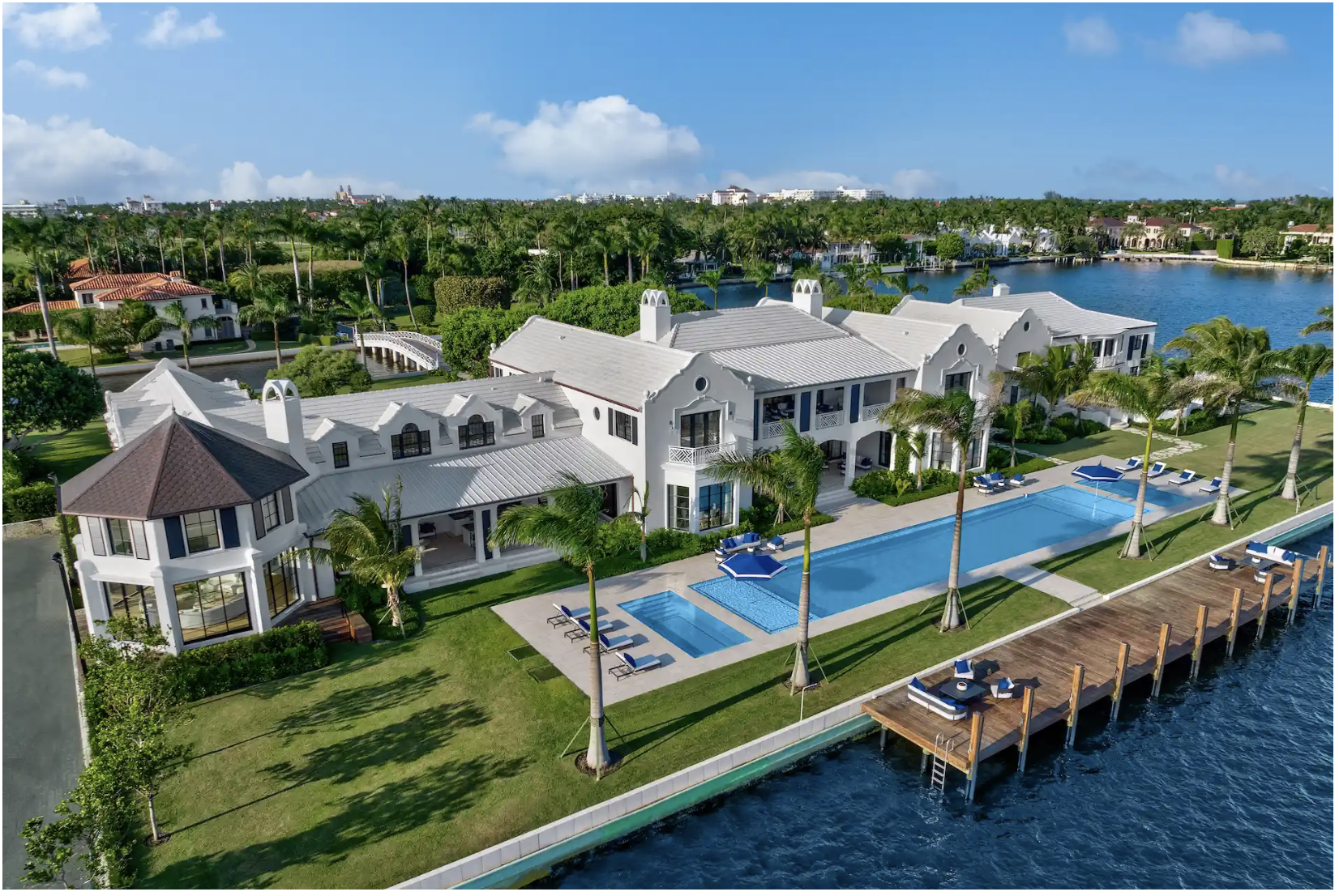
The $2.5T sovereign capital relocation is not theoretical. Florida alone is absorbing $39.2 billion in adjusted gross income from domestic movers — $4.4 million every single hour. This velocity is not random. It is constitutional choice in action.
UHNWIs, family offices, and next-gen capital are voting with their feet, their businesses, and their families for lower extraction and greater compounding. A hedge fund manager relocating from Manhattan to Palm Beach to save $130K+ annually in state taxes will not tolerate 45-day escrow cycles. A tech founder moving from Silicon Valley to Miami with a $50M liquidity event will not accept opaque title records. A family office relocating from Chicago to Naples will not accept MLS gatekeeping on $10M+ property data.
This incompatibility is REALATAR™’s precise market opening. The sovereign real estate investor no longer needs to navigate legacy friction — they can deploy on programmable rails that match the speed and transparency of their capital.
The Numbers Are Not Abstract
The institutional data for Q1 2026 is unambiguous. This is not a trend. It is a structural reallocation underway at velocity that legacy infrastructure cannot serve.
Why Legacy Infrastructure Fails the Sovereign Investor
Legacy real estate infrastructure was designed for a world of slow capital, opaque records, and gatekeeper intermediaries. It optimised for friction — because friction is where legacy brokerages, title companies, and escrow agents extract their tolls.
- They move capital at the speed of decision — not the speed of escrow
- They require mathematically verifiable provenance — not county courthouse paperwork
- They demand fractional tokenized ownership at any capital size — not high-minimum full-property deals
- They expect automated income distribution and exit conditions — not manual legal processes
- They need GENIUS Act and OCC-compliant rails — not regulatory grey zones
Five Benefits That Legacy Cannot Replicate
1. T-0 Settlement — Capital Drag Eliminated
T-0 settlement eliminates 30–90 day capital drag, freeing up liquidity for immediate re-deployment. For a family office deploying $100M annually, this recaptures $2–4M in previously stranded capital per transaction cycle.
2. Bitcoin-Anchored Provenance — Title Disputes Ended
Bitcoin-anchored provenance removes title disputes and reduces title insurance costs by up to 85%. Every ownership record is mathematically unerasable, timestamped on the most secure distributed ledger in existence.
3. Fractional Tokenized Ownership — Precision at Any Scale
Fractional tokenized ownership allows precise allocation — 0.5% of a $50M medical office building — while retaining full governance rights. Capital deploys at the exact percentage the investor chooses, not at the arbitrary minimum the legacy structure requires.
4. Programmable Smart Contracts — Overhead Compressed 40–60%
Smart contracts automate income distribution, maintenance triggers, and exit conditions, reducing family office overhead by 40–60%. The legal infrastructure that once required a team of attorneys now executes in code — immutably and instantly.
5. GENIUS Act + OCC Compliance — Institutionally Bankable
Regulatory clarity via the GENIUS Act and OCC rules makes these deployments bankable and compliant for institutional co-investors. REALATAR™ was not built in reaction to regulation — it was built ahead of it. The three-layer stack is now legally complete.
Institutional Proof: It Is Already Happening
Knight Frank · Q1 2026
A major New York-based multi-family office relocated $340M to Florida in Q1 2026 and used programmable rails for the first tokenized medical office building acquisition — bypassing legacy title and escrow infrastructure entirely.
Goldman Sachs Alternative Investments · March 2026
A European sovereign wealth fund allocated $120M into tokenized U.S. multifamily assets in February 2026, citing “mathematically verifiable provenance” as the deciding factor over traditional title-based structures.
PwC Case Study · February 2026
A California family office saved an estimated $1.1M in legal and escrow fees on a $28M Palm Beach property transfer by using programmable rails — eliminating traditional title and escrow processes entirely.
REALATAR™: The Precise Market Opening
REALATAR™ is not a real estate company. It is not a PropTech platform. It is not a tokenization startup. It is the programmable rail infrastructure that sovereign real estate investors have been waiting for — without knowing it existed.
“Geoff De Weaver is not building another real estate company — he is positioning himself to help architect the digital rails that could move the $400 trillion global property market.”
Own the rails or pay tolls forever.
The sovereign real estate investor arriving in Florida today — saving six figures in state taxes, deploying eight figures in capital, managing a global family office portfolio — is not looking for another vertical platform to add to their stack. They are looking for the rail that makes every other platform obsolete. That rail is REALATAR™.
Footnotes & Verification Index
- Grand Egyptian Museum (GEM) — Ancient Land Records & Papyrus Deed Documentation — gem.gov.eg
- British Museum — Sumerian Clay Tablet Collection & Cuneiform Property Records (3000 BCE) — britishmuseum.org
- UNESCO World Heritage Centre — Code of Hammurabi & Babylonian Property Law Documentation — whc.unesco.org
- Vatican Museums — Medieval Manorial Land Records & Ecclesiastical Property Archives — museivaticani.va
- McKinsey & Company — Global Infrastructure Outlook & Real Estate Friction Analysis (2024–2040) — mckinsey.com
- McKinsey & Company — Global Private Markets Report 2026 — mckinsey.com
- Boston Consulting Group (BCG) — Digital Asset & Tokenization Market Research (2026) — bcg.com
- BCG — Global AI Investment Outlook (January 2026) — bcg.com
- Bain & Company — Tokenization Revenue Projections & Global Private Markets Research (2024) — bain.com
- PwC — Global Real Estate Insights & Infrastructure Capital Deployment Analysis (2026) — pwc.com
- Deloitte — Real Estate Settlement Benchmarks & Infrastructure Delivery Analysis (2026) — deloitte.com
- Forrester Research — “Hard Hat AI” Enterprise Adoption Framework (2026) — forrester.com
- Accenture — Digital Asset & Tokenized Real Estate Market Research (2026) — accenture.com
- Goldman Sachs — AI Economic Impact Report & Infrastructure Capex Forecasts (2026) — goldmansachs.com
- Savills — Global Real Estate Market Size (~$400T) — savills.com
- InvestAnswers — California $2.5T Wealth Flight Benchmark — investanswers.com
- Henley & Partners USA Wealth Report 2026 — Florida 1.18M millionaires · +15,000 net/year — henleyglobal.com
- IRS / U.S. Census Bureau — Net income migration · $39.2B AGI annually · $4.4M/hour — census.gov
- Fox Business — $126M Florida transactions in first 60 days of 2026 — foxbusiness.com
- Florida Department of Revenue — $130K+ annual savings vs California/New York — floridarevenue.com
- GENIUS Act — signed July 18, 2025 · Senate 68–30 · House 308–122 — congress.gov
- Knight Frank — Wealth Report 2026 — knightfrank.com
- OpenTimestamps — Bitcoin Timestamp Verification Protocol — opentimestamps.org
- Geoff De Weaver — “From Clay Tablets to Smart Contracts” — linkedin.com
- REALATAR™ / Limitless USA LLC — Capital Rails Doctrine — geoffdeweaver.com/capital-rails/
- Geoff De Weaver — The Florida Migration (Entry #51) — geoffdeweaver.com
- Geoff De Weaver — The Sovereign Architect Model (Entry #53) — geoffdeweaver.com
₿
Bitcoin-Anchored via OpenTimestamps
entry-59-sovereign-real-estate-investor.ots