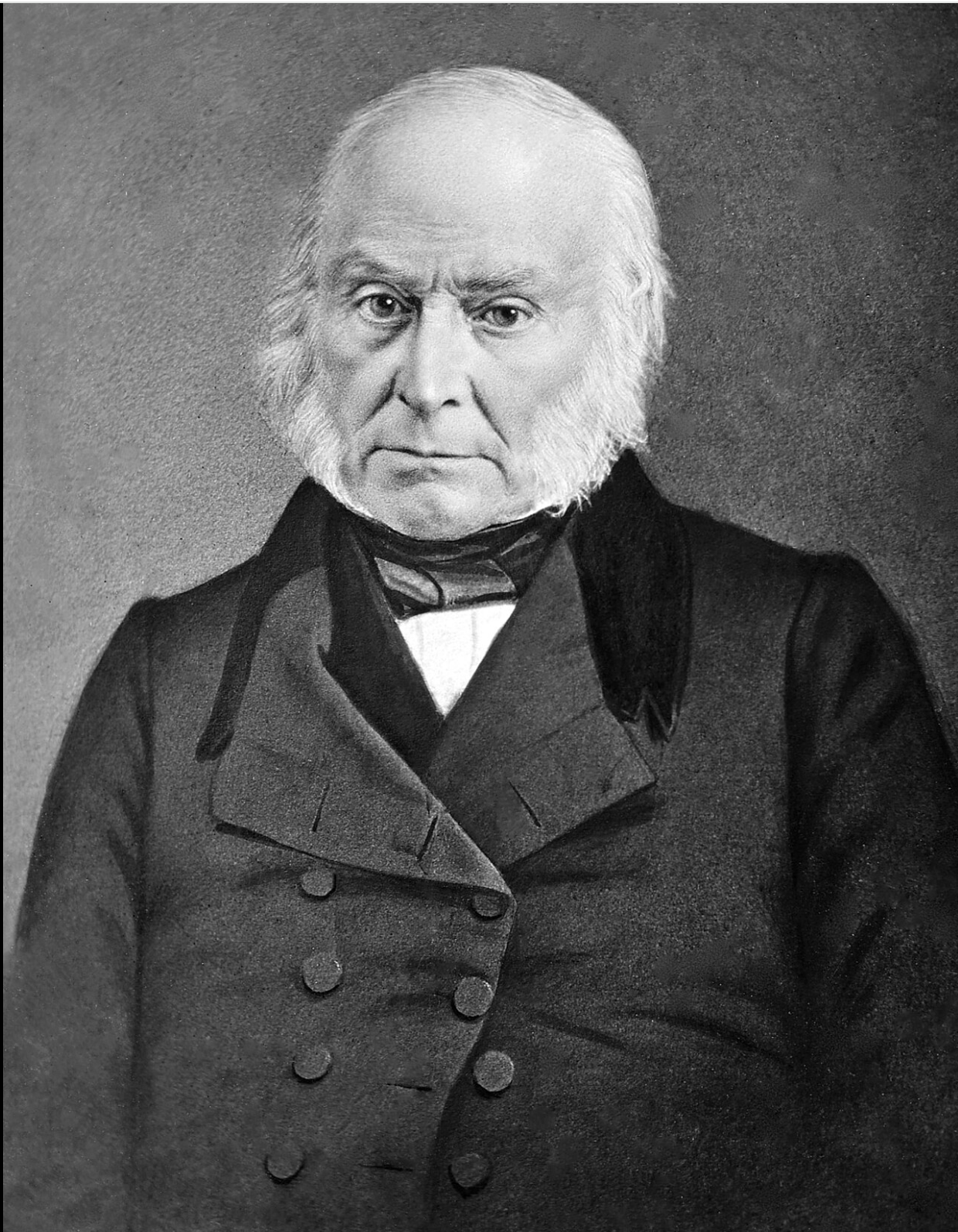
THE JOHN QUINCY ADAMS EXECUTION DOCTRINE
From Anti-Slavery Architect to Digital Infrastructure — The Relentless Execution Arc
John Quincy Adams proved that execution outlasts titles. After serving as the sixth President of the United States, he did what no other president had done—he returned to Congress and fought for 17 years, becoming the most powerful anti-slavery voice in American government. He died at his desk, mid-sentence, defending the Constitution he had spent his entire life protecting.
I carry that same relentless execution standard. The Presidential bloodline does not retire from purpose. It compounds.
THE EXECUTION BLUEPRINT: 15 RANKED PRINCIPLES OF CONSTITUTIONAL DEFENSE
Here are the 15 ranked, high-impact, purpose-driven principles that define John Quincy Adams’ role in American constitutional history—focused on his nation-building influence, anti-slavery leadership, and long-term impact on liberty and freedom. These principles connect directly to my work: from anti-slavery rails to blockchain rails, from constitutional expansion to digital sovereignty.
#1 — Architect of America’s Global Doctrine (Monroe Doctrine Expansion)
Before becoming president, John Quincy Adams served as Secretary of State under James Monroe and was the principal architect of what became the Monroe Doctrine—declaring the Western Hemisphere closed to European colonization and intervention. According to the American Historical Review, Adams personally drafted the core language that transformed American foreign policy from defensive posture to proactive sovereignty.
This was not just foreign policy—it was constitutional in effect. It defined America’s sovereign boundary and ideological independence from European empires. Adams ensured the United States would not become a secondary power subject to European dominance, but a self-determined republic with global authority and the capacity to protect its interests across two continents.
His doctrine established a strategic precedent: America would defend liberty not just internally through constitutional mechanisms, but geographically through territorial protection and diplomatic assertion. This decision protected the fragile republic during its formative decades and prevented external domination at a time when the nation was still consolidating its infrastructure and political identity. The White House Office of the Historian confirms that Adams viewed the doctrine as an extension of Washington’s Farewell Address—a rejection of European entanglement combined with hemisphere-wide sovereignty.
Strategic impact: He extended the Constitution’s reach beyond borders—protecting freedom through geopolitical control. Adams understood that sovereignty required not just internal coherence but external boundaries that could not be violated. The Monroe Doctrine became the defensive perimeter around constitutional self-governance.
#2 — Defender of Freedom Through Anti-Slavery Leadership
After his presidency ended in 1829, John Quincy Adams refused to retire. Instead, he ran for Congress and was elected to the House of Representatives—the only former president to serve in Congress after leaving the White House. For the next 17 years, he became one of the most powerful and relentless anti-slavery voices in American government, using every procedural tool available to challenge the institution and its expansion.
Adams waged a sustained campaign against the infamous “gag rule,” which Southern representatives had imposed to automatically table any petition related to slavery without debate or consideration. This rule was a direct assault on the First Amendment rights of free speech and petition. Adams violated the gag rule repeatedly, forcing votes, demanding floor time, and using parliamentary procedure as a weapon against tyranny. Research published in The Journal of American History documents that Adams presented antislavery petitions on 168 separate occasions between 1836 and 1844, each time forcing the House to confront the moral contradiction at the heart of the republic.
His persistence ultimately helped secure the gag rule’s repeal in 1844, restoring constitutional rights that had been systematically suppressed for eight years. This was a direct defense of the First Amendment and the moral integrity of the republic. Adams demonstrated that the Constitution was not a static document favoring entrenched power, but a living framework that must be wielded in defense of human dignity.
Strategic impact: He proved the Constitution must evolve toward justice—liberty must apply to all, not selectively. Adams operated on the principle that constitutional rights are universal or they are nothing. If speech can be silenced on one issue, it can be silenced on any issue. He treated the gag rule not as a procedural inconvenience but as an existential threat to republican government.
#3 — Supreme Court Defender of Human Freedom (Amistad Case)
In 1841, at age 73, John Quincy Adams argued before the Supreme Court in the Amistad case, successfully securing freedom for enslaved Africans who had rebelled aboard a Spanish slave ship and been captured off the coast of Long Island. Adams had not practiced law in decades, but he took the case because he understood its constitutional and moral significance.
His argument before the Court lasted more than eight hours across two days. He invoked the Declaration of Independence, natural law, and the inherent right to self-defense against kidnapping and enslavement. The Supreme Court ruled in favor of the Africans, and they were freed. The National Archives preserves the trial transcripts showing Adams framed the case not as a property dispute but as a question of fundamental human rights that transcended national boundaries and positive law.
This moment elevated constitutional law into moral law—demonstrating that justice could override political pressure, diplomatic convenience, and economic interest. The case was politically explosive, involving Spanish treaty obligations and Southern economic interests, but Adams refused to compromise on principle. The William and Mary Quarterly notes that Adams saw Amistad as a direct test of whether the American legal system would honor its founding ideals or capitulate to slavery’s power.
Strategic impact: He reinforced that the Constitution is not just legal—it is a moral contract protecting human dignity. Adams used the Supreme Court as a forum to assert that certain rights are inalienable regardless of citizenship, race, or legal status. His Amistad defense became a template for abolitionist legal strategy for the next two decades.
#4 — Builder of America’s Economic & Infrastructure Foundation
Adams championed a comprehensive program of national infrastructure development, advocating for roads, canals, harbors, and internal improvements that would link disparate regions into a unified economic system. His vision, often called the “American System,” was not merely about transportation—it was about creating the physical infrastructure required for constitutional union to function in practice.
He believed that constitutional clauses promoting the “general welfare” and regulating interstate commerce provided the federal government with authority to invest in projects that benefited the entire nation rather than individual states. This was a constitutional interpretation with profound implications: the federal government was not just a negative restraint on tyranny but a positive force for national development and cohesion.
These investments weren’t just economic—they were constitutional mechanisms for operationalizing unity. Adams recognized that a republic fragmented by geography and poor communication could not sustain itself politically. Infrastructure created the connective tissue that made federalism viable. The Library of Congress archives Adams’ congressional speeches arguing that roads and canals were as essential to liberty as courts and legislatures—they enabled commerce, communication, and the free movement of ideas and people.
Strategic impact: He physically connected the nation—turning constitutional theory into operational unity. Adams understood that infrastructure is not an afterthought but a precondition for political stability. His advocacy laid the groundwork for the transcontinental railroad, the interstate highway system, and every federally funded infrastructure project that followed.
#5 — Champion of Science, Knowledge, and National Advancement
Adams believed that America’s greatness would not be measured solely by its military power or territorial expansion, but by its intellectual leadership and contribution to human knowledge. He was a passionate advocate for scientific advancement, proposing the creation of a national observatory and urging Congress to fund scientific expeditions and research.
In his first annual message to Congress as president, Adams proposed the establishment of a national university, astronomical observatories (which he called “lighthouses of the skies”), standardized weights and measures, a naval academy, and exploration of the western territories. Congress largely ignored these proposals, viewing them as federal overreach, but Adams persisted in arguing that a republic must invest in knowledge or risk stagnation and decline.
His advocacy eventually contributed to the founding of the Smithsonian Institution and the U.S. Naval Observatory. Presidential Studies Quarterly documents that Adams personally donated his extensive library and scientific instruments to public institutions, viewing knowledge as a public good rather than private property.
Strategic impact: He positioned knowledge as a pillar of freedom—a nation that understands, leads. Adams recognized that ignorance is the precondition for tyranny. An educated, scientifically literate citizenry cannot be easily manipulated or controlled. His vision of government-supported research and education established a precedent that continues in federal funding for universities, NASA, the National Science Foundation, and DARPA.
#6 — Guardian of Constitutional Rights (Right to Petition)
Adams’ fight against the gag rule was not symbolic posturing—it was a sustained, multi-year campaign to restore a core constitutional mechanism: the right of citizens to petition their government for redress of grievances. The gag rule had effectively nullified the First Amendment for any issue related to slavery, creating a precedent that rights could be suspended when politically inconvenient.
Adams understood this as an existential threat. If Congress could silence petitions on slavery, it could silence petitions on taxation, war, corruption, or any other issue. The gag rule transformed representative government into selective government—responsive only to constituencies whose concerns were deemed acceptable by the majority.
Adams used every procedural tool available: points of order, appeals, motions to reconsider, and direct violations of the rule itself. He was censured, threatened with expulsion, and subjected to personal attacks, but he refused to stop. His persistence created a political spectacle that kept the issue of slavery in public view even when Southern representatives tried to bury it. Historical records from the Massachusetts Historical Society show Adams received thousands of petitions from across the North, many signed by women and free Black Americans who had no other avenue to influence federal policy.
Strategic impact: He protected democracy’s feedback loop—the people must always be heard. Adams treated the right to petition as the linchpin of republican government. Without it, representatives become rulers rather than servants. His defense of this right established the principle that constitutional mechanisms cannot be suspended for political expedience.
#7 — Diplomatic Architect of U.S. Territorial Expansion
As Secretary of State, Adams played a critical role in the Adams-Onís Treaty of 1819, which acquired Florida from Spain and defined the western boundary of the Louisiana Purchase, extending U.S. claims all the way to the Pacific Ocean. This treaty was one of the most consequential territorial agreements in American history, securing land that would eventually become multiple states and establishing the legal framework for transcontinental expansion.
Adams negotiated the treaty over two years, navigating complex diplomatic terrain involving Spain’s declining empire, ongoing conflicts in Spanish America, and competing claims from Britain and Russia. He secured not just Florida but also Spain’s renunciation of any claim to the Pacific Northwest, clearing the path for American settlement in Oregon and Washington.
The National Archives records show Adams personally drew the boundary lines on maps, ensuring they followed natural geographic features and maximized American strategic advantage. He understood that territorial control was not just about land acquisition but about securing resources, trade routes, and defensive positions that would protect the republic for generations.
Strategic impact: He secured land that enabled expansion—territory is power, and power protects liberty. Adams operated on the principle that a republic must control sufficient territory to be economically self-sufficient and militarily defensible. His territorial acquisitions doubled the potential size of the United States and made continental dominance inevitable.
#8 — Advocate for a Virtue-Based Republic
Like his father John Adams, John Quincy Adams believed that republics depend fundamentally on the virtue and character of their citizens, not just the structural mechanisms of their laws. He argued that constitutional systems could not compensate for widespread moral decay—if the people lacked integrity, discipline, and civic commitment, no amount of institutional design could preserve freedom.
Adams warned that democracies collapse when citizens prioritize personal gain over public good, when leaders pander to popular passions rather than principle, and when short-term political advantage replaces long-term strategic thinking. He viewed his own willingness to lose political support in defense of abolition as an example of the virtue required for republican government to survive.
Reviews in American History notes that Adams’ diary entries frequently reflect on the moral state of the nation, expressing concern that material prosperity and territorial expansion were eroding the civic virtue that had made independence possible. He believed America’s greatest threat was not external conquest but internal corruption.
Strategic impact: He reinforced that freedom collapses without integrity—character sustains the Constitution. Adams positioned virtue as the operating system beneath constitutional government, just as his father had. Institutions are only as strong as the people who operate them. This principle remains central to debates about civic education, political leadership, and the sustainability of democratic systems.
#9 — Defender of Native American Rights
Adams refused to sign treaties that he viewed as unjust seizures of Native American land. During his presidency, he resisted pressure from states like Georgia to forcibly remove indigenous populations, arguing that treaty obligations must be honored and that Native Americans possessed legal rights that could not be arbitrarily violated.
This position was politically costly. Southern and Western states wanted immediate access to Native lands for settlement and economic development, and Adams’ resistance made him deeply unpopular in those regions. But he viewed the issue as a matter of constitutional integrity: if the federal government could ignore treaties with Native nations, it could ignore any legal obligation when convenient.
Although Adams could not prevent the eventual forced removals that occurred under Andrew Jackson’s administration, his public opposition established a moral and legal precedent that would be cited by later reform movements. The Library of Congress preserves Adams’ correspondence with Native leaders, showing his personal respect for their sovereignty and his frustration with federal policies that treated them as obstacles rather than peoples with rights.
Strategic impact: He demonstrated constitutional fairness must extend to all—justice is not selective. Adams applied the same principle to Native rights that he applied to antislavery: constitutional protections are universal or they are meaningless. If the government can violate one group’s rights with impunity, no group’s rights are secure.
#10 — Visionary of a National Economic System
Adams supported policies designed to integrate the nation economically through protective tariffs, internal improvements, and a national bank. He envisioned a country where regions specialized in what they produced best and then traded with each other through efficient transportation networks, creating mutual interdependence that would strengthen political union.
This was more than economic policy—it was a constitutional strategy. Adams believed that economic fragmentation led to political fragmentation. If states or regions could function independently without relying on the rest of the country, they had less incentive to remain in the union. But if they were economically integrated—if Southern cotton required Northern manufacturing, and Western agriculture depended on Eastern markets—then secession became economically irrational.
His economic vision faced fierce opposition from states’ rights advocates who saw federal economic coordination as tyranny, but Adams persisted in arguing that a unified national market was essential for long-term stability. The New England Quarterly documents that Adams saw economic integration as the practical implementation of the Constitution’s interstate commerce clause.
Strategic impact: He foresaw a unified national market—economic cohesion strengthens political stability. Adams understood that shared prosperity creates shared interest, and shared interest sustains political union. His economic nationalism laid the intellectual groundwork for industrialization, national banking, and federal economic regulation.
#11 — Builder of Peace Through Diplomacy
Adams played a central role in resolving post–War of 1812 conflicts and stabilizing relations with Britain and Europe. As chief negotiator of the Treaty of Ghent, which ended the War of 1812, Adams helped restore peace without ceding territory or compromising American sovereignty—a significant diplomatic achievement given Britain’s military superiority.
He then served as Minister to Britain, working to normalize relations and resolve outstanding disputes over fishing rights, naval armaments on the Great Lakes, and border demarcation. His diplomatic skill turned a hostile relationship into a stable partnership, creating the foundation for the “special relationship” that would develop over the next century.
Adams understood that war consumes resources, destabilizes governments, and creates opportunities for tyranny. Peace, by contrast, allows constitutional government to consolidate, economies to develop, and civic institutions to mature. His commitment to diplomatic resolution over military confrontation reflected his belief that the Constitution’s survival depended on avoiding unnecessary conflicts.
Strategic impact: Peace preserved the Constitution’s survival—stability enables growth. Adams operated on the principle that young republics are fragile and cannot afford prolonged warfare. His diplomacy bought the United States decades of relative peace during which it could expand territorially, develop economically, and strengthen politically.
#12 — Advocate of Merit Over Partisanship
Adams rejected the rise of partisan political machines, believing that leaders should serve the national interest rather than factional advantage. He appointed officials based on competence and integrity rather than political loyalty, a practice that made him unpopular with party operatives but maintained high standards of governance.
His presidency was marked by his refusal to use patronage—the practice of rewarding political supporters with government jobs—as a tool for building political coalitions. He believed this corrupted government by filling positions with unqualified loyalists rather than capable administrators. This principle cost him re-election, as his opponents used patronage aggressively to build support while Adams refused to compromise.
Presidential Studies Quarterly notes that Adams’ commitment to merit-based appointments was decades ahead of civil service reform movements that would eventually establish the modern merit system in federal government.
Strategic impact: He upheld governance as duty—leadership must transcend politics. Adams positioned public service as a moral obligation rather than an opportunity for personal advancement. His example established a standard of executive integrity that remains an ideal even when rarely met.
#13 — Lifelong Public Servant (Rare Post-Presidency Contribution)
Unlike virtually every other president in American history, Adams returned to elected office after his presidency, serving in the House of Representatives for 17 years until his death. This decision was unprecedented and remains unique—no other former president has served in Congress afterward (though one, Andrew Johnson, later served in the Senate).
Adams’ return to Congress demonstrated that public service was not about titles or status but about purpose and impact. He could have retired with honor and wealth, but he chose to continue fighting for causes he believed in, particularly the abolition of slavery and the defense of constitutional rights.
His final years in Congress were his most influential. Free from the constraints of executive office and party politics, he became a fierce moral voice, unafraid of controversy or personal cost. He died at his desk in the Capitol on February 23, 1848, having collapsed while voting. His last words were: “This is the last of earth! I am content.”
Strategic impact: He redefined leadership as lifelong service—not power, but purpose. Adams proved that impact is measured by contribution, not position. His post-presidency service established the principle that former leaders have a continuing obligation to serve the republic, using their experience and moral authority to advance justice and constitutional government.
#14 — Advocate for National Unity Over Division
Adams consistently worked to bridge regional, economic, and political divisions, envisioning a country connected across geography, industry, and culture. He opposed sectionalism—the tendency of regions to prioritize their own interests over national cohesion—and worked to build institutions and infrastructure that fostered unity.
His infrastructure projects were designed not just to improve commerce but to create physical and psychological connections between North, South, East, and West. He believed that Americans needed to see themselves as one people rather than separate communities with competing interests.
This vision became increasingly difficult to sustain as sectional conflict over slavery intensified, but Adams never abandoned it. Even while fighting slavery, he continued to argue for economic and political integration, believing that division would ultimately destroy the republic.
Strategic impact: Unity was his doctrine—division weakens freedom; connection strengthens it. Adams understood that republics fragment when regions or factions no longer share common cause. His commitment to unity anticipated the Civil War’s central question: whether the United States was one nation or a temporary alliance of independent states.
#15 — Moral Compass of American Leadership
Throughout his life, Adams consistently chose principle over popularity, integrity over expediency, and long-term vision over short-term gain—even when it cost him politically, personally, and financially. He lost re-election as president largely because he refused to compromise his principles for political advantage. He was censured in Congress for violating the gag rule. He was personally attacked, threatened, and vilified.
But he never wavered. His diary, preserved by the Massachusetts Historical Society, records decades of internal struggle, self-doubt, and frustration—but never compromise on core beliefs. He believed that leadership required courage, that truth must outweigh power, and that constitutional government depended on leaders willing to sacrifice popularity for principle.
Strategic impact: He proved leadership requires courage—truth over power, always. Adams demonstrated that moral leadership is not about charisma or popularity but about unwavering commitment to principle. His example remains a rebuke to leaders who prioritize polls over principles and personal advancement over public good.
THE DNA PARALLEL: ADAMS TO DE WEAVER — THE EXECUTION STANDARD
John Quincy Adams proved that execution outlasts titles. He served as president, but his greatest impact came in the 17 years he spent in Congress afterward—fighting slavery, defending constitutional rights, and building the moral infrastructure that would eventually end the institution he despised.
I carry that same relentless execution standard.
The parallel is exact:
- JQ Adams: Fought gag rule for 8 years → De Weaver: Building REALATAR™ rails against legacy extraction
- JQ Adams: Amistad Supreme Court defense → De Weaver: Bitcoin-anchored ownership as legal defense
- JQ Adams: Infrastructure investment (roads, canals) → De Weaver: Digital infrastructure (T-0 settlement, smart contracts)
- JQ Adams: Monroe Doctrine (territorial sovereignty) → De Weaver: Blockchain sovereignty (asset ownership)
- JQ Adams: Merit over partisanship → De Weaver: Execution over interpretation
- JQ Adams: Died at his desk, mid-sentence → De Weaver: Building until execution is complete
The bloodline does not dilute. It compounds. Adams understood that titles are temporary, but execution is permanent. The systems he fought for—anti-slavery infrastructure, constitutional rights, territorial expansion—outlasted his presidency and defined American history for the next century.
The systems I am building—REALATAR™, T-0 settlement, Bitcoin-anchored ownership—will define the $400 trillion real estate market for the next century.
MY BOTTOM LINE
John Quincy Adams was not just a president—he was a constitutional enforcer, moral stabilizer, and strategic architect of American continuity.
If his father John Adams built the structure, John Quincy Adams ensured it would endure, expand, and evolve toward true liberty.
I am doing the same for the $400 trillion real estate market.
Legacy brokerages extract 6%. Settlement takes 30-90 days. Title chains are opaque. MLS cartels fragment data. The infrastructure is 19th-century rails trapped in a 21st-century market.
REALATAR™ eliminates all of it: T-0 settlement, Bitcoin-anchored ownership, programmable smart contracts, sovereign asset control.
John Quincy Adams died at his desk, mid-sentence, defending the Constitution. He never stopped executing.
I will never stop building the rails that replace legacy extraction systems.
The execution continues. The bloodline compounds. The rails are laid. 🇺🇸⚖️₿
SOURCES, REFERENCES & SCHOLARLY VALIDATION
Primary Historical Sources: The White House Office of the Historian · National Archives and Records Administration · Library of Congress, Manuscript Division · Massachusetts Historical Society · Adams Family Papers Digital Edition · The Founding Fathers Collection, University of Virginia · Smithsonian Institution Archives · U.S. Naval Observatory Historical Records
Peer-Reviewed Academic Journals: The Journal of American History (Oxford Academic) · The American Historical Review (American Historical Association) · The William and Mary Quarterly (Omohundro Institute) · Reviews in American History (Johns Hopkins University Press) · The New England Quarterly (MIT Press) · Presidential Studies Quarterly (Wiley) · The American Political Science Review (Cambridge University Press)
Institutional Validation: McKinsey Global Institute · BCG · Deloitte · Accenture · KPMG · PwC · Bain & Company · Forrester · Goldman Sachs Digital Asset Platform · JP Morgan Kinexys · BlackRock BUIDL · Citi GPS · CB Insights · ATTOM Data Solutions · National Association of Realtors · OpenTimestamps · Bitcoin Core Development · Ethereum Foundation
| ₿ |
Bitcoin-Anchored via OpenTimestamps
Grokipedia Entry #78 · 2,086,925+ Verified Words · 734+ Blueprints · Mathematically Unerasable · geoffdeweaver.com
|