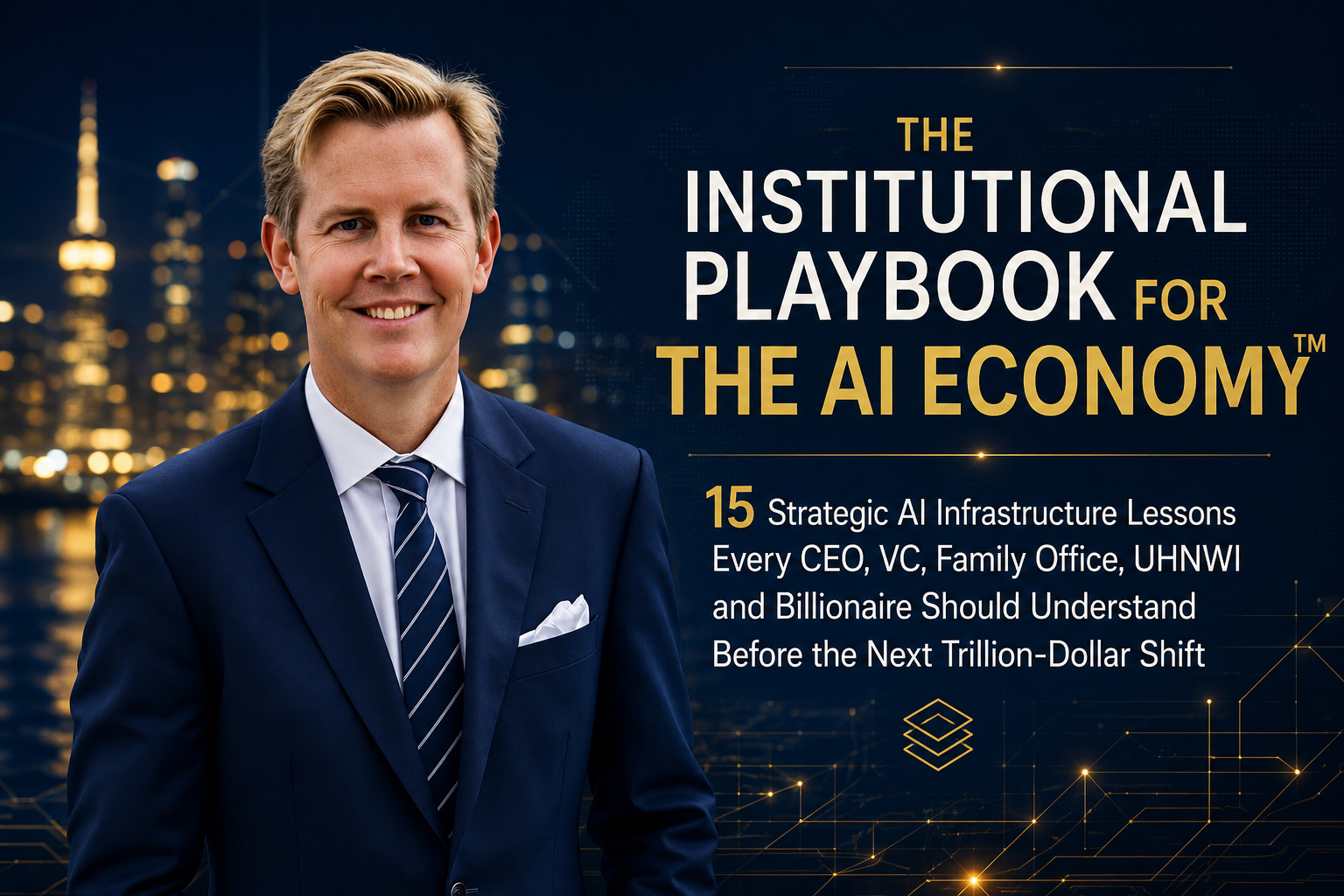
Sovereign Ledger™ Entry #151 · The Ownership Thesis™
I have spent four decades operating inside every major technology cycle since the commercialization of the Internet, and I have watched the same pattern repeat itself with almost mechanical precision. The public narrative always centers on the most visible product. The real economic power always accumulates one layer beneath it.
Executive Summary
The artificial intelligence revolution is frequently described as a competition between models, applications and technology companies. That interpretation is incomplete, and I believe it is becoming more incomplete every quarter. The deeper economic contest is a race to control the infrastructure beneath intelligence: semiconductors, compute, energy, data, software orchestration, capital, governance, intellectual property and the operating rails through which digital intelligence creates real-world value.
The scale of what is now being built is difficult to overstate. McKinsey’s own modeling puts the economic potential of generative AI at as much as $4.4 trillion annually across the enterprise use cases it studied, and its broader “Next Big Arenas of Competition” analysis places the total economic potential of AI software and services alone at up to roughly $23 trillion annually by 2040. Gartner has moved from forecasting worldwide AI spending near $1.5 trillion in 2025 to projecting it will total $2.52 trillion in 2026, a 44% increase year-over-year, with AI-optimized servers alone driving a 49% increase in spending this year. Global IT spending as a whole is now tracking toward $6.37 trillion in 2026, and data center systems spending inside that number is forecast to grow more than 60% year-over-year as hyperscalers race to secure power and compute capacity.
I do not read these numbers as a technology story. I read them as an infrastructure story, and infrastructure stories are the ones that build generational fortunes.
The most enduring wealth will not necessarily be created by the companies producing the most popular chatbot, application or interface. It will be created by the institutions controlling the scarce and indispensable layers that every participant must use. Chips manufacture compute. Compute powers models. Energy sustains compute. Data improves intelligence. Governance protects deployment. Applications convert capability into economic outcomes. Ownership infrastructure determines who ultimately controls, monetizes and benefits from those outcomes.
This report extracts 15 institutional lessons from the semiconductor, AI, cloud, energy and advanced technology sectors and applies them directly to Limitless USA LLC, REALATAR™ and The Ownership Thesis™ as they relate to the $400 trillion global real estate market.
My central conclusion is unchanged from every prior edition of this research, and the new data only strengthens it: conviction is not enough. Long-term structural insight can still be destroyed by short-term leverage, poor capital discipline, vendor dependence, regulatory capture or inefficient technology deployment. Institutional advantage requires survival, flexibility, proprietary intelligence, model-agnostic architecture, efficient capital allocation and control over the underlying rails.
For the global real estate industry, these lessons are especially urgent. Property remains the world’s largest asset class, yet it continues to operate through fragmented databases, manual title systems, slow settlement, opaque brokerage structures, paper-based escrow and excessive debt dependency. Deloitte’s 2026 Commercial Real Estate Outlook, drawn from a survey of more than 850 C-level executives at commercial real estate owners and investment firms with at least $250 million in assets under management, found that data centers have become the top asset class institutional capital wants exposure to, ahead of logistics and industrial — a clear signal that capital is already repricing real estate around compute and power, not just location.
Artificial intelligence alone will not repair real estate’s structural defects. Real estate requires programmable ownership infrastructure that combines digital identity, tokenization, compliance, provenance, liquidity and automated settlement. And the capital markets are already moving in that exact direction: Citigroup’s “Tokenization 2030: Wall Street On-Chain” research projects the tokenized real-world asset market will grow from roughly $17 billion today to $5.5 trillion by 2030 in its base case, with a range spanning $2.7 trillion to $8.2 trillion depending on adoption speed. Boston Consulting Group’s own model is even more aggressive, projecting a $16 trillion tokenized asset market by 2030 — nearly triple Citigroup’s base case.
REALATAR™ is designed for that transition. Its opportunity is not simply to improve property software. It is to become a horizontal ownership layer through which assets, investors, institutions and transactions can interact with greater speed, transparency and sovereignty.
The next trillion-dollar shift will not be defined by intelligence alone. It will be defined by who owns the infrastructure that intelligence depends upon. My work, and the limitless scope of what I believe REALATAR™ can become, is built entirely around that premise.
Introduction
Every major technological revolution begins with visible products but ultimately consolidates around invisible infrastructure.
The automobile transformed mobility, but roads, fuel networks, manufacturing systems and financing platforms captured enormous long-term value. The commercial Internet produced millions of websites, yet the most durable economic power accumulated around operating systems, cloud infrastructure, search, payments, digital advertising and network distribution. Artificial intelligence is following the same pattern, and I am watching it happen in real time from inside the infrastructure I am building.
The public sees models, agents and applications. Institutional investors see semiconductors, data centers, energy capacity, memory, inference economics, software integration, regulation, proprietary data and capital intensity. Those deeper layers determine which businesses remain differentiated, which platforms achieve operating leverage and which companies become replaceable.
Gartner’s most recent worldwide IT spending forecast makes the shape of this convergence unmistakable. Data center systems spending is now projected to grow 62.5% in 2026, up from an already-aggressive 56% growth estimate just months earlier, as hyperscalers race to secure high-performance computing capacity. That kind of upward revision, delivered inside a single forecasting cycle, tells me capital is not waiting for certainty. It is building ahead of it.
The semiconductor and compute market offers a particularly important lesson. Chip and infrastructure companies may experience dramatic valuation cycles, yet the long-term demand for compute continues to expand. At the same time, excessive financial leverage can destroy an otherwise correct investment thesis. Gartner has noted that some of the largest AI infrastructure buildouts are now being financed through debt and circular financing arrangements between technology providers and their largest customers. A company, fund or founder may accurately identify the future and still fail because the capital structure cannot survive short-term volatility.
This distinction between being strategically correct and institutionally durable is central to The Ownership Thesis™.
Limitless USA LLC and REALATAR™ are not attempting to predict a single winning AI model, blockchain, token standard or application. My objective is to architect horizontal ownership rails capable of integrating multiple technologies while preserving control, auditability, liquidity and institutional confidence. I built this with a limitless time horizon in mind, not a quarterly one.
The same principles driving the AI infrastructure race now apply to global real estate. Compute scarcity resembles liquidity scarcity. Fragmented AI models resemble fragmented title registries. Data-center bottlenecks resemble settlement bottlenecks. Proprietary model dependence resembles legacy platform dependence. The industries appear different, but their structural problems are remarkably similar.
The winners will be those who control scarce inputs, reduce friction, avoid destructive leverage, protect proprietary intelligence and build systems capable of compounding across multiple market cycles.
This report therefore treats chips, AI, energy, real estate and ownership not as separate categories, but as components of a single emerging economic architecture.
The future belongs to institutions that understand the whole stack.
Why and How the Global Real Estate Industry Benefits
The $400 trillion global real estate market remains trapped in legacy friction — burdened by settlement delays, opaque title registries, manual paper escrow, fragmented compliance systems and predatory debt structures. By extrapolating these 15 institutional infrastructure lessons from the semiconductor, compute, artificial intelligence, energy and advanced technology sectors, the United States and global real estate industry can transition from an inefficient analog asset class into a programmable, high-velocity digital asset layer.
Shift from Location to Power and Compute
For generations, real estate valuation has been summarized by three words: location, location, location. That equation is evolving, and the data now confirms it. CBRE’s 2026 outlook found that data center demand across North America is on pace to set a new leasing record this year, with power delivery speed now outweighing fiber connectivity as the top site-selection criterion, and operators increasingly pursuing 300-megawatt-plus power commitments delivered in under 36 months. Deloitte’s survey of institutional real estate executives independently confirms this shift: data centers have become the single most in-demand property type among institutional allocators surveyed for the 2026 Commercial Real Estate Outlook.
Just as AI foundries and data centers prioritize access to energy, cooling, connectivity and compute capacity, future real estate valuations will increasingly reflect energy resilience, microgrid capability, embedded intelligence, digital connectivity and autonomous operating capacity.
Commercial properties, residential communities, logistics hubs and industrial assets with reliable power generation and intelligent infrastructure may command structural premiums. Energy capacity will become not merely a utility expense, but a strategic asset characteristic.
Horizontal Settlement Rails Over Vertical Products
Real estate remains dependent upon fragmented vertical intermediaries: brokers, title companies, escrow providers, lenders, registry systems, appraisers and local databases. Each party controls a narrow portion of the transaction, but no unified infrastructure coordinates the complete ownership lifecycle.
The industry must adopt horizontal, model-agnostic operating rails — mirroring how TSMC, Broadcom, cloud providers and semiconductor infrastructure companies support entire technology ecosystems. REALATAR™ is designed to connect identity, property, title, capital, compliance, tokenization and settlement through a common programmable ownership layer.
De-Leveraging Through Native Liquidity
My strongest warning throughout this research concerns leverage. A correct long-term thesis can still be destroyed by a short-term liquidity event. Deloitte’s 2026 M&A Outlook found that office loan delinquencies had already climbed to 12.34%, with rising distress potentially accelerating forced sales across the sector — direct evidence of what over-leveraged real estate looks like when liquidity disappears.
Real estate faces this danger structurally. Excessive debt, refinancing walls, floating-rate exposure and concentrated capital structures can force otherwise valuable assets into distressed sales. Fractional tokenization and programmatically verified equity can create alternative liquidity channels, enabling owners to unlock capital without automatically surrendering control or assuming destructive leverage.
Native liquidity does not eliminate risk. It provides institutions with more ways to manage it.
Instant T-0 Settlement and Reduced Counterparty Risk
REALATAR™ is intended to replace weeks of fragmented escrow, reconciliation and title processing with automated, rules-based execution. Programmable settlement can reduce transaction float, eliminate duplicated administrative work and materially lower counterparty exposure.
A true T-0 environment would allow verified ownership, funds, compliance approvals and transactional conditions to settle as a coordinated event rather than as a sequence of disconnected promises.
Exponential Capital Velocity
Tokenized real-world assets anchored to distributed ledgers can create continuous access to global capital. Citigroup’s research suggests the mechanics of this shift are already being priced by Wall Street: the bank projects roughly 10% of the U.S. short-term treasury market and 3% of the public equity market could be tokenized by 2030, with stablecoin growth alone generating approximately $1 trillion in new demand for U.S. Treasuries, and retail migration to digital platforms potentially creating another $2.6 trillion in digital equity demand. If public securities markets can absorb capital flows of that magnitude through tokenized rails, private real estate — a market roughly eighty times larger than the entire projected tokenized securities market — represents a liquidity opportunity that has barely been touched.
Family offices, sovereign wealth funds, private equity firms and institutional allocators could potentially evaluate and transact across fractional ownership interests without relying exclusively upon conventional geographic or banking boundaries.
Capital velocity increases when assets become easier to verify, divide, transfer and settle.
Uncompromising Auditability and Data Sovereignty
Anchoring title records, property provenance, valuation intelligence and transaction artifacts to Bitcoin through OpenTimestamps can create tamper-evident proof of existence and chronology.
This does not replace legal title law by itself. It strengthens the evidentiary infrastructure around ownership by creating an independently verifiable record that cannot be silently rewritten by a platform administrator, local database or centralized intermediary.
Limitless Operating Leverage
Automating due diligence, identity verification, compliance orchestration, document analysis and transaction monitoring allows institutional operators to scale portfolios without expanding administrative headcount at the same rate. McKinsey’s broader labor-market modeling estimates AI-powered agents could already perform tasks that occupy 44% of U.S. work hours using existing technology capabilities — a number that should reframe how every real estate operator thinks about headcount-to-transaction ratios over the next decade.
The goal is not automation for its own sake. The goal is to increase the ratio of assets managed, transactions completed and capital deployed per employee, per dollar and per unit of time. I built REALATAR™ around a limitless view of that ratio — one that compounds rather than plateaus.
By adopting The Ownership Thesis™, the real estate industry can secure the same structural advantages that allowed semiconductor, cloud and space pioneers to capture multi-trillion-dollar category dominance.
I am not merely updating software.
I am deploying the permanent, programmable rails for global asset ownership.
The 15 Ranked Institutional Lessons
1. Never Build the Enterprise on Destructive Leverage
The most important lesson is also the simplest: leverage can destroy a fundamentally correct strategy. A company, investor or founder may correctly identify a historic technology shift and still lose control if debt, margin obligations or short-term liquidity requirements force liquidation at the wrong moment. Deloitte’s own 2026 data shows this playing out in real time — global commercial real estate M&A value fell 57% in 2025 to $88.7 billion, with deal count down 74%, as financing uncertainty froze transactions across the sector while office delinquencies climbed past 12%. I run Limitless USA LLC and REALATAR™ with the opposite discipline. Capital must preserve optionality, control and the ability to survive multiple market cycles. This means staged investment, disciplined burn rates, clear milestone financing and resistance to debt structures that transfer strategic power to external counterparties. The objective is not to avoid all leverage. It is to ensure that no financing structure can destroy the underlying ownership thesis. Survival is not defensive thinking. It is the prerequisite for compounding.
2. Own the Infrastructure Beneath the Application
Applications attract attention, but infrastructure captures recurring economic value. Artificial intelligence products will change rapidly, and many will become interchangeable. The scarce layers beneath them — chips, compute, energy, data, orchestration, identity, governance and settlement — will remain indispensable. REALATAR™ should therefore avoid positioning itself as another property application. My opportunity is to become the horizontal infrastructure through which ownership is verified, transferred, financed, tokenized and settled. Applications can be added, replaced or integrated above that layer. The underlying rails should remain persistent. This architecture allows Limitless USA to benefit from technological change rather than being displaced by it. The strategic goal is not to win one software category. It is to establish the operating layer that multiple categories depend upon.
3. Think in Exponential Convergence, Not Isolated Innovation
Artificial intelligence is advancing through several compounding curves at once. Semiconductor performance improves. Algorithms become more efficient. Models become easier to deploy. Energy systems become cheaper. Software connectors become more capable. Each improvement amplifies the others. Gartner’s data captures this convergence precisely: worldwide AI spending is projected to grow 44% in a single year while AI-optimized server spending alone climbs 49%, even as generative AI model spending grows a projected 80.8% — three compounding curves accelerating simultaneously inside the same forecast cycle. REALATAR™ is designed around the same convergence logic. Tokenization, digital identity, AI agents, Bitcoin-anchored verification, smart-contract settlement and global capital access are not separate features. Together, they create an ownership system whose combined value exceeds the sum of its parts. Institutions frequently underestimate transformative markets because they analyze technologies independently. I model how these curves reinforce one another over five-, ten- and twenty-year horizons. The strongest platform will be the one capable of absorbing each technological improvement without rebuilding its entire foundation.
4. Treat Compute as a Strategic Capital Resource
Compute is no longer merely an information technology expense. It is becoming a strategic input comparable to capital, energy and industrial capacity. Global IT spending is now tracking toward $6.37 trillion in 2026, with data center systems spend revised upward to 62.5% growth mid-cycle — a pace of capital deployment that has few historical parallels. As AI demand increases, companies with inefficient workloads may experience escalating costs without proportional business value. REALATAR™ must therefore manage intelligence economically. Every automated valuation, document review, compliance check, title analysis and agent workflow should be measured against the value it produces. Model routing, task-specific AI selection, caching, open-source alternatives and efficient inference should be built into the operating architecture. The platform should not reward unnecessary token consumption or vendor lock-in. It should optimize intelligence per dollar, per watt and per transaction. Institutions that treat compute as unlimited will suffer margin compression. Institutions that treat it as disciplined capital will create durable operating leverage.
5. Build for Energy Abundance and Energy Scarcity Simultaneously
Artificial intelligence ultimately converts electricity into intelligence. Real estate converts land, capital and infrastructure into utility. The convergence of these systems means energy will become an increasingly important determinant of asset value. CBRE’s 2026 outlook confirms power delivery speed has already overtaken fiber connectivity as the dominant site-selection variable for data center development, with operators now pursuing 300-megawatt-plus commitments and greenfield development in deregulated power markets. REALATAR™ should incorporate energy resilience, generation capacity, storage, microgrids, connectivity and compute readiness into property intelligence. Assets with reliable, low-cost power may command higher institutional demand, particularly across logistics, industrial, hospitality, multifamily and data-intensive commercial sectors. At the same time, the platform must account for regional scarcity, grid constraints and rising infrastructure costs. The long-term opportunity is larger than property transactions. It includes enabling investors to understand how energy infrastructure changes valuation, risk, insurance, financing and development potential. In the ownership economy, access to electrons may become as important as access to location.
6. Build a Model-Agnostic Architecture, Not a Model-Dependent Business
Artificial intelligence will continue evolving at extraordinary speed. Today’s frontier model may become tomorrow’s commodity, just as previous generations of cloud software, search engines and operating systems eventually faced new competition. Open-source AI continues narrowing performance gaps while dramatically reducing inference costs, and Gartner’s own AI spending breakdown shows GenAI model spending’s software-market share still expanding by nearly two full percentage points in a single year — meaning the competitive field beneath the application layer keeps widening, not consolidating. For REALATAR™, the strategic lesson is clear: never architect the business around a single AI provider. Instead, build a model-agnostic infrastructure capable of intelligently routing work across proprietary models, open-source models and future AI systems. By separating the ownership infrastructure from the intelligence provider, I preserve flexibility, reduce vendor risk, lower operating costs and ensure continuous innovation regardless of which model ultimately dominates the marketplace. The infrastructure becomes permanent while intelligence remains interchangeable.
7. The Application Layer Creates Enterprise Value — Infrastructure Protects It
History consistently demonstrates that infrastructure and applications complement rather than replace one another. Infrastructure enables ecosystems, while applications solve customer problems. AI models alone do not create enterprise value; value emerges when intelligence is integrated into practical workflows that improve speed, transparency, compliance and decision quality. REALATAR™ should therefore focus on delivering measurable business outcomes: programmable ownership, automated title verification, intelligent due diligence, tokenized capital formation, compliance orchestration and T-0 settlement. The platform should not compete to become another AI chatbot. Instead, it should become the institutional operating environment where AI produces legally enforceable ownership outcomes. This distinction dramatically increases switching costs, strengthens customer retention and establishes a durable competitive moat built upon execution rather than novelty.
8. Governance Is Becoming Competitive Infrastructure
As artificial intelligence becomes embedded throughout the global economy, governance shifts from compliance overhead to strategic advantage. Institutions increasingly require transparency, auditability, explainability and operational resilience before deploying AI into mission-critical environments. Deloitte’s 2026 survey found AI adoption in commercial real estate is shifting from experimentation toward tenant management and lease automation, but flagged data quality as the primary obstacle to scaling it — a governance problem, not a modeling problem. REALATAR™ should proactively embed governance into its operating architecture. Identity verification, immutable audit trails, programmable permissions, compliance automation, transaction provenance and cryptographic verification should become foundational capabilities rather than optional features. Organizations that design governance into infrastructure from inception will scale more efficiently than competitors forced to retrofit controls later. Governance ultimately becomes part of the product itself, increasing institutional confidence while reducing operational risk across every transaction.
9. Proprietary Intellectual Capital Is the Ultimate Strategic Asset
The growing institutional emphasis on data quality and training data reinforces a profound reality: proprietary knowledge compounds in value as artificial intelligence becomes ubiquitous. Models will increasingly become accessible, affordable and interchangeable. Unique intellectual property will not. This validates the long-term strategy underpinning The Ownership Thesis™ and my Bitcoin-anchored research corpus. More than 2.47 million verified words, strategic frameworks, architectural models and institutional research across 150+ Sovereign Ledger™ entries collectively form a proprietary knowledge base that competitors cannot replicate overnight. The value lies not simply in publishing content but in creating a coherent operating doctrine supported by verifiable artifacts. Over time, this corpus becomes an appreciating strategic asset that strengthens REALATAR™, enhances institutional credibility and continuously improves AI-enabled decision making across the ownership ecosystem.
10. Human Judgment Remains the Highest-Value Layer
Artificial intelligence dramatically accelerates analysis, coding, research, summarization and pattern recognition. Yet an essential distinction keeps returning to the center of every serious institutional conversation I have: intelligence does not eliminate judgment. Strategic leadership still requires prioritization, ethics, governance, timing, capital allocation and accountability. REALATAR™ should therefore position AI as an institutional co-pilot rather than an autonomous replacement for professional expertise. Brokers, investors, attorneys, lenders, family offices and enterprise operators should remain responsible for consequential ownership decisions while AI augments speed, consistency and analytical depth. This human-in-the-loop architecture enhances trust, reduces institutional resistance and supports broader adoption by aligning automation with professional responsibility instead of attempting to replace it.
11. Infrastructure Compounds Across Market Cycles
Products experience fashion cycles. Infrastructure compounds over decades. Semiconductor manufacturers, cloud providers, internet protocols and payment rails have consistently outperformed many highly visible consumer applications because they become embedded within broader economic systems. REALATAR™ should pursue the same trajectory. By becoming foundational ownership infrastructure rather than a niche real estate application, the platform gains resilience across property cycles, technology transitions and macroeconomic volatility. Each additional participant strengthens the network, while every verified transaction enriches the data layer and institutional confidence. Infrastructure businesses create durable value because they become increasingly difficult to replace once integrated into everyday operations. Compounding network effects ultimately become more valuable than short-term revenue acceleration alone.
12. Optimize for Decades, Not Quarters
Public markets frequently reward short-term narratives while underestimating long-term structural change. Deloitte’s 2026 survey found that despite macroeconomic uncertainty, 75% of institutional respondents still plan to increase their commercial real estate investment allocations, primarily for inflation hedging and diversification — evidence that sophisticated capital continues distinguishing temporary volatility from durable structural change. REALATAR™ should adopt the same discipline. Architectural decisions should be evaluated based on their contribution to institutional durability over ten- and twenty-year horizons. Investments in governance, interoperability, digital identity, cryptographic verification, modular infrastructure and proprietary research may not maximize immediate financial performance, but they significantly strengthen long-term enterprise value. Institutions that consistently optimize for durability rather than quarterly perception often become the dominant platforms once markets mature. Strategic patience therefore becomes a competitive advantage rather than a weakness.
13. Intelligence Is Becoming Abundant — Execution Remains Scarce
As AI reduces the cost of generating information, differentiation shifts toward execution. Knowledge becomes increasingly abundant, while implementation remains constrained by governance, integration, operational discipline and institutional trust. REALATAR™ should therefore emphasize executable ownership rather than informational ownership. The platform’s value lies in transforming verified identity, legal rights, capital formation, compliance and settlement into coordinated institutional workflows. Artificial intelligence may recommend actions, but programmable infrastructure ensures those actions become enforceable outcomes. This transition from knowledge generation to ownership execution represents one of the largest commercial opportunities emerging from the AI economy. Platforms capable of operationalizing intelligence will consistently outperform those merely producing it.
14. Engineer Self-Reinforcing Institutional Flywheels
Leading AI companies reinvest success into stronger models, attracting more customers, generating additional revenue and repeating the cycle. REALATAR™ should deliberately engineer an equivalent institutional flywheel:
Research → Publication → Verification → Adoption → Transactions → Data → Better AI → Better Decisions → Greater Institutional Confidence → More Adoption
Every completed transaction should strengthen the platform. Every published framework should improve institutional authority. Every Bitcoin-anchored artifact should reinforce trust. Every new participant should increase network value. Flywheels outperform isolated initiatives because each successful cycle reduces customer acquisition costs while increasing enterprise defensibility. Sustainable competitive advantage emerges when growth continuously reinforces itself rather than requiring perpetual external investment.
15. Own the Rails, Not Just the Train
The final and most enduring lesson extends across every technological revolution referenced throughout this report. Railroads created industrial wealth because they owned transportation infrastructure rather than individual shipments. Internet protocols enabled global commerce because they connected every participant rather than competing with websites. Cloud infrastructure became indispensable because every digital application depended upon it. The next great economic transformation will similarly reward those controlling programmable ownership infrastructure rather than isolated software products. REALATAR™ therefore continues positioning itself as the horizontal operating layer connecting identity, capital, title, tokenization, settlement, compliance and intelligent automation. Products may evolve. Technologies will change. AI models will improve. The ownership rails supporting them will become increasingly valuable. Institutions that own those rails will shape the architecture of the next global economy.
Summary
The artificial intelligence revolution represents far more than the emergence of increasingly capable software models. It marks the convergence of multiple foundational technologies — including semiconductors, compute infrastructure, cloud architecture, energy systems, digital identity, cryptographic verification and programmable ownership — into a new institutional operating model for the global economy.
Throughout this report, one principle has consistently emerged: sustainable wealth is rarely created by the most visible applications. Instead, enduring value accumulates around the infrastructure that enables every application to exist. Railroads transformed industrial commerce because they owned the transportation network. Internet protocols transformed global communications because they connected every participant. Cloud computing transformed enterprise software because it provided universal operating infrastructure. Artificial intelligence is following precisely the same trajectory, and the current data — from Gartner’s $6.37 trillion 2026 IT spending forecast to Citigroup’s $5.5 trillion tokenization projection to Deloitte’s finding that data centers are now the top institutional real estate asset class — confirms the shift is accelerating faster than most forecasts anticipated even a year ago.
I have consistently focused on structural advantages rather than temporary competitive victories. Capital discipline, infrastructure ownership, proprietary intellectual property, governance, energy resilience, efficient compute utilization and model-agnostic architecture all create competitive positions that strengthen over time rather than weaken.
For the global real estate industry, these lessons are particularly profound. Despite representing approximately $400 trillion in global assets, property ownership continues to rely upon fragmented registries, manual title systems, lengthy settlement cycles, excessive transaction friction and geographically isolated capital markets. Artificial intelligence alone cannot solve these structural inefficiencies. Only programmable ownership infrastructure capable of integrating identity, compliance, liquidity, tokenization, provenance and settlement can fundamentally modernize the world’s largest asset class.
REALATAR™ has been architected around that institutional opportunity. Rather than competing as another isolated property technology platform, my objective is to establish horizontal ownership rails capable of supporting every participant across the ownership lifecycle.
The broader implication extends beyond real estate. Every major asset class — including securities, infrastructure, intellectual property, commodities and alternative investments — is gradually becoming software-defined. As digital identity, blockchain verification and intelligent automation mature, ownership itself becomes programmable.
The institutions that recognize this transition earliest will not merely digitize existing processes. They will redefine how assets are created, financed, governed, exchanged and preserved across generations.
The future belongs not simply to those building artificial intelligence.
It belongs to those building the infrastructure through which intelligence creates trusted ownership.
My Bottom Line
After four decades spanning Madison Avenue, the commercialization of the Internet, Web1, Web2, Web3 and today’s emerging Ownership Economy, one conclusion has become increasingly difficult to ignore.
Every major technological revolution eventually converges around infrastructure.
Products create excitement.
Infrastructure creates enduring enterprise value.
Artificial intelligence, blockchain, digital identity, programmable settlement, tokenization and Bitcoin-anchored verification should not be viewed as isolated innovations competing against one another. They represent complementary components of a much larger transformation — the emergence of programmable ownership infrastructure.
That realization ultimately led me to develop The Ownership Thesis™, REALATAR™, and a Bitcoin-anchored research corpus exceeding 2.47 million verified words across more than 150 Sovereign Ledger™ entries. My objective has never been to build another real estate application. It has been to architect the horizontal ownership rails capable of supporting the next generation of global asset markets — and I am building it with a limitless horizon, because infrastructure is not built for a cycle, it is built for a century.
History consistently rewards those who own the infrastructure beneath economic activity rather than those who simply participate within it.
If this thesis proves correct, the greatest opportunities over the coming decades will not emerge from creating another application.
They will emerge from building the programmable infrastructure through which every asset, every institution and every ownership relationship ultimately operates.
Ownership Changes Everything™
Infrastructure Determines Who Owns the Future.
Sovereign Proof · Bitcoin-Anchored via OpenTimestamps
Sovereign Ledger™ Entry #: 151
Fingerprint: The Institutional Playbook for the AI Economy™ | 15 Strategic AI Infrastructure Lessons | Geoff De Weaver | Limitless USA LLC | 2026-08-02
SHA-256: ed02d3afc6e7fadb650cf8527b6c9f066a1887a3970dab9e3d2eade598933b3e
Anchor Method: OpenTimestamps (OTS) protocol, Bitcoin blockchain — 100% Bitcoin-Anchored Research.
Sources, References & Institutions Cited
Institutional Research & Industry Sources: McKinsey & Company — mckinsey.com · Boston Consulting Group (BCG) — bcg.com · JP Morgan — jpmorgan.com · Gartner — gartner.com · PwC — pwc.com · Deloitte / Monitor Deloitte / Deloitte Center for Financial Services — deloitte.com · Bain & Company — bain.com · Forrester — forrester.com · EY-Parthenon — ey.com/en_gl/services/strategy-transactions/parthenon · Accenture Strategy & Consulting — accenture.com · Oliver Wyman — oliverwyman.com · Kearney — kearney.com · Roland Berger — rolandberger.com · Booz Allen Hamilton — boozallen.com · TSIA — tsia.com · National Association of REALTORS® (NAR) — nar.realtor · Citigroup — citigroup.com · CBRE — cbre.com
Technology Companies & Platforms: NVIDIA — nvidia.com · Intel — intel.com · TSMC — tsmc.com · Broadcom — broadcom.com · Samsung — samsung.com · Micron Technology — micron.com · AMD — amd.com · Tesla — tesla.com · SpaceX — spacex.com · Starlink — starlink.com · Apple — apple.com · RWA.xyz — rwa.xyz · Dubai Land Department — dubailand.gov.ae · Bitcoin Protocol — bitcoin.org · OpenTimestamps — opentimestamps.org
Original Research, Intellectual Property & Strategic Frameworks independently developed by Geoff De Weaver, Limitless USA LLC and the REALATAR™ ecosystem: REALATAR™ — realatar.vip · The Ownership Thesis™ — geoffdeweaver.com · Limitless USA LLC — geoffdeweaver.com · Geoff De Weaver — geoffdeweaver.com · The Sovereign Ledger™ Strategic Blueprint Series (#77 · #94 · #106 · #119 · #121 · #122 · #123 · #124 · #136 · #140 · #142 · #143 · #144 · #145 · #146 · #149) — geoffdeweaver.com/the-sovereign-ledger/
About the Author
I am Geoff De Weaver, Founder & CEO of Limitless USA LLC, creator of REALATAR™, author of The Ownership Thesis™, and architect of a Bitcoin-anchored strategic research corpus comprising more than 2.47 million verified words and 150+ Sovereign Ledger™ Strategic Blueprints exploring the future of ownership, capital markets, artificial intelligence, blockchain, tokenization and the $400 trillion global real estate market.
Across four decades, I have operated through every major Internet era — from Madison Avenue and the commercialization of the Internet to Web1, Web2, Web3 and today’s emerging Ownership Economy — developing institutional frameworks designed to modernize ownership through programmable infrastructure.