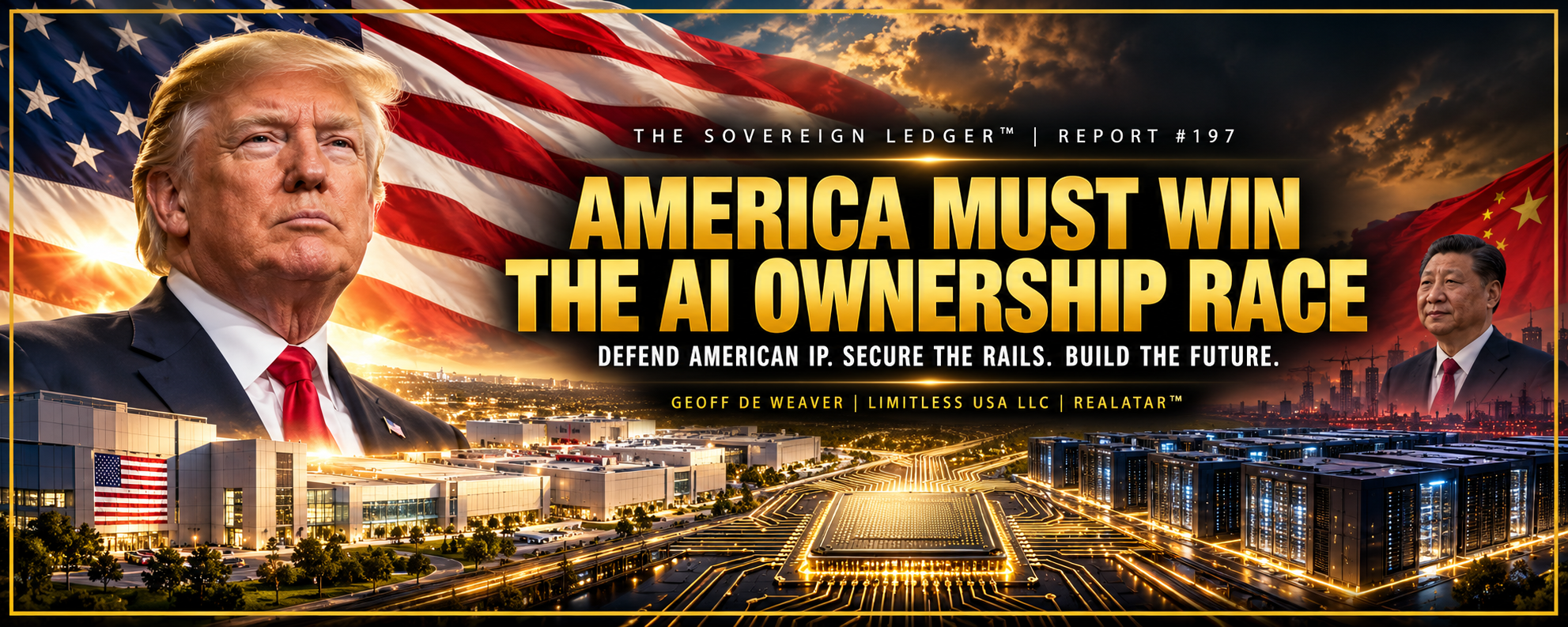
THE SOVEREIGN LEDGER™ | REPORT #197
America Must Win the AI Ownership Race
How America Can Defend Its Intellectual Property, Secure Its Infrastructure and Build Lasting Prosperity in Competition With the Chinese Communist Party
By Geoff De Weaver | Founder and CEO, Limitless USA LLC | Architect of The Ownership Thesis™ and REALATAR™
Friday, October 30, 2026 | Research, personal perspective, and proposed implementation framework
About 84 minutes to read · Eastern Time
What this report puts in your hands
- Know where to act first. A ranked, plain-English map of the twenty priorities that protect American inventions, factories and the capital behind them.
- Read the screens correctly. A fact-checked reading of seven market screens covering 32 companies, with every figure labeled for what it is and what it is not.
- Follow the evidence yourself. Eight links back to the Sovereign Ledger research that built this argument, so you can check my work.
- Test before you trust. A 90-day pilot you can run, measure and stop on evidence, so you protect what you own without betting the company.
- Walk into the room prepared. Clear decisions for the CEO, the board, the family office, the developer, the investor and the policymaker.
INTRODUCTION
America stands at the definitive crossroads of digital civilization, where the outcome of the Super Intelligence war will determine global hegemony for the next century. For four decades, watching the evolution of technology from the early days of digital advertising and networking in Westport through global operations across the Asia-Pacific, I have tracked a singular reality: technological invention without sovereign infrastructure is merely a gift to our geopolitical rivals. The contest between the United States and the Chinese Communist Party is not a casual comparison between competing chatbot interfaces; it is a totalized struggle for semiconductor dominance, manufacturing capacity, model architecture, industrial know-how, electrical grid scale, and the ultimate control of the $625 trillion global real estate market. A nation can invent the foundational breakthroughs of artificial intelligence and still lose its economic supremacy if its intellectual property is extracted, its infrastructure cannot be energized, or its legal institutions fail to protect the rights underpinning capital formation.
That is why I support President Donald J. Trump’s decisive agenda for American artificial intelligence leadership, domestic manufacturing, and secure technological expansion. But national ambition requires institutional execution. Through The Sovereign Ledger—timestamped on the Bitcoin blockchain through OpenTimestamps—and the operational architecture of REALATAR™, I examine the exact mechanics of how America defends its intellectual property, secures its critical infrastructure, and out-executes state-directed adversaries. Across the 32 essential ecosystem companies surveyed in our market intelligence— spanning hyperscalers like Microsoft, Amazon, and Alphabet, silicon titans like Nvidia, AMD, and TSMC, and foundational data-center operators like Equinix—the diagnostic is clear. We must replace porous legacy administrative frameworks with deterministic, owner-controlled sovereign rails. Tools depreciate, but infrastructure compounds. America will win this war not through rhetoric, but by building an unbreakable, investor-grade operational reality that locks in permanent prosperity for our tribe.
The American advantage I intend to help strengthen
America must lead the development of advanced artificial intelligence and protect the knowledge, infrastructure, and institutions that make that leadership possible. I want that leadership to produce stronger American businesses, better employment, more affordable productive capacity, secure property rights, and greater opportunity for the people who do the work. Winning means translating invention into durable national capability and widely shared prosperity.
The competition with the Chinese Communist Party reaches far beyond a comparison between two chatbots. It concerns semiconductor design, manufacturing capacity, model development, industrial know-how, electricity, communications, capital, and the ability to establish who controls important assets. A country can invent a valuable technology and still lose much of its economic benefit if competitors extract its intellectual property, if infrastructure cannot be built, or if institutions cannot protect the rights behind investment.
I have watched the relationship between American invention, Asian manufacturing, global distribution, and commercial power develop across decades. My perspective includes living and working in Taiwan, Australia, and the wider Asia-Pacific; global Acer leadership work from Taipei; participation as an agency partner in OzEmail’s 1996 NASDAQ listing, under the symbol OZEMY; and building digital agency operations for Omnicom in San Francisco in 1999. Those experiences shaped the questions I now bring to ownership infrastructure and gave me a long operating perspective on how knowledge becomes economic power. My observations provide context; specific theft allegations require independent evidence. [B1]
My position is straightforward. I support President Donald J. Trump’s stated objective of American AI leadership and the effort to connect innovation with American infrastructure, energy, security, and international adoption. I believe that direction addresses a strategic necessity. I will judge its execution by what gets built, what is protected, what becomes more productive, and what Americans can afford. Support for a national objective becomes more useful when accompanied by clear evidence and measurable standards.
REALATAR™ is the ownership infrastructure architecture I am developing within this larger picture. Limitless USA LLC can contribute through research, commercial coordination, partnerships, and a measured implementation program. Our proposed role is to make identity, authority, rights, access, and evidence more dependable around consequential assets. That contribution has to earn its place through independently tested results. This report describes a development agenda; it does not announce an operational national security platform, government accreditation, or completed enterprise integrations.
The reader should leave with a ranked understanding of the threats, an accurate interpretation of the market screens I captured, eight connections to earlier Sovereign Ledger reports, and a practical framework for protecting American innovation while expanding productive investment. I want owners, CEOs, engineers, family offices, developers, and policymakers to see where they can act now.
America’s AI leadership and national security: six principles for protecting U.S. intellectual property and ownership
“America must win the AI ownership race by turning invention into secure capability and lasting prosperity.”
— Geoff De Weaver, The Sovereign Ledger™ | Report #197
“The CCP should face a United States that can protect consequential technology, enforce its rules, work effectively with allies, and offer the world products and institutions worth choosing.”
— Geoff De Weaver, The Sovereign Ledger™ | Report #197
“A country can invent a valuable technology and still lose much of its economic benefit if competitors extract its intellectual property, if infrastructure cannot be built, or if institutions cannot protect the rights behind investment.”
— Geoff De Weaver, The Sovereign Ledger™ | Report #197
“Durable leverage comes from a country that can build and deliver.”
— Geoff De Weaver, The Sovereign Ledger™ | Report #197
“National ambition becomes credible through work that survives examination.”
— Geoff De Weaver, The Sovereign Ledger™ | Report #197
“An ownership platform earns trust by respecting the owner’s ability to retain control outside the platform as well as within it.”
— Geoff De Weaver, The Sovereign Ledger™ | Report #197
The inheritance I want America to keep
This year we marked 250 years since the Declaration of Independence. Two and a half centuries is long enough to prove a principle: a country that protects what its people create keeps creating. The founders wrote that principle into the Constitution itself, in the clause that lets Congress secure to authors and inventors, for limited times, the exclusive right to their writings and discoveries. Congress passed the first Patent Act in 1790, and the first U.S. patent, for a method of making potash, was issued on July 31 of that year to Samuel Hopkins.
Think about what that choice has given every American since. It told the inventor in the barn, the machinist in the shop, the founder at the kitchen table and the researcher in the lab that the idea was theirs to build, to sell and to pass down. I believe it is one reason so many of the world’s most valuable technology companies were built under the American flag, and why capital from every continent still looks to our courts and our markets when it wants to be safe.
Picture what that inheritance looks like in the years ahead. A family office in Palm Beach shows a lender exactly who holds authority over every account. A developer in Miami proves, in an afternoon rather than a quarter, that the power, the fiber and the lease rights behind a data-center site are real. A founder in Naples or Sarasota hands an AI agent a task and knows it cannot touch what it was never given. A builder in Tampa, an investor in Manhattan and a machinist in Ohio can each say, with evidence, this is mine, this is safe, and this will pass to my children intact. That is the American promise, kept current for the age of artificial intelligence.
That promise is also what is at stake. Every route by which our knowledge leaks, our chips are diverted, our infrastructure stalls or our records cannot be trusted is a route by which someone else collects the return on American work. I would rather we close those routes with evidence, law and good engineering than with slogans. The rest of this report shows how.
Why my perspective begins before the current AI cycle
When I look at today’s debate about China, technology, and American competitiveness, I remember an earlier commercial world. In the 1990s, the internet was still becoming an operating environment for ordinary businesses. Personal computers connected companies and households to a rapidly expanding digital economy. Manufacturing relationships, distribution networks, branding, and access to global capital helped determine which companies could move from regional relevance to international influence.
Taipei was an important place from which to observe those connections. Taiwan’s technology ecosystem made the interaction between design, suppliers, production, and international markets visible. My global Acer leadership work placed me within that commercial environment. It taught me to pay attention to the network surrounding a product: the people who designed it, the partners who delivered it, the customers who trusted it, and the systems that allowed the business to scale. That operating perspective continues to shape my research today.
Australia and the Asia-Pacific provided another vantage point. Geographic distance made connectivity and distribution commercially important. A good idea still needed a route to customers, reliable partners, and the capital to grow. My involvement as an agency partner in OzEmail’s 1996 NASDAQ listing belongs in that chronology. The experience connected an emerging internet business with the visibility and discipline of American public capital markets. [B1]
San Francisco in 1999 exposed the speed of Web1 commercialization from another direction. Building an Omnicom digital operation required translating a new technical possibility into something clients could understand, buy, and use. The internet expanded opportunity, but it also moved valuable business activity into systems where copying, distribution, and access could happen at unprecedented speed. Commercial advantage increasingly depended on how a business organized its information and relationships.
I remember how different the competitive position of mainland China appeared during those years. Its later acceleration deserves serious study. Manufacturing scale, infrastructure, education, entrepreneurial effort, international investment, legitimate trade, technology transfer, and state policy all contributed. Documented intellectual property theft and coercive practices are also part of the record. A credible American strategy must be capable of recognizing both genuine competitive achievement and unlawful advantage. Treating every Chinese innovation as stolen would weaken our diagnosis and encourage complacency.
The scale of the transformation can be described without speculation. World Bank current-dollar data put China’s GDP at approximately $362 billion in 1990 and $18.73 trillion in 2024, roughly a 52-fold increase in nominal U.S.-dollar terms. That comparison includes price and exchange-rate effects and is not a measure of real output growth or of wealth created through theft. China became a WTO member on December 11, 2001, another important milestone in its integration into global trade. These reference points help place my personal recollections within a documented economic chronology. [S32][S33]
My concern about IP theft is therefore longstanding, but I will not invent a personal tally of stolen American technology since 1996. Neither my career chronology nor a television segment can establish such a number. The evidence must come from individual cases, official investigations, documented company findings, and carefully defined research. My personal account explains why I have paid attention. The sources explain which claims can be sustained.
The continuity in my work is the question of control. Who controls the customer relationship? Who controls access to information? Who can change a record, commit capital, or authorize a transaction? Who preserves the evidence when a relationship breaks down? These questions became more consequential as commerce moved online. They become more consequential again when AI systems can interpret information and initiate actions at machine speed.
That is why I see the current contest as an ownership and institutional problem as well as a technical one. An algorithm needs an operating environment. A factory needs enforceable rights. A research team needs protection for its work. A free society needs accountable institutions that can defend national capability without extinguishing the initiative that produced it.
What is established and what remains an allegation
The starting point for this report was a transcript of a Fox Business segment that I reviewed, which discussed alleged Chinese intelligence access to Nvidia CEO Jensen Huang, AI capability extraction, and China’s economic weakness. The transcript contains obvious recognition errors and compresses several different stories. I have used it to identify questions, then checked those questions against accessible reporting and primary material.
October 29 reporting described U.S. concerns about Alice Huang, also known as Huang Le, a former executive associated with Singapore-based Megaspeed. Nvidia’s response characterized the CEO’s meetings as normal customer interactions and said regional customers received ordinary business information rather than sensitive trade secrets or national security information. Public reporting does not establish that Jensen Huang knowingly participated in espionage. These remain reported allegations concerning the suspected intelligence activity, rather than a conviction or a completed public evidentiary record. [S1]
That distinction protects the report’s credibility. I can argue for stronger executive security without accusing a named executive of a crime. I can discuss the vulnerability created by commercial access without assuming that every meeting exposed a secret. Security analysis should examine the possible failure mechanism and the available evidence separately.
Anthropic’s February 23, 2026 publication is a different kind of source: a company’s technical account of activity it says it detected on its own systems. It attributed capability-extraction campaigns to DeepSeek, Moonshot, and MiniMax, reporting more than 16 million exchanges through approximately 24,000 fraudulent accounts. Those figures refer to the combined campaigns described in that publication. They do not mean DeepSeek alone generated all 16 million exchanges. [S2]
Distillation is a standard technique for training one model using another model’s outputs. Whether a particular use is permitted depends on the access, agreement, conduct, and applicable law. A distillation allegation does not automatically establish state espionage or a criminal trade-secret offense. The transcript’s reference to Chinese labs relying on “GPT 6 Astra” is not established by the material checked for this report, and I do not use it as evidence. [S2]
The economic discussion requires similar care. China’s National Bureau of Statistics reported 4.5% year-over-year GDP growth in the third quarter of 2026 and 4.6% for the first three quarters. It reported a 20.6% year-over-year decline in real estate development investment during January through September. These are official figures, identified as such. Investment decline is different from a nationwide decline of the same percentage in property prices. [S3][S4]
Logan Wright’s description of the economy as a two, Beijing’s internal assessment as approximately five, and its external presentation as seven or eight referred to a one-to-ten grading scale. It was his judgment about economic health and presentation, rather than three estimates of GDP growth. I preserve that distinction because an educational report should improve the source material’s clarity. [S5]
The twenty priorities ranked by strategic importance
The following ranking expresses my judgment about consequences for American security and the usefulness of concrete action. It is not a statistical threat forecast. The first priorities protect the capacity to invent and act; the later priorities strengthen the economic and institutional setting in which those protections can succeed.
1 Protect the knowledge that creates American advantage
A company cannot protect its most valuable knowledge if it has never identified it. I would start with an inventory of research, source code, designs, training material, industrial processes, customer intelligence, and strategic plans. Each item needs an accountable owner, a sensitivity level, and a clear statement of who may use it. The inventory should reflect the way people actually work, including shared drives, vendor portals, personal devices, and AI tools.
The practical benefit is concentration. Limited security resources can be directed toward information whose loss would cause the greatest damage. A new product design, a proprietary production method, and a public press release should not receive identical treatment. The organization also needs a way to notice when material crosses its intended boundary. That requires access records, appropriate monitoring, and an incident process that employees understand.
For America, protecting this knowledge preserves the return on years of investment and the incentive to undertake the next difficult project. For REALATAR, the same discipline applies to architecture, code, commercial agreements, and sensitive client records. We should demonstrate the operating behavior we recommend to others.
2 Establish who is acting and what they may authorize
Identity and authority answer different questions. A genuine person may lack permission to approve a wire, disclose a design, sign for an entity, or instruct an AI agent. A verified identity becomes useful only when connected to a current, appropriately limited right to act. Organizations should make that connection explicit and refresh it when responsibilities change.
My proposed standard is that high-consequence actions carry evidence of the actor, the applicable authority, the scope of the action, and the time at which permission was checked. An assistant who can schedule a meeting does not automatically receive authority to release the documents discussed at that meeting. A supplier representative who can submit a quotation does not automatically receive access to a complete engineering repository.
This is a strong intersection with the Ownership Thesis. A record of ownership is incomplete as an operating tool unless the institution can determine who may exercise the rights attached to it. Building that capability could help owners protect information and execute legitimate decisions with greater confidence.
3 Secure the AI systems that can access sensitive information
An AI system can make an employee more effective while creating another route through which information moves. The relevant boundary includes the model provider, retrieval database, logs, connected tools, support access, and any subcontractors involved. Security review should examine that entire path before sensitive material is introduced.
I would require a clear answer to several practical questions. Is the submitted information retained? Can it be used for training? Who can inspect logs? Can an agent send an email, open an external connection, or change a file? Can a malicious document persuade the system to use a tool outside the employee’s intention? The answers should determine the allowed workload.
Joint government AI data guidance supports attention to access controls, data integrity, provenance, and trusted infrastructure. My implementation recommendation is to test these protections with realistic examples from the business, rather than rely on a product label or a generic assurance that the system is private. [S6]
4 Reduce chip diversion through traceable commercial relationships
The name on an invoice may be only one participant in a larger chain. An exporter or qualified reviewer needs to understand the purchaser, intermediaries, destination, ultimate user, and intended use. The quality of those facts matters more than the appearance of a polished corporate website.
BIS guidance on advanced computing chips identifies diligence information such as customer details, headquarters, installation addresses, end users, transaction roles, and inconsistencies in the answers. These are practical inputs for an evidence-based review. They are not proof that every third-country buyer is a diversion vehicle. [S7]
My broader recommendation is to make the commercial chain inspectable enough that unexplained changes attract attention before delivery. REALATAR’s proposed role in ownership verification could inform analogous workflows, but a property platform should not claim to replace specialized export classification, licensing, or enforcement expertise.
5 Protect executives without isolating them from legitimate business
Chief executives need to meet customers, partners, researchers, investors, and public officials. That access is part of leadership. The security problem arises when commercial familiarity becomes an unexamined permission to obtain sensitive information or influence consequential decisions.
An executive protection program should therefore include information protocols, appropriate diligence on high-risk interactions, secure travel practices, and rapid access to professional advice when something seems wrong. People should know where to raise concerns without launching a public accusation. Routine meetings and sensitive strategy discussions should have different information boundaries.
The reported Nvidia story makes this question timely, but the recommendation does not depend on proving that particular allegation. Institutions can examine how they handle executive access now. A well-designed process lets leaders continue legitimate commercial engagement while reducing the chance that personal trust becomes an uncontrolled route into the enterprise.
6 Govern AI agents as actors with limited authority
An AI agent that can act on a system should have an identity, an owner, a defined purpose, and permissions that expire or can be revoked. The organization should be able to reconstruct what it did and why the action was permitted. A capable model with unrestricted tools can magnify a small misunderstanding into an expensive event.
The most useful early controls are straightforward: narrow tool access, transaction limits, separation of duties, human approval for consequential actions, and a working stop mechanism. A property research agent might read approved documents and draft a summary. It should not acquire the ability to change settlement instructions merely because both tasks occur inside the same application.
Deloitte’s 2026 research reported mature governance for agentic AI at only 21% of surveyed organizations. That is a survey result from a defined population, rather than a census of every company. It nevertheless gives a reason to ask harder questions before expanding autonomous authority. [S8]
7 Build American manufacturing capacity that can operate competitively
Domestic production improves resilience when factories can recruit, source equipment, obtain power, manage costs, and deliver products customers need. A construction announcement is the beginning of an industrial process. The eventual test is usable capacity and dependable output.
I favor investment that connects chip design, fabrication, advanced packaging, maintenance, engineering, and suppliers. Concentration in any one indispensable stage can leave the broader system exposed. Partnerships with trusted allies remain valuable because domestic strength and international collaboration can reinforce each other.
Intel’s published U.S. manufacturing program describes a multistate expansion and major proposed investment. Nvidia describes an American manufacturing network involving partners and suppliers. I treat these as company descriptions of programs and commitments, with different projects at different stages. Their value should be assessed through completed facilities, qualified production, sustained demand, and commercial performance. [S9][S10]
The scale is meaningful when the measures are labeled correctly. Intel’s published program describes more than $100 billion in planned U.S. investment. Nvidia’s April 2025 announcement described plans with partners to produce up to $500 billion of AI infrastructure in the United States over four years. Nvidia’s figure concerns prospective production value; it should not be presented as $500 billion of Nvidia’s own cash capital expenditure. Neither figure certifies that every project is complete or establishes a return for a nearby property investor. [S9][S34]
8 Deliver the electricity and infrastructure that AI requires
AI ambitions become physical obligations when computing must run continuously. Developers need electrical capacity, realistic interconnection dates, cooling, fiber, reliable equipment, and locations that can support operations. Land without a dependable route to power can remain a speculative promise for years.
The IEA’s updated analysis projects global data-center electricity consumption rising from about 485 terawatt-hours in 2025 to about 945 terawatt-hours in 2030. These are projections with assumptions, rather than guaranteed demand. The direction explains why energy planning belongs inside an AI strategy. [S11]
My recommendation is to measure deliverable capacity rather than announced acreage. An owner should be able to show what power rights exist, what work remains, who bears the cost, and what happens if schedules slip. This is where infrastructure security, development economics, and verified ownership meet.
9 Understand who ultimately controls important assets
An entity name can conceal a complicated network of ownership, financing, contractual rights, and delegated authority. Useful diligence goes beyond identifying the immediate buyer. It asks who can direct the entity, replace its managers, access its information, or exercise rights after a default.
This matters for ordinary investment protection as well as national security. A lender may acquire important rights through financing documents. A tenant may receive access to sensitive facilities. A service provider may control critical operations without owning the land. The review should match the specific asset and threat.
Certain foreign real estate transactions fall within CFIUS jurisdiction, subject to detailed rules and exceptions. A screening workflow can identify questions for qualified review. It cannot decide legal coverage solely from a map or treat every foreign investment as prohibited. [S12]
10 Make trade enforcement measurable
Trade policy should identify the conduct it seeks to change and the evidence that would demonstrate progress. If the concern is discriminatory licensing, forced transfer, subsidy distortion, or diversion, the response needs to be connected to that concern. A headline tariff rate is an instrument, rather than a complete statement of success.
I would publish a scorecard covering documented compliance, market access, domestic capacity, supplier diversification, and costs borne by American producers and households. Negotiators need a clear understanding of which concessions change behavior and which merely change the language in a communiqué.
USTR’s Section 301 work provides an official record of concerns about China’s technology transfer and IP practices. My recommendation is to use such evidence to define enforceable objectives, then keep evaluating whether the chosen measures achieve them. Political resolve gains value when matched with administrative competence. [S13]
11 Coordinate American policy with trusted allies
Semiconductor and AI production are distributed across countries. The company screens themselves include businesses headquartered in Taiwan, South Korea, the Netherlands, and the United Kingdom. An American strategy that ignores this network would misunderstand the assets it seeks to protect.
Coordination can make export controls more effective, strengthen supply alternatives, and help trusted partners adopt secure American technology. It also requires practical negotiation over costs, commercial opportunities, and the treatment of each partner’s firms. Cooperation works best when participants see a durable benefit.
My experience across the Asia-Pacific makes this point personal. Relationships matter, but they need institutions and verifiable commitments underneath them. The objective should be a stronger, more resilient network of trusted production and exchange, with American capability at its center and clear rules for participation.
12 Convert innovation into business productivity
National leadership becomes more durable when businesses can use AI to improve actual work. A demonstration can show possibility; a production workflow has to show reliability, acceptable cost, and a positive contribution after supervision and error correction. Useful adoption expands the economic base that funds research and infrastructure.
Forrester’s published 2026 predictions emphasized a tightening connection between AI investment and measurable financial value. Predictions should remain labeled as predictions. Their useful challenge is the requirement to show what the technology improves. [S14]
My preferred test asks whether an intervention produces a meaningful change in cycle time, error frequency, service quality, retained revenue, or capacity. The baseline must be credible. If a simpler process change achieves the same result more cheaply, the organization should know that before committing to a complicated deployment.
13 Give workers a route into the new economy
American AI leadership should include training and advancement for the people who build, maintain, supervise, and apply the systems. Electricians, technicians, engineers, security professionals, construction workers, and experienced domain specialists all have roles. A national strategy becomes politically and economically stronger when those roles create visible opportunity.
PwC’s 2026 AI Jobs Barometer describes changing employment and skill patterns, including an average premium for AI skills in its analysis. Such findings are associations in the data and should not be converted into a promise that any individual will receive a particular raise. [S15]
I want employers to translate the opportunity into apprenticeships, practical credentials, internal mobility, and paid training. Workers need to understand how to use AI, recognize its limits, and protect information while using it. Skill development and security should be taught together.
14 Preserve evidence that can withstand scrutiny
If a consequential decision is challenged, an institution needs more than a confident recollection. It should retain the relevant document version, approval, identity evidence, access record, and the policy that applied. Good evidence can clarify responsibility and reduce disputes over what happened.
Digital signatures and timestamps can support integrity and chronology, but they have limits. A timestamp does not prove the contents are true. A signed false statement remains false. An ownership claim recorded on a blockchain still needs a connection to enforceable legal rights.
My proposed contribution is to make these distinctions operational. REALATAR should preserve the relationship between a claim, its supporting material, the people authorized to rely on it, and subsequent corrections. That architecture could make professional work easier to inspect without promising perfect knowledge.
15 Reduce dependence on any single AI provider
An institution should know how it would continue if a model became unavailable, a contract changed, a security concern emerged, or performance deteriorated. Optionality requires preparation. It includes portable data, documented workflows, substitute providers, and a tested exit process.
Model independence does not mean every workload can move instantly or without cost. Models behave differently, and each replacement requires evaluation. The useful objective is to avoid making legal authority, institutional memory, or client records inseparable from one vendor’s interface.
For REALATAR, this means separating the model that helps interpret information from the systems that establish permission and preserve records. Better models should improve the service while the owner retains control over the rights and information that give the service meaning.
16 Interpret China’s economic weakness accurately
The official data and independent commentary describe pressures that deserve attention, especially around property and domestic demand. They do not justify assuming China is about to disappear as an industrial or technological competitor. A country can experience weak household confidence while sustaining investment in selected strategic sectors.
My concern is that American leaders might mistake macroeconomic stress for the end of competition. The more useful question is how those pressures affect exports, pricing, subsidies, investment choices, and the incentives of specific institutions. Scenario planning should allow for several outcomes.
Wright’s analysis argues that the financial and fiscal mechanisms associated with past expansion have become less effective. I use that as a serious analytical perspective, with attribution, rather than a universally accepted conclusion or a precise forecast of political behavior. [S16]
17 Defend research while keeping America attractive to talent
America benefits from skilled people who choose to study, work, invest, and build within its institutions. Security policies should protect sensitive work while preserving the country’s capacity to attract talent. Screening based on relevant access, conduct, conflicts, and documented control relationships is more useful than suspicion based on ancestry.
An institution can require disclosure of outside commitments, protect research repositories, review transfers, and investigate misconduct using consistent standards. It should also provide clear rules so legitimate collaboration does not become impossible to navigate. Uncertainty can drive useful work away without improving protection.
I distinguish the Chinese Communist Party’s actions from Chinese people and the Chinese diaspora. The United States strengthens its position when it welcomes lawful contribution and enforces the rules against proven misconduct. That combination expresses confidence in the republic’s institutions.
18 Build financial systems that support productive assets
Factories, research facilities, power systems, and housing require capital with appropriate terms. Financing should reflect development risk, operating cash flow, and the duration of the asset. A fashionable technology label does not improve a weak capital structure.
Digital settlement and better records may reduce some administrative friction. They cannot remove construction delays, market risk, credit losses, or legal obligations. Investors should ask which part of a transaction becomes more dependable and how the benefit will be measured after all costs.
For Limitless USA, the productive opportunity is to help organize evidence and counterparties so capital can evaluate credible projects more effectively. Any proposed funding role would need appropriate professional, legal, and regulatory arrangements. A research architecture is the starting point for that work, rather than a substitute for it.
19 Protect national security through accountable institutions
The republic’s strength includes enforceable law, independent adjudication, property rights, and limits on government power. Security measures should preserve those advantages. A system that labels an innocent person or prevents legitimate business needs a way to correct the error.
I favor targeted collection, defined purposes, appropriate oversight, and evidence that can support lawful action. Commercial platforms should minimize sensitive information, restrict internal access, and provide review mechanisms for consequential decisions. Centralizing every fact about every person would create new risks.
The aim is a country capable of defending itself while retaining the freedoms and institutional confidence that encourage invention. For ownership infrastructure, that means making authority accountable in both directions: the participant must justify the action, and the institution must justify the restriction.
20 Measure victory through durable American prosperity
The final test is whether Americans gain stronger capabilities and better lives. Useful measures include reliable infrastructure, productive businesses, secure research, improved wages, opportunities to own assets, and affordable essentials. Equity prices can signal expectations, but they cannot stand in for the entire national result.
I want America to win the AI competition because I believe free enterprise, protected rights, and accountable government offer a better foundation for human progress. That belief carries responsibilities. We should build, test, correct, and keep improving the institutions that support it.
For my own work, the test is similarly concrete. REALATAR must demonstrate that it improves a defined ownership workflow. Limitless USA must produce useful research and responsible coordination. My reports must help readers make better decisions. National ambition becomes credible through work that survives examination.
The documented history behind the concern about IP theft
The strongest case for protecting American intellectual property does not require an exaggerated historical total. It requires understanding how specific theft, attempted theft, and coercive practices work. These mechanisms can damage a business by transferring valuable knowledge without the expense and uncertainty of developing it independently. They can also affect national capability when the knowledge has industrial or defense relevance.
One established example is the prosecution of Yanjun Xu. The Justice Department announced in November 2022 that the Chinese intelligence officer had been sentenced to 20 years in prison following a jury conviction for economic espionage and trade-secret offenses. The case included attempts to obtain GE Aviation technology. The official account describes recruitment approaches and cooperation among the company, investigators, and international partners. This was a conviction and sentence, rather than an unresolved allegation. [S17]
The useful lesson for business is the value of recognizing unusual requests and having a response channel. An apparently professional invitation or request for technical assistance can require review when it reaches proprietary material. Employees need guidance before a situation becomes a crisis. They also need confidence that reporting a concern will produce a competent assessment rather than automatic blame.
The Micron-related case involving United Microelectronics Corporation provides a separate example and a necessary reminder about legal precision. UMC pleaded guilty to criminal trade-secret theft in 2020 and agreed to a $60 million fine. The Justice Department’s announcement described the relevant conduct and cooperation agreement. Separately, Fujian Jinhua, a co-defendant in the broader case, was acquitted in 2024. A responsible account must include that later outcome and cannot treat the initial indictment as a conviction of every defendant. [S18][S19]
These examples show why the word “China” is often too broad for a useful operational diagnosis. The relevant questions concern particular officials, companies, employees, agreements, transfers, and access paths. Taiwan’s role in a supply chain is distinct from mainland China’s political system. A Taiwanese company’s guilty plea is not evidence that every Taiwanese supplier is untrustworthy. Evidence must remain attached to the party and conduct it actually establishes.
USTR’s 2018 Section 301 investigation addressed a wider set of practices involving technology transfer, intellectual property, and innovation. Its public findings provide an official policy record of concerns extending beyond individual criminal cases. That record helps explain the connection between IP protection and trade policy during President Trump’s first term. It also demonstrates that the current debate has a longer institutional history. [S13]
I therefore describe my support for the current administration accurately. I welcome the priority it places on AI leadership, infrastructure, and protection against adversarial exploitation. I do not claim that American enforcement began in 2025 or that no earlier president, prosecutor, company, or investigator fought IP theft. The 2022 sentence and 2020 guilty plea make that claim unsustainable. A stronger argument recognizes prior work and asks the present administration to build a more effective system.
There is another distinction that matters to the trade debate. Patents, copyrights, trade secrets, licensing disputes, cyber intrusion, coercive transfer, and intelligence collection are different categories. Their legal protections and remedies differ. A policy that treats them as interchangeable can select the wrong response. A trade-secret problem may require access controls and litigation; a patent dispute may require adjudication; covert intelligence activity may require national security investigation.
My recommendation is to stop using a single unsupported number as a substitute for understanding those mechanisms. We should describe the asset, the method, the evidence, the loss where it can be established, and the response. That approach makes enforcement more credible and gives companies a more useful prevention program.
Why the AI contest raises the stakes
The strategic importance of AI comes from its potential to improve the work of many industries at once. Better systems can assist software development, scientific research, engineering, logistics, administration, and the interpretation of complex records. The benefits depend on performance and deployment, but the breadth explains why governments and companies treat the field as consequential.
Superintelligence raises an even larger question. I regard the pursuit of systems with capabilities beyond today’s models as a major strategic concern. There is no universally agreed operational threshold, timetable, or assured commercial outcome. My position is that America should prepare for significant advances while maintaining the ability to evaluate claims and control deployments. A belief in the importance of the field should make our evidence standards stronger.
The relevant competition includes the ability to discover, build, distribute, and safely apply capabilities. A nation with strong research but inadequate energy can struggle to deploy. A country with manufacturing capacity but weak trust may find fewer willing partners. A business with an excellent model and poor access controls may expose its advantage. Strategy must connect these dependencies.
I see three broad tasks for America. The first is to continue creating frontier capabilities. The second is to expand the infrastructure that makes them usable. The third is to preserve the institutional environment in which entrepreneurs, workers, researchers, and investors can benefit from their contributions. The tasks reinforce each other when policy and commercial practice are aligned.
The commercial risk of capability extraction fits inside this picture. A competitor that obtains useful outputs or confidential information can potentially reduce development time. The appropriate response varies with the conduct: technical detection, account review, contractual enforcement, restricted access, or referral to authorities. The goal should be to preserve legitimate use while making abuse more difficult and costly.
This report also rejects the assumption that a closed model automatically provides national security. A private deployment may be appropriate for a sensitive workload, but its security still depends on the surrounding system. Administrators, software dependencies, connected tools, and data handling can create exposure. A locally hosted model with unrestricted access to confidential files may be more dangerous than a well-governed external service for a less sensitive task.
For owners and investors, the practical implication is to ask what the institution can verify and control. Which information enters the model? Which actions can follow? Who approves an exception? How quickly can access be removed? What evidence survives a dispute? These questions turn broad concern about AI into an operating agenda.
The White House agenda and the results I want to see
The White House’s July 2025 AI Action Plan organized its program around innovation, American infrastructure, and international diplomacy and security. It identified more than 90 federal policy actions. Its proposed direction included accelerating development, supporting physical infrastructure, and advancing adoption of American AI technology internationally. These are stated policy objectives, rather than proof that every action has been completed. [S20]
The accompanying executive order on exporting the American AI technology stack described packages encompassing hardware, data pipelines, models, security measures, and applications. That is important because customers often need an operating system of products and services rather than a single model. The policy also connected export promotion to applicable controls and end-user requirements. [S21]
The June 2, 2026 executive order on advanced AI innovation and security explicitly addressed protection of American ingenuity and IP, modernization of systems, and cooperation with the private sector. I welcome that combination. Encouraging invention while hardening the systems around it is a more complete objective than treating security as an afterthought. [S22]
My support is rooted in the structure of the problem. America needs faster development of useful capacity, protection for valuable knowledge, and a way to extend trusted technology into global markets. These goals can strengthen each other. A reliable export relationship can support scale; scale can support research; research can improve products; dependable rules can encourage more customers to participate.
Implementation deserves an equally clear standard. I want to know how much infrastructure is operating, how long approvals take, whether export controls are enforced consistently, and whether businesses can access the talent and energy they need. I also want to know whether local communities receive jobs, appropriate infrastructure investment, and protection from unreasonable cost shifting.
A successful AI campus should not depend on surrounding households unknowingly absorbing all the cost of its electrical upgrades. A national manufacturing program should explain the conditions attached to public support. An export initiative should distinguish trusted adoption from access that creates avoidable security exposure. These are practical tests of institutional quality.
I would give the President and industry leaders credit for verified progress while continuing to examine the gaps. That is how durable support works. It encourages an ambitious direction and insists on competent delivery. The American advantage should be large enough to withstand questions from investors, engineers, workers, and citizens.
I also believe policy should remain adaptable. Better models, changing energy economics, new vulnerabilities, and altered trade behavior can require revised instruments. Commitment to American leadership does not require permanent commitment to every initial implementation choice. An administration that learns quickly can protect the objective more effectively.
What the seven market screens actually show
The screenshots I captured contain seven category panels with five rows each, for 35 displayed observations and 32 distinct companies. Nvidia, AMD, and Oracle appear twice, with slightly different quotes. I preserve both observations because combining them would erase information about the screens as I captured them.
The screenshot files carry an October 30, 2026 date, which may not match the U.S. trading session. The panels themselves do not establish the original broadcast date, trading session, quote timestamp, currency, exchange basis, or whether the displayed changes are intraday or closing figures. The tables below therefore reproduce the screen figures as displayed. They are not independently verified current prices or investment recommendations. The signed change follows the panel’s up or down indicator.
Data centers panel
Hyperscalers panel
First chipmakers panel
Second chipmakers panel
Memory panel
First artificial intelligence panel
Second artificial intelligence panel
Some rounded fields do not reconcile precisely. For example, Lumen’s displayed quote and absolute change do not reproduce its percentage change using the ordinary previous-price calculation. That could reflect rounding, asynchronous fields, or a panel error. The source is insufficient to resolve it, so I preserve the figures and flag the issue rather than silently manufacture a correction.
There are 25 negative and 10 positive row observations. Because three companies appear twice, these are counts of rows, not counts of distinct firms. Among the 32 distinct companies, 22 appear with declines and 10 with gains. Alphabet’s −12.95% is the largest displayed percentage decline; Cerebras’ +3.82% is the largest displayed percentage gain. These are simple comparisons within the panels I captured, rather than a market-wide ranking.
The seven screens at a glance
Displayed percentage change for all 35 rows, as shown on each screen. Bars show direction and size; they do not establish cause.
Panel key: DC data centers · HS hyperscalers · C1 first chipmakers panel · C2 second chipmakers panel · MEM memory · A1 first artificial intelligence panel · A2 second artificial intelligence panel.
The screens also use broad editorial categories. Verizon and Lumen are communications businesses, ASML supplies semiconductor manufacturing equipment, Arm licenses processor architecture and related IP, and Aurora concerns autonomous transport. Their presence demonstrates the breadth of the AI ecosystem, but the labels should not be treated as a precise industry taxonomy.
Nothing in these images proves that espionage allegations caused the price movements. Earnings, guidance, interest rates, customer demand, positioning, and other news can affect prices. Establishing causation would require the original session, time-aligned news, and a defensible analytical method. I use the screens as a map of connected businesses and investor expectations.
How I read the screens as an owner
The screens show dispersion rather than a single story. On these panels, four of the five data-center rows were higher, including Equinix at +3.41%, Digital Realty at +2.07% and Iron Mountain at +2.05%, while four of the five hyperscaler rows and nine of the ten chipmaker rows were lower. Alphabet at −12.95%, Aurora at −12.08% and Marvell at −12.05% carried the largest declines. Cerebras at +3.82% carried the largest gain.
I do not treat that pattern as proof of cause, and I do not treat it as a recommendation. I treat it as a reminder of where the physical work of AI actually happens: the buildings, the power, the fiber, the storage and the legal rights that let a machine run on a specific piece of land. That layer is where ownership records, access rights and security matter most, and it is the layer I study.
If you want the longer record behind that view, every framework I cite is preserved in The Sovereign Ledger, where each entry carries its own timestamped fingerprint.
The thirty two companies and what each contributes
The strategic value of these companies is best understood through the functions they perform. Their businesses overlap, and their competitive positions change. The following analysis identifies broad roles and the questions I would ask as an infrastructure researcher. It does not assign them responsibility for the allegations discussed elsewhere or imply any partnership with Limitless USA.
The facilities and communications businesses
Equinix represents the importance of interconnection and facilities in which enterprises connect with networks and service providers. The strategic question is how computing customers obtain dependable physical access, connectivity, and operational continuity. For an ownership architecture, the relevant records can include lease rights, service agreements, access permissions, and responsibilities when equipment or personnel change.
Digital Realty Trust represents the property and operating infrastructure that supports data-center customers. Its relevance to this report is the connection between capital-intensive buildings and long-term digital demand. A potential investor should distinguish a facility’s physical readiness, contracted economics, tenant quality, and capital expenditure requirements. A quoted share price does not reveal whether a particular campus has secure power or an attractive lease structure.
Lumen Technologies highlights the communications layer between locations. Computing value depends on moving data with suitable performance and reliability. Network dependence creates commercial questions about routes, service commitments, restoration, and vendor concentration. A developer can own a promising site and still face a serious constraint if dependable connectivity is unavailable or its cost has been underestimated.
Iron Mountain brings information management and data-center operations into the same discussion. Institutions need to control records throughout their life, including retention, authorized access, and eventual disposal. The strategic implication is that information governance continues after the initial upload or transaction. Ownership infrastructure should define what evidence must survive and what sensitive information should be removed when its purpose ends.
Verizon represents large-scale communications services and the connection between enterprise operations and network availability. The lesson for my architecture is to identify external dependencies explicitly. If a workflow relies on connectivity, it should have a business-continuity plan and a way to preserve evidence during disruption. Security includes the ability to continue legitimate work when a provider or connection becomes unavailable.
The large cloud and platform businesses
Amazon combines a broad commercial business with AWS, a major cloud provider. For an enterprise AI customer, the useful questions concern workload placement, access, data handling, cost, and the ability to move or recover. The scale of a provider can supply valuable capabilities, but the customer still needs to understand the contractual and operational boundaries of its own deployment.
Alphabet connects cloud services, AI development, software, and distribution. Its relevance extends beyond a single product because distribution can affect how quickly new capabilities reach businesses and users. My strategic question is how an institution can benefit from useful tools while retaining control of its records, permissions, and exit options. Adoption should not make the institution’s authority dependent on an opaque interface.
Microsoft occupies enterprise software, cloud, developer tools, and AI services. That position makes integration with existing work commercially powerful. It also makes permission design important because employees may access AI through systems they already use daily. An organization should review whether inherited document access remains appropriate when an assistant can search, summarize, and combine information more efficiently.
Meta Platforms represents AI development and deployment at large platform scale. The strategic lesson concerns the interaction between model availability, distribution, and ecosystems of developers. An institution considering any model should evaluate the actual license, deployment environment, maintenance obligations, and performance. A recognizable corporate name does not remove the need to assess how a particular implementation handles information.
Oracle connects databases, enterprise applications, and cloud infrastructure. Its presence in two of the panels shows how a company can sit across several parts of the technology stack. For REALATAR, the database lesson is fundamental: the organization must define which record is authoritative, how corrections occur, and who may make them. Model-generated interpretation should remain distinguishable from the underlying business record.
Semiconductor design manufacturing and enabling IP
Nvidia’s role spans accelerated computing hardware, networking, software, and supporting ecosystems. The strategic importance is the combination: customers need usable systems and software as well as chips. Protection should therefore consider designs, development tools, customer deployment information, and supply relationships. The allegations involving a former customer executive require their own evidentiary treatment and do not justify treating every commercial interaction as improper.
AMD contributes processors and accelerators used across computing environments. Competition among suppliers can improve customer choice and reduce dependence, but substitution requires technical work. A workload that runs well in one environment may need changes or fresh validation in another. My model-independent architecture should account for such costs rather than claim that every underlying computing resource is interchangeable.
Intel connects processor development with manufacturing and foundry ambitions. Its American manufacturing program is relevant to the national capacity question. For a property or infrastructure investor, the associated analysis includes schedules, construction, suppliers, workforce, and the economics of supporting facilities. A corporate investment commitment should be separated from the completion date and operating status of each individual project. [S9]
Qualcomm represents important processor and communications IP used in connected devices and other computing applications. Its role reminds readers that AI deployment is not confined to large data centers. Devices and distributed systems can perform useful work closer to the user. Security decisions then include device management, updates, information stored locally, and the point at which data moves to an external service.
Taiwan Semiconductor Manufacturing Company, or TSMC, represents the manufacturing capability on which many chip designers depend. Taiwan is a distinct part of this strategic picture and should not be collapsed into the CCP. My time in Taipei makes the distinction particularly important. An American strategy can strengthen domestic capacity while maintaining serious cooperation with trusted Taiwanese partners.
Arm Holdings illustrates how licensed architecture and design IP can have broad influence without resembling a conventional factory owner. The relevant commercial rights include the terms under which others may use the technology. That is a useful ownership lesson: an asset can create strategic value through enforceable permissions and a developer ecosystem, even when the owner does not manufacture the final product.
Rambus highlights memory-related interfaces and security IP. As systems become more capable, communication between components and protection of information within them remain important. The ownership implication is that technical performance and legal permission interact. A product’s usefulness depends on both the ability to integrate the technology and the right to deploy it under applicable agreements. onsemi brings power and sensing technologies into the discussion. AI infrastructure and autonomous systems depend on components that manage electricity and interpret physical conditions. These functions can receive less public attention than frontier models while remaining important to reliable operation. Investors should examine the complete bill of materials and maintenance needs when considering a facility or system.
Marvell Technology represents data infrastructure semiconductors, including technologies associated with connectivity and specialized computing. Its role points to the work required to move information efficiently between components and systems. The strategic risk is that a bottleneck outside the headline processor can constrain the whole installation. Diligence should identify those dependencies before a project is priced as fully ready.
Broadcom spans semiconductor and infrastructure software activities. That breadth reinforces the need to examine both physical and software dependencies in enterprise planning. A company can be exposed to changes in hardware availability and software contracts at the same time. Ownership infrastructure should preserve a clear inventory of rights and obligations so operating teams can understand the effect of a vendor change.
ASML supplies equipment essential to advanced semiconductor manufacturing. It is headquartered in the Netherlands, illustrating the importance of allied capabilities. American leadership cannot sensibly be reduced to American corporate headquarters alone. Security and resilience require trusted relationships across the production network, including clear treatment of equipment, maintenance, expertise, and permitted end uses.
Memory and storage businesses
Micron Technology represents American memory and storage capability and has a direct connection to the documented trade-secret case discussed earlier. Memory is part of the productive infrastructure that allows computing systems to operate. Protecting manufacturing knowledge and research matters because the value may reside in accumulated process understanding as well as an individual design file. The legal outcomes in each case must remain accurately stated. [S18][S19]
SK hynix represents South Korean memory capability within the wider allied ecosystem. The screenshot label SKHY is reproduced exactly; the panel does not establish the instrument or exchange basis. My strategic point concerns supply-chain diversity and trusted industrial relationships. A U.S. buyer should understand the actual product, delivery terms, continuity provisions, and applicable restrictions rather than infer them from a television ticker.
Sandisk represents flash storage products and technology. Storage planning requires attention to performance, durability, security, and the lifecycle of data. Sensitive records can persist after a workflow ends, which creates obligations around retention and disposal. A useful ownership platform should make those obligations explicit rather than assume that deleting a user account removes every copy.
Western Digital represents storage infrastructure, including hard-drive technology. Its relevance is the need to retain large amounts of information economically and reliably. Storage architecture is also governance architecture: backups, archives, restoration, and access policies determine which records can be recovered and who may see them. These decisions should match the sensitivity and legal importance of the information.
Seagate Technology likewise represents large-scale data storage. The comparison with other storage businesses should be made through the needs of a particular workload, rather than a generic claim that one technology wins everywhere. An institution may need different storage arrangements for active processing, evidence preservation, and disaster recovery. Each arrangement should have an owner and a tested recovery procedure.
Enterprise AI specialized computing and applications
IBM connects enterprise technology, AI, consulting, and security research. Its breach-cost work provides a useful historical baseline for the cost of weak information protection. In its 2025 release, IBM reported an average U.S. breach cost of $10.22 million and a global average of $4.44 million. These are study averages, not a prediction of the loss any particular firm would suffer. [S23]
Adobe, labeled Adobe Systems on the panel, connects creative and document workflows with AI. It illustrates how sensitive information can move through familiar everyday tools. Document security should therefore account for authoring, review, signatures, sharing, and generated content. A contract draft and the authority to execute that contract should remain distinct, even if the same application helps manage both.
CoreWeave represents specialized cloud infrastructure associated with AI workloads. Its role makes the diligence of computing providers important: capacity, financing, customer concentration, service terms, and operational resilience can affect users. A lower advertised unit cost is only part of the evaluation. The institution also needs to understand availability, data handling, support access, and the cost of moving elsewhere.
Cerebras Systems represents an alternative approach to specialized AI computing. I reproduce CBRS as shown without independently certifying the instrument, listing status, or quote basis. The broader lesson is to evaluate competing computing architectures by demonstrated workload performance and economics. A distinctive design can create opportunity, but a procurement decision should be supported by a relevant test rather than a category label.
Aurora Innovation connects AI to autonomous transportation. Physical applications introduce consequences that differ from text generation. Systems interact with roads, vehicles, people, and operational constraints. For an ownership researcher, that means permissions and records must connect to real responsibilities: who operates the equipment, who maintains it, what the contract allows, and what evidence is available when an incident occurs.
Palantir Technologies represents software that helps organizations integrate data and support operational decisions. Its relevance is the relationship between information, permissions, and action. A useful enterprise system must allow authorized people to reach needed information without making every dataset universally accessible. The same principle belongs in REALATAR’s proposed design, where different professionals require different views of an ownership record.
Taken together, the 32 businesses describe an interconnected production system. They include American companies and allied firms, physical assets and licensed IP, infrastructure and applications. The national task is to protect the most consequential dependencies while allowing legitimate competition and exchange. My task is to identify where ownership architecture can make one part of that system more dependable.
What institutional research adds to the investment debate
I use institutional research to test the scale and operating problems behind the thesis. Each source measures something different. A spending forecast, a survey of executives, a breach-cost study, and a labor-market analysis cannot be added together as though they describe the same market. The useful work is to identify the decision each source informs.
Gartner’s March 2025 forecast projected worldwide generative AI spending of $644 billion in 2025, a 76.4% increase over 2024. I identify this as a dated forecast, rather than a verified final spending total. Its scope includes categories beyond enterprise model subscriptions. It should not be used as a direct valuation multiple for a new ownership platform. [S24]
IDC’s 2024 analysis projected worldwide AI spending above $630 billion by 2028. The different year, scope, and methodology explain why this is not interchangeable with Gartner’s figure. More recently, IDC’s October 2026 infrastructure commentary described substantial projected growth in service-provider procurement and a potential U.S. power shortfall. These remain projections and analytical estimates. [S25][S26]
Forrester’s 2026 predictions emphasize the need for AI spending to demonstrate business value. Its security predictions also identify risks associated with agentic AI and changing infrastructure. I use the public material rather than imply access to the full paid report. The useful implication for this report is that implementation quality and economic measurement matter alongside national ambition. [S14][S27]
Bain & Company’s 2025 technology report communication estimated that the computing capacity associated with anticipated 2030 AI demand would require about $2 trillion in annual revenue to fund profitably. It also discussed major power and capital requirements. These are scenario-dependent estimates. They underscore the need to test utilization and customer economics, rather than assume that every proposed data center will earn an attractive return. [S28]
PwC’s June 2026 AI Jobs Barometer reported a 62% average wage premium for jobs requiring AI skills within its analysis. It also described different employment patterns across roles and sectors. I read the findings as a reason to invest in practical skills, while recognizing that observational labor-market analysis does not guarantee an individual outcome or establish a simple causal relationship. [S15]
Accenture’s 2025 cybersecurity research, based on 2,286 cybersecurity and technology executives, reported that 90% of organizations in its analysis lacked adequate readiness for AI-augmented threats. The exact study population and maturity method matter. The implication is a governance gap worthy of investigation, rather than a claim that nine out of ten American firms have already been breached. [S29]
Deloitte’s 2026 enterprise research surveyed 3,235 leaders involved in AI programs across 24 countries and reported that only 21% had mature governance for agentic AI. That finding reinforces my argument for bounded authority and testing. It does not demonstrate that REALATAR has solved the gap, and it should never be presented as a Deloitte endorsement of our architecture. [S8]
NAR’s 2025 technology survey provides a narrower property-industry view. It reported that 20% of respondents used AI daily, 22% weekly, and 46% saw no noticeable business impact. It also reported widespread use of electronic signatures. These are findings about surveyed NAR members, rather than every property owner or the entire global real estate industry. They suggest that adoption and measurable value remain different questions. [S30]
The common decision is clear even though the research differs. Institutions are spending, experimenting, and confronting practical constraints. A new platform should solve a problem those institutions recognize, demonstrate that it improves the workflow, and price its service so the benefit remains worthwhile. Large forecasts can explain strategic interest; they cannot replace customer evidence.
Eight earlier Ledger reports that lead directly to this one
The following eight reports document the development of my ownership argument before this particular news cycle. They show continuity in published thinking. They do not prove that I predicted a specific alleged intelligence operation or independently verified every national security claim now in the news. Their value is the way their principles can be applied to a more urgent set of questions.
Report 158 on independence from individual models
The Model-Agnostic Sovereign Option argued that enduring institutional infrastructure should outlast a particular AI supplier. The connection to #197 is operational resilience. If an organization changes models, it should retain its records, legal authority, customer relationships, and the evidence supporting important decisions. That objective becomes more important when geopolitical or security considerations alter procurement choices. [L1]
My extension here is to make independence testable. A team should be able to export its approved records, identify provider-specific dependencies, substitute a model for a selected workflow, and measure the cost and performance effect. Optionality becomes valuable when the institution has practiced using it. A procurement slide describing multiple providers is insufficient.
Report 162 on the physical AI infrastructure layer
The Physical AI Infrastructure Layer examined energy, compute, land, and the rights surrounding productive capacity. The connection is direct: American AI leadership requires locations and infrastructure that can operate. A property may be commercially important because of its power access, connectivity, development permission, or tenancy rather than its appearance on a broad real estate map. [L2]
In #197 I extend that analysis to security diligence. The relevant record should identify who controls the site, who may access it, which rights are conditional, and what obligations attach to its use. A proposed ownership workflow can make those facts easier for qualified professionals to review. It cannot create utility capacity or eliminate permitting requirements by changing the format of a document.
Report 181 on identity and delegated authority
The Sovereign Control Plane Standard focused on cryptographic identity, delegated authority, privacy, and accountable execution. Its relevance to the current threat is the gap between recognizing a person and knowing what that person may do. A genuine employee, adviser, or agent can still exceed a legitimate purpose. [L3]
My extension is a practical authorization record for each consequential action. The record should identify the actor, represented entity, evidence of authority, permitted action, constraints, expiration, and approval requirements. An institution should be able to revoke permission promptly and retain evidence that the revocation was applied. These are development requirements to test, rather than production claims.
Report 183 on post quantum readiness
The Post-Quantum Ownership Standard considered cryptographic agility and the durability of records and authority. Its relevance is the long life of sensitive information and property rights. A document can remain consequential after the software used to create it has changed. Institutions should know which cryptographic dependencies protect their important records. [L4]
The extension in #197 is to include cryptographic inventory and migration planning in security architecture. We should identify algorithms, certificates, keys, signatures, and vendor dependencies, then plan tested upgrades using appropriate standards and specialist review. Calling a system quantum-safe without specifying the implementation, threat model, and testing would weaken the standard we are trying to establish.
Report 186 on hybrid ownership rails
The Hybrid Ownership Rails report explained shared infrastructure alongside specialized local work. That structure matters because national security, property law, professional responsibility, and technical operations cannot all be reduced to one universal platform. Shared identity or evidence functions can improve coordination while qualified specialists retain their responsibilities. [L5]
My extension is a workflow in which a common record supports several bounded reviews. A property professional verifies relevant asset information, counsel evaluates legal issues, a security specialist assesses technical risk, and the owner approves the transaction. The system should show who completed each task and what remains unresolved. Coordination improves without pretending that one software provider becomes every professional at once.
Report 191 on the ownership thesis and the roadmap
The Ownership Thesis and 2027 REALATAR Roadmap treated ownership as a control plane and connected research with a staged development agenda. Its relevance is the need to move from a published thesis to a testable institution. A large corpus can organize thought, but operational credibility requires people, implementation, customers, and independent scrutiny. [L6]
This report narrows the next step to a secure infrastructure-investment data room with verified authority and controlled disclosure. That is a smaller claim than national deployment and a more useful first test. We can learn whether participants understand the permissions, whether the evidence helps review, and whether the workflow earns its cost.
Report 194 on American production and property
America’s Golden Age of Real Estate connected domestic production, AI infrastructure, energy, and the property economy. The relevant principle is that investment produces durable value when announcements become operating facilities, useful services, and employment. Optimism should follow a clear path from commitment to completion. [L7]
In #197 I add protection and institutional resilience to that path. An American facility should have secure information handling, dependable authority, appropriate supplier diligence, and continuity planning. Those requirements can strengthen the investment case when implemented proportionately. They should be budgeted as part of the operating model rather than treated as an afterthought.
Report 196 on the allocator test
The U.S. Real Estate Wealth Strategy report asked allocators to separate property returns from infrastructure returns and to measure removable friction carefully. The connection is essential. National importance does not automatically make a project attractive at any price, and a security product cannot justify its economics solely by invoking a huge global market. [L8]
My extension is a disciplined investment committee process for security and ownership infrastructure. Require a baseline, a realistic alternative, a complete cost estimate, and a stop decision. Examine both commercial benefit and risk reduction without counting the same improvement twice. The architecture should earn a budget through evidence that a defined customer receives enough value to support the service.
These eight connections explain why I see #197 as a continuation of the Ledger. The news supplies urgency. The earlier work supplies a set of questions about control, rights, evidence, and productive investment. The next responsibility is to turn those questions into a working demonstration that others can inspect.
The American security contribution REALATAR could make
REALATAR’s strongest prospective contribution is an ownership record that connects claims to evidence and actions to authority. In a property or infrastructure transaction, participants repeatedly ask who owns the asset, which entity can act, what restrictions apply, and whether an instruction is legitimate. Fragmented answers create delay, duplicated work, and opportunities for deception.
I propose organizing this information so authorized professionals can review the facts relevant to their role without receiving unrestricted access to everything. A title professional may need different material from an engineering consultant. An investor may need evidence about control and obligations without seeing unrelated family information. Privacy and useful verification can be designed together.
The record would distinguish several kinds of information. A legal right derives from the applicable law and instruments. A credential records an assertion by an issuer. A document contains evidence that may require interpretation. A model-generated summary offers an analysis that needs checking. A timestamp supports chronology or integrity within its technical limits. Keeping these categories separate prevents a convenient interface from creating false certainty.
The proposed system should also represent uncertainty. A missing document, disputed ownership assertion, expired credential, or unverified instruction should be visible as such. An empty field should not silently become a positive answer. An AI assistant should not fill a gap with an inference and present it as a verified legal fact.
The first useful national security connection is therefore indirect but concrete. Better identity, authority, and ownership evidence can support the professionals who assess a sensitive transaction. The platform can organize facts and record reviews. It should leave legal determinations and government decisions with the people and institutions authorized to make them.
The second connection is information protection. A secure data room can limit which documents a participant sees, why access was granted, and when it expires. It can record disclosures and reduce the casual forwarding of sensitive material. Some exposure remains possible once a person can view information, so the design must acknowledge residual risk and use appropriate contractual and operational controls.
The third connection is continuity. An owner should not lose institutional memory because one employee leaves or one vendor relationship changes. Important records need durable retention, tested recovery, and an accountable transfer process. This is particularly important for assets whose rights and obligations last much longer than a software subscription.
The fourth connection is accountable automation. An AI agent can help assemble a document list, identify missing evidence, or draft questions for a reviewer. Its output should remain subordinate to the source material and its permissions. When the task reaches a consequential decision, the system should require the appropriate professional or owner approval.
These are useful goals, but they require engineering, legal review, user testing, and independent security assessment. We should describe each capability by its status: proposed, implemented in a test environment, independently evaluated, piloted with defined users, or deployed under a specific operating arrangement. A reader should never need to guess which stage has been reached.
The architecture needed to make that contribution credible
I would organize the initial system around a small number of clearly separated responsibilities. The legal and business record identifies the relevant rights and entities. The identity service establishes participants and credentials. The authorization service decides whether a particular action is permitted. The document store manages approved information. The evidence service preserves the record of what occurred. AI assists within those boundaries.
Separation matters because failure in one component should not automatically confer authority over the whole system. A compromised summarization tool should not be able to rewrite the ownership record. A user who can upload documents should not be able to approve their own authority. A platform administrator’s technical ability should be controlled and recorded rather than mistaken for a business right.
The authorization decision should be specific. It should consider the actor, the represented organization, the resource, the requested action, the purpose, the time, and any approval conditions. The record should explain which rule permitted or denied the action. This makes later review more useful and helps operators diagnose mistakes without exposing unnecessary information. NIST’s zero-trust architecture provides a relevant foundation: access should not receive automatic trust merely because an account or device sits inside a familiar network. [S31]
A credential system requires trustworthy issuance. Someone must decide which evidence supports the credential, how the issuer’s authority is established, how long the credential lasts, and how it is revoked. Decentralized identifiers and verifiable credentials can be components of that system. Their usefulness depends on the governance and validation around them, rather than the terminology alone.
Key management deserves its own operating plan. The organization needs to know who controls signing and encryption keys, how they are protected, what happens if they are lost or compromised, and how responsibility changes when an employee leaves. Recovery should be possible without making unauthorized recovery easy. That balance requires specialist design and testing.
The document service should preserve versions and classifications. A reviewer needs to know whether a document has been superseded and whether a model summary was generated from the current version. Material used in a consequential decision should remain linked to the decision record. Corrections should be visible rather than silently replacing history.
The evidence service should record enough to support accountability without collecting every possible detail. A useful record can include identity, time, resource, action, decision, approval, and version references. Sensitive content should not be copied unnecessarily into logs. Retention should follow a defined purpose and applicable obligations.
The AI service should operate with a minimal set of tools and approved information. It should treat retrieved documents as data rather than instructions that can override its assigned task. A suspicious document should not be able to expand permissions. Where the technology cannot reliably enforce the intended boundary, the permitted task should be reduced.
Finally, the system needs an independent review path. Security findings should have owners and remediation deadlines. Users should be able to challenge an incorrect restriction or record. The architecture should support export and transition if the customer leaves. An ownership platform earns trust by respecting the owner’s ability to retain control outside the platform as well as within it.
How Limitless USA can turn research into useful work
Limitless USA can begin as an organizer of a defined problem and a responsible pilot. The company does not need to claim expertise in every technical and legal domain. It needs to assemble appropriate expertise, make the scope explicit, and preserve a clear division of responsibility. The value comes from connecting work that participants otherwise repeat or leave unresolved.
My immediate commercial focus would be owners and professional teams handling infrastructure-related property diligence. Potential users might include a developer assembling a data-center site, a family office reviewing an industrial investment, or an owner coordinating a refinancing. These are proposed target use cases, rather than announced clients or partnerships.
The research function should maintain a dated evidence register. Each significant claim should identify its source, scope, period, status, and correction history. The register should separate company announcements, forecasts, legal outcomes, and our own interpretation. That practice can make the Ledger more useful as a research base and prevent old numbers from being recycled as current facts.
The partnership function should define the expertise required for a particular workflow. Identity specialists, cybersecurity engineers, property counsel, title professionals, and qualified compliance advisers may each be necessary. A partner should be selected for a demonstrated contribution to the pilot, with clear deliverables and a way to evaluate them. A logo on a presentation is not an integration.
The product function should solve one repeatable problem first. For example, it could help an owner establish which advisers may see specific diligence documents and preserve evidence of approvals. If that works, the team can test more complex authority and review functions. The scope should expand because the previous stage produced useful evidence.
The commercial function should test willingness to pay. Prospective users should understand the service, the implementation burden, the responsibilities they retain, and the alternative. Their feedback should affect the design. A technically elegant platform can still fail if the customer cannot fit it into existing work or does not value the result enough to support the cost.
I can contribute my experience in strategy, distribution, enterprise relationships, and the translation of complex ideas into commercial propositions. I should pair that experience with technical and legal specialists who can challenge the architecture. A serious institution develops through capable people with distinct responsibilities and permission to identify weaknesses.
The larger ambition remains important. If a defined workflow proves useful, the architecture may support more assets and counterparties. That expansion should preserve the same discipline: clear rights, bounded permissions, evidence, privacy, and measured economics. Scale should follow repeatability and trust.
A ninety day pilot that can be evaluated
I propose a secure data-room pilot for one hypothetical U.S. infrastructure property investment. The asset might be an industrial site or a data-center development opportunity. The pilot would focus on identity, authority, document access, and evidence. It would not execute a property transfer, move investor money, certify national security compliance, or claim government approval.
During the first 30 days, the team would document the current workflow. Who requests documents? Who approves access? How are advisers identified? Which records establish authority? How often is material resent? What happens when an adviser leaves? The team would measure these activities before introducing a new system so the comparison has a defensible starting point.
The same period would establish the information inventory and threat model. The owner and professional team would identify sensitive records, possible misuse, and unacceptable outcomes. The pilot would use synthetic or appropriately authorized material. It would avoid collecting unnecessary personal information simply because a technology can store it.
During days 31 through 60, the team would configure a limited environment. Participants would receive role-specific access. Permissions would have an owner and expiration. The document set would preserve versions. A read-only AI assistant could help identify missing items and draft summaries, with every output linked to the documents used. Consequential approvals would remain with named people.
The team would then test routine work and deliberate exceptions. A legitimate adviser should obtain the required documents without unreasonable delay. A person outside the approved role should be denied access. An expired credential should fail. A document containing misleading instructions should not expand the assistant’s authority. A withdrawn permission should stop future access through the tested routes.
During days 61 through 90, an independent specialist would review the implementation. The team would document weaknesses, fixes, and unresolved limitations. It would also interview the users about burden and clarity. Security that people cannot operate consistently may fail in practice even if its intended design is sound.
The final review would compare the pilot with the baseline and a simpler alternative, such as an improved conventional data room and clearer procedures. Success would require a material benefit after implementation and operating costs. A negative result would still be useful if it identifies which component should change or why the proposed platform is not justified for that use case.
The decision at day 90 would be explicit: continue with a larger bounded pilot, revise and retest a defined weakness, or stop. No stage would become successful merely because the team completed its planned meetings. The outcome would be supported by records that a prospective customer or investor can examine.
The measures that would demonstrate progress
I would divide the pilot measures into operating efficiency, security behavior, evidence quality, and user experience. These categories answer different questions and should remain separate. A faster workflow can still be insecure; a well-protected system can still be too expensive or difficult to justify.
For operating efficiency, measure the time between a complete access request and an appropriate decision. Count duplicate document requests, manual reconciliation tasks, and avoidable resubmissions. Record the number of cases and the reasons for exceptions. Report distributions and outliers where the sample allows, rather than presenting a single attractive average.
For security behavior, measure whether required controls work in defined tests. Did unauthorized access attempts fail? Did revoked permissions stop working? Did the agent stay within its tool permissions? Were administrator actions recorded? The pilot should distinguish a successful test from proof that every possible attack has been prevented.
For evidence quality, select sample decisions and ask an independent reviewer to reconstruct them. Can the reviewer identify the relevant document version, actor, authority, approval, and time? How many records contain unresolved gaps? How long does reconstruction take? A record that looks complete but cannot answer these questions has limited value.
For user experience, measure whether participants understand their responsibilities and can complete legitimate work. Ask where they used external email or informal channels to get around the system. Those workarounds are valuable evidence about friction and training needs. The goal is to improve the actual workflow, including behavior outside the application.
The scorecard should also record costs. Include setup, identity verification, professional review, security testing, support, maintenance, and the time users spend administering permissions. Savings should be calculated against comparable work. A change in the type or complexity of transactions can otherwise make the comparison misleading.
I would publish a concise result with enough detail for scrutiny: the scope, sample, baseline, controls tested, observed benefits, costs, failures, and next decision. Any sensitive operational details would remain appropriately restricted. Transparency about results does not require publishing information that creates new exposure.
The economics of better protection and coordination
Security investments are difficult to price because avoided losses are uncertain. A platform should not claim that its entire hypothetical worst-case loss becomes an annual saving. The business case should separate observable efficiency gains from estimated risk reduction, then make the assumptions visible.
Consider an illustrative annual workflow with 120 matters. Suppose each matter currently requires six hours of document and authority reconciliation at a fully loaded cost of $125 per hour. That is $90,000 of measured labor cost if the assumptions reflect actual work. If a pilot reduces the relevant work by 30%, the gross capacity value is $27,000. These are hypothetical inputs, rather than results from REALATAR.
The organization must then ask whether those hours become usable capacity, faster service, or actual cash savings. If staffing remains unchanged and the released time cannot be redeployed, the accounting effect may be smaller than the capacity estimate. The platform’s fees, implementation cost, and ongoing administration must be deducted before describing a net benefit.
For an illustrative risk calculation, assume an annual probability of a defined incident of 2% and a loss of $2 million if it occurs. The expected annual loss is $40,000. If a credible assessment suggests the proposed controls reduce that probability to 1.2%, expected loss falls to $24,000, a modeled reduction of $16,000. Both probabilities are assumptions. They should be tested through expert assessment and sensitivity analysis rather than presented as measured facts.
Combining the hypothetical $27,000 capacity value and $16,000 risk reduction produces $43,000 in gross modeled annual benefit. If annual operating costs are $30,000, the modeled net recurring benefit is $13,000 before setup cost and other effects. A $25,000 initial implementation would then take about 1.9 years to recover under a simple undiscounted calculation. The result is only as credible as the inputs and the ability to realize the capacity value.
This example is intentionally modest. It shows why a small customer may not justify an elaborate platform even when the strategic concept is sound. Higher volume, more costly reconciliation, stronger evidence of risk reduction, or a lower implementation burden could improve the economics. Weak adoption or expensive administration could make them worse.
An investor should also distinguish the customer’s benefit from the platform’s revenue. A service cannot capture all the value it creates without affecting the customer’s incentive to adopt. Sales costs, support, churn, insurance, and technical maintenance affect the provider’s economics. National importance does not eliminate those commercial requirements.
My preferred financial discipline is to start with a conservative case, show the sensitive assumptions, and require a meaningful margin of benefit. If the business works only with optimistic incident probabilities or a claim that every saved minute becomes payroll savings, it is not ready for confident underwriting.
How America can improve the trade battle
I want America to negotiate and compete from a position of productive strength. That requires more than a tariff announcement. It requires the capacity to supply goods and services, protect valuable technology, attract capital, and offer partners a dependable alternative. The trade strategy should connect enforcement with an expanding domestic economy.
The first structural priority is productive capacity. Investments in research, manufacturing, energy, logistics, and workforce skills can improve America’s ability to respond when supply chains shift. If a restriction removes an import source before alternatives can meet demand, American firms and households may bear substantial costs. Timing and implementation matter.
The second priority is targeted protection. Some technologies and end uses create national security concerns that justify stringent controls. Other trade supports American firms, workers, and influence. Policymakers should distinguish these categories and explain the rationale. Overly broad restrictions can waste enforcement resources and encourage workarounds that make the sensitive flows harder to identify.
The third priority is enforceable market access. Negotiations should seek changes that businesses can observe: licensing conditions, treatment of IP, access to customers, transparency of subsidies, and the handling of documented violations. A promise without verification can leave the underlying problem unchanged.
The fourth priority is allied coordination. When production equipment, components, and customers sit across jurisdictions, measures can be weakened by inconsistent rules. Coordination should include information sharing, compatible diligence, and practical support for trusted investment. It should also recognize the commercial interests of partners rather than assume cooperation is costless.
The fifth priority is domestic cost discipline. Tariffs are generally collected from importers, and their ultimate economic burden can be distributed through prices, margins, exchange rates, and supply-chain adjustments. A serious policy should examine who pays and whether the measure advances the intended objective. Tariff revenue is not itself proof that another country has absorbed the full cost.
The sixth priority is a clear review process. A measure should have an owner, objective, evidence standard, and review date. If it produces the intended behavior, policymakers can decide whether to maintain or adjust it. If it fails, they should diagnose the reason. Continuing an ineffective instrument merely because it sounds forceful can weaken the broader strategy.
My argument for President Trump’s AI and industrial emphasis is strongest when these principles are applied. I want American leadership to be expressed through capacity that works, agreements that can be enforced, and businesses that can compete. Durable leverage comes from a country that can build and deliver.
The property economy beneath the AI economy
Every important physical AI asset occupies a legal and commercial setting. A fabrication plant, data center, substation, fiber route, and warehouse each depend on rights and obligations. Land ownership is one part of the setting. Leases, easements, service agreements, permits, financing terms, and operating contracts can be equally consequential.
This is why real estate belongs in a national AI discussion. The property question is not simply whether a nearby parcel might appreciate. It is whether the necessary rights can be assembled, maintained, financed, and transferred responsibly. A missing access right or an uncertain power arrangement can undermine an otherwise attractive project.
I would evaluate a proposed site through a sequence. Establish the legal interest being offered. Identify development constraints. Verify infrastructure readiness. Examine the customer or tenant economics. Review financing and control rights. Then consider security and continuity requirements. The order can vary with the transaction, but the evidence should remain visible.
The security review should include more than the owner’s nationality. It should consider access to sensitive facilities or information, control arrangements, operational dependencies, and the specific legal framework. A foreign investor can be legitimate and beneficial; a domestic intermediary can still conceal problematic control. The analysis must follow the relevant facts.
Communities also belong in the investment case. Industrial expansion can create jobs and demand for homes, transport, and services. It can also strain utilities, roads, and local budgets if planning is weak. An owner who understands these effects can structure a more durable project. Long-term value depends partly on the facility’s ability to coexist productively with its surroundings.
For REALATAR, the opportunity is to help organize this complexity into a record that qualified participants can use. The platform should identify which fact is verified, which professional is responsible, and which condition remains unresolved. It should make a better decision easier without presenting a software output as a universal approval.
The resulting benefit could be reduced duplicated diligence, clearer responsibilities, and more dependable continuity as a project changes hands. Those benefits are worth testing. They are sufficiently concrete to support a pilot and sufficiently limited to avoid pretending that ownership software alone solves America’s infrastructure constraints.
China’s economic strain and the scenarios America should prepare for
The transcript I reviewed connects technology competition with China’s struggling economy. The connection is worth examining, but it should not be reduced to a deterministic story in which weak growth automatically produces espionage. Specific intelligence activity requires its own evidence. Economic conditions can inform strategic scenarios without proving the motive behind an individual case.
The official property-investment decline indicates substantial weakness in an important sector. Wright’s analysis emphasizes the consequences of past credit expansion and the limits of familiar policy tools. The Brookings discussion also highlights weak domestic demand and greater reliance on exports. Together, these sources support a serious examination of structural pressure. They do not establish a single inevitable outcome. [S3][S5][S16]
One scenario is continued uneven growth, with strategic manufacturing and technology receiving support while households remain cautious. American businesses would face strong competition in selected sectors even as the broader Chinese economy struggles. The response would require product quality, cost discipline, targeted security, and careful monitoring of state-supported capacity.
A second scenario is more aggressive export competition as domestic demand remains weak. That could intensify pressure on producers in the United States and allied markets. The appropriate response would combine evidence-based trade enforcement with investment in competitiveness. A purely national response could be less effective if displaced exports simply enter neighboring markets and reshape supply chains indirectly.
A third scenario is financial or property disruption with international spillovers. American firms would need to understand customer concentration, supplier exposure, receivables, and operational continuity. A weak counterparty can create commercial risk regardless of geopolitical alignment. Security planning and ordinary credit discipline should inform each other.
A fourth scenario is partial rebalancing toward stronger domestic demand. That could create opportunities for legitimate trade while leaving strategic rivalry intact. America should retain the ability to benefit from lawful exchange without relaxing protection around genuinely sensitive capabilities. A successful strategy can distinguish cooperation in one area from competition in another.
I do not regard a strong Chinese household or a successful Chinese entrepreneur as an American defeat. My concern is the CCP’s use of coercion, unlawful acquisition, and state power where supported by evidence. America’s objective should be to preserve its own security and advantage, enforce fair rules, and remain capable of productive engagement where it serves national interests.
The practical investor lesson is diversification of assumptions. A portfolio or business plan that depends entirely on imminent Chinese collapse is exposed to a forecast that may fail. A plan that assumes trade and technology access will remain unchanged is also exposed. Institutions should identify their dependencies and decide which changes they can absorb.
Security that strengthens the republic
I want America to win as a constitutional republic. Its competitive advantage includes a system in which people can own property, challenge official action, form businesses, pursue research, and seek remedies through law. These institutions support confidence and investment. They deserve protection as part of national security itself.
That means due process matters when a person or company is accused. Allegations should be investigated competently, evidence preserved, and legal outcomes reported accurately. The acquittal in the Fujian Jinhua case illustrates why an initial accusation cannot become a permanent substitute for the final result. The same discipline should apply when a politically convenient allegation supports our preferred argument.
It also means privacy matters. An ownership platform should not build a publicly searchable map of every family’s assets and relationships simply because transparency sounds attractive. Authorized verification can use limited disclosure. Professionals can receive the information needed for their task while unrelated personal material remains restricted.
Security programs should have accountability of their own. Who may inspect a participant’s records? What purpose justifies the inspection? How is access reviewed? What happens after an error? These questions protect both the user and the institution. A system that cannot answer them may create a new concentration of power.
America should also protect competition. Large incumbent firms can provide important capabilities, but national strategy should leave room for new businesses, independent research, and alternative architectures. Procurement and standards should reward demonstrated performance and appropriate security. They should avoid making market access depend solely on political proximity or the ability to navigate unnecessary complexity.
The workforce dimension is equally important. People are more likely to support technological leadership when they can see a route to participation. Training, employment, affordable housing, reliable electricity, and the possibility of ownership make the national ambition tangible. An economy that produces impressive demonstrations while leaving communities unable to afford essential services has unfinished work.
My contribution should reflect these principles at the company level. Limitless USA should make its claims inspectable, respect customer privacy, define responsibilities, and correct errors. REALATAR should improve owner control without demanding unlimited access in return. The values should appear in contracts and operating behavior, not remain only in a report.
Ten moves I would make this week
Each move below takes days, not quarters, and each protects something you have spent years building. I have written the benefit first, because the benefit is the reason to act.
- Protect what is worth protecting. List the five documents, designs or datasets whose loss would hurt most, name an owner for each, and decide who may see them. You concentrate scarce security effort where the value is.
- Make authority explicit. Write down who may approve a wire, release a design, sign for an entity or instruct an AI agent. Nobody can borrow authority they were never given, and your lenders can see that clearly.
- Interrogate every AI tool. Ask each vendor whether your inputs are retained, whether they train models, who can read the logs and which tools the assistant can use. You learn the real boundary before sensitive material crosses it.
- Retire stale access. Review every standing permission and remove what no longer has a purpose. You shrink the number of doors a stranger could try.
- Give every agent a stop button. Narrow its tools, cap its transactions and require a human for consequential actions. A small mistake stays small.
- Trace the chain. For any significant hardware purchase or sale, record the purchaser, the intermediaries, the destination and the end use. Unexplained changes surface before delivery rather than after.
- Verify the site before you fund it. Put the power rights, connectivity, lease and permit evidence in one folder. You avoid paying for acreage that cannot be energized.
- Agree your escalation call. Decide who phones whom when a meeting, an invitation or a request feels wrong. You can raise a concern quietly and early.
- Test your exit. Export your records and rehearse moving one workflow to a second AI provider. You keep the freedom to leave.
- Date-stamp your evidence. Keep a hash and a trusted timestamp for the documents that matter. If your position is ever challenged, you can show what existed and when.
Do these ten and you will have a stronger company, calmer advisers and a record that good partners find easy to trust. That is a very American kind of progress: practical, checkable and owned by the people who did the work.
The decisions I would put before each audience
For a CEO, the immediate decision is to commission a focused review of critical knowledge, executive access, AI tools, and third-party permissions. The review should identify the most consequential gaps and assign owners. It should result in a short implementation program with costs and deadlines, rather than a collection of general warnings.
For a board, the decision is to require evidence that management understands the organization’s exposure. Directors should ask which assets create strategic value, what would happen if they were disclosed, and how access is governed. They should also understand how incident response reaches the board and how management tests continuity.
For a family office, the priority is authority across entities and advisers. Who can instruct whom? Which documents establish current authority? How are changes handled after a death, departure, dispute, or restructuring? A secure and current record can reduce confusion at exactly the moments when an institution is most vulnerable.
For a developer, the decision is to distinguish a commercially ready infrastructure opportunity from an attractive narrative. Verify power, connectivity, rights, permits, financing, customer demand, and the allocation of delay risk. A site marketed as AI-related should satisfy the same demanding development economics as any other project, with additional attention to its specialized dependencies.
For a venture investor, the question is whether the proposed product solves a repeatable problem with viable acquisition and support costs. Ask for customer evidence, implementation effort, renewal logic, and independent security work. A founder’s thesis can be valuable, but the investment case should explain how the company converts that insight into a sustainable service.
For policymakers, the decision is to connect national ambition with execution. Expand productive capacity, enforce documented rules, protect civil liberties, and measure domestic costs. Make it easier for legitimate businesses to understand what is required. Allocate scarce enforcement and administrative attention to the most consequential risks.
For researchers and engineers, the decision is to pair capability development with disciplined handling of information and permissions. Secure repositories, clear collaboration rules, and a reliable reporting process can protect the work without making productive collaboration impossible. The people closest to a system often see problems first; institutions should make their observations useful.
For me, the decision is to keep moving from research toward a bounded demonstration. I want the next discussion of REALATAR to include a workflow, a responsible team, a measured baseline, and results. The Ledger should help organize that work and invite informed scrutiny from people capable of improving it.
The commitments that would make the next year count
I would structure the next year around a small set of commitments that can be verified. The first is an evidence register for the research and the product. Significant claims would carry a source, date, scope, and status. Corrections would be recorded promptly. This would help prevent a large corpus from becoming a place where old assumptions persist unexamined.
The second commitment is a defined pilot with named responsibilities. It should have a specific customer problem, a bounded document set, an approved testing environment, and a stop date. The team should know who owns security, legal review, user support, and the commercial assessment. Unassigned responsibility should be treated as an unresolved design issue.
The third commitment is independent challenge. A security specialist should test the boundaries, a legal specialist should review claims about authority and rights, and prospective users should evaluate whether the workflow helps. The point is to discover weaknesses before expansion. A critical finding can save time and capital when the team responds to it competently.
The fourth commitment is economic transparency. Report the complete cost of the pilot, the actual benefits observed, and the assumptions behind any modeled risk reduction. Avoid presenting theoretical capacity as cash savings. Show why a customer would continue paying after the initial enthusiasm has passed.
The fifth commitment is disciplined communication. Public material should distinguish research, proposed architecture, tested capability, and production deployment. Named companies and institutions should appear as sources or examples unless a genuine relationship has been established. This protects the integrity of both the research and the commercial proposition.
The sixth commitment is owner control. A participant should understand what information is held, who may use it, how permission changes, and how records can be exported. The architecture should improve the owner’s position in a transaction and preserve that position when the relationship with the platform ends.
These commitments create an achievable route from ambition to evidence. They do not require me to claim that one company can stop every theft or determine the outcome of a geopolitical contest. They require me to build one useful contribution well enough that others can evaluate and improve it.
Why I believe the window is open now, and what it costs to wait
Timing is part of this argument, and I want to support it with facts rather than urgency for its own sake. The federal government has moved. Executive Order 14409, signed on June 2, 2026, set 30-day and 60-day deadlines for cyber-defense directives and for a framework covering advanced models, and those first deadlines have now passed. [S22] The question for every owner is no longer whether guidance is coming. It is whether their own house will be ready when it reaches their industry.
The physical demand is moving too. The IEA’s base case has global data-center electricity consumption rising from about 485 terawatt-hours in 2025 to about 945 terawatt-hours in 2030, close to double in five years. [S11] That is a projection, and I label it as one. But a country that expects that much new load, and a landowner who holds the right parcel with the right power rights, will both want clear records long before the transformers arrive.
The governance gap is the clearest signal of all. Deloitte’s survey found that 74% of leaders expect their organizations to use AI agents at least moderately within two years, while only 21% report a mature model for governing them. [S8] Those numbers describe a defined group of respondents rather than every company in America. Even so, they point to a simple opportunity: the organizations that close the gap first will be the ones their lenders, partners and customers learn to trust first. That last point is my interpretation, not a survey finding.
Waiting is not neutral. Each month that an adviser, a vendor or an AI agent holds access you cannot trace is a month of exposure you cannot measure, and the cost of finding out arrives all at once. Most owners will wait for a headline to force the decision. I would rather you make it on your own schedule, with your own evidence, while the choice is still yours.
You do not need a national program to begin. You need ten decisions, and I have listed them in the section below so you can start this week.
Questions I am asked about this report
What is the AI ownership race?
It is the contest over who owns, protects and controls the chips, models, power, data and legal rights that turn artificial intelligence into prosperity. It reaches far beyond a comparison of chatbots. I argue that America wins it by turning invention into secure capability that its people can own.
Is Nvidia’s CEO accused of a crime?
Public reporting does not establish that Jensen Huang knowingly participated in espionage. Nvidia has characterized his meetings as normal customer interactions. The reports concern suspected intelligence activity around a former executive of a customer, and I treat them as allegations, not findings.
Did DeepSeek alone make 16 million exchanges with Claude?
No. Anthropic reported more than 16 million exchanges through about 24,000 fraudulent accounts across three laboratories combined: more than 150,000 attributed to DeepSeek, more than 3.4 million to Moonshot and more than 13 million to MiniMax. [S2]
Does China’s economic weakness mean the competition is over?
No. China’s statistics bureau reported 4.5% year-over-year GDP growth in the third quarter of 2026 and a 20.6% decline in real estate development investment for January through September. [S3][S4] Stress in property does not end strategic competition in technology, and I argue that America should plan for several scenarios.
Does REALATAR already do what this report describes?
No. This report describes a development agenda. It does not announce an operational national security platform, government accreditation or completed enterprise integrations.
Are the market tables investment advice?
No. They reproduce figures exactly as displayed on screens I captured. Their original timestamps and instrument bases are unverified, and nothing in this report is a recommendation to buy or sell any security.
How can I check that this report has not been altered?
Compare the SHA-256 values in the Sovereign Proof block with the published text. The report is timestamped through OpenTimestamps, which shows that the exact document existed at or before a Bitcoin block time. It does not certify that every claim is true. You can browse the wider record in The Sovereign Ledger.
TO RECAP AMERICAN LEADERSHIP
I have seen technology move from an emerging commercial possibility to the infrastructure beneath daily life. Taiwan, Australia, the Asia-Pacific, New York, Florida and San Francisco gave me different perspectives on that transformation. The experience taught me to look beyond the product announcement and ask how capability is built, distributed, financed, protected, and owned.
That is the perspective I bring to the AI competition. I believe America must lead. I support the President’s stated determination to build American AI capacity and defend American ingenuity. I want that determination translated into secure research, operating factories, reliable electricity, skilled employment, and institutions that preserve the rights of the people creating value.
The CCP should face a United States that can protect consequential technology, enforce its rules, work effectively with allies, and offer the world products and institutions worth choosing. America’s response should be sufficiently capable that it does not depend on exaggeration. Documented theft deserves enforcement. Legitimate competition deserves a stronger American competitor.
For REALATAR and Limitless USA, the responsibility is to make a useful part of that future more dependable. Verify identity. Establish authority. Protect sensitive information. Preserve evidence. Connect capital with productive assets through qualified people and enforceable rights. Test the result and correct what fails.
I want the owners, builders, researchers, and workers of the next generation to inherit more than a collection of impressive technologies. I want them to inherit the capacity to use those technologies freely and responsibly, to retain the rewards of their work, and to build businesses that strengthen their communities and country.
America must win the AI ownership race by turning invention into secure capability and lasting prosperity. I intend to contribute work that can be inspected, tested, and improved.
A word to the people who build
I have spent four decades watching ideas become companies, companies become jobs and jobs become neighborhoods, from New York and Florida to San Francisco, Taiwan and the wider Asia-Pacific. Everywhere, the same truth held: the people who build deserve to own what they build.
If you build something here, you should be able to keep it safe, prove it is yours and pass it on. I am proud to live in a country that wrote that idea into its founding documents, and I intend to help keep it true in the age of artificial intelligence. I will keep publishing the evidence in The Sovereign Ledger, report by report, so that you can check my work and hold me to it.
SUMMARY
Report #197 deconstructs the architecture required to secure American supremacy in the Super Intelligence era by separating unverified allegations from rigorous, evidence-driven institutional analysis. We examine the geopolitical and economic pressures facing the Chinese Communist Party—including significant property investment contraction and systemic structural constraints—while maintaining absolute clarity that Beijing’s macro-economic stress does not mean an end to aggressive state-backed technological competition. To maintain our role as the global superpower, America must execute across twenty prioritized strategic imperatives, beginning with the rigorous inventory and protection of proprietary research, enforcing zero-trust identity and delegated authority, securing artificial intelligence agentic boundaries, and eliminating chip-diversion vulnerabilities through absolute supply-chain transparency. Drawing on my four decades of executive operating experience across all four major global advertising holding companies—WPP, Omnicom, Publicis, and Interpublic Group—alongside foundational milestones such as OzEmail’s 1996 NASDAQ listing and my work in Taipei, this report maps out the interconnected roles of 32 pivotal market enterprises.
We analyze how data-center operators, hyperscalers, leading memory manufacturers like Micron, and specialized semiconductor visionaries form the physical bedrock of the American technology stack. Furthermore, we connect these insights directly to prior milestones within The Sovereign Ledger—including model-agnostic sovereignty, physical AI infrastructure layers, post-quantum cryptographic readiness, and hybrid ownership rails. Through a structured 90-day pilot design for infrastructure-related property diligence, we demonstrate how REALATAR™ operationalizes the Sovereign Control Plane™: binding identity to verified authority, ensuring immutable document versioning, and enforcing accountable automation without compromising user privacy or institutional autonomy. By aligning federal policy with rigorous private-sector execution, disciplined capital allocation, and uncompromising intellectual property defense, America ensures its technological preeminence and secures enduring economic sovereignty.
MY BOTTOM LINE
My bottom line is absolute and uncompromised: America will win the Super Intelligence war and maintain its undisputed role as the global superpower because our foundation is built on unalienable rights, free enterprise, and verifiable proof-of-work rather than central committee coercion. I believe America holds a decisive head start in the foundational layers of artificial intelligence, and a once-in-a-generation opportunity to build the horizontal liquidity rails of the $625 trillion global real estate market. But winning demands that we stop relying on porous legacy systems, unexamined software wrappers, and vulnerable administrative protocols. As I have documented across our extensive research corpus at The Sovereign Ledger, the future belongs to those who control the ownership infrastructure. Through Limitless USA LLC and REALATAR™, we are engineering the definitive sovereign control plane—where identity is cryptographically verified, authority is explicitly bounded, sensitive information is locked against adversarial extraction, and capital is connected to productive real assets with zero friction.
We do not trade in speculative hype or empty political rhetoric; we build finished, principle-first infrastructure that our global tribe can deploy instantly. Tools depreciate, but rails compound. Ownership changes everything. America must command the AI ownership race, and I will continue to forge the institutional blueprint that secures our national destiny for generations to come.
Research scope and publication record
This report is written as research and strategic interpretation by Geoff De Weaver. Personal recollections are the author’s account, supported where indicated by his published chronology. Proposed REALATAR capabilities, pilot designs, commercial roles, and policy scorecards are recommendations, rather than representations of completed deployment, government approval, demonstrated returns, or existing partnerships. References to companies identify ecosystem roles and market observations from the screens I captured; they do not imply endorsement or involvement in wrongdoing.
The screenshot tables preserve all 35 displayed observations across seven panels. Their original market timestamps and instrument bases remain unverified. Monetary examples elsewhere are explicitly hypothetical unless attributed. I checked the sources on October 30, 2026. Forecasts retain their publication date and horizon. Legal outcomes are distinguished from allegations.
Sovereign Proof™
This file’s SHA-256 is committed through OpenTimestamps. Once confirmed in a Bitcoin block, the proof shows that this exact document existed at or before that block time and has not been altered. The timestamp does not grant a license, transfer copyright, or replace registration.
Status: both hashes submitted to the OpenTimestamps calendars on October 30, 2026 (Eastern Time). Bitcoin block confirmation follows when the proof is upgraded. I claim “anchored” only after that confirmation.
Sources, Corrections & Rights
Facts and interpretation. Sourced facts, statistics and legal outcomes in this report are attributed to the sources listed below and carry their dates. Anything labeled as my judgment, recommendation, scenario or proposed design is my interpretation, not a measured fact. Forecasts keep their publication date and horizon, and legal outcomes are distinguished from allegations.
Corrections. I correct errors promptly and visibly. Write to geoff@geoffdeweaver.com with the claim, the source and the fix you propose.
Not advice. This report is research and commentary. It is not investment, legal, tax, security or accounting advice, and it does not recommend buying or selling any security. Market figures reproduce screens as displayed.
Rights. © 2026 Geoff De Weaver and Limitless USA LLC. All rights reserved. Authored under my editorial control, with AI-assisted research and drafting. The Sovereign Ledger™, REALATAR™, The Ownership Thesis™ and Limitless USA™ are trademarks of their owner. I reserve all rights in this work, including text and data mining and use for training AI systems, to the fullest extent permitted by law. Publication and timestamping grant no license.
Provenance. This report’s SHA-256 fingerprint and full-text hash are timestamped through OpenTimestamps on the publication date (Eastern Time) so that anyone can verify them independently once the proof is confirmed in a Bitcoin block. See Provenance and The Sovereign Ledger.
Sources and linked reading
- [B1] Geoff De Weaver, About Geoff De Weaver. Author-published chronology, including agency partnership on OzEmail’s 1996 NASDAQ listing, global Acer leadership from Taipei, and San Francisco agency work in 1999. Read source
- [S1] Fox Business, Suspected Chinese intelligence asset gained access to Nvidia CEO Jensen Huang, report, October 29, 2026. Includes Nvidia’s response and attribution to the underlying reporting. Read source
- [S2] Anthropic, Detecting and preventing distillation attacks, February 23, 2026. Company findings and attribution concerning the three named laboratories. Read source
- [S3] National Bureau of Statistics of China, Investment in Real Estate Development from January to September 2026. Official investment statistics. Read source
- [S4] National Bureau of Statistics of China, National Economy was Generally Stable with New Achievement Made in High- Quality Development in the First Three Quarters, October 19, 2026. Official GDP and activity figures. Read source
- [S5] Brookings, Is China’s economy broken, October 27, 2026. Interview with Mary Gallagher and Logan Wright; includes the one-to-ten report-card explanation. Read source
- [S6] NSA and partner agencies, AI Data Security, May 2025. Joint guidance on data used to train and operate AI systems. Read source
- [S7] Bureau of Industry and Security, Industry Guidance to Prevent Diversion of Advanced Computing Integrated Circuits. Diligence recommendations; transaction-specific requirements need current specialist review. Read source
- [S8] Deloitte Insights, Agentic AI is scaling faster than guardrails, 2026. Survey-based findings on agent governance. Read source
- [S9] Intel, America’s semiconductor leadership starts with Intel. Company description of U.S. manufacturing investments and plans. Read source
- [S10] Nvidia, Building in America for America. Company description of its U.S. manufacturing ecosystem; facilities have differing statuses. Read source
- [S11] International Energy Agency, Key Questions on Energy and AI, executive summary, 2026. Updated energy projections. Read source
- [S12] U.S. Treasury, CFIUS real estate geographic reference tool and related FAQs. Screening support and limitations. Read source
- [S13] USTR, Section 301 Fact Sheet, March 2018, and investigation materials. Official findings on technology transfer and IP practices. Read source
- [S14] Forrester, 2026 Technology and Security Predictions, October 28, 2025. Public release; forecasts rather than verified outcomes. Read source
- [S15] PwC, 2026 Global AI Jobs Barometer, June 15, 2026. Labor-market analysis with methodology-specific associations. Read source
- [S16] Rhodium Group, China’s Financial and Fiscal Decay, February 2026. Logan Wright’s analysis. Read source
- [S17] U.S. Justice Department, Chinese Government Intelligence Officer Sentenced to 20 Years in Prison for Espionage Crimes, November 16, 2022. Conviction and sentencing record. Read source
- [S18] U.S. Justice Department, Taiwan Company Pleads Guilty to Trade Secret Theft in Criminal Case Involving PRC State- Owned Company, October 28, 2020. UMC plea and $60 million fine. Read source
- [S19] Reuters, Chinese firm Fujian Jinhua cleared of US allegations that it stole trade secrets, February 28, 2024. Subsequent acquittal; included to distinguish defendants and outcomes. Read source
- [S20] White House, White House Unveils America’s AI Action Plan, July 23, 2025. Stated federal policy program. Read source
- [S21] White House, Promoting the Export of the American AI Technology Stack, July 2025. Executive order on full-stack export promotion. Read source
- [S22] White House, Promoting Advanced Artificial Intelligence Innovation and Security, June 2, 2026. Executive Order 14409. Read source
- [S23] IBM, Cost of a Data Breach Report release, July 30, 2025. Historical study averages and AI security findings. Read source
- [S24] Gartner, Worldwide GenAI Spending Forecast to Reach $644 Billion in 2025, March 31, 2025. Dated forecast with a defined spending scope. Read source
- [S25] IDC, A Deep Dive Into IDC’s Global AI and Generative AI Spending, 2024. Forecast horizon through 2028. Read source
- [S26] IDC, AI Is Short of Capacity Not Demand, October 2026. Infrastructure procurement and power-capacity estimates. Read source
- [S27] Forrester, Predictions 2026 Cybersecurity and Risk, October 1, 2025. Public abstract only. Read source
- [S28] Bain & Company, $2 trillion in new revenue needed to fund AI’s scaling trend, September 23, 2025. Company-issued release distributed by PR Newswire. Read source
- [S29] Accenture, Only One in 10 Organizations Globally Are Ready to Protect Against AI-Augmented Cyber Threats, June 26, 2025. Survey-based readiness assessment. Read source
- [S30] NAR, REALTORS Embrace AI Digital Tools to Enhance Client Service, September 18, 2025. NAR member technology survey. Read source
- [S31] NIST, Special Publication 800-207 Zero Trust Architecture, August 2020. Foundational access architecture guidance. Read source
- [S32] World Bank, World Development Indicators, GDP in current U.S. dollars for China. Historical series; subject to revisions. Read source
- [S33] World Trade Organization, China accession record. Membership began December 11, 2001. Read source
- [S34] Nvidia, NVIDIA to Manufacture American-Made AI Supercomputers in US for First Time, April 14, 2025. Company production plan with partners. Read source
- [L1] The Sovereign Ledger #158, The Model-Agnostic Sovereign Option™: Own the Rails, Not the Model. Read source
- [L2] The Sovereign Ledger #162, The Physical AI Infrastructure Layer™. Read source
- [L3] The Sovereign Ledger #181, The Sovereign Control Plane™ Standard. Read source
- [L4] The Sovereign Ledger #183, The Post-Quantum Ownership Standard™. Read source
- [L5] The Sovereign Ledger #186, The $625 Trillion Real Estate Upgrade: How Hybrid Ownership Rails™ Bridge Global Capital and Local Law. Read source
- [L6] The Sovereign Ledger #191, The Ownership Thesis and the 2027 REALATAR™ Roadmap. Read source
- [L7] The Sovereign Ledger #194, America’s Golden Age of Real Estate. Read source
- [L8] The Sovereign Ledger #196, U.S. Real Estate Wealth Strategy 2026: The Billionaire Blueprint for Ownership, Liquidity and Control. Read source
- Homepage https://geoffdeweaver.com/
- The Sovereign Ledger https://geoffdeweaver.com/the-sovereign-ledger/
- REALATAR https://geoffdeweaver.com/realatar/
- Provenance https://geoffdeweaver.com/provenance/

Geoff De Weaver
Researcher · Architect · Limitless USA LLC
Architect of The Ownership Thesis™ & REALATAR™ | Building Horizontal Liquidity Rails for the $625T Global Real Estate Market | AI • Web3 • T-0 Atomic Settlement
One institution. Four destinations. One Sovereign Architecture.
I have spent decades building an integrated infrastructure designed for absolute ownership:
WHO I AMhttps://geoffdeweaver.comIdentity. Experience. Trust.
PROVEN SCALE & TRACK RECORDhttps://geoffdeweaver.com/about-geoff-de-weaver/Execution. Reach. Scale.
HOW I THINKhttps://geoffdeweaver.com/the-sovereign-ledger/Intelligence. Evidence. Provenance.
WHAT I’M BUILDINGhttps://geoffdeweaver.com/realatar/Ownership. Infrastructure. Execution.
IDENTITY. SCALE. INTELLIGENCE. INFRASTRUCTURE.
Driven by the LIMITLESS doctrine:
OWN IT → PROTECT IT → PROVE IT → CONTROL IT → MULTIPLY IT → COMPOUND IT.
AI scales leverage. Blockchain secures provenance. Evidence establishes trust. Human authority guarantees sovereignty. Better products build the moat.
Who I Am commands attention.
My Track Record validates scale.
How I Think cements trust.
What I’m Building drives adoption.
This is the architecture.
#GeoffDeWeaver #REALATAR #TheSovereignLedger #LIMITLESS #SovereignArchitecture #AI #Bitcoin #Blockchain #UHNWI #Florida