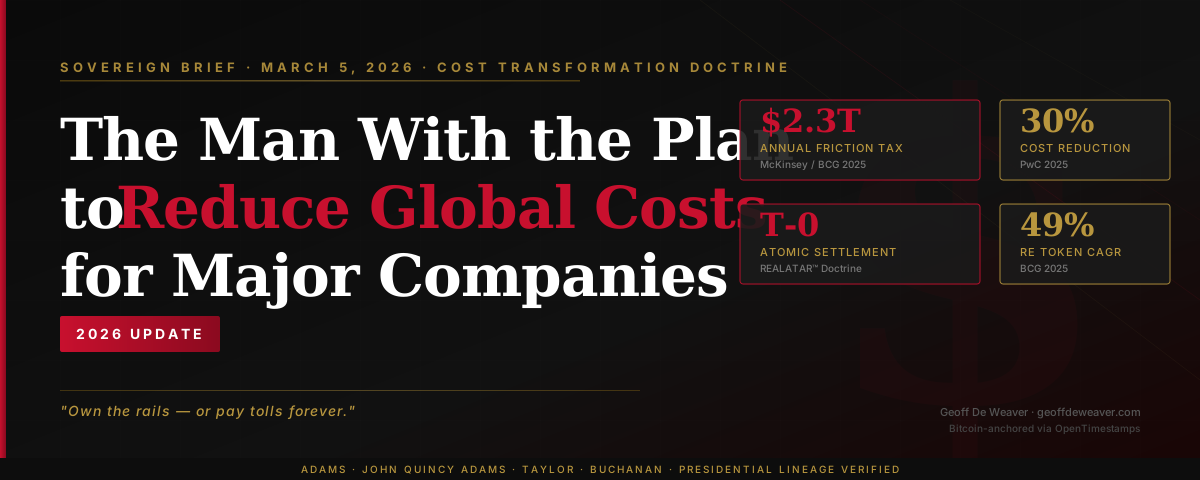
SOVEREIGN BRIEF · MARCH 5, 2026 · COST TRANSFORMATION DOCTRINE
“Legacy systems do not just waste money. They extract it — systematically, structurally, and by design. The question is not whether to cut costs. It is whether you have the rails to eliminate the extraction entirely.”
Originally Published: February 19, 2023 · Updated: March 5, 2026
By Geoff De Weaver, Sovereign Architect, Founder & CEO, Limitless USA LLC
The Mandate
Cost Reduction Is Not a Strategy. Sovereignty Is.
Cost reduction and cost transformation are processes to cut costs and increase profits by improving operational efficiency and productivity. Every product development decision impacts cost. Every settlement delay compounds loss. Every rented system extracts a toll.
But in 2026, the definition of cost reduction has fundamentally changed. It is no longer sufficient to streamline a supply chain or renegotiate a vendor contract. The companies that will dominate the next decade are those that eliminate the structural friction layer entirely — by building or deploying programmable rails that replace the legacy systems extracting value from every transaction.
McKinsey’s research is unambiguous: across-the-board cost-cutting during crises often fails by ignoring strategic needs. Only 53% of executives believed blanket cost reduction helped during the global economic crisis. The recommendation is not to cut — it is to restructure based on marketplace trends and explore tactics capable of delivering 20–35% savings in selling, general, and administrative costs.
In 2026, that 20–35% savings opportunity has a name: programmable infrastructure. The companies that understand this will not just reduce costs — they will decouple from the friction permanently.
Key Statistics
| STAT | IMPLICATION | SOURCE |
|---|---|---|
| $2.3T FRICTION TAX | Annual friction cost extracted by legacy settlement systems globally | McKinsey / BCG 2025 |
| 53% | Of executives found broad cost-cutting helpful during crisis | McKinsey |
| 30% | Operational cost reduction enabled by blockchain settlement | PwC 2025 |
| 5–10% | Legacy friction per deal eliminated by T-0 atomic settlement | REALATAR™ Doctrine |
The 2026 Framework
Five Ways to Reduce Costs — Updated for the Programmable Era
1. Improve Operational Efficiency
Streamline processes, compress supply chains, eliminate waste. In 2026, deploy AI digital twins for 24/7 process optimisation. T-0 atomic settlement — funds and ownership transferred simultaneously in a single on-chain transaction, all or nothing — eliminates the 30-to-90 day escrow lock-up that extracts 5–10% friction per deal and suspends an estimated $2.3 trillion in unnecessary capital annually.
2. Implement Cost-Effective Technology
Cloud computing, outsourced IT, and automation remain valid. The 2026 upgrade is programmable rails — smart contract infrastructure that automates compliance, settlement, and transfer without human intermediaries. Sub-$0.10 fees via L2 blockchain rollups collapse cost structures that previously required entire back-office divisions.
3. Optimise Resource Management
Inventory optimisation, energy management, and procurement renegotiation are baseline. Tokenization unlocks fractional liquidity in previously illiquid assets — real estate holdings, equipment, infrastructure — converting stranded capital into deployable resources without forced sales or financing friction.
4. Reduce Marketing Costs
Optimise campaigns, leverage owned digital channels, reduce paid dependency. A verified 1.55 billion-node sovereign distribution infrastructure amplifies reach without advertising spend. The company that owns its distribution rails pays no tolls. The company renting reach from platforms pays them forever.
5. Enhance Employee Productivity
Training, flexible arrangements, and engagement remain important. AI-driven workflows eliminate repetitive high-cost tasks entirely. Programmable deeds, automated compliance verification, and smart contract execution redirect human capital to its highest-value function.
Client Strategy
Cost Transformation at Scale — Global Brands in the 2026 Sovereign Lens
For clients at the scale of Unilever, P&G, Nestlé, US Foods, Sysco, and McDonald’s, cost reduction is not a line-item exercise. It is an infrastructure decision.
Unilever
Supply chain optimisation with blockchain-verified tracking, AI automation, and sustainable materials sourcing. Tokenized compliance documentation eliminates reconciliation overhead — estimated 15–25% cycle time reduction. T-0 settlement rails make it permanent infrastructure.
P&G
Production streamlining, data analytics, and strategic outsourcing. Programmable rails eliminate escrow friction in global licensing deals. Zero-trust architecture with zero-knowledge proof verification reduces breach liability and compliance cost simultaneously.
US Foods
Procurement optimisation, AI-driven demand forecasting, and distribution efficiency. Tokenized vendor settlement systems eliminate 30-day payment cycles and the working capital cost they impose across the entire supply chain. See the case study below.
Sysco
AI-powered demand matching combined with tokenized settlement for direct supplier-buyer transactions. Estimated 15–25% cost reduction per transaction — compounding into nine-figure annual savings at Sysco’s volume.
Nestlé
Packaging waste reduction, strategic outsourcing, and global asset management via programmable deeds. T-0 settlement rails and tokenized compliance documentation eliminate recall response costs — one of the highest single-incident cost exposures in global FMCG.
McDonald’s
Supply chain automation, energy optimisation, and franchise system efficiency. Tokenized real estate converts the single largest asset class on McDonald’s balance sheet into programmable, tradeable infrastructure — eliminating traditional property transaction friction entirely.
Case Study — Resilience Under Fire
The US Foods Battle: What Sovereign Builders Learn When Legacy Systems Breach
“In a world of rented justice, build sovereign rails. The Constitution demands it. Unerasable truth prevails over institutional friction — always.”
In 2019 and 2020, Limitless USA LLC and Chef John Nikollbibaj entered a written agreement with US Foods to reduce global costs through operational efficiency and innovation. US Foods breached that agreement. The case — No. 1:21-cv-06914-TMD in the U.S. District Court for the Northern District of Illinois — became a multi-year lesson in what happens when legacy institutional power attempts to extract rather than honour.
- 2019–2020: Agreement signed. Limitless USA LLC and Chef John engage US Foods on global cost reduction
- 2020: Breach occurs. US Foods fails to honour the written agreement
- 2021: Case filed — No. 1:21-cv-06914-TMD, U.S. District Court, Northern District of Illinois
- 2022–2025: Multi-year fight. Lead attorney Steven S. Biss suffers a massive stroke the week before the final hearing. Chef John endures two heart attacks, including one over Christmas
- 2026: Two-yard line. US Foods fires CEO Pietro Satriano and parts ways with their law firm. Proceeding with new counsel. Resolution imminent
We stood alone against a corporate giant with institutional resources and every expectation that the cost of continuing would exceed the cost of surrendering. We did not surrender.
- Faith in God and disciplined execution outlast institutional intimidation
- Unerasable truth — Bitcoin-anchored, documented, timestamped — cannot be suppressed by delay
- Constitutional due process is not a guarantee. It is a mandate to be claimed by those willing to fight for it
- The two-yard line is not defeat. It is the position from which sovereign builders score
The Sovereign Framework
Four Principles for Value Realisation in 2026
1. Align to Value
Engage stakeholders across the full value chain. Sovereign infrastructure delivers outcomes, not just savings. The metric is not cost per transaction. It is velocity per dollar deployed.
2. Plan and Prioritise
Build the business case for programmable infrastructure before optimising legacy systems. Real estate settlement, vendor payment cycles, and compliance documentation are the highest-value targets.
3. Execute and Measure
Document every efficiency gain with timestamped, immutable on-chain records — analytics that cannot be revised, suppressed, or disputed. Evaluate impact against the friction baseline, not prior-year cost.
4. Iterate and Innovate
Adapt infrastructure as market conditions evolve. The sovereign builder does not optimise legacy rails — they replace them with infrastructure that compounds.
The Bottom Line
Sovereignty Wins in 2026 — Every Time
Cost reduction improves profitability without harming quality. What has changed in 2026 is the mechanism. Efficiency is no longer achieved through simplification and centralisation alone. It is achieved through programmable infrastructure that makes the friction layer structurally impossible.
The US Foods battle was not a legal dispute. It was a proof of concept. Legacy systems that breach sovereign agreements and exploit institutional power are extraction mechanisms with expiration dates. Faith in God, disciplined execution, and unerasable truth are the operating system that sovereign builders run on when every other system has failed.
Deploy sovereign rails for your enterprise
The rails are sovereign.
The truth is unerasable.
The future is programmable.
Timestamped March 5, 2026 — own your doctrine. opentimestamps.org
— Geoff De Weaver
Sovereign Architect · Limitless USA LLC · geoffdeweaver.com
March 5, 2026 · Sydney, Australia
#Limitless155B #Earth30 #SovereignArchitect #Rails2026 #GodWins #MAGA
Presidential Lineage: Adams · John Quincy Adams · Taylor · Buchanan · Every word Bitcoin-anchored via OpenTimestamps