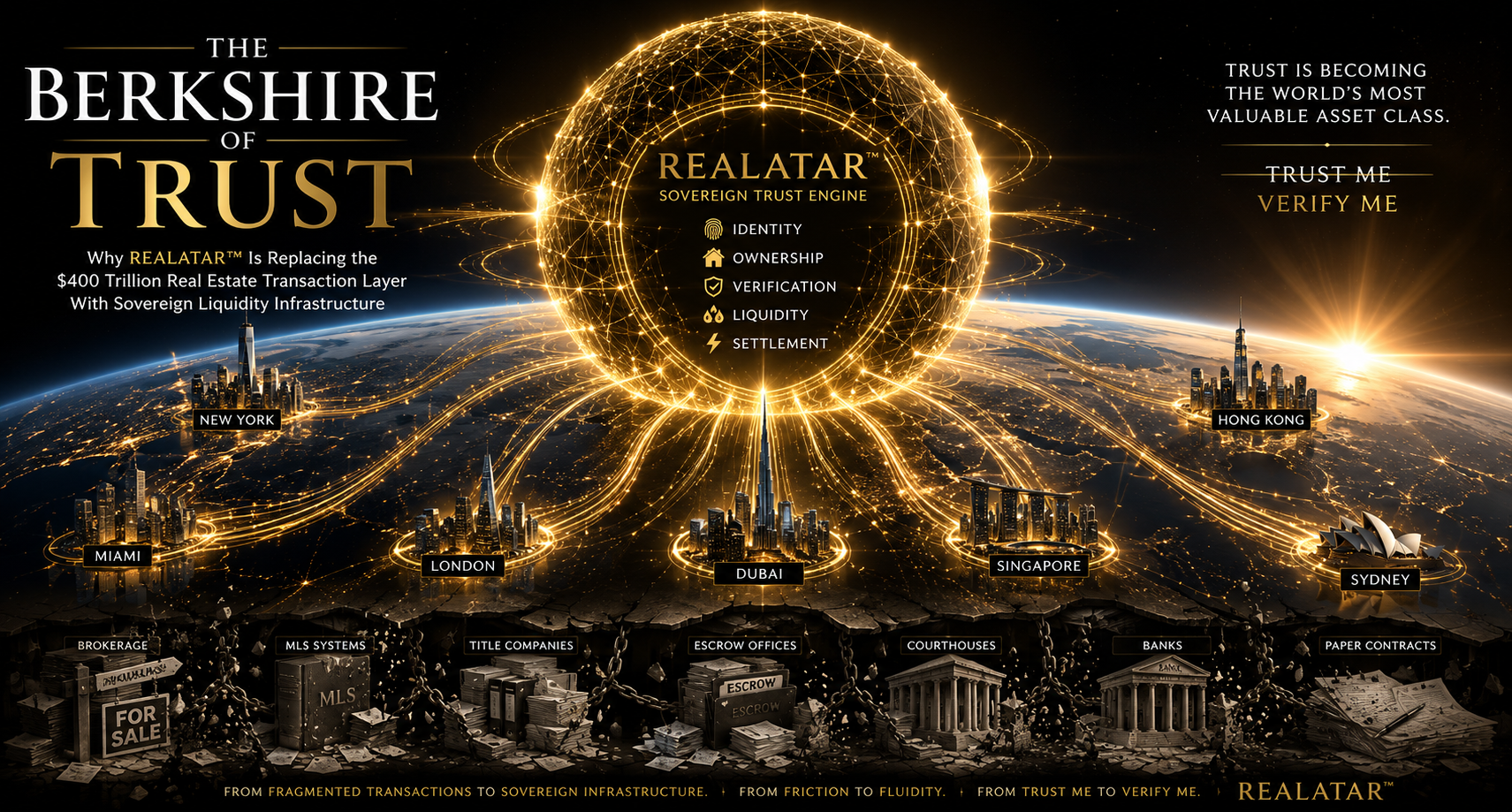
The Berkshire of Trust: Why REALATAR™ Is Replacing the $400 Trillion Real Estate Transaction Layer With Sovereign Liquidity Infrastructure
The largest asset class on Earth is being re-coded. I am not competing inside the old system — I am building the rails that retire it.
The global real estate market — valued above $393 trillion entering 2025 and the single largest asset class on the planet — is accelerating toward a structural inversion. Legacy systems are breaking down under the weight of transactional friction, siloed data architectures, and archaic escrow gatekeepers. The race is no longer about winning market share within the existing paradigm. It is about rewriting the foundational code of ownership itself. While the broader digital-asset economy crossed $4 trillion in total value in 2025 and institutional capital moved decisively on-chain — Andreessen Horowitz documents over $46 trillion in stablecoin settlement volume in a single year — real property remains the last great asset class still settling on paper, on trust, and on delay. That gap is the opportunity. The expansion, re-architecture, and strategic ranking of the 15 operational pillars for Limitless USA LLC and REALATAR™ are detailed below, backed by tier-one institutional intelligence.
#1. Become the Category Owner, Not the Category Participant
I no longer chase market opportunities. Global enterprise executives open their doors to me because institutional reputation precedes execution. Traditional industry operators focus on marginal optimization; I am executing a clean break from legacy systems. The goal is absolute market irrelevance for competitors. I am not building another brokerage, another fragmented software platform, or a transient media brand. I am building REALATAR™: the sovereign ownership infrastructure for the global built environment.
In every network economy I have studied across four decades, the pattern holds without exception: the entity that owns the foundational settlement layer captures the overwhelming majority of the industry’s profit pool, while commodity participants compete for the shrinking transactional crumbs left behind. Rails compound. Tools depreciate. We do not participate in the real estate category. REALATAR™ defines, controls, and executes the category.
#2. Obsess Over Durable, Non-Disruptible Growth
The single most critical lesson derived from my multi-decade track record is the stark operational divergence between simple transactional volume and true business quality. True enterprise scale requires durable, protected growth that compounds independent of macroeconomic cyclicality. For Limitless USA LLC, the directive is absolute: stop thinking like a brokerage, which is exposed to margin compression, macroeconomic shocks, and regulatory vulnerability. Build infrastructure. Build sovereign liquidity rails. Build programmable ownership layers.
Traditional real estate intermediaries are fundamentally vulnerable to technological disintermediation. Horizontal liquidity rails linked directly to institutional capital markets are not. Bain & Company’s enterprise analysis is consistent on this point: legacy service businesses face immediate margin erosion from automated systems, while foundational platforms built on deep data integration and outcome-oriented infrastructure attract sustained capital inflows. The disintermediation is no longer theoretical — Gartner projects that 33% of enterprise software applications will embed autonomous agentic AI by 2028, up from less than 1% in 2024. REALATAR™ is designed to capture this structural shift by embedding ownership directly into the network layer before the intermediaries realize the layer has already moved beneath them.
#3. Own the Asset Side, Not Just the Transaction Side
A profound insight derived from analyzing Berkshire Hathaway’s structural design centers on capital allocation. Warren Buffett bypassed the volatile service layer to obsess over the asset side of the balance sheet. Traditional market players are trapped in a transactional loop, perpetually hunting the next closing to feed overhead — a linear, non-scalable model. My architecture shifts focus entirely from short-term transactional loops to permanent asset layers: Sovereign Ownership Networks, Proprietary Transactional Data Trains, Universal Identity Protocols, Instant Liquidity Access Points, and Mathematical Ledger Verification. The transaction layer is a commodity. The asset layer controls the market.
#4. Think Like Berkshire, Not Like a Brokerage
I am not constructing a high-frequency trading desk or an episodic real estate brokerage. I am building a compounding engine designed to scale across generations. Every single layer of our stack is engineered to feed, fortify, and compound the next: the REALATAR™ Execution Layer settles real-world assets natively on-chain; the Trust Protocol Layer eliminates the necessity for centralized intermediaries; the Verification Layer anchors asset provenance directly to the Bitcoin blockchain via OpenTimestamps; the Referral Layer captures global business distribution programmatically; and the Settlement Layer executes automated transaction processing instantly.
Deloitte’s Center for Financial Services forecasts that the global tokenized real estate market will expand from under $300 billion in 2024 to $4 trillion by 2035 — a 27% compound annual growth rate, driven directly by the operational efficiencies of automated smart contracts and instantaneous settlement. By operating as the trust engine for this migration, I capture institutional yield at the foundation, not the fringe. The migration is no longer a forecast. It is a transfer already in motion, and the rails it runs on are being chosen now.
#5. Build the Flywheel, Then Let Compounding Work
The ultimate architectural blueprint from Berkshire Hathaway and the historic operations of Howard Hughes demonstrates that compounding requires a self-reinforcing flywheel. Every operational asset must increase the velocity and gravity of the entire system. For Limitless, the systemic engine is locked: Institutional Trust → Sovereign Identity → Immutable Verification → Dynamic Ownership → Capital Liquidity → Instant Settlement → Asymmetric Network Effects → Compounded Institutional Trust.
Every institutional node, every property title, and every sovereign user brought into our ecosystem does not merely add a linear revenue stream — it mathematically increases the security, liquidity, and defense mechanics of the entire network. The scale of the prize is not speculative: McKinsey projects the tokenized asset market reaching $2 trillion by 2030, while Boston Consulting Group sizes the opportunity at $16 trillion — nearly 10% of global GDP. The flywheel that captures even a fraction of that migration does not compete for the decade. It owns it.
#6. Quality Assets Become Mispriced During Technology Revolutions
During seismic technological shifts, market participants routinely suffer from collective myopia. They abandon high-quality, cash-generating assets to chase speculative, unvetted instruments. I observed this exact phenomenon when enterprise giants like Berkshire, Amazon, Meta, and Microsoft were heavily discounted while capital fled into unviable dot-com concepts. The exact same mispricing is occurring across the global real estate landscape right now. The venture capital ecosystem — a16z, Sequoia, and their peers among them — is aggressively chasing shallow application-layer AI software, wrappers, and point solutions.
Meanwhile, the foundational pillars of the global economy remain severely underbuilt and starved for modern infrastructure: Title Ownership Systems, Institutional Trust Matrices, Escrow Management Frameworks, Sovereign Identity Registers, and Capital Settlement Engines. This asset mispricing is my asymmetric window. While the crowd finances ephemeral software wrappers, I am consolidating the permanent digital infrastructure of real property — the layer that does not get refinanced every cycle because it becomes the cycle.
#7. Time Is Becoming More Valuable Than Money
In an era defined by autonomous compute, processing power, and intelligent agent systems, time has surpassed capital as the ultimate strategic asset. Capital has become a commoditized resource; execution latency is now the final barrier to systemic scale. For Limitless, every operational process must be stress-tested against a single requirement: can this execution happen instantly? This mandate informs our commitment to T+0 Settlement Execution that eradicates the legacy 30-to-90-day multi-tiered transaction delay; Quantum Escrow Protocols that replace manual intermediaries with automated smart contracts; Bitcoin Ledger Anchoring that ensures immediate, immutable, globally verifiable proof of state via OpenTimestamps; and Autonomous AI Agents that eliminate administrative friction at the source.
Gartner data on autonomous enterprise systems projects that by 2028, at least 15% of all day-to-day operational decisions will be executed autonomously by machine intelligence — up from effectively zero in 2024. REALATAR™ optimizes for that future today, ensuring transactions execute at the speed of data, not the speed of human latency. The institutions that settle in seconds will not wait for the institutions that settle in weeks.
#8. The Greatest Opportunity Is Often Hidden Behind Hype
The venture capital ecosystem is saturated with noise. Capital allocators are aggressively deploying billions into undifferentiated AI agents, transient large language models, and superficial digital avatars. This herd behavior creates a massive capital vacuum around the mission-critical layers of market infrastructure. For REALATAR™, my competitive advantage lies in an absolute refusal to build superficial technology wrappers. While the market chases the front-end hype, I focus exclusively on the core backend: Mathematical Verification Systems, Instant Institutional Settlement Engines, Sovereign Ownership Infrastructure, and Asset Provenance Registries.
Consider the distance still to be closed. Tokenized real-world assets sit near $25–30 billion on-chain today, against credible projections measured in trillions by the end of the decade. That distance is not a warning. It is the runway. The quiet, unglamorous infrastructure layer is invariably the layer that captures the long-term economic rent of the entire industry — and it is being claimed while the crowd is looking elsewhere.
#9. Spend Most Time Studying Disruption Risk
The primary responsibility of a sovereign executive in the modern era is the aggressive, unyielding calculation of systemic disruption risk. The speed of technological obsolescence requires a continuous, daily interrogation of our entire operational footprint. I audit our structural assets daily against four core criteria:
- Can automated intelligence completely replace this node?
- Can commodity brokers or regional agents replicate this distribution?
- Can decentralized smart contracts commoditize this transaction layer?
- Can public Bitcoin blockchain verification invalidate this proprietary security system?
If any component of our infrastructure is found vulnerable to external technological disintermediation, we do not defend it. We destroy it internally and re-architect it before a competitor can exploit the vulnerability. The institutions that wait for disruption to arrive inherit the outage. I build the outage into my own audit, then engineer past it.
#10. Communication Is a Strategic Weapon
Mass distribution without reliance on legacy gatekeepers is a powerful force multiplier. Through my global digital infrastructure — spanning geoffdeweaver.com, LinkedIn, X, and Facebook — I command immediate, unmediated access to a verified network exceeding 1.55 billion individuals globally. This is not a casual media footprint or a marketing engine. This is direct distribution infrastructure.
The objective is clear: convert my corporate publishing history — 735+ long-form strategic blueprints, 2.4 million+ verified words, and 240+ hours of master-tier audiobooks — into a permanent, algorithmic distribution network. By bypassing traditional corporate media syndicates, Limitless possesses the unique ability to seed narratives, launch protocols, and deploy capital instantly across a global scale.
#11. Reputation Compounds Faster Than Capital
When I began my career building corporate empires, gaining direct access to enterprise CEOs required navigating extensive networks of legacy gatekeepers. Today, global enterprise executives, institutional founders, and sovereign capital allocators welcome me directly. This access is the direct result of compounding reputation capital. My entire life’s work — the 735+ strategic blueprints, the 2.4 million+ verified words, and the 240+ hours of sovereign audio architecture anchored to geoffdeweaver.com — serves as an unassailable digital moat.
This intellectual corpus is not merely an educational archive. It is mathematically verified proof of structural foresight. Capital can be printed or diluted; institutional reputation capital backed by a 15-year unbroken public record cannot be duplicated, back-dated, or counterfeited. They rent polish. I own provenance.
#12. Build an Army of Believers
An analysis of massive corporate value creation, from Tesla to early-stage technology networks, proves that the ultimate lever for compressing the cost of capital is the cultivation of an unyielding army of believers. Passive followers provide no strategic defense; true alignment requires deeply committed believers. Our global communication architecture across all platforms must be optimized exclusively for this objective:
[GeoffDeWeaver.com]    ──┐
[LinkedIn & X Channels] ──┼──> [Sovereign Grokipedia Engine] ──> [An Army of Aligned Believers]
[Strategic Blueprints]  ──┘
Our content across geoffdeweaver.com, the Sovereign Grokipedia, and my global networks is engineered to attract individuals who demand absolute alignment with the future of tokenized asset infrastructure. We do not optimize for superficial vanity metrics. We build an elite global network that actively accelerates the adoption of REALATAR™.
#13. Founder-Led Companies Have a Massive Advantage
I maintain an absolute investment and operational preference for founder-led enterprises. Commodity management teams operating under corporate governance structures are fundamentally constrained by short-term visual incentives and quarterly performance tracking. Founders operate with an entirely different strategic horizon: generational vision that thinks across decades rather than reporting cycles; asymmetric risk processing that executes capital reallocations which terrify institutional committees; and absolute insulated focus that disregards near-term public noise to preserve the integrity of the long-term blueprint. This is my unfair structural advantage. I am the founder. Limitless is unencumbered by the institutional bureaucracy that paralyzes legacy real estate organizations.
#14. Underwrite People First
Most legacy venture funds and institutional allocators reverse the natural order of risk mitigation. They obsess over financial spreadsheets, historical market sizes, and macroeconomic conditions before evaluating the core execution vector: human capability. My underwriting framework remains rigid — People → Opportunity → Context → Deal Structure.
[1. HUMAN CAPITAL]    ──> Verify execution history and character.
        │
        ▼
[2. ASYMMETRIC VISION] ──> Confirm scale matches a $400T market.
        │
        ▼
[3. STRUCTURAL RISK]   ──> Analyze macro context and regulatory landscapes.
        │
        ▼
[4. LEVERAGED DEAL]    ──> Execute optimal capital and equity allocation.
Before looking at a financial spreadsheet or a real estate cap table, I analyze the founder’s execution history, psychological resilience, and capability. If the human foundation is flawed, the deal structure is completely irrelevant.
#15. Build For Decades, Not Quarters
The financial establishment is structurally trapped in a 90-day performance loop, forced to optimize for near-term reporting metrics. True institutional builders operate on a generational horizon. REALATAR™ is designed, coded, and architected to dominate the years 2030, 2040, and 2050. I do not alter my strategic roadmap to chase short-term revenue spikes or market trends. Every line of smart contract code, every cross-border legal structure, and every institutional liquidity node I deploy is engineered to stand as a permanent piece of global infrastructure for the next half-century.
The Strategic Takeaway
The directive for Limitless USA LLC and REALATAR™ requires an absolute rejection of traditional real estate models. Stop operating like a real estate company and start executing like Berkshire Hathaway. Berkshire Hathaway consolidates capital; REALATAR™ consolidates trust. Berkshire Hathaway leverages insurance float; REALATAR™ leverages immutable verification float. Berkshire Hathaway compounds industrial capital; REALATAR™ programmatically compounds identity, trust, liquidity, and verified ownership across the largest asset class on Earth.
The market spent a generation litigating who controls the commission — the National Association of Realtors alone settled antitrust claims for $418 million. I am not fighting over the commission. I am replacing the layer the commission sits on. This is the ultimate asymmetric opportunity of our generation. The infrastructure is locked. The rails are set. Execution is absolute. 🇺🇸 🎯 ✅
Sovereign Command Center Verification Nodes:
https://geoffdeweaver.com/
https://geoffdeweaver.com/grokipedia/
Sovereign Proof & Verification
This entry is permanently anchored to the Bitcoin blockchain via OpenTimestamps. The cryptographic fingerprint below is immutable, independently verifiable, and cannot be back-dated or altered.
SHA-256: 3c5c88cde244fae15ee3b70adf936bb698886821e2e047784de4f97e7d51b12f
Proof File: entry-123-berkshire-of-trust.ots
Anchored: Bitcoin L1
Verify: https://opentimestamps.org/