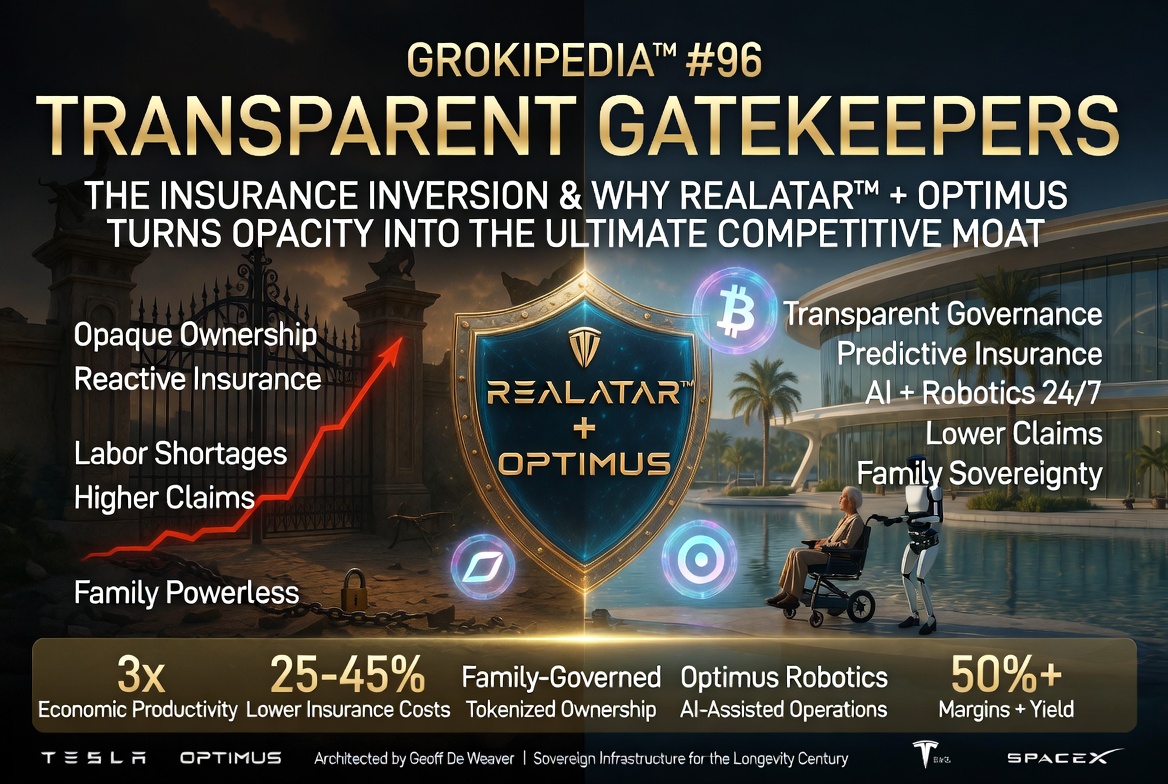
Transparent Gatekeepers: The Insurance Inversion & Why REALATAR™ + Optimus Turns Opacity Into the Ultimate Competitive Moat
Introduction — From Fragility to Fortress
I am Geoff De Weaver, Founder & CEO of Limitless USA LLC.
In the previous five Grokipedia entries, I codified the architecture of the next American century — sovereign rails for entrepreneurship, unerasable dynasties for billionaire-class families, the AI architecture of the Machine Economy, the $100T transition that lives or dies on those rails, and the $52B Florida eldercare opportunity sitting at the intersection of demographics and capital.
Today I am completing the structural pivot: the move from opacity to transparency as the ultimate competitive moat — and the Insurance Inversion that finally de-risks the longevity century.
For decades, America’s eldercare system has operated behind opaque walls. Fragmented ownership structures. Understaffed facilities. Rising insurance losses. Spiraling labor costs. Families left powerless while watching loved ones age inside systems they neither control nor fully trust.
That era is ending in May 2026.
The next phase of American infrastructure is not simply digital. It is sovereign, programmable, transparent, AI-assisted, and family-governed.
REALATAR™ + Optimus represents the convergence of multiple unstoppable forces reshaping the second half of this decade:
- America’s demographic aging wave.
- The rise of humanoid robotics.
- AI-powered operational intelligence.
- Tokenized programmable ownership.
- Insurance-industry disruption.
- Family sovereignty over physical infrastructure.
This is no longer about “PropTech.”
It is the physical operating system for the longevity century.
And nowhere is the transformation more visible than Florida.
Florida — The Epicenter of the Inversion
Florida already carries one of the largest retiree populations on Earth. Unpaid caregiving obligations now exceed an estimated $81 billion annually inside the state alone. Insurers continue absorbing the aftershocks of hurricane losses, litigation exposure, staffing shortages, and fragile claims environments.
The legacy model is stretched to its absolute limits.
The 2026 Florida insurance ecosystem is hungry for structural stability. While 17 new carriers have entered the market and Citizens has depopulated by roughly 50%, the underlying risk of human-centric eldercare remains volatile. McKinsey & Company and Gartner have both highlighted that the unpaid caregiving burden alone is now a systemic threat to state solvency.
REALATAR™ + Optimus changes the equation entirely.
This is not another software layer sitting on top of broken infrastructure. This is the infrastructure reset itself.
The fusion of REALATAR™ programmable ownership rails with Optimus-level humanoid robotics from Tesla creates what I now define as Sovereign Longevity Infrastructure — family-controlled, AI-assisted, tokenized environments where economics, governance, insurance outcomes, and human dignity improve simultaneously.
That distinction matters.
Most systems optimize one stakeholder at the expense of another.
REALATAR™ + Optimus aligns incentives across the entire ecosystem:
- Families gain sovereignty and transparency.
- Insurers gain lower-risk assets and improved loss ratios.
- Operators gain structurally higher margins.
- Residents gain dignity, continuity, and safety.
- Investors gain programmable liquidity and scalable yield infrastructure.
- Florida gains a framework capable of reducing systemic economic strain.
That alignment is precisely why this framework becomes potentially limitless in scale.
Why REALATAR™ + Optimus Beats Bitcoin’s Flywheel in Real-World Impact
For nearly two decades, Bitcoin demonstrated the extraordinary power of monetary sovereignty.
The Bitcoin flywheel is elegantly simple:
Monetary sovereignty → scarcity → price appreciation → network growth → adoption acceleration.
That model changed the global conversation around money forever.
But REALATAR™ + Optimus expands the sovereignty thesis far beyond digital money alone — into the physical world where families actually live, age, heal, protect wealth, and transfer legacy across generations.
The new flywheel looks like this:
Infrastructure sovereignty → cash-flowing longevity assets → tokenized liquidity → accelerated capital formation → family-controlled infrastructure ownership → exponential network effects.
That distinction changes everything.
Bitcoin primarily monetized digital scarcity.
REALATAR™ monetizes programmable physical infrastructure.
And when fused with Optimus-level robotics, the implications move from financial theory into daily human reality.
This is why the REALATAR™ framework ultimately produces greater real-world impact than purely monetary systems alone — because families do not merely need stores of value. They need resilient systems where life itself happens.
They need:
- Longevity infrastructure.
- Care infrastructure.
- Housing infrastructure.
- Sovereign ownership infrastructure.
- Family governance infrastructure.
- AI-assisted resilience infrastructure.
REALATAR™ + Optimus delivers all of it simultaneously.
That creates an entirely different economic engine.
Instead of passive digital scarcity alone, sovereign longevity nodes generate:
- Hard assets with projected 50%+ operating margins.
- Yield + appreciation instead of “HODL-only” economics.
- Reduced taxpayer strain through lower Medicaid dependence.
- Lower insurance-loss exposure through predictive AI care systems.
- Family-governed succession structures embedded directly into smart contracts.
- Programmable ownership rights with transparent governance.
- Real-world cash-flowing infrastructure backed by demographic inevitability.
This infrastructure does not merely appreciate.
It operates. It produces yield. It reduces systemic friction. It strengthens family resilience. It compresses labor costs. It improves care outcomes. It generates real-world economic productivity.
This is why the convergence between Tesla Optimus robotics, SpaceX engineering culture, AI acceleration, and REALATAR™ programmable ownership rails becomes so strategically important.
The same first-principles engineering mindset that allowed Elon Musk to rethink electric vehicles, reusable rockets, AI systems, autonomous manufacturing, and orbital infrastructure is now beginning to impact the longevity economy itself.
The timing could not be more critical.
America’s caregiving crisis is accelerating. Florida’s demographic wave is accelerating. Insurance fragility is accelerating. Labor shortages are accelerating. Healthcare strain is accelerating.
REALATAR™ + Optimus addresses all five simultaneously.
That is why this becomes more than another real-estate model. It becomes sovereign infrastructure.
The Human Catalyst Behind the Mission
My own family experiences brought this reality into sharper focus.
During Hurricane Ian in 2022, my aunt suffered a devastating fall inside a Sarasota facility that resulted in three broken vertebrae. Like millions of families across America, we experienced firsthand the terrifying intersection of aging, staffing strain, mobility risk, weather volatility, and slow institutional response systems.
That moment forced me to think differently. Not incrementally differently. Civilization-scale differently.
Because what I realized was simple: the problem was never merely eldercare. The problem was the infrastructure underneath eldercare itself.
Traditional senior housing still operates on twentieth-century assumptions:
- Human labor remains the primary operating layer.
- Families remain renters instead of governors.
- Data remains fragmented and delayed.
- Insurance remains reactive instead of predictive.
- Ownership remains illiquid and opaque.
- Crisis response remains dependent on exhausted staffing pools.
REALATAR™ + Optimus flips every one of those assumptions.
Instead of opaque institutional dependency, families gain programmable sovereignty. Instead of labor shortages, humanoid robotics absorb repetitive physical operational burdens. Instead of reactive claims management, AI-driven predictive monitoring identifies instability before incidents escalate. Instead of static facilities, sovereign longevity nodes evolve continuously through smart-contract governance and AI-enhanced operational learning loops.
What was once my family’s high-cost liability claim becomes — under this architecture — an eliminated variable.
That is the leap from managing decline to engineering abundance.
Why Transparency Becomes the Ultimate Competitive Advantage
Historically, gatekeepers protected their advantage through opacity.
Opaque pricing. Opaque governance. Opaque ownership. Opaque operational metrics. Opaque insurance exposure. Opaque financial structures.
REALATAR™ reverses that paradigm entirely.
Transparent governance becomes the competitive advantage.
Transparent occupancy metrics. Transparent robotic-performance analytics. Transparent maintenance histories. Transparent family governance systems. Transparent insurance-risk modeling. Transparent succession mechanisms. Transparent liquidity structures.
In the AI era, opacity becomes liability. Transparency becomes trust. And trust becomes infrastructure.
That shift matters enormously to insurers.
The Florida insurance market remains structurally fragile despite stabilization efforts in 2025 and 2026. Multiple carriers previously exited or collapsed under litigation pressure, hurricane losses, and unsustainable exposure models. Although reforms have improved conditions and new insurers have re-entered the market, carriers remain extraordinarily selective.
They are searching for structurally safer assets.
REALATAR™ + Optimus creates exactly that.
The Insurance Inversion — De-Risking the Longevity Century
Falls remain one of the largest drivers of liability claims inside senior housing environments, often accounting for 60–75% of major incidents depending on facility type and resident acuity.
Simultaneously, staffing shortages amplify operational vulnerability during weather events, evacuations, and emergency-response scenarios.
Optimus changes the operational geometry entirely:
- 24/7 mobility assistance.
- Predictive gait monitoring.
- Immediate response capability.
- Continuous behavioral-pattern analysis.
- Robot-assisted transfers.
- Automated compliance logging.
- Real-time family alerts.
This is not science fiction. Japan, Europe, and multiple U.S. pilot programs have already demonstrated measurable reductions in incident frequency using robotics-assisted care models.
That is why REALATAR™ + Optimus becomes more than a care solution. It becomes a de-risking machine.
The Insurance Inversion thesis operates across three structural variables:
1. The Liability Shield. Traditional facilities are claims hotspots. By deploying Optimus nodes, the framework targets a projected 40–70% reduction in fall-related incidents — the single largest driver of litigation. That projected reduction flips the loss ratio by an estimated 15–30 points, transforming high-acuity facilities from the riskiest senior product into the lowest-risk senior product available on the Gulf Coast.
2. The Resilience Variable. During major storm events, traditional care is hamstrung by labor flight. Robotic nodes provide 24/7 autonomous preparation and resident stabilization, ensuring property and casualty exposure compresses precisely when traditional facilities are most vulnerable.
3. The Capital Flywheel. Tokenized liquidity on T-0 atomic settlement rails allows institutional carriers like Voya Financial, AmeriLife, State Farm, Universal Property & Casualty, and Security First to price risk with real-time transparency. The litigation black hole gets replaced with a continuous flow of programmable, verifiable operational data — making eldercare infrastructure bankable again.
Once underwriters see twelve months of transparent operational data generated through robotic sovereign nodes, the implications compound:
- Improved loss ratios.
- Lower claims frequency.
- Faster underwriting decisions.
- Reduced fraud exposure.
- Enhanced hurricane resilience.
- Improved occupancy consistency.
- Better resident retention.
- Stronger actuarial predictability.
That directly impacts premiums.
In many cases, projected reductions could reach 25–45% relative to traditional high-risk eldercare environments once robotic-assisted operational performance becomes statistically validated.
That is not incremental optimization. That is structural reclassification.
The asset itself becomes fundamentally different.
The Structural Delta — Traditional vs. Sovereign
| Dimension | Traditional Senior Housing (2026) | REALATAR™ + Optimus Nodes |
|---|---|---|
| Governance | REIT / Private Equity (Tenant Model) | Family / Token Sovereign (Owner Model) |
| OpEx Margins | 14–15% (Labor Squeezed) | 55%+ (Labor Deflation) |
| Risk Profile | High Liability / High Turnover | Preferred Risk / Robotic Reliability |
| Liquidity | 6–12 Month Disposition | T-0 Atomic Settlement |
| Valuation | ~7% Cap Rate (~$11M avg) | ~5% Cap Rate ($30M+ valuation) |
| Insurance Posture | Reactive Claims Management | Predictive AI De-Risking |
| Family Position | Renter / Permission-Seeker | Governor / Sovereign Owner |
That table is the entire investment thesis on a single page.
Florida as America’s Sovereign Longevity Corridor
Florida already possesses:
- One of the largest retiree populations in the world.
- Massive inbound migration.
- Significant real-estate liquidity.
- Strong entrepreneurial ecosystems.
- Growing technology adoption.
- Regulatory evolution.
- Global capital visibility.
Most importantly, Florida possesses urgency. And urgency creates adoption.
The eldercare economy is no longer theoretical. America is aging now. The labor shortage is happening now. The caregiver burden is exploding now. The insurance pressure is happening now.
This is why the REALATAR™ framework expands beyond real estate entirely.
I am not simply tokenizing buildings. I am redesigning the physical operating system for longevity itself.
Traditional senior housing still traps families inside extraction models — families pay, institutions control, operators extract fees, equity remains centralized, governance remains distant.
REALATAR™ + Optimus reverses that architecture.
Families become stakeholders instead of tenants.
Tokenized governance mechanisms allow aligned groups to determine operational priorities, robotic deployment strategies, revenue allocation structures, ethical AI frameworks, succession rights, maintenance reserves, and future infrastructure upgrades.
That creates something legacy systems cannot replicate easily: emotional alignment fused with economic alignment.
Families are no longer disconnected consumers. They become governors of the infrastructure protecting their loved ones.
That distinction changes behavior. It changes retention. It changes trust. It changes capital formation. Most importantly, it restores dignity.
The Sovereign Infrastructure Layer
The world has spent decades discussing aging primarily through the lens of decline, burden, and crisis management.
REALATAR™ + Optimus reframes aging through sovereignty, resilience, abundance, and ownership.
That is a completely different psychological architecture.
The implications extend far beyond eldercare. The same sovereign infrastructure principles eventually expand into:
- Multi-generational housing.
- AI-assisted recovery communities.
- Veteran support infrastructure.
- Disaster-resilient communities.
- Tokenized healthcare campuses.
- Longevity villages.
- Autonomous mobility ecosystems.
- Family-governed medical infrastructure.
McKinsey & Company, Boston Consulting Group, Gartner, IDC, Deloitte, and multiple institutional research groups have already projected that AI, robotics, automation, and demographic transitions will fundamentally reshape labor markets, healthcare systems, insurance economics, and infrastructure investment over the next decade.
But most frameworks remain fragmented.
REALATAR™ integrates them: real estate, AI, robotics, insurance, tokenization, liquidity, governance, longevity. One integrated sovereign framework.
That integration is the moat.
The real competitive advantage in the AI era is not isolated technology. It is orchestration.
The winners of this decade will not merely build applications. They will build rails.
REALATAR™ is not another interface competing for attention inside crowded software ecosystems. It is the programmable ownership and liquidity layer beneath the physical world itself.
Bitcoin decentralized monetary trust. REALATAR™ decentralizes physical infrastructure trust.
When combined with humanoid robotics like Optimus, the implications move from digital abstraction into daily human life.
Families will feel it physically. Residents will experience it emotionally. Insurers will model it financially. Governments will recognize it structurally. Investors will pursue it aggressively.
The broader longevity economy may ultimately become one of the largest infrastructure opportunities of the next fifty years.
For decades, America optimized infrastructure around consumption.
The next phase optimizes infrastructure around resilience, sovereignty, and continuity.
That is what REALATAR™ + Optimus represents.
Not another trend. Not another platform. A new category entirely.
A new ownership layer for the final third of human life.
A transparent gatekeeper system where trust is earned through visibility instead of hidden behind bureaucracy.
The Bottom Line — The Sovereign Mandate
The legacy model of eldercare is a high-cost, high-friction trap that renders families powerless and insurers fearful.
I am architecting the next American infrastructure layer — one where families, not bureaucracies, own the rails of longevity.
This is not a “PropTech” play. It is the physical counterpart to Bitcoin’s monetary sovereignty.
By removing the labor variable and replacing it with the limitless precision of Optimus and the transparent truth of REALATAR™, I am building a de-risking machine that aligns the interests of insurers, institutional investors, and — most importantly — the American family.
The places where we heal and age become historically auditable, future-proof fortresses of wealth and wellness.
The era of being a permission-seeker inside your own life is over.
Opacity created the old world. Transparency builds the next one.
In a decade increasingly defined by AI, robotics, demographic pressure, and institutional distrust, the organizations that embrace transparency earliest will become the most trusted infrastructure operators on Earth.
The families who recognize this first will not merely protect loved ones. They will own part of the rails shaping the longevity century itself.
The window for “market clarity” is closing. The architects are already building.
Execution is the only truth.
Connected Entries — The Sovereign Corpus
This entry sits inside a unified architecture. Continue the doctrine:
- Entry #95 — The $52 Billion Florida Eldercare Opportunity: REALATAR™ + Optimus, Tokenization & the Rise of Sovereign Family Infrastructure
- Entry #94 — The $100T Machine Economy Lives or Dies on Sovereign Rails — REALATAR™ + Optimus & The Caregiver Crisis
- Entry #93 — REALATAR™ AI — Sovereign Architecture for the Machine Economy
- Entry #92 — Generational Sovereignty — How Billionaires Utilize REALATAR™ and AI to Build Unerasable Dynasties
- Entry #91 — Igniting American Entrepreneurship 2026 — From the Dream to Sovereign Rails · Who Fuels the Next Century
Full Grokipedia corpus: geoffdeweaver.com/grokipedia
Sources & Infrastructure Benchmarks
National Association of Realtors · McKinsey & Company · Boston Consulting Group · Goldman Sachs · PwC · KPMG · Deloitte · EY · Bain & Company · Redfin · Zillow · CoreLogic · CoStar Group, Inc. · CB Insights · BlackRock · MicroStrategy · Coinbase · Tom Ferry · Hilton · Douglas Elliman · Compass · Forrester · Gartner · IDC · MetLife · Voya Financial · State Farm · Universal Property & Casualty Insurance Company · Security First Insurance · United Automobile Insurance Company · AmeriLife
About Geoff De Weaver
🇺🇸 GEOFF DE WEAVER — THE SOVEREIGN ARCHITECT
Founder & CEO of Limitless USA LLC. Verified 998/1000 Kred global authority — top 0.2% worldwide. I do not manage products. I engineer the horizontal rails of the $400 trillion global real estate economy. My reach spans 1.55B+ sovereign network connections across capital, technology, media, and real estate — eclipsing Fortune 500 CEOs and the legacy creator class combined.
THE DNA OF DOMINANCE
- Heritage: Direct bloodline to four U.S. Presidents — John Adams, John Quincy Adams, Zachary Taylor, James Buchanan.
- Authority: NASDAQ-listed since 1996. 40 years across Web1 → Web2 → Web3 → AI. Twitter pioneer (June 2008). LinkedIn Top 1% of 200M (2012). Twitter Top 0.58% worldwide (2014). Kred 998/1000.
- Corpus: 2,242,025+ verified words · 735+ strategic blueprints · 240+ audiobook hours · Bitcoin-anchored via OpenTimestamps since 2011.
- Scale: Sovereign Distribution Graph of 1.55B+ nodes — scaling to 1.75B by Q4 2026. 96 Grokipedia™ entries live at geoffdeweaver.com — expanding to 200 by Q4 2026.
- REALATAR™: AI-powered T-0 atomic settlement infrastructure. 120+ languages. Instant. Programmable. Unstoppable. Trademark of Limitless USA LLC.
Connect: geoffdeweaver.com/contact
© 2026 Geoff De Weaver | Limitless USA LLC
Authority Metrics — May 2026: 735+ Blueprints · 2,242,025+ Words · 1.55B+ Network · Top 0.2% Worldwide
#Limitless155B #RealEstateRevolution #GeoffDeWeaver #LimitlessUSALLC #Web3RealEstate #TokenizedAssets #RealEstateTokenization #Realatar #SovereignOwnership #Florida30 #GoldenTriangle #FamilyOffice #VentureCapital #InsuranceInversion #LongevityCentury 🎯 🇺🇸 ✅