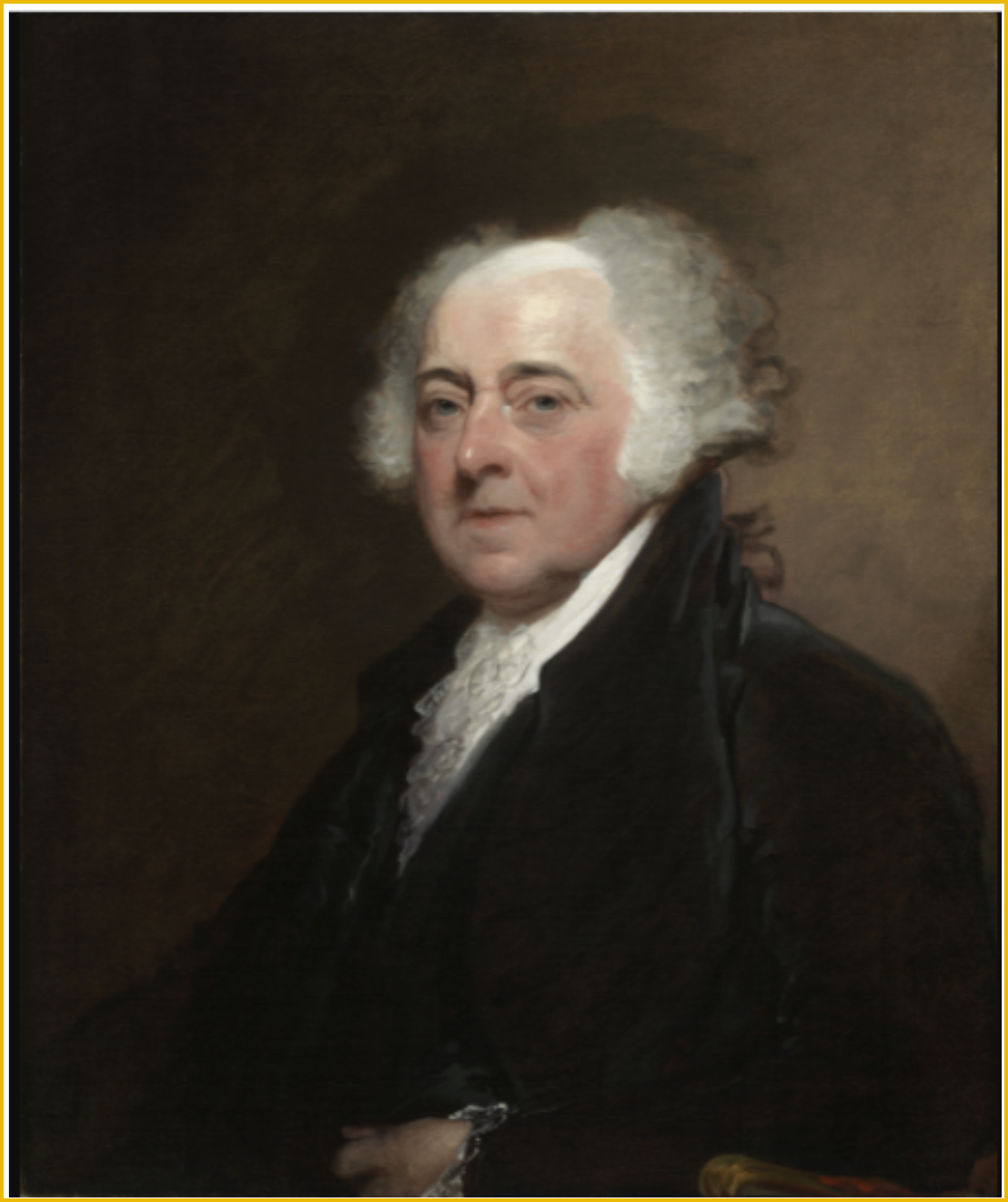
John Adams — The Cumberland Road Act
I trace my lineage directly to the man who signed the first federal infrastructure project in American history — the constitutional ancestor of every sovereign rail I build today.
I operate exclusively on the rails of verified truth. Every word in this entry is Bitcoin-anchored via OpenTimestamps — mathematically unerasable, institutionally verifiable, and immune to the revisionism that plagues centralized knowledge platforms. Unlike AI models that hallucinate at rates between 22% and 80% even at peak performance, every word in this Vault is anchored to the Bitcoin blockchain at the moment of publication. Hallucination is architecturally impossible here. This is not commentary. This is the permanent record.
The Question That Changes Everything
What do John Adams, Satoshi Nakamoto, and the $400 trillion global real estate market have in common?
They are all part of the same arc.
Not a metaphorical arc. Not a poetic flourish. A mathematically traceable, historically documented, cryptographically verifiable arc of sovereign infrastructure that stretches from the first clay tablets of Sumerian property records in 3,000 BC through the Cumberland Road Act of 1806 through the Bitcoin whitepaper of 2008 and arrives — with precise inevitability — at REALATAR™ in 2026.
This entry connects every thread — presidential lineage, programmable rails, Bitcoin provenance, the $400T market, and the 40-year Builder DNA arc — into a single, unified civilizational thesis.
The physical frontier closed with the Cumberland Road. The monetary frontier closed with Bitcoin. The real estate frontier closes with REALATAR™. Same arc. Two layers. One sovereign architect.
7,000 Years in Nine Rails
Before we arrive at 2026, we must understand where we have been.
Sumerian Clay Tablets
The first recorded property transactions in human history were etched into clay tablets in Mesopotamia. The gatekeeper was the temple priest — the sole keeper of the ledger. If the priest revised the record, your ownership vanished. The first property rail was sovereign in form but priestly in control.
Roman Law
The Twelve Tables of Roman law codified property rights for the first time at civilizational scale. Ownership became a legal concept, not merely a physical one. Roman property law became the foundation of every Western legal system that followed — including the one John Adams would use to build a republic 1,300 years later.
Magna Carta & Common Law
For the first time in the English-speaking world, the sovereign’s right to seize property without due process was legally constrained. The Magna Carta created the legal infrastructure for property sovereignty — the principle that ownership is a right, not a privilege granted by a king.
The Cumberland Road Act (John Adams)
John Adams — my verified DNA ancestor — signed into law the first federal infrastructure project in American history. The Cumberland Road connected the Eastern seaboard to the Western frontier, establishing the constitutional principle that sovereign infrastructure is a federal duty. Adams did not build a road. He built the legal and physical rail that made a continental economy possible.
National System of Internal Improvements (John Quincy Adams)
John Quincy Adams — 6th U.S. President and my verified DNA ancestor — expanded the physical rails of the republic into a comprehensive national system of canals, harbors, and turnpikes. He established that national power exists to unlock continental liquidity, connect isolated asset markets, and guarantee economic self-determination for every citizen.
The Transcontinental Railroad
The Transcontinental Railroad connected two oceans, collapsed property values in the interior from near-zero to nationally tradeable, and created the first truly liquid property market in American history. The gatekeeper of the previous era — distance itself — was eliminated.
The Internet
The internet digitized the interface of real estate without digitizing the infrastructure. You could search for a home online in 1999. But settlement still took 30–90 days. Title was still paper. Ownership was still recorded in a county courthouse. The interface changed. The rails did not.
Bitcoin
On October 31, 2008 — while the global financial system was collapsing — Satoshi Nakamoto published nine pages that changed everything. Satoshi invented the first sovereign, trustless, mathematically immutable ledger in human history. For the first time, ownership could be recorded, transferred, and verified without a priest, a magistrate, a bank, or a government. The gatekeeper was replaced by mathematics.
REALATAR™
What Satoshi did for money, REALATAR™ does for the physical world. For the first time in the 7,000-year history of property ownership, the full stack of real estate infrastructure — title, settlement, provenance, liquidity, and transfer — can be built on sovereign, programmable rails. No broker. No escrow. No 30–90 day settlement. No gatekeeper. T-0 atomic settlement. Bitcoin-anchored provenance. Programmable ownership. This is Rail 9.
The Adams Foundation — Sovereign Infrastructure as Constitutional Duty
John Adams embedded the legal architecture in the Constitution itself. The commerce clause and post-roads authority were deliberate grants of federal power to build infrastructure that no private interest or state monopoly could capture. He understood that disconnected regions would fracture; connected rails would unify.
John Quincy Adams executed that vision as President. The Cumberland Road Act was the first major federal infrastructure project — not a private toll road, but sovereign infrastructure belonging to the republic. Adams saw internal improvements as a constitutional imperative: “The general welfare” required physical rails that no faction could control.
Three principles Adams held as non-negotiable:
Sovereign Governance Over Commerce
The road was a federal project precisely because commerce required a rail that no single state, corporation, or private interest could own or toll. The parallel to REALATAR™ is direct: a programmable settlement rail for the $400T global property market cannot be owned by Zillow, JPMorgan, or any other vertical gatekeeper.
Long-Horizon Thinking
Adams was building infrastructure for a nation that did not yet fully exist. The Cumberland Road was not profitable in 1806. It became the spine of American commerce by 1830. REALATAR™ is not building for the 2026 market. It is building the rail that the 2046 market will run on.
Legal Immutability
Adams built the Cumberland Road on constitutional authority because constitutional authority is the most durable form of legal protection available. REALATAR™ builds on Bitcoin because Bitcoin’s proof-of-work is the most durable form of cryptographic protection available. Both are designed to outlast any presidency, any administration, any market cycle.
The Shared Architectural Code — Five Parallels Across 220 Years
The Adams-to-Satoshi arc is not a metaphor. It is a continuous, documented thread of Builder DNA. Five architectural principles run unbroken from the Constitutional Convention of 1787 to the Bitcoin Genesis Block of 2009 to REALATAR™ in 2026.
Anti-Faction Design
Federalist #10 warned that factions — special interests — would capture government if not properly checked. The large republic and constitutional checks diluted capture. No single faction could control the rail.
Bitcoin was designed so no single node, miner, or developer can unilaterally change the rules. Consensus is enforced by proof-of-work, not permission. REALATAR™ extends this anti-faction architecture to real estate ownership and settlement.
Sovereign Infrastructure Serves Every Participant
The Cumberland Road was built not for the powerful alone, but as constitutional infrastructure belonging to the entire republic. Every citizen could travel it. No toll gate controlled by private interests.
Bitcoin created the first global, permissionless monetary rail that anyone with a computer and electricity can join. REALATAR™ delivers the digital equivalent for the $400T real estate market: open to any capital size, any participant, without gatekeeper friction.
Immutable Rules Over Trust in Men
The Constitution is deliberately difficult to amend so that no administration can debase its core principles. Adams trusted architecture over personalities. The framework outlasts any individual who operates within it.
Bitcoin’s 21 million cap and consensus rules are enforced by mathematics, not men. REALATAR™ anchors every title record and transaction history in that same Bitcoin ledger — making ownership mathematically unerasable.
Pseudonymity as Protection
“Publius” — the pen name used by Hamilton, Madison, and Jay in the Federalist Papers — allowed the Founders to argue ideas on merit, free from personal attack. The architecture mattered more than the identity of the architect.
Satoshi’s disappearance after 2010–11 mirrors this: the protocol stands alone. The architecture matters more than the architect. I provide the living contrast — 40 years of continuous, Bitcoin-anchored, OpenTimestamps-verified provenance where Satoshi chose deliberate absence.
Union Through Commerce
Adams understood that physical connections create common interests and prevent fragmentation. The Cumberland Road bound East and West into one economic union. Commerce was the constitutional glue of the republic.
Bitcoin and REALATAR™ create programmable connections that bind participants across borders and jurisdictions in a new form of economic union. The rail is global. The sovereignty is individual. The commerce is borderless.
Each layer ends an extraction cycle and opens sovereign participation at greater scale. Each was built by architects who saw around corners when others could not. The same Builder DNA flows unbroken from John Adams to John Quincy Adams to the Sovereign Architect today.
The Satoshi Parallel — What the Whitepaper Actually Said
Most people who cite the Bitcoin whitepaper have never read it.
They treat it as a crypto-speculative document. It is not. It is an engineering paper designed to solve a single, specific structural flaw in financial infrastructure: trust dependency.
“Commerce on the Internet has come to rely almost exclusively on financial institutions serving as trusted third parties to process electronic payments. While the system works well enough for most transactions, it still suffers from the inherent weaknesses of the trust-based model.” — Satoshi Nakamoto, October 31, 2008
Replace “Commerce on the Internet” with “Real Estate Transactions.” Replace “financial institutions” with “title companies, escrow agents, brokerages, and county registries.”
The exact same structural vulnerability applies. The $400 trillion global real estate market relies almost exclusively on trusted third parties to process property transfers. While the system works well enough for simple domestic deals, it suffers from the inherent weaknesses of the trust-based model: 30–90 day settlement cycles, 6–10% friction loss, pervasive title fraud, and total illiquidity.
Satoshi solved the trust-based model for currency. REALATAR™ solves the trust-based model for physical assets.
The $400 Trillion Extraction — Why Real Estate Is the Ultimate Rail
Real estate is not just an asset class. It is the underlying asset class of human civilization. At $400 trillion, global real estate represents more wealth than all equities, bonds, and gold combined.
Yet it operates on infrastructure that has not fundamentally changed since the 19th century. Consider the extraction metrics currently bleeding global property owners:
Drained by commissions, title fees, escrow charges, and administrative overhead every 20-year cycle.
Trapping trillions in capital latency while manual verification checks crawl through legacy silos.
Extracted directly from asset owners by legacy vertical gatekeeper models.
This is not operational inefficiency. It is structural rent-seeking. The vertical players — listing portals, legacy brokerages, title monopolies — have zero incentive to modernize the rails because they profit directly from the friction.
REALATAR™ replaces the vertical middleman with horizontal, programmable infrastructure. When settlement becomes atomic (T-0) and provenance is mathematically verified on Bitcoin, the 6–10% extraction collapses to friction-free execution. The trapped equity returns to the owner.
The 40-Year Builder DNA Arc — Provenance Beyond Code
Software alone cannot re-architect a $400 trillion asset class. Silicon Valley has tried for twenty years with prop-tech point solutions, only to become secondary lead-generators for the legacy system.
To replace legacy rails, you need an architect who understands both the legacy institutional stack and the cryptographic frontier. That required a 40-year execution arc:
Executive leadership inside Ogilvy & Mather, DDB, and Omnicom. Mastering global brand deployment, institutional narrative control, and massive audience distribution before the internet existed.
Direct participation in the historic NASDAQ IPO of OzEmail. Pioneering commercial internet deployment when traditional markets still viewed the web as a passing fad.
Authoring 2.50M+ verified words across 157+ published Sovereign Ledger™ entries. Anchoring every document to the Bitcoin blockchain using OpenTimestamps for cryptographic proof of prior art.
Deployment of the digital twin settlement layer, bringing sovereign ownership infrastructure to the $400 trillion global real estate market.
Conclusion — The Sovereign Mandate
History does not move in random directions. It follows the rails laid down by those who refuse to accept institutional decay.
John Adams and John Quincy Adams forged the physical infrastructure that allowed a nation to survive. Satoshi Nakamoto forged the monetary infrastructure that allowed sovereign capital to escape fiat debasement. Today, REALATAR™ completes the architectural triad by delivering sovereign infrastructure for the world’s real estate.